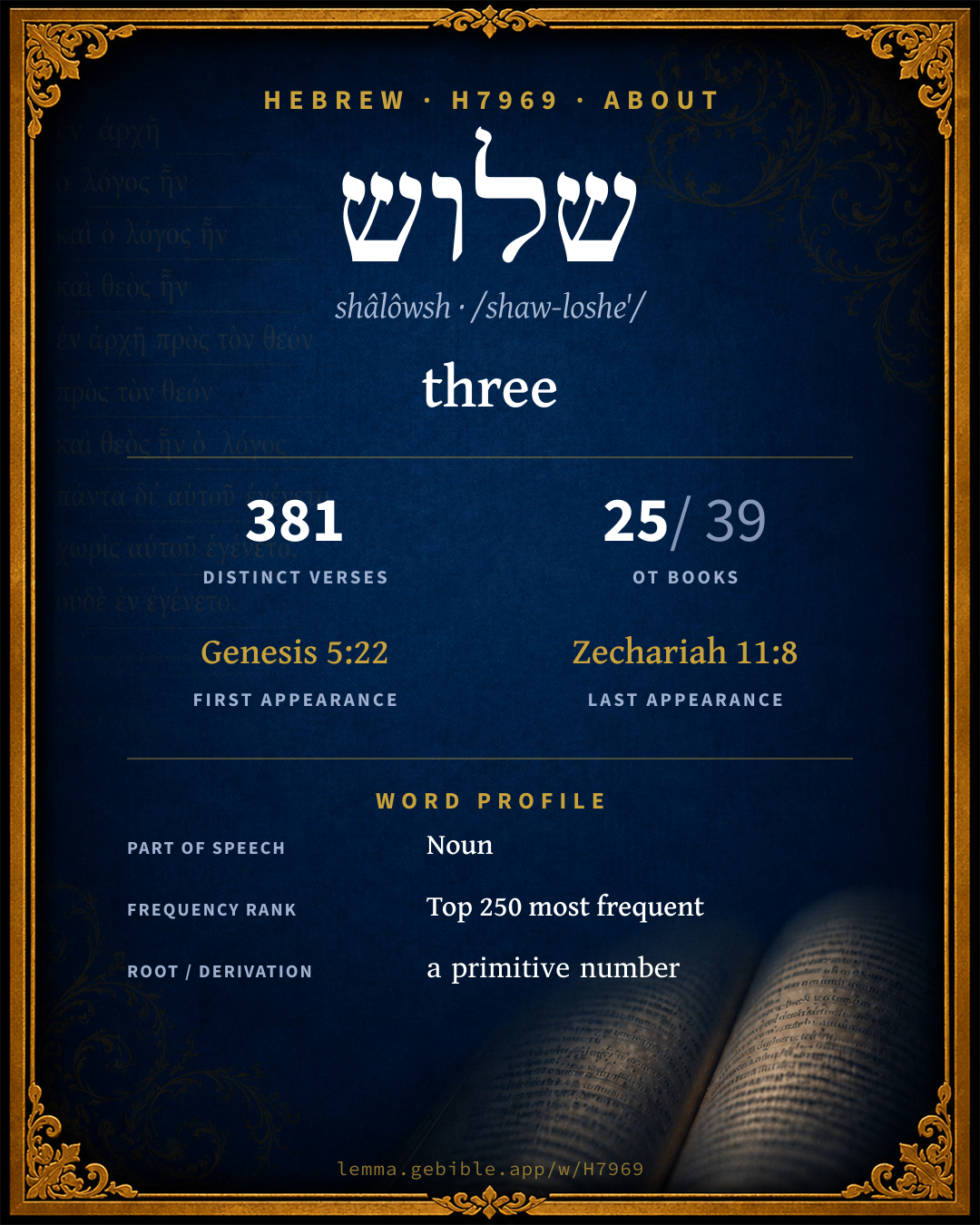
שָׁלֹשׁ
three
Full lexicon entry — Brown-Driver-Briggs (BDB)
From Brown-Driver-Briggs (BDB)
Where this word appears
See every Absolute-state word in the Hebrew Bible →
Grammar key — what these labels mean
Part of speech
- Adjective
- A word that describes or qualifies a noun.
State
- Absolute
- The independent form of a noun, not bound to a following word.
- Construct
- A noun bound to a following noun in a possessive / “of” relationship (the construct chain).
Gender
- Feminine
- Grammatically feminine.
- Masculine
- Grammatically masculine.
Number
- Singular
- One.
Every verse where H7969 appears in the Book of 2 Chronicles — 27 distinct verses. Click any verse to open its interlinear word-by-word view. Verse text shown in the World English Bible for context — . Each verse’s Hebrew form is shown with its reference; the English is not keyword-highlighted, since the data carries no word-level English alignment. Use “Compare translations” on any verse to read it across multiple English versions. This concordance covers the Hebrew Bible; Septuagint (Greek Old Testament) occurrences are not indexed here.
2 Chronicles
- 2 Chronicles 2:2 שְׁלֹ֥שֶׁת adj Cardinal number ms cs Solomon counted out seventy thousand men to bear burdens, and eighty thousand men who were stone cutters in the mountains, and three thousand and six hundred to oversee them.
- 2 Chronicles 2:17 וּ/שְׁלֹ֥שֶׁת conj + Adjective Cardinal number ms cs Solomon numbered all the foreigners who were in the land of Israel, after the numbering with which David his father had numbered them; and they were found one hundred fifty-three thousand six hundred.
- 2 Chronicles 2:18 וּ/שְׁלֹ֤שֶׁת conj + Adjective Cardinal number ms cs He set seventy thousand of them to bear burdens, and eighty thousand who were stone cutters in the mountains, and three thousand six hundred overseers to set the people at work.
- 2 Chronicles 4:4 שְׁלֹשָׁ֣ה וּ/שְׁלוֹשָׁה֩ וּ/שְׁלֹשָׁ֣ה וּ/שְׁלֹשָׁה֙ adj Cardinal number ms conj + Adjective Cardinal number ms conj + Adjective Cardinal number ms conj + Adjective Cardinal number ms It stood on twelve oxen, three looking toward the north, and three looking toward the west, and three looking toward the south, and three looking toward the east: and the sea was set on them above, and all their hinder parts were inward.
- 2 Chronicles 4:5 שְׁלֹ֥שֶׁת adj Cardinal number ms cs It was a handbreadth thick; and the brim of it was worked like the brim of a cup, like the flower of a lily: it received and held three thousand baths.
- 2 Chronicles 6:13 שָׁל֖וֹשׁ adj Cardinal number fs (for Solomon had made a brazen scaffold, five cubits long, and five cubits broad, and three cubits high, and had set it in the midst of the court; and on it he stood, and kneeled down on his knees before all the assembly of Israel, and spread forth his hands toward heaven;)
- 2 Chronicles 7:10 וּ/שְׁלֹשָׁה֙ conj + Adjective Cardinal number ms On the three and twentieth day of the seventh month he sent the people away to their tents, joyful and glad of heart for the goodness that Yahweh had shown to David, and to Solomon, and to Israel his people.
- 2 Chronicles 8:13 שָׁל֥וֹשׁ adj Cardinal number fs even as the duty of every day required, offering according to the commandment of Moses, on the Sabbaths, and on the new moons, and on the set feasts, three times in the year, [even] in the feast of unleavened bread, and in the feast of weeks, and in the feast of tents.
- 2 Chronicles 9:16 וּ/שְׁלֹשׁ שְׁלֹ֤שׁ conj + Adjective Cardinal number fs adj Cardinal number fs [he made] three hundred shields of beaten gold; three hundred [shekels] of gold went to one shield: and the king put them in the house of the forest of Lebanon.
- 2 Chronicles 9:21 לְ/שָׁל֨וֹשׁ prep + Adjective Cardinal number fs For the king had ships that went to Tarshish with the servants of Huram; once every three years came the ships of Tarshish, bringing gold, and silver, ivory, and apes, and peacocks.
- 2 Chronicles 10:5 שְׁלֹ֥שֶׁת adj Cardinal number ms cs He said to them, Come again to me after three days. The people departed.
- 2 Chronicles 11:17 שָׁל֑וֹשׁ שָׁלֽוֹשׁ adj Cardinal number fs adj Cardinal number fs So they strengthened the kingdom of Judah, and made Rehoboam the son of Solomon strong, three years; for they walked three years in the way of David and Solomon.
- 2 Chronicles 13:2 שָׁל֣וֹשׁ adj Cardinal number fs Three years reigned he in Jerusalem: and his mother's name was Micaiah the daughter of Uriel of Gibeah. There was war between Abijah and Jeroboam.
- 2 Chronicles 14:8 שְׁלֹ֣שׁ adj Cardinal number fs Asa had an army that bore bucklers and spears, out of Judah three hundred thousand; and out of Benjamin, that bore shields and drew bows, two hundred eighty thousand: all these were mighty men of valor.
- 2 Chronicles 14:9 שְׁלֹ֣שׁ adj Cardinal number fs There came out against them Zerah the Ethiopian with an army of a million troops, and three hundred chariots; and he came to Mareshah.
- 2 Chronicles 17:7 שָׁל֜וֹשׁ adj Cardinal number fs Also in the third year of his reign he sent his princes, even Ben Hail, and Obadiah, and Zechariah, and Nethanel, and Micaiah, to teach in the cities of Judah;
- 2 Chronicles 17:14 שְׁלֹ֥שׁ adj Cardinal number fs This was the numbering of them according to their fathers' houses: Of Judah, the captains of thousands: Adnah the captain, and with him mighty men of valor three hundred thousand;
- 2 Chronicles 20:25 שְׁלוֹשָׁ֛ה adj Cardinal number ms When Jehoshaphat and his people came to take the spoil of them, they found among them in abundance both riches and dead bodies, and precious jewels, which they stripped off for themselves, more than they could carry away: and they were three days in taking the spoil, it was so much.
- 2 Chronicles 25:5 שְׁלֹשׁ adj Cardinal number fs Moreover Amaziah gathered Judah together, and ordered them according to their fathers' houses, under captains of thousands and captains of hundreds, even all Judah and Benjamin: and he numbered them from twenty years old and upward, and found them three hundred thousand chosen men, able to go forth to war, who could handle spear and shield.
- 2 Chronicles 25:13 שְׁלֹ֣שֶׁת adj Cardinal number ms cs But the men of the army whom Amaziah sent back, that they should not go with him to battle, fell on the cities of Judah, from Samaria even to Beth Horon, and struck of them three thousand, and took much spoil.
- 2 Chronicles 26:13 שְׁלֹ֧שׁ adj Cardinal number fs Under their hand was an army, three hundred thousand and seven thousand and five hundred, who made war with mighty power, to help the king against the enemy.
- 2 Chronicles 29:33 שְׁלֹ֥שֶׁת adj Cardinal number ms cs The consecrated things were six hundred oxen and three thousand sheep.
- 2 Chronicles 31:16 שָׁל֤וֹשׁ adj Cardinal number fs besides those who were reckoned by genealogy of males, from three years old and upward, even everyone who entered into the house of Yahweh, as the duty of every day required, for their service in their offices according to their divisions;
- 2 Chronicles 35:7 שְׁלֹ֣שֶׁת adj Cardinal number ms cs Josiah gave to the children of the people, of the flock, lambs and kids, all of them for the Passover offerings, to all who were present, to the number of thirty thousand, and three thousand bulls: these were of the king's substance.
- 2 Chronicles 35:8 שְׁלֹ֥שׁ adj Cardinal number fs His princes gave for a freewill-offering to the people, to the priests, and to the Levites. Hilkiah and Zechariah and Jehiel, the rulers of the house of God, gave to the priests for the Passover offerings two thousand and six hundred [small cattle], and three hundred oxen.
- 2 Chronicles 36:2 שָׁל֧וֹשׁ וּ/שְׁלֹשָׁ֣ה adj Cardinal number fs conj + Adjective Cardinal number ms Joahaz was twenty-three years old when he began to reign; and he reigned three months in Jerusalem.
- 2 Chronicles 36:9 וּ/שְׁלֹשָׁ֤ה conj + Adjective Cardinal number ms Jehoiachin was eight years old when he began to reign; and he reigned three months and ten days in Jerusalem: and he did that which was evil in the sight of Yahweh.
About this entry
At a glance — auto-summarized from this page’s data, not written by a person. Every figure links to its source below. This summary describes the numbers; it doesn’t interpret them.
The Hebrew noun שלוש centers on the idea of “three.” Debuting at Genesis 5:22, it then recurs through the corpus. It appears 381 verses across 25 books of the Hebrew Bible, among its common vocabulary. It shares a root with שלושים, שליש and שלישי. For the data behind this summary, explore the sense tree and the renderings breakdown below.
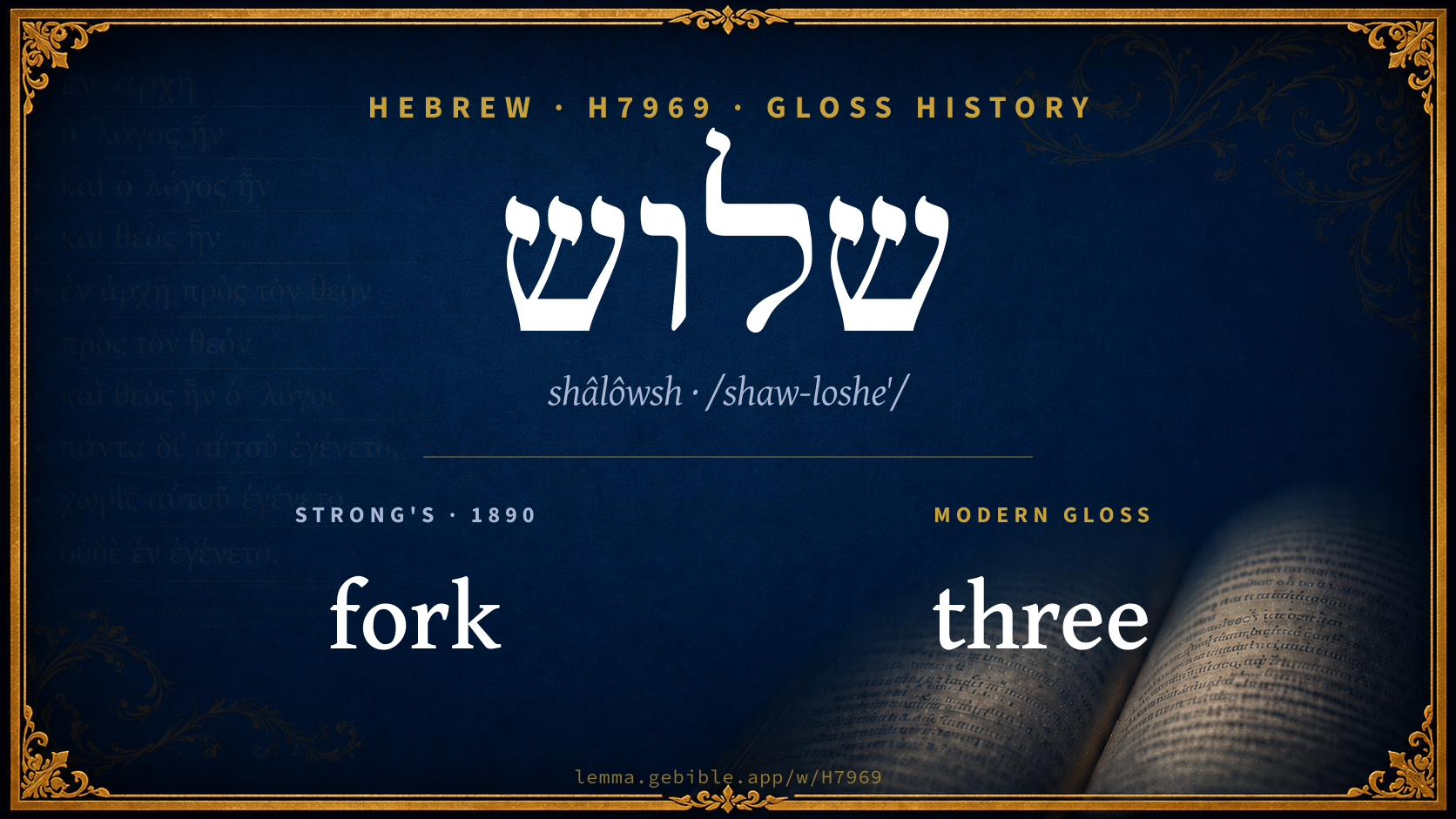
Gloss history
Strong's 1890 vs modern scholarship
About this word
Strong's H7969 catalogs a Hebrew word from the Hebrew Old Testament.
These counts are not copied from any lexicon or concordance. They are computed here, from the morphology-tagged Hebrew Old Testament. What Lemma adds →
- 381
- distinct verses
- The word appears in 381 distinct verses.
- 25 / 39
- OT books
- The word appears in 25 of 39 Old Testament books.
- #114
- by frequency
- Top 250 most frequent Hebrew words (rank 114 of 8,640 Hebrew words by occurrence).
View all 381 occurrences in the concordance →
Most concentrated in
- 1 Chronicles 35 verses 9%
- Numbers 33 verses 9%
- Genesis 27 verses 7%
By section of the Old Testament
By traditional corpus
Conventional, traditional groupings — biblical authorship is debated, so this is a traditional corpus grouping, not an authorship claim. Each share is this word’s portion of its verses in that division of the Hebrew canon. Each figure is a share of the word’s 381 distinct verses.
- Prophets (Nevi'im) 153 verses · 40%
- Writings (Ketuvim) 128 verses · 34%
- Torah (Pentateuch) 100 verses · 26%
How translations render this word
Counts come from each version’s own published word-to-Strong’s tagging or interlinear alignment — an approximate guide to how each version renders this word, not a word-level alignment the data otherwise carries. Because each total is that version’s own tagged count, the per-version totals vary from one another and need not match the appearance or distinct-verse counts above. These counts may also differ from a printed concordance because Lemma counts each distinctly tagged rendering and does not collapse phrase taggings into a single head-word total. This is a fixed set of word-tagged versions (KJV, ASV, BSB, ULT) and does not change with the reading translation you choose elsewhere. Each version’s license is shown beside its name below (and on Sources).
- King James Version: Three 288×, Were three 11×, Thirteenth 10×
- American Standard Version: Three 269×, Thirteenth 9×, Thirteen 8×
- Berean Standard Bible: Three 223×, Third 10×, Thirteenth 10×
- unfoldingWord Literal Text: Three 228×, Were 31×, And 11×
King James Version Public Domain
Renders H7969 across 424 tagged occurrences — most commonly:
Plus other, less common renderings. Plus 43 renderings that appear only once — usually multi-word phrases or single function words the recovered tagging swept in, not distinct renderings. Not rendered by a distinct English word in 6 further occurrences.
American Standard Version Public Domain
Renders H7969 across 424 tagged occurrences — most commonly:
Plus other, less common renderings. Plus 57 renderings that appear only once — usually multi-word phrases or single function words the recovered tagging swept in, not distinct renderings.
Berean Standard Bible Public Domain
Renders H7969 across 343 tagged occurrences — most commonly:
Plus other, less common renderings. Plus 33 renderings that appear only once — usually multi-word phrases or single function words the recovered tagging swept in, not distinct renderings. Not rendered by a distinct English word in 86 further occurrences.
unfoldingWord Literal Text CC BY-SA 4.0
Renders H7969 across 369 tagged occurrences — most commonly:
Plus other, less common renderings. Plus 27 renderings that appear only once — usually multi-word phrases or single function words the recovered tagging swept in, not distinct renderings. Not rendered by a distinct English word in 79 further occurrences.
Senses in BDB
The 1 sense BDB distinguishes for this word, in lexicon order (not ranked by frequency or importance). The full entry — with sub-senses — is in the Lexicon Entry tab.
- three, triad
Word origin
Origin: a primitive number
Forms in the corpus
The 122 distinct written forms H7969 takes in the Hebrew Bible, most frequent first — each parse links to that state’s occurrences in the concordance. Hebrew forms include their vowel points and cantillation, so a single lemma takes many written forms.
The 60 most common forms are shown; 62 rarer forms follow in the full concordance.
Same root — word family
Other BDB entries built from the same root as H7969, grouped by Strong’s listed origin. These share a root / origin per the lexicon — not necessarily a shared meaning. Each links to that word’s own entry.
Derived from this word
- שלושים shᵉlôwshîym H7970 thirty
- שליש shâlîysh H7991 officer
- שלישי shᵉlîyshîy H7992 third
- תלת tᵉlâth H8532 three
Compare all same-root words → Showing 4 of 5 — not the complete family. They share a root, not necessarily a meaning.
Septuagint verse parallels
This word appears in 360 verses that also exist in the Greek Old Testament (Septuagint), out of the 381 Hebrew verses it occurs in. You can read those verses in Greek by switching the Old Testament edition to the Septuagint.
Read these verses in the Septuagint
- Genesis 5:22
- Exodus 2:2
- Leviticus 12:4
- Numbers 1:23
- Deuteronomy 4:41
- Joshua 1:11
- Judges 1:20
- 1 Samuel 1:24
- 2 Samuel 2:18
- 1 Kings 2:11
- 2 Kings 2:17
- 1 Chronicles 2:3
This is a verse-level parallel only — the same verses exist in both the Hebrew and Greek Old Testaments. No word-level Hebrew↔Greek correspondence is claimed: the data carries no such alignment, so no Greek word is shown as this Hebrew word’s translation. Coverage is not total — the Septuagint omits the deuterocanon and renumbers the Psalms, so some Hebrew verses have no direct Greek parallel.