
2 Chronicles 2:18

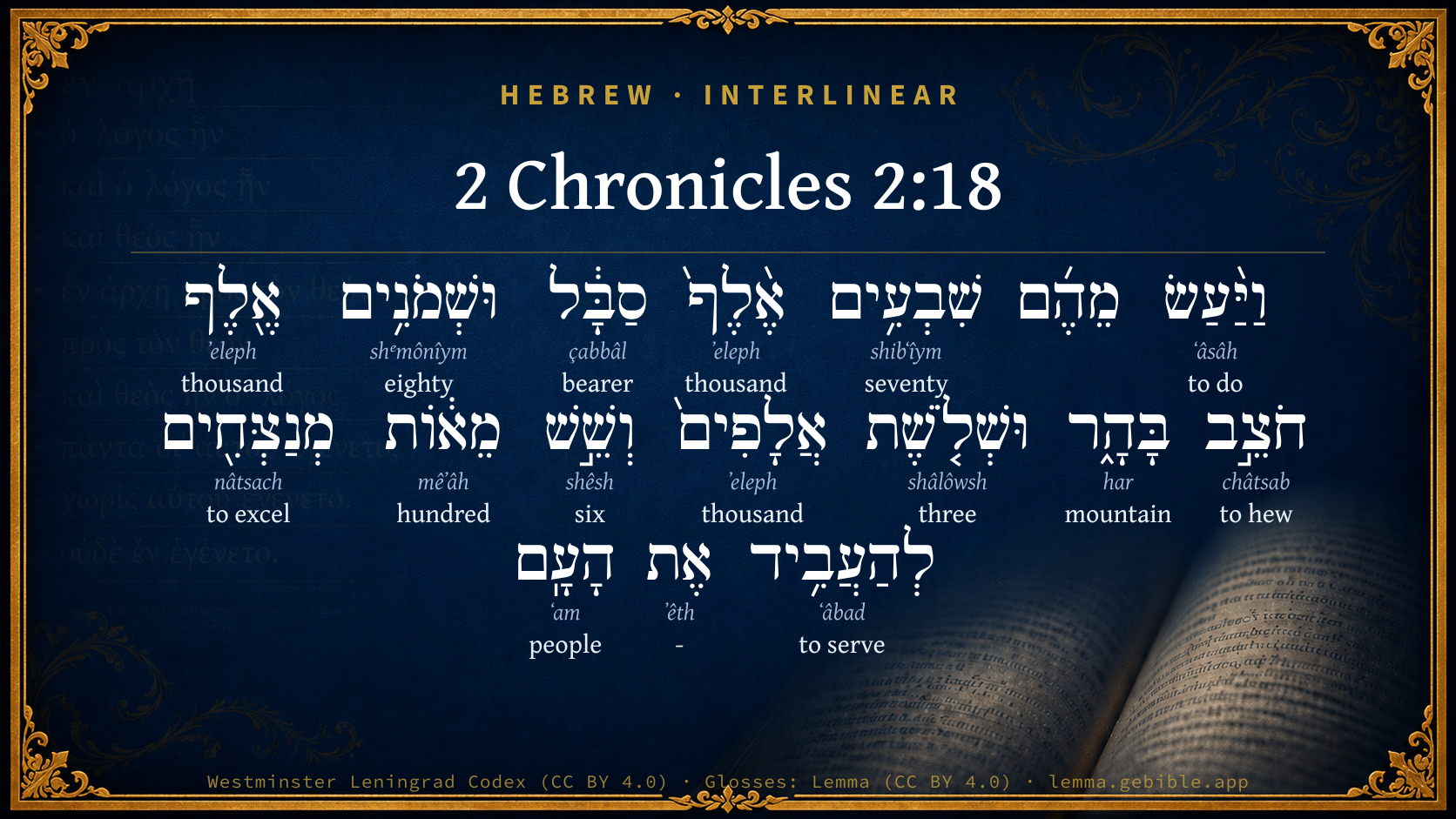
Hebrew (Westminster Leningrad Codex) 2 Chronicles 2:18 appears in the Hebrew Old Testament. The text above is from the Westminster Leningrad Codex. Each word links to its Strong’s number, a concise gloss, and parsing drawn from the Open Scriptures Hebrew Bible morphology. Click any word for its full Brown-Driver-Briggs (BDB) entry.
Download image
Cite this verse

2 Chronicles 2:18 (World English Bible). Public Domain. Lemma interlinear Bible study tool, https://lemma.gebible.app/v/2-chronicles/2/18.

Show BibTeX & RIS
BibTeX
RIS
English Translation
He set seventy thousand of them to bear burdens, and eighty thousand who were stone cutters in the mountains, and three thousand six hundred overseers to set the people at work.
World English Bible · Public Domain
Download a study sheet

One document with this verse’s original text, its word-by-word gloss line, the meaning frame, cross-references with their text, attributed commentary, and full source and license credits — printable, and it pastes into notes with its structure intact.

This verse Autodidact and up

Study sheet (.html) Plain text (.txt)

A passage Seminary Student

Up to 50 verses in one chapter. A passage sheet keeps up to 6 commentary sources and 12 cross-references per verse, in the order this page ranks them, and says so on the sheet whenever that leaves anything out. Ask for a single verse and you get the Autodidact verse sheet above.

Everything on this page stays free to read, with no account — the sheet is a download of what is already on screen, not access to it.

Want to remove ads? Support Godless Engineer
Compare translations 3

The same verse in 3 English versions, stacked beneath the original-language interlinear above. Click any original word for its lexicon entry.

Each is an independent rendering of the whole verse — the interlinear is not word-aligned to these translations.

Highlighted words mark where these versions differ — a whole-verse word diff, not a word-by-word alignment.

  • World English Bible Public Domain
    He set seventy thousand of them to bear burdens, and eighty thousand who were stone cutters in the mountains, and three thousand six hundred overseers to set the people at work.
  • King James Version Public Domain
    And he set threescore and ten thousand of them to be bearers of burdens, and fourscore thousand to be hewers in the mountain, and three thousand and six hundred overseers to set the people a work.
  • unfoldingWord Literal Text CC BY-SA 4.0
    And he made from them 70,000 burden bearers, 80,000 stonemasons in the hills, and 3,600 directors to cause the people to work.

unfoldingWord Literal Text — © unfoldingWord, licensed CC BY-SA 4.0. Word-aligned USFM3 via Door43 (git.door43.org/unfoldingWord/en_ult).

Versions to compare (up to 4)

3 of 4 selected

Show all 18 translations

Every available English version of this verse, each an independent rendering of the whole verse.

  • World English Bible Public Domain
    He set seventy thousand of them to bear burdens, and eighty thousand who were stone cutters in the mountains, and three thousand six hundred overseers to set the people at work.
  • Berean Standard Bible Public Domain
    Solomon made 70,000 of them porters, 80,000 stonecutters in the mountains, and 3,600 supervisors.
  • Majority Standard Bible Public Domain
    Solomon made 70,000 of them porters, 80,000 stonecutters in the mountains, and 3,600 supervisors.
  • King James Version Public Domain
    And he set threescore and ten thousand of them to be bearers of burdens, and fourscore thousand to be hewers in the mountain, and three thousand and six hundred overseers to set the people a work.
  • American Standard Version (1901) Public Domain
    And he set threescore and ten thousand of them to bear burdens, and fourscore thousand that were hewers in the mountains, and three thousand and six hundred overseers to set the people at work.
  • Revised Version (1885) Public Domain
    And he set threescore, and ten thousand of them to bear burdens, and fourscore thousand that were hewers in the mountains, and three thousand and six hundred overseers to set the people awork.
  • Geneva Bible (1599) Public Domain
    And he set seuentie thousande of them to the burden, and fourescore thousande to hewe stones in the mountaine, and three thousande and sixe hundreth ouerseers to cause the people to worke.
  • Douay-Rheims (1899) Public Domain
    And he set seventy thousand of them to carry burdens on their shoulders, and eighty thousand to hew stones in the mountains: and three thousand and six hundred to be overseers of the work of the people.
  • Young's Literal Translation Public Domain
    and he maketh of them seventy thousand burden-bearers, and eighty thousand hewers in the mountain, and three thousand and six hundred overseers, to cause the people to work.
  • Literal Standard Version CC BY-SA 4.0
    and he makes from them seventy thousand burden-bearers, and eighty thousand hewers in the mountain, and three thousand and six hundred overseers, to cause the people to work.
  • Unlocked Literal Bible CC BY-SA 4.0
    He assigned seventy thousand of them to carry loads, eighty thousand to be stonecutters in the mountains, and 3,600 to be supervisors to put the people to work.
  • unfoldingWord Literal Text CC BY-SA 4.0
    And he made from them 70,000 burden bearers, 80,000 stonemasons in the hills, and 3,600 directors to cause the people to work.
  • Darby Bible Public Domain
    And he set seventy thousand of them to be bearers of burdens, and eighty thousand to be stone-masons in the mountains, and three thousand six hundred overseers to set the people to work.
  • World Messianic Bible Public Domain
    He set seventy thousand of them to bear burdens, eighty thousand who were stone cutters in the mountains, and three thousand six hundred overseers to assign the people their work.
  • Webster's Bible Public Domain
    And he set seventy thousand of them to be bearers of burdens, and eighty thousand to be hewers in the mountain, and three thousand and six hundred overseers to set the people to work.
  • Free Bible Version CC BY-SA 4.0
    He allocated 70,000 as laborers, 80,000 as stonecutters in the mountains, and 3,600 as foremen.
  • Bible in Basic English Public Domain
    Seventy thousand he put to the work of transport, eighty thousand to cutting stone in the mountains, and three thousand, six hundred as overseers to put the people to work.
  • JPS Tanakh (1917) Public Domain
    (2-17) And he set threescore and ten thousand of them to bear burdens, and fourscore thousand to be hewers in the mountains, and three thousand and six hundred overseers to set the people at work.

Literal Standard Version (2020), Covenant Press — licensed CC BY-SA 4.0. Text via the HelloAO Bible API (eBible.org). Unlocked Literal Bible (unfoldingWord) — licensed CC BY-SA 4.0. Text via the HelloAO Bible API (eBible.org). unfoldingWord Literal Text — © unfoldingWord, licensed CC BY-SA 4.0. Word-aligned USFM3 via Door43 (git.door43.org/unfoldingWord/en_ult). Free Bible Version, Dr. Jonathan Gallagher — licensed CC BY-SA 4.0. Text via the HelloAO Bible API (eBible.org).

Word by word

More ways to search: Search by grammar → Find every occurrence → Compare this word →

Practice this passage: Drill this verse → Learn its vocabulary →

סַבָּ֔ל
çabbâl
H5449
“bearer”
Noun, Common, Masculine, Singular, Absolute
Part of Speech
Noun
Type
Common
Gender
Masculine
Number
Singular
State
Absolute
Full BDB Definition

Origin: from H5445

TWOT: 1458b

burden-bearer
  1. וַיַּ֨עַשׂ ʻâsâh H6213 “and · to do” Conjunction + Verb, Qal, Sequential Imperfect, 3rd Person, Masculine, Singular
  2. שִׁבְעִ֥ים shibʻîym H7657 “seventy” Adjective, Cardinal number, Both, Plural, Absolute
  3. אֶ֨לֶף֙ ʼeleph H505 “thousand” Adjective, Cardinal number, Both, Singular, Absolute
  4. וּשְׁמֹנִ֥ים shᵉmônîym H8084 “and · eighty” Conjunction + Adjective, Cardinal number, Both, Plural, Absolute
  5. אֶ֖לֶף ʼeleph H505 “thousand” Adjective, Cardinal number, Both, Singular, Absolute
  6. חֹצֵ֣ב châtsab H2672 “hewing” Verb, Qal, Participle Active, Masculine, Singular, Absolute
  7. בָּהָ֑ר har H2022 “in/at the · mountain” Preposition, Determined + Noun, Common, Masculine, Singular, Absolute
  8. וּשְׁלֹ֤שֶׁת shâlôwsh H7969 “and · three” Conjunction + Adjective, Cardinal number, Masculine, Singular, Construct
  9. אֲלָפִים֙ ʼeleph H505 “thousand” Adjective, Cardinal number, Both, Plural, Absolute
  10. וְשֵׁ֣שׁ shêsh H8337 “and · six” Conjunction + Adjective, Cardinal number, Feminine, Singular, Absolute
  11. מֵא֔וֹת mêʼâh H3967 “hundred” Adjective, Cardinal number, Both, Plural, Absolute
  12. מְנַצְּחִ֖ים nâtsach H5329 “excelling” Verb, Piel, Participle Active, Masculine, Plural, Absolute
  13. לְהַעֲבִ֥יד ʻâbad H5647 “to serve” Preposition + Verb, Hiphil, Infinitive Construct
  14. אֶת ʼêth H853 “-” Particle, Direct Object
  15. הָעָֽם ʻam H5971 “the · people” Particle, Definite Article + Noun, Common, Masculine, Singular, Absolute

About this verse

These counts appear in no published source. They are computed here, from the morphology-tagged text and Lemma’s own curated glosses. What Lemma adds →

17
words
14
distinct lemmas
Historical
section

Notable vocabulary

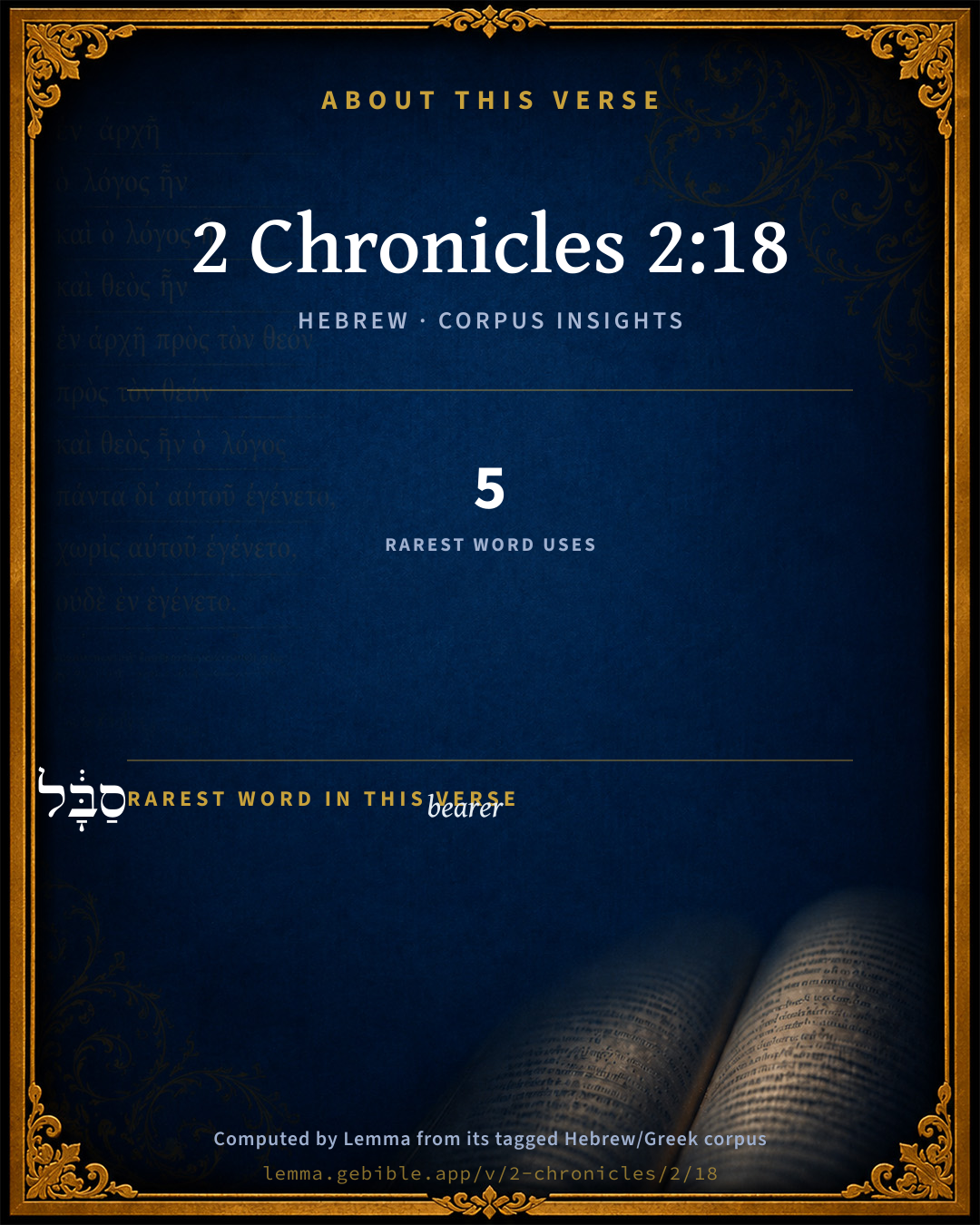
The rarest word here is סַבָּ֔ל bearer H5449 — appearing just 5 times in the whole Hebrew Bible.

Shared distinctive vocabulary

סַבָּ֔ל bearer H5449 occurs in 5 verses of the Hebrew Bible. Also found in:

Grammatical profile

  • 4 verbs
  • 3 nouns
  • 8 adjectives
  • 1 preposition
  • 1 particle

Verb forms

  • וַיַּ֨עַשׂ Qal · Sequential Imperfect
  • חֹצֵ֣ב Qal · Participle Active
  • מְנַצְּחִ֖ים Piel · Participle Active
  • לְהַעֲבִ֥יד Hiphil · Infinitive Construct

Repetition

A word recurs within this verse — often emphatic in Hebrew:

  • אֶ֨לֶף֙ thousand H505 ×3

Hebrew & Septuagint length

In English translation the verse runs 31 words from the Hebrew and 23 from the Septuagint (LXX English) — closely comparable.

A rough comparison of the two English renderings, which tokenize alike — not a word-level alignment.

Word counts can differ between the Hebrew and the Greek without any difference in meaning — e.g. the Hebrew direct-object marker אֵת has no separate Greek word, and Greek often adds the article ὁ.

Cross-references

1

Topical passages linked to 2 Chronicles 2:18 in the Treasury of Scripture Knowledge — connected by theme and wording, ordered by reader-vote popularity; previews shown in the World English Bible.

  • 2 Chronicles 2:2 Solomon counted out seventy thousand men to bear burdens, and eighty thousand men who were stone cutters in the mountains, and three thousand and six hundred to oversee them.

Cross-references courtesy of OpenBible.info (CC BY 4.0).

Hebrew and Greek witnesses Masoretic Hebrew ↔ Greek Septuagint

The same verse in the two great witnesses to the Old Testament, shown verse-for-verse.

These are two independent witnesses, not word-aligned to each other, and the Septuagint is shown in lemma (dictionary) form.

Hebrew 2 Chronicles 2:18 Masoretic · Westminster Leningrad Codex

וַיַּ֨עַשׂ מֵהֶ֜ם שִׁבְעִ֥ים אֶ֨לֶף֙ סַבָּ֔ל וּשְׁמֹנִ֥ים אֶ֖לֶף חֹצֵ֣ב בָּהָ֑ר וּשְׁלֹ֤שֶׁת אֲלָפִים֙ וְשֵׁ֣שׁ מֵא֔וֹת מְנַצְּחִ֖ים לְהַעֲבִ֥יד אֶת הָעָֽם

He set seventy thousand of them to bear burdens, and eighty thousand who were stone cutters in the mountains, and three thousand six hundred overseers to set the people at work.

World English Bible · Public Domain

Greek LXX 2 Chronicles 2:18 Septuagint · lemma form
And he made of them seventy thousand burden-bearers, and eighty thousand hewers of stone, and three thousand six hundred taskmasters over the people.

LXX2012 (modern English Septuagint) · Public Domain

Hebrew: Westminster Leningrad Codex (CC BY 4.0). Greek: Septuagint (public domain); English from LXX2012 (modern English Septuagint) (Public Domain). How the Septuagint differs from the Hebrew →

Commentary

Notes on 2 Chronicles 2:18 from classic Christian and Jewish commentators (each source and its license shown beneath its notes). The classic Christian expositions comment on the surrounding passage and are grouped to its opening verse, so a note may address several verses; the Jewish commentaries on the Tanakh (Rashi and others) are per-verse, so they appear only where the commentator wrote on this verse.

Lemma curates 59 commentaries, every one of them public domain or Creative Commons licensed, each selected and text-cleaned for this edition rather than reprinted as found. About our sources →

Trapp's Complete Commentary

John Trapp

2Ch 2:18 And he set threescore and ten thousand of them [to be] bearers of burdens, and fourscore thousand [to be] hewers in the mountain, and three thousand and six hundred overseers to set the people a work.

Ver. 18. And he set threescore and ten thousand of them.] Hereby were shadowed out the several offices in Christ’s Church: this St Paul setteth forth by the similitude of the diffferent members in man’s body, &c.

To set the people a work.] Heb., To make them to pass, sc., from one business to another.

John Trapp, A Commentary or Exposition upon All the Books of the Old and New Testament (1647–1656) — public domain. Text from a community e-Sword module.

Joseph Benson's Commentary

2Ch 2:18. To be hewers in the mountain — He would not employ the free- born Israelites in this drudgery, but the strangers that were proselytes, who, having no lands, applied themselves to trades, and got their living by their industry or ingenuity.

Joseph Benson's Commentary on the Old and New Testaments (1811–1818) — public domain. Text from a community e-Sword module.

Ellicott's Commentary for English Readers

(18) And he set . . .—Literally, and he made seventy thousand of them bearers of burdens, and eighty thousand hewers in the mountains. This exactly agrees with 1Ki_5:15.

And three thousand and six hundred overseers.—The same number was given in 2Ch_2:2. In 1Ki_5:16 we read of 3,300 officers. In the Hebrew, three (shâlôsh) and six (shêsh) might easily be confused; our reading appears right. The chronicler omits all notice of the levy of 30,000 Israelites, which the parallel passage records (1Ki_5:13-14); whether by an oversight, or from disapproval, we cannot say. Adding that number to the 70,000 and 80,000 other labourers, we get a grand total of 180,000, which gives a company of 50 for each of the 3,600 overseers.

Overseers.—Heb. mĕnaççĕhîm. Only here and in 2Ch_2:2 supra, and 2Ch_34:13. It is the plural of a participle which occurs only in the titles of the Psalms (including Hab_3:19), while the verb is read only in Chronicles and Ezr_3:8-9. (See Note on 1Ch_15:21.)

To set the people a work—i.e., on work or a-working. (Comp. “I go a-fishing,” Joh_21:3.) Literally, to make the people work.

A Bible Commentary for English Readers, edited by Charles John Ellicott (1878–1897) — public domain. Text from a community e-Sword module.

The Cambridge Bible for Schools and Colleges

gen. ed. J. J. S. Perowne

18. three thousand and six hundred overseers] In 1Ki_5:16, three thousand and three hundred. Three in Hebrew (which may be represented in English by the letters SLS) is easily corrupted into six (= SS in English). Cp. also 2Ch_8:10 (= 1Ki_9:23).

a work] i.e. on work, to work.

The Cambridge Bible for Schools and Colleges (gen. ed. J. J. S. Perowne; Cambridge University Press, 1878–1918) — public domain. Text from a community e-Sword module.

Albert Barnes' Notes on the Bible

On the numbers, see the 1Ki 5:16 note.

To set the people a work - Or, “to set the people to work” - i. e., to compel them to labor. Probably, like the Egyptian and Assyrian overseers of forced labor, these officers carried whips or sticks, with which they quickened the movements of the sluggish.

Albert Barnes' Notes on the Bible (1834–1885) — public domain. Text from a community e-Sword/MySword module.

Haydock's Catholic Bible Commentary

Six. We read three, 3 Kings v. 16.: people who where strangers, as the Israelites were not forced to work, chap. viii. 9. (Calmet)

George Leo Haydock (1774–1849), Haydock's Catholic Family Bible and Commentary, 1859 edition — public domain. Excludes Psalms (Douay-Rheims chapter numbering differs from Protestant) and Deuterocanonical books (Catholic canon only).

The Pulpit Commentary

Three thousand and six hundred. Adding to these the 250 2Ch_8:10, infra, the total 3850 of 1Ki_5:16 is exactly reached. That total, however, is reached by a somewhat different classification, the division being into 3300 "strangers," and 500 "chief of the officers". (1Ki_9:23) The explanation probably is that of the 3600 "stranger" overseers, the small proportion of 300 were of much higher grade in office than the rest, and were ranked by the writer in Kings with those overseers (250) of Solomon, who were probably Israelites.

The Pulpit Commentary (1880–1919), ed. H.D.M. Spence-Jones & Joseph S. Exell — public domain. Text from a community e-Sword module.

John Wesley's Explanatory Notes

Hewers in the mountains - He would not employ the free-born Israelites in this drudgery, but the strangers that were proselytes, who having no lands, applied themselves to trades, and got their living by their industry or ingenuity.

John Wesley, Explanatory Notes Upon the Whole Bible (1754–1765) — public domain. Text via the GEBible commentary corpus.

Lesson kit

Teaching starters — assembled from the data on this page, not authored interpretation. Every prompt links to the verse data it draws on. Edit before teaching.

2 Chronicles, in the Historical, opens this verse with 17 words (14 distinct Hebrew lemmas). Its most distinctive word is çabbâl (“bearer”). A historical commentator’s framing appears above. Read the whole chapter for the surrounding context.

Discussion questions

  1. The word çabbâl carries the sense “bearer.” How does it shape the verse?
  2. How does 1 Kings 5:15, which shares the word «bearer», read alongside this verse?
  3. What does the repetition of “thousand” (3× in this one verse) do in this verse?
  4. These translations render this verse differently; the difference is in the English rendering, not the original. What questions does that raise?
  5. «וַיַּ֨עַשׂ» is a Qal Sequential Imperfect verb. How does that grammatical form shape the action described?
  6. Compare how Trapp's Complete Commentary and Joseph Benson's Commentary read this verse. Where do they agree or differ?

Things to notice

Reading settings

Reading text

Shown beneath each verse's original-language words.

Old Testament
Old Testament edition

Read the OT as the Masoretic Hebrew (MT) or the Greek Septuagint (LXX).

English shown for the Greek Septuagint (in the Hebrew ↔ Greek comparison).

Comparing translations? Open the Compare panel on any verse page to stack up to four side by side.