
2 Chronicles 9:16

Hebrew (Westminster Leningrad Codex) 2 Chronicles 9:16 appears in the Hebrew Old Testament. The text above is from the Westminster Leningrad Codex. Each word links to its Strong’s number, a concise gloss, and parsing drawn from the Open Scriptures Hebrew Bible morphology. Click any word for its full Brown-Driver-Briggs (BDB) entry.
Download image
Cite this verse

2 Chronicles 9:16 (World English Bible). Public Domain. Lemma interlinear Bible study tool, https://lemma.gebible.app/v/2-chronicles/9/16.

Show BibTeX & RIS
BibTeX
RIS
English Translation
[he made] three hundred shields of beaten gold; three hundred [shekels] of gold went to one shield: and the king put them in the house of the forest of Lebanon.
World English Bible · Public Domain
Download a study sheet

One document with this verse’s original text, its word-by-word gloss line, the meaning frame, cross-references with their text, attributed commentary, and full source and license credits — printable, and it pastes into notes with its structure intact.

This verse Autodidact and up

Study sheet (.html) Plain text (.txt)

A passage Seminary Student

Up to 50 verses in one chapter. A passage sheet keeps up to 6 commentary sources and 12 cross-references per verse, in the order this page ranks them, and says so on the sheet whenever that leaves anything out. Ask for a single verse and you get the Autodidact verse sheet above.

Everything on this page stays free to read, with no account — the sheet is a download of what is already on screen, not access to it.

Want to remove ads? Support Godless Engineer
Compare translations 3

The same verse in 3 English versions, stacked beneath the original-language interlinear above. Click any original word for its lexicon entry.

Each is an independent rendering of the whole verse — the interlinear is not word-aligned to these translations.

Highlighted words mark where these versions differ — a whole-verse word diff, not a word-by-word alignment.

  • World English Bible Public Domain
    [he made] three hundred shields of beaten gold; three hundred [shekels] of gold went to one shield: and the king put them in the house of the forest of Lebanon.
  • King James Version Public Domain
    And three hundred shields made he of beaten gold: three hundred shekels of gold went to one shield. And the king put them in the house of the forest of Lebanon.
  • unfoldingWord Literal Text CC BY-SA 4.0
    And 300 shields of beaten gold; 300 gold he brought up for one shield. And the king placed them in the House of the Forest of Lebanon.

unfoldingWord Literal Text — © unfoldingWord, licensed CC BY-SA 4.0. Word-aligned USFM3 via Door43 (git.door43.org/unfoldingWord/en_ult).

Versions to compare (up to 4)

3 of 4 selected

Show all 18 translations

Every available English version of this verse, each an independent rendering of the whole verse.

  • World English Bible Public Domain
    [he made] three hundred shields of beaten gold; three hundred [shekels] of gold went to one shield: and the king put them in the house of the forest of Lebanon.
  • Berean Standard Bible Public Domain
    He also made three hundred small shields of hammered gold; three hundred shekels of gold went into each shield. And the king put them in the House of the Forest of Lebanon.
  • Majority Standard Bible Public Domain
    He also made three hundred small shields of hammered gold; three hundred shekels of gold went into each shield. And the king put them in the House of the Forest of Lebanon.
  • King James Version Public Domain
    And three hundred shields made he of beaten gold: three hundred shekels of gold went to one shield. And the king put them in the house of the forest of Lebanon.
  • American Standard Version (1901) Public Domain
    And `he made' three hundred shields of beaten gold; three hundred `shekels' of gold went to one shield: and the king put them in the house of the forest of Lebanon.
  • Revised Version (1885) Public Domain
    And he made three hundred shields of beaten gold; three hundred shekels of gold went to one shield: and the king put them in the house of the forest of Lebanon.
  • Geneva Bible (1599) Public Domain
    And three hundreth shieldes of beaten golde: three hundreth shekels of golde went to one shielde, and the King put them in the house of the wood of Lebanon.
  • Douay-Rheims (1899) Public Domain
    And three hundred golden shields of three hundred pieces of gold, which went to the covering of every shield: and the king put them in the armoury, which was compassed with a wood.
  • Young's Literal Translation Public Domain
    and three hundred shields of alloyed gold, three hundred `shekels' of gold he causeth to go up on the one shield, and the king putteth them in the house of the forest of Lebanon.
  • Literal Standard Version CC BY-SA 4.0
    and three hundred shields of alloyed gold—he causes three hundred [shekels] of gold to go up on the one shield, and the king puts them in the House of the Forest of Lebanon.
  • Unlocked Literal Bible CC BY-SA 4.0
    He also made three hundred shields of beaten gold. Three minas of gold went into each shield; the king put them into the House of the Forest of Lebanon.
  • unfoldingWord Literal Text CC BY-SA 4.0
    And 300 shields of beaten gold; 300 gold he brought up for one shield. And the king placed them in the House of the Forest of Lebanon.
  • Darby Bible Public Domain
    and three hundred shields of beaten gold, -- he applied three hundred [shekels] of gold to one shield; and the king put them in the house of the forest of Lebanon.
  • World Messianic Bible Public Domain
    He made three hundred shields of beaten gold. Three hundred shekels of gold went to one shield. The king put them in the House of the Forest of Lebanon.
  • Webster's Bible Public Domain
    And three hundred shields made he of beaten gold: three hundred shekels of gold went to one shield. And the king put them in the house of the forest of Lebanon.
  • Free Bible Version CC BY-SA 4.0
    He also made three hundred small shields of hammered gold. Each of these shields required three hundred gold coins. The king placed them in the Palace of the Forest of Lebanon.
  • Bible in Basic English Public Domain
    And he made three hundred smaller body-covers of hammered gold, using three hundred shekels of gold for every cover, and the king put them in the house of the Woods of Lebanon.
  • JPS Tanakh (1917) Public Domain
    three hundred shields of beaten gold also: three hundred shekels of gold went to one shield; and the king put them in the house of the forest of Lebanon.

Literal Standard Version (2020), Covenant Press — licensed CC BY-SA 4.0. Text via the HelloAO Bible API (eBible.org). Unlocked Literal Bible (unfoldingWord) — licensed CC BY-SA 4.0. Text via the HelloAO Bible API (eBible.org). unfoldingWord Literal Text — © unfoldingWord, licensed CC BY-SA 4.0. Word-aligned USFM3 via Door43 (git.door43.org/unfoldingWord/en_ult). Free Bible Version, Dr. Jonathan Gallagher — licensed CC BY-SA 4.0. Text via the HelloAO Bible API (eBible.org).

Word by word

More ways to search: Search by grammar → Find every occurrence → Compare this word →

Practice this passage: Drill this verse → Learn its vocabulary →

שָׁח֔וּט
shâchaṭ
H7820
“beaten”
Verb, Qal, Participle Passive, Masculine, Singular, Absolute
Part of Speech
Verb
Stem
Qal
Form
Participle Passive
Gender
Masculine
Number
Singular
State
Absolute
Full BDB Definition

Origin: a primitive root [identical with H7819 through the idea of striking]

TWOT: 2362

to beat, hammer - (Qal) beaten (participle) - (TWOT) to kill, slaughter
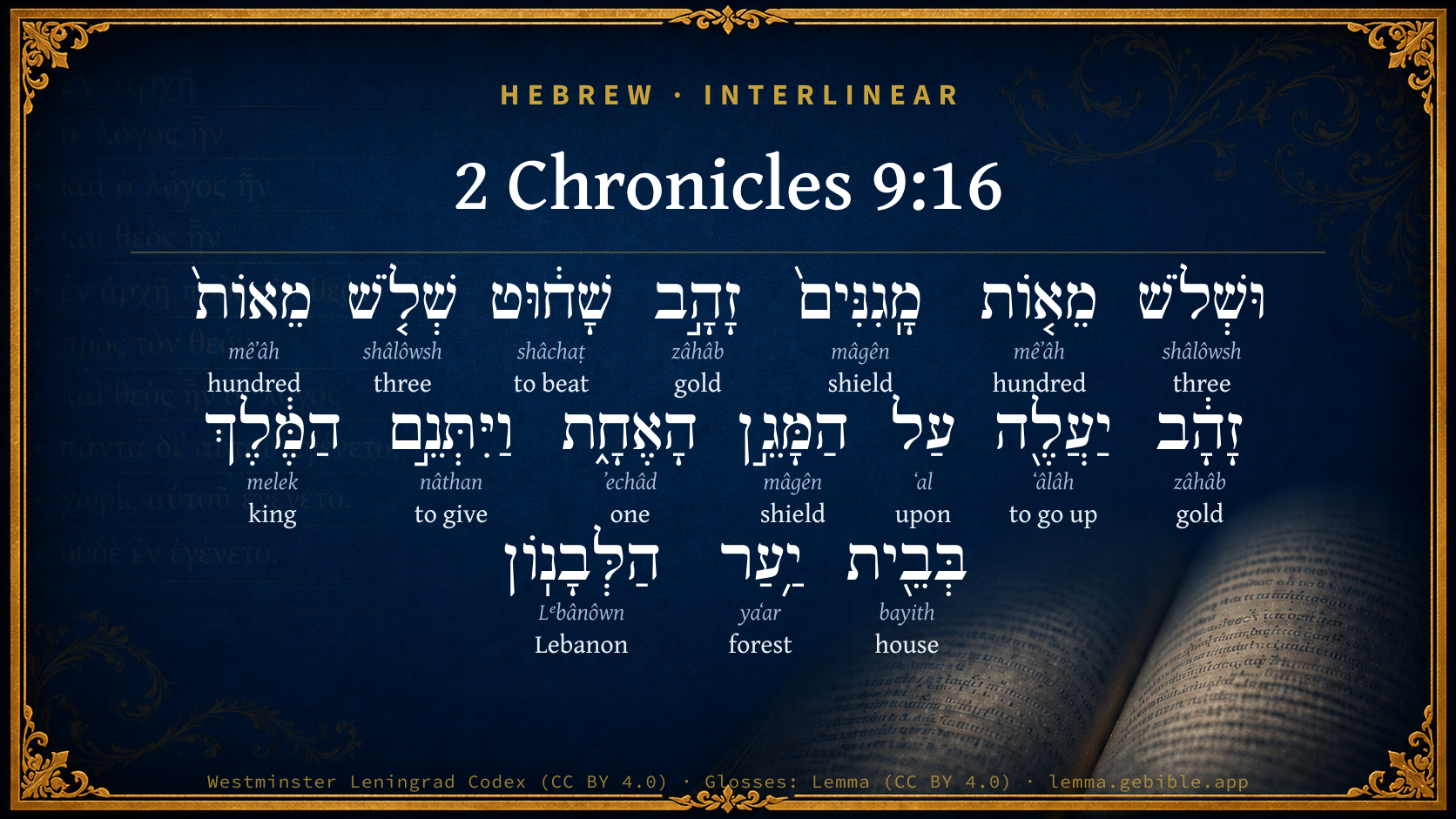
  1. וּשְׁלֹשׁ shâlôwsh H7969 “and · three” Conjunction + Adjective, Cardinal number, Feminine, Singular, Absolute
  2. מֵא֤וֹת mêʼâh H3967 “hundred” Adjective, Cardinal number, Both, Plural, Absolute
  3. מָֽגִנִּים֙ mâgên H4043 “shields” Noun, Common, Both, Plural, Absolute
  4. זָהָ֣ב zâhâb H2091 “gold” Noun, Common, Masculine, Singular, Absolute
  5. שְׁלֹ֤שׁ shâlôwsh H7969 “three” Adjective, Cardinal number, Feminine, Singular, Absolute
  6. מֵאוֹת֙ mêʼâh H3967 “hundred” Adjective, Cardinal number, Both, Plural, Absolute
  7. זָהָ֔ב zâhâb H2091 “gold” Noun, Common, Masculine, Singular, Absolute
  8. יַעֲלֶ֖ה ʻâlâh H5927 “to go up” Verb, Hiphil, Imperfect, 3rd Person, Masculine, Singular
  9. עַל ʻal H5921 “upon” Preposition
  10. הַמָּגֵ֣ן mâgên H4043 “the · shield” Particle, Definite Article + Noun, Common, Both, Singular, Absolute
  11. הָאֶחָ֑ת ʼechâd H259 “the · one” Particle, Definite Article + Adjective, Cardinal number, Feminine, Singular, Absolute
  12. וַיִּתְּנֵ֣ם nâthan H5414 “and · to give · them” Conjunction + Verb, Qal, Sequential Imperfect, 3rd Person, Masculine, Singular + Suffix, Personal, 3rd Person, Masculine, Plural
  13. הַמֶּ֔לֶךְ melek H4428 “the · king” Particle, Definite Article + Noun, Common, Masculine, Singular, Absolute
  14. בְּבֵ֖ית bayith H1004 “in/at · house of” Preposition + Noun, Common, Masculine, Singular, Construct
  15. יַ֥עַר yaʻar H3293 “forest of” Noun, Common, Masculine, Singular, Construct
  16. הַלְּבָנֽוֹן Lᵉbânôwn H3844 “the · Lebanon” Particle, Definite Article + Noun, Proper

About this verse

These counts appear in no published source. They are computed here, from the morphology-tagged text and Lemma’s own curated glosses. What Lemma adds →

17
words
13
distinct lemmas
Historical
section

Notable vocabulary

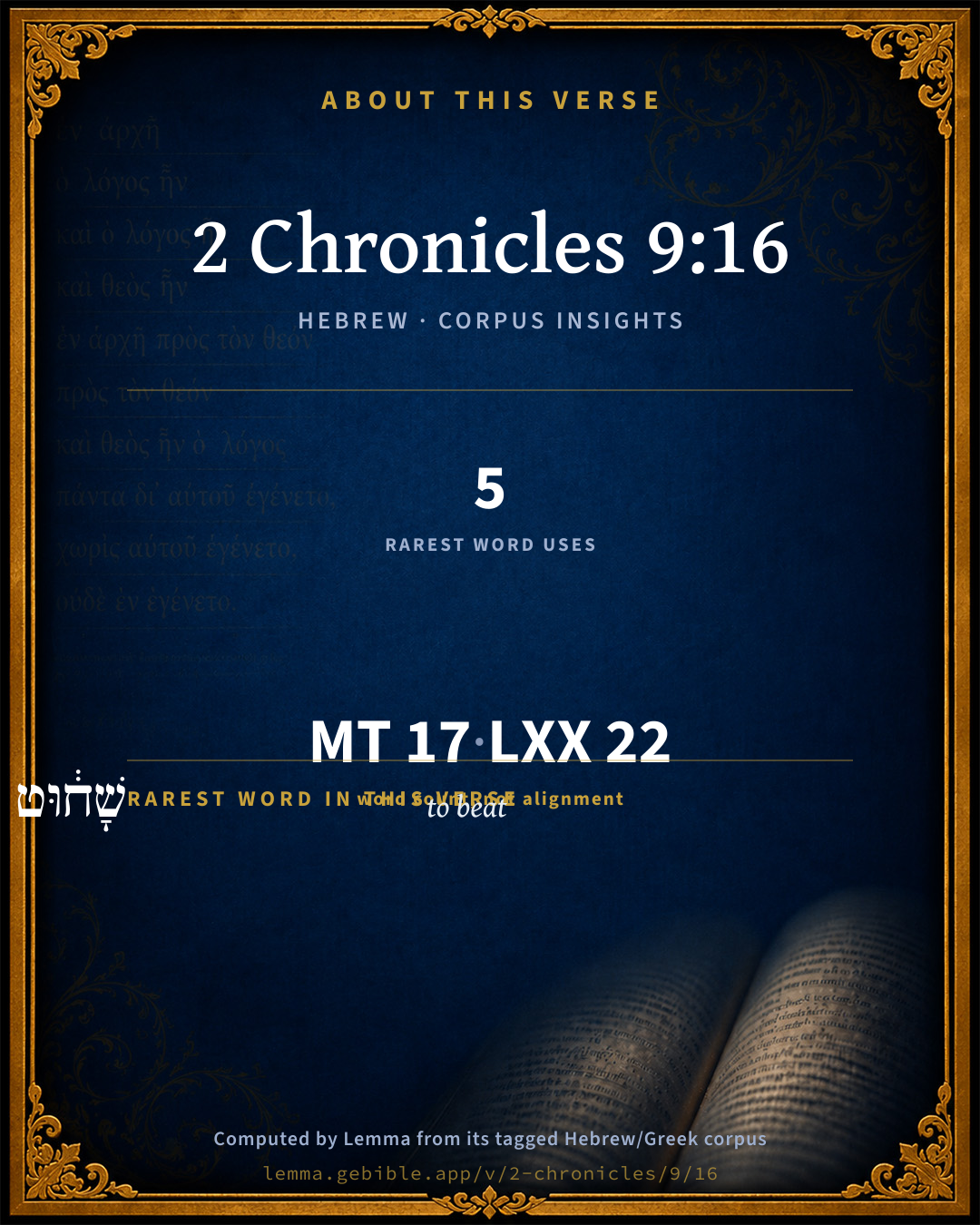
The rarest word here is שָׁח֔וּט to beat H7820 — appearing just 5 times in the whole Hebrew Bible.

Shared distinctive vocabulary

שָׁח֔וּט to beat H7820 occurs in 4 verses of the Hebrew Bible. Also found in:

Grammatical profile

  • 3 verbs
  • 8 nouns
  • 5 adjectives
  • 1 preposition

Verb forms

  • שָׁח֔וּט Qal · Participle Passive
  • יַעֲלֶ֖ה Hiphil · Imperfect
  • וַיִּתְּנֵ֣ם Qal · Sequential Imperfect

Repetition

Words recur within this verse — often emphatic in Hebrew:

  • וּשְׁלֹשׁ three H7969 ×2
  • מֵא֤וֹת hundred H3967 ×2
  • מָֽגִנִּים֙ shield H4043 ×2
  • זָהָ֣ב gold H2091 ×2

Hebrew & Septuagint length

In English translation the verse runs 30 words from the Hebrew and 31 from the Septuagint (LXX English) — closely comparable.

A rough comparison of the two English renderings, which tokenize alike — not a word-level alignment.

Word counts can differ between the Hebrew and the Greek without any difference in meaning — e.g. the Hebrew direct-object marker אֵת has no separate Greek word, and Greek often adds the article ὁ.

In the original languages it is 17 Hebrew tokens and 22 Greek tokens — but the two are counted differently (Hebrew bundles its prefixes and suffixes into one token; the Greek is in lemma form), so that isn’t a like-for-like length.

Cross-references

1

Topical passages linked to 2 Chronicles 9:16 in the Treasury of Scripture Knowledge — connected by theme and wording, ordered by reader-vote popularity; previews shown in the World English Bible.

  • 1 Kings 7:2 For he built the house of the forest of Lebanon; the length of it was one hundred cubits, and the breadth of it fifty cubits, and the height of it thirty cubits, on four rows of cedar pillars, with cedar beams on the pillars.

Cross-references courtesy of OpenBible.info (CC BY 4.0).

Hebrew and Greek witnesses Masoretic Hebrew ↔ Greek Septuagint

The same verse in the two great witnesses to the Old Testament, shown verse-for-verse.

These are two independent witnesses, not word-aligned to each other, and the Septuagint is shown in lemma (dictionary) form.

Hebrew 2 Chronicles 9:16 Masoretic · Westminster Leningrad Codex

וּשְׁלֹשׁ מֵא֤וֹת מָֽגִנִּים֙ זָהָ֣ב שָׁח֔וּט שְׁלֹ֤שׁ מֵאוֹת֙ זָהָ֔ב יַעֲלֶ֖ה עַל הַמָּגֵ֣ן הָאֶחָ֑ת וַיִּתְּנֵ֣ם הַמֶּ֔לֶךְ בְּבֵ֖ית יַ֥עַר הַלְּבָנֽוֹן

[he made] three hundred shields of beaten gold; three hundred [shekels] of gold went to one shield: and the king put them in the house of the forest of Lebanon.

World English Bible · Public Domain

Greek LXX 2 Chronicles 9:16 Septuagint · lemma form

καί τριακόσιοι ἀσπίς ἐλάτη χρυσοῦς τριακόσιοι χρυσοῦς ἀναφέρω ἐπί ὁ ἀσπίς ἕκαστος καί δίδωμι αὐτός ὁ βασιλεύς ἐν οἶκος δρυμός ὁ λιβάνος

And three hundred buckles of beaten gold: the weight of three hundred gold shekels went to one buckler: and the king placed them in the house of the forest of Lebanon.

LXX2012 (modern English Septuagint) · Public Domain

On this verse, Ellicott's Commentary for English Readers discusses the Septuagint’s reading. Read the note in Commentary ↓

Hebrew: Westminster Leningrad Codex (CC BY 4.0). Greek: Septuagint (public domain); English from LXX2012 (modern English Septuagint) (Public Domain). How the Septuagint differs from the Hebrew →

Commentary

Notes on 2 Chronicles 9:16 from classic Christian and Jewish commentators (each source and its license shown beneath its notes). The classic Christian expositions comment on the surrounding passage and are grouped to its opening verse, so a note may address several verses; the Jewish commentaries on the Tanakh (Rashi and others) are per-verse, so they appear only where the commentator wrote on this verse.

Lemma curates 59 commentaries, every one of them public domain or Creative Commons licensed, each selected and text-cleaned for this edition rather than reprinted as found. About our sources →

Geneva Bible (1599)

Geneva Bible translators

Or, pounds called mina, whereof every one seemed to make an hundred shekels.

Geneva Bible (1599) marginal notes — public domain. Text via Bolls.life.

Ellicott's Commentary for English Readers

(16) Shields.—Maginnîm. The mâgçn was a rouud or oval shield, about half the size of the “target” (çinnah), with which it is often contrasted; e.g., Psa_35:2; LXX., ἀσπίδα.

Three hundred shekels of gold.—Kings, three manehs of gold. The maneh or mina (Assyrian, mana), was 1-60th part of a talent, and was equivalent to fifty or sixty shekels. Either the reading of our text is an error of transcription (sh’losh mç’ôth for sh’losheth manîm), or the word shekels is wrongly supplied in our version, and we ought rather to read drachms (100 drachms = 1 mina). The Syriac reads, “And three minas of gold wrought on the handle of one shield;” so also the Arabic.

A Bible Commentary for English Readers, edited by Charles John Ellicott (1878–1897) — public domain. Text from a community e-Sword module.

The Cambridge Bible for Schools and Colleges

gen. ed. J. J. S. Perowne

16. shields] See note on 2Ch_9:15.

the house of the forest of Lebanon] So called probably because it was built of cedar of Lebanon (1Ki_7:2). It was in Jerusalem and seems to have existed as late as the time of Isaiah (Isa_22:8) as an armoury.

The Cambridge Bible for Schools and Colleges (gen. ed. J. J. S. Perowne; Cambridge University Press, 1878–1918) — public domain. Text from a community e-Sword module.

Haydock's Catholic Bible Commentary

Pieces. In 3 Kings, we read, three pounds. --- Wood; or, "in the palace of the forest of Libanus," (3 Kings x. 17.; Calmet) as it is expressed in the Septuagint. (Tirinus)

George Leo Haydock (1774–1849), Haydock's Catholic Family Bible and Commentary, 1859 edition — public domain. Excludes Psalms (Douay-Rheims chapter numbering differs from Protestant) and Deuterocanonical books (Catholic canon only).

Rashi

Rabbi Shlomo Yitzchaki (Rashi)

the forest of Lebanon Solomon built a huge house in Jerusalem, as is proven further, and Shishak took all those shields (below 12:9), and he made them (sic) from an abundance of the large trees of Lebanon, as it is written in I Kings (7:2): “And he built the house of the forest of Lebanon, etc. on four rows, etc.,” and there he deposited those shields, and that is what is written (Isa. 22:8): “and you looked on that day to the weapons of the house of the forest.”

Rashi on the Tanakh — English translations: “The Judaica Press complete Tanach with Rashi, translated by A. J. Rosenberg” (CC BY 4.0); “Pentateuch with Rashi's commentary by M. Rosenbaum and A.M. Silbermann, 1929-1934” (public domain); “The Metsudah Tanach series, Lakewood, N.J” (CC BY 4.0); and “The Book of Joshua, Metsudah Publications, 1997” (CC BY 4.0). Text via Sefaria.

Lesson kit

Teaching starters — assembled from the data on this page, not authored interpretation. Every prompt links to the verse data it draws on. Edit before teaching.

2 Chronicles, in the Historical, opens this verse with 17 words (13 distinct Hebrew lemmas). Its most distinctive word is shâchaṭ (“to beat”). A historical commentator’s framing appears above. Read the whole chapter for the surrounding context.

Discussion questions

  1. How does “to beat” (shâchaṭ) shape what this verse is saying?
  2. 1 Kings 10:16 shares the word «to beat» with this verse. How do the two illuminate each other?
  3. “three” occurs 2× in this one verse. What is the effect of the repetition?
  4. These translations render this verse differently. What is at stake in choosing one wording over another?
  5. The verb «שָׁח֔וּט» is Qal Participle Passive. How does its form color the action?
  6. Reading how Geneva Bible (1599) and Ellicott's Commentary for English Readers read this verse, where do the two commentators agree and where do they part?

Things to notice

Reading settings

Reading text

Shown beneath each verse's original-language words.

Old Testament
Old Testament edition

Read the OT as the Masoretic Hebrew (MT) or the Greek Septuagint (LXX).

English shown for the Greek Septuagint (in the Hebrew ↔ Greek comparison).

Comparing translations? Open the Compare panel on any verse page to stack up to four side by side.