
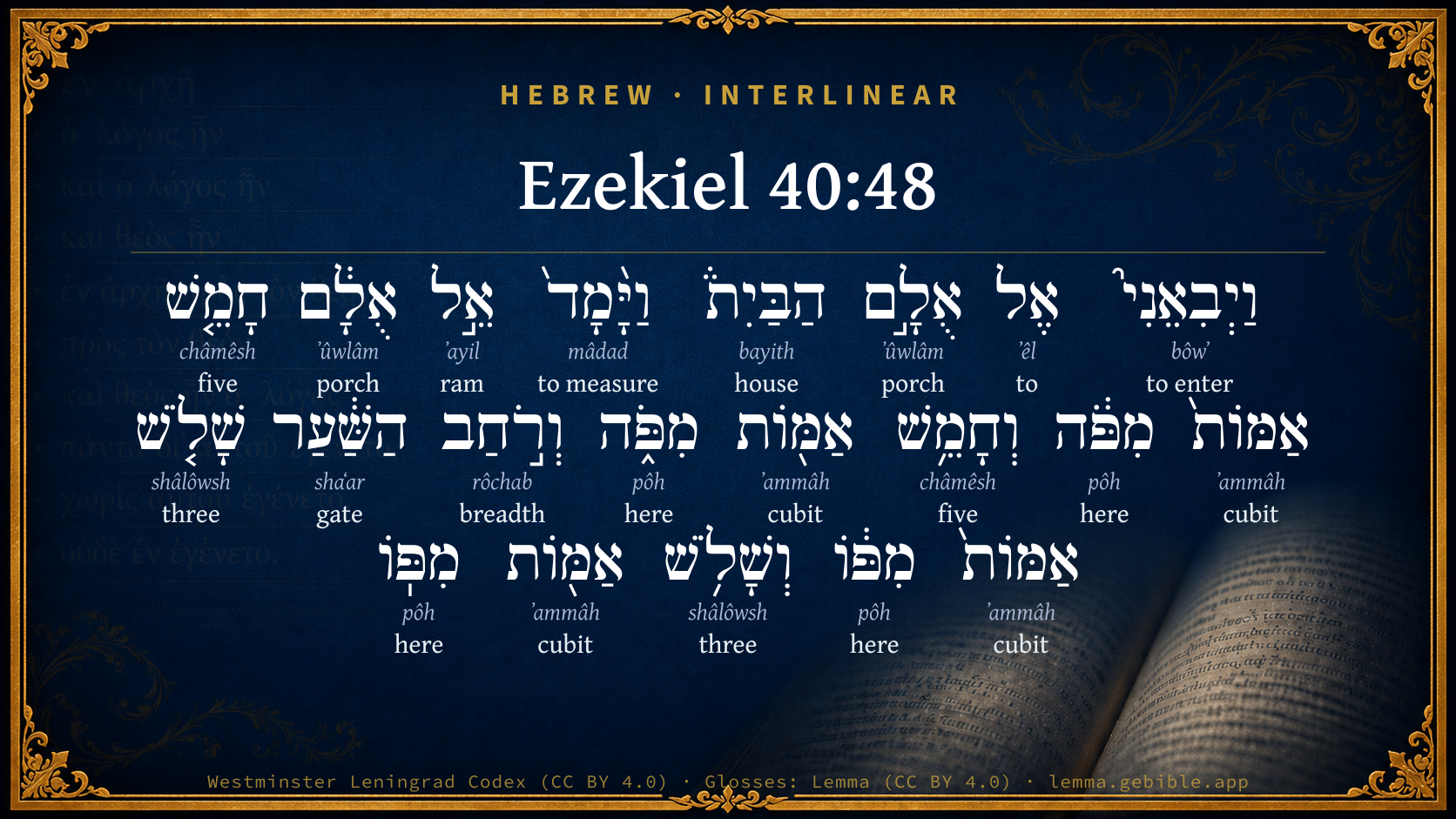
Ezekiel 40:48

Hebrew (Westminster Leningrad Codex) Ezekiel 40:48 appears in the Hebrew Old Testament. The text above is from the Westminster Leningrad Codex. Each word links to its Strong’s number, a concise gloss, and parsing drawn from the Open Scriptures Hebrew Bible morphology. Click any word for its full Brown-Driver-Briggs (BDB) entry.
Download image
Cite this verse

Ezekiel 40:48 (World English Bible). Public Domain. Lemma interlinear Bible study tool, https://lemma.gebible.app/v/ezekiel/40/48.

Show BibTeX & RIS
BibTeX
RIS
English Translation
Then he brought me to the porch of the house, and measured each post of the porch, five cubits on this side, and five cubits on that side: and the breadth of the gate was three cubits on this side, and three cubits on that side.
World English Bible · Public Domain
Download a study sheet

One document with this verse’s original text, its word-by-word gloss line, the meaning frame, cross-references with their text, attributed commentary, and full source and license credits — printable, and it pastes into notes with its structure intact.

This verse Autodidact and up

Study sheet (.html) Plain text (.txt)

A passage Seminary Student

Up to 50 verses in one chapter. A passage sheet keeps up to 6 commentary sources and 12 cross-references per verse, in the order this page ranks them, and says so on the sheet whenever that leaves anything out. Ask for a single verse and you get the Autodidact verse sheet above.

Everything on this page stays free to read, with no account — the sheet is a download of what is already on screen, not access to it.

Want to remove ads? Support Godless Engineer
Compare translations 3

The same verse in 3 English versions, stacked beneath the original-language interlinear above. Click any original word for its lexicon entry.

Each is an independent rendering of the whole verse — the interlinear is not word-aligned to these translations.

Highlighted words mark where these versions differ — a whole-verse word diff, not a word-by-word alignment.

  • World English Bible Public Domain
    Then he brought me to the porch of the house, and measured each post of the porch, five cubits on this side, and five cubits on that side: and the breadth of the gate was three cubits on this side, and three cubits on that side.
  • King James Version Public Domain
    And he brought me to the porch of the house, and measured each post of the porch, five cubits on this side, and five cubits on that side: and the breadth of the gate was three cubits on this side, and three cubits on that side.
  • unfoldingWord Literal Text CC BY-SA 4.0
    Then the man brought me to the portico of the house and measured its doorposts—they were five cubits thick on either side. The entryway itself was fourteen cubits in width, and the walls on each side of it were three cubits in width.

unfoldingWord Literal Text — © unfoldingWord, licensed CC BY-SA 4.0. Word-aligned USFM3 via Door43 (git.door43.org/unfoldingWord/en_ult).

Versions to compare (up to 4)

3 of 4 selected

Show all 18 translations

Every available English version of this verse, each an independent rendering of the whole verse.

  • World English Bible Public Domain
    Then he brought me to the porch of the house, and measured each post of the porch, five cubits on this side, and five cubits on that side: and the breadth of the gate was three cubits on this side, and three cubits on that side.
  • Berean Standard Bible Public Domain
    Then he brought me to the portico of the temple and measured the side pillars of the portico to be five cubits on each side. The width of the gateway was fourteen cubits and its sidewalls were three cubits on either side.
  • Majority Standard Bible Public Domain
    Then he brought me to the portico of the temple and measured the side pillars of the portico to be five cubits on each side. The width of the gateway was fourteen cubits and its sidewalls were three cubits on either side.
  • King James Version Public Domain
    And he brought me to the porch of the house, and measured each post of the porch, five cubits on this side, and five cubits on that side: and the breadth of the gate was three cubits on this side, and three cubits on that side.
  • American Standard Version (1901) Public Domain
    Then he brought me to the porch of the house, and measured each post of the porch, five cubits on this side, and five cubits on that side: and the breadth of the gate was three cubits on this side, and three cubits on that side.
  • Revised Version (1885) Public Domain
    Then he brought me to the porch of the house, and measured each post of the porch, five cubits on this side, and five cubits on that side: and the breadth of the gate was three cubits on this side, and three cubits on that side.
  • Geneva Bible (1599) Public Domain
    And hee brought mee to the porch of the house, and measured the postes of the porch, fiue cubites on this side, and fiue cubites on that side: and the breadth of the gate was three cubites on this side, and three cubites on that side.
  • Douay-Rheims (1899) Public Domain
    And he brought me into the porch of the temple: and he measured the porch five cubits on this side, and five cubits on that side: and the breadth of the gate three cubits on this side, and three cubits on that side.
  • Young's Literal Translation Public Domain
    And he bringeth me in unto the porch of the house, and he measureth the post of the porch, five cubits on this side, and five cubits on that side, and the breadth of the gate, three cubits on this side, and three cubits on that side;
  • Literal Standard Version CC BY-SA 4.0
    And he brings me to the porch of the house, and he measures the post of the porch—five cubits on this side and five cubits on that side, and the breadth of the gate—three cubits on this side and three cubits on that side;
  • Unlocked Literal Bible CC BY-SA 4.0
    Then the man brought me to the portico of the house and measured its doorposts—they were five cubits thick on either side. The entryway itself was fourteen cubits in width, and the walls on each side of it were three cubits in width.
  • unfoldingWord Literal Text CC BY-SA 4.0
    Then the man brought me to the portico of the house and measured its doorposts—they were five cubits thick on either side. The entryway itself was fourteen cubits in width, and the walls on each side of it were three cubits in width.
  • Darby Bible Public Domain
    And he brought me to the porch of the house; and he measured the post of the porch, five cubits on this side, and five cubits on that side; and the breadth of the gate, three cubits on this side, and three cubits on that side.
  • World Messianic Bible Public Domain
    Then he brought me to the porch of the house, and measured each post of the porch, five cubits on this side, and five cubits on that side. The width of the gate was three cubits on this side and three cubits on that side.
  • Webster's Bible Public Domain
    And he brought me to the porch of the house, and measured each post of the porch, five cubits on this side, and five cubits on that side: and the breadth of the gate was three cubits on this side, and three cubits on that side.
  • Free Bible Version CC BY-SA 4.0
    He took me to the Temple porch and measured the pillars of the porch as five cubits on each side. The gateway was fourteen cubits wide and its sides measured three cubits.
  • Bible in Basic English Public Domain
    Then he took me to the covered way before the house, and took the measure of its uprights, five cubits on one side and five cubits on the other: and the doorway was fourteen cubits wide; and the side-walls of the doorway were three cubits on one side and three cubits on the other.
  • JPS Tanakh (1917) Public Domain
    Then he brought me to the porch of the house, and measured each post of the porch, five cubits on this side, and five cubits on that side; and the breadth of the gate was three cubits on this side, and three cubits on that side.

Literal Standard Version (2020), Covenant Press — licensed CC BY-SA 4.0. Text via the HelloAO Bible API (eBible.org). Unlocked Literal Bible (unfoldingWord) — licensed CC BY-SA 4.0. Text via the HelloAO Bible API (eBible.org). unfoldingWord Literal Text — © unfoldingWord, licensed CC BY-SA 4.0. Word-aligned USFM3 via Door43 (git.door43.org/unfoldingWord/en_ult). Free Bible Version, Dr. Jonathan Gallagher — licensed CC BY-SA 4.0. Text via the HelloAO Bible API (eBible.org).

Word by word

More ways to search: Search by grammar → Find every occurrence → Compare this word →

Practice this passage: Drill this verse → Learn its vocabulary →

אֻלָ֣ם
ʼûwlâm
H197
“porch of”
Noun, Common, Masculine, Singular, Construct
Part of Speech
Noun
Type
Common
Gender
Masculine
Number
Singular
State
Construct
Full BDB Definition

Origin: from H481 (in the sense of tying)

TWOT: 45c

porch - in Solomon's temple - in Solomon's palace - in temple of Ezekiel's vision
  1. וַיְבִאֵנִי֮ bôwʼ H935 “and · to enter · me” Conjunction + Verb, Hiphil, Sequential Imperfect, 3rd Person, Masculine, Singular + Suffix, Personal, 1st Person, Common, Singular
  2. אֶל ʼêl H413 “to” Preposition
  3. הַבַּיִת֒ bayith H1004 “the · house” Particle, Definite Article + Noun, Common, Masculine, Singular, Absolute
  4. וַיָּ֨מָד֙ mâdad H4058 “and · to measure” Conjunction + Verb, Qal, Sequential Imperfect, 3rd Person, Masculine, Singular
  5. אֵ֣ל ʼayil H352 “ram of” Noun, Common, Masculine, Singular, Construct
  6. אֻלָ֔ם ʼûwlâm H197 “porch” Noun, Common, Masculine, Singular, Absolute
  7. חָמֵ֤שׁ châmêsh H2568 “five” Adjective, Cardinal number, Feminine, Singular, Absolute
  8. אַמּוֹת֙ ʼammâh H520 “cubits” Noun, Common, Feminine, Plural, Absolute
  9. מִפֹּ֔ה pôh H6311 “from · here” Preposition + Adverb
  10. וְחָמֵ֥שׁ châmêsh H2568 “and · five” Conjunction + Adjective, Cardinal number, Feminine, Singular, Absolute
  11. אַמּ֖וֹת ʼammâh H520 “cubits” Noun, Common, Feminine, Plural, Absolute
  12. מִפֹּ֑ה pôh H6311 “from · here” Preposition + Adverb
  13. וְרֹ֣חַב rôchab H7341 “and · breadth of” Conjunction + Noun, Common, Masculine, Singular, Construct
  14. הַשַּׁ֔עַר shaʻar H8179 “the · gate” Particle, Definite Article + Noun, Common, Masculine, Singular, Absolute
  15. שָׁלֹ֤שׁ shâlôwsh H7969 “three” Adjective, Cardinal number, Feminine, Singular, Absolute
  16. אַמּוֹת֙ ʼammâh H520 “cubits” Noun, Common, Feminine, Plural, Absolute
  17. מִפּ֔וֹ pôh H6311 “from · here” Preposition + Adverb
  18. וְשָׁלֹ֥שׁ shâlôwsh H7969 “and · three” Conjunction + Adjective, Cardinal number, Feminine, Singular, Absolute
  19. אַמּ֖וֹת ʼammâh H520 “cubits” Noun, Common, Feminine, Plural, Absolute
  20. מִפּֽוֹ pôh H6311 “from · here” Preposition + Adverb

About this verse

These counts appear in no published source. They are computed here, from the morphology-tagged text and Lemma’s own curated glosses. What Lemma adds →

21
words
12
distinct lemmas
Prophets
section

Shared distinctive vocabulary

אֻלָ֣ם porch H197 occurs in 29 verses of the Hebrew Bible. Also found in:

Grammatical profile

  • 2 verbs
  • 10 nouns
  • 4 adjectives
  • 1 preposition
  • 4 adverbs

Verb forms

  • וַיְבִאֵנִי֮ Hiphil · Sequential Imperfect
  • וַיָּ֨מָד֙ Qal · Sequential Imperfect

Repetition

Words recur within this verse — often emphatic in Hebrew:

  • אַמּוֹת֙ cubit H520 ×4
  • מִפֹּ֔ה here H6311 ×4
  • אֻלָ֣ם porch H197 ×2
  • חָמֵ֤שׁ five H2568 ×2
  • שָׁלֹ֤שׁ three H7969 ×2

Hebrew & Septuagint length

In English translation the verse runs 46 words from the Hebrew and 64 from the Septuagint (LXX English) — closely comparable.

A rough comparison of the two English renderings, which tokenize alike — not a word-level alignment.

Word counts can differ between the Hebrew and the Greek without any difference in meaning — e.g. the Hebrew direct-object marker אֵת has no separate Greek word, and Greek often adds the article ὁ.

Cross-references

2

Topical passages linked to Ezekiel 40:48 in the Treasury of Scripture Knowledge — connected by theme and wording, ordered by reader-vote popularity; previews shown in the World English Bible.

  • 1 Kings 6:3 The porch before the temple of the house, twenty cubits was the length of it, according to the breadth of the house; [and] ten cubits was the breadth of it before the house.
  • 2 Chronicles 3:4 The porch that was before [the house], the length of it, according to the breadth of the house, was twenty cubits, and the height one hundred twenty; and he overlaid it within with pure gold.

Cross-references courtesy of OpenBible.info (CC BY 4.0).

Hebrew and Greek witnesses Masoretic Hebrew ↔ Greek Septuagint

The same verse in the two great witnesses to the Old Testament, shown verse-for-verse.

These are two independent witnesses, not word-aligned to each other, and the Septuagint is shown in lemma (dictionary) form.

Hebrew Ezekiel 40:48 Masoretic · Westminster Leningrad Codex

וַיְבִאֵנִי֮ אֶל אֻלָ֣ם הַבַּיִת֒ וַיָּ֨מָד֙ אֵ֣ל אֻלָ֔ם חָמֵ֤שׁ אַמּוֹת֙ מִפֹּ֔ה וְחָמֵ֥שׁ אַמּ֖וֹת מִפֹּ֑ה וְרֹ֣חַב הַשַּׁ֔עַר שָׁלֹ֤שׁ אַמּוֹת֙ מִפּ֔וֹ וְשָׁלֹ֥שׁ אַמּ֖וֹת מִפּֽוֹ

Then he brought me to the porch of the house, and measured each post of the porch, five cubits on this side, and five cubits on that side: and the breadth of the gate was three cubits on this side, and three cubits on that side.

World English Bible · Public Domain

Greek LXX Ezekiel 40:48 Septuagint · lemma form

καί εἰςἄγω ἐγώ εἰς ὁ αιλαμ ὁ οἶκος καί διαμετρέω ὁ αιλ ὁ αιλαμ πηχύς πέντε ὁ πλάτος ἔνθεν καί πηχύς πέντε ἔνθεν καί ὁ εὖρος ὁ θύρωμα πηχύς δέκα τέσσαρες καί ἐπωμίς ὁ θύρα ὁ αιλαμ πηχύς τρεῖς ἔνθεν καί πηχύς τρεῖς ἔνθεν

And he brought me into the porch of the house; and he measured the post of the porch, the breadth was five cubits on one side and five cubits on the other side; and the breadth of the door was fourteen cubits, and the side-pieces of the door of the porch were three cubits on one side, and three cubits on the other side.

LXX2012 (modern English Septuagint) · Public Domain

On this verse, The Cambridge Bible for Schools and Colleges discusses the Septuagint’s reading. Read the note in Commentary ↓

Hebrew: Westminster Leningrad Codex (CC BY 4.0). Greek: Septuagint (public domain); English from LXX2012 (modern English Septuagint) (Public Domain). How the Septuagint differs from the Hebrew →

Targum (Aramaic paraphrase)

1

The Targum is the ancient Jewish Aramaic paraphrase of the Hebrew Scriptures — an interpretive translation, not the Hebrew text itself. Onkelos (literal) and Pseudo-Jonathan (expansive) render the Torah, and Jonathan the Prophets. Coverage is partial: where no permissively-licensed English translation exists for a verse, only the Aramaic is shown. This is verse-level text, not a word-by-word alignment to the Hebrew.

  1. Targum Jonathan Prophets (Joshua–Malachi)
    וְאָעֲלַנִי לְאוּלַמָא דְבֵיתָא וּמְשַׁח אֵילָא דְאוּלַמָא חֲמֵשׁ אַמִין מִכָּא וַחֲמֵשׁ אַמִין מִכָּא וּפוּתְיָא דְתַרְעָא תְּלַת אַמִין מִכָּא וּתְלַת אַמִין מִכָּא:

    (no public-domain English translation for this verse)

    Targum Jonathan — Aramaic: “Mikraot Gedolot” (public domain). English: “Sefaria Community Translation” (CC0 1.0 (public-domain dedication)); “London "Chaldee Paraphrase," 1871” (public domain). Text via Sefaria.

Commentary

Notes on Ezekiel 40:48 from classic Christian and Jewish commentators (each source and its license shown beneath its notes). The classic Christian expositions comment on the surrounding passage and are grouped to its opening verse, so a note may address several verses; the Jewish commentaries on the Tanakh (Rashi and others) are per-verse, so they appear only where the commentator wrote on this verse.

Lemma curates 59 commentaries, every one of them public domain or Creative Commons licensed, each selected and text-cleaned for this edition rather than reprinted as found. About our sources →

The Cambridge Bible for Schools and Colleges

gen. ed. J. J. S. Perowne

48. post of the porch] The “post” is as before the front or jamb of the advancing wall on each side of the entrance. This wall was 5 cubits thick. Fig. 2, ab.

breadth of the gate was three cubits] The “gate” here means the two bits of wall (N. to S.) on either side, the fronts of which formed the posts or jambs of the entrance, Fig. 2, bh. The language is brief; LXX. either read or judged that the reading should be: and the breadth of the entrance was fourteen cubits, and the side pieces of the entrance of the porch were three cubits on one side and three cubits, &c. These measures are correct and probably original, for 14 (entrance, Fig. 2, aa, bb) + 6 (3 + 3) = 20 the extent of the porch N. to S. (Eze_40:49).

Eze_40:48 to Eze_41:4. Measurements of the Temple house, in its three parts, porch, holy place and most holy place

48, 49. The porch. Fig. 2, A.

The Cambridge Bible for Schools and Colleges (gen. ed. J. J. S. Perowne; Cambridge University Press, 1878–1918) — public domain. Text from a community e-Sword module.

Trapp's Complete Commentary

John Trapp

Eze 40:48 And he brought me to the porch of the house, and measured [each] post of the porch, five cubits on this side, and five cubits on that side: and the breadth of the gate [was] three cubits on this side, and three cubits on that side.

Ver. 48. The porch of the house.] Which was covered over-head, to keep them dry in foul weather. What Christ doth for all his. See Isa 4:5-6; Isa 25:4. {See Trapp on "Isa 25:4"}

John Trapp, A Commentary or Exposition upon All the Books of the Old and New Testament (1647–1656) — public domain. Text from a community e-Sword module.

Joseph Benson's Commentary

Eze 40:48-49. And measured each post of the porch — By the posts are meant the side-posts, or columns, on each side of the door of entrance: see Eze 40:9; these were measured to be five cubits thick, both on the north and south sides. And the breadth of the gate was three cubits on this side, &c. — “Two doors, of three cubits wide, opening each way, formed the entrance; these, with five on each side, called the posts of the porch, amount to sixteen cubits; and the other four may be supposed to have been the distance from these posts to the outside of the walls of the temple.” — Scott.

Joseph Benson's Commentary on the Old and New Testaments (1811–1818) — public domain. Text from a community e-Sword module.

Keil & Delitzsch

C. F. Keil & F. Delitzsch

The Temple-Porch

(see Plate III A). The measuring angel conducts the prophet still farther to the porch of the temple, and measures its breadth and length. - Eze 40:48. And he led me to the porch of the house, and measured the pillar of the porch, five cubits on this side and five cubits on that side; and the breadth of the gate, three cubits on this side and three cubits on that side. Eze 40:49. The length of the porch was twenty cubits, and the breadth eleven cubits, and that by the steps by which one went up; and columns were by the pillars, one on this side and one on that side. - הבּית is the temple in the more restricted sense of the word, the temple-house, as in Kg1 6:2, etc.; and אלם, the porch before the entrance into the holy place (cf. Kg1 6:3). The measurements in Eze 40:48 and Eze 40:49, which are apparently irreconcilable with one another, led the lxx to the adoption of arbitrary interpolations and conjectures in Eze 40:49, in accordance with which Bttcher, Hitzig, and others have made corrections in the text, which have a plausible justification in the many artificial and for the most part mistaken interpretations that have been given of the text. The measures in Eze 40:49 are perfectly plain, namely, the length of the porch twenty cubits, and the breadth eleven cubits; and there is no question that these measurements are to be understood in the clear, that is to say, as referring to the internal space, excluding the side-walls, as in the case of the holy place, the most holy place, and the inner court. The only question is whether the length signifies the dimension from east to west, i.e., the distance which had to be traversed on entering the temple, and therefore the breadth, the extent from north to south; or whether we are to understand by the length the larger dimension, and by the breadth the smaller, in which case the measurement from north to south, which formed the breadth of the house, would be designated the length of the porch, and that from east to west the breadth. Nearly all the commentators have decided in favour of the latter view, because, in the porch of Solomon's temple, the length of twenty cubits was measured according to the breadth of the house. But the fact has been overlooked, that in Kg1 6:3 the length given is more precisely defined by the clause, "in front of the breadth of the house." There is no such definition here, and the analogy of the building of Solomon's temple is not sufficient in itself to warrant our regarding the construction of the porch in the temple seen by Ezekiel as being precisely the same; since it was only in the essential portions, the form of which was of symbolical significance (the holy place and the most holy), that this picture of a temple resembled the temple of Solomon, whereas in those which were less essential it differed from that temple in various ways. At the very outset, therefore, the more probable assumption appears to be, that just as in the case of the holy place and the holy of holies, so also in that of the porch, we are to understand by the length, the distance to be traversed (from east to west), and by the breadth, the extension on either side (i.e., from south to north).

If, then, we understand the measurements in Eze 40:49 in this way, the measures given in Eze 40:48 may also be explained without any alterations in the text. The measuring of the pillar of the porch on either side, and of the gate on this side and that (Eze 40:48), is sufficient of itself to lead to the conclusion that the front turned toward a person entering is the breadth from south to north. This breadth presented to the eye a pillar on this side and one on that - two pillars, therefore, each five cubits broad (c c), and a breadth of gate of three cubits on this side and three on that, six cubits in all (b), that is to say, a total breadth (k-k) of 5 + 3 + 3 + 5 = 16 cubits. The only thing that can surprise one here is the manner in which the breadth of the gate is defined: three cubits on this side and that, instead of simply six cubits. But the only reason in all probability is, that the pillars on either side are mentioned just before, and the gate of six cubits' breadth consisted of two halves, which had their hinges fastened to the adjoining pillars, so that each half was measured by itself from the pillar to which it was attached. The breadth of front mentioned, viz., sixteen cubits, agrees very well with the breadth of the porch inside, i.e., eleven cubits (m-m), for it allows a thickness of two cubits and a half for each side wall (a), and this was sufficient for the walls of a porch. The pillars, which were five cubits broad on the outer face, were therefore only half that breadth (2 1/2 cubits) in the inner side within the porch, the other two cubits and a half forming the side wall. All the particulars given in Eze 40:48 may be explained in this way without any artifice, and yield a result the proportions of which are in harmony with those of the entire building. For the porch, with an external breadth of sixteen cubits, was half as broad as the house, which had a breadth of twenty cubits in the clear, and side walls of six cubits in thickness (Eze 41:5), so that when measured on the outside it was 6 + 20 + 6 = 32 cubits broad. The breadth of the interior also is apparently perfectly appropriate, as the porch was not intended either for the reception of vessels or for the abode of individuals, but was a simple erection in front of the entrance into the holy place, the door of which (d) was ten cubits broad (Eze 41:2), that is to say, half a cubit narrower on either side than the porch-way leading to it. And lastly, the length of the porch was also in good proportion to the holy place, which followed the porch; the porch being twenty cubits long, and the holy place forty cubits. If we add to this the front wall, with a thickness of two cubits and a half, corresponding to that of the side walls, we obtain an external length of twenty-two cubits and a half for the porch. In front were the steps by which one went up to the porch (l). It is generally supposed that there were ten steps, the אשׁר after בּמּעלות being changed into עשׂר (ten) after the example of the lxx. But however this alteration may commend itself when the facts of the case are considered, ten steps in front of the porch answering very well to the eight steps before the gateway of the inner court, and to the seven steps in front of the gateway of the outer court, it is not absolutely necessary, and in all probability is merely a conjecture of the Seventy, who did not know what to do with אשׁר, and possibly it is not even correct (see at Eze 41:8). The words וּבמּעלות אשׁר can be attached without difficulty to the preceding account of the breadth: "the breadth was eleven cubits, and that at the steps by which they went up to it," i.e., when measured on the side on which the flight of steps stood. If the words are taken in this way, they serve to remove all doubt as to the side which is designated as the breadth, with special reference to the fact that the porch of Solomon's temple was constructed in a different manner. The number of steps, therefore, is not given, as was also the case with the east gate of the outer court (Eze 40:6), because it was of no essential importance in relation to the entire building. The last statement, "and there were columns by the pillars on this side and on that," is free from difficulty, although there is also a difference of opinion among the commentators as to the position of these columns. האילים points back to אל אלם (Eze 40:48). The preposition אל does not imply that the columns stood close to the pillars, and had the form of half-columns, but simply that they stood near the pillars (see Plate III K), like the columns Jachin and Boaz in Solomon's temple, to which they correspond.

Keil & Delitzsch — Biblical Commentary on the Old Testament (1861–1891) — public domain (CC PDM 1.0). Text via the HelloAO Bible API. (Old Testament only.)

Fairbairn on Ezekiel, Jonah & the Pastoral Epistles

Patrick Fairbairn

CHAPER 40:48-41:11.

THE TEMPLE ITSELF.

Eze 40:48. And he brought me to the porch of the house, and he measured for the porch five cubits on the one side, and five cubits on the other; and the breadth of the gate three cubits on the one side, and three cubits on the other.

Eze 40:49. The length of the porch twenty cubits, and the breadth eleven cubits; and by the steps which they go up to it; and posts beside the pillar-work, one on this side, and another on that. (It is not to be denied that there are some peculiarities in this last verse, which look very like corruptions of the text. Thus the eleven cubits assigned for the breadth of the porch gate, which do not bear any exact proportion to the length, and which also differ from the dimensions given in 1Ki 4:3, of Solomon’s temple, while the length agrees. Some would therefore altogether omit the two, and read ten; and others, with the LXX. (changing עַשְׁתֵּי into שְׁתֵּי), would make the number twelve. Again in the clause about the steps, which certainly reads awkwardly as it stands, many substitute עֵשֶׂר for אֳשׁור, and render: and by ten steps they go up to it. If the present text is retained, we must supply, “And he measured,” or something like it: (he measured) by the steps which they go up to it—the course merely being noticed, but not the exact measurement, as the description here is very brief. It seems intended to show that the porch was much the same as in the old temple of Solomon.) 41:

Eze 40:1. And he brought me to the temple, and he measured the pillars (or pillar-work), six cubits broad on the one side, and six cubits broad on the other side; the breadth of the tabernacle. (The introducing of the tabernacle has certainly a peculiar appearance in this connection; hence some would regard אֹחֶל as used in an unusual sense for temple, while the greater part suppose a corruption of the text, and render “porch,” or “projection-work.” Häv., however, defends the existing text, and conceives that the prophet, as in the dimensions of the outer porch he had pointed to Solomon’s temple, so here in the temple proper he points to the old tabernacle, which being composed in its breadth of eight boards, each one and a half cubit broad, would make in all twelve cubits, as here. This was the breadth externally of the tabernacle, though the interior was only ten cubits. The prophet would thus connect together the two most sacred erections of former times. Such was probably the reason, though the mention of the tabernacle even in such a way looks somewhat artificial.)

Eze 40:2. And the breadth of the entrance was ten cubits, and the sides of the entrance ten cubits, and the sides of the entrance five cubits on the one side, and five cubits on the other side; and he measured its length (viz. of the holy place) forty cubits, and its breadth twenty cubits.

Eze 40:3. And he went inward (toward the most holy place), and measured the post of the entrance, two cubits; and the entrance, six cubits; and the breadth of the entrance, seven cubits.

Eze 40:4. And he measured its length twenty cubits, and its breadth twenty cubits, before the temple; (This expression, “before (or in front of) the temple,” is used on account of the peculiar sacredness of the most holy place, which stood in a sense by itself and into which the prophet did not enter with the angel. Hence he had said, not that the angel brought him in thither, but that the angel went in himself, and measured it; so that the most holy place appeared like a separate apartment in front of the portion of the temple which alone was accessible to him (comp. 1Ki 6:3, where temple is used in the same restricted sense). The dimensions of the two apartments are precisely those of Solomon’s temple, which having been fixed of old by Divine direction, are to be regarded as already finally determined.) and he said to me, This is the holy of holies.

Eze 40:5. And he measured the wall of the house, six cubits; and the breadth of the side-chambers (rib-like structures on the wall—the singular again used collectively), four cubits, round about the house on every side.

Eze 40:6. And the side-chambers were three-storeyed (literally, chamber on chamber three), and thirty in succession; and joinings were to the wall of the house for the side-chambers round about; that they might be holden, yet were they not holden in the wall of the house. (The meaning of this rather obscure description, as we learn by turning to 1Ki 6:6, is that there were rests made in the walls of the temple for supports to the side-chambers; but the temple walls did not thereby become part of this side building, they stood separate from it.)

Eze 40:7. And there was an enlarging and a winding still upwards to the chambers; for the house had a winding stair still upwards round about for the house; therefore there was an enlarging of the house upwards, and so one ascended from the lower to the higher, through the middle.

Eze 40:8. And I saw the house’s height round about; the foundations of the chambers were a full rod, six cubits to the joining (or corner). (The אַצִיל here must be regarded as an architectural term, denoting something about the foundations; and as it is used elsewhere in the sense of joints, the natural supposition is that it indicates the point where the foundation of one chamber ceased and another began. Yet, it must be confessed, there is no certainty.)

Eze 40:9. The thickness of the wall, which belonged to the chambers outside, was five cubits; and there was an unoccupied place (literally, what remained free) within chambers that belonged to the house.

Eze 40:10. And between the apartments (i.e., of the priests in the court, between these and the side-chambers) was the width of twenty cubits round about the house on every side.

Eze 40:11. And the entrance to the chambers was toward the unoccupied place; one entrance toward the north, and one entrance toward the south: and the breadth of the unoccupied place was five cubits round about.

THERE is considerable minuteness in the description of these side-chambers, as compared, at least, with the original description in 1 Kings 6, where the whole that is said of them is comprised in two verses. And yet with the advantage of the greater minuteness here, it would be impossible to construct an architectural plan without taking a good deal for granted that has no place in the prophet’s delineation. One can easily understand how there might be a winding stair within, leading up through the several storeys, but how should this have been accompanied with an enlarging or widening of the house itself? What is meant by the foundations being a full rod of six cubits,—some underground buildings on which they rested, or the ground itself on which they were raised? (Both have their advocates.) What was the object of the unoccupied place of five cubits? and how did it differ from the space of twenty cubits lying between the side-chambers and the halls of the priests? Very different answers might be and have been given to these questions, and the greatest liberties taken with the text to lighten the difficulties connected with the account. But we deem it needless to enter into these, or to attempt fixing what the prophet himself has left vague and obscure. He never intended that a structure should be reared precisely according to the plan and measurements he furnishes; otherwise he would have been still more minute in his delineations. He has given enough, however, for his great object, which was chiefly to show that in the Divine purpose respecting the future there was to be a full and everyway complete reconstruction of the house of God—if not in the outward and material sense, yet in the higher things, which that represented and symbolized; and with the effect of securing a far purer and more elevated condition for the covenant-people. It is this last point which throughout he seeks to render prominent by the nature of his descriptions. Hence, in marked contrast to the earlier delineations respecting the tabernacle and Solomon’s temple, he passes rapidly over the things that more immediately respected God, and dwells upon those which bore on the state and condition of the people. The temple itself, in its two important divisions, is hastily sketched, and nothing scarcely said of its sacred furniture, not even the slightest notice taken of the ark of the covenant, the heart and centre of the whole in former times; while the most lengthened details are given of all that concerned the chambers of the priests, and the courts which were to be frequented by the worshippers. The prophet would thus teach that there was to be in the future a conformity to the Divine idea, where there had been but little before; that while Jehovah should remain the same in all his essential attributes and manifestations as formerly, he should be otherwise known and glorified by his people; their dwellings should all become true sanctuaries, and their services fragrant with the odour of living piety. In the excellent words of Hävernick, “Jehovah will dwell among a new people; and accordingly he must do so in a new manner, though one still analogous to the old. The most essential and indispensable condition of this new indwelling of Jehovah among his people is the due elevation of the Divine community; hence the importance and high significance attached by the prophet to the otherwise much inferior and outward parts of the temple buildings. The description now advances to the preparation of the proper centre of those external forms. No longer, as in the old sanctuary, will Jehovah manifest himself in an imperfect manner, but in the full spendour of his glory, as at chap. Eze 43:1-12. The interior of the temple there stands empty, waiting for the entrance of the Lord, that he may come and fill it with his glory. It is the same temple, but the courts of it have become different, in order to accommodate a far more numerous people; and all the provisions and arrangements here bespeak the sincerity and the zeal with which they now seek and serve the Lord. The entire compass of the temple-mount has become a holy of holies (Eze 42:12); consequently every thing now rises to a higher, to its true dignity and importance. On this account the ark of the covenant had no place in this temple; the full display of the Divine Shechinah has come into its room. And so Ezekiel treads very closely in the footsteps of his predecessor Jeremiah—who, under the dark foreboding of the near loss of the sacred ark, consoles the people with the glorious promise, that what might seem in a natural point of view to be an irreparable loss, was going to be compensated by an unparalleled manifestation of the immediate glory of Jehovah: l In those days they shall say no more, The ark of the covenant of the Lord, and it shall not come to mind; neither shall it be missed; and another shall not be made. At that time they shall call Jerusalem the throne of the Lord (Jer 3:16-17). This thought is merely carried out by Ezekiel after his own manner.”

Patrick Fairbairn — An Exposition of Ezekiel (1851), Jonah (1849), and The Pastoral Epistles (1874) — public domain. Text from a community e-Sword module.

Tyndale Open Study Notes

Tyndale Open Resources

40:48–41:3 The Temple was at the protected center of the Temple complex, adjacent to the inner court. It was located at the highest point of the complex, a further ten steps up from the inner court, which was itself eight steps above the outer court. Like Solomon’s Temple before it, this Temple was made up of three areas: the entry room, the sanctuary, and the Most Holy Place.

Tyndale Open Study Notes — © Tyndale Open Resources, licensed CC BY-SA 4.0. Text via the HelloAO Bible API.

Jamieson, Fausset & Brown

Robert Jamieson, A. R. Fausset & David Brown

These two verses belong to the forty-first chapter, which treats of the temple itself.

Jamieson, Fausset & Brown — Commentary Critical and Explanatory on the Whole Bible (1871) — public domain (CC PDM 1.0). Text via the HelloAO Bible API.

Adam Clarke's Commentary

Verse 48. Breadth of the gate] It is evident that the gate was a bivalve, or had folding doors. The length of the porch was twenty cubits. Josephus says the vestibule was twenty cubits long and ten broad. Antiq. lib. viii. 3, 2.

Adam Clarke's Commentary on the Bible (1810–1826) — public domain. Text from a community e-Sword/MySword module.

Albert Barnes' Notes on the Bible

The Porch of the House. The front of the temple-porch (see G, Plan I) consisted of a central opening with two columns on either side. Two columns with the space between them were called “a post of the gate.” “The breadth of the gate” on either side was a side opening, that is, the opening between two columns. The columns having bases of a cubit square, two columns and the “breadth of the gate,” which we are told was three cubits, made up the “five cubits” on either side the central entrance, which, like the entrance into the temple itself, was ten cubits. Thus we have twenty cubits for the porch-front.

Eze 40:49

The porch of Solomon’s Temple was twenty cubits broad and ten deep 1Ki 6:3. This corresponds nearly with the dimensions of Ezekiel’s porch; the difference in the breadth may be explained by supposing a space of one cubit in front of the porch (as Eze 40:11-12). The circumstance of this porch being approached by stairs of probably ten steps makes this more probable, a small space in front of the porch being naturally required.

Pillars by the posts - literally, to “the posts,” meaning that upon the bases (posts) stood shafts (pillars). These shafts were probably in the form of palm-trees Eze 40:16. The porch with its steps must have jutted into the inner court.

Albert Barnes' Notes on the Bible (1834–1885) — public domain. Text from a community e-Sword/MySword module.

Haydock's Catholic Bible Commentary

That side. Septuagint add, "and the opening (Greek: euros, width) of the gate was 14 cubits, and the breadth (projections, Greek: epomides) of the," &c., (Haydock) or the wall on each side of the door was three cubits, so that the porch was 20 cubits broad. (Calmet)

George Leo Haydock (1774–1849), Haydock's Catholic Family Bible and Commentary, 1859 edition — public domain. Excludes Psalms (Douay-Rheims chapter numbering differs from Protestant) and Deuterocanonical books (Catholic canon only).

Matthew Poole's English Annotations

He brought me, from the measuring the building and court, to the porch of the house, that porch which joined to the temple, and was part of the house.

Each post of the porch; the post or wall on each side of the gate. The thickness or space between the outside of the wall and the inside of the wall was five cubits on each side, north and south, if we suppose the breadth of the porch from north to south, and the length from east to west. The whole breadth was eleven cubits, but the breadth of each leaf of this folding gate was three cubits, and they met, or shut, on an upright post, set in the middle of the gatespace, and this one cubit broad; and then each leaf hanged on posts two cubits thick; which amount to eleven cubits.

Matthew Poole's English Annotations on the Holy Bible (1683–1685) — public domain. Text from a community e-Sword/MySword module.

Whedon's Commentary on the Bible

Daniel D. Whedon

48. With this verse the description of the house or temple begins. Toy, following the Greek text, renders, “Then he brought me to the porch of the temple and measured the jambs of the porch on each side five cubits thick; the width of the entrance was fourteen cubits, and the jambs of the entrance were three cubits wide on each side.”

Daniel D. Whedon (gen. ed.), Commentary on the Old and New Testaments (1874–1909) — public domain. Text from a community e-Sword module.

The Pulpit Commentary

Vers. 48, 49 With these verses the following chapter ought to have commenced, as the seer now advances to a description of the house, or temple proper, as in 1Ki_6:2, with its three parts a porch (vers. 48, 49), a holy place, (Eze_41:1) and a holy of holies. (Eze_41:4)

The porch, or vestibule, according to Keil, appears to have been entered by a folding door of two leaves, each three cubits broad, which were attached to two side pillars five cubits broad, and met in the middle, so that the whole breadth of the porch front was six cubits, or, including the posts, sixteen cubits. The measurements in ver. 49 of the length of the porch (from east to west) twenty cubits, and the breadth (from north to south) eleven cubits, he harmonizes with this view by assuming that the pillars, which were five cubits bread in front, were only half that breadth in the inside, the side wall dividing it in two, so that, although to one entering the opening was only six cubits, the moment one stood in the interior it was 6 cubits + 2 2.5 cubits = 11 cubits. Kliefoth, however, rejects this explanation, and understands the three cubits to refer to the portion of the entrance on either side which was closed by a gate, perhaps of lattice-work, leaving for the ingress and egress of priests a passage of five cubits. In this view the whole front of the porch would he 5 cubits of passage + 6 (2 3) cubits of lattice-work + 10 (2 5) cubits of pillar, equal in all to 21 cubits. Dr. Currey, in the "Speaker"s Commentary," includes the three cubits of door in the five cubits of post, and, supposing the temple entrance to be ten cubits, makes the whole front to have been twenty cubits. We prefer Kliefoth"s opinion.

The Pulpit Commentary (1880–1919), ed. H.D.M. Spence-Jones & Joseph S. Exell — public domain. Text from a community e-Sword module.

John Wesley's Explanatory Notes

The breadth - The whole breadth was eleven cubits, but the breadth of each leaf of this folding-gate was three cubits, and they met, or shut on an upright post, set in the middle of the gate space, and this was one cubit broad. And each leaf hung on posts two cubits thick, which amount to eleven cubits.

John Wesley, Explanatory Notes Upon the Whole Bible (1754–1765) — public domain. Text via the GEBible commentary corpus.

unfoldingWord translationNotes

Door43 World Missions Community

portico

See how you translated this in Ezekiel 8:16.

the house

this refers to the temple

its doorposts

"the doorposts of the house"

cubits

See how you translated these "long" cubits in Ezekiel 40:05.

five cubits

about 2.7 meters (See: Biblical Distance)

fourteen cubits

about 7.5 meters

three cubits

about 1.6 meters

twenty cubits

about 11 meters

eleven cubits

about 6 meters

columns

pieces of stone that were tall and narrow and supported the roof of the building

translationWords

doorpost

sanctuary

unfoldingWord translationNotes — © Distant Shores Media and the Door43 World Missions Community, licensed CC BY-SA 4.0. Source: git.door43.org/Door43/en_tn.

Rashi

Rabbi Shlomo Yitzchaki (Rashi)

to the Hall of the Temple the Hall of the Heichal.

and he measured the pillars of the hall [Heb. אֵל אֻלָם,] like אֶל אֻלָם, the pillars of the hall; the thickness of the sides of the entrance (that look toward the east absent in some editions) he measured from east to west. (And I, the copyist, found in other commentaries as I copied.)

(and the width of the gate, three cubits from here, etc. That was the width of the northern pillar [going] into the hall space to the west. So too was the thickness of the southern pillar which went inside the Hall on the west. And although we learned that (Mid. 4:7): “The wall of the Hall was five [cubits] and the Hall was eleven,” that of the future Temple will only be three, but in the Hall of the Second Temple etc. - absent in some editions.)

five cubits That of the Second Temple was the same, for so we learned (Mid. 4:7): “The wall of the Hall was five [cubits] and the Hall was eleven [cubits],” except that there were no [front wall] sides to the entrance on the north and south in the Hall of the Second Temple. The width of the entrance was twenty cubits, just as the width of the Hall, and here it says, “and the width of the gate: three cubits over here and three cubits over there,” (and I do not know how to reconcile it) except [to say] that the width of the front sides of the entrance was three cubits closing in on the space of the entrance here and three cubits there.

Rashi on the Tanakh — English translations: “The Judaica Press complete Tanach with Rashi, translated by A. J. Rosenberg” (CC BY 4.0); “Pentateuch with Rashi's commentary by M. Rosenbaum and A.M. Silbermann, 1929-1934” (public domain); “The Metsudah Tanach series, Lakewood, N.J” (CC BY 4.0); and “The Book of Joshua, Metsudah Publications, 1997” (CC BY 4.0). Text via Sefaria.

Lesson kit

Teaching starters — assembled from the data on this page, not authored interpretation. Every prompt links to the verse data it draws on. Edit before teaching.

Ezekiel, in the Prophets, opens this verse with 21 words (12 distinct Hebrew lemmas). Its most distinctive word is ʼûwlâm (“porch”). A historical commentator’s framing appears above. Read the whole chapter for the surrounding context.

Discussion questions

  1. What does “porch” (ʼûwlâm) contribute to the verse as a whole?
  2. How does 1 Kings 6:3, which shares the word «porch», read alongside this verse?
  3. What does the repetition of “cubit” (4× in this one verse) do in this verse?
  4. These translations render this verse differently; the difference is in the English rendering, not the original. What questions does that raise?
  5. «וַיְבִאֵנִי֮» is a Hiphil Sequential Imperfect verb. How does that grammatical form shape the action described?
  6. Compare how The Cambridge Bible for Schools and Colleges and Trapp's Complete Commentary read this verse. Where do they agree or differ?

Things to notice

Reading settings

Reading text

Shown beneath each verse's original-language words.

Old Testament
Old Testament edition

Read the OT as the Masoretic Hebrew (MT) or the Greek Septuagint (LXX).

English shown for the Greek Septuagint (in the Hebrew ↔ Greek comparison).

Comparing translations? Open the Compare panel on any verse page to stack up to four side by side.