
2 Samuel 23:18

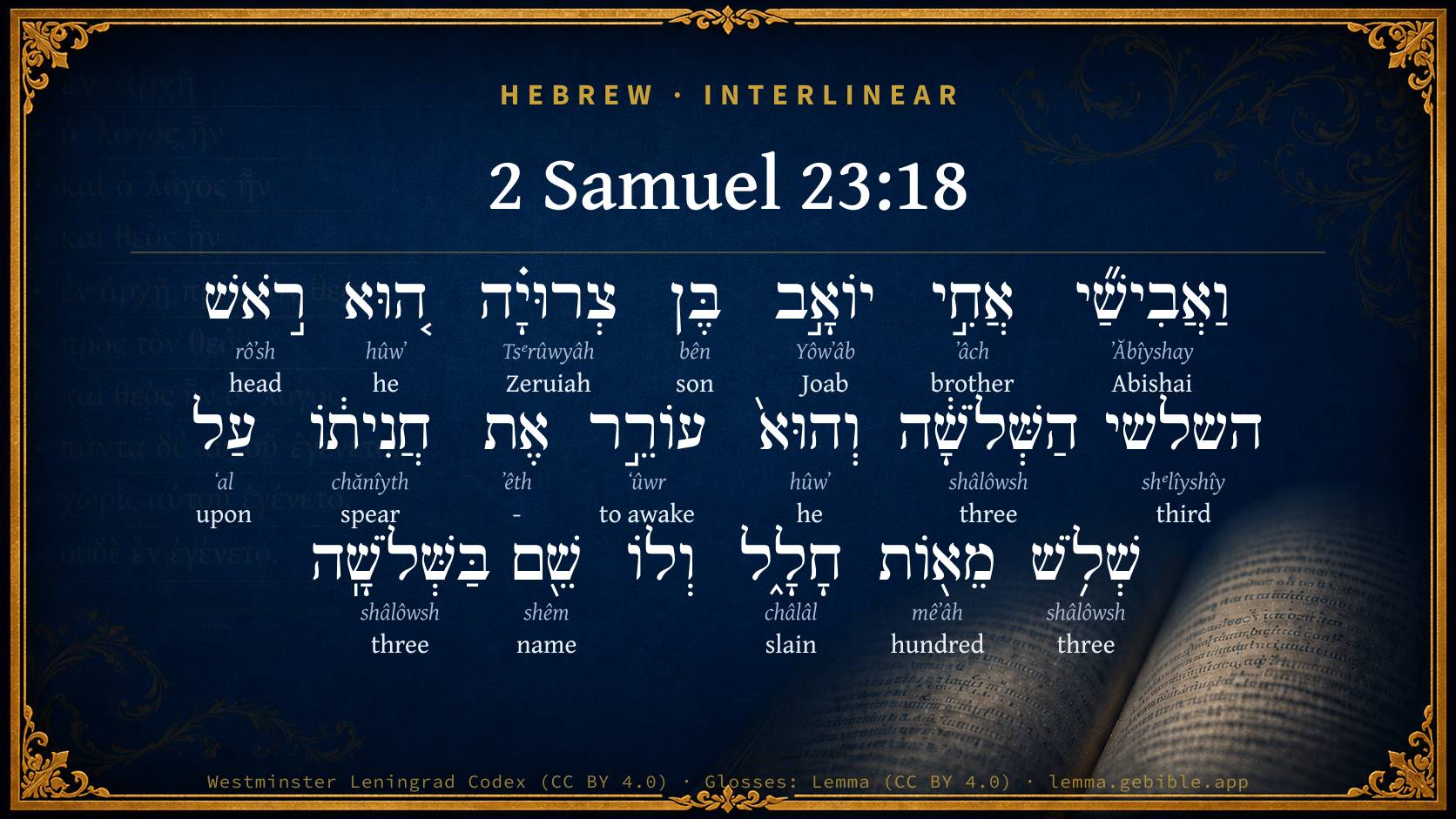
Hebrew (Westminster Leningrad Codex) 2 Samuel 23:18 appears in the Hebrew Old Testament. The text above is from the Westminster Leningrad Codex. Each word links to its Strong’s number, a concise gloss, and parsing drawn from the Open Scriptures Hebrew Bible morphology. Click any word for its full Brown-Driver-Briggs (BDB) entry.
Download image
Cite this verse

2 Samuel 23:18 (World English Bible). Public Domain. Lemma interlinear Bible study tool, https://lemma.gebible.app/v/2-samuel/23/18.

Show BibTeX & RIS
BibTeX
RIS
English Translation
Abishai, the brother of Joab, the son of Zeruiah, was chief of the three. He lifted up his spear against three hundred and killed them, and had a name among the three.
World English Bible · Public Domain
Download a study sheet

One document with this verse’s original text, its word-by-word gloss line, the meaning frame, cross-references with their text, attributed commentary, and full source and license credits — printable, and it pastes into notes with its structure intact.

This verse Autodidact and up

Study sheet (.html) Plain text (.txt)

A passage Seminary Student

Up to 50 verses in one chapter. A passage sheet keeps up to 6 commentary sources and 12 cross-references per verse, in the order this page ranks them, and says so on the sheet whenever that leaves anything out. Ask for a single verse and you get the Autodidact verse sheet above.

Everything on this page stays free to read, with no account — the sheet is a download of what is already on screen, not access to it.

Want to remove ads? Support Godless Engineer
Compare translations 3

The same verse in 3 English versions, stacked beneath the original-language interlinear above. Click any original word for its lexicon entry.

Each is an independent rendering of the whole verse — the interlinear is not word-aligned to these translations.

Highlighted words mark where these versions differ — a whole-verse word diff, not a word-by-word alignment.

  • World English Bible Public Domain
    Abishai, the brother of Joab, the son of Zeruiah, was chief of the three. He lifted up his spear against three hundred and killed them, and had a name among the three.
  • King James Version Public Domain
    And Abishai, the brother of Joab, the son of Zeruiah, was chief among three. And he lifted up his spear against three hundred, and slew them, and had the name among three.
  • unfoldingWord Literal Text CC BY-SA 4.0
    And Abishai, the brother of Joab, the son of Zeruiah, he the head of the three, and he was lifting his spear against 300, slain. And to him a name among the Three.

unfoldingWord Literal Text — © unfoldingWord, licensed CC BY-SA 4.0. Word-aligned USFM3 via Door43 (git.door43.org/unfoldingWord/en_ult).

Versions to compare (up to 4)

3 of 4 selected

Show all 18 translations

Every available English version of this verse, each an independent rendering of the whole verse.

  • World English Bible Public Domain
    Abishai, the brother of Joab, the son of Zeruiah, was chief of the three. He lifted up his spear against three hundred and killed them, and had a name among the three.
  • Berean Standard Bible Public Domain
    Now Abishai, the brother of Joab and son of Zeruiah, was chief of the Three, and he lifted his spear against three hundred men, killed them, and won a name along with the Three.
  • Majority Standard Bible Public Domain
    Now Abishai, the brother of Joab and son of Zeruiah, was chief of the Three, and he wielded his spear against three hundred men, killed them, and won a name along with the Three.
  • King James Version Public Domain
    And Abishai, the brother of Joab, the son of Zeruiah, was chief among three. And he lifted up his spear against three hundred, and slew them, and had the name among three.
  • American Standard Version (1901) Public Domain
    And Abishai, the brother of Joab, the son of Zeruiah, was chief of the three. And he lifted up his spear against three hundred and slew them, and had a name among the three.
  • Revised Version (1885) Public Domain
    And Abishai, the brother of Joab, the son of Zeruiah, was chief of the three. And he lifted up his spear against three hundred and slew them, and had a name among the three.
  • Geneva Bible (1599) Public Domain
    And Abishai the brother of Ioab, the sonne of Zeruiah, was chiefe among the three, and he lifted vp his speare against three hundreth, and slewe them, and he had the name among the three.
  • Douay-Rheims (1899) Public Domain
    Abisai also the brother of Joab, the son of Sarvia, was chief among three: and he lifted up his spear against three hundred whom he slew, and he was renowned among the three,
  • Young's Literal Translation Public Domain
    And Abishai brother of Joab, son of Zeruiah, he `is' head of three, and he is lifting up his spear against three hundred -- wounded, and he hath a name among three.
  • Literal Standard Version CC BY-SA 4.0
    And Abishai brother of Joab, son of Zeruiah, he [is] head of three, and he is lifting up his spear against three hundred—wounded, and he has a name among three.
  • Unlocked Literal Bible CC BY-SA 4.0
    Abishai, brother of Joab and son of Zeruiah, was captain over the three. He once fought with his spear against three hundred men and killed them. He was often mentioned along with the three soldiers.
  • unfoldingWord Literal Text CC BY-SA 4.0
    And Abishai, the brother of Joab, the son of Zeruiah, he the head of the three, and he was lifting his spear against 300, slain. And to him a name among the Three.
  • Darby Bible Public Domain
    And Abishai, the brother of Joab, the son of Zeruiah, was the chief of three; and he brandished his spear against three hundred and slew them; and he had a name among the three.
  • World Messianic Bible Public Domain
    Abishai, the brother of Joab, the son of Zeruiah, was chief of the three. He lifted up his spear against three hundred and killed them, and had a name among the three.
  • Webster's Bible Public Domain
    And Abishai, the brother of Joab, the son of Zeruiah, was chief among three. And he lifted up his spear against three hundred, and slew them, and had the name among three.
  • Free Bible Version CC BY-SA 4.0
    Abishai, Joab's brother, was leader of the second Three. Using his spear, he once killed 300 men, and became famous among the Three.
  • Bible in Basic English Public Domain
    And Abishai, the brother of Joab, the son of Zeruiah, was chief of the thirty. He put to death three hundred with his spear, and he got for himself a name among the thirty.
  • JPS Tanakh (1917) Public Domain
    And Abishai, the brother of Joab, the son of Zeruiah, was chief of the three. And he lifted up his spear against three hundred and slew them, and had a name among the three.

Literal Standard Version (2020), Covenant Press — licensed CC BY-SA 4.0. Text via the HelloAO Bible API (eBible.org). Unlocked Literal Bible (unfoldingWord) — licensed CC BY-SA 4.0. Text via the HelloAO Bible API (eBible.org). unfoldingWord Literal Text — © unfoldingWord, licensed CC BY-SA 4.0. Word-aligned USFM3 via Door43 (git.door43.org/unfoldingWord/en_ult). Free Bible Version, Dr. Jonathan Gallagher — licensed CC BY-SA 4.0. Text via the HelloAO Bible API (eBible.org).

Word by word

More ways to search: Search by grammar → Find every occurrence → Compare this word →

Practice this passage: Drill this verse → Learn its vocabulary →

וַאֲבִישַׁ֞י
ʼĂbîyshay
H52
“and · Abishai”
Conjunction + Noun, Proper
Part of Speech
Conjunction + Noun
Type
Proper
Full BDB Definition

Origin: from H1 and H7862

TWOT: None

Abishai = "my father is Jesse" or " my father is a gift" - grandson of Jesse, nephew of David via his sister Zeruiah, brother of Joab
  1. אֲחִ֣י ʼâch H251 “brother of” Noun, Common, Masculine, Singular, Construct
  2. יוֹאָ֣ב Yôwʼâb H3097 “Joab” Noun, Proper
  3. בֶּן bên H1121 “son of” Noun, Common, Masculine, Singular, Construct
  4. צְרוּיָ֗ה Tsᵉrûwyâh H6870 “Zeruiah” Noun, Proper
  5. ה֚וּא hûwʼ H1931 “he” Pronoun, Personal, 3rd Person, Masculine, Singular
  6. רֹ֣אשׁ rôʼsh H7218 “head of” Noun, Common, Masculine, Singular, Construct
  7. השלשי shᵉlîyshîy H7992 “the · third” Particle, Definite Article + Adjective, Ordinal number, Masculine, Singular, Absolute
  8. הַשְּׁלֹשָׁ֔ה shâlôwsh H7969 “the · three” Particle, Definite Article + Adjective, Cardinal number, Masculine, Singular, Absolute
  9. וְהוּא֙ hûwʼ H1931 “and · he” Conjunction + Pronoun, Personal, 3rd Person, Masculine, Singular
  10. עוֹרֵ֣ר ʻûwr H5782 “to awake” Verb, Polel, Perfect, 3rd Person, Masculine, Singular
  11. אֶת ʼêth H853 “-” Particle, Direct Object
  12. חֲנִית֔וֹ chănîyth H2595 “spear · his” Noun, Common, Feminine, Singular, Construct + Suffix, Personal, 3rd Person, Masculine, Singular
  13. עַל ʻal H5921 “upon” Preposition
  14. שְׁלֹ֥שׁ shâlôwsh H7969 “three” Adjective, Cardinal number, Feminine, Singular, Absolute
  15. מֵא֖וֹת mêʼâh H3967 “hundred” Adjective, Cardinal number, Both, Plural, Absolute
  16. חָלָ֑ל châlâl H2491 “slain” Adjective, Adjective, Masculine, Singular, Absolute
  17. שֵׁ֖ם shêm H8034 “name” Noun, Common, Masculine, Singular, Absolute
  18. בַּשְּׁלֹשָֽׁה shâlôwsh H7969 “in/at the · three” Preposition, Determined + Adjective, Cardinal number, Masculine, Singular, Absolute

About this verse

These counts appear in no published source. They are computed here, from the morphology-tagged text and Lemma’s own curated glosses. What Lemma adds →

20
words
16
distinct lemmas
Historical
section

Notable vocabulary

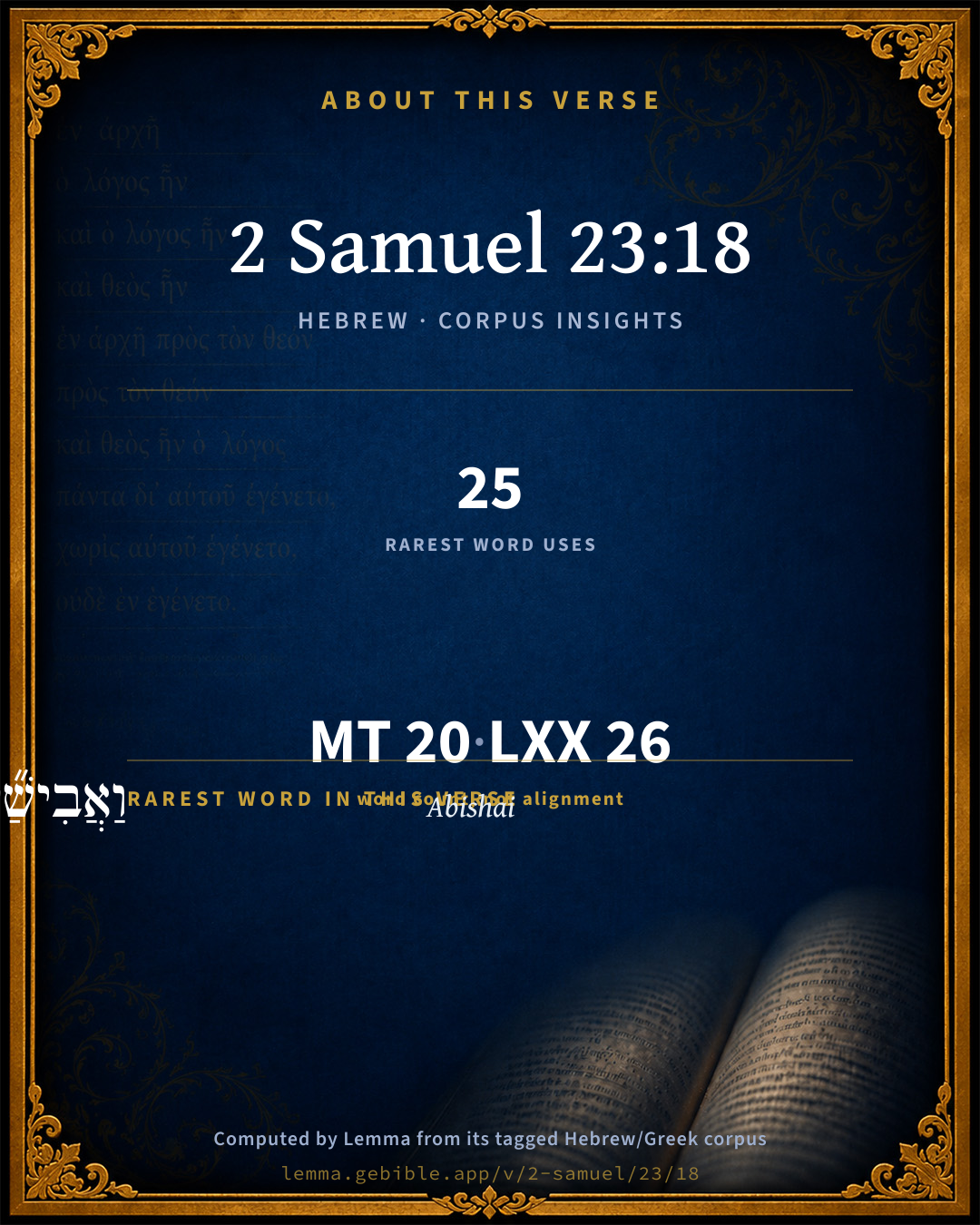
The rarest word here is וַאֲבִישַׁ֞י Abishai H52 — appearing just 25 times in the whole Hebrew Bible.

Shared distinctive vocabulary

וַאֲבִישַׁ֞י Abishai H52 occurs in 24 verses of the Hebrew Bible. Also found in:

Grammatical profile

  • 1 verb
  • 8 nouns
  • 6 adjectives
  • 2 pronouns
  • 2 prepositions
  • 1 particle

Verb forms

  • עוֹרֵ֣ר Polel · Perfect

Repetition

Words recur within this verse — often emphatic in Hebrew:

  • הַשְּׁלֹשָׁ֔ה three H7969 ×3
  • ה֚וּא he H1931 ×2

Hebrew & Septuagint length

In English translation the verse runs 32 words from the Hebrew and 35 from the Septuagint (LXX English) — closely comparable.

A rough comparison of the two English renderings, which tokenize alike — not a word-level alignment.

Word counts can differ between the Hebrew and the Greek without any difference in meaning — e.g. the Hebrew direct-object marker אֵת has no separate Greek word, and Greek often adds the article ὁ.

In the original languages it is 20 Hebrew tokens and 26 Greek tokens — but the two are counted differently (Hebrew bundles its prefixes and suffixes into one token; the Greek is in lemma form), so that isn’t a like-for-like length.

Cross-references

9

Topical passages linked to 2 Samuel 23:18 in the Treasury of Scripture Knowledge — connected by theme and wording, ordered by reader-vote popularity; previews shown in the World English Bible.

  • 2 Samuel 10:10 The rest of the people he committed into the hand of Abishai his brother; and he put them in array against the children of Ammon.
  • 2 Samuel 10:14 When the children of Ammon saw that the Syrians were fled, they likewise fled before Abishai, and entered into the city. Then Joab returned from the children of Ammon, and came to Jerusalem.
  • 2 Samuel 18:2 David sent forth the people, a third part under the hand of Joab, and a third part under the hand of Abishai the son of Zeruiah, Joab's brother, and a third part under the hand of Ittai the Gittite. The king said to the people, I will surely go forth with you myself also.
  • 1 Chronicles 11:20–21 Abishai, the brother of Joab, he was chief of the three; for he lifted up his spear against three hundred and killed them, and had a name among the three.
  • 1 Samuel 26:6–8 Then answered David and said to Ahimelech the Hittite, and to Abishai the son of Zeruiah, brother to Joab, saying, Who will go down with me to Saul to the camp? Abishai said, I will go down with you.
  • 2 Samuel 2:18 The three sons of Zeruiah were there, Joab, and Abishai, and Asahel: and Asahel was as light of foot as a wild gazelle.
  • 2 Samuel 3:30 So Joab and Abishai his brother killed Abner, because he had killed their brother Asahel at Gibeon in the battle.
  • 2 Samuel 20:10 But Amasa took no heed to the sword that was in Joab's hand: so he struck him therewith in the body, and shed out his bowels to the ground, and didn't strike him again; and he died. Joab and Abishai his brother pursued after Sheba the son of Bichri.
  • 1 Chronicles 2:16 and their sisters were Zeruiah and Abigail. The sons of Zeruiah: Abishai, and Joab, and Asahel, three.

Cross-references courtesy of OpenBible.info (CC BY 4.0).

Hebrew and Greek witnesses Masoretic Hebrew ↔ Greek Septuagint

The same verse in the two great witnesses to the Old Testament, shown verse-for-verse.

These are two independent witnesses, not word-aligned to each other, and the Septuagint is shown in lemma (dictionary) form.

Hebrew 2 Samuel 23:18 Masoretic · Westminster Leningrad Codex

וַאֲבִישַׁ֞י אֲחִ֣י יוֹאָ֣ב בֶּן צְרוּיָ֗ה ה֚וּא רֹ֣אשׁ השלשי הַשְּׁלֹשָׁ֔ה וְהוּא֙ עוֹרֵ֣ר אֶת חֲנִית֔וֹ עַל שְׁלֹ֥שׁ מֵא֖וֹת חָלָ֑ל וְלוֹ שֵׁ֖ם בַּשְּׁלֹשָֽׁה

Abishai, the brother of Joab, the son of Zeruiah, was chief of the three. He lifted up his spear against three hundred and killed them, and had a name among the three.

World English Bible · Public Domain

Greek LXX 2 Samuel 23:18 Septuagint · lemma form

καί αβεσσα ἀδελφός ιωαβ υἱός σαρουιας αὐτός ἄρχω ἐν ὁ τρεῖς καί αὐτός ἐκἀγείρω ὁ δόρυ αὐτός ἐπί τριακόσιοι τραυματίας καί αὐτός ὄνομα ἐν ὁ τρεῖς

And Abessa the brother of Joab the son of Saruia, he was chief among the three, and he lifted up his spear against three hundred whom he killed; and he had a name among three.

LXX2012 (modern English Septuagint) · Public Domain

On this verse, Haydock's Catholic Bible Commentary discusses the Septuagint’s reading. Read the note in Commentary ↓

Hebrew: Westminster Leningrad Codex (CC BY 4.0). Greek: Septuagint (public domain); English from LXX2012 (modern English Septuagint) (Public Domain). How the Septuagint differs from the Hebrew →

Targum (Aramaic paraphrase)

1

The Targum is the ancient Jewish Aramaic paraphrase of the Hebrew Scriptures — an interpretive translation, not the Hebrew text itself. Onkelos (literal) and Pseudo-Jonathan (expansive) render the Torah, and Jonathan the Prophets. Coverage is partial: where no permissively-licensed English translation exists for a verse, only the Aramaic is shown. This is verse-level text, not a word-by-word alignment to the Hebrew.

  1. Targum Jonathan Prophets (Joshua–Malachi)
    וַאֲבִישַׁי אֲחוּהִי דְיוֹאָב בַּר צְרוּיָה הוּא רֵישׁ גִבָּרַיָא וְהוּא תַבֵּיב יַת מוּרְנִיתֵיהּ עַל תְּלַת מְאָה קְטִילִין וְלֵיהּ שׁוּם בִּתְלָתָא גִבָּרַיָא:

    (no public-domain English translation for this verse)

    Targum Jonathan — Aramaic: “Mikraot Gedolot” (public domain). English: “Sefaria Community Translation” (CC0 1.0 (public-domain dedication)); “London "Chaldee Paraphrase," 1871” (public domain). Text via Sefaria.

Commentary

Notes on 2 Samuel 23:18 from classic Christian and Jewish commentators (each source and its license shown beneath its notes). The classic Christian expositions comment on the surrounding passage and are grouped to its opening verse, so a note may address several verses; the Jewish commentaries on the Tanakh (Rashi and others) are per-verse, so they appear only where the commentator wrote on this verse.

Lemma curates 59 commentaries, every one of them public domain or Creative Commons licensed, each selected and text-cleaned for this edition rather than reprinted as found. About our sources →

Trapp's Complete Commentary

John Trapp

2Sa 23:18 And Abishai, the brother of Joab, the son of Zeruiah, was chief among three. And he lifted up his spear against three hundred, [and] slew [them], and had the name among three.

Ver. 18. Against three hundred.] Josephus saith six hundred; but he is out in this count, as he is oft, seeking the honour of his nation.

John Trapp, A Commentary or Exposition upon All the Books of the Old and New Testament (1647–1656) — public domain. Text from a community e-Sword module.

Joseph Benson's Commentary

2Sa 23:18-19. Abishai was chief among three — The chief of those three mighty men before mentioned. See 1Ch 11:20. Had the name among the three — That is, was most eminent and famous. Was he not most honourable? — Worthy to be the leader of them, for his superior valour and virtue? He attained not unto the first three — He fell short of them in strength and valour.

Joseph Benson's Commentary on the Old and New Testaments (1811–1818) — public domain. Text from a community e-Sword module.

Tyndale Open Study Notes

Tyndale Open Resources

23:18-23 Here are examples of the prowess of Abishai and Benaiah. Elsewhere, Abishai was intensely combative toward David’s enemies, especially Saul (1 Sam 26:6-9) and Saul’s kinsman Shimei (2 Sam 16:9-11). Abishai had saved David’s life during one of the Philistine wars (21:16-17). • Benaiah appeared first as the commander of the mercenaries who served as David’s bodyguard, independent of the regular army (8:18; 20:23). He was also the leader of a 24,000-man division of the regular army that served the king in the third month of every year (1 Chr 27:5-6). He played a major role in Solomon’s ascension to the throne (1 Kgs 1:32-49) and became the commander of Solomon’s army, as Joab was for David.

Tyndale Open Study Notes — © Tyndale Open Resources, licensed CC BY-SA 4.0. Text via the HelloAO Bible API.

Geneva Bible (1599)

Geneva Bible translators

Hebrew, slain.

Geneva Bible (1599) marginal notes — public domain. Text via Bolls.life.

Ellicott's Commentary for English Readers

(18) Among three.—The Hebrew margin has “the three,” and so also the text in the following clause. “The three” are the triad of heroes just mentioned, of whom Abishai was first, Benaiah second, with an unnamed third. A somewhat similar feat of daring is told of Abishai in 1Sa_26:6-12.

A Bible Commentary for English Readers, edited by Charles John Ellicott (1878–1897) — public domain. Text from a community e-Sword module.

The Cambridge Bible for Schools and Colleges

gen. ed. J. J. S. Perowne

18–23. Exploits of Abishai and Benaiah

18. Abishai] David’s valiant but hard-hearted nephew, who shared the command of the army with his brother Joab in the Ammonite war and in Absalom’s rebellion (ch. 2Sa_10:10; 2Sa_10:14, 2Sa_18:2). The characteristic trait of his nature was a blunt impetuous ferocity. See 1Sa_26:8; 2Sa_16:9; 2Sa_19:21.

chief among three] The Qrî reads chief of the three; those namely who were mentioned in 2Sa_23:17. But the Kthîbh has chief of the aides-de-camp, as in 2Sa_23:8.

among three] As before, among the three.

The Cambridge Bible for Schools and Colleges (gen. ed. J. J. S. Perowne; Cambridge University Press, 1878–1918) — public domain. Text from a community e-Sword module.

John Gill's Exposition

And Abishai, the brother of Joab, the son of Zeruiah, was chief among the three,.... Another triumvirate, of which he was the head:

and he lifted up his spear against three hundred, and slew them; Josephus (e) says six hundred; this seems to confirm the reading of Sa2 23:8, that the number eight hundred is right, for if it was only three hundred, Abishai would have been equal to one, even the first, of the former three; which yet is denied him in Sa2 23:19,

and had the name among three; of which he was one; and he had the chief name among them, or was the most famous of them.

(e) Antiqu. l. 7. c. 12. sect. 4.

John Gill's Exposition of the Whole Bible (1746–1763) — public domain (CC PDM 1.0). Text via the HelloAO Bible API.

Albert Barnes' Notes on the Bible

Three - “The three” 2Sa 23:22. It was Abishai’s prowess on this occasion that raised him to be chief of this triad.

Albert Barnes' Notes on the Bible (1834–1885) — public domain. Text from a community e-Sword/MySword module.

Haydock's Catholic Bible Commentary

Three. Septuagint (Alexandrian) and Josephus read "six hundred," (Haydock) against all the rest.

George Leo Haydock (1774–1849), Haydock's Catholic Family Bible and Commentary, 1859 edition — public domain. Excludes Psalms (Douay-Rheims chapter numbering differs from Protestant) and Deuterocanonical books (Catholic canon only).

Matthew Poole's English Annotations

He fought with and killed three hundred men in one battle.

Had the name among the three, i.e. was the most famous and eminent among them.

Matthew Poole's English Annotations on the Holy Bible (1683–1685) — public domain. Text from a community e-Sword/MySword module.

Whedon's Commentary on the Bible

Daniel D. Whedon

18. Chief among three — Rather, a chief among the captains, as the same words are rendered in 2Sa_23:8. All the thirty-seven mentioned in this chapter were chiefs of distinguished rank.

Lifted up his spear against three hundred — His great feat resembled that of Jashobeam, though it was not so celebrated.

Daniel D. Whedon (gen. ed.), Commentary on the Old and New Testaments (1874–1909) — public domain. Text from a community e-Sword module.

The Pulpit Commentary

Abishai was chief among three. The sense is obscured in the Authorized Version by the translators having failed to notice the presence of the definite article. Abishai, by reason of this exploit, became "chief of the three;" that is, of the second order of three established in the fraternity of the mighties. At the end of the verse, and in ver. 19, the Authorized Version strangely puts the article where it is absent in the Hebrew, and omits it where it is present. The right rendering and meaning is, "He had a name, that is, rank, reputation, among the three. Was he not the most honourable of the three? For this he was made their captain: yet he attained not to equal dignity with the first three.

Vers. 18-23. (1Ch_11:22-25)

The heroism of Benaiah.

He was son of Jehoiada, chief priest and leader of the Aaronites who came to David at Hebron; (1Ch_12:27) one of (a second) three "mighties" (with Abishai and, perhaps, Asahel), and above the thirty; (1Ch_27:5, 1Ch_27:6) captain of the host for the third month; and commander of the body guard. (2Sa_8:18 2Sa_20:23) He remained faithful to Solomon in the conspiracy of Adonijah, was commissioned to execute Joab, and appointed commander-in-chief in his stead. (1Ki_1:26, 36 2:29, 35) He was "a valiant man, of many illustrious deeds." His name (equivalent to "built by Jah") is suggestive of the Divine source of his strength, valour, and successful conflicts with the enemies of the people of God. He slew

(1) two Moabitish champions, or princes, "lions of God"; (2Sa_8:2)

(2) a ferocious lion, which had been driven by a heavy fall of snow into the neighbourhood of human habitations, to the terror of the inhabitants, and had taken refuge in a pit or (empty) cistern; and

(3) an Egyptian giant (fighting on the side of the Philistines). "His valour and virtues are recorded, not only for commemoration and remembrance, but likewise for example and imitation of his virtues, and to show how great works the Lord wrought by weak means" (Guild).

1. We ought never to contend, except in a good cause; for truth, justice, and liberty, the honour of God, the kingdom of Christ, and the welfare of men. "If it be possible," etc.. (Rom_12:18)

2. We cannot avoid conflict altogether without sin, captivity, dishonour, and destruction. In a world like this there is often no choice but to fight or be slain. "Curse ye Meroz," etc.. (Jud_1:5:23) "Contend earnestly for the faith," etc. (Jud_1:3). "Now we must fight if we would reign.

3. We must not be dismayed by the power of the enemy; "in nothing affrighted by the adversaries"; (Php_1:28) their strength, their number (two to one, ver. 20), their formidable appearance, their varied character, natural or spiritual; lionlike men, real lions, or "your adversary the devil," who, "as a roaring lion, walketh about," etc.. (1Pe_5:8) Be strong and fear not.

4. We should not be unduly concerned about our own safety; but seek, above all things, to do our duty faithfully, and use our best endeavours to secure the ends for which we strive. Having traced the footprints of the lion in the snow, "he went down" (voluntarily placing his own life in imminent peril to secure the safety of others.) "and slew the lion in the pit" (knowing that he must succeed or perish) "in a time of snow" (which is apt to benumb man"s strength and to cool their courage, and when beasts of prey are most fierce and ravenous from hunger). "None of these things move me," etc. (Act_20:24 Act_21:13; 2Ti_4:16, 2Ti_4:17)

1. We must make the best of our resources, however inadequate they may appear; and not shrink from the conflict until we are as fully armed as our opponents. "He went down to him with only a staff" (ver. 22); skilfully

2. and adroitly deprived him of his spear ("like a weaver"s beam"), rendered him defenceless, and turned his weapon against himself. We must fight with such means as we have.

3. We should never forget the example of our great Leader; (1Sa_17:50) that he sees us, is ready to help us, and will greatly honour "him that overcometh". (vers. 22, 23; Rev_2:26)

Though the sons of night blaspheme, More there are with us than them; Hell is nigh, but Christ is nigher, Circling us with hosts of fire.

4. we should be encouraged by the remembrance of past successes, achieved by ourselves and others. These are a sure earnest of the final victory of the kingdom of light over the kingdom of darkness. "Greater is he that is in you," etc.. D. (1Jn_4:4)

The Pulpit Commentary (1880–1919), ed. H.D.M. Spence-Jones & Joseph S. Exell — public domain. Text from a community e-Sword module.

unfoldingWord translationNotes

Door43 World Missions Community

Abishai ... Zeruiah

These are the names of men. Translate them as in 2 Samuel 2:18.

captain over the three

This means Abishai was the leader of the three who went and got water for David.

three hundred men

"300 men" (See: Numbers)

He was often mentioned along with the three soldiers

This can be stated in active form. AT: "People often mentioned him when they spoke about the three bravest men" (See: Active or Passive)

Was he not even more famous than the three?

This question is used to emphasize how famous he was. This rhetorical question can be translated as a statement. AT: "He was even more famous than the three." (See: Rhetorical Question)

three most famous soldiers

This refers to Josheb Basshebeth, Eleazar, and Shimeah. Abishai was not as famous as these soldiers.

translationWords

brother

Joab

son

unfoldingWord translationNotes — © Distant Shores Media and the Door43 World Missions Community, licensed CC BY-SA 4.0. Source: git.door43.org/Door43/en_tn.

Lesson kit

Teaching starters — assembled from the data on this page, not authored interpretation. Every prompt links to the verse data it draws on. Edit before teaching.

2 Samuel, in the Historical, opens this verse with 20 words (16 distinct Hebrew lemmas). Its most distinctive word is ʼĂbîyshay (“Abishai”). A historical commentator’s framing appears above. Read the whole chapter for the surrounding context.

Discussion questions

  1. What does “Abishai” (ʼĂbîyshay) contribute to the verse as a whole?
  2. How does 1 Samuel 26:6, which shares the word «Abishai», read alongside this verse?
  3. What does the repetition of “three” (3× in this one verse) do in this verse?
  4. These translations render this verse differently. What is at stake in choosing one wording over another?
  5. «עוֹרֵ֣ר» is a Polel Perfect verb. How does that grammatical form shape the action described?
  6. Compare how Trapp's Complete Commentary and Joseph Benson's Commentary read this verse. Where do they agree or differ?

Things to notice

Reading settings

Reading text

Shown beneath each verse's original-language words.

Old Testament
Old Testament edition

Read the OT as the Masoretic Hebrew (MT) or the Greek Septuagint (LXX).

English shown for the Greek Septuagint (in the Hebrew ↔ Greek comparison).

Comparing translations? Open the Compare panel on any verse page to stack up to four side by side.