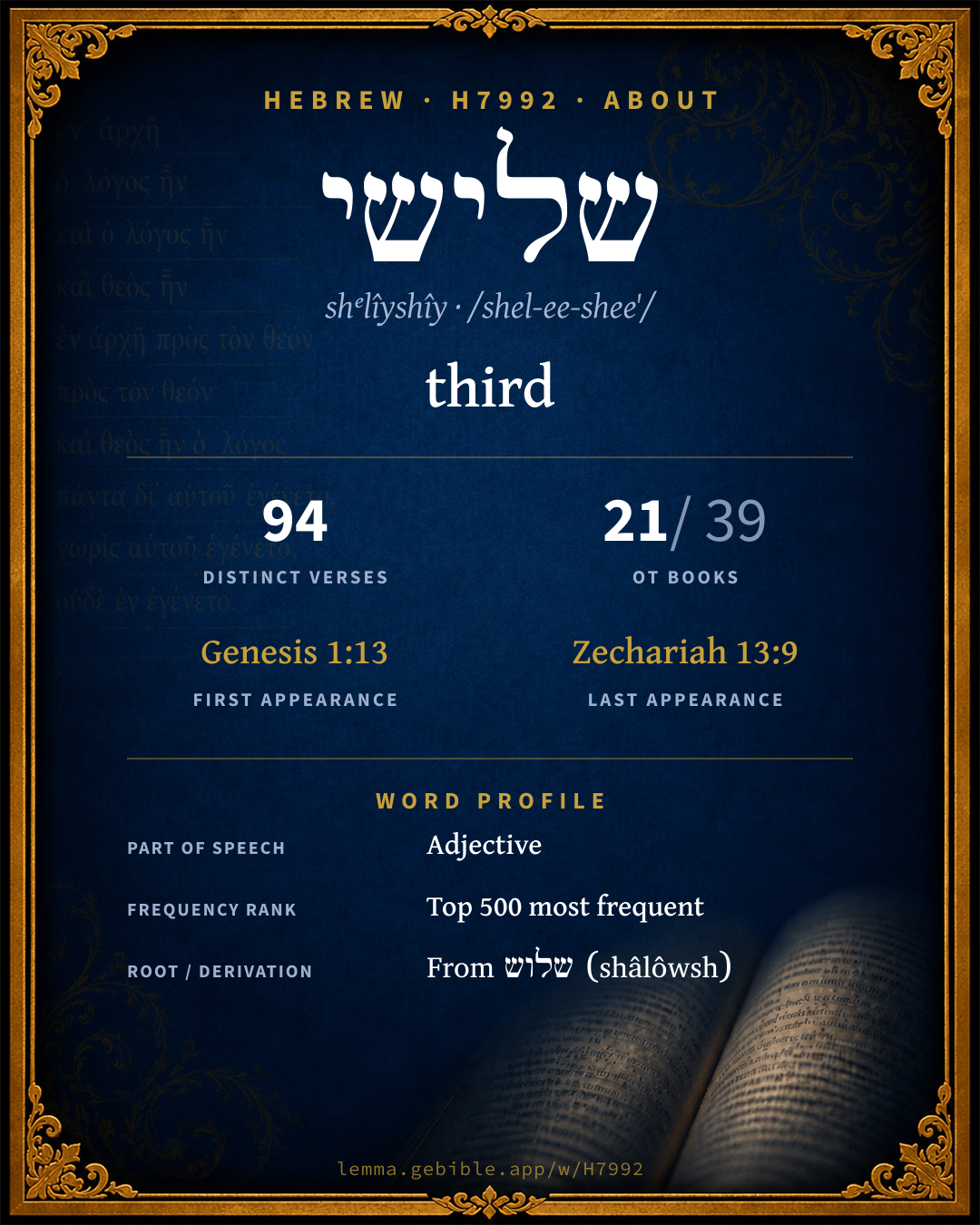
שְׁלִישִׁי
third
also: one third, third part, third time fuller range ↓
Full lexicon entry — Brown-Driver-Briggs (BDB)
From Brown-Driver-Briggs (BDB)
Where this word appears
See every Absolute-state word in the Hebrew Bible →
Grammar key — what these labels mean
Part of speech
- Adjective
- A word that describes or qualifies a noun.
- Noun
- A naming word — a person, place, thing, or idea.
Noun type
- Common
- A common noun — a general class of person, place, or thing (“king,” “city,” “water”), not a specific name.
- Proper
- A name of a specific person, place, or people (e.g. Abraham, Zion, Israel).
State
- Absolute
- The independent form of a noun, not bound to a following word.
- Construct
- A noun bound to a following noun in a possessive / “of” relationship (the construct chain).
Gender
- Masculine
- Grammatically masculine.
- Feminine
- Grammatically feminine.
Number
- Singular
- One.
- Plural
- More than one (in Hebrew, generally three or more).
Grammatical forms
- Adjective, Ordinal number, Masculine, Singular, Absolute 64 times (59%)
- Adjective, Ordinal number, Feminine, Singular, Absolute 19 times (18%)
- Noun, Common, Feminine, Singular, Absolute 13 times (12%)
- Adjective, Ordinal number, Masculine, Plural, Absolute 6 times (6%)
- Adjective, Ordinal number, Feminine, Singular, Construct 3 times (3%)
- Noun, Proper 2 times (2%)
- Noun, Common, Feminine, Singular, Construct 1 time (1%)
Parsed forms decoded from the imported morphology (morphhb / Westminster Leningrad Codex — WLC text public domain, morphhb tagging CC BY 4.0), counted across 108 parsed occurrences — not distinct verses.
Every verse where H7992 appears — 94 distinct verses across 21 books. Click any verse to open its interlinear word-by-word view. Verse text shown in the World English Bible for context — . Each verse’s Hebrew form is shown with its reference; the English is not keyword-highlighted, since the data carries no word-level English alignment. Use “Compare translations” on any verse to read it across multiple English versions. This concordance covers the Hebrew Bible; Septuagint (Greek Old Testament) occurrences are not indexed here.
Genesis 9 verses
- Genesis 1:13 שְׁלִישִֽׁי adj Ordinal number ms There was evening and there was morning, a third day.
- Genesis 2:14 הַ/שְּׁלִישִׁי֙ ptcl def.art + Adjective Ordinal number ms The name of the third river is Hiddekel: this is the one which flows in front of Assyria. The fourth river is the Euphrates.
- Genesis 6:16 וּ/שְׁלִשִׁ֖ים conj + Adjective Ordinal number mp You shall make a roof in the ark, and to a cubit shall you finish it upward. You shall set the door of the ark in the side of it. You shall make it with lower, second, and third levels.
- Genesis 22:4 הַ/שְּׁלִישִׁ֗י ptcl def.art + Adjective Ordinal number ms On the third day Abraham lifted up his eyes, and saw the place far off.
- Genesis 31:22 הַ/שְּׁלִישִׁ֑י ptcl def.art + Adjective Ordinal number ms Laban was told on the third day that Jacob had fled.
- Genesis 32:19 הַ/שְּׁלִישִׁ֔י ptcl def.art + Adjective Ordinal number ms He commanded also the second, and the third, and all that followed the herds, saying, "This is how you shall speak to Esau, when you find him.
- Genesis 34:25 הַ/שְּׁלִישִׁ֜י ptcl def.art + Adjective Ordinal number ms It happened on the third day, when they were sore, that two of Jacob's sons, Simeon and Levi, Dinah's brothers, each took his sword, came upon the unsuspecting city, and killed all the males.
- Genesis 40:20 הַ/שְּׁלִישִׁ֗י ptcl def.art + Adjective Ordinal number ms It happened the third day, which was Pharaoh's birthday, that he made a feast for all his servants, and he lifted up the head of the chief cupbearer and the head of the chief baker among his servants.
- Genesis 42:18 הַ/שְּׁלִישִׁ֔י ptcl def.art + Adjective Ordinal number ms Joseph said to them the third day, "Do this, and live, for I fear God.
Exodus 5 verses
- Exodus 19:1 הַ/שְּׁלִישִׁ֔י ptcl def.art + Adjective Ordinal number ms In the third month after the children of Israel had gone forth out of the land of Egypt, on that same day they came into the wilderness of Sinai.
- Exodus 19:11 הַ/שְּׁלִישִׁ֑י הַ/שְּׁלִישִׁ֗י ptcl def.art + Adjective Ordinal number ms ptcl def.art + Adjective Ordinal number ms and be ready against the third day; for on the third day Yahweh will come down in the sight of all the people on Mount Sinai.
- Exodus 19:16 הַ/שְּׁלִישִׁ֜י ptcl def.art + Adjective Ordinal number ms It happened on the third day, when it was morning, that there were thunders and lightnings, and a thick cloud on the mountain, and the sound of an exceedingly loud trumpet; and all the people who were in the camp trembled.
- Exodus 28:19 הַ/שְּׁלִישִׁ֑י ptcl def.art + Adjective Ordinal number ms and the third row a jacinth, an agate, and an amethyst;
- Exodus 39:12 הַ/שְּׁלִישִׁ֑י ptcl def.art + Adjective Ordinal number ms and the third row, a jacinth, an agate, and an amethyst;
Leviticus 4 verses
- Leviticus 7:17 הַ/שְּׁלִישִׁ֔י ptcl def.art + Adjective Ordinal number ms but what remains of the flesh of the sacrifice on the third day shall be burned with fire.
- Leviticus 7:18 הַ/שְּׁלִישִׁי֮ ptcl def.art + Adjective Ordinal number ms If any of the flesh of the sacrifice of his peace offerings is eaten on the third day, it will not be accepted, neither shall it be imputed to him who offers it. It will be an abomination, and the soul who eats any of it will bear his iniquity.
- Leviticus 19:6 הַ/שְּׁלִישִׁ֔י ptcl def.art + Adjective Ordinal number ms It shall be eaten the same day you offer it, and on the next day: and if anything remains until the third day, it shall be burned with fire.
- Leviticus 19:7 הַ/שְּׁלִישִׁ֑י ptcl def.art + Adjective Ordinal number ms If it is eaten at all on the third day, it is an abomination. It will not be accepted;
Numbers 9 verses
- Numbers 2:24 וּ/שְׁלִשִׁ֖ים conj + Adjective Ordinal number mp "All who were numbered of the camp of Ephraim were one hundred eight thousand one hundred, according to their divisions. They shall set out third.
- Numbers 7:24 הַ/שְּׁלִישִׁ֔י ptcl def.art + Adjective Ordinal number ms On the third day Eliab the son of Helon, prince of the children of Zebulun
- Numbers 15:6 שְׁלִשִׁ֥ית adj Ordinal number fs Or for a ram, you shall prepare for a meal-offering two tenth parts [of an ephah] of fine flour mixed with the third part of a hin of oil:
- Numbers 15:7 שְׁלִשִׁ֣ית adj Ordinal number fs and for the drink-offering you shall offer the third part of a hin of wine, of a sweet savor to Yahweh.
- Numbers 19:12 הַ/שְּׁלִישִׁ֛י הַ/שְּׁלִישִׁ֛י ptcl def.art + Adjective Ordinal number ms ptcl def.art + Adjective Ordinal number ms the same shall purify himself therewith on the third day, and on the seventh day he shall be clean: but if he doesn't purify himself the third day, then the seventh day he shall not be clean.
- Numbers 19:19 הַ/שְּׁלִישִׁ֖י ptcl def.art + Adjective Ordinal number ms and the clean person shall sprinkle on the unclean on the third day, and on the seventh day: and on the seventh day he shall purify him; and he shall wash his clothes, and bathe himself in water, and shall be clean at even.
- Numbers 28:14 וּ/שְׁלִישִׁ֧ת conj + Adjective Ordinal number fs cs Their drink-offerings shall be half a hin of wine for a bull, and the third part of a hin for the ram, and the fourth part of a hin for a lamb: this is the burnt offering of every month throughout the months of the year.
- Numbers 29:20 הַ/שְּׁלִישִׁ֛י ptcl def.art + Adjective Ordinal number ms On the third day eleven bulls, two rams, fourteen he-lambs a year old without blemish;
- Numbers 31:19 הַ/שְּׁלִישִׁי֙ ptcl def.art + Adjective Ordinal number ms Encamp you outside of the camp seven days: whoever has killed any person, and whoever has touched any slain, purify yourselves on the third day and on the seventh day, you and your captives.
Deuteronomy 2 verses
- Deuteronomy 23:8 שְׁלִישִׁ֑י adj Ordinal number ms The children of the third generation who are born to them shall enter into the assembly of Yahweh.
- Deuteronomy 26:12 הַ/שְּׁלִישִׁ֖ת ptcl def.art + Adjective Ordinal number fs When you have made an end of tithing all the tithe of your increase in the third year, which is the year of tithing, then you shall give it to the Levite, to the foreigner, to the fatherless, and to the widow, that they may eat within your gates, and be filled.
Joshua 2 verses
- Joshua 9:17 הַ/שְּׁלִישִׁ֑י ptcl def.art + Adjective Ordinal number ms The children of Israel traveled, and came to their cities on the third day. Now their cities were Gibeon, and Chephirah, and Beeroth, and Kiriath Jearim.
- Joshua 19:10 הַ/שְּׁלִישִׁ֔י ptcl def.art + Adjective Ordinal number ms The third lot came up for the children of Zebulun according to their families; and the border of their inheritance was to Sarid;
Judges 1 verse
1 Samuel 6 verses
- 1 Samuel 3:8 בַּ/שְּׁלִשִׁית֒ prep det + Adjective Ordinal number fs Yahweh called Samuel again the third time. He arose and went to Eli, and said, Here am I; for you called me. Eli perceived that Yahweh had called the child.
- 1 Samuel 17:13 וְ/הַ/שְּׁלִשִׁ֖י conj + ptcl def.art + Adjective Ordinal number ms The three eldest sons of Jesse had gone after Saul to the battle: and the names of his three sons who went to the battle were Eliab the firstborn, and next to him Abinadab, and the third Shammah.
- 1 Samuel 19:21 שְׁלִשִׁ֔ים adj Ordinal number mp When it was told Saul, he sent other messengers, and they also prophesied. Saul sent messengers again the third time, and they also prophesied.
- 1 Samuel 20:5 הַ/שְּׁלִשִֽׁית ptcl def.art + Adjective Ordinal number fs David said to Jonathan, Behold, tomorrow is the new moon, and I should not fail to sit with the king at meat: but let me go, that I may hide myself in the field to the third day at evening.
- 1 Samuel 20:12 הַ/שְּׁלִשִׁ֔ית ptcl def.art + Adjective Ordinal number fs Jonathan said to David, Yahweh, the God of Israel, [be witness]: when I have sounded my father about this time tomorrow, [or] the third day, behold, if there be good toward David, shall I not then send to you, and disclose it to you?
- 1 Samuel 30:1 הַ/שְּׁלִישִׁ֑י ptcl def.art + Adjective Ordinal number ms It happened, when David and his men were come to Ziklag on the third day, that the Amalekites had made a raid on the South, and on Ziklag, and had struck Ziklag, and burned it with fire,
2 Samuel 4 verses
- 2 Samuel 1:2 הַ/שְּׁלִישִׁ֗י ptcl def.art + Adjective Ordinal number ms it happened on the third day, that behold, a man came out of the camp from Saul, with his clothes torn, and earth on his head: and so it was, when he came to David, that he fell to the earth, and did obeisance.
- 2 Samuel 3:3 וְ/הַ/שְּׁלִשִׁי֙ conj + ptcl def.art + Adjective Ordinal number ms and his second, Chileab, of Abigail the wife of Nabal the Carmelite; and the third, Absalom the son of Maacah the daughter of Talmai king of Geshur;
- 2 Samuel 18:2 הַ/שְּׁלִשִׁ֤ית וְ֠/הַ/שְּׁלִשִׁית וְ/הַ֨/שְּׁלִשִׁ֔ת ptcl def.art + n c fs conj + ptcl def.art + n c fs conj + ptcl def.art + Adjective Ordinal number fs David sent forth the people, a third part under the hand of Joab, and a third part under the hand of Abishai the son of Zeruiah, Joab's brother, and a third part under the hand of Ittai the Gittite. The king said to the people, I will surely go forth with you myself also.
- 2 Samuel 23:18 ה/שלשי ptcl def.art + Adjective Ordinal number ms Abishai, the brother of Joab, the son of Zeruiah, was chief of the three. He lifted up his spear against three hundred and killed them, and had a name among the three.
1 Kings 6 verses
- 1 Kings 3:18 הַ/שְּׁלִישִׁי֙ ptcl def.art + Adjective Ordinal number ms It happened the third day after I was delivered, that this woman was delivered also; and we were together; there was no stranger with us in the house, save we two in the house.
- 1 Kings 6:6 וְ/הַ֨/שְּׁלִישִׁ֔ית conj + ptcl def.art + Adjective Ordinal number fs The nethermost story was five cubits broad, and the middle was six cubits broad, and the third was seven cubits broad; for on the outside he made offsets [in the wall] of the house round about, that [the beams] should not have hold in the walls of the house.
- 1 Kings 6:8 הַ/שְּׁלִשִֽׁים ptcl def.art + Adjective Ordinal number mp The door for the middle side-chambers was in the right side of the house: and they went up by winding stairs into the middle [story], and out of the middle into the third.
- 1 Kings 12:12 הַ/שְּׁלִישִׁ֑י הַ/שְּׁלִישִֽׁי ptcl def.art + Adjective Ordinal number ms ptcl def.art + Adjective Ordinal number ms So Jeroboam and all the people came to Rehoboam the third day, as the king bade, saying, Come to me again the third day.
- 1 Kings 18:1 הַ/שְּׁלִישִׁ֖ית ptcl def.art + Adjective Ordinal number fs It happened after many days, that the word of Yahweh came to Elijah, in the third year, saying, Go, show yourself to Ahab; and I will send rain on the earth.
- 1 Kings 22:2 הַ/שְּׁלִישִׁ֑ית ptcl def.art + Adjective Ordinal number fs It happened in the third year, that Jehoshaphat the king of Judah came down to the king of Israel.
2 Kings 6 verses
- 2 Kings 1:13 שְׁלִשִׁ֖ים הַ/שְּׁלִישִׁ֜י adj Ordinal number mp ptcl def.art + Adjective Ordinal number ms Again he sent the captain of a third fifty with his fifty. The third captain of fifty went up, and came and fell on his knees before Elijah, and begged him, and said to him, man of God, please let my life, and the life of these fifty your servants, be precious in your sight.
- 2 Kings 11:5 הַ/שְּׁלִשִׁ֤ית ptcl def.art + n c fs He commanded them, saying, This is the thing that you shall do: a third part of you, who come in on the Sabbath, shall be keepers of the watch of the king's house;
- 2 Kings 11:6 וְ/הַ/שְּׁלִשִׁית֙ וְ/הַ/שְּׁלִשִׁ֥ית conj + ptcl def.art + n c fs conj + ptcl def.art + n c fs A third part shall be at the gate Sur; and a third part at the gate behind the guard: so shall you keep the watch of the house, and be a barrier.
- 2 Kings 19:29 הַ/שְּׁלִישִׁ֗ית ptcl def.art + Adjective Ordinal number fs This shall be the sign to you: You shall eat this year that which grows of itself, and in the second year that which springs of the same; and in the third year sow you, and reap, and plant vineyards, and eat the fruit of it.
- 2 Kings 20:5 הַ/שְּׁלִישִׁ֔י ptcl def.art + Adjective Ordinal number ms Turn back, and tell Hezekiah the prince of my people, Thus says Yahweh, the God of David your father, I have heard your prayer, I have seen your tears: behold, I will heal you; on the third day you shall go up to the house of Yahweh.
- 2 Kings 20:8 הַ/שְּׁלִישִׁ֖י ptcl def.art + Adjective Ordinal number ms Hezekiah said to Isaiah, What shall be the sign that Yahweh will heal me, and that I shall go up to the house of Yahweh the third day?
1 Chronicles 14 verses
- 1 Chronicles 2:13 הַ/שְּׁלִישִֽׁי ptcl def.art + Adjective Ordinal number ms and Jesse became the father of his firstborn Eliab, and Abinadab the second, and Shimea the third,
- 1 Chronicles 3:2 הַ/שְּׁלִשִׁי֙ ptcl def.art + Adjective Ordinal number ms the third, Absalom the son of Maacah the daughter of Talmai king of Geshur; the fourth, Adonijah the son of Haggith;
- 1 Chronicles 3:15 הַ/שְּׁלִשִׁי֙ ptcl def.art + Adjective Ordinal number ms The sons of Josiah: the firstborn Johanan, the second Jehoiakim, the third Zedekiah, the fourth Shallum.
- 1 Chronicles 8:1 הַ/שְּׁלִישִֽׁי ptcl def.art + Adjective Ordinal number ms Benjamin became the father of Bela his firstborn, Ashbel the second, and Aharah the third,
- 1 Chronicles 8:39 הַ/שְּׁלִשִֽׁי ptcl def.art + Adjective Ordinal number ms The sons of Eshek his brother: Ulam his firstborn, Jeush the second, and Eliphelet the third.
- 1 Chronicles 12:9 הַ/שְּׁלִשִֽׁי ptcl def.art + Adjective Ordinal number ms Ezer the chief, Obadiah the second, Eliab the third,
- 1 Chronicles 23:19 הַ/שְּׁלִישִׁ֔י ptcl def.art + Adjective Ordinal number ms The sons of Hebron: Jeriah the chief, Amariah the second, Jahaziel the third, and Jekameam the fourth.
- 1 Chronicles 24:8 הַ/שְּׁלִישִׁ֔י ptcl def.art + Adjective Ordinal number ms the third to Harim, the fourth to Seorim,
- 1 Chronicles 24:23 הַ/שְּׁלִישִׁ֔י ptcl def.art + Adjective Ordinal number ms The sons [of Hebron]: Jeriah [the chief], Amariah the second, Jahaziel the third, Jekameam the fourth.
- 1 Chronicles 25:10 הַ/שְּׁלִשִׁ֣י ptcl def.art + Adjective Ordinal number ms the third to Zaccur, his sons and his brothers, twelve:
- 1 Chronicles 26:2 הַ/שְּׁלִישִׁ֔י ptcl def.art + Adjective Ordinal number ms Meshelemiah had sons: Zechariah the firstborn, Jediael the second, Zebadiah the third, Jathniel the fourth,
- 1 Chronicles 26:4 הַ/שְּׁלִשִׁי֙ ptcl def.art + Adjective Ordinal number ms Obed-edom had sons: Shemaiah the firstborn, Jehozabad the second, Joah the third, and Sacar the fourth, and Nethanel the fifth,
- 1 Chronicles 26:11 הַ/שְּׁלִשִׁ֔י ptcl def.art + Adjective Ordinal number ms Hilkiah the second, Tebaliah the third, Zechariah the fourth: all the sons and brothers of Hosah were thirteen.
- 1 Chronicles 27:5 הַ/שְּׁלִישִׁי֙ הַ/שְּׁלִישִׁ֔י ptcl def.art + Adjective Ordinal number ms ptcl def.art + Adjective Ordinal number ms The third captain of the host for the third month was Benaiah, the son of Jehoiada the priest, chief: and in his division were twenty-four thousand.
2 Chronicles 6 verses
- 2 Chronicles 10:12 הַ/שְּׁלִשִׁ֑י הַ/שְּׁלִשִֽׁי ptcl def.art + Adjective Ordinal number ms ptcl def.art + Adjective Ordinal number ms So Jeroboam and all the people came to Rehoboam the third day, as the king bade, saying, Come to me again the third day.
- 2 Chronicles 15:10 הַ/שְּׁלִישִׁ֑י ptcl def.art + Adjective Ordinal number ms So they gathered themselves together at Jerusalem in the third month, in the fifteenth year of the reign of Asa.
- 2 Chronicles 23:4 הַ/שְּׁלִשִׁ֨ית ptcl def.art + n c fs This is the thing that you shall do: a third part of you, who come in on the Sabbath, of the priests and of the Levites, shall be porters of the thresholds;
- 2 Chronicles 23:5 וְ/הַ/שְּׁלִשִׁית֙ וְ/הַ/שְּׁלִשִׁ֖ית conj + ptcl def.art + n c fs conj + ptcl def.art + n c fs and a third part shall be at the king's house; and a third part at the gate of the foundation: and all the people shall be in the courts of the house of Yahweh.
- 2 Chronicles 27:5 וְ/הַ/שְּׁלִשִֽׁית conj + ptcl def.art + Adjective Ordinal number fs He fought also with the king of the children of Ammon, and prevailed against them. The children of Ammon gave him the same year one hundred talents of silver, and ten thousand measures of wheat, and ten thousand of barley. So much did the children of Ammon render to him, in the second year also, and in the third.
- 2 Chronicles 31:7 הַ/שְּׁלִשִׁ֔י ptcl def.art + Adjective Ordinal number ms In the third month they began to lay the foundation of the heaps, and finished them in the seventh month.
Nehemiah 1 verse
Esther 2 verses
- Esther 5:1 הַ/שְּׁלִישִׁ֗י ptcl def.art + Adjective Ordinal number ms Now it happened on the third day, that Esther put on her royal clothing, and stood in the inner court of the king's house, over against the king's house: and the king sat on his royal throne in the royal house, over against the entrance of the house.
- Esther 8:9 הַ/שְּׁלִישִׁ֜י ptcl def.art + Adjective Ordinal number ms Then were the king's scribes called at that time, in the third month Sivan, on the three and twentieth [day] of it; and it was written according to all that Mordecai commanded to the Jews, and to the satraps, and the governors and princes of the provinces which are from India to Ethiopia, one hundred twenty-seven provinces, to every province according to the writing of it, and to every people after their language, and to the Jews according to their writing, and according to their language.
Job 1 verse
Isaiah 3 verses
- Isaiah 15:5 שְׁלִשִׁיָּ֑ה n Proper My heart cries out for Moab; her nobles [flee] to Zoar, to Eglath Shelishiyah: for by the ascent of Luhith with weeping they go up; for in the way of Horonaim they raise up a cry of destruction.
- Isaiah 19:24 שְׁלִ֣ישִׁיָּ֔ה adj Ordinal number fs In that day shall Israel be the third with Egypt and with Assyria, a blessing in the midst of the earth;
- Isaiah 37:30 הַ/שְּׁלִישִׁ֗ית ptcl def.art + Adjective Ordinal number fs This shall be the sign to you: you shall eat this year that which grows of itself, and in the second year that which springs of the same; and in the third year sow you, and reap, and plant vineyards, and eat the fruit of it.
Jeremiah 2 verses
- Jeremiah 38:14 הַ/שְּׁלִישִׁ֔י ptcl def.art + Adjective Ordinal number ms Then Zedekiah the king sent, and took Jeremiah the prophet to him into the third entry that is in the house of Yahweh: and the king said to Jeremiah, I will ask you a thing; hide nothing from me.
- Jeremiah 48:34 שְׁלִֽשִׁיָּ֑ה n Proper From the cry of Heshbon even to Elealeh, even to Jahaz have they uttered their voice, from Zoar even to Horonaim, to Eglath Shelishiyah: for the waters of Nimrim also shall become desolate.
Ezekiel 7 verses
- Ezekiel 5:2 שְׁלִשִׁ֗ית הַ/שְּׁלִשִׁ֗ית וְ/הַ/שְּׁלִשִׁית֙ adj Ordinal number fs ptcl def.art + n c fs conj + ptcl def.art + n c fs A third part shall you burn in the fire in the midst of the city, when the days of the siege are fulfilled; and you shall take a third part, and strike with the sword round about it; and a third part you shall scatter to the wind, and I will draw out a sword after them.
- Ezekiel 5:12 שְׁלִשִׁתֵ֞/יךְ וְ/הַ֨/שְּׁלִשִׁ֔ית וְ/הַ/שְּׁלִישִׁית֙ adj Ordinal number fs cs + sfx pers 2fs conj + ptcl def.art + n c fs conj + ptcl def.art + Adjective Ordinal number fs A third part of you shall die with the pestilence, and with famine shall they be consumed in the midst of you; and a third part shall fall by the sword round about you; and a third part I will scatter to all the winds, and will draw out a sword after them.
- Ezekiel 10:14 וְ/הַ/שְּׁלִישִׁי֙ conj + ptcl def.art + Adjective Ordinal number ms Every one had four faces: the first face was the face of the cherub, and the second face was the face of a man, and the third face the face of a lion, and the fourth the face of an eagle.
- Ezekiel 21:14 שְׁלִישִׁ֨תָ/ה֙ adj Ordinal number fs + sfx h You therefore, son of man, prophesy, and strike your hands together; and let the sword be doubled the third time, the sword of the deadly wounded: it is the sword of the great one who is deadly wounded, which enters into their chambers.
- Ezekiel 31:1 בַּ/שְּׁלִישִׁ֖י prep det + Adjective Ordinal number ms It happened in the eleventh year, in the third [month], in the first [day] of the month, that the word of Yahweh came to me, saying,
- Ezekiel 42:3 בַּ/שְּׁלִשִֽׁים prep det + Adjective Ordinal number mp Over against the twenty [cubits] which belonged to the inner court, and over against the pavement which belonged to the outer court, was gallery against gallery in the third story.
- Ezekiel 46:14 שְׁלִישִׁ֥ית n c fs cs You shall prepare a meal-offering with it morning by morning, the sixth part of an ephah, and the third part of a hin of oil, to moisten the fine flour; a meal-offering to Yahweh continually by a perpetual ordinance.
Hosea 1 verse
Zechariah 3 verses
- Zechariah 6:3 הַ/שְּׁלִשִׁ֖ית ptcl def.art + Adjective Ordinal number fs in the third chariot white horses; and in the fourth chariot dappled horses, all of them powerful.
- Zechariah 13:8 וְ/הַ/שְּׁלִשִׁ֖ית conj + ptcl def.art + n c fs It shall happen that in all the land," says Yahweh, Two parts in it will be cut off and die; But the third will be left in it.
- Zechariah 13:9 הַ/שְּׁלִשִׁית֙ ptcl def.art + n c fs I will bring the third part into the fire, And will refine them as silver is refined, And will test them like gold is tested. They will call on my name, and I will hear them. I will say, 'It is my people;' And they will say, 'Yahweh is my God.'"
About this entry
At a glance — auto-summarized from this page’s data, not written by a person. Every figure links to its source below. This summary describes the numbers; it doesn’t interpret them.
The Hebrew adjective שלישי centers on the idea of “third.” “third part” is the historic King James Version rendering; modern versions use “third.” See the renderings breakdown. Spanning 94 verses in 21 books, it ranks among the moderately common words of the Hebrew Bible. Debuting at Genesis 1:13, it then recurs through the corpus. BDB distinguishes 2 senses; alongside “third” it spans “one third”, “third part”, and “third time”. For the data behind this summary, explore the sense tree and the renderings breakdown below.
Gloss history
Strong's 1890 vs modern scholarship
About this word
Strong's H7992 catalogs a Hebrew word from the Hebrew Old Testament.
These counts are not copied from any lexicon or concordance. They are computed here, from the morphology-tagged Hebrew Old Testament. What Lemma adds →
- 94
- distinct verses
- The word appears in 94 distinct verses.
- 21 / 39
- OT books
- The word appears in 21 of 39 Old Testament books.
- #401
- by frequency
- Top 500 most frequent Hebrew words (rank 401 of 8,640 Hebrew words by occurrence).
View all 94 occurrences in the concordance →
Most concentrated in
- 1 Chronicles 14 verses 15%
- Genesis 9 verses 10%
- Numbers 9 verses 10%
By section of the Old Testament
By traditional corpus
Conventional, traditional groupings — biblical authorship is debated, so this is a traditional corpus grouping, not an authorship claim. Each share is this word’s portion of its verses in that division of the Hebrew canon. Each figure is a share of the word’s 94 distinct verses.
- Prophets (Nevi'im) 41 verses · 44%
- Torah (Pentateuch) 29 verses · 31%
- Writings (Ketuvim) 24 verses · 26%
How translations render this word
Counts come from each version’s own published word-to-Strong’s tagging or interlinear alignment — an approximate guide to how each version renders this word, not a word-level alignment the data otherwise carries. Because each total is that version’s own tagged count, the per-version totals vary from one another and need not match the appearance or distinct-verse counts above. These counts may also differ from a printed concordance because Lemma counts each distinctly tagged rendering and does not collapse phrase taggings into a single head-word total. This is a fixed set of word-tagged versions (KJV, ASV, BSB, ULT) and does not change with the reading translation you choose elsewhere. Each version’s license is shown beside its name below (and on Sources).
- King James Version: Third 67×, Third part 17×, Came to pass on the third 2×
- American Standard Version: Third 64×, Third part 15×, Came to pass on the third 3×
- Berean Standard Bible: Third 93×, Three 3×, After three 2×
- unfoldingWord Literal Text: Third 89×, Third of 7×, Third day 4×
King James Version Public Domain
Renders H7992 across 108 tagged occurrences — most commonly:
Plus 16 renderings that appear only once — usually multi-word phrases or single function words the recovered tagging swept in, not distinct renderings.
American Standard Version Public Domain
Renders H7992 across 108 tagged occurrences — most commonly:
Plus 20 renderings that appear only once — usually multi-word phrases or single function words the recovered tagging swept in, not distinct renderings.
Berean Standard Bible Public Domain
Renders H7992 across 106 tagged occurrences — most commonly:
Plus 8 renderings that appear only once — usually multi-word phrases or single function words the recovered tagging swept in, not distinct renderings. Not rendered by a distinct English word in 2 further occurrences.
unfoldingWord Literal Text CC BY-SA 4.0
Renders H7992 across 112 tagged occurrences — most commonly:
Plus 7 renderings that appear only once — usually multi-word phrases or single function words the recovered tagging swept in, not distinct renderings.
Senses in BDB
The 2 senses BDB distinguishes for this word, in lexicon order (not ranked by frequency or importance). The full entry — with sub-senses — is in the Lexicon Entry tab.
- third, one third, third part, third time
- ordinal number
Word origin
m. שְׁלִישִׁית f. adj.num. ord.108 third;—יוֹם שְׁלִישִׁי Gn 1:13 + 31 times, etc. (64 times, rarely שְׁלִשִׁי); pl. שְׁלִשִׁים (third 50, set of messengers, etc.) 1 S 19:21; 2 K 1:13 + 4 times; בַּשָּׁנָה הַשְּׁלִישִׁית 1 K 18:1 + 4 times, etc. (33 times; sometimes שְׁלִשִׁית, שְׁלִשִׁת, etc.); = third part, a third 2 S 18:2(×3) + 13 times, + (cstr.) Nu 15:6 + 4 times, + שְׁלִשִׁתֵיךְ (Ges§ 911) Ez 5:12 third part of thee; = third time 1 S 3:8; also שְׁלִישִׁיָּה Is 19:24 third (on par with other two); בַּשְּׁלֵישִׁים Ez 42:3 in the thirds, i.e. third story;—שְׁלִשִׁיָּה עֶגְלַת Is 15:5; Je 48:34, v. ע׳ p. 722.—שְׁלִישִׁתָה Ez 21:19 is corrupt; Krae proposes וְשֻׁלְּשָׁה the sword shall be doubled and trebled; other conj. in Co Toy. 1 S 20:5 del. הַשּׁ׳ 𝔊 We Dr al., so v 12 2 S 23:18 read הַשְּׁלשִׁם 𝔖 We Dr al.
— Brown-Driver-Briggs (Oxford 1906, public domain), digitized via Sefaria, supplemented by the OpenScriptures HebrewLexicon (CC BY 4.0). See Sources.
Derived from שלוש (shâlôwsh) (H7969) — three.
Jastrow Dictionary
A second Hebrew/Aramaic lexicon for comparison, covering Aramaic and post-biblical (Talmudic, Targumic, Midrashic) usage that the biblical-Hebrew BDB does not. Matched by lemma rather than by Strong’s number, so a lemma may carry more than one Jastrow headword (shown separately below), and the entries cover usage well beyond the Bible.
שְׁלִישִׁי
- preced. wds.) third. Mekh. B’shall., s. 1, v. שָׁלִישׁ. Tam. VII, 4 בַּשְּׁ׳ היו וכ׳ on the third day of the week they recited &c. Meg. I, 2. Gen. R. s. 3. Gen. R. s. 4; a. v. fr.—Esp. a) ש׳ לטומאה (or sub. לטומאה) unclean in the third degree by contact with uncleanness of the second degree (שֵׁנִי). Toh. II, 2, sq. Ḥag. III, 2, v. רְבִיעִי; a. fr.—b) ש׳ relation in the third degree, second cousin. Snh. 28ᵃ, a. e., v. שֵׁנִי.—c) talk about a third (absent) person, gossip, calumny (v. לִישָׁן). Midr. Till. to Ps. CXX לשון הרע קורין אותו ש׳ וכ׳ we call the evil tongue sh’lishi, because it slays three: himself (the maligner), the receiver, and the maligned.—Pl. שְׁלִישִׁין. Deut. R. s. 233, v. שָׁלַשׁ.—Fem. שְׁלִישִׁית. Taan. II, 4 על הש׳ וכ׳ when blowing the Shofar at the third benediction, one says &c. Meg. III, 4 בש׳ וכ׳ on the third Sabbath of the month we read &c. Tanḥ. Vaëthḥ. 6 ש׳ הצאן וכ׳ the third time (didst thou sin, when thou didst say,) shall flocks &c. (Num. XI, 22); a. v. fr.—Par. I, 1 אם אתה אומר ש׳ … כשאתה אומר שְׁלשִׁית וכ׳ when you say sh’lishith, it means the third in the count with others; when you say sh’loshith, it means in its third year. e.g. Numbers 11:22
A Dictionary of the Targumim, the Talmud Babli and Yerushalmi, and the Midrashic Literature (Marcus Jastrow; London, Luzac, 1903) — Public Domain. Digitized via Sefaria. Digitized via Sefaria. Full attribution on Sources.
Forms in the corpus
The 57 distinct written forms H7992 takes in the Hebrew Bible, most frequent first — each parse links to that state’s occurrences in the concordance. Hebrew forms include their vowel points and cantillation, so a single lemma takes many written forms.
Same root — word family
Other BDB entries built from the same root as H7992, grouped by Strong’s listed origin. These share a root / origin per the lexicon — not necessarily a shared meaning. Each links to that word’s own entry.
Derives from
Shares the same root
Compare all same-root words → Showing 4 of 5 — not the complete family. They share a root, not necessarily a meaning.
Septuagint verse parallels
This word appears in 91 verses that also exist in the Greek Old Testament (Septuagint), out of the 94 Hebrew verses it occurs in. You can read those verses in Greek by switching the Old Testament edition to the Septuagint.
Read these verses in the Septuagint
- Genesis 1:13
- Exodus 19:1
- Leviticus 7:17
- Numbers 2:24
- Deuteronomy 23:8
- Joshua 9:17
- Judges 20:30
- 1 Samuel 3:8
- 2 Samuel 1:2
- 1 Kings 3:18
- 2 Kings 1:13
- 1 Chronicles 2:13
This is a verse-level parallel only — the same verses exist in both the Hebrew and Greek Old Testaments. No word-level Hebrew↔Greek correspondence is claimed: the data carries no such alignment, so no Greek word is shown as this Hebrew word’s translation. Coverage is not total — the Septuagint omits the deuterocanon and renumbers the Psalms, so some Hebrew verses have no direct Greek parallel.