
Job 1:2

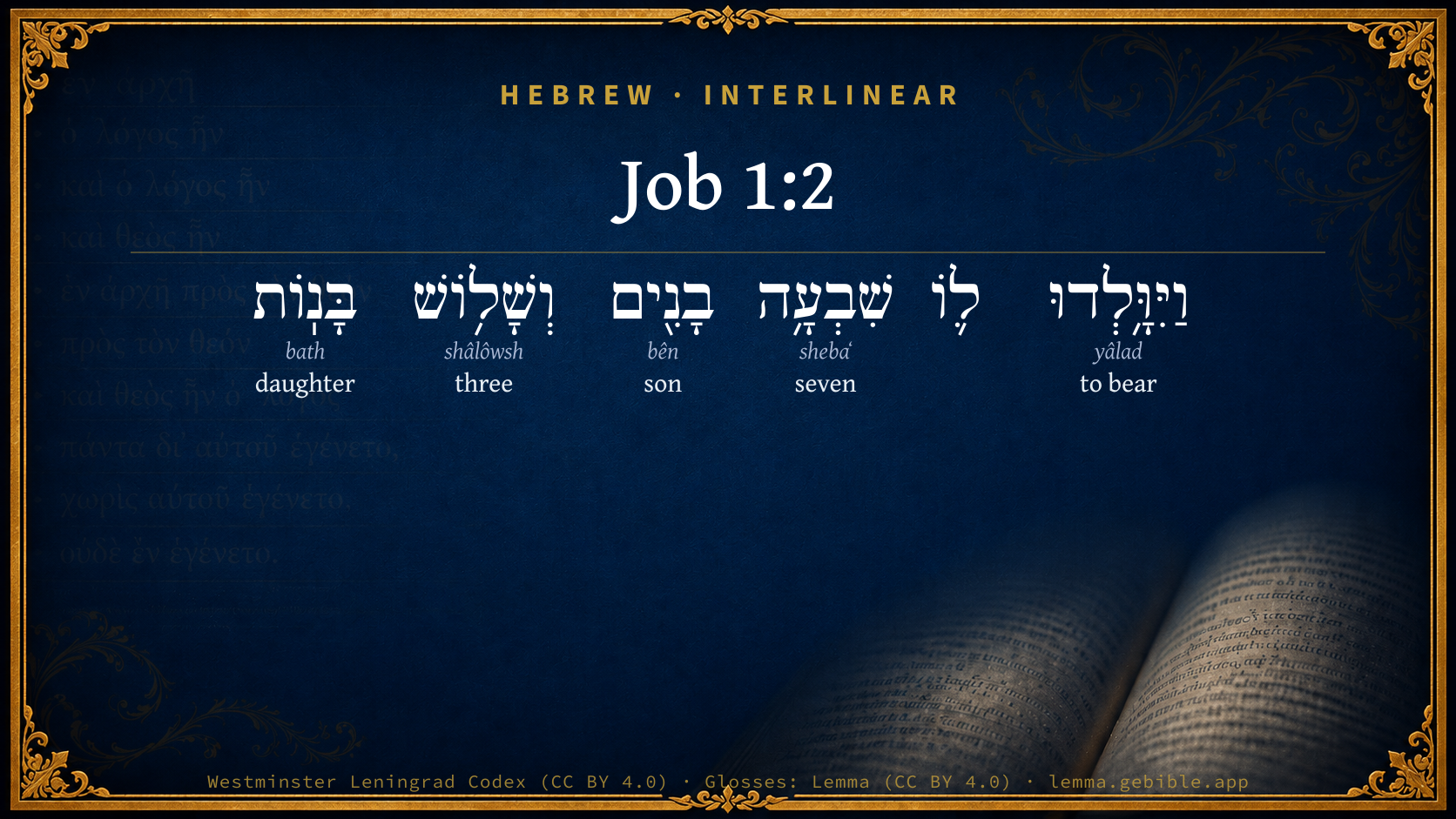
Hebrew (Westminster Leningrad Codex) Job 1:2 appears in the Hebrew Old Testament. The text above is from the Westminster Leningrad Codex. Each word links to its Strong’s number, a concise gloss, and parsing drawn from the Open Scriptures Hebrew Bible morphology. Click any word for its full Brown-Driver-Briggs (BDB) entry.
Download image
Cite this verse

Job 1:2 (World English Bible). Public Domain. Lemma interlinear Bible study tool, https://lemma.gebible.app/v/job/1/2.

Show BibTeX & RIS
BibTeX
RIS
English Translation
There were born to him seven sons and three daughters.
World English Bible · Public Domain
Download a study sheet

One document with this verse’s original text, its word-by-word gloss line, the meaning frame, cross-references with their text, attributed commentary, and full source and license credits — printable, and it pastes into notes with its structure intact.

This verse Autodidact and up

Study sheet (.html) Plain text (.txt)

A passage Seminary Student

Up to 50 verses in one chapter. A passage sheet keeps up to 6 commentary sources and 12 cross-references per verse, in the order this page ranks them, and says so on the sheet whenever that leaves anything out. Ask for a single verse and you get the Autodidact verse sheet above.

Everything on this page stays free to read, with no account — the sheet is a download of what is already on screen, not access to it.

Want to remove ads? Support Godless Engineer
Compare translations 3

The same verse in 3 English versions, stacked beneath the original-language interlinear above. Click any original word for its lexicon entry.

Each is an independent rendering of the whole verse — the interlinear is not word-aligned to these translations.

Highlighted words mark where these versions differ — a whole-verse word diff, not a word-by-word alignment.

  • World English Bible Public Domain
    There were born to him seven sons and three daughters.
  • King James Version Public Domain
    And there were born unto him seven sons and three daughters.
  • unfoldingWord Literal Text CC BY-SA 4.0
    Seven sons and three daughters were born to him.

unfoldingWord Literal Text — © unfoldingWord, licensed CC BY-SA 4.0. Word-aligned USFM3 via Door43 (git.door43.org/unfoldingWord/en_ult).

Versions to compare (up to 4)

3 of 4 selected

Show all 18 translations

Every available English version of this verse, each an independent rendering of the whole verse.

  • World English Bible Public Domain
    There were born to him seven sons and three daughters.
  • Berean Standard Bible Public Domain
    He had seven sons and three daughters,
  • Majority Standard Bible Public Domain
    He had seven sons and three daughters,
  • King James Version Public Domain
    And there were born unto him seven sons and three daughters.
  • American Standard Version (1901) Public Domain
    And there were born unto him seven sons and three daughters.
  • Revised Version (1885) Public Domain
    And there were born unto him seven sons and three daughters.
  • Geneva Bible (1599) Public Domain
    And he had seue sonnes, and three daughters.
  • Douay-Rheims (1899) Public Domain
    And there were born to him seven sons and three daughters.
  • Young's Literal Translation Public Domain
    And there are borne to him seven sons and three daughters,
  • Literal Standard Version CC BY-SA 4.0
    And seven sons and three daughters are borne to him,
  • Unlocked Literal Bible CC BY-SA 4.0
    There were born to him seven sons and three daughters.
  • unfoldingWord Literal Text CC BY-SA 4.0
    Seven sons and three daughters were born to him.
  • Darby Bible Public Domain
    And there were born to him seven sons and three daughters.
  • World Messianic Bible Public Domain
    There were born to him seven sons and three daughters.
  • Webster's Bible Public Domain
    And there were born to him seven sons and three daughters.
  • Free Bible Version CC BY-SA 4.0
    He had seven sons and three daughters.
  • Bible in Basic English Public Domain
    And he had seven sons and three daughters.
  • JPS Tanakh (1917) Public Domain
    And there were born unto him seven sons and three daughters.

Literal Standard Version (2020), Covenant Press — licensed CC BY-SA 4.0. Text via the HelloAO Bible API (eBible.org). Unlocked Literal Bible (unfoldingWord) — licensed CC BY-SA 4.0. Text via the HelloAO Bible API (eBible.org). unfoldingWord Literal Text — © unfoldingWord, licensed CC BY-SA 4.0. Word-aligned USFM3 via Door43 (git.door43.org/unfoldingWord/en_ult). Free Bible Version, Dr. Jonathan Gallagher — licensed CC BY-SA 4.0. Text via the HelloAO Bible API (eBible.org).

Word by word

More ways to search: Search by grammar → Find every occurrence → Compare this word →

Practice this passage: Drill this verse → Learn its vocabulary →

About this verse

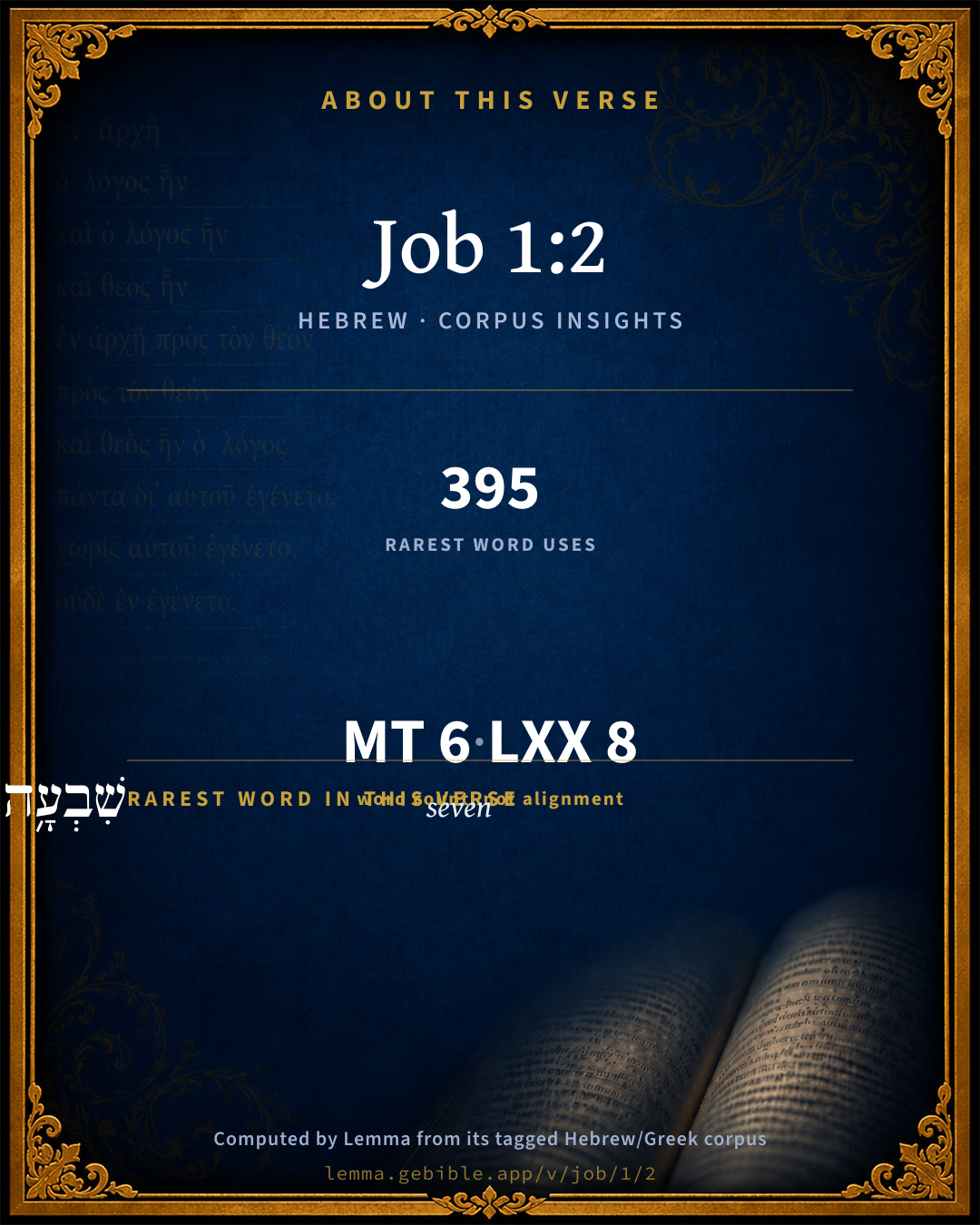
These counts appear in no published source. They are computed here, from the morphology-tagged text and Lemma’s own curated glosses. What Lemma adds →

6
words
5
distinct lemmas
Wisdom
section

Grammatical profile

  • 1 verb
  • 2 nouns
  • 2 adjectives
  • 1 preposition

Verb forms

  • וַיִּוָּ֥לְדוּ Niphal · Sequential Imperfect

Hebrew & Septuagint length

In English translation the verse runs 10 words from the Hebrew and 8 from the Septuagint (LXX English) — closely comparable.

A rough comparison of the two English renderings, which tokenize alike — not a word-level alignment.

Word counts can differ between the Hebrew and the Greek without any difference in meaning — e.g. the Hebrew direct-object marker אֵת has no separate Greek word, and Greek often adds the article ὁ.

In the original languages it is 6 Hebrew tokens and 8 Greek tokens — but the two are counted differently (Hebrew bundles its prefixes and suffixes into one token; the Greek is in lemma form), so that isn’t a like-for-like length.

Cross-references

6

Topical passages linked to Job 1:2 in the Treasury of Scripture Knowledge — connected by theme and wording, ordered by reader-vote popularity; previews shown in the World English Bible.

  • Job 42:13 He had also seven sons and three daughters.
  • Psalms 127:3–5 Behold, children are a heritage of Yahweh. The fruit of the womb is his reward.
  • Esther 5:11 Haman recounted to them the glory of his riches, and the multitude of his children, and all the things in which the king had promoted him, and how he had advanced him above the princes and servants of the king.
  • Job 13:13 "Be silent, leave me alone, that I may speak. Let come on me what will.
  • Psalms 107:38 He blesses them also, so that they are multiplied greatly. He doesn't allow their cattle to decrease.
  • Psalms 128:3 Your wife will be as a fruitful vine, In the innermost parts of your house; Your children like olive plants, Around your table.

Cross-references courtesy of OpenBible.info (CC BY 4.0).

Hebrew and Greek witnesses Masoretic Hebrew ↔ Greek Septuagint

The same verse in the two great witnesses to the Old Testament, shown verse-for-verse.

These are two independent witnesses, not word-aligned to each other, and the Septuagint is shown in lemma (dictionary) form.

Hebrew Job 1:2 Masoretic · Westminster Leningrad Codex

וַיִּוָּ֥לְדוּ ל֛וֹ שִׁבְעָ֥ה בָנִ֖ים וְשָׁל֥וֹשׁ בָּנֽוֹת

There were born to him seven sons and three daughters.

World English Bible · Public Domain

Greek LXX Job 1:2 Septuagint · lemma form

γίγνομαι δέ αὐτός υἱός ἑπτά καί θυγάτηρ τρεῖς

And he had seven sons and three daughters.

LXX2012 (modern English Septuagint) · Public Domain

Hebrew: Westminster Leningrad Codex (CC BY 4.0). Greek: Septuagint (public domain); English from LXX2012 (modern English Septuagint) (Public Domain). How the Septuagint differs from the Hebrew →

Commentary

Notes on Job 1:2 from classic Christian and Jewish commentators (each source and its license shown beneath its notes). The classic Christian expositions comment on the surrounding passage and are grouped to its opening verse, so a note may address several verses; the Jewish commentaries on the Tanakh (Rashi and others) are per-verse, so they appear only where the commentator wrote on this verse.

Lemma curates 59 commentaries, every one of them public domain or Creative Commons licensed, each selected and text-cleaned for this edition rather than reprinted as found. About our sources →

Trapp's Complete Commentary

John Trapp

Job 1:2 And there were born unto him seven sons and three daughters.

Ver. 2. And there were born unto him seven sons] This was a main part of his prosperity, to have such a numerous issue to build up his house and to heir his estate, though it proved to be luctuosa fecunditas, mournful fertility, as Jerome said Laeta’s was, who lived to see her children buried before her. Job’s children are spoken of before his wealth, because better valued; and yet after this fearing God and eschewing evil, to show (saith Fetus) that he was not like the men of these times, who, if they have many children, will take any evil course to get something for them, and think it a sufficient plea against works of piety or charity that they have many children to provide for. But such should know that not getting, but giving, is the way to thrive; neither can men better lay up for their children than by laying it out upon the backs and bellies of God’s poor, to whom he that giveth shall not lack, Pro 28:27, that is a bargain of God’s own making; this the righteous knowing, "is merciful, and lendeth, and his seed is blessed," Psa 37:26, when the wicked wretch’s riches "perish by evil travail, and he begetteth a son, and there is nothing in his hand," Ecc 5:14. I read of a graceless son who, after his father’s death, finding his hoard of money and evil gotten wealth, cried out, O faithful drudge! and he soon made a hand of it.

And three daughters] Hopeful and towardly; not like those of Augustus Caesar, whom, for the evil courses they took, he was wont to term them three pussful abscesses and ulcerous sores, wishing that either he had lived a bachelor or died childless, Tres vomicas trio carcinomata (Sueton.); but rather like those of Charles the Great, who so pleased him, that he could not at any time be well without their company, nor find in his heart to part with them, though it were to be well married.

John Trapp, A Commentary or Exposition upon All the Books of the Old and New Testament (1647–1656) — public domain. Text from a community e-Sword module.

Tyndale Open Study Notes

Tyndale Open Resources

1:2-3 Job was prosperous in sons, daughters, livestock, and servants (cp. Gen 30:43; Deut 7:13; Ps 107:38). • Numbers such as seven and three (and 7,000 and 3,000) indicate the completeness of the blessing Job experienced (see Job 42:13; see also Pss 127:3-5; 128:3). • the richest person in that entire area: The figures that catalogue Job’s wealth might not be exact, but they are realistic for a wealthy man of that time (cp. Nabal’s wealth, 1 Sam 25:2).

Tyndale Open Study Notes — © Tyndale Open Resources, licensed CC BY-SA 4.0. Text via the HelloAO Bible API.

Ellicott's Commentary for English Readers

(2) Seven sons and three daughters.—The like number was restored to him after his probation (Job_42:13).

A Bible Commentary for English Readers, edited by Charles John Ellicott (1878–1897) — public domain. Text from a community e-Sword module.

The Cambridge Bible for Schools and Colleges

gen. ed. J. J. S. Perowne

2, 3. Job’s family and wealth. A first principle in the Oriental Wisdom, which corresponds in part to our Ethics, was, that it is well with the righteous and ill with the wicked, Isa_3:10-11. This principle is set at the head of the Psalter in Psalms 1, and is reiterated in many shapes as an unalterable law in the Book of Proverbs. According to this principle Job and all acquainted with him would see his piety reflected in his worldly prosperity, and regard this as God’s blessing upon him on account of it. It is not the intention of the writer of the Book to break with this principle absolutely. On the contrary when he lets Job at the end of his trials be restored to a prosperity double that which he enjoyed before, he gives in his adhesion to the principle in general. If he had not done so his position would have been more false than that of Job’s friends, who asserted that the principle prevailed in the world without exceptions. The Author’s design goes no further than to teach that the principle is subject to great modifications, and that sufferings may arise from causes more general than any connected with the sufferer’s own life. His object, however, in teaching this doctrine cannot have been the limited one of correcting a false theory of Providence, he must have had before him the wider purpose of sustaining individuals or most probably his nation under severe and inexplicable trials and encouraging them with brilliant hopes of the future.

The round Numbers 7, 3, 5, by which Job’s children and his flocks are described, express, according to the ideas connected with such numbers in the East, their perfection and complete sufficiency. They teach at the same time that what we have before us here is not actual history, but history idealized by the Poet and Teacher, that he may convey by it more vividly the moral lessons which he desires to inculcate. Job’s sons were seven and his daughters three, for sons were more esteemed in the East than daughters, partly for reasons connected with the state of society, one of which is alluded to in the Psalm: “They shall not be ashamed, they shall speak with the enemies in the gate,” Psa_127:5. Mohammed expresses the feelings of the Arabs when he says: For when any one of them is informed of the birth of a daughter a black shadow falls upon his face and he is wroth, and with-draweth himself from men because of the evil tidings, uncertain whether he shall keep it with disgrace or bury it (alive) in the dust, Kor. 16:60; and even the modern Jew in his prayers gives thanks in this way: Blessed art thou, O king of the universe, who hast not made me a woman.

As a great Eastern Emeer, Job was rich in camels. These were used for riding when the journey was long, and for transporting produce and merchandise to the distant cities. They were also eaten by the Arabs. She-asses, the price of one of which is said to be three times that of a male, were esteemed not on account of their milk, but for the sake of their foals. In a country where wheeled carriages are unknown, they were used not only for riding, but for all purposes of home and agricultural carriage. Oxen were used for labouring the fields, for which the horse is not employed in the East. The amount of arable land was measured by the number of yoke, that is, pairs, of oxen required to cultivate it. Job’s rich and extensive fields were plowed by a thousand oxen, Job_1:14. Such wide possessions implied a very great “household,” that is, body of servants. And the writer finishes his picture of Job by saying that he “was the greatest of all the men (lit. children) of the East.” His “greatness” did not lie in his wealth alone, but in the respect in which he was held and in his influence. See the pathetic picture which he draws of his own former estate, ch. 29. On the general phrase “children of the East” see Gen_29:1; Jdg_6:3; Jdg_7:12; Jdg_8:10; 1Ki_4:30; Jer_49:28; Eze_25:4; Eze_25:10.

The Cambridge Bible for Schools and Colleges (gen. ed. J. J. S. Perowne; Cambridge University Press, 1878–1918) — public domain. Text from a community e-Sword module.

John Gill's Exposition

And there were born unto him,.... By his wife, in lawful wedlock, who was now living, and after mentioned:

seven sons and three daughters; next to his religious character, his graces, and spiritual blessings, and as the chief of his outward mercies and enjoyments, his children are mentioned; and which are indeed blessings from the Lord, and such as good men, and those that fear the Lord, are sometimes blessed with, see Psa 127:3 and to have a numerous offspring was always esteemed a very great favour and blessing, and as such was reckoned by Job; who, having so many sons, might hope to have his name perpetuated by them, as well as his substance shared among them; and having so many daughters, he might please himself with the thought of marrying them into families, which would strengthen his friendship and alliance with them; just the same number of sons and daughters had Bacchaeus, the third king of Corinth (y).

(y) Heraclides de Politiis ad calcem Aelian. Var. Hist. p. 439.

John Gill's Exposition of the Whole Bible (1746–1763) — public domain (CC PDM 1.0). Text via the HelloAO Bible API.

Albert Barnes' Notes on the Bible

And there were born unto him seven sons and three daughters - The same number was given to him again after these were lost, and his severe trials had been endured; see Job 42:13. Of his second family the names of the daughters are mentioned, Job 42:14. Of his first, it is remarkable that neither the names of his wife, his sons nor his daughters are recorded. The Chaldee, however, on what authority is unknown, says that the name of his wife was דינה dı̂ynâh, Job 2:9.

Albert Barnes' Notes on the Bible (1834–1885) — public domain. Text from a community e-Sword/MySword module.

Whedon's Commentary on the Bible

Daniel D. Whedon

2. Seven sons — The head of a large family has always been regarded in the East as pre-eminently happy. In the patriarchal age especially a large progeny was a source of military strength, each son, as well as each bondman, being a possible soldier. Elements of power, they, more than any other worldly gifts, entitled their possessor to distinction and honour. “Happy is the man that hath his quiver full of them.” “They shall speak with the enemy in the gate.” Hence “the young men” appear first in the enumeration of the blessings of Providence, even as in the series of terrible calamities their destruction is the last climactic stroke. The number ten, as Hitzig and others have remarked, is here divided into seven and three, as well as in the following verse, where the seven and three also appear together with the halves of ten. In other portions of the Bible, however, similar numerical relationships appear. (Comp. 1Ki_17:21 with 2Ki_4:35; 1Sa_20:41 with Gen_33:3. See note on sacred numbers, Luk_6:13.) The exact round numbers, seven and three, and their symbolic selection, so frequent in the Book of Job, in the opinion of some indicate the poetical overlying the historical.

Daniel D. Whedon (gen. ed.), Commentary on the Old and New Testaments (1874–1909) — public domain. Text from a community e-Sword module.

The Pulpit Commentary

And there were born unto him seven sons and three daughters. The numbers three and seven, and their product, ten, are certainly sacred numbers, regarded as expressive of ideal perfection. But this does not prevent their being also historical. As Canon Cook observes, "Striking coincidences between outward facts and ideal numbers are not uncommon in the purely historical portions of Scripture" ("Speaker"s Commentary," vol. 4. p. 20). There are twelve apostles, seventy (7 10) disciples sent out by our Lord, seven deacons, three synoptic Gospels, twelve minor prophets, seven princes of Persia and Media, ten sons of Haman, three of Noah, Gomer, Terah, Levi, and Zeruiah, seven of Japhet, Mizraim, Seir the Horite, Gad, and Jesse, (1Ch_2:13-15) twelve of Ishmael, twelve of Jacob, etc. Our Lord is thirty (3 x 10) years old when he begins to teach, and his ministry lasts three years; he heals seven lepers, casts out of Mary Magdalene seven devils, speaks upon the cross seven "words," bids Peter forgive his brother seventy times seven," etc. It is thus not only in vision or in prophecy, or in symbolical language, that these "ideal numbers" come to the front far more frequently than ethers, but also in the most matter-of-fact histories.

Vers. 2-5. The dangers of prosperity.

This book proposes to give us a picture of extreme and probably unprecedented adversity. It is fitting that it should open with a scene of exceptional prosperity, to serve as a contrast to the dark scenes that follow. Moreover, the idea of the book is the better realized if we observe that the original prosperity is considered in its moral aspect, as concealing a possible temptation to sin.

I THE PROSPERITY WAS SUBSTANTIAL.

1. A large family. This is always regarded in the Bible as a mark of prosperity. It is an unnatural social condition of congested populations that has led to the opposite idea in our own time. Certainly, where there are means for a livelihood, the family is a source of joy and influence, as well as wholesome self-sacrifice.

2. Great property. Job had more than the means for a livelihood. According to the estimate of a pastoral life, he was a very rich man, notoriously rich, and without an equal. Yet this man knew and feared God. It is therefore possible with God for a rich man to enter the kingdom of heaven. (Mat_19:26)

II THE PROSPERITY WAS ENJOYED. Job"s sons and daughters were feasting together. Here is a picture of happy family life in the midst of affluence. The jealousy and bitterness that sometimes poison the cup of prosperity were not known in Job"s household. His family was united and affectionate. It was by no means ascetic; but we have no reason for thinking it ought to have been so. No reproach is urged against Job"s sons and daughters for feasting together. There is a time for innocent enjoyment, and when this is taken temperately and gratefully, only superstitious fears can suggest the idea of a Nemesis. The motto Carpe diem is mean and execrable, because it carries with it an implied renunciation of duty.

III THERE WAS A DANGER IN THIS PROSPERITY. Job feared lest his children might have renounced God in their hearts.

1. A danger of godlessness. This is serious in the mind of Job, though it did not show itself in unkind or unjust conduct to men. To forsake God is sin, even though a man pay his debts.

2. An internal evil. "In their hearts" There might be no open blasphemy; yet the hearts of the gay and careless young men and women might be alienated from God. Even this is sin.

3. An evil threatened by prosperity. It is remarkable that this is the very sin which Job is subsequently tempted to commit by the agonies of overwhelming calamities. Here he thinks that prosperity may induce it in his children, for that tempts men to be satisfied with earth, to be vain, proud, and self-complacent.

IV JOB GUARDED AGAINST THE DANGER. The patriarchal religion made the father the priest of his household. So he must be always when he realizes his position. Parents lay up property for their children; it is more important that they should make provision for their children"s spiritual welfare. They watch anxiously for symptoms of disease in them; much more should they be on their guard against the first signs of moral defects. Job"s children were sanctified ceremonially cleansed. Ours need to be truly dedicated to God by parental prayers. W.F.A.

The Pulpit Commentary (1880–1919), ed. H.D.M. Spence-Jones & Joseph S. Exell — public domain. Text from a community e-Sword module.

Keil & Delitzsch

C. F. Keil & F. Delitzsch

2, 3 And there were born unto him seven sons and three daughters. His substance also was seven thousand sheep, and three thousand camels, and five hundred yoke of oxen, and five hundred she-asses, and servants in great number; so that this man was the greatest of all the men of the east.

It is a large, princely household. The numbers are large, but must not on that account be considered an invention. The four animals named include both kinds. With the doubled אלפי corresponds the also constructive מאות, the Tsere of which is never shortened, though in the singular one says מאת, from מאה. The aorists, especially of the verb היה (הוה), which, according to its root, signifies not so much esse as fieri, existere, are intended to place us at once in the midst of his prosperity. Ex iis, says Leo Africanus in reference to flocks, Arabes suas divitias ac possessiones aestimant. In fine, Job was without his equal among the קרם בני. So the tribes are called which extend from Arabia Deserta, lying to the east of Palestine, northwards to the countries on the Euphrates, and south over Arabia Petraea and Felix. The wisdom of these tribes, treasured up in proverbs, songs, and traditions, is mentioned in Kg1 5:10, side by side with the wisdom of the Egyptians. The writer now takes a very characteristic feature from the life of Job, to show that, even in the height of prosperity, he preserved and manifested the piety affirmed of him.

Keil & Delitzsch — Biblical Commentary on the Old Testament (1861–1891) — public domain (CC PDM 1.0). Text via the HelloAO Bible API. (Old Testament only.)

Lesson kit

Teaching starters — assembled from the data on this page, not authored interpretation. Every prompt links to the verse data it draws on. Edit before teaching.

Job, in the Wisdom, opens this verse with 6 words (5 distinct Hebrew lemmas). Its most distinctive word is shebaʻ (“seven”). A historical commentator’s framing appears above. Read the whole chapter for the surrounding context.

Discussion questions

  1. What does “seven” (shebaʻ) contribute to the verse as a whole?
  2. Job 42:13 shares this passage’s theme. How do the two illuminate each other?
  3. These translations render this verse differently. What is at stake in choosing one wording over another?
  4. The verb «וַיִּוָּ֥לְדוּ» is Niphal Sequential Imperfect. How does its form color the action?
  5. Reading how Trapp's Complete Commentary and Tyndale Open Study Notes read this verse, where do the two commentators agree and where do they part?

Things to notice

Reading settings

Reading text

Shown beneath each verse's original-language words.

Old Testament
Old Testament edition

Read the OT as the Masoretic Hebrew (MT) or the Greek Septuagint (LXX).

English shown for the Greek Septuagint (in the Hebrew ↔ Greek comparison).

Comparing translations? Open the Compare panel on any verse page to stack up to four side by side.