Exodus 27:14

Hebrew (Westminster Leningrad Codex) Exodus 27:14 appears in the Hebrew Old Testament. The text above is from the Westminster Leningrad Codex. Each word links to its Strong’s number, a concise gloss, and parsing drawn from the Open Scriptures Hebrew Bible morphology. Click any word for its full Brown-Driver-Briggs (BDB) entry.
Download image
Cite this verse

Exodus 27:14 (World English Bible). Public Domain. Lemma interlinear Bible study tool, https://lemma.gebible.app/v/exodus/27/14.

Show BibTeX & RIS
BibTeX
RIS
English Translation
The hangings for the one side of the gate shall be fifteen cubits; their pillars three, and their sockets three.
World English Bible · Public Domain
Highlights
  • 1 first appearance in the Hebrew Bible
Full analysis ↓
Download a study sheet

One document with this verse’s original text, its word-by-word gloss line, the meaning frame, cross-references with their text, attributed commentary, and full source and license credits — printable, and it pastes into notes with its structure intact.

This verse Autodidact and up

Study sheet (.html) Plain text (.txt)

A passage Seminary Student

Up to 50 verses in one chapter. A passage sheet keeps up to 6 commentary sources and 12 cross-references per verse, in the order this page ranks them, and says so on the sheet whenever that leaves anything out. Ask for a single verse and you get the Autodidact verse sheet above.

Everything on this page stays free to read, with no account — the sheet is a download of what is already on screen, not access to it.

Want to remove ads? Support Godless Engineer
Compare translations 3

The same verse in 3 English versions, stacked beneath the original-language interlinear above. Click any original word for its lexicon entry.

Each is an independent rendering of the whole verse — the interlinear is not word-aligned to these translations.

Highlighted words mark where these versions differ — a whole-verse word diff, not a word-by-word alignment.

  • World English Bible Public Domain
    The hangings for the one side of the gate shall be fifteen cubits; their pillars three, and their sockets three.
  • King James Version Public Domain
    The hangings of one side of the gate shall be fifteen cubits: their pillars three, and their sockets three.
  • unfoldingWord Literal Text CC BY-SA 4.0
    The curtains for the side fifteen cubits their three pillars and their three bases.

unfoldingWord Literal Text — © unfoldingWord, licensed CC BY-SA 4.0. Word-aligned USFM3 via Door43 (git.door43.org/unfoldingWord/en_ult).

Versions to compare (up to 4)

3 of 4 selected

Show all 18 translations

Every available English version of this verse, each an independent rendering of the whole verse.

  • World English Bible Public Domain
    The hangings for the one side of the gate shall be fifteen cubits; their pillars three, and their sockets three.
  • Berean Standard Bible Public Domain
    Make the curtains on one side fifteen cubits long, with three posts and three bases,
  • Majority Standard Bible Public Domain
    Make the curtains on one side fifteen cubits long, with three posts and three bases,
  • King James Version Public Domain
    The hangings of one side of the gate shall be fifteen cubits: their pillars three, and their sockets three.
  • American Standard Version (1901) Public Domain
    The hangings for the one side `of the gate' shall be fifteen cubits; their pillars three, and their sockets three.
  • Revised Version (1885) Public Domain
    The hangings for the one side of the gate shall be fifteen cubits: their pillars three, and their sockets three.
  • Geneva Bible (1599) Public Domain
    Also hangings of fifteene cubites shalbe on the one side with their three pillars and their three sockets.
  • Douay-Rheims (1899) Public Domain
    In which there shall be for one side hangings of fifteen cubits, and three pillars and as many sockets.
  • Young's Literal Translation Public Domain
    And the hangings at the side `are' fifteen cubits, their pillars three, and their sockets three.
  • Literal Standard Version CC BY-SA 4.0
    And the hangings at the side [are] fifteen cubits, their pillars three, and their sockets three.
  • Unlocked Literal Bible CC BY-SA 4.0
    The hangings for one side of the entrance must be fifteen cubits long. They must have three posts with three bases.
  • unfoldingWord Literal Text CC BY-SA 4.0
    The curtains for the side fifteen cubits their three pillars and their three bases.
  • Darby Bible Public Domain
    the hangings on the one wing, of fifteen cubits; their pillars three, and their bases three.
  • World Messianic Bible Public Domain
    The hangings for the one side of the gate shall be fifteen cubits; their pillars three, and their sockets three.
  • Webster's Bible Public Domain
    The hangings of one side of the gate shall be fifteen cubits: their pillars three, and their sockets three.
  • Free Bible Version CC BY-SA 4.0
    Make the curtains on one side fifteen cubits long, with three posts and three stands,
  • Bible in Basic English Public Domain
    On the one side of the doorway will be hangings fifteen cubits long, with three pillars and three bases;
  • JPS Tanakh (1917) Public Domain
    The hangings for the one side of the gate shall be fifteen cubits: their pillars three, and their sockets three.

Literal Standard Version (2020), Covenant Press — licensed CC BY-SA 4.0. Text via the HelloAO Bible API (eBible.org). Unlocked Literal Bible (unfoldingWord) — licensed CC BY-SA 4.0. Text via the HelloAO Bible API (eBible.org). unfoldingWord Literal Text — © unfoldingWord, licensed CC BY-SA 4.0. Word-aligned USFM3 via Door43 (git.door43.org/unfoldingWord/en_ult). Free Bible Version, Dr. Jonathan Gallagher — licensed CC BY-SA 4.0. Text via the HelloAO Bible API (eBible.org).

Word by word

More ways to search: Search by grammar → Find every occurrence → Compare this word →

Practice this passage: Drill this verse → Learn its vocabulary →

קְלָעִ֖ים
qelaʻ
H7050
“slings”
Noun, Common, Masculine, Plural, Absolute
Part of Speech
Noun
Type
Common
Gender
Masculine
Number
Plural
State
Absolute
Full BDB Definition

Origin: from H7049

TWOT: 2030a , 2030c

sling, slingstones - curtain, drape, hanging
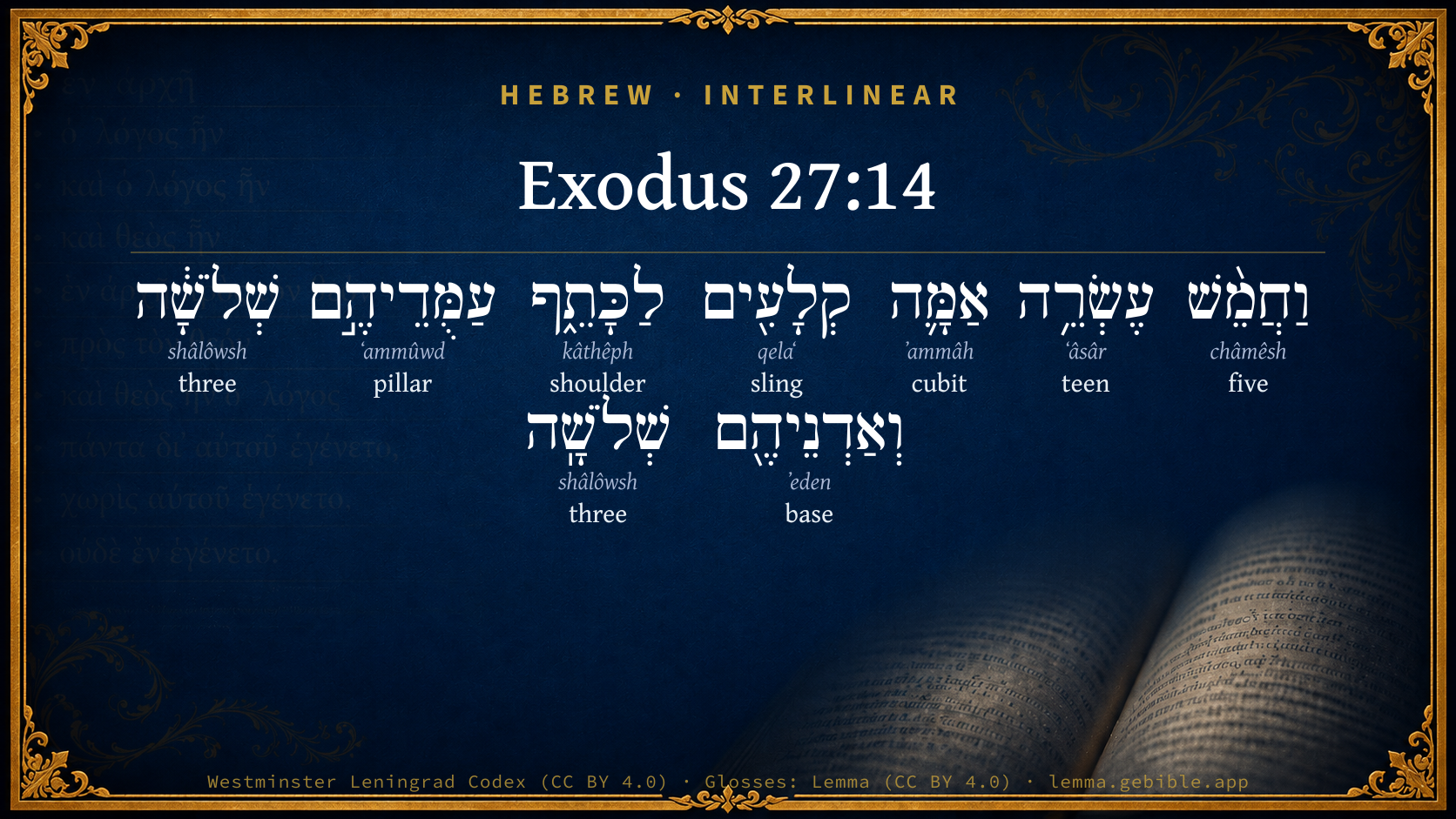
  1. וַחֲמֵ֨שׁ châmêsh H2568 “and · five” Conjunction + Adjective, Cardinal number, Feminine, Singular, Absolute
  2. עֶשְׂרֵ֥ה ʻâsâr H6240 “teen” Adjective, Cardinal number, Feminine, Singular, Absolute
  3. אַמָּ֛ה ʼammâh H520 “cubit” Noun, Common, Feminine, Singular, Absolute
  4. לַכָּתֵ֑ף kâthêph H3802 “to/for the · shoulder” Preposition, Determined + Noun, Common, Feminine, Singular, Absolute
  5. עַמֻּדֵיהֶ֣ם ʻammûwd H5982 “pillars · their” Noun, Common, Masculine, Plural, Construct + Suffix, Personal, 3rd Person, Masculine, Plural
  6. שְׁלֹשָׁ֔ה shâlôwsh H7969 “three” Adjective, Cardinal number, Masculine, Singular, Absolute
  7. וְאַדְנֵיהֶ֖ם ʼeden H134 “and · bases · their” Conjunction + Noun, Common, Masculine, Plural, Construct + Suffix, Personal, 3rd Person, Masculine, Plural
  8. שְׁלֹשָֽׁה shâlôwsh H7969 “three” Adjective, Cardinal number, Masculine, Singular, Absolute

About this verse

These counts appear in no published source. They are computed here, from the morphology-tagged text and Lemma’s own curated glosses. What Lemma adds →

9
words
8
distinct lemmas
Pentateuch
section

Notable vocabulary

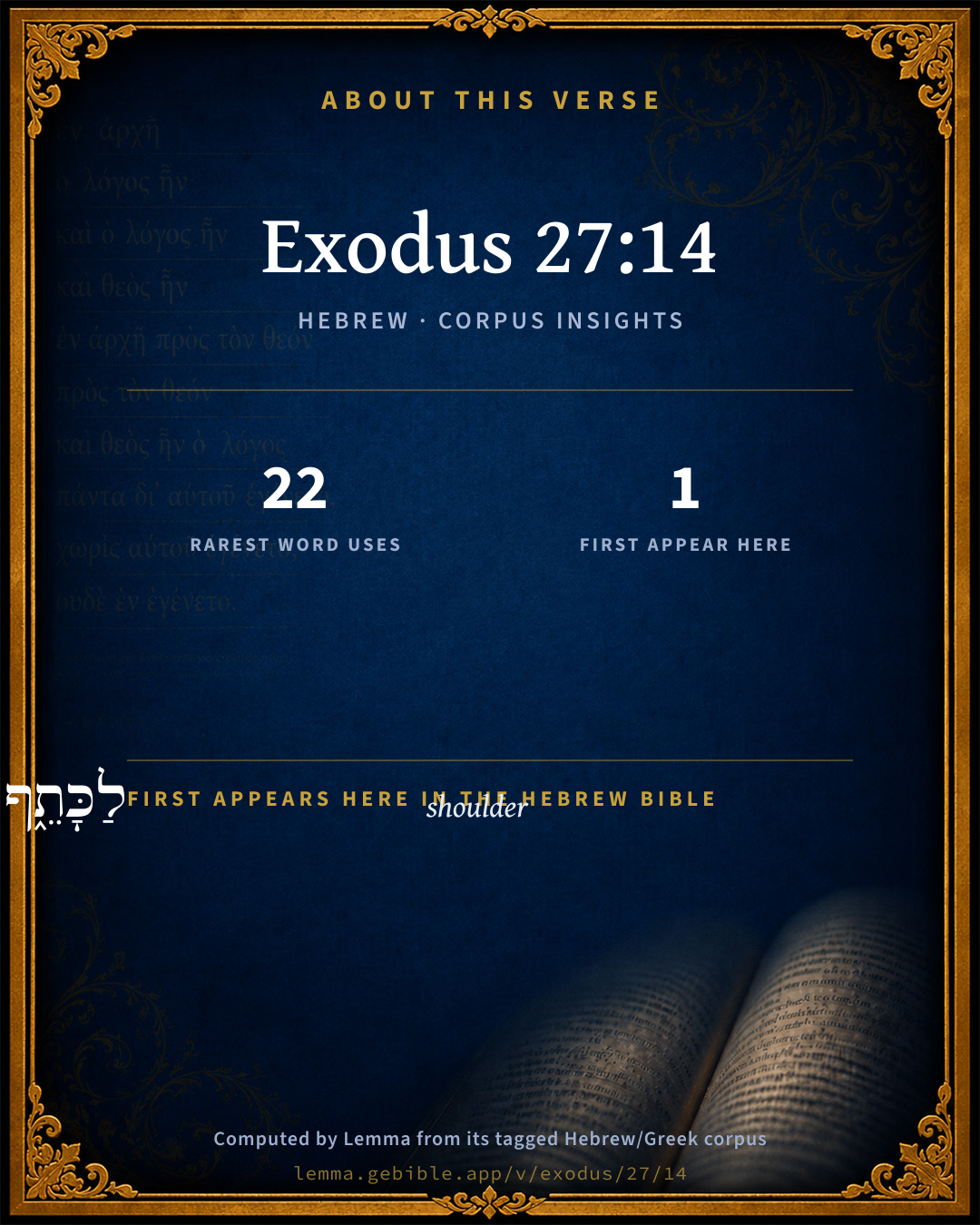
The rarest word here is קְלָעִ֖ים sling H7050 — appearing just 22 times in the whole Hebrew Bible.

First appearance in Scripture

This word makes its first canonical appearance in the Hebrew Bible here:

  • לַכָּתֵ֑ף shoulder H3802

Shared distinctive vocabulary

קְלָעִ֖ים sling H7050 occurs in 22 verses of the Hebrew Bible. Also found in:

Grammatical profile

  • 5 nouns
  • 4 adjectives

Repetition

A word recurs within this verse — often emphatic in Hebrew:

  • שְׁלֹשָׁ֔ה three H7969 ×2

Hebrew & Septuagint length

In English translation the verse runs 20 words from the Hebrew and 25 from the Septuagint (LXX English) — closely comparable.

A rough comparison of the two English renderings, which tokenize alike — not a word-level alignment.

Word counts can differ between the Hebrew and the Greek without any difference in meaning — e.g. the Hebrew direct-object marker אֵת has no separate Greek word, and Greek often adds the article ὁ.

Cross-references

2

Topical passages linked to Exodus 27:14 in the Treasury of Scripture Knowledge — connected by theme and wording, ordered by reader-vote popularity; previews shown in the World English Bible.

  • Exodus 26:36 "You shall make a screen for the door of the Tent, of blue, and purple, and scarlet, and fine twined linen, the work of the embroiderer.
  • Exodus 27:9 "You shall make the court of the tent: for the south side southward there shall be hangings for the court of fine twined linen one hundred cubits long for one side:

Cross-references courtesy of OpenBible.info (CC BY 4.0).

Hebrew and Greek witnesses Masoretic Hebrew ↔ Greek Septuagint

The same verse in the two great witnesses to the Old Testament, shown verse-for-verse.

These are two independent witnesses, not word-aligned to each other, and the Septuagint is shown in lemma (dictionary) form.

Hebrew Exodus 27:14 Masoretic · Westminster Leningrad Codex

וַחֲמֵ֨שׁ עֶשְׂרֵ֥ה אַמָּ֛ה קְלָעִ֖ים לַכָּתֵ֑ף עַמֻּדֵיהֶ֣ם שְׁלֹשָׁ֔ה וְאַדְנֵיהֶ֖ם שְׁלֹשָֽׁה

The hangings for the one side of the gate shall be fifteen cubits; their pillars three, and their sockets three.

World English Bible · Public Domain

Greek LXX Exodus 27:14 Septuagint · lemma form

καί πεντεκαίδεκα πῆχυς ὁ ὕψος ὁ ἱστίον ὁ κλίτος ὁ εἷς στῦλος αὐτός τρεῖς καί ὁ βάσις αὐτός τρεῖς

And the height of the curtains shall be of fifty cubits for the one side of the gate; their pillars three, and their sockets three.

LXX2012 (modern English Septuagint) · Public Domain

Hebrew: Westminster Leningrad Codex (CC BY 4.0). Greek: Septuagint (public domain); English from LXX2012 (modern English Septuagint) (Public Domain). How the Septuagint differs from the Hebrew →

Targum (Aramaic paraphrase)

2

The Targum is the ancient Jewish Aramaic paraphrase of the Hebrew Scriptures — an interpretive translation, not the Hebrew text itself. Onkelos (literal) and Pseudo-Jonathan (expansive) render the Torah, and Jonathan the Prophets. Coverage is partial: where no permissively-licensed English translation exists for a verse, only the Aramaic is shown. This is verse-level text, not a word-by-word alignment to the Hebrew.

  1. Targum Onkelos Torah (Genesis–Deuteronomy)
    וַחֲמֵשׁ עֶשְׂרֵי אַמִין סְרָדִין לְעִבְרָא עַמוּדֵיהוֹן תְּלָתָא וְסַמְכֵיהוֹן תְּלָתָא:

    (no public-domain English translation for this verse)

    Targum Onkelos — Aramaic: “Onkelos Genesis” (public domain); “Onkelos Exodus” (public domain); “Onkelos Leviticus” (public domain); “Onkelos Numbers” (public domain); “Onkelos Deuteronomy” (public domain). English: “Sefaria Community Translation” (CC0 1.0 (public-domain dedication)); “J.W. Etheridge. The Targums of Onkelos and Jonathan Ben Uzziel on the Pentateuch. London: Longmans, Green, 1862” (public domain). Text via Sefaria.

  2. Targum Pseudo-Jonathan Torah (Genesis–Deuteronomy)
    וַחֲמֵיסְרֵי אַמִּין וִילַוָון לְעִיבְרָא עַמּוּדֵיהוֹן תְּלָתָא וְחוּמְרֵיהוֹן תְּלָתָא

    and fifteen cubits the hangings of the side, their pillars three and the their foundations three.

    Targum Pseudo-Jonathan — Aramaic: “Targum Jonathan on Genesis” (public domain); “Targum Jonathan on Exodus” (public domain); “Targum Jonathan on Leviticus” (public domain); “Targum Jonathan on Numbers” (public domain); “Targum Jonathan on Deuteronomy” (public domain). English: “The Targum of Jonathan ben Uzziel, trans. J. W. Etheridge, London, 1862” (public domain). Text via Sefaria.

Commentary

Notes on Exodus 27:14 from classic Christian and Jewish commentators (each source and its license shown beneath its notes). The classic Christian expositions comment on the surrounding passage and are grouped to its opening verse, so a note may address several verses; the Jewish commentaries on the Tanakh (Rashi and others) are per-verse, so they appear only where the commentator wrote on this verse.

Lemma curates 59 commentaries, every one of them public domain or Creative Commons licensed, each selected and text-cleaned for this edition rather than reprinted as found. About our sources →

Geneva Bible (1599)

Geneva Bible translators

Of the door of the court.

Geneva Bible (1599) marginal notes — public domain. Text via Bolls.life.

Ellicott's Commentary for English Readers

(14) The hangings of one side.—Rather, at one side. On three sides of the court—the south, the west, and the north—there was to be no interruption in the hangings—no entrance or gateway. But it was otherwise on the fourth side, towards the east. Here was to be the entrance to the court, and here consequently the line of hangings was to be broken in the middle. A curtain, similar to that at the east end of the tabernacle (Exo_26:36), but hung on four pillars instead of five, and capable of being drawn up of down, was to give admission to the court on this side, and was to occupy twenty cubits out of the fifty which formed the entire width of the court. On either side would remain a space of fifteen cubits, which was to be occupied by “hangings,” similar to those on the other three sides of the court. Each of these lengths of fifteen cubits required three pillars for its support. Thus the pillars on the east side were ten, as on the west.

A Bible Commentary for English Readers, edited by Charles John Ellicott (1878–1897) — public domain. Text from a community e-Sword module.

John Gill's Exposition

The hangings of one side of the gate,.... Or entrance into the court:

shall be fifteen cubits; or seven yards and a half:

their pillars three, and their sockets three; and so stood at the same distance from one another as the rest of the pillars did, the distance of five cubits.

John Gill's Exposition of the Whole Bible (1746–1763) — public domain (CC PDM 1.0). Text via the HelloAO Bible API.

Matthew Poole's English Annotations

These fifteen cubits, with the fifteen cubits Exo 27:15, and the twenty cubits Exo 27:16, make up the fifty cubits mentioned.

Matthew Poole's English Annotations on the Holy Bible (1683–1685) — public domain. Text from a community e-Sword/MySword module.

The Pulpit Commentary

The hangings of one side. Literally, "of one shoulder." The two extreme parts of the east side, between the entrance (ver. 16) and the corners are thus named. They were to extend on either side a distance of fifteen cubits, and to have their curtains suspended to four pillars, one of them being the corner pillar, which is not counted. Hence the pillars are said to be three

The Pulpit Commentary (1880–1919), ed. H.D.M. Spence-Jones & Joseph S. Exell — public domain. Text from a community e-Sword module.

unfoldingWord translationNotes

Door43 World Missions Community

General Information:

Yahweh continues to tell Moses what the people must do.

The hangings

These were large curtains made of cloth. See how you translated this in Exodus 26:36.

posts

These were strong pieces of wood set upright and used as supports. See how you translated these in Exodus 27:10.

bases

These were metal blocks that had a slot in them to keep the board in place. See how you translated this in Exodus 26:19.

fifteen cubits

about seven meters (See: Biblical Distance)

The courtyard gate must be a curtain twenty cubits long

This could be stated as a command. AT: "You must make a curtain twenty cubits long to be the courtyard gate"

The curtain must be made ... fine twined linen, the work of an embroiderer

This can be stated in active form. AT: "They must make the curtain ... fine twined linen, the work of an embroiderer" or "Embroiderers must make the curtain ... fine twined linen" (See: Active or Passive)

blue, purple, and scarlet material and fine twined linen

Possible meanings are 1) "yarn that is dyed blue, purple, and scarlet," probably wool yarn, or 2) "blue, purple, and scarlet dye" to dye the linen.

an embroiderer

a person who sews designs into cloth

translationWords

court

gate

works

unfoldingWord translationNotes — © Distant Shores Media and the Door43 World Missions Community, licensed CC BY-SA 4.0. Source: git.door43.org/Door43/en_tn.

Rashi

Rabbi Shlomo Yitzchaki (Rashi)

עמדיהם שלשה THEIR COLUMNS THREE — There were five cubits space between one column and another column: between the column at the end of the southern row, standing at the southeast corner, to the first column which was one of the three in the east there were five cubits; from that to the second, five cubits, and from the second to the third, five cubits. It was similar at the other side of the entrance. And four columns for the screen are mentioned here, so that you have ten columns for the east corresponding to the ten columns in the west side (v. 12).

Rashi on the Tanakh — English translations: “The Judaica Press complete Tanach with Rashi, translated by A. J. Rosenberg” (CC BY 4.0); “Pentateuch with Rashi's commentary by M. Rosenbaum and A.M. Silbermann, 1929-1934” (public domain); “The Metsudah Tanach series, Lakewood, N.J” (CC BY 4.0); and “The Book of Joshua, Metsudah Publications, 1997” (CC BY 4.0). Text via Sefaria.

Lesson kit

Teaching starters — assembled from the data on this page, not authored interpretation. Every prompt links to the verse data it draws on. Edit before teaching.

Exodus, in the Pentateuch, opens this verse with 9 words (8 distinct Hebrew lemmas). Its most distinctive word is qelaʻ (“sling”). A historical commentator’s framing appears above. Read the whole chapter for the surrounding context.

Discussion questions

  1. How does “sling” (qelaʻ) shape what this verse is saying?
  2. The word “shoulder” first appears here in Scripture. What is being introduced at this debut?
  3. Exodus 27:9 shares the word «sling» with this verse. How do the two illuminate each other?
  4. “three” occurs 2× in this one verse. What is the effect of the repetition?
  5. These translations render this verse differently; the difference is in the English rendering, not the original. What questions does that raise?
  6. Reading how Geneva Bible (1599) and Ellicott's Commentary for English Readers read this verse, where do the two commentators agree and where do they part?

Things to notice

  • 1 word makes its first canonical appearance in Scripture here.
  • These translations choose different wording for 7 words in this verse.
  • “three” occurs 2× in this single verse.
  • 8 distinct Hebrew lemmas span 9 words in this verse.

Reading settings

Reading text

Shown beneath each verse's original-language words.

Old Testament
Old Testament edition

Read the OT as the Masoretic Hebrew (MT) or the Greek Septuagint (LXX).

English shown for the Greek Septuagint (in the Hebrew ↔ Greek comparison).

Comparing translations? Open the Compare panel on any verse page to stack up to four side by side.