
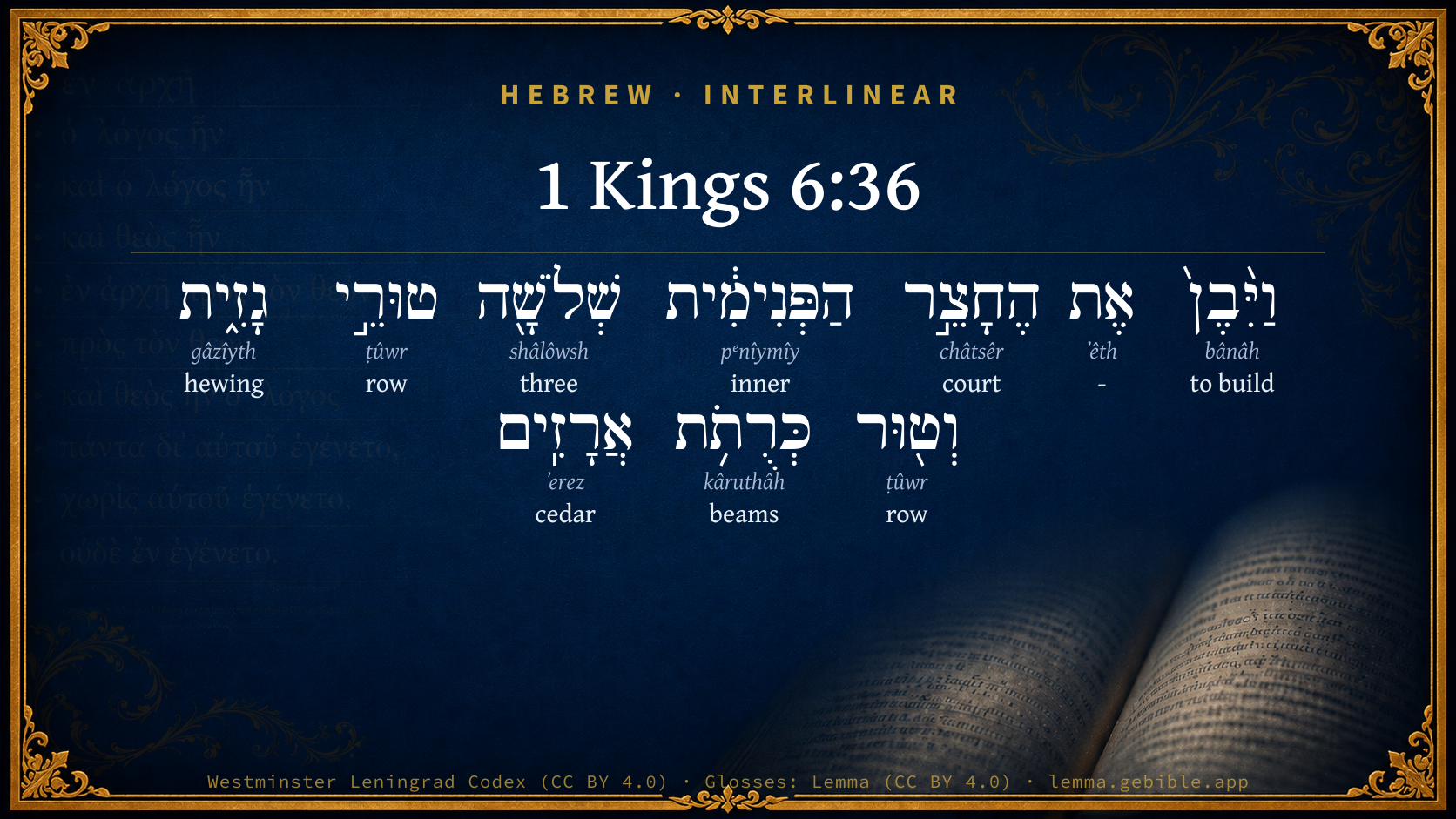
1 Kings 6:36

Hebrew (Westminster Leningrad Codex) 1 Kings 6:36 appears in the Hebrew Old Testament. The text above is from the Westminster Leningrad Codex. Each word links to its Strong’s number, a concise gloss, and parsing drawn from the Open Scriptures Hebrew Bible morphology. Click any word for its full Brown-Driver-Briggs (BDB) entry.
Download image
Cite this verse

1 Kings 6:36 (World English Bible). Public Domain. Lemma interlinear Bible study tool, https://lemma.gebible.app/v/1-kings/6/36.

Show BibTeX & RIS
BibTeX
RIS
English Translation
He built the inner court with three courses of hewn stone, and a course of cedar beams.
World English Bible · Public Domain
Highlights Full analysis ↓
Download a study sheet

One document with this verse’s original text, its word-by-word gloss line, the meaning frame, cross-references with their text, attributed commentary, and full source and license credits — printable, and it pastes into notes with its structure intact.

This verse Autodidact and up

Study sheet (.html) Plain text (.txt)

A passage Seminary Student

Up to 50 verses in one chapter. A passage sheet keeps up to 6 commentary sources and 12 cross-references per verse, in the order this page ranks them, and says so on the sheet whenever that leaves anything out. Ask for a single verse and you get the Autodidact verse sheet above.

Everything on this page stays free to read, with no account — the sheet is a download of what is already on screen, not access to it.

Want to remove ads? Support Godless Engineer
Compare translations 3

The same verse in 3 English versions, stacked beneath the original-language interlinear above. Click any original word for its lexicon entry.

Each is an independent rendering of the whole verse — the interlinear is not word-aligned to these translations.

Highlighted words mark where these versions differ — a whole-verse word diff, not a word-by-word alignment.

  • World English Bible Public Domain
    He built the inner court with three courses of hewn stone, and a course of cedar beams.
  • King James Version Public Domain
    And he built the inner court with three rows of hewed stone, and a row of cedar beams.
  • unfoldingWord Literal Text CC BY-SA 4.0
    And he built the inner courtyard three rows of hewn stone and a row of beams of cedar.

unfoldingWord Literal Text — © unfoldingWord, licensed CC BY-SA 4.0. Word-aligned USFM3 via Door43 (git.door43.org/unfoldingWord/en_ult).

Versions to compare (up to 4)

3 of 4 selected

Show all 18 translations

Every available English version of this verse, each an independent rendering of the whole verse.

  • World English Bible Public Domain
    He built the inner court with three courses of hewn stone, and a course of cedar beams.
  • Berean Standard Bible Public Domain
    Solomon built the inner courtyard with three rows of dressed stone and one row of trimmed cedar beams.
  • Majority Standard Bible Public Domain
    Solomon built the inner courtyard with three rows of dressed stone and one row of trimmed cedar beams.
  • King James Version Public Domain
    And he built the inner court with three rows of hewed stone, and a row of cedar beams.
  • American Standard Version (1901) Public Domain
    And he built the inner court with three courses of hewn stone, and a course of cedar beams.
  • Revised Version (1885) Public Domain
    And he built the inner court with three rows of hewn stone, and a row of cedar beams.
  • Geneva Bible (1599) Public Domain
    And hee built the court within with three rowes of hewed stone, and one rowe of beames of cedar.
  • Douay-Rheims (1899) Public Domain
    And two doors of fir tree, one of each side: and each door was double, and so opened with folding leaves.
  • Young's Literal Translation Public Domain
    And he buildeth the inner court, three rows of hewn work, and a row of beams of cedar.
  • Literal Standard Version CC BY-SA 4.0
    And he builds the inner court, three rows of hewn work, and a row of beams of cedar.
  • Unlocked Literal Bible CC BY-SA 4.0
    He built the inner courtyard with three rows of cut stone and a row of cedar beams.
  • unfoldingWord Literal Text CC BY-SA 4.0
    And he built the inner courtyard three rows of hewn stone and a row of beams of cedar.
  • Darby Bible Public Domain
    And he built the inner court of three rows of hewn stone, and a row of cedar-beams.
  • World Messianic Bible Public Domain
    He built the inner court with three courses of cut stone and a course of cedar beams.
  • Webster's Bible Public Domain
    And he built the inner court with three rows of hewn stone, and a row of cedar beams.
  • Free Bible Version CC BY-SA 4.0
    Solomon had the inner courtyard built with three courses of dressed stone and one of cedar beams.
  • Bible in Basic English Public Domain
    And the inner space was walled with three lines of squared stones and a line of cedar-wood boards.
  • JPS Tanakh (1917) Public Domain
    And he built the inner court with three rows of hewn stone, and a row of cedar beams.

Literal Standard Version (2020), Covenant Press — licensed CC BY-SA 4.0. Text via the HelloAO Bible API (eBible.org). Unlocked Literal Bible (unfoldingWord) — licensed CC BY-SA 4.0. Text via the HelloAO Bible API (eBible.org). unfoldingWord Literal Text — © unfoldingWord, licensed CC BY-SA 4.0. Word-aligned USFM3 via Door43 (git.door43.org/unfoldingWord/en_ult). Free Bible Version, Dr. Jonathan Gallagher — licensed CC BY-SA 4.0. Text via the HelloAO Bible API (eBible.org).

Word by word

More ways to search: Search by grammar → Find every occurrence → Compare this word →

Practice this passage: Drill this verse → Learn its vocabulary →

About this verse

These counts appear in no published source. They are computed here, from the morphology-tagged text and Lemma’s own curated glosses. What Lemma adds →

10
words
9
distinct lemmas
Historical
section

Notable vocabulary

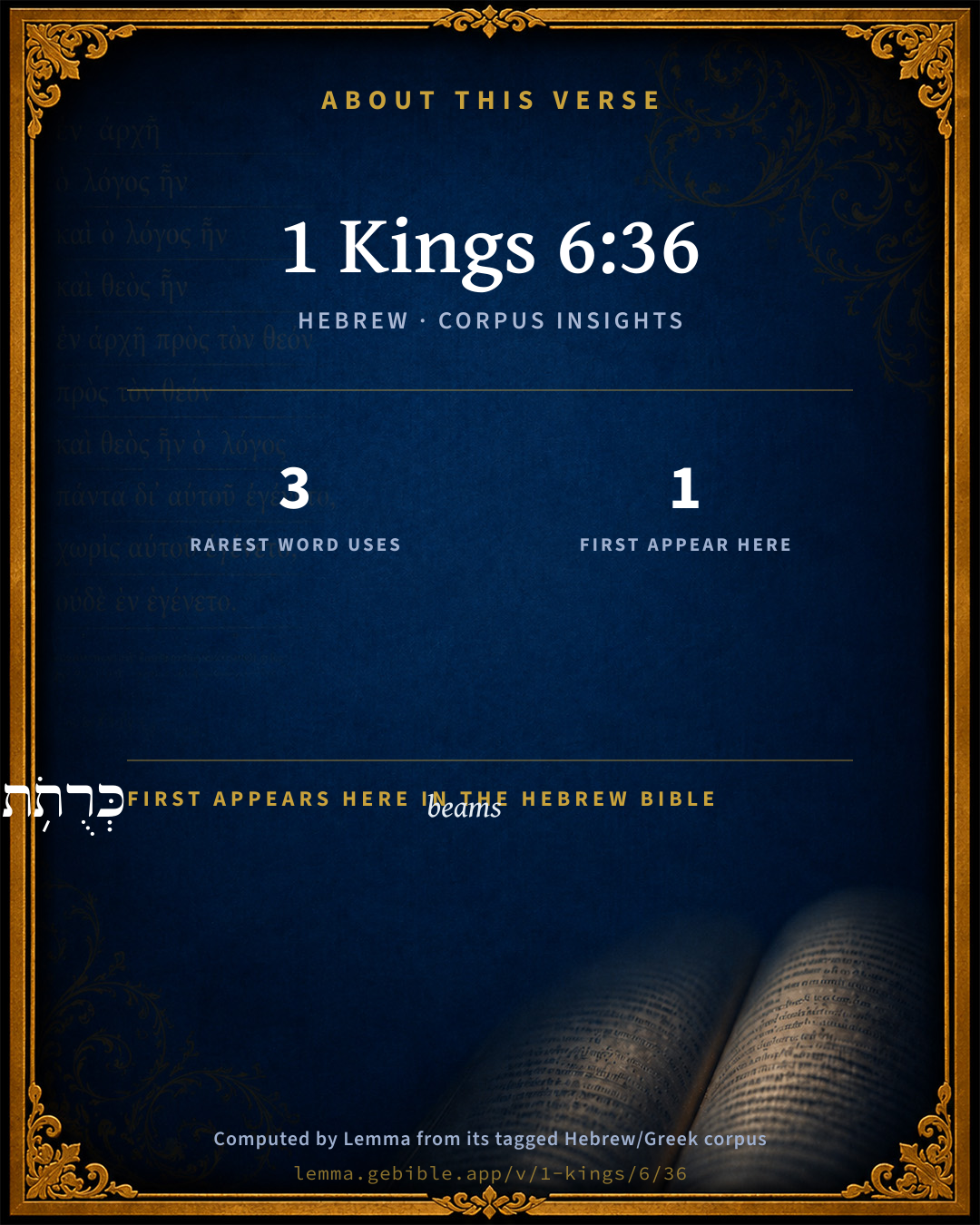
The rarest word here is כְּרֻתֹ֥ת beams H3773 — appearing just 3 times in the whole Hebrew Bible.

First appearance in Scripture

This word makes its first canonical appearance in the Hebrew Bible here:

  • כְּרֻתֹ֥ת beams H3773

Shared distinctive vocabulary

כְּרֻתֹ֥ת beams H3773 occurs in 3 verses of the Hebrew Bible. Also found in:

Grammatical profile

  • 1 verb
  • 6 nouns
  • 2 adjectives
  • 1 particle

Verb forms

  • וַיִּ֨בֶן֙ Qal · Sequential Imperfect

Repetition

A word recurs within this verse — often emphatic in Hebrew:

  • טוּרֵ֣י row H2905 ×2

Hebrew & Septuagint length

In English translation the verse runs 17 words from the Hebrew and 40 from the Septuagint (LXX English) — the Septuagint runs noticeably longer here. See the side-by-side →

A rough comparison of the two English renderings, which tokenize alike — not a word-level alignment.

Word counts can differ between the Hebrew and the Greek without any difference in meaning — e.g. the Hebrew direct-object marker אֵת has no separate Greek word, and Greek often adds the article ὁ.

Cross-references

6

Topical passages linked to 1 Kings 6:36 in the Treasury of Scripture Knowledge — connected by theme and wording, ordered by reader-vote popularity; previews shown in the World English Bible.

  • 1 Kings 7:12 The great court round about had three courses of hewn stone, and a course of cedar beams; like as the inner court of the house of Yahweh, and the porch of the house.
  • Exodus 27:9–19 "You shall make the court of the tent: for the south side southward there shall be hangings for the court of fine twined linen one hundred cubits long for one side:
  • Exodus 38:9–20 He made the court: for the south side southward the hangings of the court were of fine twined linen, one hundred cubits;
  • 2 Chronicles 4:9 Furthermore he made the court of the priests, and the great court, and doors for the court, and overlaid the doors of them with brass.
  • 2 Chronicles 7:7 Moreover Solomon made the middle of the court holy that was before the house of Yahweh; for there he offered the burnt offerings, and the fat of the peace-offerings, because the brazen altar which Solomon had made was not able to receive the burnt offering, and the meal-offering, and the fat.
  • Revelation 11:2 Leave out the court which is outside of the temple, and don't measure it, for it has been given to the gentiles. They will tread the holy city under foot for forty-two months.

Cross-references courtesy of OpenBible.info (CC BY 4.0).

Hebrew and Greek witnesses Masoretic Hebrew ↔ Greek Septuagint

The same verse in the two great witnesses to the Old Testament, shown verse-for-verse.

Here the Septuagint runs noticeably longer than the Hebrew — LXX2012 (modern English Septuagint) 40 words vs World English Bible 17. A rough length comparison of the two English translations, not a word-level alignment — read both below.

These are two independent witnesses, not word-aligned to each other, and the Septuagint is shown in lemma (dictionary) form.

Hebrew 1 Kings 6:36 Masoretic · Westminster Leningrad Codex

וַיִּ֨בֶן֙ אֶת הֶחָצֵ֣ר הַפְּנִימִ֔ית שְׁלֹשָׁ֖ה טוּרֵ֣י גָזִ֑ית וְט֖וּר כְּרֻתֹ֥ת אֲרָזִֽים

He built the inner court with three courses of hewn stone, and a course of cedar beams.

World English Bible · Public Domain

Greek LXX 1 Kings 6:36 Septuagint · lemma form

καί οἰκοδομέω ὁ αὐλή ὁ ἐσώτερος τρεῖς στίχος ἀπολέγω καί στίχος καταἐργάζομαι κέδρος κυκλόθεν καί οἰκοδομέω καταπέτασμα ὁ αὐλή ὁ αιλαμ ὁ οἶκος ὁ κατά πρόσωπον ὁ ναός

And he built the inner court, three rows of hewn stones, and a row of wrought cedar round about, and he made the curtain of the court of the porch of the house that was in front of the temple.

LXX2012 (modern English Septuagint) · Public Domain

On this verse, The Pulpit Commentary discusses the Septuagint’s reading. Read the note in Commentary ↓

Hebrew: Westminster Leningrad Codex (CC BY 4.0). Greek: Septuagint (public domain); English from LXX2012 (modern English Septuagint) (Public Domain). How the Septuagint differs from the Hebrew →

Targum (Aramaic paraphrase)

1

The Targum is the ancient Jewish Aramaic paraphrase of the Hebrew Scriptures — an interpretive translation, not the Hebrew text itself. Onkelos (literal) and Pseudo-Jonathan (expansive) render the Torah, and Jonathan the Prophets. Coverage is partial: where no permissively-licensed English translation exists for a verse, only the Aramaic is shown. This is verse-level text, not a word-by-word alignment to the Hebrew.

  1. Targum Jonathan Prophets (Joshua–Malachi)
    וּבְנָא יַת דַרְתָּא גַוְיָתָא תְּלָתָא סִדְרִין דְאֶבֶן טָבָא וְסִדְרָא חָד דְמָרֵישׁ אֲעֵי אַרְזַיָא:

    (no public-domain English translation for this verse)

    Targum Jonathan — Aramaic: “Mikraot Gedolot” (public domain). English: “Sefaria Community Translation” (CC0 1.0 (public-domain dedication)); “London "Chaldee Paraphrase," 1871” (public domain). Text via Sefaria.

Commentary

Notes on 1 Kings 6:36 from classic Christian and Jewish commentators (each source and its license shown beneath its notes). The classic Christian expositions comment on the surrounding passage and are grouped to its opening verse, so a note may address several verses; the Jewish commentaries on the Tanakh (Rashi and others) are per-verse, so they appear only where the commentator wrote on this verse.

Lemma curates 59 commentaries, every one of them public domain or Creative Commons licensed, each selected and text-cleaned for this edition rather than reprinted as found. About our sources →

Trapp's Complete Commentary

John Trapp

1Ki 6:36 And he built the inner court with three rows of hewed stone, and a row of cedar beams.

Ver. 36. And he built the inner court.] Called the court of the priests, {2Ch 4:9} and had without it an outer court, {Eze 10:3; Eze 10:5} called also the great court, {2Ch 4:9} where the people prayed, {Luk 1:10} and heard the word preached. {Act 3:11-12 Ezr 10:9} In this outer court it was that our Saviour preached, when he is said to have taught in the temple: here he disputed, cast out the buyers and sellers, &c. {Joh 2:14; Joh 2:16} This court of the people surrounded not only the priests’ court, but also the whole temple: by the name whereof also it is sometimes called.

John Trapp, A Commentary or Exposition upon All the Books of the Old and New Testament (1647–1656) — public domain. Text from a community e-Sword module.

Joseph Benson's Commentary

1Ki 6:36. The inner court — That wherein the priests officiated, (2Ch 4:9,) so called because it was next to the temple, which it encompassed. With three rows of hewed stone, and a row of cedar beams — It is difficult to ascertain the precise meaning of the sacred historian here. He may be understood as speaking, either, 1st, Of the thickness of the wall, the three rows of stones being one within another, and the cedar innermost, as a lining to the wall. Or, 2d, Of the height of the wall, which was only three cubits high, that the people might see the priests sacrificing upon the altar, which was in their court; each row of stones being about a cubit, and, possibly, of a colour different from the rest, and all covered with cedar. Or, 3d, He is to be understood of so many galleries, one on each side of the temple, whereof the three first were stone, and the fourth of cedar, all supported with rows of pillars, upon which there were many chambers for the uses of the temple, and of the priests.

Joseph Benson's Commentary on the Old and New Testaments (1811–1818) — public domain. Text from a community e-Sword module.

Tyndale Open Study Notes

Tyndale Open Resources

6:36-38 The inner courtyard surrounding the Temple was restricted to the priests (2 Chr 4:9) and contained the bronze altar (2 Chr 4:1), the bronze Sea (1 Kgs 7:23-26; 2 Chr 4:2-5), and ten carts that could hold ten basins of water for purification (1 Kgs 7:27-40; 2 Chr 4:6).

Tyndale Open Study Notes — © Tyndale Open Resources, licensed CC BY-SA 4.0. Text via the HelloAO Bible API.

Geneva Bible (1599)

Geneva Bible translators

Where the Priests were, and was thus called in respect of the great court, which is called in Acts 3:11, the porch of Solomon, where the people used to pray.

Geneva Bible (1599) marginal notes — public domain. Text via Bolls.life.

Jamieson, Fausset & Brown

Robert Jamieson, A. R. Fausset & David Brown

the inner court--was for the priests. Its wall, which had a coping of cedar, is said to have been so low that the people could see over it.

Jamieson, Fausset & Brown — Commentary Critical and Explanatory on the Whole Bible (1871) — public domain (CC PDM 1.0). Text via the HelloAO Bible API.

Adam Clarke's Commentary

Verse 36. Three rows of hewed stone, and a row of cedar beams.] Does not this intimate that there were three courses of stone, and then one course of timber all through this wall? Three strata of stone and one stratum of timber, and so on. If so, could such a building be very durable? This is also referred to in the succeeding chapter, 1Kg 7:11; and as both the temple and Solomon's house were built in the same manner, we may suppose that this was the ordinary way in which the better sort of buildings were constructed. Calmet thinks that to this mode of building the prophet alludes, Hab 2:11: The stone shall cry out of the wall, and the beam out of the timber shall answer it. But it should be observed that this was in the inner court, and therefore the timber was not exposed to the weather. The outer court does not appear to have been built stratum super stratum of stone and wood.

Adam Clarke's Commentary on the Bible (1810–1826) — public domain. Text from a community e-Sword/MySword module.

Ellicott's Commentary for English Readers

(36) The inner court (probably the “higher court” of Jer_35:10) is described as built round the Temple proper, evidently corresponding to the outer court of the Tabernacle. As this was (see Exo_27:9-13) 50 cubits by 100, it may be inferred, that by a duplication similar to that of all dimensions of the Temple itself, Solomon’s Court was 100 cubits (or 150 feet) by 200 cubits (or 300 feet), covering a little more than an acre. The verse has been interpreted in two ways: either that the floor of the court was raised by three courses of stone, covered with a planking of cedar, or (as Josephus understands it) enclosed by a wall of three courses of stone, with a coping of cedar wood. The latter seems more probable. For in this court stood the altar of burnt offering and the laver, and all sacrifices went on, and this could hardly have been done on a wooden pavement; and besides this we observe that the whole arrangement is (1Ki_7:12) compared with that of the great outer court of the palace where the wooden pavement would be still more unsuitable. It was what was called afterwards the “Court of the Priests,” and in it (see Eze_40:45) appear to have been chambers for the priests.

The mention of the “inner court” suggests that there was an outer court also. We have in 2Ki_21:5; 2Ki_23:12, a reference to the “two courts” of the Temple, and in Eze_40:17; Eze_42:1; Eze_42:8, a mention of the “outward” or “utter court.” Josephus (Antt. viii. 3, § 3) declares that Solomon built beyond the inner court a great quadrangle, erected for it great and broad cloisters, and closed it with golden doors, into which all could enter, “being pure and observant of the laws.” Even beyond this he indicates, though in rather vague and rhetorical language, an extension of the Temple area, as made by Solomon’s great substructures, forming a court less perfectly enclosed, like the Court of the Gentiles in the later Temple. Of these outer courts and cloisters the tradition remained in the assignment of the title of “Solomon’s Porch” to the eastern cloister of the later Temple. It has been thought that in this outer court were planted trees (in spite of the prohibition of Deu_16:21); and this may have been the case, till the association of idol worship with them made these seem to be unfit for the House of the Lord. But the passages usually quoted to support this view are from the Psalms (Psa_52:8; Psa_92:13), of which the former certainly refers to the Tabernacle, and the latter may do so.

A Bible Commentary for English Readers, edited by Charles John Ellicott (1878–1897) — public domain. Text from a community e-Sword module.

The Cambridge Bible for Schools and Colleges

gen. ed. J. J. S. Perowne

36. And he built the inner court] This inner court is that which in Jer_36:10 is called ‘the higher court’ and must be that intended (2Ch_4:9) by the ‘court of the priests’ in contradistinction to ‘the great court,’ which must have enclosed the inner one. There is some doubt as to how the description in this verse is to be understood. It seems clear from the passage in Jeremiah that the inner was on a higher level than the outer court. Some have thought that this elevation was made by three layers of stone and then a wooden planking put over all. But to do this for the whole enclosure would have been very laborious work and seemingly for no purpose. It seems better to take it that the elevation was artificially made, and then to understand the three rows of hewn stone, covered by one row of cedar wood at the top, to have made a sort of sunk fence all round the inner court. The people standing in the outer court would need to see what the priests were doing. This they would all be able to do if the wall of stone and cedar work were very little, if at all, higher than the level of the inner court.

The Cambridge Bible for Schools and Colleges (gen. ed. J. J. S. Perowne; Cambridge University Press, 1878–1918) — public domain. Text from a community e-Sword module.

Albert Barnes' Notes on the Bible

The inner court - An outer court is mentioned in 2Ch 4:9. The inner court is probably identical with the “higher court” of Jeremiah Jer 36:10, being raised above the outer, as were sometimes the inner courts of Assyrian palaces. The court seems to have surrounded the temple. Its dimensions may be reasonably presumed to have been double those of the court of the tabernacle, i. e., 100 cubits on each side of the temple, and 200 cubits at the ends; or, about 720 feet long by 360 broad.

With three rows of hewed stone - Either a fence enclosing the court, or the area of the court, which was possibly formed by three layers of hewn stone placed one above the other, and was then boarded on the top with cedar planks. Such a construction would no doubt be elaborate; but if it was desired to elevate the inner court above the outer, this is the way in which it would be likely to have been done. The temple would be placed, like the Assyrian palaces, on an artificial platform; and the platform, being regarded as a part of the sacred building, would be constructed of the best material.

Albert Barnes' Notes on the Bible (1834–1885) — public domain. Text from a community e-Sword/MySword module.

Haydock's Catholic Bible Commentary

Court of the priests. --- Cedar. Some think that the court was surrounded with galleries, supported on three rows of pillars; or one gallery was above another, on pillars of stone, with a third supported by cedar pillars. (Menochius) --- But Josephus takes no notice of these galleries. Others think that the wall of separation consisted only of two rows of stone, with a third of wood, in all three cubits high. (Josephus, [Antiquities?] viii. 2.) (Villalpand) --- But the sacred writers seem rather to indicate, that beams of cedar were fixed in the walls, at the distance of three courses of stone, even to the top. This mode of architecture is clearly mentioned, chap. vii. 12., 1 Esdras vi. 3, 4., and v. 8., and Habacuc ii. 11. The ancients admired such a variety, and deemed the building more solid. (Vit. i. 5.) Eupolemus (ap. Eusebius, præp. ix. 34.) take notice, that these beams were fastened together, in the temple, by hooks of copper, weighing each a talent. (Haydock) --- Such was the structure of the inner court. (Calmet)

George Leo Haydock (1774–1849), Haydock's Catholic Family Bible and Commentary, 1859 edition — public domain. Excludes Psalms (Douay-Rheims chapter numbering differs from Protestant) and Deuterocanonical books (Catholic canon only).

Matthew Poole's English Annotations

The inner court, i.e. the priests’ court, 2Ch 4:9; so called, because it was next to the temple, which it did encompass.

With three rows of hewed stone, and a row of cedar beams; which is understood either,

1. Of the thickness of the wall, the three rows of stones being one within another, and the cedar innermost, as a lining to the wall. Or,

2. Of the height of the wall, which was only three cubits high, that the people might see the priests sacrificing upon the altar, which was in their court; each row of stones being about a cubit, and possibly of a differing colour from the rest, and all covered with cedar. Or rather,

3. Of so many galleries, one on each side of the temple, whereof the three first were of stone, and the fourth of cedar, all supported with rows of pillars; upon which there were many chambers for the uses of the temple, and of the priests; for it is hard to think that only the making of a low wall about the court would be called a building of the court. And that a great number of buildings and rooms were necessary for the various offices and works which were to be done, and the treasures of all sorts which were to be laid up in the temple, largely so called, is sufficiently evident from the nature of the things, and divers passages in Scripture: see, among others, 1Ch 28:11,12.

Matthew Poole's English Annotations on the Holy Bible (1683–1685) — public domain. Text from a community e-Sword/MySword module.

Whedon's Commentary on the Bible

Daniel D. Whedon

36. The inner court — The temple was surrounded by a double court or enclosure, an inner and an outer. The outer was much larger than the inner court, but the exact size of each it is now impossible to decide. These courts seem also to have been called respectively the upper and the lower, (Jer_36:10,) probably because the one occupied a higher terrace than the other, in 2Ch_4:9, the outer is called the great court, and the inner the court of the priests.

Three rows of hewed stone, and a row of cedar beams — The precise meaning is obscure, but is usually understood of the enclosing wall of the inner court being so constructed that three layers of hewn stone were placed one upon another, and a row of cedar beams fastened on the top, either horizontally or in the form of a railing or balustrade. Perhaps, however, it is better to understand these layers of stone and cedar as forming the pavement of the inner court, and covering its entire area. This would have boon the natural way to elevate the platform of the inner court above that of the outer, (compare Jer_36:10,) and thus, says Rawlinson, “the temple would be placed, like the Assyrian palaces, on an artificial platform; and the platform, being regarded as a part of the sacred building, would be constructed of the best material.”

Daniel D. Whedon (gen. ed.), Commentary on the Old and New Testaments (1874–1909) — public domain. Text from a community e-Sword module.

The Pulpit Commentary

The description of the buildings concludes with a brief reference to the enceinte or court. And he built the inner court The mention of an inner court, called in 2Ch_4:9 the "court of the priests," presupposes, of course, the existence of an outer court. Our author does not mention this, but the chronicler does, under the name of "the great court." In Jer_36:10, the former is called the "higher court," because it occupied a higher level with three rows of hewed stone and a row of cedar beams. These, it is thought, formed the enclosing wall of the court (the LXX adds kukloqen). The cedar beams were instead of coping stones. It has been supposed, however (J.D. Michaelis), that these three rows of stone, boarded with cedar, formed the pavement of the court. But the question at once suggests itself, Why pile three rows of stones one upon another merely to form a pavement, and why hew and shape them if they were to be concealed beneath a stratum of wood? It is a fair inference from 2Ch_7:3, that the wall was low enough to permit men to look over it. Fergusson, on the contrary, argues that it must have been twice the height of the enclosure of the tabernacle, which would give us an elevation of ten cubits. (Exo_27:18) It is worth suggesting, however, whether, the inner court being raised above the outer, which surrounded it, these stones may not have formed the retaining wall or sides of the platform. As the outer court had (2Ki_11:6 2Ki_12:9; 2Ch_4:9 2Ch_23:5 2Ch_24:8) it also must have had walls. From 2Ki_23:11; Jer_35:2 Jer_36:10, we gather that there were various chambers in the forecourt. Such were certainly contemplated by David; (1Ch_28:12) but it is not recorded that Solomon built them. Nor have we any warrant, except the bare assertion of Josephus, for the belief that he built a colonnade or cloister on the east side, such as was known to later ages by the name of "Solomon"s Porch" (Joh_10:23; Act_3:11 Act_5:12) As to the dimensions of these spaces, we are left to conjecture. If, as in everything else, the dimensions of the tabernacle were doubled, then the court of the priests would measure 200 cubits from east to west, and 100 cubits from north to south. It should be stated, however, that in the temple of Ezekiel, the proportions of which, in the present instance, may well he historical, both courts are represented as perfect squares. Rawlinson inadvertently puts down the length (along the side of temple) at 100 cubits, and the breadth (ends of temple) at 200. The outer court would probably be twice as large as the inner, i.e., 400 x 200 cubits. But all this is necessarily uncertain.

The Pulpit Commentary (1880–1919), ed. H.D.M. Spence-Jones & Joseph S. Exell — public domain. Text from a community e-Sword module.

John Wesley's Explanatory Notes

Inner court - The priests court, 2 Chron. iv, 9, so called, because it was next to the temple which it compassed. Cedar beams - Which is understood, of so many galleries, one on each side of the temple, whereof the three first were of stone, and the fourth of cedar, all supported with rows of pillars: upon which there were many chambers for the uses of the temple, and of the priests.

John Wesley, Explanatory Notes Upon the Whole Bible (1754–1765) — public domain. Text via the GEBible commentary corpus.

Keil & Delitzsch

C. F. Keil & F. Delitzsch

The courts. - "He built the inner court three rows of hewn stones and one row of hewn cedar beams." The epithet inner court applied to the "court of the priests" (Ch2 4:9) presupposes an outer one, which is also mentioned in Ch2 4:9, and called "the great court." The inner one is called the upper (higher) court in Jer 36:10, from which it follows that it was situated on a higher level than the outer one, which surrounded it on all sides. It was enclosed by a low wall, consisting of three rows of hewn stones, or square stones, laid one upon another, and a row of hewn cedar beams, which were either laid horizontally upon the stones, after the analogy of the panelling of the temple walls on the inside, or placed upright so as to form a palisading, in order that the people might be able to see through into the court of the priests. According to Ch2 4:9, the outer court had gates lined with brass, so that it was also surrounded with a high wall. Around it there were chambers and cells (Kg2 23:11; Jer 35:4; Jer 36:10) for the priests and Levites, the plans for which had already been made by David (Ch1 28:12). The principal gate was the east gate (Eze 11:1). Other gates are mentioned in Kg2 11:6; Ch2 23:5, Jer 20:2 Kg2 12:10; Ch2 24:8. The size of these courts is not given. At the same time, following the analogy of the tabernacle, and with the reduplication of the rooms of the tabernacle which is adopted in other cases in the temple, we may set down the length of the court of the priests from east to west at 200 cubits, and the breadth from south to north at 100 cubits; so that in front of the temple-building on the east there was a space of 100 cubits in length and breadth, or 10,000 square cubits, left free for the altar of burnt-offering and the other vessels, in other words, for the sacrificial worship. The outer or great court will therefore, no doubt, have been at least twice as large, namely, 400 cubits long and 200 cubits broad, i.e., in all, 80,000 square cubits; so that the front space before the court of the priests (on the eastern side) was 150 cubits long from east to west, and 200 cubits broad from south to north, and 50 cubits in breadth or depth still remained for the other three sides.

Keil & Delitzsch — Biblical Commentary on the Old Testament (1861–1891) — public domain (CC PDM 1.0). Text via the HelloAO Bible API. (Old Testament only.)

unfoldingWord translationNotes

Door43 World Missions Community

He built the inner courtyard

Solomon would have commanded his workers to do this work. AT: "They built the inner courtyard" (See: Metonymy)

cedar beams

A beam is a long heavy piece of wood used to support a building. See how you translated this in 1 Kings 6:6.

translationWords

cedar

unfoldingWord translationNotes — © Distant Shores Media and the Door43 World Missions Community, licensed CC BY-SA 4.0. Source: git.door43.org/Door43/en_tn.

Rashi

Rabbi Shlomo Yitzchaki (Rashi)

The inner court. This was the court of Kohanim and the court of Yisroel, and it was [located] before the entrance hall, yet he calls it “the inner one” because it was inward of the women’s court. (In the Biblical text we do not find written “עזרת” except for in the Mishnah. )

And a row of cut cedar beams. A tier of (cut) beams made [part of] the wall.

Rashi on the Tanakh — English translations: “The Judaica Press complete Tanach with Rashi, translated by A. J. Rosenberg” (CC BY 4.0); “Pentateuch with Rashi's commentary by M. Rosenbaum and A.M. Silbermann, 1929-1934” (public domain); “The Metsudah Tanach series, Lakewood, N.J” (CC BY 4.0); and “The Book of Joshua, Metsudah Publications, 1997” (CC BY 4.0). Text via Sefaria.

Lesson kit

Teaching starters — assembled from the data on this page, not authored interpretation. Every prompt links to the verse data it draws on. Edit before teaching.

1 Kings, in the Historical, opens this verse with 10 words (9 distinct Hebrew lemmas). Its most distinctive word is kâruthâh (“beams”). The Greek Septuagint runs longer here. A historical commentator’s framing appears above. Read the whole chapter for the surrounding context.

Discussion questions

  1. How does “beams” (kâruthâh) shape what this verse is saying?
  2. The word “beams” first appears here in Scripture. What is being introduced at this debut?
  3. 1 Kings 7:2 shares the word «beams» with this verse. How do the two illuminate each other?
  4. “row” occurs 2× in this one verse. What is the effect of the repetition?
  5. Compared with the Hebrew, the Septuagint runs longer here. What questions does that raise?
  6. The translations on this page render this verse differently — a whole-verse word diff, not a word-by-word alignment. What might account for the different wordings?
  7. The verb «וַיִּ֨בֶן֙» is Qal Sequential Imperfect. How does its form color the action?
  8. Reading how Trapp's Complete Commentary and Joseph Benson's Commentary read this verse, where do the two commentators agree and where do they part?

Things to notice

  • 1 word makes its first canonical appearance in Scripture here.
  • These translations choose different wording for 8 words in this verse.
  • “row” occurs 2× in this single verse.
  • 9 distinct Hebrew lemmas span 10 words in this verse.

Reading settings

Reading text

Shown beneath each verse's original-language words.

Old Testament
Old Testament edition

Read the OT as the Masoretic Hebrew (MT) or the Greek Septuagint (LXX).

English shown for the Greek Septuagint (in the Hebrew ↔ Greek comparison).

Comparing translations? Open the Compare panel on any verse page to stack up to four side by side.