
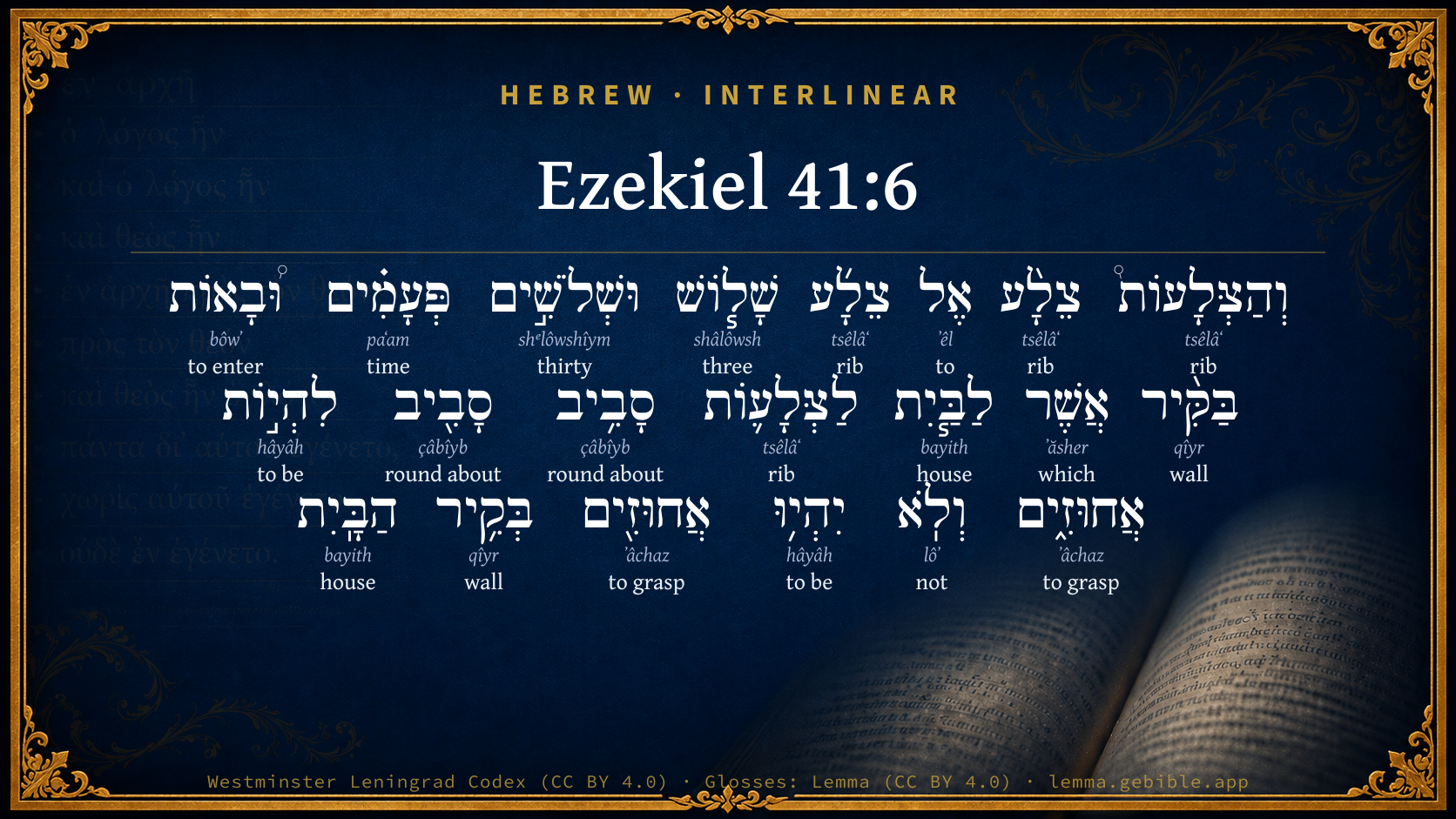
Ezekiel 41:6

Hebrew (Westminster Leningrad Codex) Ezekiel 41:6 appears in the Hebrew Old Testament. The text above is from the Westminster Leningrad Codex. Each word links to its Strong’s number, a concise gloss, and parsing drawn from the Open Scriptures Hebrew Bible morphology. Click any word for its full Brown-Driver-Briggs (BDB) entry.
Download image
Cite this verse

Ezekiel 41:6 (World English Bible). Public Domain. Lemma interlinear Bible study tool, https://lemma.gebible.app/v/ezekiel/41/6.

Show BibTeX & RIS
BibTeX
RIS
English Translation
The side-chambers were in three stories, one over another, and thirty in order; and they entered into the wall which belonged to the house for the side-chambers round about, that they might have hold [therein], and not have hold in the wall of the house.
World English Bible · Public Domain
Download a study sheet

One document with this verse’s original text, its word-by-word gloss line, the meaning frame, cross-references with their text, attributed commentary, and full source and license credits — printable, and it pastes into notes with its structure intact.

This verse Autodidact and up

Study sheet (.html) Plain text (.txt)

A passage Seminary Student

Up to 50 verses in one chapter. A passage sheet keeps up to 6 commentary sources and 12 cross-references per verse, in the order this page ranks them, and says so on the sheet whenever that leaves anything out. Ask for a single verse and you get the Autodidact verse sheet above.

Everything on this page stays free to read, with no account — the sheet is a download of what is already on screen, not access to it.

Want to remove ads? Support Godless Engineer
Compare translations 3

The same verse in 3 English versions, stacked beneath the original-language interlinear above. Click any original word for its lexicon entry.

Each is an independent rendering of the whole verse — the interlinear is not word-aligned to these translations.

Highlighted words mark where these versions differ — a whole-verse word diff, not a word-by-word alignment.

  • World English Bible Public Domain
    The side-chambers were in three stories, one over another, and thirty in order; and they entered into the wall which belonged to the house for the side-chambers round about, that they might have hold [therein], and not have hold in the wall of the house.
  • King James Version Public Domain
    And the side chambers were three, one over another, and thirty in order; and they entered into the wall which was of the house for the side chambers round about, that they might have hold, but they had not hold in the wall of the house.
  • unfoldingWord Literal Text CC BY-SA 4.0
    There were side rooms on three levels, one room above another, thirty rooms on each level. There were ledges around the wall of the house, to support all of the side rooms, for there was no support put in the wall of the house.

unfoldingWord Literal Text — © unfoldingWord, licensed CC BY-SA 4.0. Word-aligned USFM3 via Door43 (git.door43.org/unfoldingWord/en_ult).

Versions to compare (up to 4)

3 of 4 selected

Show all 18 translations

Every available English version of this verse, each an independent rendering of the whole verse.

  • World English Bible Public Domain
    The side-chambers were in three stories, one over another, and thirty in order; and they entered into the wall which belonged to the house for the side-chambers round about, that they might have hold [therein], and not have hold in the wall of the house.
  • Berean Standard Bible Public Domain
    The side rooms were arranged one above another in three levels of thirty rooms each. There were ledges all around the wall of the temple to serve as supports for the side rooms, so that the supports would not be fastened into the wall of the temple itself.
  • Majority Standard Bible Public Domain
    The side rooms were arranged one above another in three levels of thirty rooms each. There were ledges all around the wall of the temple to serve as supports for the side rooms, so that the supports would not be fastened into the wall of the temple itself.
  • King James Version Public Domain
    And the side chambers were three, one over another, and thirty in order; and they entered into the wall which was of the house for the side chambers round about, that they might have hold, but they had not hold in the wall of the house.
  • American Standard Version (1901) Public Domain
    And the side-chambers were in three stories, one over another, and thirty in order; and they entered into the wall which belonged to the house for the side-chambers round about, that they might have hold `therein', and not have hold in the wall of the house.
  • Revised Version (1885) Public Domain
    And the side-chambers were in three stories, one over another, and thirty in order; and they entered into the wall which belonged to the house for the side-chambers round about, that they might have hold therein, and not have hold in the wall of the house.
  • Geneva Bible (1599) Public Domain
    And the chambers were chamber vpon chaber, three and thirtie foote high, and they entred into the wall made for the chambers which was round about the house, that the postes might bee fastened therein, and not be fastened in the wall of the house.
  • Douay-Rheims (1899) Public Domain
    And the side chambers one by another, were twice thirty-three: and they bore outwards, that they might enter in through the wall of the house in the sides round about, to hold in, and not to touch the wall of the temple.
  • Young's Literal Translation Public Domain
    And the side-chambers `are' side-chamber by side-chamber, three and thirty times; and they are entering into the wall -- which the house hath for the side-chambers all round about -- to be taken hold of, and they are not taken hold of by the wall of the house.
  • Literal Standard Version CC BY-SA 4.0
    And the side-chambers [are] side-chamber by side-chamber, thirty-three times; and they are entering into the wall—which the house has for the side-chambers all around—to be taken hold of, and they are not taken hold of by the wall of the house.
  • Unlocked Literal Bible CC BY-SA 4.0
    There were side rooms on three levels, one room above another, thirty rooms on each level. There were ledges around the wall of the house, to support all of the side rooms, for there was no support put in the wall of the house.
  • unfoldingWord Literal Text CC BY-SA 4.0
    There were side rooms on three levels, one room above another, thirty rooms on each level. There were ledges around the wall of the house, to support all of the side rooms, for there was no support put in the wall of the house.
  • Darby Bible Public Domain
    And the side-chambers were three, chamber over chamber, and thirty in order; and they entered into the wall which the house had for the side-chambers round about, that they might have hold; but they had not hold in the wall of the house.
  • World Messianic Bible Public Domain
    The side rooms were in three stories, one over another, and thirty in each story. They entered into the wall which belonged to the house for the side rooms all around, that they might be supported and not penetrate the wall of the house.
  • Webster's Bible Public Domain
    And the side-chambers were three, one over another, and thirty in order; and they entered into the wall which was of the house for the side-chambers around, that they might have hold, but they had not hold in the wall of the house.
  • Free Bible Version CC BY-SA 4.0
    There were three levels of side rooms above one another, each having thirty rooms. The wall of the Temple had external supports for the side rooms, so that they would not be fixed into the wall of the Temple itself.
  • Bible in Basic English Public Domain
    And the side-rooms, room over room, were three times thirty; there were inlets in the wall of the house for the side-rooms round about, for supports in the wall of the house.
  • JPS Tanakh (1917) Public Domain
    And the side-chambers were one over another, three and thirty times; and there were cornices in the wall which belonged to the house for the side-chambers round about, that they might have hold therein, and not have hold in the wall of the house.

Literal Standard Version (2020), Covenant Press — licensed CC BY-SA 4.0. Text via the HelloAO Bible API (eBible.org). Unlocked Literal Bible (unfoldingWord) — licensed CC BY-SA 4.0. Text via the HelloAO Bible API (eBible.org). unfoldingWord Literal Text — © unfoldingWord, licensed CC BY-SA 4.0. Word-aligned USFM3 via Door43 (git.door43.org/unfoldingWord/en_ult). Free Bible Version, Dr. Jonathan Gallagher — licensed CC BY-SA 4.0. Text via the HelloAO Bible API (eBible.org).

Word by word

More ways to search: Search by grammar → Find every occurrence → Compare this word →

Practice this passage: Drill this verse → Learn its vocabulary →

וְהַצְּלָעוֹת֩
tsêlâʻ
H6763
“and · the · ribs”
Conjunction + Particle, Definite Article + Noun, Common, Both, Plural, Absolute
Part of Speech
Conjunction + Particle + Noun
Type
Common
Gender
Both
Number
Plural
State
Absolute
Full BDB Definition

Origin: from H6760

TWOT: 1924a

side, rib, beam - rib (of man) - rib (of hill, ridge, etc) - side-chambers or cells (of temple structure) - rib, plank, board (of cedar or fir) - leaves (of door) - side (of ark)
  1. צֵלָ֨ע tsêlâʻ H6763 “rib” Noun, Common, Both, Singular, Absolute
  2. אֶל ʼêl H413 “to” Preposition
  3. צֵלָ֜ע tsêlâʻ H6763 “rib” Noun, Common, Both, Singular, Absolute
  4. שָׁל֧וֹשׁ shâlôwsh H7969 “three” Adjective, Cardinal number, Feminine, Singular, Absolute
  5. וּשְׁלֹשִׁ֣ים shᵉlôwshîym H7970 “and · thirty” Conjunction + Adjective, Cardinal number, Both, Plural, Absolute
  6. פְּעָמִ֗ים paʻam H6471 “times” Noun, Common, Feminine, Plural, Absolute
  7. וּ֠בָאוֹת bôwʼ H935 “and · entering” Conjunction + Verb, Qal, Participle Active, Feminine, Plural, Absolute
  8. בַּקִּ֨יר qîyr H7023 “in/at the · wall” Preposition, Determined + Noun, Common, Masculine, Singular, Absolute
  9. אֲשֶׁר ʼăsher H834 “which” Particle, Relative
  10. לַבַּ֧יִת bayith H1004 “to/for the · house” Preposition, Determined + Noun, Common, Masculine, Singular, Absolute
  11. לַצְּלָע֛וֹת tsêlâʻ H6763 “to/for the · ribs” Preposition, Determined + Noun, Common, Both, Plural, Absolute
  12. סָבִ֥יב çâbîyb H5439 “round about” Noun, Common, Both, Singular, Absolute
  13. סָבִ֖יב çâbîyb H5439 “round about” Noun, Common, Both, Singular, Absolute
  14. לִהְי֣וֹת hâyâh H1961 “to be” Preposition + Verb, Qal, Infinitive Construct
  15. אֲחוּזִ֑ים ʼâchaz H270 “grasped” Verb, Qal, Participle Passive, Masculine, Plural, Absolute
  16. וְלֹֽא lôʼ H3808 “and · not” Conjunction + Particle, Negative
  17. יִהְי֥וּ hâyâh H1961 “to be” Verb, Qal, Imperfect, 3rd Person, Masculine, Plural
  18. אֲחוּזִ֖ים ʼâchaz H270 “grasped” Verb, Qal, Participle Passive, Masculine, Plural, Absolute
  19. בְּקִ֥יר qîyr H7023 “in/at · wall of” Preposition + Noun, Common, Masculine, Singular, Construct
  20. הַבָּֽיִת bayith H1004 “the · house” Particle, Definite Article + Noun, Common, Masculine, Singular, Absolute

About this verse

These counts appear in no published source. They are computed here, from the morphology-tagged text and Lemma’s own curated glosses. What Lemma adds →

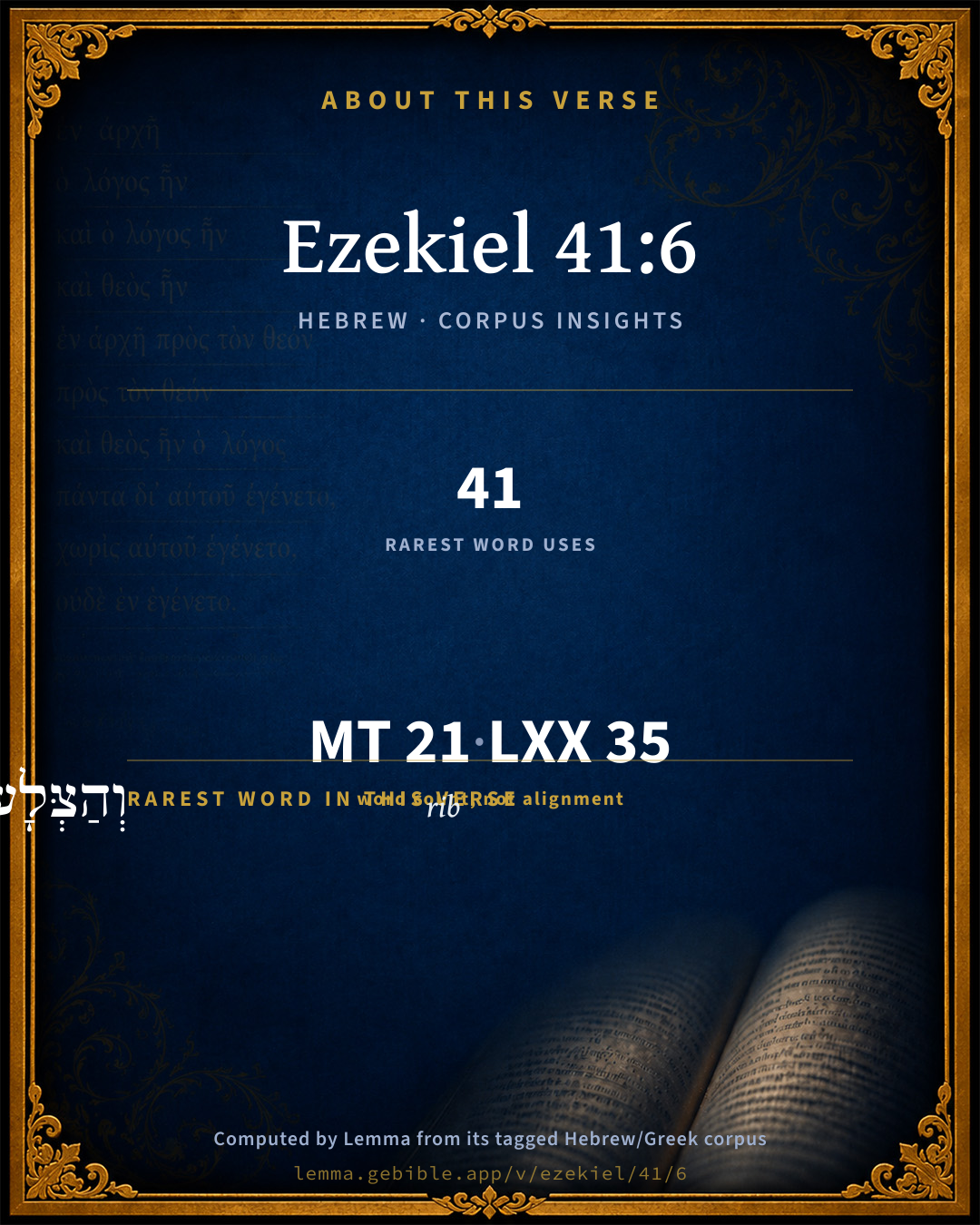
21
words
13
distinct lemmas
Prophets
section

Shared distinctive vocabulary

וְהַצְּלָעוֹת֩ rib H6763 occurs in 32 verses of the Hebrew Bible. Also found in:

Grammatical profile

  • 5 verbs
  • 11 nouns
  • 2 adjectives
  • 1 preposition
  • 2 particles

Verb forms

  • וּ֠בָאוֹת Qal · Participle Active
  • לִהְי֣וֹת Qal · Infinitive Construct
  • אֲחוּזִ֑ים Qal · Participle Passive
  • יִהְי֥וּ Qal · Imperfect
  • אֲחוּזִ֖ים Qal · Participle Passive

Repetition

Words recur within this verse — often emphatic in Hebrew:

  • וְהַצְּלָעוֹת֩ rib H6763 ×4
  • בַּקִּ֨יר wall H7023 ×2
  • לַבַּ֧יִת house H1004 ×2
  • סָבִ֥יב round about H5439 ×2
  • לִהְי֣וֹת to be H1961 ×2
  • אֲחוּזִ֑ים to grasp H270 ×2

Hebrew & Septuagint length

In English translation the verse runs 45 words from the Hebrew and 50 from the Septuagint (LXX English) — closely comparable.

A rough comparison of the two English renderings, which tokenize alike — not a word-level alignment.

Word counts can differ between the Hebrew and the Greek without any difference in meaning — e.g. the Hebrew direct-object marker אֵת has no separate Greek word, and Greek often adds the article ὁ.

In the original languages it is 21 Hebrew tokens and 35 Greek tokens — but the two are counted differently (Hebrew bundles its prefixes and suffixes into one token; the Greek is in lemma form), so that isn’t a like-for-like length.

Cross-references

4

Topical passages linked to Ezekiel 41:6 in the Treasury of Scripture Knowledge — connected by theme and wording, ordered by reader-vote popularity; previews shown in the World English Bible.

  • 1 Kings 6:10 He built the stories against all the house, each five cubits high: and they rested on the house with timber of cedar.
  • 1 Kings 6:5–6 Against the wall of the house he built stories round about, against the walls of the house round about, both of the temple and of the oracle; and he made side-chambers round about.
  • Ezekiel 40:17 Then brought he me into the outer court; and, behold, there were chambers and a pavement, made for the court round about: thirty chambers were on the pavement.
  • 1 Peter 1:5 who by the power of God are guarded through faith for a salvation ready to be revealed in the last time.

Cross-references courtesy of OpenBible.info (CC BY 4.0).

Hebrew and Greek witnesses Masoretic Hebrew ↔ Greek Septuagint

The same verse in the two great witnesses to the Old Testament, shown verse-for-verse.

These are two independent witnesses, not word-aligned to each other, and the Septuagint is shown in lemma (dictionary) form.

Hebrew Ezekiel 41:6 Masoretic · Westminster Leningrad Codex

וְהַצְּלָעוֹת֩ צֵלָ֨ע אֶל צֵלָ֜ע שָׁל֧וֹשׁ וּשְׁלֹשִׁ֣ים פְּעָמִ֗ים וּ֠בָאוֹת בַּקִּ֨יר אֲשֶׁר לַבַּ֧יִת לַצְּלָע֛וֹת סָבִ֥יב סָבִ֖יב לִהְי֣וֹת אֲחוּזִ֑ים וְלֹֽא יִהְי֥וּ אֲחוּזִ֖ים בְּקִ֥יר הַבָּֽיִת

The side-chambers were in three stories, one over another, and thirty in order; and they entered into the wall which belonged to the house for the side-chambers round about, that they might have hold [therein], and not have hold in the wall of the house.

World English Bible · Public Domain

Greek LXX Ezekiel 41:6 Septuagint · lemma form

καί ὁ πλευρόν πλευρόν ἐπί πλευρόν τριάκοντα καί τρεῖς δίς καί διάστημα ἐν ὁ τοῖχος ὁ οἶκος ἐν ὁ πλευρόν κύκλος ὁ εἰμί ὁ ἐπιλαμβάνω ὁράω ὅπως ὁ παράπαν μή ἅπτομαι ὁ τοῖχος ὁ οἶκος

And the sides were twice ninety, side against side; and there was a space in the wall of the house at the sides round about, that they should be for them that take hold of them to see, that they should not at all touch the walls of the house.

LXX2012 (modern English Septuagint) · Public Domain

On this verse, The Cambridge Bible for Schools and Colleges discusses the Septuagint’s reading. Read the note in Commentary ↓

Hebrew: Westminster Leningrad Codex (CC BY 4.0). Greek: Septuagint (public domain); English from LXX2012 (modern English Septuagint) (Public Domain). How the Septuagint differs from the Hebrew →

Targum (Aramaic paraphrase)

1

The Targum is the ancient Jewish Aramaic paraphrase of the Hebrew Scriptures — an interpretive translation, not the Hebrew text itself. Onkelos (literal) and Pseudo-Jonathan (expansive) render the Torah, and Jonathan the Prophets. Coverage is partial: where no permissively-licensed English translation exists for a verse, only the Aramaic is shown. This is verse-level text, not a word-by-word alignment to the Hebrew.

  1. Targum Jonathan Prophets (Joshua–Malachi)
    וּמְחִיצַיָא מְחִיצָא עַל מְחִיצָא תְּלָתִין וּתְלַת חֲדָא עַסְרֵי בְּסִידְרָא קְבִיעִין בְּכִתְלָא דְמִגָיו לִמְחִיצָא סְחוֹר סְחוֹר לְמֶהֱוֵי רֵישֵׁי שַׁרְיָתָא נָיְחִין עַל זִיזָא וְלָא יֶהֶוְיָן שַׁרְיָתָא מְעַבְּרָן בְּכָתְלֵי בֵּיתָא:

    (no public-domain English translation for this verse)

    Targum Jonathan — Aramaic: “Mikraot Gedolot” (public domain). English: “Sefaria Community Translation” (CC0 1.0 (public-domain dedication)); “London "Chaldee Paraphrase," 1871” (public domain). Text via Sefaria.

Commentary

Notes on Ezekiel 41:6 from classic Christian and Jewish commentators (each source and its license shown beneath its notes). The classic Christian expositions comment on the surrounding passage and are grouped to its opening verse, so a note may address several verses; the Jewish commentaries on the Tanakh (Rashi and others) are per-verse, so they appear only where the commentator wrote on this verse.

Lemma curates 59 commentaries, every one of them public domain or Creative Commons licensed, each selected and text-cleaned for this edition rather than reprinted as found. About our sources →

Trapp's Complete Commentary

John Trapp

Eze 41:6 And the side chambers [were] three, one over another, and thirty in order; and they entered into the wall which [was] of the house for the side chambers round about, that they might have hold, but they had not hold in the wall of the house.

Ver. 6. And the side chambers were three, one over another, and thirty in order,] i.e., Three stories, {a} and thirty in each story. Resemblably, there is a threefold rank or order of the members of the Church; there are lowermost, middlemost, and uppermost. These, as they have their several offices and gifts accordingly, so they must keep to their own stations, do their own business, live in love, and wait till called unto a higher room.

{a} Substractiones. - Polan. Coatae. - Vatab.

John Trapp, A Commentary or Exposition upon All the Books of the Old and New Testament (1647–1656) — public domain. Text from a community e-Sword module.

Jamieson, Fausset & Brown

Robert Jamieson, A. R. Fausset & David Brown

might . . . hold, but . . . not hold in . . . wall of the house-- Kg1 6:6 tells us there were rests made in the walls of the temple for supports to the side chambers; but the temple walls did not thereby become part of this side building; they stood separate from it. "They entered," namely, the beams of the chambers, which were three-storied and thirty in consecutive order, entered into the wall, that is, were made to lean on rests projecting from the wall.

Jamieson, Fausset & Brown — Commentary Critical and Explanatory on the Whole Bible (1871) — public domain (CC PDM 1.0). Text via the HelloAO Bible API.

Adam Clarke's Commentary

Verse 6. The side chambers were three] We find by Joseph. Antiq. viii. 3, 2, that round Solomon's temple were chambers three stories high, each story consisting of thirty chambers. It is supposed that twelve were placed to the north of the temple, twelve to the south, and six to the east.

Entered into the wall] The beams were admitted into the outer wall, but they rested on projections of the inner wall.

Adam Clarke's Commentary on the Bible (1810–1826) — public domain. Text from a community e-Sword/MySword module.

Ellicott's Commentary for English Readers

(6) Three, one over another, and thirty in order.—Literally, three (and that) thirty times—i.e., there were three storeys of chambers one above the other, and this was repeated thirty times, giving thirty chambers in each storey, or ninety in all. These chambers were exactly like those surrounding Solomon’s Temple, except that they were one cubit narrower, and the description of them is made clearer by a comparison with 1Ki_6:5-10. The Greek version says that there was a space between these chambers and the wall of the house, and several interpreters have followed this explanation; but this is quite inconsistent with the language of the original, and would involve an inner wall for the chambers, of which there is no mention, and for which no space is allowed.

Entered into the wall . . . but they had not hold.—More exactly, they came upon the wall. The “house” cannot without violence be understood of anything but the Temple itself. The construction was the same as in Solomon’s Temple (1Ki_6:6), the wall receding with each storey of the chambers, thus leaving a ledge on which the beams should rest, “that the beams should not be fastened in the walls of the house.”

Nothing is said of the distribution of these chambers, but, as will be seen by the plan, a uniform size requires that they should be placed twelve on each side, and six at the end of the Temple.

A Bible Commentary for English Readers, edited by Charles John Ellicott (1878–1897) — public domain. Text from a community e-Sword module.

The Cambridge Bible for Schools and Colleges

gen. ed. J. J. S. Perowne

6. The Heb. would naturally read: “and the side-chambers were side-chamber against side-chamber three and thirty times”—which would give 33 chambers. Apart from syntax this is not probable. LXX. and some other versions give a different order: “and the side-chambers, side-chamber against side-chamber, were thirty, three times” (cf. 1Ki_7:4-5). It is probable that the chambers were thirty; those in the outer court were also thirty (Eze_40:17), and Josephus is cited as witness for this number (Boett., Corn.).

wall … of the house for the side chambers] It must not of course be supposed that the house had two walls,—a separate one for the chambers. The word “entered into” must either be taken as a noun: and there were intakes in the wall of the house for the side chambers; or it must be altered into some other word having this sense (1Ki_6:6, LXX. uses the same word here as there)—and there were rebatements &c.; or some word of this meaning has fallen out before “entered into.” LXX. has rendered the word “times,” doubly, “thrice” “twice.” If the word “times,” lit. steps, could have the required meaning of intakes, it might be supposed that being written twice it had fallen out. But this is doubtful.

might have hold] It is self-evident that the second and third stories must have been supported in some way by the wall of the house, which was their own wall on one side, and mere contact with a perpendicular wall could be no support. The beams had support on the wall, but were not let into the wall in holes.

The Cambridge Bible for Schools and Colleges (gen. ed. J. J. S. Perowne; Cambridge University Press, 1878–1918) — public domain. Text from a community e-Sword module.

John Gill's Exposition

And the side chambers were three, one over another, and thirty in order,.... There were three stories of them, and thirty in every storey, in all ninety; there were such chambers round about Solomon's temple, and so many stories of them, though their number is not expressed, Kg1 6:5, but Josephus (z) says they were thirty, and one above another, three stories of them, as here. Some think twelve were on the north side, twelve on the south, and six on the west; or fifteen on the north, and fifteen on the south. The Misnic doctors (a) say there were thirty eight in the second temple, fifteen on the north side, fifteen on the south, and eight on the west. The Targum is,

"the chambers were chamber over chamber thirty three, eleven in a row;''

and so some (b) understand it, that they were in all but thirty three, eleven in the first storey, as many in the second, and the same number in the third; and place them four in the north, four in the south, and three in the west, so Starckius; but the first account seems best. This denotes the number of churches in Gospel times, especially in the latter day; when there will be large conversions, and room enough for all the converts: and as there are many mansions in heaven for all the saints; so there will be room enough in the New Jerusalem, the more perfect state of the church on earth, to hold the whole palm bearing company, whose number no man can number; and all the nations of them that are saved, who will walk in the light of it, Rev 7:9,

and they entered into the wall which was of the house for the side chambers round about, that they might have hold, but they had not hold in the wall of the house; the beams of the floors of those side chambers rested indeed upon the wall of the house which was built for them; but were not inserted into it, or laid in it, as we see in some buildings; but there were projections or buttresses in the wall, or what are called narrowed rests, Kg1 6:6 or rebatements of the breadth of a cubit, on which they were laid and rested; and so it was in the upper stories, as in the lowermost; there being an abatement of a cubit in the thickness of the wall in each storey, as in the following verse. This shows the firmness of this spiritual building resting upon such a wall and such buttresses as God himself is to it; See Gill on Eze 41:5.

(z) Antiqu. l. 8. c. 3. sect. 2. (a) Misn. Middot, c. 4. sect. 3. (b) Lipman. Tzurath Beth Hamikdash, sect. 69. fol. 10. 1.

John Gill's Exposition of the Whole Bible (1746–1763) — public domain (CC PDM 1.0). Text via the HelloAO Bible API.

Albert Barnes' Notes on the Bible

Three, one over another, and thirty in order - i. e., there were three stories, and each story was divided into thirty chambers.

The wall which was of the house for the side chambers - Not the wall of the temple but another wall Eze 41:9 parallel to it, which might be said to be “of the house,” i. e., belonging to it. The side-chambers of Solomon’s Temple were built against the temple-wall, but in Ezekiel’s vision the desire to keep the temple still more separate and holy led to a fresh arrangement, namely, that another wall should be built at such a distance from the temple-wall as to allow of chambers being built against it, facing the temple-wall, and opening into a passage or corridor (F), separating them from the temple itself.

That they might have hold, but they had not hold in the wall of the house - that they might have hold but not have hold on the wall of the house, i. e., entirely separating the chambers from the temple-wall proper.

Albert Barnes' Notes on the Bible (1834–1885) — public domain. Text from a community e-Sword/MySword module.

Haydock's Catholic Bible Commentary

One by another, or one over another: literally, side to side, or side upon side. (Challoner) --- The word side is here equivocal, like Hebrew tsela, sometimes denoting the boards, and at other times the apartments round the temple, except on the west, over against the sanctuary, which seems to be the case here. It is true, we shall not easily find sixty-six chambers. But the Hebrew, &c., have only thirty-three. (Calmet) --- Villalpand rightly translated anterides, (ver. 5.) but here he substitutes trabes, "beams or thick planks," to make it agree with 3 Kings vi. 6., as if the same temple were meant. He also adopts the Vulgate bis. --- Twice. Hebrew pehamim. Yet he afterwards places in his commentary, pedes, "thirty-three feet, that is twenty-two cubits," though feet are never used at all as a measure in Scripture. (Houbigant)

George Leo Haydock (1774–1849), Haydock's Catholic Family Bible and Commentary, 1859 edition — public domain. Excludes Psalms (Douay-Rheims chapter numbering differs from Protestant) and Deuterocanonical books (Catholic canon only).

Matthew Poole's English Annotations

One over another; in three stories high.

Thirty in order: how these thirty in a row were distributed is not said, some guess twelve on the north side, as many on the south side, and six on the west; but as this may be, so possibly it may not be; but we are sure the whole number is thirty in a row on each story, i.e. three times thirty, or ninety in all.

The wall; not the five or six cubit wall, which was the wall of the house, but another wall of one cubit thickness, on the top whereof was a rest or ledge of one cubit breadth, on which the ends of the cedar beams were fastened. It is said this was built

for the side chambers: either from the foundation the wall was made so thick, that at five cubits from the ground they might rebate or draw in the thickness of the ascending wall one cubit, or else this cubit-thick wall was after added; but this, as not probable, I reject.

That they might have hold; that the beams of the chambers might have good and firm resting hold.

They had not hold in the wall; the ends of the beams were not thrust into the main body of the wall of the temple, as we see beams laid into the body of the walls of houses. But for each story a rebatement of one cubit in the thickness of the wall, so that six cubits thick at the ground, up to the first floor, and five cubits thick from that to the second floor, and four cubits thick from the second to the third floor, so each floor rests on a ledge of one cubit without the wall, and each story grows a cubit broader than that which is next lower.

Matthew Poole's English Annotations on the Holy Bible (1683–1685) — public domain. Text from a community e-Sword/MySword module.

The Pulpit Commentary

The side chambers were three, one over another, and thirty in order; literally, side chamber over side chamber, three and thirty times; which means that they were ranged in three stories of thirty each; in this, again, agreeing, as to number and position, with the chambers in Solomon"s temple (see Josephus, "Ant.," 8:3. 2). It is not needful to alter the text, as Bottcher, Hitzig, Havernick, and Ewald propose to do, in order to make it read, with the LXX, "chamber against chamber, thirty and (this) three times," on the ground that lae and not l is the preposition, because in Ezekiel lae often stands for l. (Eze_18:6 Eze_31:12 Eze_40:2) How the chambers were arranged along the three sides is not stated; but most likely there were twelve threes on each of the longer sides, the north and the south, and six threes on the shorter or western side. Like the chambers in Solomon"s temple. (1Ki_6:6) those in Ezekiel"s were not fastened to "the wall of the house," i.e. of the temple proper; the only question is whether they were built against the temple wall, as Kliefoth, Keil, Smend, and Schroder suppose, or, as Ewald and Dr. Currey seem to think, against another wall, five cubits thick (ver. 9), which ran parallel to the temple wall, and which, having been built expressly for the support of the side chambers, might properly enough be said to be "of the house," i.e. belonging to it. In the former case the chambers would doubtless be fastened to the temple wall by means of "ledges," "holds," "rebates," as in the temple of Solomon: in the latter case, as Ewald translates, there would be "a light passage between the wall of the house and the side chambers around."

The Pulpit Commentary (1880–1919), ed. H.D.M. Spence-Jones & Joseph S. Exell — public domain. Text from a community e-Sword module.

John Wesley's Explanatory Notes

They might - That the beams of the chambers might have good and firm resting-hold. Had not hold - The ends of the beams were not thrust into the main body of the wall of the temple.

John Wesley, Explanatory Notes Upon the Whole Bible (1754–1765) — public domain. Text via the GEBible commentary corpus.

Rashi

Rabbi Shlomo Yitzchaki (Rashi)

thirty-three times But in the Second Temple, there were thirty-eight: fifteen in the north, and fifteen in the south - five upon five, and five atop them - and eight in the west. [The term] צֵלָע is synonymous with יָצִיעַ and with תָּא. I say that the cells in the north and the south were arranged as follows: each one was twelve cubits long, totaling sixty cubits for five cells, and five walls of five cubits each, totaling 85. The width of the cleared space was five cubits. Thus you have accounted for ninety cubits of the length of the wall, and so to the south. Those in the west were one on top of another, and a third atop them, and their length across their top was twenty cubits, paralleling the width of the Holy of Holies, making eleven in each row. So did Jonathan render: eleven in a row. (thirty-three times eleven upon eleven, and eleven atop them. So did Jonathan render: eleven in a row, but in the Second Temple etc.... and with תָּא, and no more.)

and they rested upon the inside of the wall The beams of the cells of the top story - their ends on the side toward the cells’ outer wall would rest upon the wall, on its inner side, and puncture it. This is the meaning of “the inside of the wall of the cells” into the side that was toward the interior of the cells; and this is the meaning of “that they might hold therein,” - be fastened securely, po[r]pris in Old French, firmly held.

that they should not be held in the wall of the House Their ends on the side toward the wall of the Heichal rested on, and penetrated the recesses, i.e., the wall of the Heichal protruded into the interior of the cells, as it is stated regarding Solomon’s [Temple] building (I Kings 6:6): “for he made rebatements in [the wall of] the House round about on the outside.” The width of the interior of the nethermost chamber was five cubits, and its upper story was six, for the wall of the Heichal was recessed from above one cubit; therefore the interior of the nethermost one was five cubits wide and the third chamber was seven cubits wide and this was atop the middle one, which had the wall of the Heichal protruding into it one cubit from above and these too were like them. And this is what is meant by “and they would nor be held in the wall of the House”; they did not penetrate into the wall of the Heichal as do ends of other low beams which are fastened onto a high wall, i.e., [builders usually] make holes in the wall and thrust the beams into the holes.

Rashi on the Tanakh — English translations: “The Judaica Press complete Tanach with Rashi, translated by A. J. Rosenberg” (CC BY 4.0); “Pentateuch with Rashi's commentary by M. Rosenbaum and A.M. Silbermann, 1929-1934” (public domain); “The Metsudah Tanach series, Lakewood, N.J” (CC BY 4.0); and “The Book of Joshua, Metsudah Publications, 1997” (CC BY 4.0). Text via Sefaria.

Lesson kit

Teaching starters — assembled from the data on this page, not authored interpretation. Every prompt links to the verse data it draws on. Edit before teaching.

Ezekiel, in the Prophets, opens this verse with 21 words (13 distinct Hebrew lemmas). Its most distinctive word is tsêlâʻ (“rib”). A historical commentator’s framing appears above. Read the whole chapter for the surrounding context.

Discussion questions

  1. How does “rib” (tsêlâʻ) shape what this verse is saying?
  2. Genesis 2:21 shares the word «rib» with this verse. How do the two illuminate each other?
  3. “rib” occurs 4× in this one verse. What is the effect of the repetition?
  4. These translations render this verse differently; the difference is in the English rendering, not the original. What questions does that raise?
  5. The verb «וּ֠בָאוֹת» is Qal Participle Active. How does its form color the action?
  6. Reading how Trapp's Complete Commentary and Jamieson, Fausset & Brown read this verse, where do the two commentators agree and where do they part?

Things to notice

Reading settings

Reading text

Shown beneath each verse's original-language words.

Old Testament
Old Testament edition

Read the OT as the Masoretic Hebrew (MT) or the Greek Septuagint (LXX).

English shown for the Greek Septuagint (in the Hebrew ↔ Greek comparison).

Comparing translations? Open the Compare panel on any verse page to stack up to four side by side.