
1 Chronicles 2:22

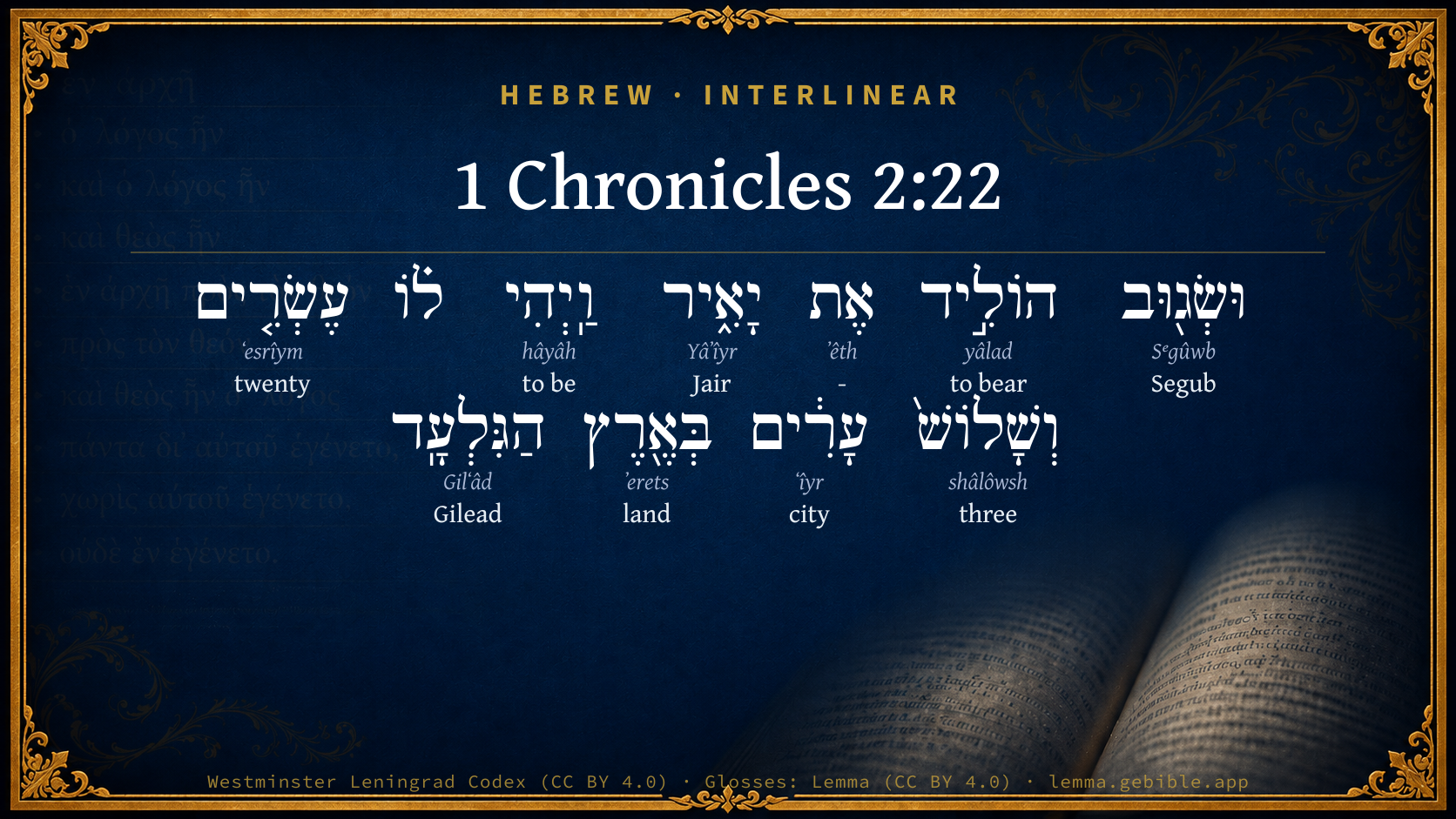
Hebrew (Westminster Leningrad Codex) 1 Chronicles 2:22 appears in the Hebrew Old Testament. The text above is from the Westminster Leningrad Codex. Each word links to its Strong’s number, a concise gloss, and parsing drawn from the Open Scriptures Hebrew Bible morphology. Click any word for its full Brown-Driver-Briggs (BDB) entry.
Download image
Cite this verse

1 Chronicles 2:22 (World English Bible). Public Domain. Lemma interlinear Bible study tool, https://lemma.gebible.app/v/1-chronicles/2/22.

Show BibTeX & RIS
BibTeX
RIS
English Translation
Segub became the father of Jair, who had twenty-three cities in the land of Gilead.
World English Bible · Public Domain
Download a study sheet

One document with this verse’s original text, its word-by-word gloss line, the meaning frame, cross-references with their text, attributed commentary, and full source and license credits — printable, and it pastes into notes with its structure intact.

This verse Autodidact and up

Study sheet (.html) Plain text (.txt)

A passage Seminary Student

Up to 50 verses in one chapter. A passage sheet keeps up to 6 commentary sources and 12 cross-references per verse, in the order this page ranks them, and says so on the sheet whenever that leaves anything out. Ask for a single verse and you get the Autodidact verse sheet above.

Everything on this page stays free to read, with no account — the sheet is a download of what is already on screen, not access to it.

Want to remove ads? Support Godless Engineer
Compare translations 3

The same verse in 3 English versions, stacked beneath the original-language interlinear above. Click any original word for its lexicon entry.

Each is an independent rendering of the whole verse — the interlinear is not word-aligned to these translations.

Highlighted words mark where these versions differ — a whole-verse word diff, not a word-by-word alignment.

  • World English Bible Public Domain
    Segub became the father of Jair, who had twenty-three cities in the land of Gilead.
  • King James Version Public Domain
    And Segub begat Jair, who had three and twenty cities in the land of Gilead.
  • unfoldingWord Literal Text CC BY-SA 4.0
    And Segub fathered Jair. And 23 cities were to him in the land of Gilead. ts\*

unfoldingWord Literal Text — © unfoldingWord, licensed CC BY-SA 4.0. Word-aligned USFM3 via Door43 (git.door43.org/unfoldingWord/en_ult).

Versions to compare (up to 4)

3 of 4 selected

Show all 18 translations

Every available English version of this verse, each an independent rendering of the whole verse.

  • World English Bible Public Domain
    Segub became the father of Jair, who had twenty-three cities in the land of Gilead.
  • Berean Standard Bible Public Domain
    Segub was the father of Jair, who had twenty-three cities in the land of Gilead.
  • Majority Standard Bible Public Domain
    Segub was the father of Jair, who had twenty-three cities in the land of Gilead.
  • King James Version Public Domain
    And Segub begat Jair, who had three and twenty cities in the land of Gilead.
  • American Standard Version (1901) Public Domain
    And Segub begat Jair, who had three and twenty cities in the land of Gilead.
  • Revised Version (1885) Public Domain
    And Segub begat Jair, who had three and twenty cities in the land of Gilead.
  • Geneva Bible (1599) Public Domain
    And Segub begate Iair, which had three and twentie cities in the land of Gilead.
  • Douay-Rheims (1899) Public Domain
    And Segub beget Jair, and he had three and twenty cities in the land of Galaad.
  • Young's Literal Translation Public Domain
    And Segub begat Jair, and he hath twenty and three cities in the land of Gilead,
  • Literal Standard Version CC BY-SA 4.0
    And Segub begot Jair, and he has twenty-three cities in the land of Gilead,
  • Unlocked Literal Bible CC BY-SA 4.0
    Segub became the father of Jair, who controlled twenty-three cities in the land of Gilead.
  • unfoldingWord Literal Text CC BY-SA 4.0
    And Segub fathered Jair. And 23 cities were to him in the land of Gilead. ts\*
  • Darby Bible Public Domain
    And Segub begot Jair, who had twenty-three cities in the land of Gilead;
  • World Messianic Bible Public Domain
    Segub became the father of Jair, who had twenty-three cities in the land of Gilead.
  • Webster's Bible Public Domain
    And Segub begat Jair, who had three and twenty cities in the land of Gilead.
  • Free Bible Version CC BY-SA 4.0
    Segub was the father of Jair, who had twenty-three towns in Gilead.
  • Bible in Basic English Public Domain
    And Segub was the father of Jair, who had twenty-three towns in the land of Gilead.
  • JPS Tanakh (1917) Public Domain
    And Segub begot Jair, who had three and twenty cities in the land of Gilead.

Literal Standard Version (2020), Covenant Press — licensed CC BY-SA 4.0. Text via the HelloAO Bible API (eBible.org). Unlocked Literal Bible (unfoldingWord) — licensed CC BY-SA 4.0. Text via the HelloAO Bible API (eBible.org). unfoldingWord Literal Text — © unfoldingWord, licensed CC BY-SA 4.0. Word-aligned USFM3 via Door43 (git.door43.org/unfoldingWord/en_ult). Free Bible Version, Dr. Jonathan Gallagher — licensed CC BY-SA 4.0. Text via the HelloAO Bible API (eBible.org).

Word by word

More ways to search: Search by grammar → Find every occurrence → Compare this word →

Practice this passage: Drill this verse → Learn its vocabulary →

וּשְׂג֖וּב
Sᵉgûwb
H7687
“and · Segub”
Conjunction + Noun, Proper
Part of Speech
Conjunction + Noun
Type
Proper
Full BDB Definition

Origin: from H7682

TWOT: None

Segub = "exalted" - the youngest son of Hiel the Bethelite who rebuilt Jericho - a Judaite, son of Hezron
  1. הוֹלִ֣יד yâlad H3205 “to bear” Verb, Hiphil, Perfect, 3rd Person, Masculine, Singular
  2. אֶת ʼêth H853 “-” Particle, Direct Object
  3. יָאִ֑יר Yâʼîyr H2971 “Jair” Noun, Proper
  4. וַֽיְהִי hâyâh H1961 “and · to be” Conjunction + Verb, Qal, Sequential Imperfect, 3rd Person, Masculine, Singular
  5. עֶשְׂרִ֤ים ʻesrîym H6242 “twenty” Adjective, Cardinal number, Both, Plural, Absolute
  6. וְשָׁלוֹשׁ֙ shâlôwsh H7969 “and · three” Conjunction + Adjective, Cardinal number, Feminine, Singular, Absolute
  7. עָרִ֔ים ʻîyr H5892 “cities” Noun, Common, Feminine, Plural, Absolute
  8. בְּאֶ֖רֶץ ʼerets H776 “in/at · land of” Preposition + Noun, Common, Both, Singular, Construct
  9. הַגִּלְעָֽד Gilʻâd H1568 “the · Gilead” Particle, Definite Article + Noun, Proper

About this verse

These counts appear in no published source. They are computed here, from the morphology-tagged text and Lemma’s own curated glosses. What Lemma adds →

11
words
10
distinct lemmas
Historical
section

Notable vocabulary

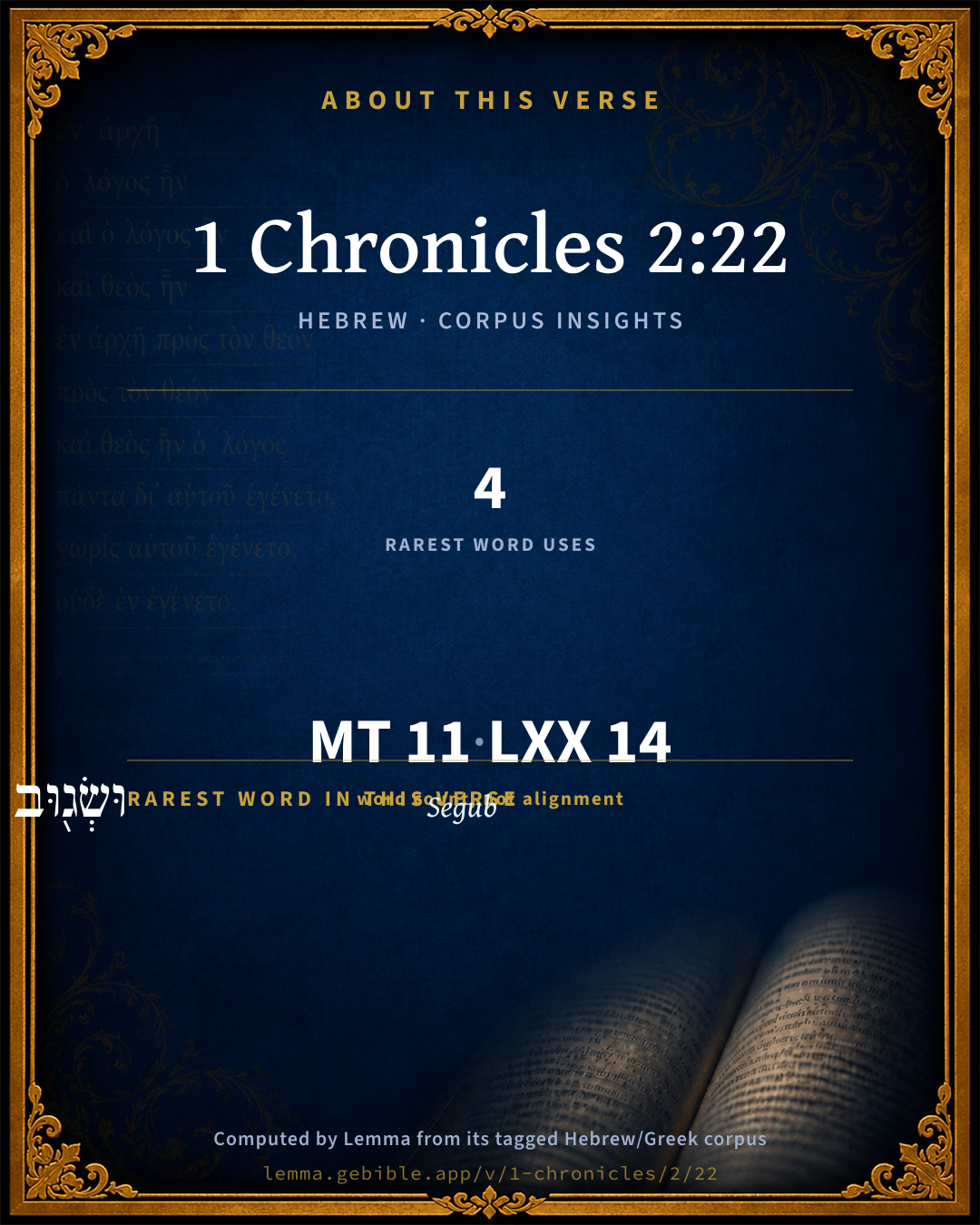
The rarest word here is וּשְׂג֖וּב Segub H7687 — appearing just 4 times in the whole Hebrew Bible.

Shared distinctive vocabulary

וּשְׂג֖וּב Segub H7687 occurs in 3 verses of the Hebrew Bible. Also found in:

Grammatical profile

  • 2 verbs
  • 5 nouns
  • 2 adjectives
  • 1 preposition
  • 1 particle

Verb forms

  • הוֹלִ֣יד Hiphil · Perfect
  • וַֽיְהִי Qal · Sequential Imperfect

Hebrew & Septuagint length

In English translation the verse runs 15 words from the Hebrew and 11 from the Septuagint (LXX English) — closely comparable.

A rough comparison of the two English renderings, which tokenize alike — not a word-level alignment.

Word counts can differ between the Hebrew and the Greek without any difference in meaning — e.g. the Hebrew direct-object marker אֵת has no separate Greek word, and Greek often adds the article ὁ.

In the original languages it is 11 Hebrew tokens and 14 Greek tokens — but the two are counted differently (Hebrew bundles its prefixes and suffixes into one token; the Greek is in lemma form), so that isn’t a like-for-like length.

Cross-references

3

Topical passages linked to 1 Chronicles 2:22 in the Treasury of Scripture Knowledge — connected by theme and wording, ordered by reader-vote popularity; previews shown in the World English Bible.

  • Numbers 32:41 Jair the son of Manasseh went and took the towns of it, and called them Havvoth Jair.
  • Deuteronomy 3:14 Jair the son of Manasseh took all the region of Argob, to the border of the Geshurites and the Maacathites, and called them, even Bashan, after his own name, Havvoth Jair, to this day.)
  • Joshua 13:30 Their border was from Mahanaim, all Bashan, all the kingdom of Og king of Bashan, and all the towns of Jair, which are in Bashan, sixty cities:

Cross-references courtesy of OpenBible.info (CC BY 4.0).

Hebrew and Greek witnesses Masoretic Hebrew ↔ Greek Septuagint

The same verse in the two great witnesses to the Old Testament, shown verse-for-verse.

These are two independent witnesses, not word-aligned to each other, and the Septuagint is shown in lemma (dictionary) form.

Hebrew 1 Chronicles 2:22 Masoretic · Westminster Leningrad Codex

וּשְׂג֖וּב הוֹלִ֣יד אֶת יָאִ֑יר וַֽיְהִי ל֗וֹ עֶשְׂרִ֤ים וְשָׁלוֹשׁ֙ עָרִ֔ים בְּאֶ֖רֶץ הַגִּלְעָֽד

Segub became the father of Jair, who had twenty-three cities in the land of Gilead.

World English Bible · Public Domain

Greek LXX 1 Chronicles 2:22 Septuagint · lemma form

καί σεγουβ γεννάω ὁ ιαϊρ καί εἰμί αὐτός εἴκοσι τρεῖς πόλις ἐν ὁ γαλαάδ

And Seruch begot Jair, and he had twenty-three cities in Galaad.

LXX2012 (modern English Septuagint) · Public Domain

Hebrew: Westminster Leningrad Codex (CC BY 4.0). Greek: Septuagint (public domain); English from LXX2012 (modern English Septuagint) (Public Domain). How the Septuagint differs from the Hebrew →

Commentary

Notes on 1 Chronicles 2:22 from classic Christian and Jewish commentators (each source and its license shown beneath its notes). The classic Christian expositions comment on the surrounding passage and are grouped to its opening verse, so a note may address several verses; the Jewish commentaries on the Tanakh (Rashi and others) are per-verse, so they appear only where the commentator wrote on this verse.

Lemma curates 59 commentaries, every one of them public domain or Creative Commons licensed, each selected and text-cleaned for this edition rather than reprinted as found. About our sources →

Jamieson, Fausset & Brown

Robert Jamieson, A. R. Fausset & David Brown

Jair, who had three and twenty cities in the land of Gilead--As the son of Segub and the grandson of Hezron, he was of the tribe of Judah; but from his maternal descent he is called (Num 32:41; Deu 3:14) "the son of Manasseh." This designation implies that his inheritance lay in that tribe in right of his grandmother; in other words, his maternal and adopting great-grandfather was Machir the son of Manasseh. Jair, inheriting his property, was his lineal representative; and accordingly this is expressly stated to be the case; for the village group of "Havoth-Jair" was awarded to him in that tribe, in consequence of his valiant and patriotic exploits. This arrangement, however, took place previous to the law (Num 36:1-13), by which it was enacted that heiresses were to marry in their own tribe. But this instance of Jair shows that in the case of a man obtaining an inheritance in another tribe it required him to become thoroughly incorporated with it as a representative of the family through which the inheritance was received. He had been adopted into Manasseh, and it would never have been imagined that he was other than "a son of Manasseh" naturally, had not this passage given information supplementary to that of the passage in Numbers.

Jamieson, Fausset & Brown — Commentary Critical and Explanatory on the Whole Bible (1871) — public domain (CC PDM 1.0). Text via the HelloAO Bible API.

Ellicott's Commentary for English Readers

(22) And Segub begat Jair . . .—The Havothjair (tent-villages of Jair) are several times mentioned in the Pentateuch. In the passage Num_32:39-42 it is related—(1) That the Manassite clan of the sons of Machir took Gilead from the Amorites; (2) That Moses then formally assigned Giiead “to Machir son of Manasseh,” and the clan accordingly settled there; (3) That Jair son of Manasseh had taken their (i.e., the Amorite) tent-villages, and called them Havoth-jair. Comp. Deu_3:14-15 : “Jair son of Manasseh had taken all the region of Argob unto the bounds of the Geshurite and the Maacnathite; and he called them (that is, Bashan) after his own name, Havoth-jair, unto this day. And to Machir I gave Gilead.”

1Ch_2:21-23 show a connection between Jair and the two tribes of Judah and Manasseh thus:—

Judah

|Manasseh

|PharezHezron married the daughter of Machir, chief of GileadSegub

|JairJair is of course the name of a group of kindred families or clans, settled in the twenty-three cities.

A Bible Commentary for English Readers, edited by Charles John Ellicott (1878–1897) — public domain. Text from a community e-Sword module.

The Cambridge Bible for Schools and Colleges

gen. ed. J. J. S. Perowne

21–24. Other Descendants of Hezron

22. Jair] He was one of the Judges (Jdg_10:3-4 where thirty cities, not twenty-three, are assigned him).

the land of Gilead] This name is sometimes restricted to that part of the land E. of Jordan which lies S. of the Yarmuk; see Camb. Companion, Map 2. Here, as often, it is applied to all the land E. of Jordan occupied by Israel.

The Cambridge Bible for Schools and Colleges (gen. ed. J. J. S. Perowne; Cambridge University Press, 1878–1918) — public domain. Text from a community e-Sword module.

John Gill's Exposition

And the sons of Onam,.... The son of Jerahmeel by his other wife:

were Shammai and Jada. And the sons of Shammai; Nadab, and Abishur; whose posterity are mentioned in the two following verses.

John Gill's Exposition of the Whole Bible (1746–1763) — public domain (CC PDM 1.0). Text via the HelloAO Bible API.

Albert Barnes' Notes on the Bible

Jair, who had three and twenty cities - The places called “Havoth-Jair” in the earlier Scriptures (see Num 32:41 note), which appear to have been a number of “small towns,” or villages, in the Ledjah, the Classical “Trachonitis.”

Albert Barnes' Notes on the Bible (1834–1885) — public domain. Text from a community e-Sword/MySword module.

Matthew Poole's English Annotations

Which he had, though he was of the tribe of Judah, as here we see, because he married a daughter of Manasseh, Num 26:29, whence he is called a son of Manasseh, Num 32:41; Deu 3:14; and because, being a man of great courage, he joined himself with that half tribe in subduing Gilead, wherein he acted so valiantly and successfully, that he had twenty-three cities or great towns given to him to possess or dispose of; or rather, to rule over them, and have some advantage from them; as a king is said to have his kingdom, although he hath not the propriety of all the lands and houses in it.

Matthew Poole's English Annotations on the Holy Bible (1683–1685) — public domain. Text from a community e-Sword/MySword module.

The Pulpit Commentary

Vers. 22, 23.

The prowess of Jair.

The story of this man is given in Num_32:41; Deuteronomy Jos_13:30. From the repeated mention of him we may assume that he was a remarkable man for military genius, and was in so large a degree successful in his warlike enterprises as to stand out before the ages as a prominent example of the warlike endowment, and its place in the Divine purposes. The brief notice of this man suggests for our consideration The consecration to God of the military talent. We cannot accept fully the facts of human history without recognizing the Divine gift of the genius of the warrior. Different views are held on the righteousness of war. From the Christian standpoint all offensive war must be at once and entirely condemned, but defensive war and aid to those called to defensive war appears to be fully consistent with Christian principles. Still, we shall unfeignedly rejoice when the principle of arbitration can be universally adopted, and the "nations learn war no more." It is, even in its best forms, a terrible human scourge and evil. But, whatever our view of it may be, history keeps her testimony, and declares that, in the long story of our race, war has been one of the important agencies used by God, and overruled by him, to the accomplishment of his gracious ends; and that he has, again and again, raised up men who had "war" for their life-mission, and the military endowment as their precise trust. There have been the Joshuas, the Davids, the Maccabees, the Marlboroughs, and the Wellingtons, etc. Times and circumstances have made war the only possible agency for the punishing of wrong and the deliverance and confirmation of the right. Still, we should distinctly observe that warfare is the creation of man"s lust of power and dominion, his ambition to be supreme; and that the "God of peace" does but if we may so say fit, temporarily, into the circumstances thus created, until he can get fully established his kingdom of righteousness in which war will be unknown.

I THE DISTINCTIVE MILITARY GIFT. It is the gift of command over other men finding one particular mode of expression. This is the essence of it, but it is combined with the constructive faculty, the power of organization, courage, bodily skill, quickness of invention, etc. all, it may be pointed out, endowments which may find other spheres than battlefields. Illustrate by the devotion of F. W. Robertson"s soldierly gifts to the service of the Church, and by the gift of ruling men found in the heads of large mills and factories.

II THE LOYALTY THAT GUIDES THE USE OF THE MILITARY GIFTS. It is characteristic of the soldier that he is loyal to his king, and this loyalty finds expression in instant and unquestioning obedience. So the soldier among us is a plea urging us to maintain similar relations to our Lord, who is the "King of kings." So far as we can see, it would be a loss to the moral health of a nation if the example of soldierly loyalty and obedience were removed. St. Paul was essentially a loyal soldier. When a command came from his Lord, he tells us, "Immediately we conferred not with flesh and blood.

III THE WITNESS TO VIRTUE AND DUTY THAT IS MADE BY MILITARY MEN. Lord Nelson"s words embody the witness all soldiers make. We must work for, suffer for, and, if need be, die for, duty. "England expects that every man will do his duty. " And in this time-serving, self-seeking, money-getting age we cannot afford to lose any agency which renders public witness to the fact that there is something nobler than even life it is duty. If it could be so that, in the world of the future, the military genius was no longer needed, still even a world at peace would need the story of the heroic ages, and its witness to the dignity of endurance, obedience, promptitude, sacrifice for a high idea, and above all to the paramount claims of duty. R.T.

The Pulpit Commentary (1880–1919), ed. H.D.M. Spence-Jones & Joseph S. Exell — public domain. Text from a community e-Sword module.

Keil & Delitzsch

C. F. Keil & F. Delitzsch

And the sons of Onam,.... The son of Jerahmeel by his other wife:

were Shammai and Jada. And the sons of Shammai; Nadab, and Abishur; whose posterity are mentioned in the two following verses.

Keil & Delitzsch — Biblical Commentary on the Old Testament (1861–1891) — public domain (CC PDM 1.0). Text via the HelloAO Bible API. (Old Testament only.)

Lesson kit

Teaching starters — assembled from the data on this page, not authored interpretation. Every prompt links to the verse data it draws on. Edit before teaching.

1 Chronicles, in the Historical, opens this verse with 11 words (10 distinct Hebrew lemmas). Its most distinctive word is Sᵉgûwb (“Segub”). A historical commentator’s framing appears above. Read the whole chapter for the surrounding context.

Discussion questions

  1. What does “Segub” (Sᵉgûwb) contribute to the verse as a whole?
  2. How does 1 Kings 16:34, which shares the word «Segub», read alongside this verse?
  3. These translations render this verse differently; the difference is in the English rendering, not the original. What questions does that raise?
  4. «הוֹלִ֣יד» is a Hiphil Perfect verb. How does that grammatical form shape the action described?
  5. Compare how Jamieson, Fausset & Brown and Ellicott's Commentary for English Readers read this verse. Where do they agree or differ?

Things to notice

Reading settings

Reading text

Shown beneath each verse's original-language words.

Old Testament
Old Testament edition

Read the OT as the Masoretic Hebrew (MT) or the Greek Septuagint (LXX).

English shown for the Greek Septuagint (in the Hebrew ↔ Greek comparison).

Comparing translations? Open the Compare panel on any verse page to stack up to four side by side.