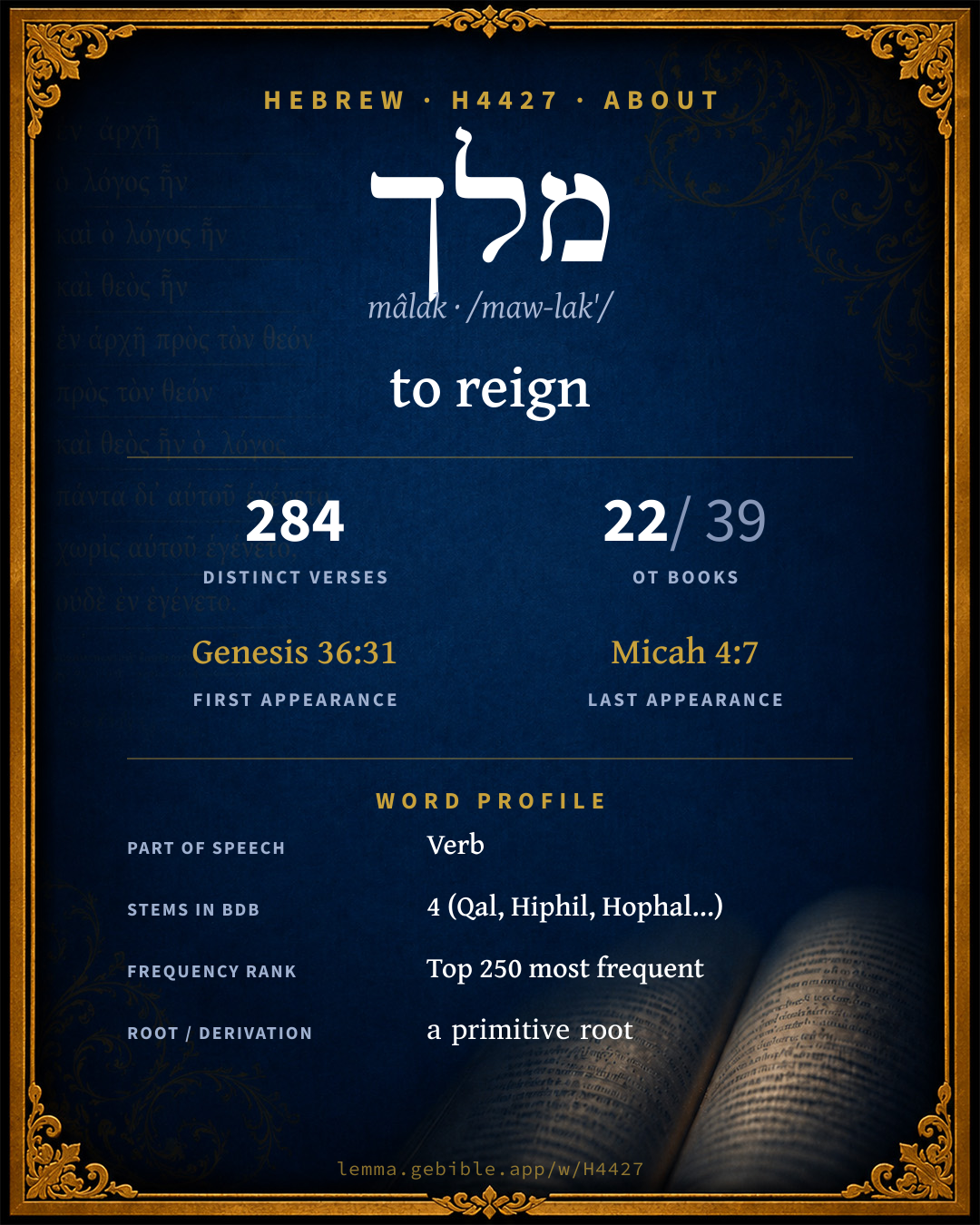
מָלַךְ
to reign
‘to reign’ is one of 2 main senses fuller range ↓
Full lexicon entry — Brown-Driver-Briggs (BDB)
From Brown-Driver-Briggs (BDB)
Where this word appears
See every Qal verb in the Hebrew Bible →
Grammar key — what these labels mean
Part of speech
- Verb
- An action or state-of-being word.
Stem
- Qal
- The basic, simple active stem — the plain form of the verb (“he wrote”).
- Hiphil
- The causative active stem (“he caused / brought about”).
- Niphal
- Usually the simple passive or reflexive of the Qal (“he was written”).
- Hophal
- The passive counterpart of the Hiphil (“he was caused to…”).
Form
- Perfect
- A completed action or state — Hebrew marks aspect (completeness) more than strict tense (“he wrote”).
- Sequential Imperfect
- An imperfect with prefixed waw — the standard past-narrative form (waw-consecutive imperfect).
- Infinitive Construct
- A bound verbal noun, frequently with prepositions (“to write / in writing”).
- Imperfect
- An incomplete, ongoing, or future action (“he will / would write”).
- Imperative
- A direct command (“write!”).
- Sequential Perfect
- A perfect with prefixed waw continuing a preceding imperfect or command (waw-consecutive perfect).
- Participle Active
- A verbal adjective expressing ongoing or characteristic action (“writing / one who writes”).
- Infinitive Absolute
- An unbound verbal noun, often intensifying or standing in for a finite verb.
- Jussive
- A third- or second-person volitional form expressing wish or command (“let him write”).
State
- Absolute
- The independent form of a noun, not bound to a following word.
Person
- 3rd Person
- The one spoken about (“he / she / it / they”).
- 2nd Person
- The one addressed (“you”).
- 1st Person
- The speaker (“I / we”).
Gender
- Masculine
- Grammatically masculine.
- Feminine
- Grammatically feminine.
- Common
- Either gender — not distinguished for this form.
Number
- Singular
- One.
- Plural
- More than one (in Hebrew, generally three or more).
Every verse where H4427 appears in the Book of 1 Kings — 51 distinct verses. Click any verse to open its interlinear word-by-word view. Verse text shown in the World English Bible for context — . Each verse’s Hebrew form is shown with its reference; the English is not keyword-highlighted, since the data carries no word-level English alignment. Use “Compare translations” on any verse to read it across multiple English versions. This concordance covers the Hebrew Bible; Septuagint (Greek Old Testament) occurrences are not indexed here.
1 Kings
- 1 Kings 1:5 אֶמְלֹ֑ךְ Qal impf 1cs Then Adonijah the son of Haggith exalted himself, saying, I will be king: and he prepared him chariots and horsemen, and fifty men to run before him.
- 1 Kings 1:11 מָלַ֖ךְ Qal pf 3ms Then Nathan spoke to Bathsheba the mother of Solomon, saying, Haven't you heard that Adonijah the son of Haggith reigns, and David our lord doesn't know it?
- 1 Kings 1:13 יִמְלֹ֣ךְ מָלַ֥ךְ Qal impf 3ms Qal pf 3ms Go and get you in to king David, and tell him, Didn't you, my lord, king, swear to your handmaid, saying, Assuredly Solomon your son shall reign after me, and he shall sit on my throne? why then does Adonijah reign?
- 1 Kings 1:17 יִמְלֹ֣ךְ Qal impf 3ms She said to him, My lord, you swore by Yahweh your God to your handmaid, [saying], Assuredly Solomon your son shall reign after me, and he shall sit on my throne.
- 1 Kings 1:18 מָלָ֑ךְ Qal pf 3ms Now, behold, Adonijah reigns; and you, my lord the king, don't know it:
- 1 Kings 1:24 יִמְלֹ֣ךְ Qal impf 3ms Nathan said, My lord, king, have you said, Adonijah shall reign after me, and he shall sit on my throne?
- 1 Kings 1:30 יִמְלֹ֣ךְ Qal impf 3ms most assuredly as I swore to you by Yahweh, the God of Israel, saying, Assuredly Solomon your son shall reign after me, and he shall sit on my throne in my place; most assuredly so will I do this day.
- 1 Kings 1:35 יִמְלֹ֖ךְ Qal impf 3ms Then you shall come up after him, and he shall come and sit on my throne; for he shall be king in my place; and I have appointed him to be prince over Israel and over Judah.
- 1 Kings 1:43 הִמְלִ֥יךְ Hiphil pf 3ms Jonathan answered Adonijah, Most assuredly our lord king David has made Solomon king:
- 1 Kings 2:11 מָלַ֤ךְ מָלַךְ֙ מָלַ֔ךְ Qal pf 3ms Qal pf 3ms Qal pf 3ms The days that David reigned over Israel were forty years; seven years reigned he in Hebron, and thirty-three years reigned he in Jerusalem.
- 1 Kings 2:15 לִ/מְלֹ֑ךְ prep + Qal inf.cs He said, You know that the kingdom was mine, and that all Israel set their faces on me, that I should reign: however the kingdom is turned about, and is become my brother's; for it was his from Yahweh.
- 1 Kings 3:7 הִמְלַ֣כְתָּ Hiphil pf 2ms Now, Yahweh my God, you have made your servant king instead of David my father: and I am but a little child; I don't know how to go out or come in.
- 1 Kings 6:1 לִ/מְלֹ֥ךְ prep + Qal inf.cs It happened in the four hundred and eightieth year after the children of Israel were come out of the land of Egypt, in the fourth year of Solomon's reign over Israel, in the month Ziv, which is the second month, that he began to build the house of Yahweh.
- 1 Kings 11:24 וַֽ/יִּמְלְכ֖וּ conj + Qal wimpf 3mp He gathered men to him, and became captain over a troop, when David killed them [of Zobah]: and they went to Damascus, and lived therein, and reigned in Damascus.
- 1 Kings 11:25 וַ/יִּמְלֹ֖ךְ conj + Qal wimpf 3ms He was an adversary to Israel all the days of Solomon, besides the mischief that Hadad [did]: and he abhorred Israel, and reigned over Syria.
- 1 Kings 11:37 וּ/מָ֣לַכְתָּ֔ conj + Qal wpf 2ms I will take you, and you shall reign according to all that your soul desires, and shall be king over Israel.
- 1 Kings 11:42 מָלַ֨ךְ Qal pf 3ms The time that Solomon reigned in Jerusalem over all Israel was forty years.
- 1 Kings 11:43 וַ/יִּמְלֹ֛ךְ conj + Qal wimpf 3ms Solomon slept with his fathers, and was buried in the city of David his father: and Rehoboam his son reigned in his place.
- 1 Kings 12:1 לְ/הַמְלִ֥יךְ prep + Hiphil inf.cs Rehoboam went to Shechem: for all Israel were come to Shechem to make him king.
- 1 Kings 12:17 וַ/יִּמְלֹ֥ךְ conj + Qal wimpf 3ms But as for the children of Israel who lived in the cities of Judah, Rehoboam reigned over them.
- 1 Kings 12:20 וַ/יַּמְלִ֥יכוּ conj + Hiphil wimpf 3mp It happened, when all Israel heard that Jeroboam was returned, that they sent and called him to the congregation, and made him king over all Israel: there was none who followed the house of David, but the tribe of Judah only.
- 1 Kings 14:19 מָלָ֑ךְ Qal pf 3ms The rest of the acts of Jeroboam, how he warred, and how he reigned, behold, they are written in the book of the chronicles of the kings of Israel.
- 1 Kings 14:20 מָלַ֣ךְ וַ/יִּמְלֹ֛ךְ Qal pf 3ms conj + Qal wimpf 3ms The days which Jeroboam reigned were two and twenty years: and he slept with his fathers, and Nadab his son reigned in his place.
- 1 Kings 14:21 מָלַ֖ךְ בְּ/מָלְכ֜/וֹ מָלַ֣ךְ Qal pf 3ms prep + Qal inf.cs + sfx pers 3ms Qal pf 3ms Rehoboam the son of Solomon reigned in Judah. Rehoboam was forty-one years old when he began to reign, and he reigned seventeen years in Jerusalem, the city which Yahweh had chosen out of all the tribes of Israel, to put his name there: and his mother's name was Naamah the Ammonitess.
- 1 Kings 14:31 וַ/יִּמְלֹ֛ךְ conj + Qal wimpf 3ms Rehoboam slept with his fathers, and was buried with his fathers in the city of David: and his mother's name was Naamah the Ammonitess. Abijam his son reigned in his place.
- 1 Kings 15:1 מָלַ֥ךְ Qal pf 3ms Now in the eighteenth year of king Jeroboam the son of Nebat began Abijam to reign over Judah.
- 1 Kings 15:2 מָלַ֖ךְ Qal pf 3ms Three years reigned he in Jerusalem: and his mother's name was Maacah the daughter of Abishalom.
- 1 Kings 15:8 וַ/יִּמְלֹ֛ךְ conj + Qal wimpf 3ms Abijam slept with his fathers; and they buried him in the city of David: and Asa his son reigned in his place.
- 1 Kings 15:9 מָלַ֥ךְ Qal pf 3ms In the twentieth year of Jeroboam king of Israel began Asa to reign over Judah.
- 1 Kings 15:10 מָלַ֖ךְ Qal pf 3ms Forty-one years reigned he in Jerusalem: and his mother's name was Maacah the daughter of Abishalom.
- 1 Kings 15:24 וַ/יִּמְלֹ֛ךְ conj + Qal wimpf 3ms Asa slept with his fathers, and was buried with his fathers in the city of David his father; and Jehoshaphat his son reigned in his place.
- 1 Kings 15:25 מָלַךְ֙ וַ/יִּמְלֹ֥ךְ Qal pf 3ms conj + Qal wimpf 3ms Nadab the son of Jeroboam began to reign over Israel in the second year of Asa king of Judah; and he reigned over Israel two years.
- 1 Kings 15:28 וַ/יִּמְלֹ֖ךְ conj + Qal wimpf 3ms Even in the third year of Asa king of Judah did Baasha kill him, and reigned in his place.
- 1 Kings 15:29 כְ/מָלְכ֗/וֹ prep + Qal inf.cs + sfx pers 3ms It happened that, as soon as he was king, he struck all the house of Jeroboam: he didn't leave to Jeroboam any who breathed, until he had destroyed him; according to the saying of Yahweh, which he spoke by his servant Ahijah the Shilonite;
- 1 Kings 15:33 מָ֠לַךְ Qal pf 3ms In the third year of Asa king of Judah began Baasha the son of Ahijah to reign over all Israel in Tirzah, [and reigned] twenty-four years.
- 1 Kings 16:6 וַ/יִּמְלֹ֛ךְ conj + Qal wimpf 3ms Baasha slept with his fathers, and was buried in Tirzah; and Elah his son reigned in his place.
- 1 Kings 16:8 מָ֠לַךְ Qal pf 3ms In the twenty-sixth year of Asa king of Judah began Elah the son of Baasha to reign over Israel in Tirzah, [and reigned] two years.
- 1 Kings 16:10 וַ/יִּמְלֹ֖ךְ conj + Qal wimpf 3ms and Zimri went in and struck him, and killed him, in the twenty-seventh year of Asa king of Judah, and reigned in his place.
- 1 Kings 16:11 בְ/מָלְכ֜/וֹ prep + Qal inf.cs + sfx pers 3ms It happened, when he began to reign, as soon as he sat on his throne, that he struck all the house of Baasha: he didn't leave him a single man-child, neither of his relatives, nor of his friends.
- 1 Kings 16:15 מָלַ֥ךְ Qal pf 3ms In the twenty-seventh year of Asa king of Judah did Zimri reign seven days in Tirzah. Now the people were encamped against Gibbethon, which belonged to the Philistines.
- 1 Kings 16:16 וַ/יַּמְלִ֣כוּ conj + Hiphil wimpf 3mp The people who were encamped heard say, Zimri has conspired, and has also struck the king: therefore all Israel made Omri, the captain of the host, king over Israel that day in the camp.
- 1 Kings 16:21 לְ/הַמְלִיכ֔/וֹ prep + Hiphil inf.cs + sfx pers 3ms Then were the people of Israel divided into two parts: half of the people followed Tibni the son of Ginath, to make him king; and half followed Omri.
- 1 Kings 16:22 וַ/יִּמְלֹ֖ךְ conj + Qal wimpf 3ms But the people who followed Omri prevailed against the people who followed Tibni the son of Ginath: so Tibni died, and Omri reigned.
- 1 Kings 16:23 מָלַ֤ךְ מָלַ֥ךְ Qal pf 3ms Qal pf 3ms In the thirty-first year of Asa king of Judah began Omri to reign over Israel, [and reigned] twelve years: six years reigned he in Tirzah.
- 1 Kings 16:28 וַ/יִּמְלֹ֛ךְ conj + Qal wimpf 3ms So Omri slept with his fathers, and was buried in Samaria; and Ahab his son reigned in his place.
- 1 Kings 16:29 מָלַךְ֙ וַ֠/יִּמְלֹךְ Qal pf 3ms conj + Qal wimpf 3ms In the thirty-eighth year of Asa king of Judah began Ahab the son of Omri to reign over Israel: and Ahab the son of Omri reigned over Israel in Samaria twenty-two years.
- 1 Kings 22:40 וַ/יִּמְלֹ֛ךְ conj + Qal wimpf 3ms So Ahab slept with his fathers; and Ahaziah his son reigned in his place.
- 1 Kings 22:41 מָלַ֖ךְ Qal pf 3ms Jehoshaphat the son of Asa began to reign over Judah in the fourth year of Ahab king of Israel.
- 1 Kings 22:42 בְּ/מָלְכ֔/וֹ מָלַ֖ךְ prep + Qal inf.cs + sfx pers 3ms Qal pf 3ms Jehoshaphat was thirty-five years old when he began to reign; and he reigned twenty-five years in Jerusalem. His mother's name was Azubah the daughter of Shilhi.
- 1 Kings 22:50 וַ/יִּמְלֹ֛ךְ conj + Qal wimpf 3ms Jehoshaphat slept with his fathers, and was buried with his fathers in the city of David his father; Jehoram his son reigned in his place.
- 1 Kings 22:51 מָלַ֤ךְ וַ/יִּמְלֹ֥ךְ Qal pf 3ms conj + Qal wimpf 3ms Ahaziah the son of Ahab began to reign over Israel in Samaria in the seventeenth year of Jehoshaphat king of Judah, and he reigned two years over Israel.
About this entry
At a glance — auto-summarized from this page’s data, not written by a person. Every figure links to its source below. This summary describes the numbers; it doesn’t interpret them.
“to reign” is the headline sense of the Hebrew verb מלך (mâlak). As a verb its force shifts by stem, across 4 stems (Qal, Hiphil, and more). The Hebrew Bible uses it across 284 verses — common. More than a quarter of its appearances fall in 2 Kings. First canonically at Genesis 36:31, it enters the text early. See the sense tree, 284-verse concordance, and the renderings breakdown below.
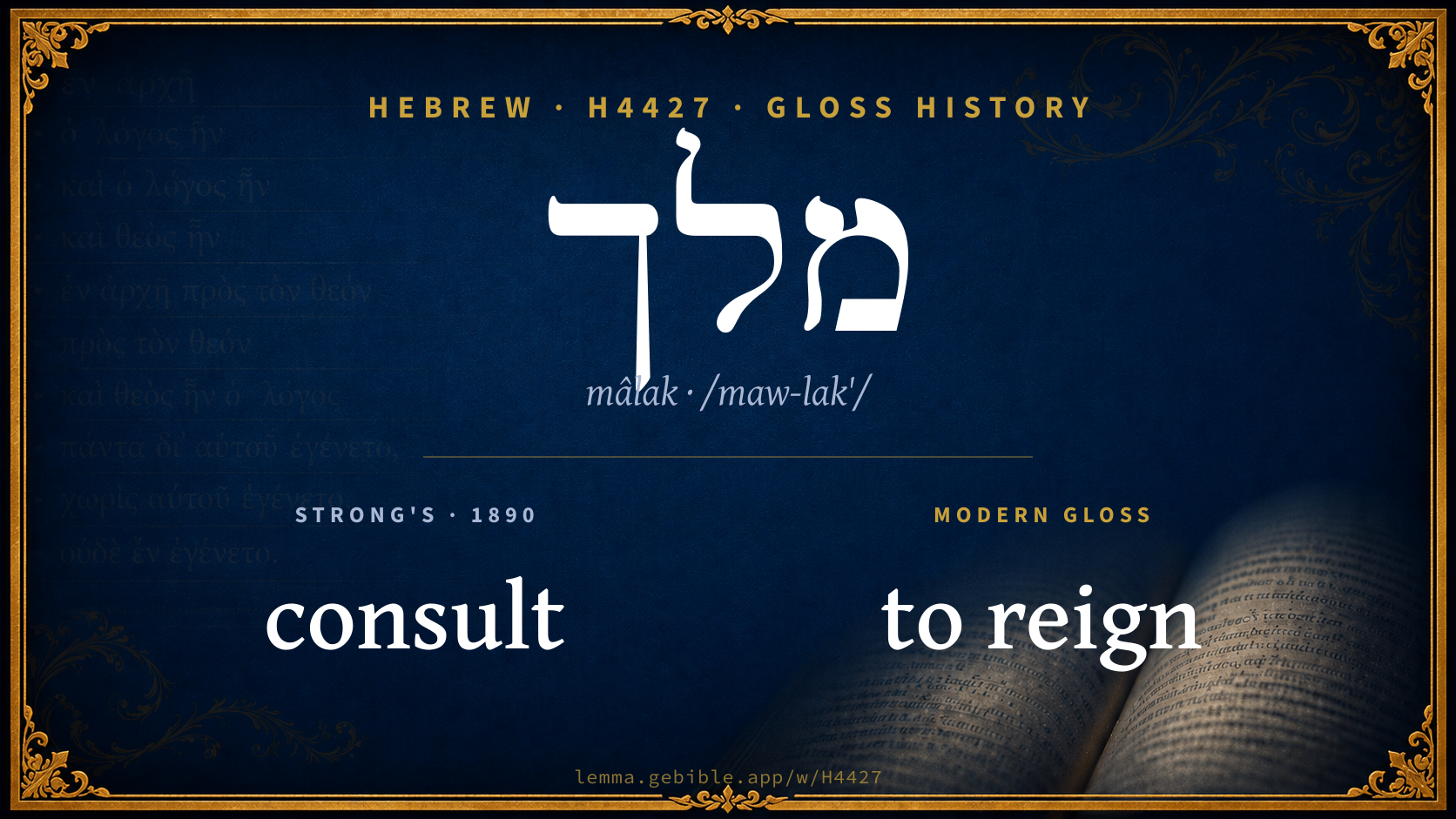
Gloss history
Strong's 1890 vs modern scholarship
About this word
Strong's H4427 catalogs a Hebrew word from the Hebrew Old Testament.
These counts are not copied from any lexicon or concordance. They are computed here, from the morphology-tagged Hebrew Old Testament. What Lemma adds →
- 284
- distinct verses
- The word appears in 284 distinct verses.
- 22 / 39
- OT books
- The word appears in 22 of 39 Old Testament books.
- #139
- by frequency
- Top 250 most frequent Hebrew words (rank 139 of 8,640 Hebrew words by occurrence).
View all 284 occurrences in the concordance →
Most concentrated in
- 2 Kings 73 verses 26%
- 2 Chronicles 57 verses 20%
- 1 Kings 51 verses 18%
By section of the Old Testament
By traditional corpus
Conventional, traditional groupings — biblical authorship is debated, so this is a traditional corpus grouping, not an authorship claim. Each share is this word’s portion of its verses in that division of the Hebrew canon. Each figure is a share of the word’s 284 distinct verses.
- Prophets (Nevi'im) 177 verses · 62%
- Writings (Ketuvim) 96 verses · 34%
- Torah (Pentateuch) 11 verses · 4%
How translations render this word
Counts come from each version’s own published word-to-Strong’s tagging or interlinear alignment — an approximate guide to how each version renders this word, not a word-level alignment the data otherwise carries. Because each total is that version’s own tagged count, the per-version totals vary from one another and need not match the appearance or distinct-verse counts above. These counts may also differ from a printed concordance because Lemma counts each distinctly tagged rendering and does not collapse phrase taggings into a single head-word total. This is a fixed set of word-tagged versions (KJV, ASV, BSB, ULT) and does not change with the reading translation you choose elsewhere. Each version’s license is shown beside its name below (and on Sources).
BDB lists this Strong’s number as 2 distinct words (homographs). Each count above pools all of them and is not split by sense — see the Senses section below. A low-frequency rendering may belong to a different one of those words, not the primary meaning.
- King James Version†: Reigned 115×, He reigned 38×, Reign 35×
- American Standard Version†: Reigned in his stead 51×, He reigned 47×, Reigned 43×
- Berean Standard Bible†: Reigned 75×, He reigned 54×, He became king 39×
- unfoldingWord Literal Text†: Reigned 102×, He reigned 81×, And 76×
King James Version Public Domain
Renders H4427 across 350† tagged occurrences — most commonly:
Plus other, less common renderings. Plus 45 renderings that appear only once — usually multi-word phrases or single function words the recovered tagging swept in, not distinct renderings.
American Standard Version Public Domain
Renders H4427 across 347† tagged occurrences — most commonly:
Plus other, less common renderings. Plus 53 renderings that appear only once — usually multi-word phrases or single function words the recovered tagging swept in, not distinct renderings.
Berean Standard Bible Public Domain
Renders H4427 across 340† tagged occurrences — most commonly:
Plus other, less common renderings. Plus 51 renderings that appear only once — usually multi-word phrases or single function words the recovered tagging swept in, not distinct renderings. Not rendered by a distinct English word in 8 further occurrences.
unfoldingWord Literal Text CC BY-SA 4.0
Renders H4427 across 463† tagged occurrences — most commonly:
Plus other, less common renderings. Plus 46 renderings that appear only once — usually multi-word phrases or single function words the recovered tagging swept in, not distinct renderings.
Senses in the full BDB
Hebrew verbs can shift meaning by stem (binyan): Qal is the basic action, Niphal is often passive or reflexive, Piel often intensifies or makes it factitive, and Hiphil is typically causative. The senses below are grouped under the stem BDB assigns to each. This entry also uses Hophal (the passive of Hiphil).
What do BDB’s symbols mean?
BDB uses these scholarly abbreviations:
| Symbol | Meaning |
|---|---|
| 𝔊 | the Septuagint (the ancient Greek translation, LXX) |
| 𝔙 | the Vulgate (the Latin translation) |
| 𝔖 | the Syriac version (the Peshitta) |
| 𝔗 | the Targum (the Aramaic translation) |
| ψ | the Psalms |
| √ | root (the underlying root or stem) |
| ‖ | parallel passage (a synonymous or contrasted parallel) |
| † | the dagger: every passage where the word occurs is cited |
The 4 senses and sub-senses the full Brown-Driver-Briggs lexicon distinguishes for this word, in lexicon order (not ranked by frequency), with BDB’s own verbatim wording and sub-sense lettering. Shown in Hebrew script with BDB’s own scholarly abbreviations. The condensed entry is in the Lexicon Entry tab. See also the Forms in the corpus table below.
מלך I denom. be, or become king, or queen, reign
Qal
- Pf. מ׳ Jos 13:10 +, etc.; Impf. יִמְלֹךְ (-לוֹךְ) Ex 15:18 +; וַיִּמְלֹךְ Gn 36:32 +; 2 ms. תִּמְלֹךְ Gn 37:8 +, (הֲתִֽמֲלֹךְ Je 22:15 Bear); Imv. מְלָךְ־, Ju 9:14; מָלְכָה Ju 9:8; מָלְכִי Ju 9:10, 12; Inf. abs. מָלֹךְ Gn 37:8 1 S 24:21; cstr. מְלֹךְ 1 K 2:15 +; sf. מָלְכוֹ 1 S 13:1 +; Pt. מֹלֵךְ Je 22:11 + 2 times; מֹלֶכֶת 2 K 11:3 = 2 Ch 22:12;—be (become) king, reign, mostly of Hebrew kings, 2 S 2:10 1 K 16:22 2 K 3:1; 9:13, but also gen. Pr 8:15; 30:22; of Can., Edom., Aramaic, Assyrian, Pers. kings, etc.: Ju 4:2 Gn 36:31 1 K 11:25 2 K 8:15; 19:37 Est 1:1 +; sq. בְּ loc. (usually city) Jos 13:10, 12 Ju 4:2 2 S 5:5 1 K 11:24; 14:21 + often; but also Gn 36:31, 32 1 Ch 1:43 בְּארץ, and even בְּכֹל אֲשֶׁר־תְּאַוֶּה נַפְשֶׁ֑ךָ 2 S 3:21; sq. עַל c. people or land 1 S 8:9, 11; 12:14; 13:1 1 K 15:1, 9; 16:23 + often; sq. בְּ loc. + עַל territ. (or pop.) 2 S 5:5 1 K 11:42; sq. תַּחַת (תַּחְתָּיו) 2 S 16:8 Gn 36:33f. = 1 Ch 1:44f., 1 K 14:20, 31 2 K 8:15; 13:24 Je 22:11 + often; †subj. God, sq. על ψ 47:9 Mi 4:7 Ez 20:33 1 S 8:7; sq. בְּ Is 24:23; abs. Ex 15:18 Is 52:7 ψ 93:1; 96:10 = 1 Ch 16:31, 97:1; 99:1; 146:10†; subj. future (Mess.) king Is 32:1 Je 23:5; †subj. a woman (= be queen) 2 K 11:3 = 2 Ch 22:12 (both sq. עַל), Est 2:4 sq. תַּחַת†; Imv. only in fable, king of trees, Ju 9:8, 10, 12, 14 all sq. על; בְּמָלְכוֹ especially = when he began to reign, became king 1 S 13:1 2 S 2:10 1 K 14:21 + often; Inf. also = reign: בְּשְׁנַת שְׁמֹנֶה לְמָלְכוֹ 2 K 24:12; 25:1, cf. v 27; 1 K 6:1 2 Ch 16:13; 17:7; 29:3; 34:3, 8, cf. עַד מְלֹךְ דָּוִד 1 Ch 4:31; עַד מְלֹךְ מַלְכוּת פָּרָס 2 Ch 36:20; began to reign and reigned מָלַךְ וַיִּמְלֹךְ 1 K 15:25; 16:29 2 K 3:1 +; often מָלַךְ alone with same meaning 1 K 16:23 2 K 13:1, 10; 14:23 +. e.g. Joshua 13:10
Hiphil
- Pf. הִמְלִיךְ 1 S 15:35 + 2 times; הִמְלַ֫כְתָּ 1 K 3:7, etc.; Impf. וַיַּמְלֵךְ 2 K 23:34 + 4 times; וַיַּמְלִיכוּ Ju 9:6 + etc.; Inf. cstr. הַמְלִיךְ 1 K 12:1 + etc.; Pt. מַמְלִיךְ Ez 17:16;—make king, or queen, cause to reign, sq. acc. pers. Ju 9:16 1 S 11:15 1 K 1:43; 12:1; 16:21 2 K 10:5; 11:12 (anointing and coronation) = 2 Ch 23:11, 2 K 17:21 1 Ch 11:10; 12:32, 39 2 Ch 10:1; 11:22 Ez 17:16; sq. לִשׁלמֹה (לְ of dir. obj., as Aramaic) 1 Ch 29:22; sq. acc. cogn. 1 S 8:22 (+ לָהֶם), 12:1 (+ על), Is 7:6 (+ בְּתוֹךְ); sq. לְמֶלֶךְ Ju 9:6 1 S 15:11; sq. acc. pers. + בְּ loc. Je 37:1; + עַל Ju 9:18 1 S 15:35 1 K 12:20; 16:16 2 K 8:20 1 Ch 12:38; 28:4 (acc. om.), 23:1 2 Ch 1:9, 11; 21:8; 36:4, 10, cf. 2 S 2:9 (3 times עֲל־, 3 times אֶל־); + תַּחַת 1 K 3:7 2 K 14:21; 21:24; 23:30 (anointing), v 34; 24:17 2 Ch 1:8; 22:1; 26:1; 33:25; 36:1; Est 2:17 (= make queen at coronation); abs. Ho 8:4. e.g. 1 Samuel 15:35
Hophal
- Pf. הָמְלַךְ עַל מַלְכוּת כַּשְׂדִּים Dn 9:1. e.g. Daniel 9:1
מלך II counsel, advise (loan-wd. from Aramaic ܡܠܰܟ, מְלַךְ
Niphal
- (so NH) Impf. וַיִּמָּלֵךְ לִבִּי עָלַי i.e. I considered carefully, Ne 5:7. e.g. Nehemiah 5:7
Senses from the full Brown-Driver-Briggs lexicon (Brown, Driver, Briggs; Oxford 1906 — public domain), digitized via Sefaria, supplemented by the OpenScriptures HebrewLexicon (CC BY 4.0). Full attribution on Sources.
Word origin
I. vb. denom. be, or become king, or queen, reign;—
II. vb. counsel, advise (loan-wd. from Aramaic ܡܠܰܟ, מְלַךְ; cf. Assyrian malâku, DlHWB 412);—only
— Brown-Driver-Briggs (Oxford 1906, public domain), digitized via Sefaria, supplemented by the OpenScriptures HebrewLexicon (CC BY 4.0). See Sources.
Origin: a primitive root
Jastrow Dictionary
A second Hebrew/Aramaic lexicon for comparison, covering Aramaic and post-biblical (Talmudic, Targumic, Midrashic) usage that the biblical-Hebrew BDB does not. Matched by lemma rather than by Strong’s number, so a lemma may carry more than one Jastrow headword (shown separately below), and the entries cover usage well beyond the Bible.
*מַלָּךְ
- (= מַה לָךְ) what is it to thee?; of no practical value. Sabb. 150ᵃ sq. חשבונות של מ׳ ושל מה בכך (Ms. M. מה לך, v. Rabb. D. S. a. l. note) accounts of ‘what is it to thee?’ and of ‘what is in it?’, i.e. for no practical purpose. [Oth. opin., v. Ar.]
מָלַךְ
- (b. h.) [to lead in council,] to preside; to officiate; to be ruler. B. Bath. 164ᵇ מ׳ שנה מונין לו שתים when he has been in office one year, they date (in documents) ‘the second year’. Meg. 11ᵃ (ref. to המֹלֵךְ, Esth. I, 1) מ׳ מעצמו started a dynasty with himself (had no claims of succession). Ib. מָלְכוּ בכיפה, v. כִּיפָּה. Zeb. 118ᵇ עשרה שנה שמ׳ וכ׳ ten years during which Samuel ruled alone, ושנה שמ׳ שאול וכ׳ and one year during which Saul and Samuel ruled conjointly; Tem. 15ᵃ; a. fr. e.g. Esther 1:1
- [to be led,]
- 1. to take council, to ask advice or permission. Ber. 3ᵇ נִמְלָכִין בסנהדרין they ask the Sanhedrin for their confirmation. Ib. 4ᵃ כל מה … אני נ׳ במפיבשת וכ׳ in whatever I undertake, I consult the opinion of M., my teacher. Ib. 29ᵇ וכשאתה … הִמָּלֵךְ בקונך וצא and when thou art about to go on a journey, take council of thy Maker (pray) and go out. B. Mets. 14ᵃ צריך לִימָּלֵךְ the scribe must ask for authorization (to insert in the contract); a. fr.
- 2. [to take council with one’s self,] to reconsider, change one’s mind. Gitt. III, 1. Dem. III, 2 הלוקח … ונ׳ להחזיר if one buys vegetables …. and then decides to return (the goods). Ib. 3 נטלן לאוכלן ונ׳ להצניע if he took them up to eat them and changed his mind (deciding) to keep them; a. fr.
- to appoint or elect for rulership, to acknowledge the authority of. Snh. 64ᵃ שהִמְלִיכוּהוּ עליהם, v. מוֹלֶךְ. Y. Ned. IX, beg. 41ᵇ (ref. to Ps. LXXXI, 10) זר שבקרבך אל תַּמְלִיכֵהוּ עליך allow not the tyrant within thee (the evil inclination) to rule over thee. Ab. Zar. 18ᵃ אומה זו מן השמים הִמְלִיכוּהָ this (Roman) nation has been given the rulership by divine decree. R. Hash. 16ᵃ אמרו לפני … מלכיות שתַּמְלִיכוּנִי עליכם recite before me verses of homage (v. מַלְכוּת), in order that you may declare me your ruler; a. fr. e.g. Psalms 81:10
מְלַךְ
- 1. to rule. Targ. Gen. XXXVII, 8; a. fr.—Part. מָלִיךְ. Targ. Jer. XXXIII, 21 (ed. Wil. מְלִיךְ, corr. acc.); a. fr.—Ab. Zar. 10ᵃ בעינא דיִמְלַךְ וכ׳ I desire that my son Severus be king after me; ib. דיִמְלוֹךְ.—Ber. 64ᵃ מ׳ רבה Rabbah officiated (as teacher and judge); a. fr.
- 2. (mostly מליך) to decide. Targ. Is. XIV, 27. Ib. XXIII, 8 (ed. Ven. מַלִּיךְ). Ib. 9 מִילְכָהּ ed. Lag. (some ed. מלכא, read: מִלְכָהּ); a. fr.—Part. pass. מְלִיךְ. Ib. XIV, 26; a. e.
- 3. to advise. Targ. II Sam. XVII, 7. Targ. I Kings I, 12; a. fr.
- 1. to advise. Targ. Job XXVI, 3.
- 2. to decide, v. supra.
- 1. = preced. = preced. Hif. Targ. I Kings III, 7; a. fr.
- 2. to counsel, persuade. Targ. Josh. XV, 18. Targ. Y. Deut. XXX, 6; a. e.—[Targ. Prov. VIII, 15 מַמְלְכִין ed. Lag. rule (oth. ed. מלכין).]
- , אִמְּ׳ = preced. Nif.—Targ. Is. XXXII, 7; a. fr.—B. Bath. 4ᵃ בתר דעבדין מִתְמַלְּכִין do people ask for advice (or permission) after they have acted? Ber. 27ᵇ אִימְּלִיךְ וכ׳ consult my family. Ib. אזיל ואִמְּ׳ וכ׳ he went and consulted his wife. Ned. 54ᵃ כל מילתא דצריך שליחא לאִמְּלוּכֵי וכ׳ any change of order for which the messenger has to ask special authorization, is heterogeneous (to the object of the original commission); כל מילתא דמִימְּלִיךְ שליח עלה וכ׳ a change for which the messenger asks for instructions is homogeneous. Sot. 43ᵇ אי אימ׳ עלה if he reconsiders his original disposal; a. fr.
מֶלֶךְ
- preced.) leader in council, chief, king. Ber. 3ᵇ אדוננו המ׳ our lord the king! Tosef. Snh. VIII, 5, a. fr. מ׳ מלכי המלכים the Most Supreme King (the Lord). Ib. IX, 8 אפי׳ מ׳ של מלכים even a king of kings (great sovereign). Snh. 38ᵃ, a. fr. מ׳ בו"ד (v. בָּשָׂר) a human chief. Ab. Zar. 10ᵃ אין מושיבין מ׳ בן מ׳ they (the Romans) do not allow the son of a king to succeed his father. Kerith. 5ᵇ מ׳ ראשון a first king, starter of a dynasty. Shebu. 6ᵇ מַלְכֹּו של זה this hyparch’s chief. Num. R. s. 18 משה מ׳ וכ׳ Moses has made himself the chief, and Aaron is high priest &c.; a. v. fr.—Pl. מְלָכִים. Hor. 12ᵃ כיצד מושחין את המ׳ וכ׳ how are kings anointed? By drawing with the oil the outlines of a crown; Ker. 5ᵇ. Ib. מַלְכֵי בית דוד the kings of the house of David (southern kingdom); מ׳ ישראל the kings of the northern kingdom; a. v. fr.—בַּת מְ׳ Princess, name of a demon afflicting the eye, also a certain disorder of the eye, v. בַּת I. Sabb. 109ᵃ (Var. בת חורין, v. Rabb. D. S. a. l. note).—Pl. בנות מֶלֶךְ. Tosef. B. Kam. IX, 27 יצאו בנות מ׳ the ‘princesses’ (humors of the eye) escaped (in consequence of a blow).
מֶלֶךְ ²
- Targ. Ps. XXIV, 7; 9. Targ. Ex. I, 8; a. fr.—Snh. 110ᵃ איהו הוה מ׳ he (Moses) himself is chief. Y. Yeb. XVI, 15ᶜ, v. אָרְסְקִינָס. Y. Ter. VIII, 46ᵇ bot. אתעביד מ׳ he (Dioclet) became king; a. fr.—Pl. מַלְכֵין, מַלְכַיָּא, מַלְכֵי. Targ. Gen. XVII, 6. Ib. XIV, 5. Targ. Prov. VIII, 15; a. fr.—Gitt. 62ᵃ שלמא עלייכו מ׳ (to scholars) peace be with you, chiefs!—Shebu. 6ᵇ תרי מ׳ וכ׳ two kings and two viceroys (hyparchs); a. fr.
מֵלַךְ
- (preced. wds.) counsel, advice. Targ. Is. III, 3. Targ. Y. Deut. VIII, 18 (O. עצה; h. text כֹּחַ); a. fr.—Pl. מִלְכִין, מִלְכַיָּא, מִי׳. Targ. Is. XXV, 1. Targ. Job XII, 17 (not מַ׳). Targ. Hos. X, 6; a. e.
A Dictionary of the Targumim, the Talmud Babli and Yerushalmi, and the Midrashic Literature (Marcus Jastrow; London, Luzac, 1903) — Public Domain. Digitized via Sefaria. Digitized via Sefaria. Full attribution on Sources.
Forms in the corpus
The 119 distinct written forms H4427 takes in the Hebrew Bible, most frequent first — each parse links to that stem’s occurrences in the concordance. Hebrew forms include their vowel points and cantillation, so a single lemma takes many written forms.
The 60 most common forms are shown; 59 rarer forms follow in the full concordance.
Same root — word family
Other BDB entries built from the same root as H4427, grouped by Strong’s listed origin. These share a root / origin per the lexicon — not necessarily a shared meaning. Each links to that word’s own entry.
Derived from this word
- מלוכה mᵉlûwkâh H4410 kingship
- מלך melek H4428 king
- מלך mᵉlak H4431 counsel
- מלכות malkûwth H4438 kingdom
- מלכת mᵉleketh H4446 queen
- ממלכה mamlâkâh H4467 kingdom
Proper names from this root
People and places named from this root — a name, not an additional meaning of the word.
- ימלך Yamlêk H3230 Jamlech
- מלוך Mallûwk H4409 Malluch
- מלך Môlek H4432 Molech
- מלכת Môleketh H4447 Hammoleketh
Compare all same-root words → Showing 4 of 11 — not the complete family. 4 of the same-root words are proper names (people or places). They share a root, not necessarily a meaning.
Septuagint verse parallels
This word appears in 264 verses that also exist in the Greek Old Testament (Septuagint), out of the 284 Hebrew verses it occurs in. You can read those verses in Greek by switching the Old Testament edition to the Septuagint.
Read these verses in the Septuagint
- Genesis 36:31
- Exodus 15:18
- Joshua 13:10
- Judges 4:2
- 1 Samuel 8:7
- 2 Samuel 2:9
- 1 Kings 1:5
- 2 Kings 1:17
- 1 Chronicles 3:4
- 2 Chronicles 1:8
- Esther 1:1
- Job 34:30
This is a verse-level parallel only — the same verses exist in both the Hebrew and Greek Old Testaments. No word-level Hebrew↔Greek correspondence is claimed: the data carries no such alignment, so no Greek word is shown as this Hebrew word’s translation. Coverage is not total — the Septuagint omits the deuterocanon and renumbers the Psalms, so some Hebrew verses have no direct Greek parallel.