
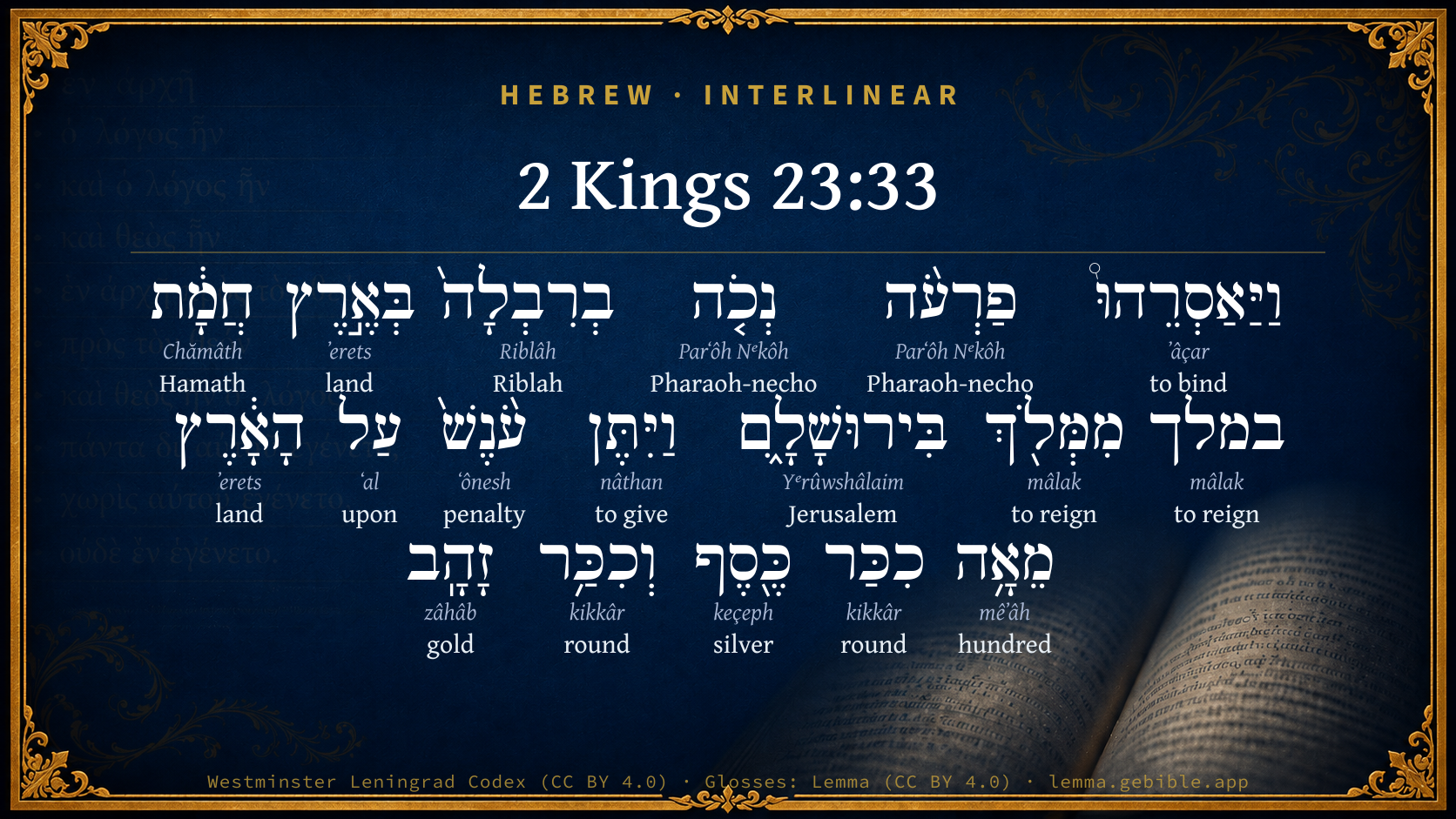
2 Kings 23:33

Hebrew (Westminster Leningrad Codex) 2 Kings 23:33 appears in the Hebrew Old Testament. The text above is from the Westminster Leningrad Codex. Each word links to its Strong’s number, a concise gloss, and parsing drawn from the Open Scriptures Hebrew Bible morphology. Click any word for its full Brown-Driver-Briggs (BDB) entry.
Download image
Cite this verse

2 Kings 23:33 (World English Bible). Public Domain. Lemma interlinear Bible study tool, https://lemma.gebible.app/v/2-kings/23/33.

Show BibTeX & RIS
BibTeX
RIS
English Translation
Pharaoh Necoh put him in bonds at Riblah in the land of Hamath, that he might not reign in Jerusalem; and put the land to a tribute of one hundred talents of silver, and a talent of gold.
World English Bible · Public Domain
Highlights
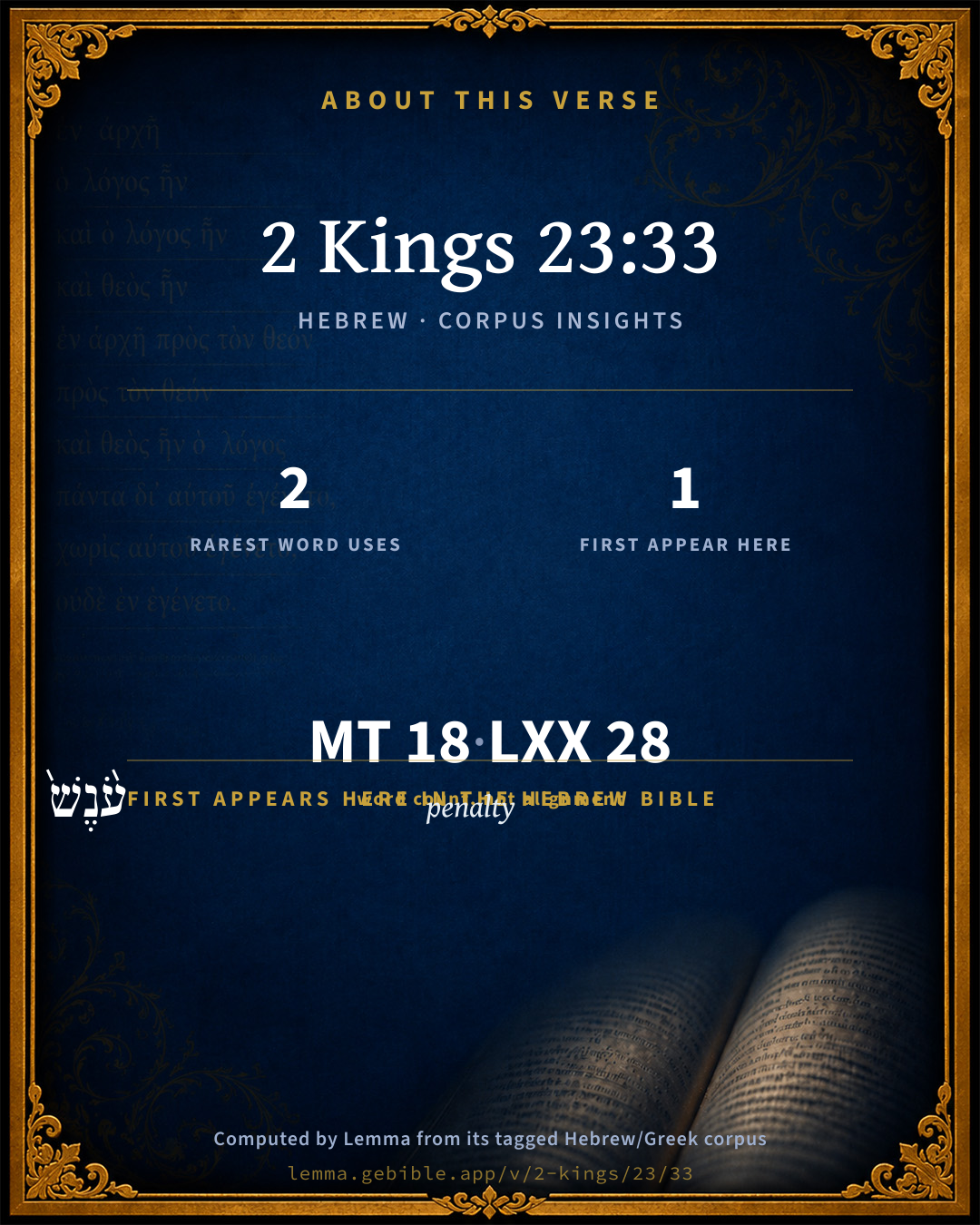
  • 1 first appearance in the Hebrew Bible
Full analysis ↓
Download a study sheet

One document with this verse’s original text, its word-by-word gloss line, the meaning frame, cross-references with their text, attributed commentary, and full source and license credits — printable, and it pastes into notes with its structure intact.

This verse Autodidact and up

Study sheet (.html) Plain text (.txt)

A passage Seminary Student

Up to 50 verses in one chapter. A passage sheet keeps up to 6 commentary sources and 12 cross-references per verse, in the order this page ranks them, and says so on the sheet whenever that leaves anything out. Ask for a single verse and you get the Autodidact verse sheet above.

Everything on this page stays free to read, with no account — the sheet is a download of what is already on screen, not access to it.

Want to remove ads? Support Godless Engineer
Compare translations 3

The same verse in 3 English versions, stacked beneath the original-language interlinear above. Click any original word for its lexicon entry.

Each is an independent rendering of the whole verse — the interlinear is not word-aligned to these translations.

Highlighted words mark where these versions differ — a whole-verse word diff, not a word-by-word alignment.

  • World English Bible Public Domain
    Pharaoh Necoh put him in bonds at Riblah in the land of Hamath, that he might not reign in Jerusalem; and put the land to a tribute of one hundred talents of silver, and a talent of gold.
  • King James Version Public Domain
    And Pharaohnechoh put him in bands at Riblah in the land of Hamath, that he might not reign in Jerusalem; and put the land to a tribute of an hundred talents of silver, and a talent of gold.
  • unfoldingWord Literal Text CC BY-SA 4.0
    And Pharaoh Neco bound him in Riblah, in the land of Hamath, from reigning in Jerusalem. And he imposed tribute on the land, 100 kikkars of silver and a kikkar of gold.

unfoldingWord Literal Text — © unfoldingWord, licensed CC BY-SA 4.0. Word-aligned USFM3 via Door43 (git.door43.org/unfoldingWord/en_ult).

Versions to compare (up to 4)

3 of 4 selected

Show all 18 translations

Every available English version of this verse, each an independent rendering of the whole verse.

  • World English Bible Public Domain
    Pharaoh Necoh put him in bonds at Riblah in the land of Hamath, that he might not reign in Jerusalem; and put the land to a tribute of one hundred talents of silver, and a talent of gold.
  • Berean Standard Bible Public Domain
    And Pharaoh Neco imprisoned Jehoahaz at Riblah in the land of Hamath so that he could not reign in Jerusalem, and he imposed on Judah a levy of a hundred talents of silver and a talent of gold.
  • Majority Standard Bible Public Domain
    And Pharaoh Neco imprisoned Jehoahaz at Riblah in the land of Hamath so that he could not reign in Jerusalem, and he imposed on Judah a levy of a hundred talents of silver and a talent of gold.
  • King James Version Public Domain
    And Pharaohnechoh put him in bands at Riblah in the land of Hamath, that he might not reign in Jerusalem; and put the land to a tribute of an hundred talents of silver, and a talent of gold.
  • American Standard Version (1901) Public Domain
    And Pharaoh-necoh put him in bonds at Riblah in the land of Hamath, that he might not reign in Jerusalem; and put the land to a tribute of a hundred talents of silver, and a talent of gold.
  • Revised Version (1885) Public Domain
    And Pharaoh-necoh put him in bands at Riblah in the land of Hamath, that he might not reign in Jerusalem; and put the land to a tribute of an hundred talents of silver, and a talent of gold.
  • Geneva Bible (1599) Public Domain
    And Pharaoh Nechoh put him in bondes at Riblah in the lande of Hamath, while he reigned in Ierusalem, and put the lande to a tribute of an hundreth talents of siluer, and a talent of golde.
  • Douay-Rheims (1899) Public Domain
    And Pharao Nechao bound him at Rebla, which is in the land of Emath, that he should not reign in Jerusalem: and he set a fine upon the land, of a hundred talents of silver, and a talent of gold.
  • Young's Literal Translation Public Domain
    and Pharaoh-Nechoh bindeth him in Riblah, in the land of Hamath, from reigning in Jerusalem, and he putteth a fine on the land -- a hundred talents of silver, and a talent of gold.
  • Literal Standard Version CC BY-SA 4.0
    and Pharaoh Necho binds him in Riblah, in the land of Hamath, from reigning in Jerusalem, and he puts a fine on the land—one hundred talents of silver, and a talent of gold.
  • Unlocked Literal Bible CC BY-SA 4.0
    Pharaoh Necho put him in chains at Riblah in the land of Hamath, so that he might not reign in Jerusalem. Then Necho fined Judah one hundred talents of silver and one talent of gold.
  • unfoldingWord Literal Text CC BY-SA 4.0
    And Pharaoh Neco bound him in Riblah, in the land of Hamath, from reigning in Jerusalem. And he imposed tribute on the land, 100 kikkars of silver and a kikkar of gold.
  • Darby Bible Public Domain
    And Pharaoh-Nechoh had him bound at Riblah in the land of Hamath, that he might not reign in Jerusalem; and laid a tribute upon the land of a hundred talents of silver and a talent of gold.
  • World Messianic Bible Public Domain
    Pharaoh Necoh put him in bonds at Riblah in the land of Hamath, that he might not reign in Jerusalem; and put the land to a tribute of one hundred talents of silver and a talent of gold.
  • Webster's Bible Public Domain
    And Pharaoh-nechoh put him in bands at Riblah in the land of Hamath, that he might not reign in Jerusalem; and subjected the land to a tribute of a hundred talents of silver, and a talent of gold.
  • Free Bible Version CC BY-SA 4.0
    Pharaoh Neco imprisoned Jehoahaz at Riblah in the land of Hamath to stop him ruling in Jerusalem. He also imposed on Judah a tribute of one hundred talents of silver and a talent of gold.
  • Bible in Basic English Public Domain
    And Pharaoh-necoh put him in chains at Riblah in the land of Hamath, so that he might not be king in Jerusalem; and took from the land a tax of a hundred talents of silver and a talent of gold.
  • JPS Tanakh (1917) Public Domain
    And Pharaoh-necoh put him in bands at Riblah in the land of Hamath, that he might not reign in Jerusalem; and put the land to a fine of a hundred talents of silver, and a talent of gold.

Literal Standard Version (2020), Covenant Press — licensed CC BY-SA 4.0. Text via the HelloAO Bible API (eBible.org). Unlocked Literal Bible (unfoldingWord) — licensed CC BY-SA 4.0. Text via the HelloAO Bible API (eBible.org). unfoldingWord Literal Text — © unfoldingWord, licensed CC BY-SA 4.0. Word-aligned USFM3 via Door43 (git.door43.org/unfoldingWord/en_ult). Free Bible Version, Dr. Jonathan Gallagher — licensed CC BY-SA 4.0. Text via the HelloAO Bible API (eBible.org).

Word by word

More ways to search: Search by grammar → Find every occurrence → Compare this word →

Practice this passage: Drill this verse → Learn its vocabulary →

עֹ֨נֶשׁ֙
ʻônesh
H6066
“penalty”
Noun, Common, Masculine, Singular, Absolute
Part of Speech
Noun
Type
Common
Gender
Masculine
Number
Singular
State
Absolute
Full BDB Definition

Origin: from H6064

TWOT: 1659a

fine, penalty, indemnity
  1. וַיַּאַסְרֵהוּ֩ ʼâçar H631 “and · to bind · him” Conjunction + Verb, Qal, Sequential Imperfect, 3rd Person, Masculine, Singular + Suffix, Personal, 3rd Person, Masculine, Singular
  2. פַרְעֹ֨ה Parʻôh Nᵉkôh H6549 “Pharaoh-necho” Noun, Proper
  3. נְכֹ֤ה Parʻôh Nᵉkôh H6549 “Pharaoh-necho” Noun, Proper
  4. בְרִבְלָה֙ Riblâh H7247 “in/at · Riblah” Preposition + Noun, Proper
  5. בְּאֶ֣רֶץ ʼerets H776 “in/at · land of” Preposition + Noun, Common, Both, Singular, Construct
  6. חֲמָ֔ת Chămâth H2574 “Hamath” Noun, Proper
  7. במלך mâlak H4427 “in/at · to reign” Preposition + Verb, Qal, Infinitive Construct
  8. מִמְּלֹ֖ךְ mâlak H4427 “from · to reign” Preposition + Verb, Qal, Infinitive Construct
  9. בִּירוּשָׁלִָ֑ם Yᵉrûwshâlaim H3389 “in/at · Jerusalem” Preposition + Noun, Proper
  10. וַיִּתֶּן nâthan H5414 “and · to give” Conjunction + Verb, Qal, Sequential Imperfect, 3rd Person, Masculine, Singular
  11. עַל ʻal H5921 “upon” Preposition
  12. הָאָ֔רֶץ ʼerets H776 “the · land” Particle, Definite Article + Noun, Common, Both, Singular, Absolute
  13. מֵאָ֥ה mêʼâh H3967 “hundred” Adjective, Cardinal number, Both, Singular, Absolute
  14. כִכַּר kikkâr H3603 “round of” Noun, Common, Both, Singular, Construct
  15. כֶּ֖סֶף keçeph H3701 “silver” Noun, Common, Masculine, Singular, Absolute
  16. וְכִכַּ֥ר kikkâr H3603 “and · round of” Conjunction + Noun, Common, Both, Singular, Construct
  17. זָהָֽב zâhâb H2091 “gold” Noun, Common, Masculine, Singular, Absolute

About this verse

These counts appear in no published source. They are computed here, from the morphology-tagged text and Lemma’s own curated glosses. What Lemma adds →

18
words
14
distinct lemmas
Historical
section

Notable vocabulary

The rarest word here is עֹ֨נֶשׁ֙ penalty H6066 — appearing just 2 times in the whole Hebrew Bible.

First appearance in Scripture

This word makes its first canonical appearance in the Hebrew Bible here:

  • עֹ֨נֶשׁ֙ penalty H6066

Shared distinctive vocabulary

עֹ֨נֶשׁ֙ penalty H6066 occurs in 2 verses of the Hebrew Bible. Also found in:

Grammatical profile

  • 4 verbs
  • 12 nouns
  • 1 adjective
  • 1 preposition

Verb forms

  • וַיַּאַסְרֵהוּ֩ Qal · Sequential Imperfect
  • במלך Qal · Infinitive Construct
  • מִמְּלֹ֖ךְ Qal · Infinitive Construct
  • וַיִּתֶּן Qal · Sequential Imperfect

Repetition

Words recur within this verse — often emphatic in Hebrew:

  • פַרְעֹ֨ה Pharaoh-necho H6549 ×2
  • בְּאֶ֣רֶץ land H776 ×2
  • במלך to reign H4427 ×2
  • כִכַּר round H3603 ×2

Hebrew & Septuagint length

In English translation the verse runs 38 words from the Hebrew and 38 from the Septuagint (LXX English) — the same length.

A rough comparison of the two English renderings, which tokenize alike — not a word-level alignment.

Word counts can differ between the Hebrew and the Greek without any difference in meaning — e.g. the Hebrew direct-object marker אֵת has no separate Greek word, and Greek often adds the article ὁ.

In the original languages it is 18 Hebrew tokens and 28 Greek tokens — but the two are counted differently (Hebrew bundles its prefixes and suffixes into one token; the Greek is in lemma form), so that isn’t a like-for-like length.

Cross-references

13

Topical passages linked to 2 Kings 23:33 in the Treasury of Scripture Knowledge — connected by theme and wording, ordered by reader-vote popularity; previews shown in the World English Bible.

  • 1 Kings 8:65 So Solomon held the feast at that time, and all Israel with him, a great assembly, from the entrance of Hamath to the brook of Egypt, before Yahweh our God, seven days and seven days, even fourteen days.
  • 2 Kings 25:6 Then they took the king, and carried him up to the king of Babylon to Riblah; and they gave judgment on him.
  • Jeremiah 39:5–6 But the army of the Chaldeans pursued after them, and overtook Zedekiah in the plains of Jericho: and when they had taken him, they brought him up to Nebuchadrezzar king of Babylon to Riblah in the land of Hamath; and he gave judgment on him.
  • Jeremiah 52:9–10 Then they took the king, and carried him up to the king of Babylon to Riblah in the land of Hamath; and he gave judgment on him.
  • Jeremiah 52:26–27 Nebuzaradan the captain of the guard took them, and brought them to the king of Babylon to Riblah.
  • Exodus 21:22 "If men fight and hurt a pregnant woman so that she gives birth prematurely, and yet no harm follows, he shall be surely fined as much as the woman's husband demands and the judges allow.
  • Numbers 13:21 So they went up, and spied out the land from the wilderness of Zin to Rehob, to the entrance of Hamath.
  • Numbers 34:11 and the border shall go down from Shepham to Riblah, on the east side of Ain; and the border shall go down, and shall reach to the side of the sea of Chinnereth eastward;
  • 2 Kings 18:14 Hezekiah king of Judah sent to the king of Assyria to Lachish, saying, I have offended; return from me: that which you put on me will I bear. The king of Assyria appointed to Hezekiah king of Judah three hundred talents of silver and thirty talents of gold.
  • 2 Kings 23:29 In his days Pharaoh Necoh king of Egypt went up against the king of Assyria to the river Euphrates: and king Josiah went against him; and [Pharaoh Necoh] killed him at Megiddo, when he had seen him.
  • 2 Chronicles 36:3–4 The king of Egypt deposed him at Jerusalem, and fined the land one hundred talents of silver and a talent of gold.
  • Proverbs 19:19 A hot-tempered man must pay the penalty, For if you rescue him, you must do it again.
  • Ezekiel 19:3–4 She brought up one of her cubs: he became a young lion, and he learned to catch the prey; he devoured men.

Cross-references courtesy of OpenBible.info (CC BY 4.0).

Hebrew and Greek witnesses Masoretic Hebrew ↔ Greek Septuagint

The same verse in the two great witnesses to the Old Testament, shown verse-for-verse.

These are two independent witnesses, not word-aligned to each other, and the Septuagint is shown in lemma (dictionary) form.

Hebrew 2 Kings 23:33 Masoretic · Westminster Leningrad Codex

וַיַּאַסְרֵהוּ֩ פַרְעֹ֨ה נְכֹ֤ה בְרִבְלָה֙ בְּאֶ֣רֶץ חֲמָ֔ת במלך מִמְּלֹ֖ךְ בִּירוּשָׁלִָ֑ם וַיִּתֶּן עֹ֨נֶשׁ֙ עַל הָאָ֔רֶץ מֵאָ֥ה כִכַּר כֶּ֖סֶף וְכִכַּ֥ר זָהָֽב

Pharaoh Necoh put him in bonds at Riblah in the land of Hamath, that he might not reign in Jerusalem; and put the land to a tribute of one hundred talents of silver, and a talent of gold.

World English Bible · Public Domain

Greek LXX 2 Kings 23:33 Septuagint · lemma form

καί μεταἵστημι αὐτός φαραώ νεχαω ἐν δεβλαθα ἐν γῆ εμαθ ὁ μή βασιλεύω ἐν ἰερουσαλήμ καί δίδωμι ζημία ἐπί ὁ γῆ ἑκατόν τάλαντον ἀργύριον καί ἑκατόν τάλαντον χρυσίον

And Pharao Nechao removed him to Rablaam in the land of Emath, so that he should not reign in Jerusalem; and imposed a tribute on the land, one hundred talents of silver, and one hundred talents of gold.

LXX2012 (modern English Septuagint) · Public Domain

On this verse, Keil & Delitzsch discusses the Septuagint’s reading. Read the note in Commentary ↓

Hebrew: Westminster Leningrad Codex (CC BY 4.0). Greek: Septuagint (public domain); English from LXX2012 (modern English Septuagint) (Public Domain). How the Septuagint differs from the Hebrew →

Targum (Aramaic paraphrase)

1

The Targum is the ancient Jewish Aramaic paraphrase of the Hebrew Scriptures — an interpretive translation, not the Hebrew text itself. Onkelos (literal) and Pseudo-Jonathan (expansive) render the Torah, and Jonathan the Prophets. Coverage is partial: where no permissively-licensed English translation exists for a verse, only the Aramaic is shown. This is verse-level text, not a word-by-word alignment to the Hebrew.

  1. Targum Jonathan Prophets (Joshua–Malachi)
    וְאַסְרֵיהּ פַרְעֹה חֲגִירָא בְרִבְלָה בְּאַרְעָא דַחֲמָת מִלְמִמְלַךְ בִּירוּשְׁלֵם וּרְמָא מַגְבֵּיתָא עַל עַמָא דְאַרְעָא מֵאָה כִּכְּרֵי כַסְפָא וְכִכְּרָא דְדַהֲבָא:

    (no public-domain English translation for this verse)

    Targum Jonathan — Aramaic: “Mikraot Gedolot” (public domain). English: “Sefaria Community Translation” (CC0 1.0 (public-domain dedication)); “London "Chaldee Paraphrase," 1871” (public domain). Text via Sefaria.

Commentary

Notes on 2 Kings 23:33 from classic Christian and Jewish commentators (each source and its license shown beneath its notes). The classic Christian expositions comment on the surrounding passage and are grouped to its opening verse, so a note may address several verses; the Jewish commentaries on the Tanakh (Rashi and others) are per-verse, so they appear only where the commentator wrote on this verse.

Lemma curates 59 commentaries, every one of them public domain or Creative Commons licensed, each selected and text-cleaned for this edition rather than reprinted as found. About our sources →

Trapp's Complete Commentary

John Trapp

2Ki 23:33 And Pharaohnechoh put him in bands at Riblah in the land of Hamath, that he might not reign in Jerusalem; and put the land to a tribute of an hundred talents of silver, and a talent of gold.

Ver. 33. That he might not reign.] He deposed him; to show that he had now the disposal of the kingdom. Or, Because he reigned, sc., without his good leave and liking.

John Trapp, A Commentary or Exposition upon All the Books of the Old and New Testament (1647–1656) — public domain. Text from a community e-Sword module.

Joseph Benson's Commentary

2Ki 23:33. Pharaoh-nechoh put him in bands — Either because he presumed to take the kingdom without his consent; or, because he renewed the war against Egypt. At Riblah — An eminent city in Syria, where Pharaoh now was, that he might finish or make good his conquests, and whither Jehoahaz was carried to receive his sentence. That he might not reign — Or, because he had reigned, that is, taken the kingdom without right, and without his leave. And put the land to a tribute — Namely, an annual tribute, whereby they should acknowledge him to be their superior, and for which he would be their protector when they needed his help.

Joseph Benson's Commentary on the Old and New Testaments (1811–1818) — public domain. Text from a community e-Sword module.

Keil & Delitzsch

C. F. Keil & F. Delitzsch

"Pharaoh Necho put him in fetters (ויּאסרהוּ) at Riblah in the land of Hamath, when he had become king at Jerusalem." In Ch2 36:3 we have, instead of this, "the king of Egypt deposed him (יסירהוּ) at Jerusalem." The Masoretes have substituted as Keri ממּלך, "away from being king," or "that he might be no longer king," in the place of בּמלך, and Thenius and Bertheau prefer the former, because the lxx have τοὺ μὴ βασιλεύειν not in our text only, but in the Chronicles also; but they ought not to have appealed to the Chronicles, inasmuch as the lxx have not rendered the Hebrew text there, but have simply repeated the words from the text of the book of Kings. The Keri is nothing more than an emendation explaining the sense, which the lxx have also followed. The two texts are not contradictory, but simply complete each other: for, as Clericus has correctly observed, "Jehoahaz would of course be removed from Jerusalem before he was cast into chains; and there was nothing to prevent his being dethroned at Jerusalem before he was taken to Riblah."

We are not told in what way Necho succeeded in getting Jehoahaz into his power, so as to put him in chains at Riblah. The assumption of J. D. Michaelis and others, that his elder brother Eliakim, being dissatisfied with the choice of Jehoahaz as king, had recourse to Necho at Riblah, in the hope of getting possession of his father's kingdom through his instrumentality, is precluded by the face that Jehoahaz would certainly not have been so foolish as to appear before the enemy of his country at a mere summons from Pharaoh, who was at Riblah, and allow him to depose him, when he was perfectly safe in Jerusalem, where the will of the people had raised him to the throne. If Necho wanted to interfere with the internal affairs of the kingdom of Judah, it would never have done for him to proceed beyond Palestine to Syria after the victory at Megiddo, without having first deposed Jehoahaz, who had been raised to the throne at Jerusalem without any regard to his will. The course of events was therefore probably the following: After the victory at Megiddo, Necho intended to continue his march to the Euphrates; but on hearing that Jehoahaz had ascended the throne, and possibly also in consequence of complaints which Eliakim had made to him on that account, he ordered a division of his army to march against Jerusalem, and while the main army was marching slowly to Riblah, he had Jerusalem taken, king Jehoahaz dethroned, the land laid under tribute, Eliakim appointed king as his vassal, and the deposed Jehoahaz brought to his headquarters at Riblah, then put into chains and transported to Egypt; so that the statement in Ch2 36:3, "he deposed him at Jerusalem," is to be taken quite literally, even if Necho did not come to Jerusalem in propri person, but simply effected this through the medium of one of his generals.

(Note: Ewald (Gesch. iii. p. 720) also observes, that "Necho himself may have been in Jerusalem at the time for the purpose of installing his vassal:" this, he says, "is indicated by the brief words in Kg2 23:33-34, and nothing can be found to say against it in other historical sources;" though he assumes that Jehoahaz had allowed himself to be enticed by Necho to go to Riblah into the Egyptian camp, where he was craftily put into chains, and soon carried off as a prisoner to Egypt. - We should have a confirmation of the taking of Jerusalem by Necho in the account given by Herodotus (ii. 159): μετὰ δὲ τήν μάχην (i.e., after the battle at Megiddo) Κάδυτιν πόλιν τῆς Συρίης ἐοῦσαν μεγάλην εἶλε, if any evidence could be brought to establish the opinion that by Κάδυτις we are to understand Jerusalem. But although what Herodotus says (iii. 5) concerning Κάδυτις does not apply to any other city of Palestine so well as to Jerusalem, the use of the name Κάδυτις for Jerusalem has not yet been sufficiently explained, since it cannot come from קדושה, the holy city, because the ש of this word does not pass into t in any Semitic dialect, and the explanation recently attempted by Bttcher (N. ex. Krit. Aehrenlese, ii. pp. 119ff.) from the Aramaean חדיתא, the renewed city (new-town), is based upon many very questionable conjectures. At the same time so much is certain, that the view which Hitzig has revived (de Cadyti urbe Herod. Gott. 1829, p. 11, and Urgeschichte der Philister, pp. 96ff.), and which is now the prevalent one, viz., that Κάδυτις is Gaza, is exposed to some well-founded objections, even after what Stark (Gaza, pp. 218ff.) has adduced in its favour. The description which Herodotus gives (iii. 5) of the land-road to Egypt: ἀπὸ Φοινίκης μέχρι οὔρων τῶν Καδύτιος πόλιος ἥ ἐστι Σύρων τῶν Παλαιστινῶν καλεομένων· ἀπὸ δὲ Καδύτιος, ἐούσης πόλιος (ὡς ἐμοὶ δοκέει) Σαρδίων ου ̓ πολλῷ ἐλάσσονος, ἀπὸ ταύτης τὰ ἐμπόρια τὰ ἐπὶ θαλάσσης μέχρι Ἰηνύσου πόλιός ἐστι τοῦ Ἀραβίου· does not apply to Gaza, because there were no commercial towns on the sea-coast between the district of Gaza and the town of Yenysus (the present Khan Ynas); but between the district of Jerusalem and the town of Yenysus there were the Philistian cities Ashkelon and Gaza, which Herodotus might call τὰ ἐμπόρια τοὺ Ἀραβίου, whereas the comparison made between the size of Kadytis and that of Sardes points rather to Jerusalem than to Gaza. Still less can the datum in Jer 47:1, "before Pharaoh smote Gaza," be adduced in support of Gaza. If we bear in mind that Jeremiah's prophecy (2 Kings 47) was not uttered before the fourth year of Jehoiakim's reign, and therefore that Pharaoh had not smitten Gaza at that time, supposing that this Pharaoh was really Necho, it cannot have been till after his defeat at Carchemish that Necho took Gaza on his return home. Ewald, Hitzig, and Graf assume that this was the case; but, as M. v. Niebuhr has correctly observed, it has "every military probability" against it, and even the incredibility that "a routed Oriental army in its retreat, which it evidently accomplished in one continuous march, notwithstanding the fact that on its line of march there were the strongest positions, on the Orontes, Lebanon, etc., at which it might have halted, should have taken the city upon its flight." And, lastly, the name Κάδυτις does not answer to the name Gaza, even through the latter was spelt Gazatu in early Egyptian (Brugsch, Geograph. Inschr. ii. p. 32) since the u (y) of the second syllable still remains unexplained.)

Riblah has been preserved in the miserable village of Rible, from ten to twelve hours to the S.S.W. of Hums (Emesa) by the river el Ahsy (Orontes), in a large fruitful plain of the northern portion of the Bekaa, which was very well adapted to serve as the camping ground of Necho's army as well as of that of Nebuchadnezzar (Kg2 25:6, Kg2 25:20-21), not only because it furnished the most abundant supply of food and fodder, but also on account of its situation on the great caravan-road from Palestine by Damascus, Emesa, and Hamath to Thapsacus and Carchemish on the Euphrates (cf. Rob. Bibl. Res. pp. 542-546 and 641).

In the payment imposed upon the land by Necho, one talent of gold (c. 25,000 thalers: 3750) does not seem to bear any correct proportion to 100 talents of silver (c. 250,000 thalers, or 37,500), and consequently the lxx have 100 talents of gold, the Syr. and Arab. 10 talents; and Thenius supposes this to have been the original reading, and explains the reading in the text from the dropping out of a y (= 10), though without reflecting that as a rule the number 10 would require the plural כּכּרים.

Keil & Delitzsch — Biblical Commentary on the Old Testament (1861–1891) — public domain (CC PDM 1.0). Text via the HelloAO Bible API. (Old Testament only.)

Tyndale Open Study Notes

Tyndale Open Resources

23:33 Riblah was a fortified administrative center in Aramean territory about sixty miles northeast of Damascus.

Tyndale Open Study Notes — © Tyndale Open Resources, licensed CC BY-SA 4.0. Text via the HelloAO Bible API.

Geneva Bible (1599)

Geneva Bible translators

Which was Antioch in Syria, called also Hamath.

Or, that he should not reign.

Geneva Bible (1599) marginal notes — public domain. Text via Bolls.life.

Adam Clarke's Commentary

Verse 33. Nechoh put him in bands] But what was the cause of his putting him in bands? It is conjectured, and not without reason, that Jehoahaz, otherwise called Shallum, raised an army, met Nechoh in his return from Carchemish, fought, was beaten, taken prisoner, put in chains; and taken into Egypt, where he died; 2Ch 23:34, and Jer 22:11-12. Riblah or Diblath, the place of this battle, was probably a town in Syria, in the land or district of Hamath.

Adam Clarke's Commentary on the Bible (1810–1826) — public domain. Text from a community e-Sword/MySword module.

Ellicott's Commentary for English Readers

(33) And Pharaoh-nechoh put him in bands . . .—See Note on 2Ch_36:3. The LXX. here has “removed him,” but the other versions “bound him.”

That he might not reign.—This is the reading of the Hebrew margin, some MSS., and the LXX., Vulg., and Targum. The Syriac and Arabic have, “when he reigned,” which is the ordinary Hebrew text. The original text of the whole was perhaps this: “and Pharaoh-nechoh bound him at Riblah . . . and removed him from reigning in Jerusalem;” i.e., he threw him into bonds, and pronounced his deposition. (Comp, the construction in 1Ki_15:13.) Riblah (now Ribleh) lay in a strong position on the Orontes, commanding the caravan route from Palestine to the Euphrates. Necho had advanced so far, after the battle of Megiddo, and taken up his quarters there, as Nebuchadnezzar did afterwards (2Ki_25:6; 2Ki_25:20-21). Josephus relates that Necho summoned Jehoahaz to his camp at Riblah. The passage, Eze_19:4, suggests that he got the king of Judah into his power by fraud: “he was taken in their pit.” It used to be supposed, on the strength of Herod, ii. 159, that Necho captured Jerusalem. What Herodotus says is this: “And engaging the Syrians on foot at Magdolus, Nechoh was victorious. After the battle he took Kadytis, a great city of Syria.” Kadytis has been thought to be either Hadath (“the new town;” referring to the rebuilding of Jerusalem after the Return), or el-Kuds(“the holy;” the modern Arabic title of Jerusalem), or Gaza. In reality it is Kadesh on the Orontes, one of the great Hittite capitals, and not far from Hamath.

A talent of gold.—So Chronicles. The LXX. here reads, an hundred talents of gold (a transcriber’s error). The Syriac and Arabic, ten talents, which may be right. (Comp. 2Ki_18:14, where the proportion of silver to gold is ten to one.)

Tribute.—The Hebrew word means fine. The Vulg. renders rightly, “et imposuit multum terrae.”

A Bible Commentary for English Readers, edited by Charles John Ellicott (1878–1897) — public domain. Text from a community e-Sword module.

The Cambridge Bible for Schools and Colleges

gen. ed. J. J. S. Perowne

33. put him in bands at Riblah in the land of Hamath] In 2Ch_36:3 it is said ‘the king of Egypt put Jehoahaz down at Jerusalem’. We cannot, however, be sure that this implies an advance by Pharaoh-nechoh upon the holy city. However, the appointment which the people had made was clearly not acceptable to the Egyptian king, and Jehoahaz was carried away to the point which Pharaoh had reached in his march from Carchemish, and there put in bonds.

Riblah] (called also Riblathah) was a city on the Orontes, and on the road which led from Palestine to Babylon. It is afterwards mentioned as the place at which Nebuchadnezzar tarried during the reduction of Jerusalem (2Ki_25:20-21) and whither the captives were brought to him.

tribute of an hundred talents] On the value of these sums, see above on 2Ki_5:5.

The Cambridge Bible for Schools and Colleges (gen. ed. J. J. S. Perowne; Cambridge University Press, 1878–1918) — public domain. Text from a community e-Sword module.

John Gill's Exposition

And Jehoiakim gave the silver and gold to Pharaoh,.... The one hundred talents of silver and the talent of gold, which he imposed as a tribute upon the land:

but he taxed the land to give the money according to the commandment of Pharaoh; he did not take it out of his own treasures nor the treasures of the house of the Lord, which perhaps might be exhausted, but levied it of the people of the land:

he exacted the silver and gold of the people of the land, required them to pay it in:

of everyone according to his taxation, to give it unto Pharaohnechoh: everyone was taxed according to his abilities, in proportion to what he was worth, or to the estate he was possessed of.

John Gill's Exposition of the Whole Bible (1746–1763) — public domain (CC PDM 1.0). Text via the HelloAO Bible API.

Albert Barnes' Notes on the Bible

Pharaoh-Nechoh, after bringing Phoenicia and Syria under his rule, and penetrating as far as Carchemish, returned to Southern Syria, and learned what had occurred at Jerusalem in his absence. He sent orders to Jehoahaz to attend the court which he was holding at Riblah, and Jehoahaz fell into the trap Eze 19:4.

Riblah still retains its name. It is situated on the Orontes, in the Coele-Syrian valley, near the point where the valley opens into a wide and fertile plain. Neco seems to have been the first to perceive its importance. Afterward Nebuchadnezzar made it his headquarters during his sieges of Jerusalem and Tyre 2Ki 25:21; Jer 39:5; Jer 52:9-10, Jer 52:26.

Albert Barnes' Notes on the Bible (1834–1885) — public domain. Text from a community e-Sword/MySword module.

Haydock's Catholic Bible Commentary

Rebla. Syriac and Arabic, "Deblat;" probably (Calmet) Apamea on the Orontes. (Chaldean, on Numbers xxxiv. 11.)

George Leo Haydock (1774–1849), Haydock's Catholic Family Bible and Commentary, 1859 edition — public domain. Excludes Psalms (Douay-Rheims chapter numbering differs from Protestant) and Deuterocanonical books (Catholic canon only).

Matthew Poole's English Annotations

Pharaoh-nechoh put him in bands; either because he presumed to take the kingdom without his leave and consent; or because he renewed the war against Pharaoh, as some affirm, and by him was conquered and taken prisoner.

Riblah; an eminent city in Syria; of which see Num 34:11; 2Ki 25:6; where Pharaoh now was to finish or make good his conquests, whither Jehoahaz was carried to receive his sentence.

That he might not reign; or, because he had reigned, i.e. taken the kingdom without right, and without his leave. Or, according to the other reading,

in the beginning of his reign; the word reigning being commonly used for beginning to reign; when he was scarce warm in his throne.

A tribute, to wit, a yearly tribute, whereby they should acknowledge him to be their superior; and for which he would be their protector when they needed his help.

Matthew Poole's English Annotations on the Holy Bible (1683–1685) — public domain. Text from a community e-Sword/MySword module.

Whedon's Commentary on the Bible

Daniel D. Whedon

33. Put him in bands at Riblah — Some render, made him, or took him, captive at Riblah. But how came Jehoahaz at Riblah? Some think he marched thither at the head of his army to fight with the Egyptian king, and to avenge the death of his father. More probable, however, is the statement of Josephus, that when Necho returned from his eastern campaign, and arrived at the land of Hamath, “he sent for Jehoahaz to come to him, and when he was come, he put him in bands.” Perhaps Necho induced him by some false pretext to come to his camp. Riblah is mentioned at Num_34:11, as a border city of Israel. Some, however, doubt its identity with this Riblah in the land of Hamath. The site of this latter is beyond all question identical with the modern village of the same name, situated on the east bank of the Orontes, about thirty-five miles northeast of Baalbek. It lies in the midst of a vast plain of great beauty and fertility. Here Nebuchadnezzar was encamped when Zedekiah and his sons were brought captives into his presence; and here the sons were slain and the father’s eyes put out. 2Ki_25:6-7. Here, too, Zedekiah’s principal officers were put to death. 2Ki_25:21. Dr. Robinson, who visited this spot in 1852, remarks: “A more advantageous place of encampment for the hosts of Egypt and Babylon can hardly be imagined. On the banks of a mountain stream, in the midst of this vast and fertile plain, the most abundant supplies of provisions and forage were at hand. From this point the roads were open to the Egyptian monarch across the desert, either by Aleppo and the Euphrates to Nineveh, or by Palmyra to Babylon. From Riblah, too, the host of the Babylonian conqueror could sweep around the end of Lebanon and along the coast to Palestine and Egypt; or, passing on southwards through the Buka’a, could spread themselves out over the land either eastwards or westwards from the valley of the Jordan.” The land of Hamath was the territory belonging to the kingdom of this name, and seems to have included the whole valley of the Orontes.

That he might not reign in Jerusalem — This is the reading of the Keri, (ממלךְ,) which is sustained by the Septuagint, Chaldee, and Vulgate. and makes better sense than the Kethib, (במלךְ) whilst he reigned in Jerusalem. Why Necho refused to ratify the election of Jehoahaz, and made his elder brother king in his place, does not appear, unless it be that Eliakim was the rightful heir to the throne. See on 2Ki_23:31. It may be that Jehoahaz was a more bold and energetic prince than his elder brother, and the Egyptian king feared that he would soon lead the nation into rebellion against him. Ezekiel (Eze_19:2-3) represents him as a young lion which devoured men, of whom, when the nations heard, “he was taken in their pit, and they brought him with chains unto the land of Egypt.”

A hundred talents of silver — About one hundred and sixty-six thousand dollars.

A talent of gold — About fifty-six thousand nine hundred dollars. “The relative amount of the silver and the gold is remarkable; but as the same figures are given in 2Ch_36:3, and in 3 Esra (1 Esdras) 1Es_1:36, we are not justified in changing them. It may be that Necho wanted silver, which was rarer in the Orient, or that he did not wish to alienate the country too much from himself by pitiless severity.” — Bahr.

Daniel D. Whedon (gen. ed.), Commentary on the Old and New Testaments (1874–1909) — public domain. Text from a community e-Sword module.

The Pulpit Commentary

And Pharaoh-Nechoh put him in bands at Riblah. "Riblah," which retains its name, was situated in the Coele-Syrian plain, on the right bank of the Orontes, in lat. 34 23" N. nearly. It commanded a ford over the river (Condor, "Heth and Moab," p. 17), and is in the midst of a rich, corn-producing country. Hamath, to which it was regarded as belonging, is situated more than fifty miles further down the river. Riblah was well placed as a center for communication with the neighboring countries. As Dr. Robinson says ("Researches," vol. 3. p. 545), "From this point the roads were open by Aleppo and the Euphrates to Nineveh, or by Palmyra (Tadmor) to Babylon, by the end of Lebanon and the coast to Palestine (Philistia) and Egypt, or through the, Bukaa and the Jordan valley to the center of the Holy Land." Nebuchadnezzar followed the example of Nechoh in making Ribiah his headquarters during his sieges of Tyro and Jerusalem (see 2Ki_25:21; Jer_39:5 Jer_52:9, Jer_52:10, Jer_52:26, Jer_52:27) In the land of Hamath. The "land of Hamath" was the upper part of the Coele-Syrian valley from about lat. 34 to lat. 35 30" N. That he might not reign in Jerusalem. Nechoh might naturally distrust the people"s choice. He might also regard the setting up of any king at Jerusalem without his sanction as an act of contumacy on the part of a nation which had been practically conquered by the complete defeat of Josiah at Megiddo. Whether his conduct in seizing Jehoahaz after inviting him to a conference was justifiable or not may be questioned; but, in point of fact, he did but use the right of the conqueror somewhat harshly. And put the land to a tribute of a hundred talents of silver, and a talent of gold. (So Josephus, l.s.c. ) The tribute was a very moderate one. A century earlier Sennacherib had enacted a tribute of three hundred talents of silver, and thirty of gold. (see above, 2Ki_18:14) We may conjecture that Nechoh wished to conciliate the Jews, regarding them as capable of rendering him good service in the struggle, on which he had entered, with Babylon.

The Pulpit Commentary (1880–1919), ed. H.D.M. Spence-Jones & Joseph S. Exell — public domain. Text from a community e-Sword module.

John Wesley's Explanatory Notes

In bands - Either, because he presumed to take the kingdom without his consent: or because he renewed the war against Pharaoh.

John Wesley, Explanatory Notes Upon the Whole Bible (1754–1765) — public domain. Text via the GEBible commentary corpus.

Lesson kit

Teaching starters — assembled from the data on this page, not authored interpretation. Every prompt links to the verse data it draws on. Edit before teaching.

2 Kings, in the Historical, opens this verse with 18 words (14 distinct Hebrew lemmas). Its most distinctive word is ʻônesh (“penalty”). A historical commentator’s framing appears above. Read the whole chapter for the surrounding context.

Discussion questions

  1. What does “penalty” (ʻônesh) contribute to the verse as a whole?
  2. This is the first place “penalty” appears in Scripture (first appears here). What does its debut here establish?
  3. How does Proverbs 19:19, which shares the word «penalty», read alongside this verse?
  4. What does the repetition of “Pharaoh-necho” (2× in this one verse) do in this verse?
  5. The translations on this page render this verse differently — a whole-verse word diff, not a word-by-word alignment. What might account for the different wordings?
  6. «וַיַּאַסְרֵהוּ֩» is a Qal Sequential Imperfect verb. How does that grammatical form shape the action described?
  7. Compare how Trapp's Complete Commentary and Joseph Benson's Commentary read this verse. Where do they agree or differ?

Things to notice

Reading settings

Reading text

Shown beneath each verse's original-language words.

Old Testament
Old Testament edition

Read the OT as the Masoretic Hebrew (MT) or the Greek Septuagint (LXX).

English shown for the Greek Septuagint (in the Hebrew ↔ Greek comparison).

Comparing translations? Open the Compare panel on any verse page to stack up to four side by side.