
2 Kings 8:20

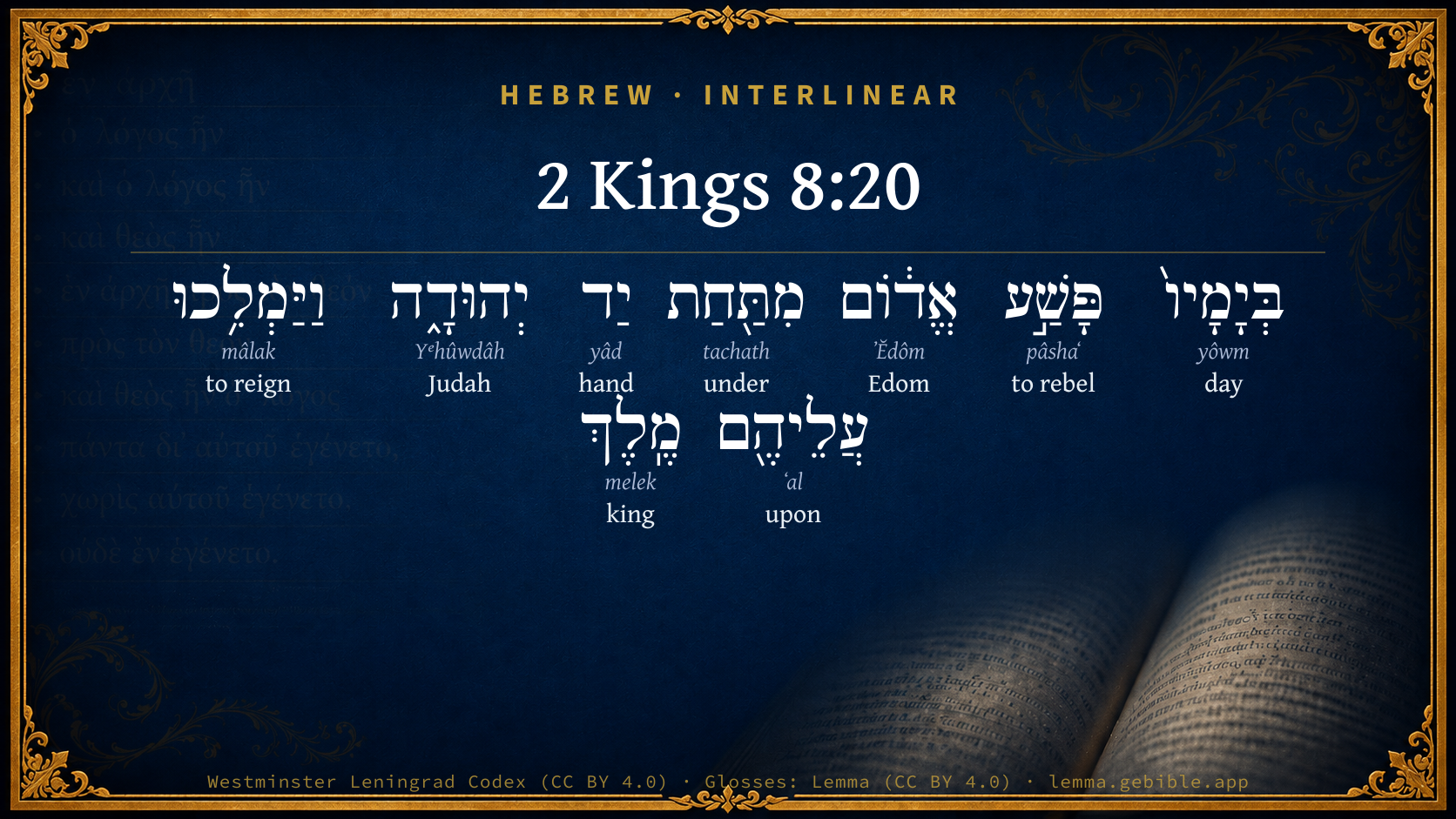
Hebrew (Westminster Leningrad Codex) 2 Kings 8:20 appears in the Hebrew Old Testament. The text above is from the Westminster Leningrad Codex. Each word links to its Strong’s number, a concise gloss, and parsing drawn from the Open Scriptures Hebrew Bible morphology. Click any word for its full Brown-Driver-Briggs (BDB) entry.
Download image
Cite this verse

2 Kings 8:20 (World English Bible). Public Domain. Lemma interlinear Bible study tool, https://lemma.gebible.app/v/2-kings/8/20.

Show BibTeX & RIS
BibTeX
RIS
English Translation
In his days Edom revolted from under the hand of Judah, and made a king over themselves.
World English Bible · Public Domain
Download a study sheet

One document with this verse’s original text, its word-by-word gloss line, the meaning frame, cross-references with their text, attributed commentary, and full source and license credits — printable, and it pastes into notes with its structure intact.

This verse Autodidact and up

Study sheet (.html) Plain text (.txt)

A passage Seminary Student

Up to 50 verses in one chapter. A passage sheet keeps up to 6 commentary sources and 12 cross-references per verse, in the order this page ranks them, and says so on the sheet whenever that leaves anything out. Ask for a single verse and you get the Autodidact verse sheet above.

Everything on this page stays free to read, with no account — the sheet is a download of what is already on screen, not access to it.

Want to remove ads? Support Godless Engineer
Compare translations 3

The same verse in 3 English versions, stacked beneath the original-language interlinear above. Click any original word for its lexicon entry.

Each is an independent rendering of the whole verse — the interlinear is not word-aligned to these translations.

Highlighted words mark where these versions differ — a whole-verse word diff, not a word-by-word alignment.

  • World English Bible Public Domain
    In his days Edom revolted from under the hand of Judah, and made a king over themselves.
  • King James Version Public Domain
    In his days Edom revolted from under the hand of Judah, and made a king over themselves.
  • unfoldingWord Literal Text CC BY-SA 4.0
    In his days, Edom rebelled from under the hand of Judah, and they made a king rule over them.

unfoldingWord Literal Text — © unfoldingWord, licensed CC BY-SA 4.0. Word-aligned USFM3 via Door43 (git.door43.org/unfoldingWord/en_ult).

Versions to compare (up to 4)

3 of 4 selected

Show all 18 translations

Every available English version of this verse, each an independent rendering of the whole verse.

  • World English Bible Public Domain
    In his days Edom revolted from under the hand of Judah, and made a king over themselves.
  • Berean Standard Bible Public Domain
    In the days of Jehoram, Edom rebelled against the hand of Judah and appointed their own king.
  • Majority Standard Bible Public Domain
    In the days of Jehoram, Edom rebelled against the hand of Judah and appointed their own king.
  • King James Version Public Domain
    In his days Edom revolted from under the hand of Judah, and made a king over themselves.
  • American Standard Version (1901) Public Domain
    In his days Edom revolted from under the hand of Judah, and made a king over themselves.
  • Revised Version (1885) Public Domain
    In his days Edom revolted from under the hand of Judah, and made a king over themselves.
  • Geneva Bible (1599) Public Domain
    In those dayes Edom rebelled from vnder the hand of Iudah, and made a King ouer themselues.
  • Douay-Rheims (1899) Public Domain
    In his days Edom revolted, from being under Juda, and made themselves a king.
  • Young's Literal Translation Public Domain
    In his days hath Edom revolted from under the hand of Judah, and they cause a king to reign over them,
  • Literal Standard Version CC BY-SA 4.0
    In his days Edom has revolted from under the hand of Judah, and they cause a king to reign over them,
  • Unlocked Literal Bible CC BY-SA 4.0
    In Jehoram's days, Edom revolted from under the hand of Judah, and they set a king over themselves.
  • unfoldingWord Literal Text CC BY-SA 4.0
    In his days, Edom rebelled from under the hand of Judah, and they made a king rule over them.
  • Darby Bible Public Domain
    In his days Edom revolted from under the hand of Judah, and they set a king over themselves.
  • World Messianic Bible Public Domain
    In his days Edom revolted from under the hand of Judah, and made a king over themselves.
  • Webster's Bible Public Domain
    In his days Edom revolted from under the hand of Judah, and made a king over themselves.
  • Free Bible Version CC BY-SA 4.0
    During Jehoram's time as king, Edom rebelled against Judah's rule and chose their own king.
  • Bible in Basic English Public Domain
    In his time, Edom made themselves free from the rule of Judah, and took a king for themselves.
  • JPS Tanakh (1917) Public Domain
    In his days Edom revolted from under the hand of Judah, and made a king over themselves.

Literal Standard Version (2020), Covenant Press — licensed CC BY-SA 4.0. Text via the HelloAO Bible API (eBible.org). Unlocked Literal Bible (unfoldingWord) — licensed CC BY-SA 4.0. Text via the HelloAO Bible API (eBible.org). unfoldingWord Literal Text — © unfoldingWord, licensed CC BY-SA 4.0. Word-aligned USFM3 via Door43 (git.door43.org/unfoldingWord/en_ult). Free Bible Version, Dr. Jonathan Gallagher — licensed CC BY-SA 4.0. Text via the HelloAO Bible API (eBible.org).

Word by word

More ways to search: Search by grammar → Find every occurrence → Compare this word →

Practice this passage: Drill this verse → Learn its vocabulary →

About this verse

These counts appear in no published source. They are computed here, from the morphology-tagged text and Lemma’s own curated glosses. What Lemma adds →

9
words
9
distinct lemmas
Historical
section

Shared distinctive vocabulary

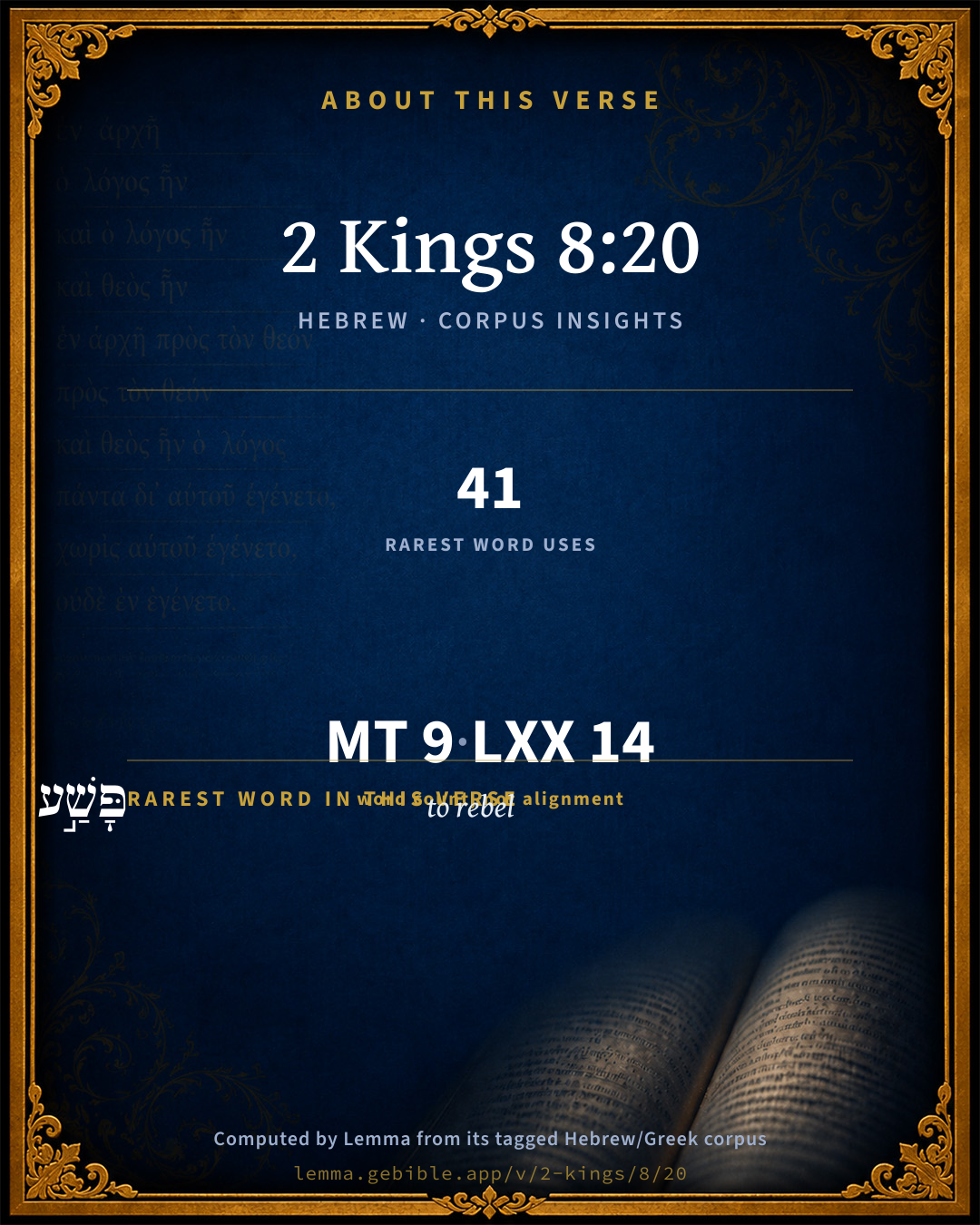
פָּשַׁ֣ע to rebel H6586 occurs in 37 verses of the Hebrew Bible. Also found in:

Grammatical profile

  • 2 verbs
  • 5 nouns
  • 2 prepositions

Verb forms

  • פָּשַׁ֣ע Qal · Perfect
  • וַיַּמְלִ֥כוּ Hiphil · Sequential Imperfect

Hebrew & Septuagint length

In English translation the verse runs 17 words from the Hebrew and 18 from the Septuagint (LXX English) — closely comparable.

A rough comparison of the two English renderings, which tokenize alike — not a word-level alignment.

Word counts can differ between the Hebrew and the Greek without any difference in meaning — e.g. the Hebrew direct-object marker אֵת has no separate Greek word, and Greek often adds the article ὁ.

In the original languages it is 9 Hebrew tokens and 14 Greek tokens — but the two are counted differently (Hebrew bundles its prefixes and suffixes into one token; the Greek is in lemma form), so that isn’t a like-for-like length.

Cross-references

7

Topical passages linked to 2 Kings 8:20 in the Treasury of Scripture Knowledge — connected by theme and wording, ordered by reader-vote popularity; previews shown in the World English Bible.

  • 1 Kings 22:47 There was no king in Edom: a deputy was king.
  • 2 Kings 3:9 So the king of Israel went, and the king of Judah, and the king of Edom; and they made a circuit of seven days' journey: and there was no water for the host, nor for the animals that followed them.
  • 2 Kings 3:27 Then he took his eldest son who would have reigned in his place, and offered him for a burnt offering on the wall. There was great wrath against Israel: and they departed from him, and returned to their own land.
  • 2 Kings 8:22 So Edom revolted from under the hand of Judah to this day. Then did Libnah revolt at the same time.
  • Genesis 27:40 By your sword will you live, and you will serve your brother. It will happen, when you will break loose, That you shall shake his yoke from off your neck."
  • 2 Samuel 8:14 He put garrisons in Edom; throughout all Edom put he garrisons, and all the Edomites became servants to David. Yahweh gave victory to David wherever he went.
  • 2 Chronicles 21:8–10 In his days Edom revolted from under the hand of Judah, and made a king over themselves.

Cross-references courtesy of OpenBible.info (CC BY 4.0).

Hebrew and Greek witnesses Masoretic Hebrew ↔ Greek Septuagint

The same verse in the two great witnesses to the Old Testament, shown verse-for-verse.

These are two independent witnesses, not word-aligned to each other, and the Septuagint is shown in lemma (dictionary) form.

Hebrew 2 Kings 8:20 Masoretic · Westminster Leningrad Codex

בְּיָמָיו֙ פָּשַׁ֣ע אֱד֔וֹם מִתַּ֖חַת יַד יְהוּדָ֑ה וַיַּמְלִ֥כוּ עֲלֵיהֶ֖ם מֶֽלֶךְ

In his days Edom revolted from under the hand of Judah, and made a king over themselves.

World English Bible · Public Domain

Greek LXX 2 Kings 8:20 Septuagint · lemma form

ἐν ὁ ἡμέρα αὐτός ἀθετέω εδωμ ὑποκάτωθεν χείρ ιουδα καί βασιλεύω ἐπί ἑαυτοῦ βασιλεύς

In his days Edom revolted from under the hand of Juda, and they made a king over themselves.

LXX2012 (modern English Septuagint) · Public Domain

Hebrew: Westminster Leningrad Codex (CC BY 4.0). Greek: Septuagint (public domain); English from LXX2012 (modern English Septuagint) (Public Domain). How the Septuagint differs from the Hebrew →

Targum (Aramaic paraphrase)

1

The Targum is the ancient Jewish Aramaic paraphrase of the Hebrew Scriptures — an interpretive translation, not the Hebrew text itself. Onkelos (literal) and Pseudo-Jonathan (expansive) render the Torah, and Jonathan the Prophets. Coverage is partial: where no permissively-licensed English translation exists for a verse, only the Aramaic is shown. This is verse-level text, not a word-by-word alignment to the Hebrew.

  1. Targum Jonathan Prophets (Joshua–Malachi)
    בְּיוֹמוֹהִי מְרָדוּ אֱדוֹמָאֵי מִתְּחוֹת יַד אֱנַשׁ יְהוּדָה וְאַמְלִיכוּ עֲלֵיהוֹן מַלְכָּא:

    (no public-domain English translation for this verse)

    Targum Jonathan — Aramaic: “Mikraot Gedolot” (public domain). English: “Sefaria Community Translation” (CC0 1.0 (public-domain dedication)); “London "Chaldee Paraphrase," 1871” (public domain). Text via Sefaria.

Commentary

Notes on 2 Kings 8:20 from classic Christian and Jewish commentators (each source and its license shown beneath its notes). The classic Christian expositions comment on the surrounding passage and are grouped to its opening verse, so a note may address several verses; the Jewish commentaries on the Tanakh (Rashi and others) are per-verse, so they appear only where the commentator wrote on this verse.

Lemma curates 59 commentaries, every one of them public domain or Creative Commons licensed, each selected and text-cleaned for this edition rather than reprinted as found. About our sources →

Ellicott's Commentary for English Readers

(20) In his days Edom revolted.—The connection of ideas is this: Although Jehovah was not willing to extirpate Judah, yet He suffered it to be seriously weakened by the defections recorded in 2Ki_8:20-22.

Made a king over themselves.—Josephus says they slew the vassal king appointed over them by Jehoshaphat (1Ki_22:48). Edom appears to have been subject to the hegemony of Judah from the time of the disruption under Rehoboam.

A Bible Commentary for English Readers, edited by Charles John Ellicott (1878–1897) — public domain. Text from a community e-Sword module.

Trapp's Complete Commentary

John Trapp

2Ki 8:20 In his days Edom revolted from under the hand of Judah, and made a king over themselves.

Ver. 20. In his days Edom revolted.] And so fulfilled old Isaac’s prophecy, {Gen 27:40} for the punishment of this idolatrous tyrant, who had lately imbrued his hands in the blood of his six brethren, with others their partisans, and set up high places in the mountains of Judah, &c. {2Ch 21:2; 2Ch 21:10-11}

John Trapp, A Commentary or Exposition upon All the Books of the Old and New Testament (1647–1656) — public domain. Text from a community e-Sword module.

Joseph Benson's Commentary

2Ki 8:20. In his days Edom revolted — After they had been subject to Judah one hundred and fifty years, ever since the time of David, who subdued that country. This was a great dishonour to him. Hereby, however, the prophecy of Isaac (Gen 27:40) was fulfilled.

Joseph Benson's Commentary on the Old and New Testaments (1811–1818) — public domain. Text from a community e-Sword module.

Geneva Bible (1599)

Geneva Bible translators

Which had been subject from David’s time, until this time of Jehoram.

Geneva Bible (1599) marginal notes — public domain. Text via Bolls.life.

The Cambridge Bible for Schools and Colleges

gen. ed. J. J. S. Perowne

20. Edom revolted] In Solomon’s time, Hadad (1Ki_11:14) recovered the kingdom of Edom, which had been overthrown by David (2Sa_8:14). But by the time of Jehoshaphat the Edomites were again subject to Judah (1Ki_22:47) and appear to have continued so until the time of the revolution here mentioned.

made a king over themselves] i.e. They deposed the deputy of Judah, and made one of their own royal family king, or chose a king of their own.

The Cambridge Bible for Schools and Colleges (gen. ed. J. J. S. Perowne; Cambridge University Press, 1878–1918) — public domain. Text from a community e-Sword module.

John Gill's Exposition

In his days Edom revolted from under the hand of Judah,.... Who had been tributary to Judah ever since the times of David, for the space of one hundred and fifty years:

and made a king over themselves; for though they are said to have kings, those were only deputy kings, as in Kg1 22:47 and now the prediction of Isaac began to be accomplished, Gen 27:40.

John Gill's Exposition of the Whole Bible (1746–1763) — public domain (CC PDM 1.0). Text via the HelloAO Bible API.

Albert Barnes' Notes on the Bible

Edom, which had been reduced by David 2Sa 8:14; 1Ki 11:15-16, but had apparently revolted from Solomon 1Ki 11:14, was again subjected to Judah in the reign of Jehoshaphat 2 Kings 3:8-26. The Edomites had, however, retained their native kings, and with them the spirit of independence. They now rose in revolt, and fulfilled the prophecy Gen 27:40, remaining from henceforth a separate and independent people (Jer 25:21; Jer 27:3; Amo 1:11, etc.). Kings of Edom, who seem to be independent monarchs, are often mentioned in the Assyrian inscriptions.

Albert Barnes' Notes on the Bible (1834–1885) — public domain. Text from a community e-Sword/MySword module.

Haydock's Catholic Bible Commentary

King. The one under Josaphat was dependant, chap. iii. 9., and 3 Kings xxii. 48. Thus the prediction of Jacob was verified, (Genesis xxvii. 40.; Calmet) and Joram punished. (Haydock)

George Leo Haydock (1774–1849), Haydock's Catholic Family Bible and Commentary, 1859 edition — public domain. Excludes Psalms (Douay-Rheims chapter numbering differs from Protestant) and Deuterocanonical books (Catholic canon only).

Matthew Poole's English Annotations

From under the hand of Judah; under which they had been from David’s time, 2Sa 8:14. Compare 1Ki 22:47.

Matthew Poole's English Annotations on the Holy Bible (1683–1685) — public domain. Text from a community e-Sword/MySword module.

Whedon's Commentary on the Bible

Daniel D. Whedon

20. Edom revolted — This was a determined and successful effort on the part of the Edomites to break away from the thraldom which had oppressed them ever since the days of David. See note on 1Ki_22:47.

Daniel D. Whedon (gen. ed.), Commentary on the Old and New Testaments (1874–1909) — public domain. Text from a community e-Sword module.

The Pulpit Commentary

In his days Edom revolted from under the hand of Judah. Edom had been conquered by Joab in the time of David, and had been treated with great severity, all the males, or at any rate all those of full age, having been put to death. (1Ki_11:15, 1Ki_11:16) On the death of David, Edom seems to have revolted under a prince named Hadad, and to have reestablished its independence. It had been again sub-jeered by the time of Jehoshaphat, who appointed a governor over it, (1Ki_22:47) and treated it as a portion of his own territories. (2Ki_3:8) Now the yoke was finally thrown off, as had been prophesied. (Gen_27:40) Edom became once more a separate kingdom, and was especially hostile to Judah. In the reign of Ahaz the Edomites "smote Judah" and carried away many captives. (2Ch_28:17) When the Chaldaeans attacked and besieged Jerusalem, they cried, "Down with it, down with it, even to the ground!". (Psa_137:7) They looked on with joy at the capture of the holy city, (Oba_1:12) and "stood in the crossway, to cut off such as escaped". (Oba_1:14) After the return from the Captivity, they were still Judah"s enemies, and am especially denounced as such by the Prophet Malachi. (Mal_1:3-5) In the Maccabee wars, we find them always on the Syrian side, (RAPC 1Ma 4:29, 61 5:3 6:31 2Ma 10:15, etc.) doing their best to rivet the hateful yoke of the heathen on their suffering brethren. As Idumaeans, the Herodian family must have been specially hateful to the Jews. And made a king over themselves. The king mentioned in 2Ki_3:9, 26 was probably a mere vassal king under Jehoshaphat.

The Pulpit Commentary (1880–1919), ed. H.D.M. Spence-Jones & Joseph S. Exell — public domain. Text from a community e-Sword module.

Keil & Delitzsch

C. F. Keil & F. Delitzsch

Nevertheless the divine chastisement was not omitted. The ungodliness of Joram was punished partly by the revolt of the Edomites and of the city of Libnah from his rule, and partly by a horrible sickness of which he died (Ch2 21:12-15). Edom, which had hitherto had only a vicegerent with the title of king (see Kg2 3:9 and Kg1 22:48), threw off the authority of Judah, and appointed its own king, under whom it acquired independence, as the attempt of Joram to bring it back again under his control completely failed. The account of this attempt in Kg2 8:21 and Ch2 21:9 is very obscure. "Joram went over to Zair, and all his chariots of war with him; and it came to pass that he rose up by night and smote the Edomites round about, and indeed the captains of the war-chariots, and the people fled (i.e., the Judaean men of war, not the Edomites) to their tents." It is evident from this, that Joram had advanced to Zair in Idumaea; but there he appears to have been surrounded and shut in, so that in the night he fought his way through, and had reason to be glad that he had escaped utter destruction, since his army fled to their homes. צעירה is an unknown place in Idumaea, which Movers, Hitzig, and Ewald take to be Zoar, but without considering that Zoar was in the land of Moab, not in Edom. The Chronicles have instead שׂריו עם, "with his captains," from a mere conjecture; whilst Thenius regards צעירה as altered by mistake from שׂעירה ("to Seir"), which is very improbable in the case of so well-known a name as שׂעיר. הסּביב is a later mode of writing for הסּובב, probably occasioned by the frequently occurring word סביב. "To this day," i.e., to the time when the original sources of our books were composed. For the Edomites were subjugated again by Amaziah and Uzziah (Kg2 14:7 and Kg2 14:22), though under Ahaz they made incursions into Judah again (Ch2 28:17). - At that time Libnah also revolted. This was a royal city of the early Canaanites, and at a later period it was still a considerable fortress (Kg2 19:8). It is probably to be sought for in the ruins of Arak el Menshiyeh, two hours to the west of Beit-Jibrin (see the Comm. on Jos 10:29). This city probably revolted from Judah on the occurrence of an invasion of the land by the Philistines, when the sons of Joram were carried off, with the exception of the youngest, Jehoahaz (Ahaziah: Ch2 21:16-17).

Keil & Delitzsch — Biblical Commentary on the Old Testament (1861–1891) — public domain (CC PDM 1.0). Text via the HelloAO Bible API. (Old Testament only.)

unfoldingWord translationNotes

Door43 World Missions Community

Edom revolted from under

"Edom rebelled against"

the hand of Judah

Here the word "hand" refers to the control of Judah, and "Judah" refers specifically to the king of Judah. AT: "the control of the king of Judah" (See: Metonymy)

they set a king over themselves

"they appointed a king to rule over themselves"

Then Jehoram crossed over

What was "crossed over" can be stated clearly. AT: "Then Jehoram crossed the enemy lines" (See: Assumed Knowledge and Implicit Information)

translationWords

Edom

commander

chariot

unfoldingWord translationNotes — © Distant Shores Media and the Door43 World Missions Community, licensed CC BY-SA 4.0. Source: git.door43.org/Door43/en_tn.

Rashi

Rabbi Shlomo Yitzchaki (Rashi)

And appointed a king over themselves. From the time of Dovid they did not have a king, as it is stated, “There was no king in Edom,.” [and] “And he appointed governors in Edom.” Eight kings reigned in Edom before a king reigned in Yisroel, they are listed in the Book of Bereishis. Corresponding to them, eight kings reigned in Yisroel: Ish-Boshes, Dovid, Shlomo, Rechovom, Aviyom, Asa, Yehoshophot, and Yehorom, while Edom had no king. What is written above that the king of Edom went with Yehorom son of Achov, and with Yehoshophot, to war against the king of Mo’av [can be explained that] he was not a real king, but a governor, who is also referred to as a king, as it is stated, “There was no king in Edom, the governor was king.” The governor served instead of a king.

Rashi on the Tanakh — English translations: “The Judaica Press complete Tanach with Rashi, translated by A. J. Rosenberg” (CC BY 4.0); “Pentateuch with Rashi's commentary by M. Rosenbaum and A.M. Silbermann, 1929-1934” (public domain); “The Metsudah Tanach series, Lakewood, N.J” (CC BY 4.0); and “The Book of Joshua, Metsudah Publications, 1997” (CC BY 4.0). Text via Sefaria.

Lesson kit

Teaching starters — assembled from the data on this page, not authored interpretation. Every prompt links to the verse data it draws on. Edit before teaching.

2 Kings, in the Historical, opens this verse with 9 words (9 distinct Hebrew lemmas). Its most distinctive word is pâshaʻ (“to rebel”). A historical commentator’s framing appears above. Read the whole chapter for the surrounding context.

Discussion questions

  1. The word pâshaʻ carries the sense “to rebel.” How does it shape the verse?
  2. 1 Kings 8:50 shares the word «to rebel» with this verse. How do the two illuminate each other?
  3. These translations render this verse differently; the difference is in the English rendering, not the original. What questions does that raise?
  4. The verb «פָּשַׁ֣ע» is Qal Perfect. How does its form color the action?
  5. Reading how Ellicott's Commentary for English Readers and Trapp's Complete Commentary read this verse, where do the two commentators agree and where do they part?

Things to notice

Reading settings

Reading text

Shown beneath each verse's original-language words.

Old Testament
Old Testament edition

Read the OT as the Masoretic Hebrew (MT) or the Greek Septuagint (LXX).

English shown for the Greek Septuagint (in the Hebrew ↔ Greek comparison).

Comparing translations? Open the Compare panel on any verse page to stack up to four side by side.