1 Kings 16:8

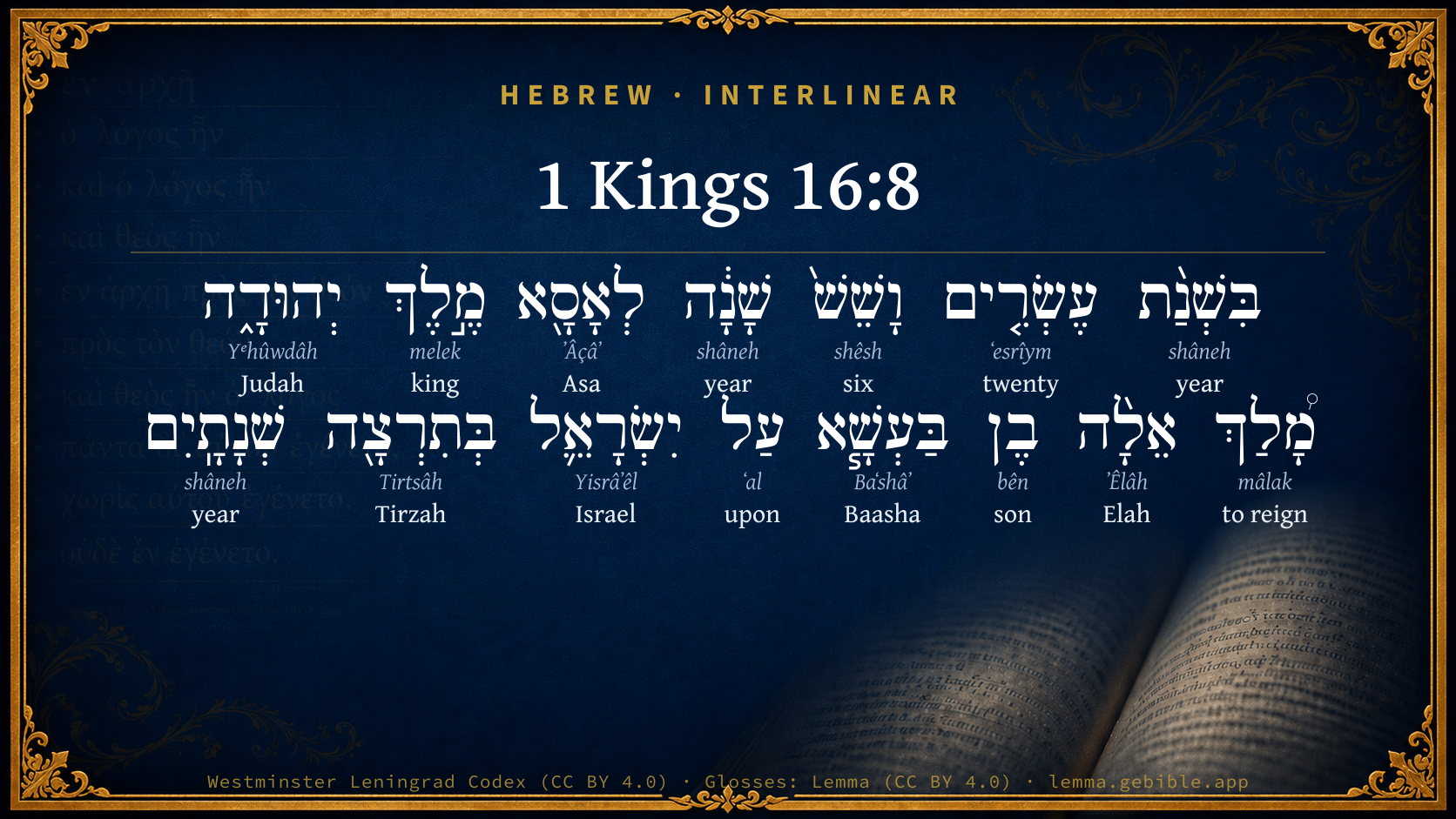
Hebrew (Westminster Leningrad Codex) 1 Kings 16:8 appears in the Hebrew Old Testament. The text above is from the Westminster Leningrad Codex. Each word links to its Strong’s number, a concise gloss, and parsing drawn from the Open Scriptures Hebrew Bible morphology. Click any word for its full Brown-Driver-Briggs (BDB) entry.
Download image
Cite this verse

1 Kings 16:8 (World English Bible). Public Domain. Lemma interlinear Bible study tool, https://lemma.gebible.app/v/1-kings/16/8.

Show BibTeX & RIS
BibTeX
RIS
English Translation
In the twenty-sixth year of Asa king of Judah began Elah the son of Baasha to reign over Israel in Tirzah, [and reigned] two years.
World English Bible · Public Domain
Download a study sheet

One document with this verse’s original text, its word-by-word gloss line, the meaning frame, cross-references with their text, attributed commentary, and full source and license credits — printable, and it pastes into notes with its structure intact.

This verse Autodidact and up

Study sheet (.html) Plain text (.txt)

A passage Seminary Student

Up to 50 verses in one chapter. A passage sheet keeps up to 6 commentary sources and 12 cross-references per verse, in the order this page ranks them, and says so on the sheet whenever that leaves anything out. Ask for a single verse and you get the Autodidact verse sheet above.

Everything on this page stays free to read, with no account — the sheet is a download of what is already on screen, not access to it.

Want to remove ads? Support Godless Engineer
Compare translations 3

The same verse in 3 English versions, stacked beneath the original-language interlinear above. Click any original word for its lexicon entry.

Each is an independent rendering of the whole verse — the interlinear is not word-aligned to these translations.

Highlighted words mark where these versions differ — a whole-verse word diff, not a word-by-word alignment.

  • World English Bible Public Domain
    In the twenty-sixth year of Asa king of Judah began Elah the son of Baasha to reign over Israel in Tirzah, [and reigned] two years.
  • King James Version Public Domain
    In the twenty and sixth year of Asa king of Judah began Elah the son of Baasha to reign over Israel in Tirzah, two years.
  • unfoldingWord Literal Text CC BY-SA 4.0
    In the year of 26, the year to Asa, the king of Judah, Elah the son of Baasha reigned over Israel in Tirzah, two years.

unfoldingWord Literal Text — © unfoldingWord, licensed CC BY-SA 4.0. Word-aligned USFM3 via Door43 (git.door43.org/unfoldingWord/en_ult).

Versions to compare (up to 4)

3 of 4 selected

Show all 18 translations

Every available English version of this verse, each an independent rendering of the whole verse.

  • World English Bible Public Domain
    In the twenty-sixth year of Asa king of Judah began Elah the son of Baasha to reign over Israel in Tirzah, [and reigned] two years.
  • Berean Standard Bible Public Domain
    In the twenty-sixth year of Asa’s reign over Judah, Elah son of Baasha became king of Israel, and he reigned in Tirzah two years.
  • Majority Standard Bible Public Domain
    In the twenty-sixth year of Asa’s reign over Judah, Elah son of Baasha became king of Israel, and he reigned in Tirzah two years.
  • King James Version Public Domain
    In the twenty and sixth year of Asa king of Judah began Elah the son of Baasha to reign over Israel in Tirzah, two years.
  • American Standard Version (1901) Public Domain
    In the twenty and sixth year of Asa king of Judah began Elah the son of Baasha to reign over Israel in Tirzah, `and reigned' two years.
  • Revised Version (1885) Public Domain
    In the twenty and sixth year of Asa king of Judah began Elah the son of Baasha to reign over Israel in Tirzah, and reigned two years.
  • Geneva Bible (1599) Public Domain
    In the sixe and twentie yeere of Asa king of Iudah began Elah ye sonne of Baasha to reigne ouer Israel in Tirzah, and reigned two yeere.
  • Douay-Rheims (1899) Public Domain
    In the six and twentieth year of Asa king of Juda, Ela the son of Baasa reigned over Israel in Thersa two years.
  • Young's Literal Translation Public Domain
    In the twenty and sixth year of Asa king of Judah reigned hath Elah son of Baasha over Israel in Tirzah, two years;
  • Literal Standard Version CC BY-SA 4.0
    In the twenty-sixth year of Asa king of Judah, Elah son of Baasha has reigned over Israel in Tirzah, two years;
  • Unlocked Literal Bible CC BY-SA 4.0
    In the twenty-sixth year of Asa king of Judah, Elah son of Baasha began to reign over Israel in Tirzah; he reigned two years.
  • unfoldingWord Literal Text CC BY-SA 4.0
    In the year of 26, the year to Asa, the king of Judah, Elah the son of Baasha reigned over Israel in Tirzah, two years.
  • Darby Bible Public Domain
    In the twenty-sixth year of Asa king of Judah, Elah the son of Baasha began to reign over Israel in Tirzah for two years.
  • World Messianic Bible Public Domain
    In the twenty-sixth year of Asa king of Judah, Elah the son of Baasha began to reign over Israel in Tirzah for two years.
  • Webster's Bible Public Domain
    In the twenty and sixth year of Asa king of Judah began Elah the son of Baasha to reign over Israel in Tirzah, two years.
  • Free Bible Version CC BY-SA 4.0
    Elah, son of Baasha, became king of Israel in the twenty-sixth year of the reign of King Asa of Judah. He reigned in Tirzah for two years.
  • Bible in Basic English Public Domain
    In the twenty-sixth year that Asa was king of Judah, Elah, the son of Baasha, became king of Israel in Tirzah, and he was king for two years.
  • JPS Tanakh (1917) Public Domain
    In the twenty and sixth year of Asa king of Judah began Elah the son of Baasa to reign over Israel in Tirzah, and reigned two years.

Literal Standard Version (2020), Covenant Press — licensed CC BY-SA 4.0. Text via the HelloAO Bible API (eBible.org). Unlocked Literal Bible (unfoldingWord) — licensed CC BY-SA 4.0. Text via the HelloAO Bible API (eBible.org). unfoldingWord Literal Text — © unfoldingWord, licensed CC BY-SA 4.0. Word-aligned USFM3 via Door43 (git.door43.org/unfoldingWord/en_ult). Free Bible Version, Dr. Jonathan Gallagher — licensed CC BY-SA 4.0. Text via the HelloAO Bible API (eBible.org).

Word by word

More ways to search: Search by grammar → Find every occurrence → Compare this word →

Practice this passage: Drill this verse → Learn its vocabulary →

אֵלָ֨ה
ʼÊlâh
H425
“Elah”
Noun, Proper
Part of Speech
Noun
Type
Proper
Full BDB Definition

Origin: the same as H424

TWOT: None

Elah = "An oak" - an Edomite chief - a king of Israel for two years, son of Baasha - the father of king Hoshea of Israel - a son of Caleb - son of Uzzi
  1. בִּשְׁנַ֨ת shâneh H8141 “in/at · year of” Preposition + Noun, Common, Feminine, Singular, Construct
  2. עֶשְׂרִ֤ים ʻesrîym H6242 “twenty” Adjective, Cardinal number, Both, Plural, Absolute
  3. וָשֵׁשׁ֙ shêsh H8337 “and · six” Conjunction + Adjective, Cardinal number, Feminine, Singular, Absolute
  4. שָׁנָ֔ה shâneh H8141 “year” Noun, Common, Feminine, Singular, Absolute
  5. לְאָסָ֖א ʼÂçâʼ H609 “to/for · Asa” Preposition + Noun, Proper
  6. מֶ֣לֶךְ melek H4428 “king of” Noun, Common, Masculine, Singular, Construct
  7. יְהוּדָ֑ה Yᵉhûwdâh H3063 “Judah” Noun, Proper
  8. מָ֠לַךְ mâlak H4427 “to reign” Verb, Qal, Perfect, 3rd Person, Masculine, Singular
  9. בֶן bên H1121 “son of” Noun, Common, Masculine, Singular, Construct
  10. בַּעְשָׁ֧א Baʻshâʼ H1201 “Baasha” Noun, Proper
  11. עַל ʻal H5921 “upon” Preposition
  12. יִשְׂרָאֵ֛ל Yisrâʼêl H3478 “Israel” Noun, Proper
  13. בְּתִרְצָ֖ה Tirtsâh H8656 “in/at · Tirzah” Preposition + Noun, Proper
  14. שְׁנָתָֽיִם shâneh H8141 “years” Noun, Common, Feminine, Dual, Absolute

About this verse

These counts appear in no published source. They are computed here, from the morphology-tagged text and Lemma’s own curated glosses. What Lemma adds →

15
words
13
distinct lemmas
Historical
section

Notable vocabulary

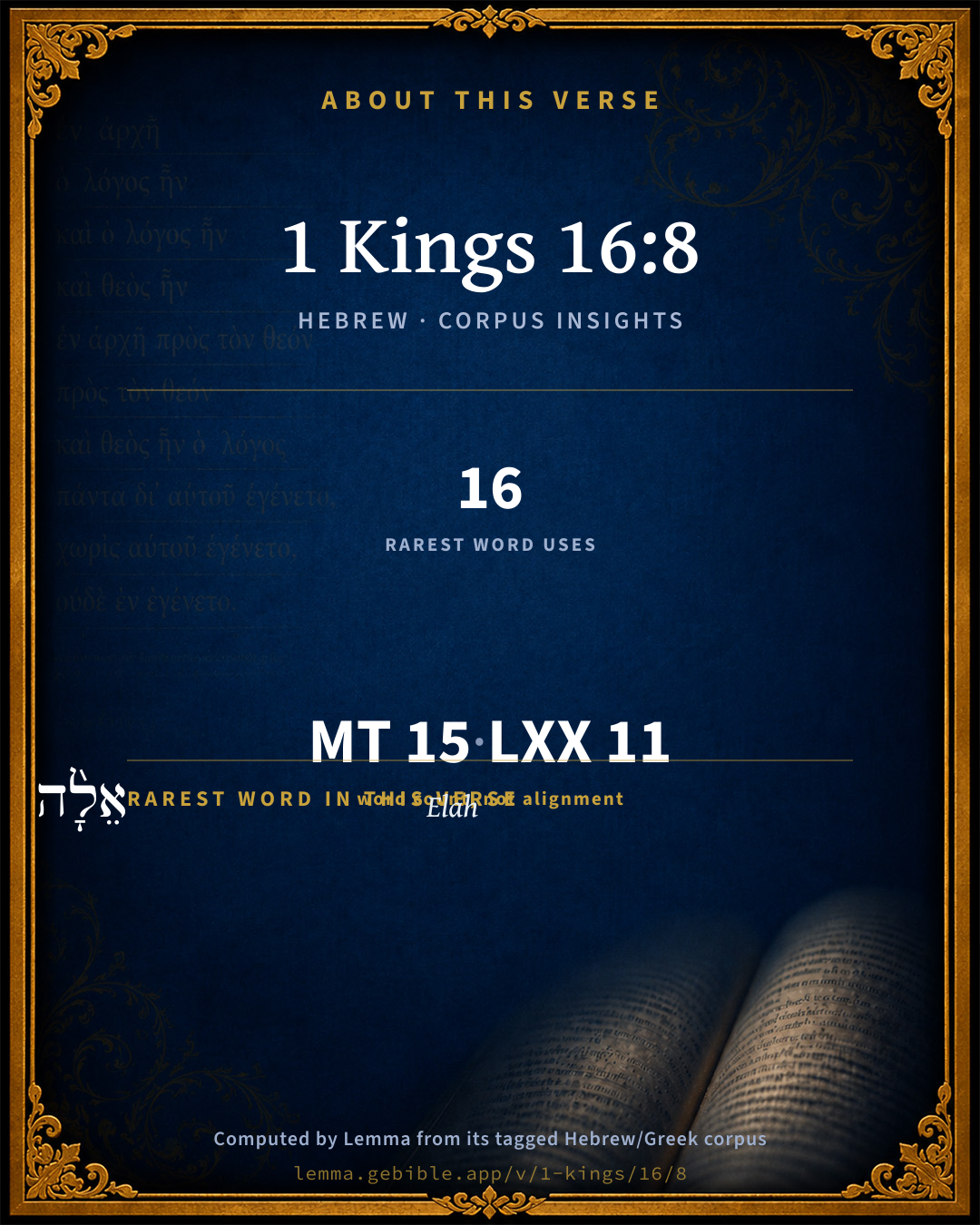
The rarest word here is אֵלָ֨ה Elah H425 — appearing just 16 times in the whole Hebrew Bible.

Shared distinctive vocabulary

אֵלָ֨ה Elah H425 occurs in 15 verses of the Hebrew Bible. Also found in:

Grammatical profile

  • 1 verb
  • 11 nouns
  • 2 adjectives
  • 1 preposition

Verb forms

  • מָ֠לַךְ Qal · Perfect

Repetition

A word recurs within this verse — often emphatic in Hebrew:

  • בִּשְׁנַ֨ת year H8141 ×3

Hebrew & Septuagint length

In English translation the verse runs 25 words from the Hebrew and 12 from the Septuagint (LXX English) — the Septuagint runs noticeably shorter here. See the side-by-side →

A rough comparison of the two English renderings, which tokenize alike — not a word-level alignment.

Word counts can differ between the Hebrew and the Greek without any difference in meaning — e.g. the Hebrew direct-object marker אֵת has no separate Greek word, and Greek often adds the article ὁ.

In the original languages it is 15 Hebrew tokens and 11 Greek tokens — but the two are counted differently (Hebrew bundles its prefixes and suffixes into one token; the Greek is in lemma form), so that isn’t a like-for-like length.

Hebrew and Greek witnesses Masoretic Hebrew ↔ Greek Septuagint

The same verse in the two great witnesses to the Old Testament, shown verse-for-verse.

Here the Septuagint runs noticeably shorter than the Hebrew — LXX2012 (modern English Septuagint) 12 words vs World English Bible 25. A rough length comparison of the two English translations, not a word-level alignment — read both below.

These are two independent witnesses, not word-aligned to each other, and the Septuagint is shown in lemma (dictionary) form.

Hebrew 1 Kings 16:8 Masoretic · Westminster Leningrad Codex

בִּשְׁנַ֨ת עֶשְׂרִ֤ים וָשֵׁשׁ֙ שָׁנָ֔ה לְאָסָ֖א מֶ֣לֶךְ יְהוּדָ֑ה מָ֠לַךְ אֵלָ֨ה בֶן בַּעְשָׁ֧א עַל יִשְׂרָאֵ֛ל בְּתִרְצָ֖ה שְׁנָתָֽיִם

In the twenty-sixth year of Asa king of Judah began Elah the son of Baasha to reign over Israel in Tirzah, [and reigned] two years.

World English Bible · Public Domain

Greek LXX 1 Kings 16:8 Septuagint · lemma form

καί ηλα υἱός βαασα βασιλεύω ἐπί ἰσραήλ δύο ἔτος ἐν θερσα

And Ela son of Baasa reigned over Israel two years in Thersa.

LXX2012 (modern English Septuagint) · Public Domain

On this verse, The Cambridge Bible for Schools and Colleges discusses the Septuagint’s reading. Read the note in Commentary ↓

Hebrew: Westminster Leningrad Codex (CC BY 4.0). Greek: Septuagint (public domain); English from LXX2012 (modern English Septuagint) (Public Domain). How the Septuagint differs from the Hebrew →

Targum (Aramaic paraphrase)

1

The Targum is the ancient Jewish Aramaic paraphrase of the Hebrew Scriptures — an interpretive translation, not the Hebrew text itself. Onkelos (literal) and Pseudo-Jonathan (expansive) render the Torah, and Jonathan the Prophets. Coverage is partial: where no permissively-licensed English translation exists for a verse, only the Aramaic is shown. This is verse-level text, not a word-by-word alignment to the Hebrew.

  1. Targum Jonathan Prophets (Joshua–Malachi)
    בִשְׁנַת עַסְרִין וְשִׁית שְׁנִין לְאָסָא מֶלֶךְ שִׁבְטָא דְבֵית יְהוּדָה מְלַךְ אֵלָה בַר בַּעְשָׁא עַל יִשְׂרָאֵל בְּתִרְצָה תַּרְתֵּין שְׁנִין:

    (no public-domain English translation for this verse)

    Targum Jonathan — Aramaic: “Mikraot Gedolot” (public domain). English: “Sefaria Community Translation” (CC0 1.0 (public-domain dedication)); “London "Chaldee Paraphrase," 1871” (public domain). Text via Sefaria.

Commentary

Notes on 1 Kings 16:8 from classic Christian and Jewish commentators (each source and its license shown beneath its notes). The classic Christian expositions comment on the surrounding passage and are grouped to its opening verse, so a note may address several verses; the Jewish commentaries on the Tanakh (Rashi and others) are per-verse, so they appear only where the commentator wrote on this verse.

Lemma curates 59 commentaries, every one of them public domain or Creative Commons licensed, each selected and text-cleaned for this edition rather than reprinted as found. About our sources →

Trapp's Complete Commentary

John Trapp

1Ki 16:8 In the twenty and sixth year of Asa king of Judah began Elah the son of Baasha to reign over Israel in Tirzah, two years.

Ver. 8. Two years.] Current, but not fully complete. {1Ki 16:15} So God paid Baasha in kind for his cruelty to Nadab. He loveth to retaliate.

John Trapp, A Commentary or Exposition upon All the Books of the Old and New Testament (1647–1656) — public domain. Text from a community e-Sword module.

The Biblical Illustrator

Joseph S. Exell

1Ki_16:8-10

Elah . . . Zimri . . . Arza.

Elah, Zimri, and Arza

There was once a king in Israel called Elah. He reigned over Israel in Tirzah two years. He had a servant called Zimri who was a captain of his chariots. Zimri was a born traitor. Treachery was in his very blood. In the case of Elah, Zimri had a marked advantage; for Elah was a drunken fool. He was in the habit of visiting the house of another of his servants, a steward called Arza, and there he had what drink he asked for; and he asked for a good deal, so much so that he was often drunk in his servants house, and on one of these occasions, Zimri went in and killed him, and reigned in his stead. These are the facts which we have to deal with. Are they very ancient, or are they happening round about us every day?

1. Elah lives in every man who has great chances or opportunities in life, but allows them to slip away through one leak in the character. Elah was a king, and the son of a king, so his openings in life were wide and splendid; but he loved strong drink, and through that leak in his character all that might have made him a man oozed away, and left him a king in nothing but the barren name. Strong drink will ruin any man. What is true of this leak in a mans character is true of every other. Take indecision for example, or idleness, or love of company, or devotion to pleasure. A great merchant once said to me of a certain man in his employment, I would to-morrow give that man a thousand a year to begin with, if he could do one thing, and that is, hold his tongue; but he would no sooner get the appointment than he would go into an ale-house, and tell the whole company everything I am doing. There is the leak in the character, and it means ruin! It is astounding what one leak will do.

2. Zimri still lives in all persons who take advantage of the weaknesses of others. Zimri knew that Elah was a drunkard, and he further knew that through his habit of drunkenness alone he could reach the king. On every other side of his character Elah may have been a strong man: acute, shrewd, far-sighted; but when in drink, weak and foolish. And Zimri played his game accordingly. Some people trade on the weaknesses of others. They study them. Thy adapt themselves to them. They watch for striking time, and seldom miss the mark. How else could the net be always ready for the bird? How else the pit be always prepared for the unexpected and bewildered traveller? There is an infernal science in these things--a devils black art!

3. And does not Arza still live in those who find the means whereby men may conceal their evil habits and indulge their unholy desires? They seem to say, In my house you may do what you please. I shall not look at you. Come when you please; go when you like; I am nobody, if you like to call me so. My wonder is that any young man can keep his morals uncorrupted in a strange city. Houses of destruction are open in every street. How foolish, too, are the wicked! If they would devote their talents to some virtuous end they would attain honourable success, sweetened with a sense of honesty. They often have great talents, fine powers, large capacities, and if they gave themselves with ardour and energy to the pursuit of good ends they would outrun many, and gain a prize worthy and lasting. (J. Parker, D. D.)

The Biblical Illustrator, edited by Joseph S. Exell (c. 1880s–1900s) — public domain. Text from a community e-Sword module.

Joseph Benson's Commentary

1Ki 16:8-10. Began Elah to reign in Tirzah two years — One complete and part of another. Zimri, captain, of half his chariots — Of all his military chariots, and the men belonging to them; the chariots, or carriages for necessary things being put into meaner hands. Conspired against him as he was in Tirzah — While his forces were elsewhere employed, (1Ki 16:15,) which gave Zimri advantage to execute his design. Zimri went in and smote him — Here was a speedy execution of the vengeance threatened against him by Jehu.

Joseph Benson's Commentary on the Old and New Testaments (1811–1818) — public domain. Text from a community e-Sword module.

Whedon's Commentary on the Bible

Daniel D. Whedon

ELAH’S REIGN, 1Ki_16:8-14.

8. Elah — The records of this king are a sad repetition of that of Nadab, the son of Jeroboam. As Nadab ended the first, so did Elah end the second, dynasty of Israelitish kings.

Daniel D. Whedon (gen. ed.), Commentary on the Old and New Testaments (1874–1909) — public domain. Text from a community e-Sword module.

Lange's Commentary on the Holy Scriptures

B.—The reigns of Elah, Zimri, Omri, and Ahab

1Ki_16:8-34

8In the twenty and sixth year of Asa king of Judah1 began Elah the son of Baasha to reign over Israel in Tirzah, two years. 9And his servant Zimri, captain of half his chariots, conspired against him, as he was in Tirzah, drinking himself drunk in the house of Arza, steward of his house in Tirzah. 10And Zimri went in and smote him, and killed him, in the twenty and seventh year of Asa king of Judah, and reigned in his stead. 11And it came to pass, when he began to reign, as soon as he sat on his throne, that he slew all the house of Baasha: he left him not one that pisseth against a wall, neither of his kinsfolks,2 nor of his friends.3 12Thus did Zimri destroy all the house of Baasha, according to the word of the Lord [Jehovah], which he spake against Baasha by Jehu the prophet, 13for all the sins of Baasha, and the sins of Elah his son, by which they sinned, and by which they made Israel to sin, in provoking the Lord [Jehovah] God of Israel to anger with their vanities. 14Now the rest of the acts of Elah, and all that he did, are they not written in the book of the Chronicles of the kings of Israel?

15In the twenty and seventh year of Asa king of Judah4 did Zimri reign seven days in Tirzah. And the people were encamped against Gibbethon, which belonged to the Philistines. 16And the people that were encamped heard say, Zimri hath conspired, and hath also slain the king: wherefore all Israel made Omri, the captain of the host, king over Israel that day in the camp. 17And Omri went up from Gibbethon, and all Israel with him, and they besieged Tirzah. 18And it came to pass, when Zimri saw that the city was taken, that he went into the palace [citadel] of the king’s house, and burnt the king’s house over him with fire, and died,5 19for his sins which he sinned in doing evil in the sight of the Lord [Jehovah], in walking in the way of Jeroboam, and in his sin which he did, to make Israel to sin. 20Now the rest of the acts of Zimri, and his treason [conspiracy] that he wrought, are they not written in the book of the Chronicles of the kings of Israel? 21Then were the people of Israel divided into two parts: half of the people followed Tibni the son of Ginath, to make him king; and half followed Omri. 22But the people that followed Omri prevailed against the people that followed Tibni the son of Ginath: so Tibni died,6 and Omri reigned.

23In the thirty and first year of Asa king of Judah began Omri to reign over Israel, twelve years: six years reigned he in Tirzah. 24And he bought the hill Samaria of Shemer for two talents of silver, and built on the hill, and called the name of the city which he built, after the name of Shemer, owner of the hill, Samaria. 25But Omri wrought evil in the eyes of the Lord [Jehovah], and did worse than all that were before him. 26For he walked in all the way of Jeroboam the son of Nebat, and in his sin [sins] wherewith he made. Israel to sin, to provoke the Lord [Jehovah] God of Israel to anger with their vanities. 27Now the rest of the acts of Omri which he did, and his might7 that he shewed, are they not 28 written in the book of the Chronicles of the kings of Israel? So Omri slept with his fathers, and was buried in Samaria: and Ahab his son reigned in his stead.8

29And in the thirty and eighth year of Asa king of Judah began Ahab the soil of Omri to reign over Israel: and Ahab the son of Omri reigned over Israel in Samaria twenty and two years. 30And Ahab the son of Omri did evil in the sight of the Lord [Jehovah] above all that were before him. 31And it came to pass, as if it had been a light thing for him to walk in the sins of Jeroboam the son of Nebat, that he took to wife Jezebel the daughter of Ethbaal king of the Zidonians, and went and served Baal, and worshipped him. 32And he reared up an altar for Baal in the house of Baal, which he had built in Samaria. 33And Ahab made a grove; and Ahab did more to provoke the Lord [Jehovah] God of Israel to anger than all the kings of Israel that were before him. In his days did Hiel 34the Beth-elite build Jericho: he laid the foundation thereof in Abiram his first-born, and set up the gates thereof in his youngest son Segub, according to the word of the Lord [Jehovah], which he spake by Joshua the son of Nun.

Exegetical and Critical

1Ki_16:8-14. Began Elah to reign, &c. For Tirzah see on 1Ki_14:17. As Elah commenced his reign in the twenty-sixth year of Asa, and according to 1Ki_16:10 was killed in the twenty-ninth, the two years he was king could not have been full ones. רֶכֶב is now generally translated riding; but a comparison with 1Ki_9:19; 1Ki_10:26 would seem to indicate that it should be chariot. There is no doubt that some of the chariot-cities which Solomon built (see on the place) were in the kingdom of Israel; perhaps “the half” of all the chariots were at the capital, and Zimri was placed over them. According to Josephus (Antiq.viii. 12, 4), Zimri took advantage of the absence of the army and its chief to undertake the siege of Gibbethon (see above on 1Ki_15:27). The house steward Arza, who had arranged a drinking bout, was no doubt the principal person in the conspiracy which Zimri set on foot. Cf. 1Ki_14:10 with 1Ki_16:11. Zimri acted, as Grotius remarks, according to the tyrannical principles νήπιος, ὃς πατέρα κτείνας υἱοὺς κατέλιπε. But he went farther than Baasha, inasmuch as he not only killed the relatives of the king, but also his friends, in order to secure himself from any possible blood-revenge; all this took place in a few days, for his whole reign was only seven days. For 1Ki_16:12-13 cf. 1Ki_16:3, and above on 1Ki_14:15-16. הֲבָלִיםi. e., vanitates, anything which is called God, yet is not God, and which is consequently vain and empty (cf. Deu_32:21). The word here does not refer to idols, properly speaking, but to images of Jehovah, which, however, are, like the former, empty and vain.

1Ki_16:15-20. Did Zimri reign seven days, &c. The distance of Tirzah from Gibbethon requires us to suppose that the seven days apply to the time during which Zimri was in undisturbed possession of the throne, i. e., until the day when the army in Gibbethon made their chief, Omri, king, who then first went to Tirzah and besieged it. Zimri’s death followed when he saw that he could not hold the town against the besiegers. The “people” and “all Israel” mean here all those who were armed, i. e., the men of war. אֲרְמוֹן, from the root אָרַם to be high, is the part that was highest, that is “the fortress of the royal palace, the securest and inmost place, the citadel, as it were; for the royal palace contained a great number of buildings” (Gesenius, cf. 2Ki_15:25). Zimri set fire to this last place of refuge, and through it to the entire palace, in order not to fall into the hands of his enemies, and to prevent the palace and all it contained from passing into their possession. Similar instances are to be found in Justin. hist. i. 3; Liv. xxi. 1 Kings 14 : Flor. ii. 18. Ewald’s rendering of אַרְמוֹן is quite arbitrary; he gives the “women’s chamber,” the harem; and supposes that Zimri went there, for the “effeminate man had only suffered the queen and other women of the palace to live, as they readily lent themselves to the murder of their lord; and the queen mother seems to have offered him her favor.” However, there is not a syllable of all this either in the text or anywhere else. Besides, the deed recorded in 1Ki_16:18 rather displays courage and contempt of death than effeminacy. The Syriac has: and they, the besiegers, fired his royal house over his head; and Kimchi translates: and he, that is Omri, set fire, &c.; both are decidedly wrong. In consideration of Zimri’s short reign of seven days, we must conclude from 1Ki_16:19 that he had formerly shown much partiality for the calf-worship of Jeroboam, and that, at the time of his accession, he had no intention of removing it.

1Ki_16:21-22. Then the people of Israel divided. 1Ki_16:21 sq. It is generally thought that two parties had arisen within the army, each of which wished to make their leader king, and that they fought for some time until the weaker party succumbed, and their leader Tibni fell in battle. According to Ewald, Tibni was assisted in the war by his brother Joram, and both fell in the one battle. But it is very doubtful if the “people of Israel,” 1Ki_16:21, means the same as “the people that were encamped,” 1Ki_16:18, i. e., only the army. The latter had not divided, for according to 1Ki_16:16 Omri was made king by “all” the army; it is only said of him that he was the captain of the host, but neither this nor anything similar is said of Tibni. We have therefore more reason to suppose that after the death of Zimri a faction arose, which did not acknowledge the soldier-king Omri, who had been chosen by the army alone, and which faction set up Tibni in opposition. The Sept only makes mention of a brother of Tibni (καὶ ἀπέθανε θαβνὶ καὶ ’Ιωρὰμ ὁ ἀδελφὸς αὐτοῦ ἐν τῷ καιρῷ ἐκείνῳ), and Josephus also (Ant.viii. 12, 15), only says, Tibni was killed by Omri’s faction, but not that the two brothers fell in the same battle.

1Ki_16:23-28. Began Omri to reign over Israel, twelve years. 1Ki_16:23. According to 1Ki_16:15 the elevation and death of Zimri occurred in the twenty-seventh year of the reign of Asa, king of Judah (929); according to 1Ki_16:29, Ahab, the successor of Omri, came to the throne in the thirty-eighth year of Asa (918); therefore the twelve years of Omri’s reign could not have been twelve full years. And furthermore, if Omri became king in the thirty-first year of Asa, according to 1Ki_16:23 (925), and yet died in the 38th year of Asa, according to 1Ki_16:29 (918), that is, in from seven to eight years, it is plain that the twelve years of his reign are reckoned from the year in which he was made king by the host (929), but did not at the same time attain the sole sovereignty, as part of the people wished Tibni to be king. He became sole sovereign only in the year 925, so that the struggle with Tibni’s faction must have lasted four years. The six years during which Omri resided at Tirzah were the first half of the twelve years of his reign; during the latter six years he lived in Samaria, a city which he had newly built (1Ki_16:24). In order to explain some chronological difficulties that occur later, with regard to the kings Jehoram and Jehoshaphat, Ewald (III. s. 432) refuses to reckon the four years before Tibni’s death in the twelve years of Omri’s reign, and as Asa reigned four years as a contemporary of Ahab, the successor of Omri (1Ki_22:41), Asa could not have reigned forty-one years (1Ki_15:10) but forty-seven, for the years mentioned in 1Ki_16:15 amount to that; 27+4+12+4. “But according to this supposition, the numbers here and in 1Ki_16:29, also in 1Ki_15:10, which are perfectly correct, should be altered” (Thenius), and there is no reason whatever for doing so. The name שֶׁמֶר (1Ki_16:24), is probably the same as שׁוֹמֵר and שָׁמֵר (1Ch_7:32-34), we cannot, therefore, pronounce the derivation of the name of the city to be “wrong,” because the owner must otherwise have been called שֹׁמֵר (Petermann). The mountain of Shemer is not far to the east of Tirzah, and it lies north-east of Shechem. The palace at Tirzah, which was destroyed under Zimri, does not seem to have been rebuilt, and Omri appears, as soon as he became king, to have taken the resolution of building a new capital and royal city, for which that mountain was peculiarly adapted. It was a “beautiful round mountain, covered with splendid trees, and lying in a valley or basin enclosed with mountains; “it commanded” a glorious prospect of the fruitful valley and the heights and villages surrounding it” (Knobel on Isa_28:1-4; Robinson, Palest. III. 1, p. 503 sq.). Samaria, therefore, continued to be the capital of the kingdom until its destruction. The two talents of silver, for which Omri bought the hill, are reckoned at 5,200 Thr. by Keil, and at 4,000 Thr. by Thenius [$3,900 and $3,000 respectively]. We may infer from Mic_6:16, where Judah is reproached with keeping “the statutes of Omri and all the works of the house of Ahab,” that Omri went further in regard to the worship than the former kings of Israel (1Ki_16:25). We have no more exact information, but it is certain, at any rate, that he prepared the way for the state of things under his successor Ahab. That Omri was a valiant warrior appears from the word גְּבוּרָתוֹ (1Ki_16:27), which is used respecting Asa and Baasha, Elah and Zimri, but not of Nadab.

1Ki_16:29-33. Ahab.… to reign over Israel. 1Ki_16:29-34 describe the government of Ahab generally; from chaps, 17 to 22 follow notices of separate events that occurred in this time, and then in 1Ki_22:39-40, comes the usual concluding formula, the rest of the acts, &c. Our section, therefore, forms a general introduction, and at the same time the superscription to the following particulars; it is also designed to place the reader beforehand upon the stand-point from which all that is coming must be viewed and judged. Omri had departed farther than any of his predecessors from the fundamental law, but Ahab went still farther than his father (1Ki_16:30 is therefore no mere repetition of 1Ki_16:25). He was not contented with the sin of Jeroboam, but he formally introduced the service of Baal into his kingdom, in consequence of his marriage with Jezebel, and he even built a temple to Baal in the royal city and capital Samaria. Ethbaal is no doubt the Εἰθώβαλος (who was mentioned by Menander in Josephus c. Apion.I. 18), king of Tyre and Sidon, who succeeded to the throne about fifty years after Hiram’s death, and could, therefore, have very well been the father-in-law of Ahab; he was priest of Astarte and the murderer of his brother, king Pheles. What is related of Jezebel afterwards coincides perfectly with what we should expect from the daughter of such a father. הַבַּעַל is the known chief male divinity of the Phœnicians, “the sun god, which was regarded as the primary preserver and principle of physical life, and of the generative, reproductive power in nature, which flowed from his being” (Movers, Rel. d. Phön. s. 184). According to 2Ki_3:2; 2Ki_10:27 the image of Baal which Ahab had made, was מַצֵּבָה, i. e., a monument, a monumental pillar (see on 1Ki_14:23). In the temple of the Tyrian Hercules (=Baal), at Tyre, there stood two pillars, one of gold, the other of emerald (Herodot. II. 44, see above). Besides the male divinity there was also the הָאֲשֵׁרָח, the female deity a (wooden) image of Astarte (see above 7). From the great number of the priests who were employed in the worship of Baal which Ahab introduced (chap, 1Ki_18:19), it appears that it was very extensive and magnificent. More particulars regarding the temple of Baal are given in 2Ki_10:25-27. That Ahab built besides “another splendid building of the same kind, which served as a sacred grove for Astarte, and which was probably close to his favorite palace at Jezreel” (Ewald III. s. 457), is a pure invention, of which there is not a single word in the text.

1Ki_16:34. In his days did Hiel the Bethelite build Jericho. 1Ki_16:34. The city of Jericho, which was very strong at the time of the conquest of the promised land, was destroyed after being taken, and Joshua pronounced these words over it: “Cursed be the man before the Lord that raiseth up and buildeth Jericho; he shall lay the foundation thereof in his first-born, and in his youngest son shall he set up the gates of it” (Jos_6:1-2). This does not mean that no one should live there again, but he who endeavors to make it again what it was, i. e., a fortress, shall be severely punished. Jericho was afterwards apportioned to the tribe of Benjamin, but in Ahab’s time it certainly belonged to the kingdom of Israel (Jos_18:21; 2Ki_2:5; 2Ki_2:18). At the command of Ahab, Hiel of Bethel (the chief seat of the calf-worship) now built, i. e. fortified (בָּנָה as in chaps. 1Ki_11:27; 1Ki_12:25), Jericho again; probably because it lay on the borders of Ephraim, or was designed to protect the passage of the Jordan, which was near. Whether this was done in defiance of Joshua’s prediction, as older commentators think, or in ignorance of it, is uncertain; at any rate Joshua’s word was fulfilled. “We cannot doubt the truth of what is related in this verse, for the names are mentioned, and the signification of these names has no reference to the event” (Thenius). There is no other ground for the supposition that Joshua’s utterance was a vaticinium ex eventu than the rationalistic presupposition that all prophecies are impossible. The supposition of the Rabbins that all the sons of Hiel, from the eldest to the youngest, were destroyed during the building, is unsupported by the text. However, the question remains how the whole of the information contained in 1Ki_16:34 comes to be inserted just here. As it follows immediately after the account of the introduction of the Canaanitish idolatrous worship by Ahab (1Ki_16:30-33), our author may very well have thought of it in connection with the latter. The fortress of Jericho was, in Joshua’s time, die gate and key to the whole laud of Canaan; he who possessed it had the entire country open before him (Jos_2:1; Jos_2:24; Jos_6:1 sq.). The taking of this town was, therefore, of the greatest importance; it was achieved by a miraculous act of Jehovah, which was compared, on that account, to the passage through the Red Sea, i. e., the complete deliverance from Egypt (Jos_2:9 sq.). With it, the land of Canaan fell into the hands of the Israelites; with the walls of Jericho the stronghold of Canaanitism fell, its destruction was begun, and the pledge of the same lay, in a measure, in the destruction of that city. But just for this very reason it should never again become what it was before its capture. Ahab, however, who placed the country again in its ante-Israelitish condition through the introduction of the Canaanite idol-worship, caused the fortress, which had been destroyed by the almighty power of Jehovah, to be restored. As he denied the God of Israel, and placed the Baal of the Canaanites in His stead, so he also denied the great saving act of Jehovah as manifested in the fall and destruction of Jericho. He showed his apostasy from Jehovah by causing the walls of Jericho to be rebuilt. It appears, however, that the God of Israel would not surfer contempt of Him to go unpunished. The curse of Joshua was fulfilled as a warning that the divine threatenings would not remain unfulfilled. The account in 1Ki_16:34, thus understood, is so well connected with that of 1Ki_16:32, that it forms the direct transition to the activity of the prophet Elijah (of whom the following chapter treats) against the apostasy of Ahab.

Historical and Ethical

1. The unspeakable results of the partition of the kingdom, and the consequent breach of the fundamental law of Israel, appears more plainly in the history of the reigns of Elah, Zimri, Omri, and Ahab, than in those of the three previous kings. All four of these kings continued in the sins of Jeroboam, because they as well as he considered it to be necessary to the separate existence of their kingdom and to the support of their power. In fact each One surpassed the other until the image-worship reached its natural goal in the worship of idols (see above), which the last of them, Ahab, not only permitted, but introduced as the State-religion. With Ahab, therefore, the history of the kingdom of Israel comes to a conclusion relatively, and a new epoch begins, characterized by the appearing of the great prophet Elijah and his struggle with idolatry (chap. 17). The consequences of the partition, which were felt in the sphere of religion, were felt, in like manner, in that of politics, on account of the peculiar and inseparable connection of the Israelite people with their religion. The monarchy in Israel had arisen by means of rebellion and forcible separation from the house of David, and thus it lacked the ground of divine law. What Jeroboam conceived he was justified in doing, every other one thought he had a right to do also, as soon as he had followers and power enough; that was the case with Baasha and still more with Zimri and Omri. Thus the kingdom became the football of human ambition and caprice, so that one insurrection followed another; and in the comparatively short time of from fifty to sixty years, seven kings reigned, of whom four attained the throne by violence and even murder. But no blessing could rest on such a kingdom. The people of the ten tribes, who were already more inclined to nature-life, and therefore more adapted for the reception of Jeroboam’s calf-worship, must, by the persistence of their kings in this worship, and by their complete separation from Judah, the guardian and protector of the law, and with it of the spirited life by the nation, have sunk lower and lower. A people can indeed endure a bad ruler without themselves degenerating; but a whole line of sovereigns, of whom each obtained the throne by conspiracy, rebellion, and murder, is only possible where the people themselves are rough and barbarous. What social and religious degeneracy is presupposed, where the nation accepted all the abominations of its rulers, and where an Ahab (finally) met no opposition in instituting the shameful and indecent worship of Baal and Astarte as the State-religion! How far different the state of things in Judah! For though the religious liberty permitted by Solomon bore evil fruit, yet the fundamental law was always adhered to by the kings, and the idol-worship was completely destroyed by Asa, who reigned two years contemporaneously with Ahab. The kingdom was firm; there was not a trace of conspiracy or rebellion, and the house of David retained the throne. Although the kingdom of Judah was much smaller and weaker than that of Israel, and was continually in danger from the latter; yet, holding fast to its royal house, it victoriously repelled all attempts to subjugate it. Such was the blessing which rested in fidelity to Jehovah and His law.

2. Of the two kings, Elah and Zimri, we learn nothing besides that they held to the sin of Jeroboam, except how they died. This was, however, sufficient to characterize them. We see that Elah did not even inherit energy and courage from his father Baasha, but was a coward and a low-souled glutton; because when the whole army was engaged in combat with the Philistines before Gibbethon, he not only remained at home, but drank and caroused. Zimri was still worse; ambition led him to unfaithfulness and treason; he not only murdered his king and master, but the king’s whole house. How little esteemed and respected he was, appears from the fact that the whole army, as soon as they heard of his having ascended the throne, immediately made another king, and marched against Zimri. Then, when shut in and surrounded, he set fire to the citadel over his head and gave himself to the flames—his act was one of despair rather than of heroism.

3. The accounts of Omri’s reign are limited entirely to this: that he built the city of Samaria after the taking of Tirzah, and that he walked in all the ways of Jeroboam, and was worse than all who preceded him. It is not said in what respect he was worse, but it certainly implies that he maintained the anti-theocratic institutions of Jeroboam with great zeal and decision. It appears that he stood well as captain of the army, for it was in the camp that he was elected to the throne. Yet however valiant he may have been as a warrior, in the chief thing, i. e., in his relation to Jehovah and the theocratic fundamental law, he stood worse than any of his predecessors, and was furthest from being what was especially required of a theocratic king, that is, a servant of Jehovah. According to Ewald (III. s. 452 sq.), whom Eisenlohr (II. s. 150) again follows, Omri was “a ruler as enterprising as he was prudent,” and “very wisely took advantage of the times to secure greater prosperity for his kingdom and security to his own house. This camp-king ruled his people with great power and decision, not even sparing the prophets when they opposed his designs. But without, he sought..… the needful peace in order to strengthen himself in his internal relations. He concluded peace with the kingdom of Judah.… Omri’s chief efforts were directed towards the furtherance of trade, commerce,” &c. Every one that has eyes can see that the text does not say a word of all this; it gives us another example of how history is made. Omri is not great and distinguished even as a commander, for it took him four years to conquer the already weaker faction of Tibni, and according to 1Ki_20:34; 1Ki_22:3, he was, as Eisenlohr himself is obliged to confess, “forced to conclude a peace with (the Syrian king) Benhadad on very humiliating conditions.” It is not credible that a soldier-king should have thought only of quiet and peace; and it does not follow from the marriage of his son Ahab with the Sidonian Jezebel that his chief desires were for the furtherance of trade and commerce, for Ahab did not marry till after he became king, that is, after the death of Omri (1Ki_16:31). It is just as arbitrary to conclude that because he was worse than they all, the prophets must have thrown obstacles in the way of his designs, and that he “punished their interference with the utmost severity.” Ahab is the first of these kings of whom we have a complete picture, which is given in the following chapters.

Homiletical and Practical

1Ki_16:8-34. General reflections upon the history of the reigns of the four kings in the following succession, Elah, Zimri, Omri, and Ahab. (a) At variance as they were with each other, hating, destroying, and killing each other, yet they all remained faithful to the calf-worship, regarding it as the means by which they could maintain their own kingdom and their dominion over Judah. The religion of the people in the service of the policy of the sovereign. How often does it happen that selfish profit, power, or seeming form the real motive of a confession of faith. (b) One exceeds the other in revolt against the living God.—Calw. B.: In sin and departure from God there are always gradual advances, just as in godliness and well-doing—one step follows another, and the slavery of sin is ever increasing (2Ti_3:13). (c) One successful insurrection seldom stands alone in history, but is ever followed by a fresh one, and becomes a passion, which, like a deadly plague, saps the moral and religious life of a nation to its foundations. Hence the apostle’s meaning: let no man, &c. (1Ti_2:1-3).

1Ki_16:8-10. King Elah. (a) He riots and carouses whilst his people are pouring out their blood in war. It is a sign of great barbarousness and rudeness amid exterior refinement, when the great and rich lead a frivolous and luxurious life, whilst the masses eat their bread in the sweat of their brow, and are famishing. A riotous court life is the usual precursor of the storm which shakes or destroys the throne (b) Death overtakes him in drunkenness. To go suddenly and unprepared from time into eternity is a heavy fate; but it is still more fearful to leave the world in darkness. Therefore, we should daily pray: Lord, teach us so to, &c. (Psa_90:12).—Würt. Summ.: The nearer chastisement comes to the ungodly the more secure are they. When they say, “There is peace, there is no danger,” then destruction shall overtake them suddenly, and they shall not escape from it (1Th_5:3; cf. Psa_39:6). Therefore: be sober, &c. (1Pe_5:8). It is fearful, when one can say nothing more of a man than, “He has despised God and his word, served his belly, and ended his life with a revel. Better to famish and be miserable with Lazarus, and then to be borne by angels into Abraham’s bosom, than with the rich man to live in splendor and revelry, and afterwards to suffer the pains of hell.

1Ki_16:9. Drunken revels are an abomination unto the Lord, and only occur where the fear of the Lord is absent. The drunkards rank with those (1Co_6:9-10) who will not inherit the kingdom of God, and the Lord Christ warns: Take heed to yourselves, &c. (Luk_21:34).

1Ki_16:11-20. Zimri, King, (a) His way to the throne: Treachery, cunning, murder. He shunned no means to gain his end. That is the way of the ungodly; but without their knowledge or will they are compelled to be scourges and whips in the hand of the Lord (Isa_10:5). (b) His end: a speedy and fearful one. Only seven days did the dominion which he so coveted, and attained through such villany, last. Lightly come, lightly go. The ungodly are like the chaff, &c. (Psa_1:4; Psa_1:6). He gave himself up to death, in flames of fire. The ungodly are utterly consumed, &c. (Psa_73:19). As he had lived, so he died.

1Ki_16:18. The doom of despair is the end of a life given over to sin, which has lost sight of the living God, and can never again find Him. Frequently, what the world regards as heroism and contempt of death is simply cowardice and crime in the sight of God. The Lord has no pleasure, &c. (Eze_18:23). It requires more courage and bravery to bear the merited punishment of one’s sins than to escape from it by suicide.

1Ki_16:21-28. The King Omri. (a) How he became king. When the king is chosen by the people instead of receiving the crown from the hand of God by right of inheritance, which is by the grace of God, factions are sure to arise, which wage bloody conflicts, and waste the best strength of the people, until, at length, the stronger party conquers the weaker by violence.9 The curse of party spirit, (b) How he reigned. He built Samaria, making it the strong centre of the kingdom, but he walked in all the sins of Jeroboam, and “did worse” than all who went before him. A man may be skilful and useful to himself and others, in all material and worldly things, whilst in spiritual and divine things he works only mischief and destruction. What, without religion, is so-called civilization?

1Ki_16:29-34. The King Ahab. (a) His union with Jezebel—a marriage contracted not in obedience to God’s holy will, but merely upon worldly grounds and political considerations, and was therefore the source of great mischief to himself and to his people. (b) The uplifting of idolatry over the religion of the country. The calf-worship was merged in the Baal worship. The greatest tyranny is the tyranny over conscience, which pretends to rule also over belief. The worst rule is that which, instead of demanding recognition of the truth, substitutes lies and errors, and exercises its power in aid of unbelief and of superstition, (c) The rebuilding of Jericho. By means of “faith” the walls of Jericho fell (Heb_11:30). Idolatry will build them up again, but the curse rests upon them. He who builds up what the Lord has destroyed, falls under his judgment. 2Ch_13:12 : Fight ye not, &c. Julian, who rebuilt the heathen temple, and the Jews, who rebuilt the temple of Jerusalem, were confounded and brought to shame.

Footnotes:

[1]1Ki_16:8.—[The Vat. Sept. omits the preceding comparative date.

[2]1Ki_16:11.—[The Vat. Sept. omits the latter half of 1Ki_16:11 and the first of 1Ki_16:12.

[3]1Ki_16:11.—[גֹּֽאֲלָיו = his kinsman who might avenge his death. The full force of the word גֹּאִל as the avenger of blood can hardly be conveyed by any single English word.

[4]1Ki_16:15.—[The Vat. Sept. here again omits the comparative date.

[5]1Ki_16:18.—[The division of verses breaks the connection, and obscures the dependence of 1Ki_16:19 upon the word “died.”

[6]1Ki_16:22.—[The Sept. adds, “and Joram his brother at that time.”

[7]1Ki_16:27.—[Many MSS. and editions, followed by the Sept. and the Syr., insert וְכָל before אֲשֶׁר עָשָׂה = “his might and all that he did,” thus assimilating the expression to that used in regard to some other kings, cf. 1Ki_16:14; 1Ki_15:7; 1Ki_15:23; 1Ki_15:31, &c., although the expression of this text is also used elsewhere.

[8]1Ki_16:28.—[The Vat. Sept. here inserts (with some chronological variations) the account of the reign of Jehoshaphat from 1Ki_22:41-50, again repeating that account (without those variations) in its proper place. The insertion was evidently made to avoid the chronological difficulty between verses 23 and 29, for the explanation of which see the Exeg. Com. Accordingly in 1Ki_16:29 instead of the 38th year of Asa the Vat. Sept. has “in the second year of Jehoshaphat.” The Alex. Sept. follows the Hebrew.—F. G.]

[9][Of course our readers will estimate at their value these stiff monarchial sentiments. The present Editor, here as elsewhere, prefers to translate in this work rather than omit them, because it is due to the author to give his work fairly in a translation. But here he enters a mild caveat, and avails himself of the opportunity to say that his task is not that of a reviewer, and consequently he has allowed many things to pass without comment, from which he differs widely and thoroughly.—E. H.]

Lange's Commentary on the Holy Scriptures (Critical, Doctrinal, and Homiletical), ed. John Peter Lange, English translation edited by Philip Schaff (1864–1880) — public domain. Text from a community e-Sword module.

Jamieson, Fausset & Brown

Robert Jamieson, A. R. Fausset & David Brown

began Elah the son of Baasha to reign--(compare Kg1 15:33). From this it will appear that Baasha died in the twenty-third year of his reign (see on Kg1 15:2), and Elah, who was a prince of dissolute habits, reigned not fully two years.

Jamieson, Fausset & Brown — Commentary Critical and Explanatory on the Whole Bible (1871) — public domain (CC PDM 1.0). Text via the HelloAO Bible API.

The Cambridge Bible for Schools and Colleges

gen. ed. J. J. S. Perowne

8–14. Elah king of Israel (Not in Chronicles)

8. In the twenty and sixth year of Asa king of Judah began] These words, like most other chronological dates, are omitted by the LXX.

in Tirzah, two years] Here as in 1Ki_15:33 the R.V. inserts in italics after ‘Tirzah’ the words and reigned, which makes the sense clearer.

The Cambridge Bible for Schools and Colleges (gen. ed. J. J. S. Perowne; Cambridge University Press, 1878–1918) — public domain. Text from a community e-Sword module.

John Gill's Exposition

And Zimri went in and smote him, and killed him,.... When in his drunken fit: and this was

in the twenty seventh year of Asa; when Elah had not reigned two full years:

and reigned in his stead; that is, Zimri; his reign was short indeed, but seven days, Kg1 16:15.

John Gill's Exposition of the Whole Bible (1746–1763) — public domain (CC PDM 1.0). Text via the HelloAO Bible API.

Albert Barnes' Notes on the Bible

Two years - i. e., More than one year, or, at any rate, some portion of two distinct years (compare 1Ki 16:10).

Albert Barnes' Notes on the Bible (1834–1885) — public domain. Text from a community e-Sword/MySword module.

Haydock's Catholic Bible Commentary

Years, in part, as he was slain in the 27th year of Asa, ver. 10.

George Leo Haydock (1774–1849), Haydock's Catholic Family Bible and Commentary, 1859 edition — public domain. Excludes Psalms (Douay-Rheims chapter numbering differs from Protestant) and Deuterocanonical books (Catholic canon only).

Matthew Poole's English Annotations

One complete, and part of the other, 1Ki 16:10, which in Scripture account is reckoned for a year. See Poole "1Ki 15:25".

Matthew Poole's English Annotations on the Holy Bible (1683–1685) — public domain. Text from a community e-Sword/MySword module.

The Pulpit Commentary

The Reign of Elah.

In the twenty and sixth year of Asa, king of Judah, began Elah, son of Baasha, to reign over Israel, two years. (cf. ch. 15. and see note on 1Ki_15:28)

Vers. 8-14.

The House of Baasha.

The character of Baasha is drawn in the paragraphs immediately preceding, which also contain an account of his end, which was better than he deserved, and suggests the reality of a future retribution. His family so fully followed in his steps that we have no mention of an Abijah amongst them, "in whom was found some good thing towards the Lord God of Israel". (1Ki_14:18) The judgment of God upon this wicked house is written in the words before us. We have to reflect upon

I THE DEPRAVITY OF THE HOUSE OF BAASHA.

1. The prophecy of Jehu came to them as a warning.

(1) Such is the nature of this class of prophecies. The threatenings of God, like His promises, are conditional. So, had they repented, the judgments denounced would have been removed or moderated.

(2) Of this principle the Scriptures furnish many illustrations. Take, e.g., the argument of Abraham"s prayer for Sodom and its success. (Gen_18:23-32) See the effect of. the contrition of Ahab. (1Ki_21:27-29) How the judgment of the Lord upon Nineveh was averted through their humiliation before God. (Jon_3:4)

(3) This prophecy, therefore, came in mercy, as a respite, to give space for repentance. Else judgment might have fallen without remonstrance, as it did in the issue. By timely repentance and reformation let us seek to avert all threatened judgments.

2. But here was no repentance.

(1) Elah walked in the steps of his father. He followed the sin of Jeroboam. Their idolatries are called "vanities." The gods they worshipped could neither profit nor help them. "Happy is that people whose God is the Lord." Miserable, those whose gods are vanities!

(2) Moreover Elah abandoned himself to sensuality. See him in Tirzah, a palace beautifully situated (Song of Son_6:4), where he might have found innocent and rational enjoyment. But there he is in the apartments of Arza, his major domo, drunk! What a condition for a king!

(3) What a condition for a nation, to be ruled by such a king! The Ephrathites had reason to repent of their revolution. They did not improve upon the house of David. Revolutionists have generally found their dreams of a political Paradise illusory.

(4) The wisdom of Christians would be to make the best of the political system they may inherit, and pray for the speedy coming of the kingdom of Christ. This was the spirit of Paul"s exhortations, even when such a monster as Nero ruled the kingdoms of the world. (see Rom_13:1; 1Ti_2:1, 1Ti_2:2; Tit_3:1; also 1Pe_2:18, 1Pe_2:17)

II THE INSTRUMENTS OF THE JUDGMENTS OF GOD.

1. The wicked follow their own devices.

(1) Zimri had an ambition to reign. Such an ambition is not uncommon. Few can ascend the throne of a kingdom. But there are tyrants on the magisterial bench, in the factory, in the shop, in the mansion, in the college.

(2) Zimri had also a desperate resolution to bend circumstances to his object. His rank as a cavalry officer, commanding half the chariots of Elah, gave him access to the palace. There, finding his lord helplessly drunk, he sacrificed gratitude and duty, and struck the fatal blow. What a warning to drunkards! Death is especially terrible when it surprises the sinner in his sin. (Luk_21:34)

(3) With infernal promptitude Zimri proceeded to slaughter the whole of the seed royal. In the massacre he involved also the "kinsfolk and friends," so as to leave no rival to contest the throne.

(4) But how little did he dream, after wading through this sea of blood, that his reign should be limited to a single week! How disproportionate was the end to the means! If men could duly estimate the end, how it would lead them to hesitate over the employment of the means!

2. But the providence of God is over all.

(1) God foresaw everything. This is evident in the word of prophecy. And He so controlled the actors that the results answered the ends of justice. This also is evident in the same word.

(2) But this did not excuse the wickedness of the executioners. God allows the wicked to punish each other for Him. So makes He the wrath of man to praise Him. (see 2Ki_9:31)

(3) He has better work for His saints. To bless is more congenial to them than to destroy. The ambition of the spiritual is too noble to be satisfied with an earthly crown, or to pay its price. J.A.M.

HOMILIES BY J. URQUHART Vers. 8-20.

A Divine judgment and its instrument.

I THE JUDGMENT.

1. It was delayed in God"s long suffering. Baasha had reigned nearly twenty-four years; Elah nearly two. The Lord is swift to bless but slow to strike. He has no delight in a sinner"s death. Do we remember that God"s

2. long suffering today is not forgetfulness or indifference, but the restraining of infinite love?

3. It came upon him in his sin. The army was in the field, but he was not there. He was deaf to the calls of duty and honour. He had lost his self respect; he "was drinking himself drunk in the house" of his chamberlain. And now in a moment pleasure was swallowed up in terror, the misused life in death. The suddenness of God"s judgments: "at such an hour as ye think not," etc.

4. Its extent. It was not less than was predicted. His kindred and his friends were cut off and their offspring (ver. 11). Every word was fulfilled. God"s threatenings are not exaggerations meant to frighten us away from sin; they are descriptions. God"s eye is resting on the woe which is hid from us, and His words are those of perfect truth and tenderest love.

II THE INSTRUMENT.

1. Zimri was his servant. He had trusted and advanced him. Again we notice how ingratitude and rebellion against God are repaid in kind. If there be no love and truth toward God in us, let us not be surprised if we find these wanting in others toward us.

2. Though his deed fulfilled God"s word, it was not of God: "he sinned in doing evil in the sight of the Lord;" it was "treason that he wrought." That which punishes evil may itself be sin. God"s shield was withdrawn from around the house of Baasha, and an ambitious, cruel heart was allowed to work its will upon them. It is no justification of our act that the nation or persons against whom it is clone were wicked and deserved their fate; the question remains, Were we righteous in inflicting it?

3. The scourge was soon broken and cast away. He reigned but seven days. In slaying the king he was but ending his own life; in entering the palace gained by blood, he was laying himself upon his funeral pyre. The cup we covet may be a cup of death. Take God"s way, and bide God"s time: He will give that which is good. J.U.

The Pulpit Commentary (1880–1919), ed. H.D.M. Spence-Jones & Joseph S. Exell — public domain. Text from a community e-Sword module.

John Wesley's Explanatory Notes

Two years - One compleat, and part of the other, ver. 10.

John Wesley, Explanatory Notes Upon the Whole Bible (1754–1765) — public domain. Text via the GEBible commentary corpus.

Keil & Delitzsch

C. F. Keil & F. Delitzsch

The Reign of Elah. - As Baasha reigned from the third to the twenty-sixth year of Asa, i.e., not quite twenty-four years, but only twenty-three years and a few months, so his son Elah reigned from the twenty-sixth to the twenty-seventh year of Asa, i.e., not quite two years.

Kg1 16:9-11

Zimri, the commander of the half of his war-chariots, conspired against him, and not only slew him, when he was intoxicated (שׁכּור שׁתה) at a drinking bout in the house of Arza, the prefect of his palace, but after ascending the throne exterminated the whole family of Baasha to the very last man. The prefect of the palace was no doubt a party to the conspiracy, and had probably arranged the drinking bout in his house for the purpose of carrying it out. "He did not leave him בּקיר משׁתּין (see at Kg1 14:10), either his avengers (גּאליו, blood-relations, who might have avenged his death) or his friends." These words simply serve to explain בּקיר משׁתּין, and show that this phrase is to be understood as relating to males only.

Kg1 16:12-14

"According to the word of the Lord;" see at Kg1 16:1. כּל־חטּאות אל, with regard to all, i.e., on account of all the sins (compare Kg1 16:7, where על is used). בּהבליהם, through their nothingnesses, i.e., their idols, by which the golden calves are meant.

Keil & Delitzsch — Biblical Commentary on the Old Testament (1861–1891) — public domain (CC PDM 1.0). Text via the HelloAO Bible API. (Old Testament only.)

unfoldingWord translationNotes

Door43 World Missions Community

Tirzah

This is the name of a city. See how you translated it in 1 Kings 14:17.

His servant Zimri

"Elah's servant Zimri"

captain of half his chariots

The word "chariots" here represents the soldiers who drove the chariots. AT: "captain of half his chariot drivers" (See: Metonymy)

drinking himself drunk

This is an idiom. AT: "drinking so much wine that he was getting drunk" or "getting drunk" (See: Idiom)

who was over the household

Being over the household represents being in charge of the things in King Elah's house. AT: "who was in charge of the things in the Elah's house" (See: Metaphor)

attacked him and killed him

"attacked and killed Elah"

became king in his place

The phrase "in his place" is a metaphor meaning "instead of him." AT: "became king instead of Elah" (See: Metaphor)

translationWords

Asa

king

kingdom of Judah

reign

kingdom of Israel

chariot

drunk

house

household

unfoldingWord translationNotes — © Distant Shores Media and the Door43 World Missions Community, licensed CC BY-SA 4.0. Source: git.door43.org/Door43/en_tn.

Lesson kit

Teaching starters — assembled from the data on this page, not authored interpretation. Every prompt links to the verse data it draws on. Edit before teaching.

1 Kings, in the Historical, opens this verse with 15 words (13 distinct Hebrew lemmas). Its most distinctive word is ʼÊlâh (“Elah”). The Greek Septuagint runs shorter here. A historical commentator’s framing appears above. Read the whole chapter for the surrounding context.

Discussion questions

  1. How does “Elah” (ʼÊlâh) shape what this verse is saying?
  2. Genesis 36:41 shares the word «Elah» with this verse. How do the two illuminate each other?
  3. “year” occurs 3× in this one verse. What is the effect of the repetition?
  4. Compared with the Hebrew, the Septuagint runs shorter here. What questions does that raise?
  5. The translations on this page render this verse differently — a whole-verse word diff, not a word-by-word alignment. What might account for the different wordings?
  6. The verb «מָ֠לַךְ» is Qal Perfect. How does its form color the action?
  7. Reading how Trapp's Complete Commentary and The Biblical Illustrator read this verse, where do the two commentators agree and where do they part?

Things to notice

Reading settings

Reading text

Shown beneath each verse's original-language words.

Old Testament
Old Testament edition

Read the OT as the Masoretic Hebrew (MT) or the Greek Septuagint (LXX).

English shown for the Greek Septuagint (in the Hebrew ↔ Greek comparison).

Comparing translations? Open the Compare panel on any verse page to stack up to four side by side.