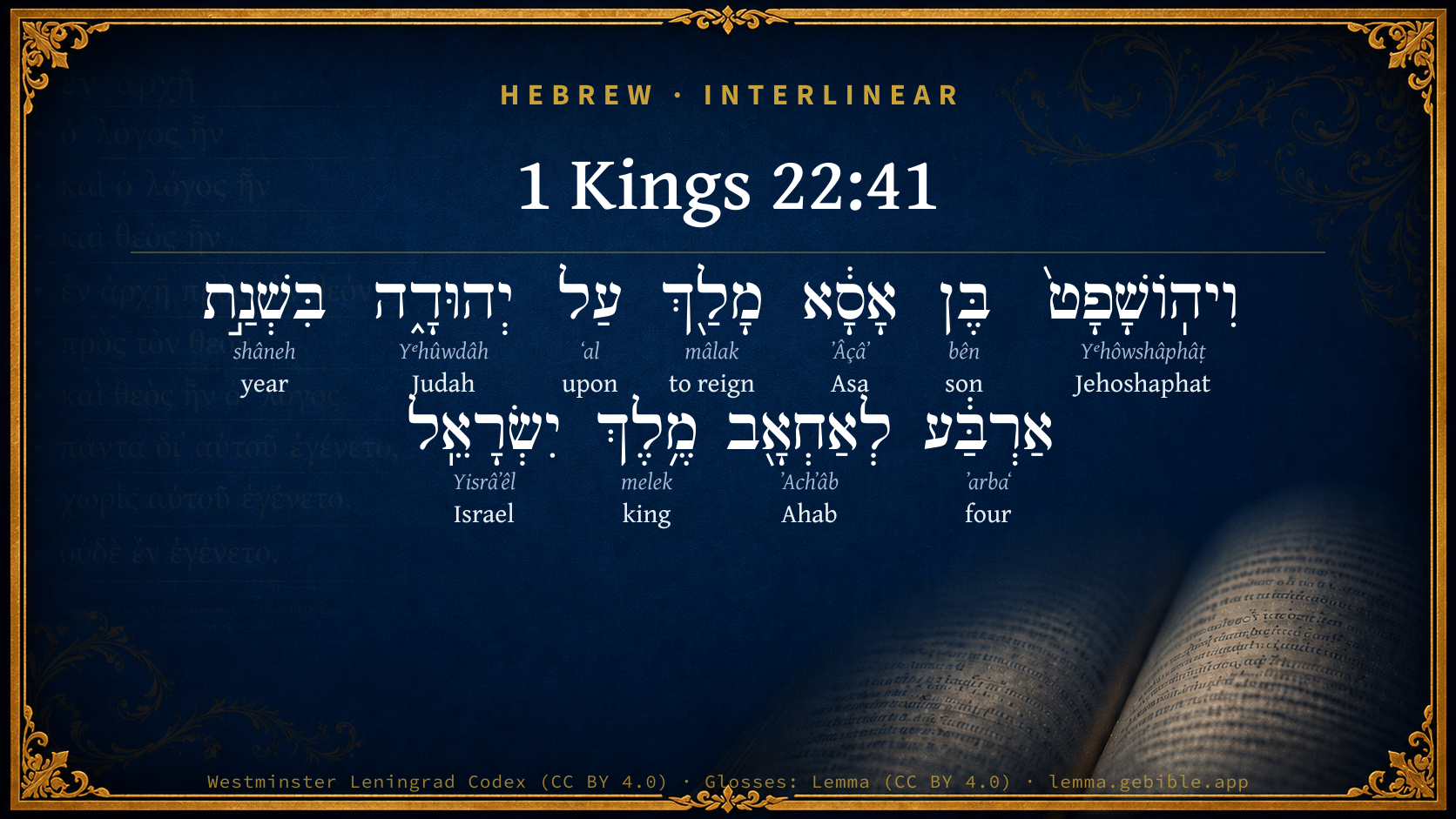
1 Kings 22:41

Hebrew (Westminster Leningrad Codex) 1 Kings 22:41 appears in the Hebrew Old Testament. The text above is from the Westminster Leningrad Codex. Each word links to its Strong’s number, a concise gloss, and parsing drawn from the Open Scriptures Hebrew Bible morphology. Click any word for its full Brown-Driver-Briggs (BDB) entry.
Download image
Cite this verse

1 Kings 22:41 (World English Bible). Public Domain. Lemma interlinear Bible study tool, https://lemma.gebible.app/v/1-kings/22/41.

Show BibTeX & RIS
BibTeX
RIS
English Translation
Jehoshaphat the son of Asa began to reign over Judah in the fourth year of Ahab king of Israel.
World English Bible · Public Domain
Download a study sheet

One document with this verse’s original text, its word-by-word gloss line, the meaning frame, cross-references with their text, attributed commentary, and full source and license credits — printable, and it pastes into notes with its structure intact.

This verse Autodidact and up

Study sheet (.html) Plain text (.txt)

A passage Seminary Student

Up to 50 verses in one chapter. A passage sheet keeps up to 6 commentary sources and 12 cross-references per verse, in the order this page ranks them, and says so on the sheet whenever that leaves anything out. Ask for a single verse and you get the Autodidact verse sheet above.

Everything on this page stays free to read, with no account — the sheet is a download of what is already on screen, not access to it.

Want to remove ads? Support Godless Engineer
Compare translations 3

The same verse in 3 English versions, stacked beneath the original-language interlinear above. Click any original word for its lexicon entry.

Each is an independent rendering of the whole verse — the interlinear is not word-aligned to these translations.

Highlighted words mark where these versions differ — a whole-verse word diff, not a word-by-word alignment.

  • World English Bible Public Domain
    Jehoshaphat the son of Asa began to reign over Judah in the fourth year of Ahab king of Israel.
  • King James Version Public Domain
    And Jehoshaphat the son of Asa began to reign over Judah in the fourth year of Ahab king of Israel.
  • unfoldingWord Literal Text CC BY-SA 4.0
    And Jehoshaphat, the son of Asa, reigned over Judah in year four of Ahab, the king of Israel.

unfoldingWord Literal Text — © unfoldingWord, licensed CC BY-SA 4.0. Word-aligned USFM3 via Door43 (git.door43.org/unfoldingWord/en_ult).

Versions to compare (up to 4)

3 of 4 selected

Show all 18 translations

Every available English version of this verse, each an independent rendering of the whole verse.

  • World English Bible Public Domain
    Jehoshaphat the son of Asa began to reign over Judah in the fourth year of Ahab king of Israel.
  • Berean Standard Bible Public Domain
    In the fourth year of Ahab’s reign over Israel, Jehoshaphat son of Asa became king of Judah.
  • Majority Standard Bible Public Domain
    In the fourth year of Ahab’s reign over Israel, Jehoshaphat son of Asa became king of Judah.
  • King James Version Public Domain
    And Jehoshaphat the son of Asa began to reign over Judah in the fourth year of Ahab king of Israel.
  • American Standard Version (1901) Public Domain
    And Jehoshaphat the son of Asa began to reign over Judah in the fourth year of Ahab king of Israel.
  • Revised Version (1885) Public Domain
    And Jehoshaphat the son of Asa began to reign over Judah in the fourth year of Ahab king of Israel.
  • Geneva Bible (1599) Public Domain
    And Iehoshaphat the sonne of Asa began to reigne vpon Iudah in the fourth yeere of Ahab King of Israel.
  • Douay-Rheims (1899) Public Domain
    But Josaphat the son of Asa began to reign over Juda in the fourth year of Achab king of Israel.
  • Young's Literal Translation Public Domain
    And Jehoshaphat son of Asa hath reigned over Judah in the fourth year of Ahab king of Israel,
  • Literal Standard Version CC BY-SA 4.0
    And Jehoshaphat son of Asa has reigned over Judah in the fourth year of Ahab king of Israel,
  • Unlocked Literal Bible CC BY-SA 4.0
    Then Jehoshaphat son of Asa began to reign over Judah in the fourth year of Ahab king of Israel.
  • unfoldingWord Literal Text CC BY-SA 4.0
    And Jehoshaphat, the son of Asa, reigned over Judah in year four of Ahab, the king of Israel.
  • Darby Bible Public Domain
    And Jehoshaphat the son of Asa began to reign over Judah in the fourth year of Ahab king of Israel.
  • World Messianic Bible Public Domain
    Jehoshaphat the son of Asa began to reign over Judah in the fourth year of Ahab king of Israel.
  • Webster's Bible Public Domain
    And Jehoshaphat the son of Asa began to reign over Judah in the fourth year of Ahab king of Israel.
  • Free Bible Version CC BY-SA 4.0
    Jehoshaphat, son of Asa, became king of Judah in the fourth year of the reign of Ahab, king of Israel.
  • Bible in Basic English Public Domain
    And Jehoshaphat, the son of Asa, became king over Judah in the fourth year of Ahab's rule over Israel.
  • JPS Tanakh (1917) Public Domain
    And Jehoshaphat the son of Asa began to reign over Judah in the fourth year of Ahab king of Israel.

Literal Standard Version (2020), Covenant Press — licensed CC BY-SA 4.0. Text via the HelloAO Bible API (eBible.org). Unlocked Literal Bible (unfoldingWord) — licensed CC BY-SA 4.0. Text via the HelloAO Bible API (eBible.org). unfoldingWord Literal Text — © unfoldingWord, licensed CC BY-SA 4.0. Word-aligned USFM3 via Door43 (git.door43.org/unfoldingWord/en_ult). Free Bible Version, Dr. Jonathan Gallagher — licensed CC BY-SA 4.0. Text via the HelloAO Bible API (eBible.org).

Word by word

More ways to search: Search by grammar → Find every occurrence → Compare this word →

Practice this passage: Drill this verse → Learn its vocabulary →

About this verse

These counts appear in no published source. They are computed here, from the morphology-tagged text and Lemma’s own curated glosses. What Lemma adds →

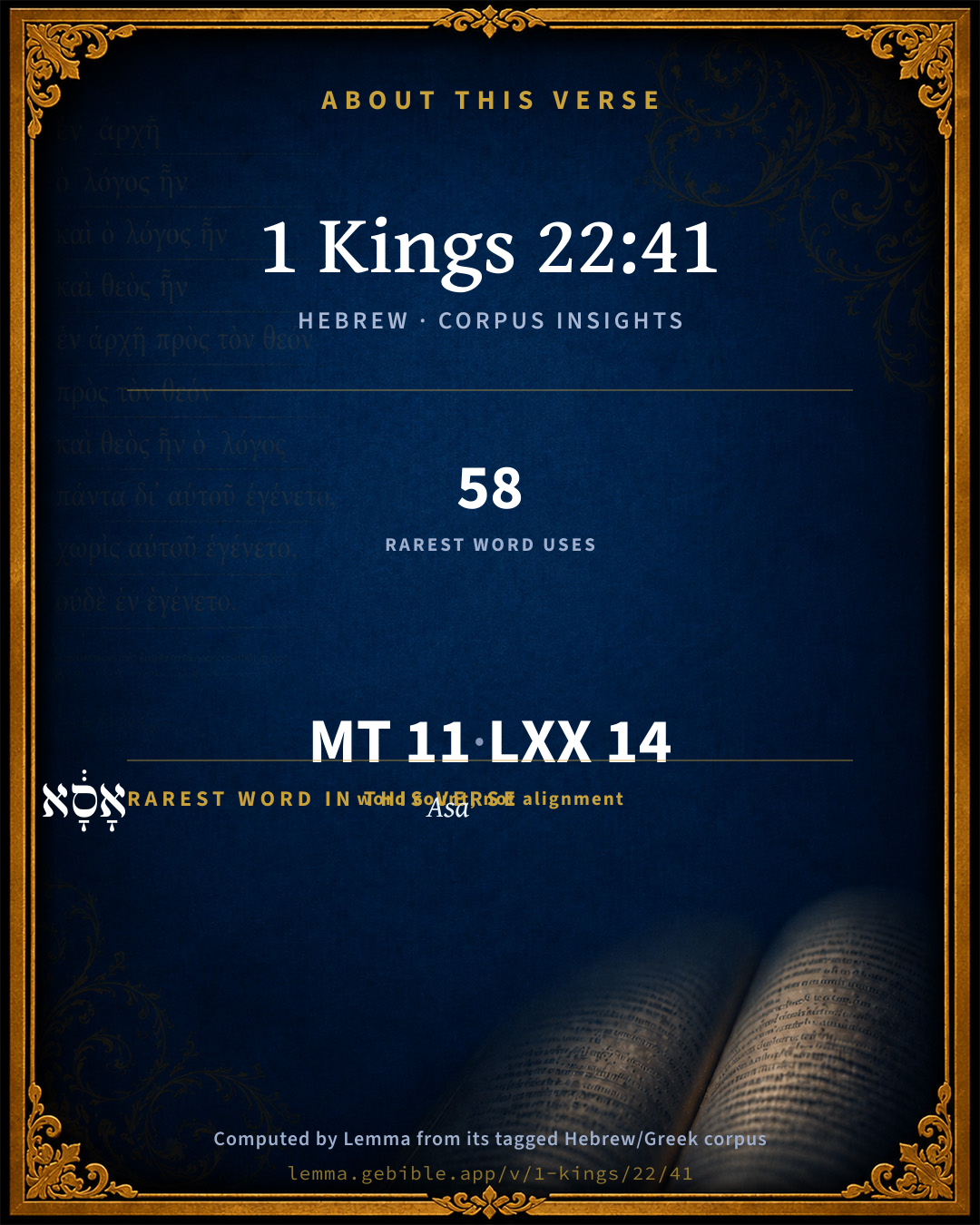
11
words
11
distinct lemmas
Historical
section

Shared distinctive vocabulary

אָסָ֔א Asa H609 occurs in 52 verses of the Hebrew Bible. Also found in:

Grammatical profile

  • 1 verb
  • 8 nouns
  • 1 adjective
  • 1 preposition

Verb forms

  • מָלַ֖ךְ Qal · Perfect

Hebrew & Septuagint length

In English translation the verse runs 19 words from the Hebrew and 22 from the Septuagint (LXX English) — closely comparable.

A rough comparison of the two English renderings, which tokenize alike — not a word-level alignment.

Word counts can differ between the Hebrew and the Greek without any difference in meaning — e.g. the Hebrew direct-object marker אֵת has no separate Greek word, and Greek often adds the article ὁ.

In the original languages it is 11 Hebrew tokens and 14 Greek tokens — but the two are counted differently (Hebrew bundles its prefixes and suffixes into one token; the Greek is in lemma form), so that isn’t a like-for-like length.

Cross-references

4

Topical passages linked to 1 Kings 22:41 in the Treasury of Scripture Knowledge — connected by theme and wording, ordered by reader-vote popularity; previews shown in the World English Bible.

  • 2 Chronicles 20:31 Jehoshaphat reigned over Judah: he was thirty-five years old when he began to reign; and he reigned twenty-five years in Jerusalem: and his mother's name was Azubah the daughter of Shilhi.
  • 1 Kings 22:2 It happened in the third year, that Jehoshaphat the king of Judah came down to the king of Israel.
  • 1 Chronicles 3:10 Solomon's son was Rehoboam, Abijah his son, Asa his son, Jehoshaphat his son,
  • 2 Chronicles 17:1 Jehoshaphat his son reigned in his place, and strengthened himself against Israel.

Cross-references courtesy of OpenBible.info (CC BY 4.0).

Hebrew and Greek witnesses Masoretic Hebrew ↔ Greek Septuagint

The same verse in the two great witnesses to the Old Testament, shown verse-for-verse.

These are two independent witnesses, not word-aligned to each other, and the Septuagint is shown in lemma (dictionary) form.

Hebrew 1 Kings 22:41 Masoretic · Westminster Leningrad Codex

וִיהֽוֹשָׁפָט֙ בֶּן אָסָ֔א מָלַ֖ךְ עַל יְהוּדָ֑ה בִּשְׁנַ֣ת אַרְבַּ֔ע לְאַחְאָ֖ב מֶ֥לֶךְ יִשְׂרָאֵֽל

Jehoshaphat the son of Asa began to reign over Judah in the fourth year of Ahab king of Israel.

World English Bible · Public Domain

Greek LXX 1 Kings 22:41 Septuagint · lemma form

καί ιωσαφατ υἱός ασα βασιλεύω ἐπί ἰουδά ἔτος τέταρτος ὁ αχααβ βασιλεύς ἰσραήλ βασιλεύω

And Josaphat the son of Asa reigned over Juda: in the fourth year of Achaab king of Israel began Josaphat to reign.

LXX2012 (modern English Septuagint) · Public Domain

Hebrew: Westminster Leningrad Codex (CC BY 4.0). Greek: Septuagint (public domain); English from LXX2012 (modern English Septuagint) (Public Domain). How the Septuagint differs from the Hebrew →

Targum (Aramaic paraphrase)

1

The Targum is the ancient Jewish Aramaic paraphrase of the Hebrew Scriptures — an interpretive translation, not the Hebrew text itself. Onkelos (literal) and Pseudo-Jonathan (expansive) render the Torah, and Jonathan the Prophets. Coverage is partial: where no permissively-licensed English translation exists for a verse, only the Aramaic is shown. This is verse-level text, not a word-by-word alignment to the Hebrew.

  1. Targum Jonathan Prophets (Joshua–Malachi)
    וִיהוֹשָׁפָט בַּר אָסָא מְלַךְ עַל דְבֵית יְהוּדָה בִּשְׁנַת אַרְבַּע לְאַחְאָב מַלְכָּא דְיִשְׂרָאֵל:

    (no public-domain English translation for this verse)

    Targum Jonathan — Aramaic: “Mikraot Gedolot” (public domain). English: “Sefaria Community Translation” (CC0 1.0 (public-domain dedication)); “London "Chaldee Paraphrase," 1871” (public domain). Text via Sefaria.

Commentary

Notes on 1 Kings 22:41 from classic Christian and Jewish commentators (each source and its license shown beneath its notes). The classic Christian expositions comment on the surrounding passage and are grouped to its opening verse, so a note may address several verses; the Jewish commentaries on the Tanakh (Rashi and others) are per-verse, so they appear only where the commentator wrote on this verse.

Lemma curates 59 commentaries, every one of them public domain or Creative Commons licensed, each selected and text-cleaned for this edition rather than reprinted as found. About our sources →

Trapp's Complete Commentary

John Trapp

1Ki 22:41 And Jehoshaphat the son of Asa began to reign over Judah in the fourth year of Ahab king of Israel.

Ver. 41. Jehoshaphat the son of Asa.] The father was good, but the son better; he repented when he was reproved; but his father stormed, and put the prophet in prison.

John Trapp, A Commentary or Exposition upon All the Books of the Old and New Testament (1647–1656) — public domain. Text from a community e-Sword module.

Whedon's Commentary on the Bible

Daniel D. Whedon

JEHOSHAPHAT’S REIGN, 1Ki_22:41-50.

The reign of this king of Judah is rapidly passed over in this book, but is more fully detailed in 2 Chronicles chaps. 17-20.

Daniel D. Whedon (gen. ed.), Commentary on the Old and New Testaments (1874–1909) — public domain. Text from a community e-Sword module.

The Preacher's Complete Homiletical Commentary

Joseph S. Exell (gen. ed.)

CRITICAL AND EXPLANATORY NOTES.—

1Ki_22:41. History of the reign of Jehoshaphat of Judah—Scant records of Judah occur in the Scriptures, but Chronicles give them more fully.

1Ki_22:46. The sodomites … he took out of the land—Lit., extinguished from the land.

1Ki_22:49. Then said Ahaziah—At that time king of Israel. He wished to unite with Jehoshaphat in maritime expeditions; the explanation of his refusal is found in 2Ch_20:35-37. Ezion-geber (1Ki_22:48) abounds in perilous and destructive rocks.—W. H. J.

HOMILETICS OF 1Ki_22:41-50

THE PRAISEWORTHY EFFORTS OF A GOOD KING

AN agreeable change comes across the character of the history—like a wavering stream of light which silvers and beautifies the dark and restless sea. The last seven chapters have been wholly occupied with the history of the kingdom of Israel; a dismal record of defection, idolatry, bloodshed, ever intensifying wickedness, and of terrible judgments. Here we have interposed, as if to relieve the blackness of the picture, a brief epitome of the career of the good Jehoshaphat. For a fuller account of his reign consult 2 Chronicles 17 -

20. In the paragraph before us we have a representation of the praiseworthy efforts of a good king.

I. He is solicitous to maintain the religious prestige of the nation (1Ki_22:43).

1. He follows the example of the good. “He walked in all the ways of Asa, his father, he turned not aside from it.” On the general piety of Asa see 1Ki_15:11-15, and compare 2Ch_14:2-5; 2Ch_15:8-17. Jehosphaphat seems to have been a still better king, for he did not, like Asa, fall away in his old age (2Ch_16:2-12). It is an unspeakable advantage to have an early pious training; and to have constantly in view the best patterns of religious excellence to imitate.

2. He strives after personal righteousness. “Doing that which was right in the eyes of the Lord.” Goodness should be sought and practised for its own sake, and with a sincere desire to please God. Nothing is good which will not bear the test of the Divine scrutiny—which is not right in the eyes of the Lord.”

3. He may not accomplish all the religious reforms he desires. “Nevertheless, the high places were not taken away.” The only faults with which Jehoshaphat is charged are his allowance of the high places, and his tenderness towards the house of Ahab, which led him, first, to take a wife for his eldest son from among Ahab’s daughters, and then to join both him and his successor in their military and other enterprises (1Ki_22:29; 2Ki_3:7; 2Ch_20:35-37). There are few reformers who do not make some mistakes; and few who accomplish all at which they aim. Even to attempt a great and noble enterprise has an elevating moral influence on the zealous reformer. It is one of the first and highest duties of a king to look well after the religious condition of his people.

II. He labours to promote peace (1Ki_22:44). For sixty years, from the first separation of the two kingdoms down to the accession of Jehoshaphat, there was an uninterrupted series of wars between Israel and Judah. This fratricidal policy was ended by the declaration of a formal peace, which was perhaps at once cemented by a marriage between the two children of the contracting parties, Jehoram and Athaliah. A wise and judicious king will use all legitimate means to promote and maintain an honourable peace, without the surrender of any one essential right, or the least sacrifice of dignity.

III. He is alive to the importance of a judicious manifestation of kingly power (1Ki_22:45). “His might that he showed and how he warred.” He tries to promote peaceful relations with other nations, not because he is weak, but because he is strong! He discourages war in others by being always prepared for it himself. He will not suffer his authority to be despised, nor will he allow a wrong to his nation to go unpunished. Government that is not backed with power will soon drift into rebellion and anarchy.

IV. He is anxious about the morality of his people (1Ki_22:46). Sensual indulgence grows into still more abominable enormities, the more it is practised and tolerated. It saps the foundations of national life and morality. Much had been done to root out the wretched class referred to in this verse (1Ki_15:12); but the evil was so inveterate and deep-seated that it could not be all at once extinguished. An examination of the social life of the Greeks and Romans when at the acme of their national greatness shows how possible it is for the most brilliant attainments in literature, science, and art, to co-exist alongside the most debasing and shameless immorality. Christianity is the apostle and donor of the highest and purest morality.

V. He encourages the exercise of good government. “There was then no king in Edom: a deputy was king” (1Ki_22:47). The last reference to Edom was in the time of Solomon, when Hadad, having returned thither from Egypt, was “an adversary unto Solomon” (1Ki_11:14), and reigned over Egypt. It seems to have been again reduced, and to be dependent on the kingdom of Judah, being governed by a deputy, or viceroy, who, however, was allowed the royal title. This government of dependencies by means of subject kings was the all but universal practice in the East down to the time of Cyrus. A good king is careful to provide effective government in every part of his dominions. When the government is feeble, every other interest suffers.

VI. He seeks to advance commercial enterprise (1Ki_22:48-49). Jehoshaphat sought to re-establish the maritime trade to Ophir, which had proved such a source of wealth in Solomon’s reign; and, though the shipbuilding in this instance proved a failure, it illustrates the active desire of the king to promote the commercial welfare of the nation. The ships were wrecked while in the harbour, because they were badly built, the Jewish sailors having but an imperfect knowledge of the sea and of the rig and management of ships; or, according to the prophet Eliezer, as a Divine judgment against Jehoshaphat for joining himself with the idolatrous Ahaziah in this business (2Ch_20:36-37). The commercial genius of Jehoshaphat would find scope in other directions, which would all tend to increase the national prosperity. If commerce is stifled, the nation is starved. “Every profession implies system. The meanest trade demands it, and would run to waste without something of it. The marvellous achievements of modern commerce, stretching its relations over distant seas and many lands, and gathering the materials of every civilization within its ample bosom, are, more than anything, the result of an expanding and victorious system, which shrinks at no obstacles and adapts itself to every emergency.” A good king readily appreciates the application of system to commercial success, and is not too proud or too indifferent to act accordingly.

VII. He transmits a heritage of good to his successor (1Ki_22:50). Jehoram enters upon the government with all the advantages of his father’s achievements and prestige. Fortunate indeed is the youthful king who succeeds a provident and far-seeing father; and who has before him, as a constant inspiration, the example of a holy and useful life. To leave a good name to posterity is better than riches. It is a solemn and sacred trust to receive all that Jehoram received. It may be shamefully abused, as, alas! it was in his case (2Ch_21:6).

LESSONS:—

1. A crown brings great opportunities and great responsibilities.

2. The best king cannot accomplish all the good he would.

3. A good man is honoured for the good he attempted, as well as for what he actually accomplished.

GERM NOTES ON THE VERSES

1Ki_22:41-50. The reign of Jehoshaphat was a very successful and prosperous one for Judah, both internally and externally. The author does not enter more particularly into the details of its history, evidently because, from the time of the division of the kingdom, his main object was rather to give a representation of the monarchy in Israel until its downfall. Jehoshaphat’s aim, after he had established legal order in his dominions as far as possible, reduced the neighbouring people to subjection again, and concluded peace with the brother kingdom, was to restore the times of prosperity that existed in the days of Solomon, and to bring his kingdom up to the height of that of Solomon once more. The glory of the kingdom, however, as it had existed under Solomon, was, according to the purpose of God, for ever gone by. Its return was not a part of the divine plan of salvation, and every human attempt to restore it must necessarily fail. The fleet of Jehoshaphat went down in the harbour of Ezion-geber, even before it had sailed out, and that, too, not by human fault, but by a storm—that is to say, by a dispensation of God.—Lange.

—All Christian rulers and governors ought to follow the example of the pious king Jehoshaphat—to do what is pleasing to God, to walk in His ways without departing from them, to maintain and extend pure religon, to remove and destroy what is evil, and especially not to permit whoredom, but with earnestness to do away with it and punish it, and to guard themselves from having too much intercourse with godless persons, or from entering into any covenant with them, because this leads to no good, as indeed Jehoshaphat got only danger and loss by it. Every one should profit by the life experience of Jehoshaphat. All that he undertook according to God’s word and will went on fortunately, and attained good success, and was attended with blessing; but all that he undertook in conjunction with Ahab and Ahaziah turned out unfortunately: there was no blessing upon that.—Wurt. Summ.

1Ki_22:43. An upright life.

1. Is modelled after a worthy pattern.

2. Is marked by fidelity and perseverance.

3. Is approved and owned of God.

4. May not be free from some imperfections.

1Ki_22:48-49. The risks of commerce.

1. Demand great toil and enterprise.

2. Liable to great losses.

3. May be involved in unfortunate partnerships.

4. Cultivate decision of character: “Jehoshaphat would not” (1Ki_22:49).

1Ki_22:48. “For his ships were broken.” This cross was in great mercy to Jehoshaphat. “Thou in very faithfulness hast afflicted me,” said David. This should be a patienting consideration; as it is said to have been to Philip of Spain, upon the defeating and scattering of his navy in 1588. He gave, and commanded to be given all over Spain, thanks to God that the loss was no more grievous; and used singular mercy in relieving the distressed soldiers and sailors—Trapp.

1Ki_22:49-50. The heart of man proposes its own way, but the Lord alone allows it to proceed therein (Pro_16:9). He often confounds our purposes and destroys our plans which reach so far and so high, that we may not become puffed up, but learn to yield to His holy will, and to say: “It is the Lord; let Him do what seemeth Him good.”—What God has clearly destroyed as a punishment, that let us not build up again at the counsel or demand of any man, for when He breaks in pieces, it cannot avail to build again (Job_12:14).—So Jehoshaphat would not build again. The offers of a man who had departed from God, even if he offer thee ever so much profit and pleasantness, do thou reject with determined will.—Lange.

The Preacher's Complete Homiletical Commentary (gen. ed. Joseph S. Exell; Funk & Wagnalls, c. 1892) — public domain (pre-1929). A full-Bible homiletical/sermon-outline anthology covering 65 of 66 books (2 John is absent from the source module). Text from a community e-Sword module.

Keil & Delitzsch

C. F. Keil & F. Delitzsch

Reign of Jehoshaphat of Judah. - The account of this in the books before us is a very condensed one. Beside the two campaigns in which he joined with Ahab and Joram of Israel against the Syrians and Moabites, and which are described in the history of the kingdom of Israel (1 Kings 22:1-35 and 2 Kings 3), we have simply a short notice of his attempt to restore the trade with Ophir, and a general statement of the spirit of his reign; whereas we learn from the extract preserved in the Chronicles from the annals of the kings, that he also carried on a victorious war against the Edomites and Ammonites (2 Chron 20), and did a great deal to promote the spread of the knowledge of the law among his people, and to carry out the restoration of a better administration of justice, and to improve the condition of the army (Ch2 16:1-14 and Ch2 19:1-11).

Kg1 22:41-42

Kg1 22:41-44, which give the age of Jehoshaphat when he ascended the throne, and the duration and character of his reign, are also found with slight deviations in Ch2 20:31-33, in the closing summary of the history of his reign.

Kg1 22:43

"He walked entirely in the way of his father Asa and departed not from it, to do what was well-pleasing to the Lord," whereas Asa's heart had become more estranged from the Lord in the last years of his reign (see Kg1 15:18.). - On the worship of the high places (Kg1 22:43), see at Kg1 15:14.

Kg1 22:44

He maintained peace with the king of Israel, i.e., with every one of the Israelitish kings who were contemporaneous with him, viz., Ahab, Ahaziah, and Joram, whereas hitherto the two kingdoms had assumed an attitude of hostility towards each other. Even if this friendly bearing towards Israel was laudable in itself, Jehoshaphat went beyond the bounds of what was allowable, since he formed a marriage alliance with the house of Ahab, by letting his son Joram marry a daughter of Ahab and Jezebel (Ch2 18:1).

Kg1 22:45-46

The brave deeds (הגּבוּרה) which he performed include both his efforts to strengthen his kingdom, partly by raising fortifications and organizing the military force, and partly by instructing the people in the law and improving the administration of justice (Ch2 17:7-19 and Ch2 19:4-11), and also the wars which he waged, viz., the expeditions already mentioned. - For Kg1 22:46 see Kg1 15:12.

Kg1 22:47

"There was (then) no (real) king in Edom; a vicegerent was king," i.e., governed the country. This remark is introduced here merely on account of what follows, namely, to show how it was that Jehoshaphat was able to attempt to restore the maritime trade with Ophir. If we observe this connection between the verse before us and what follows, we cannot infer from it, as Ewald does (Gesch. iii. pp. 464 and 474ff.), that the Edomites with Egyptian help had forced from Rehoboam both their liberty and also their right to have a king of their own blood, and had remained in this situation till Jehoshaphat completely subjugated them again. (See the remarks on Kg1 11:21-22.) All that can be gathered from 2 Chron 20 is, that the Edomites, in league with the Ammonites and other desert tribes, made an incursion into Judah, and therefore tried to throw off the supremacy of Judah, but did not succeed in their attempt.

Kg1 22:48-50

The brief notice concerning Jehoshaphat's attempt to build Tarshish ships (for the word, see pp. 105f) for the voyage to Ophir is expanded in Ch2 20:36-37, where we learn that Jehoshaphat had allied himself with Ahaziah of Israel for this purpose, and that the prophet Eliezer predicted the destruction of his ships on account of this alliance. When the ships had been broken in pieces in Eziongeber, no doubt by a storm, Ahaziah made this fresh proposal to him: "Let my people sail with thy people;" but Jehoshaphat would not. Ahaziah evidently wanted to persuade Jehoshaphat to make another attempt, after the destruction of the ships which were first built; but Jehoshaphat did not agree to it any more, because it was impossible for him, after the fulfilment of Eliezer's prediction, to expect a more favourable result. Thus the two accounts can be harmonized in a very simple manner, with the exception of the words "to go to Tarshish," which we find in the Chronicles in the place of "to go to Ophir," the reading in our text, and which sprang from an erroneous interpretation of the expression "ships of Tarshish" (see above, pp. 105f). The Chethb עשׂר is an error of the pen for עשׂה (Keri); but נשׁבּרה (Chethb) is not to be altered into נשׁבּרוּ, since the construction of a singular verb with the subject following in the plural is by no means rare (vid., Ewald, 317, a.). On Eziongeber and Ophir, see at Kg1 9:26 and Kg1 9:28.

Keil & Delitzsch — Biblical Commentary on the Old Testament (1861–1891) — public domain (CC PDM 1.0). Text via the HelloAO Bible API. (Old Testament only.)

The Expositor's Bible

JEHOSHAPHAT

1Ki_22:41-50

BEFORE we leave the House of David we must speak of Jehoshaphat, the last king of Judah whose reign is narrated in the First Book of Kings. He was abler, more powerful, and more faithful to Jehovah than any of his predecessors, and was alone counted worthy in later ages to rank with Hezekiah and Josiah among the most pious rulers of the Davidic line. The annals of his reign are found chiefly in the Second Book of Chronicles, where his story occupies four long chapters. The First Book of Kings compresses all record of him into nine verses, except so far as his fortunes are commingled with the history of Ahab. But both accounts show us a reign which contributed as greatly to the prosperity of Judah as that of Jeroboam II contributed to the prosperity of Israel.

He ascended the throne at the age of thirty-five. He was apparently the only son of Asa, by Azubah, the daughter of Shilhi; for Asa, greatly to his credit, seems to have been the first king of Judah who set his face against the monstrous polygamy of his predecessors, and, so far as we know, contented himself with a single wife. He received the high eulogy that "he turned not aside from doing that which was right in the eyes of the Lord," with the customary qualification that, nevertheless, the people still burnt incense and offerings at the Bamoth, which were not taken away. The chronicler says that he did take them away. This stock contradiction between the two authorities must be accounted for either by a contrast between the effort and its failure, or by a distinction between idolatrous Bamoth and those dedicated to the worship of Jehovah to which the people clung with the deep affection which local sanctuaries inspire.

To the historians of the Book of Kings the central fact of Jehoshaphats history is that "he made peace with the King of Israel." As a piece of ordinary statesmanship no step could have been more praiseworthy. The sixty-eight years or more which had elapsed since the divinely-suggested choice of Jeroboam by the Northern Kingdom had tended to soften old exasperations. The kingdom of Israel was now an established fact, and nothing had become more obvious than that the past could not be undone. Meanwhile the threatening specter of Syria. under the dynasty of Benhadad, was beginning to throw a dark shadow over both kingdoms. It had become certain that, if they continued to destroy each other by internecine warfare, both would succumb to the foreign invader. Wisely, therefore, and kindly Jehoshaphat determined to make peace with Ahab, in about the eighth year after his accession; and this policy he consistently maintained to the close of his twenty-five years reign.

No one surely could blame him for putting an end to an exhaustive civil war between brethren. Indeed, in so doing he was but carrying out the policy which had been dictated to Rehoboam by the prophet Shemaiah, when he forbade him to attempt the immense expedition which he had prepared to annihilate Jeroboam. Peace was necessary to the development and happiness of both kingdoms, but even more so to the smaller and weaker, threatened as it was not only by the more distant menace of Syria, but by the might of Egypt on the south and the dangerous predatory warfare of Edom and Moab on the east.

But Jehoshaphat went further than this. He cemented the new peace by an alliance between his young son Jehoram and Athaliah, daughter of Ahab and Jezebel, who was then perhaps under fifteen years of age.

Later chroniclers formed their moral estimates by a standard which did not exist so many centuries before the date at which they wrote. If we are to judge the conduct of these kings truthfully we must take an unbiased view of their conduct. We adopt this principle when we try to understand the characters of saints and patriarchs like Abraham, Isaac, and Jacob, or judges and prophets like Gideon, Deborah, and Samuel; and in general we must not sweepingly condemn the holy men of old because they lacked the full illumination of the gospel. We must be guided by a spirit of fairness if we desire to form a true conception of the kings who lived in the ninth century before Christ. It is probable that the religious gulf between the kings of Judah and Israel was not so immense as on a superficial view it might appear to be; indeed, the balance seems to be in favor of Jeroboam as against Abijam, Rehoboam, or even Solomon. The worship of the golden symbols at Dan and Bethel did not appear half so heinous to the people of Judah as it does to us. Even in the Temple they had cherubim and oxen. The Bamoth to Chemosh, Milcom, and Astarte glittered before them undisturbed on the summit of Olivet, and abominations which they either tolerated or could not remove sheltered themselves in the very precincts of the Temple, under the shadows of its desecrated trees. To the pious Jehoshaphat the tolerance of Baal-worship by Ahab could hardly appear more deadly than the tolerance of Chemosh-worship by his great-great-grandfather, and the permission of Asherim and Chammanim by his grandfather, to say nothing of the phallic horror openly patronised by the queen-mother who was a granddaughter of David. That Ahab himself was a worshipper of Jehovah is sufficiently proved by the fact that he had given the name of Athaliah to the young princess whose hand Jehoshaphat sought for his son, and the name of Ahaziah ("Jehovah taketh hold") to the prince who was to be his heir. Jehoshaphat acted from policy; but so has every king done who has ever reigned. He could neither be expected to see these things with the illumination of a prophet, nor to read-as later writers could do in the light of history-the awful issues involved in an alliance which looked to him so necessary and so advantageous.

At the time of the proposed alliance there seems to have been no protest-at any rate, none of which we read. Micaiah alone among the prophets uttered his stern warning when the expedition to Ramoth Gilead was actually on foot, and Jehu, son of Hanani, went out to rebuke Jehoshaphat at the close of that disastrous enterprise. It is to the history attributed to this seer and embodied in the annals of Israel that the chronicler refers: "Shouldst thou help the wicked," asked the bold prophet, "and love them that hate the Lord? For this thing wrath is upon thee from the Lord. Nevertheless, there are good things found, in thee, in that thou hast put away the Asheroth out of the land, and hast set thy heart to seek God."

The moral principle which Jehu, son of Hanani, here enunciated is profoundly true. It was terribly emphasized by the subsequent events. A just and wise forecast may have sanctioned the restoration of peace, but Jehoshaphat might at least have learnt enough to avoid affinity with a queen who, like Jezebel, had introduced frightful and tyrannous iniquities into the House of Ahab. Faithful as the King of Judah evidently intended to be to the law of Jehovah, he should have hesitated before forming such close bonds of connection with the cruel daughter of the usurping Tyrian priest. His error hardly diminished the warmth of that glowing eulogy which even the chronicler pronounces upon him; but it brought upon his kingdom, and upon the whole family of his grandchildren, overwhelming misery and all but total extermination. The rules of Gods moral government are written large on the story of nations, and the consequences of our actions come upon us not arbitrarily, but in accordance with universal laws. When we err, even though our error be leniently judged and fully pardoned, the human consequences of the deeds which we have done may still come flowing over us with the resistless march of the ocean tides.

"You little fancy what rude shocks apprise us. We sin: Gods intimations rather fall In clearness than in energy."

Jehoshaphat did not live to see the ultimate issues of massacre and despotism which came in the train of his son Jehorams marriage. Perhaps to him it wore the golden aspect which it wears on the forty-fifth Psalm, which, as some have imagined, was composed on this occasion. But he had abundant proof that close relationship for mutual offence and defense with the kings of Israel brought no blessing in its train. In the expedition against Ramoth Gilead when Ahab was slain, he too very nearly lost his life. Even this did not disturb his alliance with Ahabs son Ahaziah, with whom he joined in a maritime enterprise which like its predecessors, turned out to be a total failure.

Jehoshaphat in his successful wars had established the supremacy over Edom which had been all but lost in the days of Solomon. The Edomite Hadad and his successors had not been able to hold their own, and the present kings of Edom were deputies or vassals under the suzerainty of Judaea. This once more opened the path to Elath and Ezion-Geber on the gulf of Akaba. Jehoshaphat, in his prosperity, felt a desire to revive the old costly commerce of Solomon with Ophir for gold, sandal wood, and curious animals. For this purpose he built "ships of Tarshish," i.e., merchant ships, like those used for the Phoenician trade between Tyre and Tartessus, to go this long voyage. The ships, however, were wrecked on the reefs of Ezion-Geber, for the Jews were timid and inexperienced mariners. Hearing of this disaster, according to the Book of Kings, Ahaziah made an offer to Jehoshaphat to make the enterprise a joint one, -thinking, apparently, that the Israelites, who, perhaps, held Joppa and some of the ports on the coast, would bring more skill and knowledge to bear on the result. But Jehoshaphat had had enough of an attempt which was so dangerous and which offered no solid advantages. He declined Ahaziahs offer. The story of these circumstances in the chronicler is different. He speaks as if from the first it was a joint experiment of the two kings, and says that, after the wreck of the fleet, a prophet of whom we know nothing, "Eliezer, the son of Dodavahu of Mareshah," prophesied against Jehoshaphat, saying, "Because thou hast joined thyself with Ahaziah, Jehovah hath made a breach in thy works." The passage shows that the word "prophesied" was constantly used in the sense of "preached," and did not necessarily imply any prediction of events yet future. The chronicler, however, apparently makes the mistake of supposing that ships were built at Ezion-Geber on the Red Sea to sail to Tartessus in Spain! The earlier and better authority says correctly that these merchantmen were built to trade with Ophir, in India, or Arabia. The chronicler seems to have been unaware that "ships of Tarshish," like our "Indiamen," was a general title for vessels of a special build.

We see enough in the Book of Kings to show the greatness and goodness of Jehoshaphat, and later on we shall hear details of his military expeditions. The chronicler, glorifying him still more, says that he sent princes and Levites and priests to teach the Book of the Law throughout all the cities of Judah; that he received large presents and tribute from neighboring peoples; that he built castles and stone cities; and that he had a stupendous army of 160, 000 troops under four great generals. He also narrates that when an immense host of Moabites, Ammonites, and Meunim came against him to Hazezon-Tamar or Engedi he took his stand before the people in the Temple in front of the new court and prayed. Thereupon the spirit of the Lord came upon "Jahaziel the son of Zechariah, the son of Benaiah, the son of Jeiel, the son of Mattaniah the Levite, of the sons of Asaph," who told them that the next day they should go against the invader, but that they need not strike a blow. The battle was Gods, not theirs. All they had to do was to stand still and see the salvation of Jehovah. On hearing this the king and all his people prostrated themselves, and the Levites stood up to praise God. Next morning Jehoshaphat told his people to believe God and His prophets and they should prosper, and bade them chant the verse, "Give thanks unto the Lord, for His mercy endureth for ever," which now forms the refrain of Psalms 136. On this Jehovah "set liers in wait against the children of Ammon, Moab, and Mount Seir." Intestine struggles arose among the invaders. The inhabitants of Mount Seir were first destroyed, and the rest then turned their swords against each other until they were all "dead bodies fallen to the earth." The soldiers of Jehoshaphat despoiled these corpses for three days, and on the fourth assembled themselves in the valley of Beracah ("Blessing"), which received its name from their tumultuous rejoicings. After this they returned to Jerusalem with psalteries and harps and trumpets, and God gave Jehoshaphat rest from all his enemies round about. Of all this the historian of the Kings tells us nothing. Jehoshaphat died full of years and honors, leaving seven sons, of whom the eldest was Jehoram. {2Ch_21:2-3} His reign marks a decisive triumph of the prophetic party. The prophets not only felt a fiercely just abhorrence of the abominations of Canaanite idolatry, but wished to establish a theocracy to the exclusion on the one hand of all local and symbolic worship, and on the other of all reliance on worldly policy. Up to this time, as Dean Stanley says m his usual strikingly picturesque manner,

"if there was a holy city, there was also an unholy city within the walls of Sion. It was like a seething caldron of blood and froth whose scum is therein and whose scum has not gone out of it. The Temple was hemmed in by dark idolatries on every side. Mount Olivet was covered with heathen sanctuaries, monumental stones, and pillars of Baal. Wooden images of Astarte under the sacred trees, huge images of Molech appeared at every turn in the walks around Jerusalem." Jehoshaphat introduced a decisive improvement into the conditions which prevailed under Rehoboam and Abijah, but practically the conflict between light and darkness goes on for ever. It was in days when Jerusalem had come to be regarded by herself and by all nations as exceptionally holy, that she, who had been for centuries the murderess of the prophets, became under her priestly religionists the murderess of the Christ, and-far different in Gods eyes from what she was in her own-deserved the dreadful stigma of being "the great city which spiritually is called Sodom and Egypt."

William Robertson Nicoll, ed., The Expositor's Bible (London: Hodder & Stoughton, 1887–1910) — public domain. 65 of 66 books (1 Corinthians is not separately keyed, as that volume carries no machine-parseable verse references); section-level commentary keyed to the opening verse. Introductory and overview sections not keyed to a specific passage are excluded.

Tyndale Open Study Notes

Tyndale Open Resources

22:41-50 This overview provides basic information about Jehoshaphat’s twenty-five-year reign as king of Judah. The Chronicler provides more details on Jehoshaphat’s good spiritual character that led to religious reforms and the Lord’s blessing (2 Chr 17:1–21:1). Including a two-year co-regency with his father, Asa, Jehoshaphat reigned from 872 to 848 BC.

Tyndale Open Study Notes — © Tyndale Open Resources, licensed CC BY-SA 4.0. Text via the HelloAO Bible API.

Matthew Henry's Commentary

Here is, I. A short account of the reign of Jehoshaphat king of Judah, of which we shall have a much fuller narrative in the book of Chronicles, and of the greatness and goodness of that prince, neither of which was lessened or sullied by any thing but his intimacy with the house of Ahab, which, upon several accounts, was a diminution to him. His confederacy with Ahab in war we have already found dangerous to him, and his confederacy with Ahaziah his son in trade sped no better. He offered to go partner with him in a fleet of merchant-ships, that should fetch gold from Ophir, as Solomon's navy did, Kg1 22:49. See Ch2 20:35, Ch2 20:36. But, while they were preparing to set sail, they were exceedingly damaged and disabled by a storm (broken at Ezion-geber), which a prophet gave Jehoshaphat to understand was a rebuke to him for his league with wicked Ahaziah (Ch2 20:37); and therefore, as we are told here (Kg1 22:49), when Ahaziah desired a second time to be a partner with him, or, if that could not be obtained, that he might but send his servants with some effects of board Jehoshaphat's ships, he refused: Jehoshaphat would not. The rod of God, expounded by the word of God, had effectually broken him off from his confederacy with that ungodly unhappy prince. Better buy wisdom dear than be without it; but experience is therefore said to be the mistress of fools because those are fools that will not learn till they are taught by experience, and particularly till they are taught the danger of associating with wicked people. Now Jehoshaphat's reign appears here to have been none of the longest, but one of the best. 1. It was none of the longest, for he reigned but twenty-five years (Kg1 22:42), but then it was in the prime of his time, between thirty-five and sixty, and these twenty-five, added to his father's happy forty-one, give us a grateful idea of the flourishing condition of the kingdom of Judah, and of religion in it, for a great while, even when things were very bad, upon all accounts, in the kingdom of Israel. If Jehoshaphat reigned not so long as his father, to balance this he had not those blemishes on the latter end of his reign that his father had (Ch2 16:9, Ch2 16:10, Ch2 16:12), and it is better for a man that has been in reputation for wisdom and honour to die in the midst of it than to outlive it. 2. Yet is was one of the best, both in respect of piety and prosperity. (1.) He did well: He did that which was right in the eyes of the Lord (Kg1 22:43), observed the commands of his God, and trod in the steps of his good father; and he persevered therein: He turned not aside from it. Yet every man's character has some but or other, so had his; the high places were not taken away, no not out of Judah and Benjamin, though those tribes lay so near Jerusalem that they might easily bring their offerings and incense to the altar there, and could not pretend, as some other of the tribes, the inconveniency of lying remote. But old corruptions are with difficulty rooted out, especially when they have formerly had the patronage of those that were good, as the high places had of Samuel, Solomon, and some others. (2.) His affairs did well. He prevented the mischiefs which had attended their wars with the kingdom of Israel, establishing a lasting peace (Kg1 22:44), which would have been a greater blessing if he had contented himself with a peace, and not carried it on to an affinity with Israel; he put a deputy, or viceroy, in Edom, so that the kingdom was tributary to him (Kg1 22:47), and therein the prophecy concerning Esau and Jacob was fulfilled, that the elder should serve the younger. And, in general, mention is made of his might and his wars, Kg1 22:45. He pleased God, and God blessed him with strength and success. His death is spoken of (Kg1 22:50), to shut up his story, yet, in the history of the kings of Israel, we find mention of him afterwards, Kg2 3:7.

II. The beginning of the story of Ahaziah the son of Ahab, Kg1 22:51-53. His reign was very short, not two years. Some sinners God makes quick work with. It is a very bad character that is here given him. He not only kept up Jeroboam's idolatry, but the worship of Baal likewise; though he had heard of the ruin of Jeroboam's family, and had seen his own father drawn into destruction by the prophets of Baal, who had often been proved false prophets, yet he received no instruction, took no warning, but followed the example of his wicked father and the counsel of his more wicked mother Jezebel, who was still living. Miserable are the children that not only derive a stock of corruption from their parents, but are thus taught by them to trade with it; and unhappy, most unhappy parents, are those that help to damn their children's souls.

Matthew Henry's Commentary on the Whole Bible (1708–1710) — public domain (CC PDM 1.0). Text via the HelloAO Bible API.

Ellicott's Commentary for English Readers

(41) Jehoshaphat.—The narrative here, so far as it is full and continuous, centres round the prophetic work of Elijah and Elisha, the scene of which was in Israel; and the compiler contents himself with the insertion of a few brief annalistic notices of the kingdom of Judah, taking up the thread of the narrative of chapter 15:24, except where (as in 2 Kings 3) it becomes again connected with the history of Israel. In the Chronicles, on the contrary, there is a full and interesting account of the reign of Jehoshaphat, and especially of his great religious revival (2 Chronicles 17-20), coinciding with this chapter, almost verbally, in the account of the battle at Ramoth-gilead. The brief notices here of the religious work of Jehoshaphat, his “might,” and his “wars,” agree entirely with this fuller record.

A Bible Commentary for English Readers, edited by Charles John Ellicott (1878–1897) — public domain. Text from a community e-Sword module.

The Cambridge Bible for Schools and Colleges

gen. ed. J. J. S. Perowne

41–50. Brief notice of the reign of Jehoshaphat, king of Judah (2Ch_20:31-37; 2Ch_21:1)

41. Jehoshaphat the son of Asa] For the events of the twenty-five years of Jehoshaphat’s reign the books of Kings give but a scanty record. His alliance with Jehoram, Ahab’s son, against the king of Moab, is mentioned (2Ki_2:7, seqq.) and that Jehoram, his son, was made king during his father’s lifetime (2Ki_8:16). But this is all. Yet clearly Jehoshaphat was a king of much influence. The Chronicler also tells much good concerning him. The Lord was with him (2 Chronicles 17) and he prospered. He sent out Levites with the princes to teach the people in the cities of Judah. His enemies were dismayed by his greatness, for he had famous commanders and mighty armies. He made the improper alliance with Ahab (2 Chronicles 18) but after Ahab’s death, he returned to Jerusalem and appointed and instructed judges and priests and Levites (2 Chronicles 19) to act in the fear of the Lord and with a perfect heart. He was attacked by Moab (2 Chronicles 20) but seeking unto the Lord he gained a great victory, which he celebrated in such way that the place of the celebration was known afterwards as ‘The valley of blessing.’

The Cambridge Bible for Schools and Colleges (gen. ed. J. J. S. Perowne; Cambridge University Press, 1878–1918) — public domain. Text from a community e-Sword module.

John Gill's Exposition

Jehoshaphat made ships of Tarshish,.... Ships to go to sea, particularly the Indian sea, Kg1 10:22. Tarshish is used for the sea in general, Psa 48:7, in the Cetib, or text, it is "ten"; in the Keri, or margin, it is "made", which we follow, and may be put together, as in the Tigurine version, and read, "he made ten ships to go by sea":

even to go to Ophir for gold; as Solomon did; of which place see Kg1 9:28,

but they went not, for the ships were broken at Eziongeber; the port where they were built: as soon as they were launched, or sailed, they were broken to pieces against the rocks near the harbour, which stood up like a man's backbone, whence the port had its name; See Gill on Kg1 9:26, and if this was Calzem, as there observed, near to it was a dangerous place for ships, and where many were lost, and is supposed to be the place where Pharaoh and his host were drowned (y); the reason of this shipwreck was, because Jehoshaphat joined himself with Ahaziah king of Israel, for which he was reproved by the prophet Eliezer, and this was his punishment, Ch2 20:35.

(y) Vid. Geograph. Nub. Climat. 3. par. 3. in fine.

John Gill's Exposition of the Whole Bible (1746–1763) — public domain (CC PDM 1.0). Text via the HelloAO Bible API.

Albert Barnes' Notes on the Bible

The writer returns to the history of the kingdom of Judah (connect this verse with 1Ki 15:24), sketching briefly a reign much more fully given by the writer of Chronicles 2 Chr. 17–20. Compare also the marginal references.

Albert Barnes' Notes on the Bible (1834–1885) — public domain. Text from a community e-Sword/MySword module.

Matthew Poole's English Annotations

Who reigned twenty-two years; therefore he reigned about eighteen years with Ahab.

Matthew Poole's English Annotations on the Holy Bible (1683–1685) — public domain. Text from a community e-Sword/MySword module.

The Pulpit Commentary

Reign of Jehoshaphat.

And Jehoahaphat "Whom Jehovah judges" the son of Asa began to reign over Judah in the fourth year of Ahab king of Israel.

The historian now resumes for a moment the history of Judah, which has dropped out of notice since 1Ki_15:24, where the accession of Jehoshaphat was mentioned. His reign, which is here described in the briefest possible way, occupies four chapters (17-20.) of 2 Chronicles

Vers. 41-50.

Jehoshaphat.

These words give a summary of the life of this king of Judah, and faithfully record, as the Scriptures do to admiration, the good and the bad, as these will be considered in the judgment of the great day. Consider

I THE PRAISE OF JEHOSHAPHAT.

1. He came of a good stock.

(1) He was "of the house and lineage of David." The traditions of that house were in many respects a glorious inheritance. David was a "man after God"s own heart." In no instance was he found inclining to idolatry.

(2) He was the son of Asa. Of his mother we have this significant mention: "And his mother"s name was Azubah, the daughter of Shilhi. And he walked in the ways of Asa his father, and departed not from it, doing that which was right in the sight of the Lord." This suggests the healthiness of his mothers moral influence. The reference here to Asa, too, is highly honourable.

(3) The blessing of pious parents is inestimable. It works beneficially in example, in precept, in solicitude. This last is most effectual in prayer to God. Those who are favoured with godly parents should praise God evermore. Wicked children of pious parents are doubly culpable.

2. He improved his advantages.

(1) He "walked in the ways of Asa his father." These were ways of righteousness. Let the children of godly parents now ask themselves whether they walk in the good ways of their ancestors.

(2) He "turned not aside from it. He showed no favour to idolatry. The note which follows is no impeachment of the truth of this statement: "Nevertheless the high places were not taken away; for the people offered and burnt incense yet in the high places." The high places that Jehoshaphat spared were those in which the true God was worshipped in accordance with the usage of patriarchal times. (see 2Ch_33:17)

(3) He went farther than Asa in the work of reformation: remnant of the Sodomites which remained in the days of Asa his father he took out of the land." The parallel place to this in the Chronicles is: "And his heart was lifted up in the ways of the Lord: moreover he took away the high places and the groves ( out of Judah". (2Ch_17:6 2Ch_19:8) By removing the Sodomites we understand that he demolished their shrines, their Asherim, their instruments of pollution. When the nests are destroyed the rooks fly.

3. This was to his praise.

(1) Others, similarly placed, failed to make this good use of their advantages. Jehoram, his own son, may be mentioned in sad contrast to him. Several of his ancestors had scandalously departed from the godly ways of their father David. Men will be justified or condemned in the light of such comparisons in the last great day. (see Luk_11:31, Luk_11:32)

(2) God rewarded him with prosperity. (2Ch_17:4, 2Ch_17:5) He had an army probably an enrolled militia of 1, 100, 000 men. The Philistines, Arabians, and Edomites were subject to him. The note here, that "there was then no king in Edom: a deputy was king," which prefaces the account of his fleet at Ezion-Geber, was designed to explain how Jehoshaphat was able to have a fleet at a port which belonged to Edom, (1Ki_9:26) viz., because he appointed the viceroy in Edom which was tributary to him (see Gen_27:29, Gen_27:37; 2Sa_8:14)

II THE BLAME OF JEHOSHAPHAT. This seems all to have been connected with the "peace" which he made "with the king of Israel." It appears to have commenced with

1. The marriage of his son.

(1) Jehoram, the eldest son of Jehoshaphat, and with his consent, took Athaliah, the daughter of Ahab and Jezebel, to be his wife. Jehoshaphat"s heart was lifted up with the abundance of his "riches and honour," and "joined affinity with Ahab". (see 2Ch_18:1) tie became too great to be content with a humble match for his son, and sacrificed godliness to grandeur. He has many imitators in this.

(2) Unequal yoking has ever been prolific in mischief. Athaliah inherited the evil spirit of both her parents, and she led away the heart of Jehoram from God to his ruin. The object of this marriage was to build up the house of Jehoshaphat, but it well-nigh proved its ruin (see 2Ch_22:10, 2Ch_22:11) God is the builder of families (see 2Sa_7:11, 2Sa_7:27; 1Ki_2:24 1Ki_11:38; Psa_127:1)

2. His friendship with Ahab.

(1) This evil grew out of the marriage. The peace between Israel and Judah, which in the abstract was a benefit, was probably a condition of the marriage. But the friendship between Jehoshaphat and Ahab which followed, was too intimate for the good of the king of Judah"s soul

(2) Evils beget evils. This friendship led to Jehosha. plat helping Ahab in his war against Syria, and had nearly cost Jehoshaphat his life. It also sullied his reputation, for he was persuaded into it by Ahab against the voice of Micaiah. This friendship exposed Jehoshaphat to the reproof of the prophet. (2Ch_19:2)

3. His friendship with Ahaziah.

(1) This son of Ahab was no more a companion fit for Jehoshaphat than Ahab. For Ahaziah "walked in the way of his father, and in the way of his mother, and in the way of Jeroboam the son of Nebat, who made Israel to sin: for he served Baal and worshipped him, and provoked to anger the Lord God of Israel, according to all that his father had done.

(2) Yet Jehoshaphat formed a trade alliance with Ahaziah. They jointly fitted out a fleet at the port of Ezion-Geber, on the Red Sea, to sail to Ophir for gold. But for this God rebuked him, and "the ships were broken" in the port. (see 2Ch_20:35-37) Let no money consideration, no gold of Ophir, induce godly young men to enter into trade partnerships with the ungodly.

(3) This judgment of God had a salutary effect upon Jehoshaphat. For when Ahaziah would renew the attempt at Ezion-Geber, Jehoshaphat declined (ver. 49). Let us be careful never to repeat a blunder. J.A.M.

Vers. 41-53.

Two Life Stories.

I JEHOSHAPHAT"S.

1. He prolonged the good influence of his fathers reign. Judah"s thought was still kept under the light of truth, and its life more fully led into the ways of God: he completed his father"s reforms (ver. 46). The continuance of God s work anywhere is as important as the origination of it.

2. He was consistent. "He turned not aside from it." He did not merely begin well; over his whole reign there rested the Divine approval; he did "that which was right in the eyes of the Lord." The life which is ever sinning, repenting, forgetting, achieves nothing. It is like a plant uprooted and planted again, to be again uprooted, etc., and which, even should its life be preserved, will never bear fruit. It is like "a backsliding heifer," and with such a life the great Husbandman"s work cannot be carried on.

3. There was failure as well as success in his career. "Nevertheless the high places were not taken away." tie had endeavoured to remove them. (2Ch_17:6) But "the people offered and burnt incense yet in the high places." The mightiest efforts in the great warfare with darkness leave something for other hands to do, and must till He come who alone can perfect all things.

1. He sought to be at peace with his brethren (ver. 44). He went further in this, indeed, than he ought to have done, (2Ch_19:2) but the desire for peace was laudable.

2. He humbled himself under Gods rebuke (compare vers. 48, 49 with. 2Ch_20:35-37) At first he had been beguiled into.fellowship with the idolatrous king of Israel without reflecting upon the danger which lay in it for himself and his people. But when God had manifested His displeasure, nothing could make him renew the confederacy. The judgment might mistake, but the heart was loyal to God.

II AHAZIAH"S.

1. A sinful life. "He did evil in the sight of the Lord." With such a life there was no possibility of blessing for his people. The roots of his usefulness were destroyed. To do, we must first of all become. Our work cannot rise above the level of our life.

2. A disastrous policy (vers. 52, 53). He continued the work of Israel"s destruction. The departure made by Jeroboam and perfected by Ahab and Jezebel, he accepted in its full rejection of Jehovah. He did not go beyond them, he simply did "according to all that his father had done," but in doing this his sin was of the deepest dye. His father had been judged, but God was still braved, and Israel was led still nearer to destruction. We may only continue what others have begun; but if we pay no heed to the proofs of God"s anger, and take no thought of the inevitable results of the policy we pursue, our persistence may be one of the deepest crimes against God and man. U.

The Pulpit Commentary (1880–1919), ed. H.D.M. Spence-Jones & Joseph S. Exell — public domain. Text from a community e-Sword module.

John Wesley's Explanatory Notes

Of Ahab - Who reigned twenty two years; therefore he reigned about eighteen years with Ahab.

John Wesley, Explanatory Notes Upon the Whole Bible (1754–1765) — public domain. Text via the GEBible commentary corpus.

Kretzmann's Popular Commentary

Paul E. Kretzmann

Jehoshaphat in Judah, Ahaziah in Isreal

v. 41. And Jehoshaphat, the son of Asa, began to reign over Judah in the fourth year of Ahab, king of Israel. Cf 2 Chronicles 17-21.

v. 42. Jehoshaphat, of whose reign only a very brief summary is here given, was thirty and five years old when he began to reign, and he reigned twenty and five years in Jerusalem. And his mother’s name, mentioned, as usual, on account of the obvious great influence of the mother in Oriental harems, was Azubah, the daughter of Shilhi.

v. 43. And he walked in all the ways of Asa, his father, keeping the covenant of Jehovah; he turned not aside from it, doing that which was right in the eyes of the Lord; nevertheless, the high places, those devoted to Jehovah worship, against the real purpose of the Lord, were not taken away; for the people offered and burned incense yet in the high places, they did not confine their worship to the Temple at Jerusalem, as the Lord had ordered.

v. 44. And Jehoshaphat made peace with the king of Israel, a state of war having existed between the two kingdoms for about seventy years.

v. 45. Now, the rest of the acts of Jehoshaphat, and his might that he showed, especially in building fortresses and in increasing the military forces of the country, and how he warred, are they not written in the Book of the Chronicles of the Kings of Judah?

v. 46. And the remnant of the sodomites, the male prostitutes, which remained in the days of his father Asa, he took out of the land, his rule being notable also for that reason.

v. 47. There was then no king in Edom, for the Edomites, who had been conquered by David, had either not succeeded in regaining their independence, or they had not been able to keep it; a deputy was king, acting as governor under the overlordship of the king of Judah.

v. 48. Jehoshaphat made ships of Tharshish, ocean-going vessels such as were used for the trade with Spain, to go to Ophir for gold; but they went not, for the ships were broken at Ezion-geber, the harbor at the head of the Elanitic Gulf, a storm destroying them at God’s command, 2Ch 20:37.

v. 49. Then said Ahaziah, the son of Ahab, unto Jehoshaphat, Let my servants go with thy servants in the ships. But Jehoshaphat would not, he refused to make a second attempt, after the Lord had so plainly shown his disapproval of the undertaking.

v. 50. And Jehoshaphat slept with his. fathers, and was buried with his fathers in the city of David, his father; and Jehoram, his son, reigned in his stead.

v. 51. Ahaziah, the son of Ahab, whose accession to the throne was noted

v. 40. began to reign over Israel in Samaria the seventeenth year of Jehoshaphat, king of Judah, and reigned two years over Israel.

v. 52. And. he did evil in the sight of the Lord, and walked in the way of his father and in the way of his mother, in extreme idolatry, and in the way of Jeroboam, the son of Nebat, who made Israel to sin, by introducing idolatry when he erected the golden calves;

v. 53. for he served Baal, and worshiped him, and provoked to anger the Lord God of Israel, according to all that his father had done. The terrible end of his father had not taught this idolater the lesson which he should have learned. It is due to men’s own deliberate blindness that they meet with misfortune and are condemned.

Paul E. Kretzmann, Popular Commentary of the Bible (1921–1924) — public domain. Text from a community e-Sword module.

unfoldingWord translationNotes

Door43 World Missions Community

thirty-five years old

"35 years old" (See: Numbers)

twenty-five years

"25 years" (See: Numbers)

translationWords

Jehoshaphat

Asa

reign

kingdom of Judah

kingdom of Israel

Jerusalem

unfoldingWord translationNotes — © Distant Shores Media and the Door43 World Missions Community, licensed CC BY-SA 4.0. Source: git.door43.org/Door43/en_tn.

Lesson kit

Teaching starters — assembled from the data on this page, not authored interpretation. Every prompt links to the verse data it draws on. Edit before teaching.

1 Kings, in the Historical, opens this verse with 11 words (11 distinct Hebrew lemmas). Its most distinctive word is ʼÂçâʼ (“Asa”). A historical commentator’s framing appears above. Read the whole chapter for the surrounding context.

Discussion questions

  1. How does “Asa” (ʼÂçâʼ) shape what this verse is saying?
  2. 1 Kings 15:8 shares the word «Asa» with this verse. How do the two illuminate each other?
  3. These translations render this verse differently; the difference is in the English rendering, not the original. What questions does that raise?
  4. The verb «מָלַ֖ךְ» is Qal Perfect. How does its form color the action?
  5. Reading how Trapp's Complete Commentary and Whedon's Commentary on the Bible read this verse, where do the two commentators agree and where do they part?

Things to notice

Reading settings

Reading text

Shown beneath each verse's original-language words.

Old Testament
Old Testament edition

Read the OT as the Masoretic Hebrew (MT) or the Greek Septuagint (LXX).

English shown for the Greek Septuagint (in the Hebrew ↔ Greek comparison).

Comparing translations? Open the Compare panel on any verse page to stack up to four side by side.