1 Kings 11:37

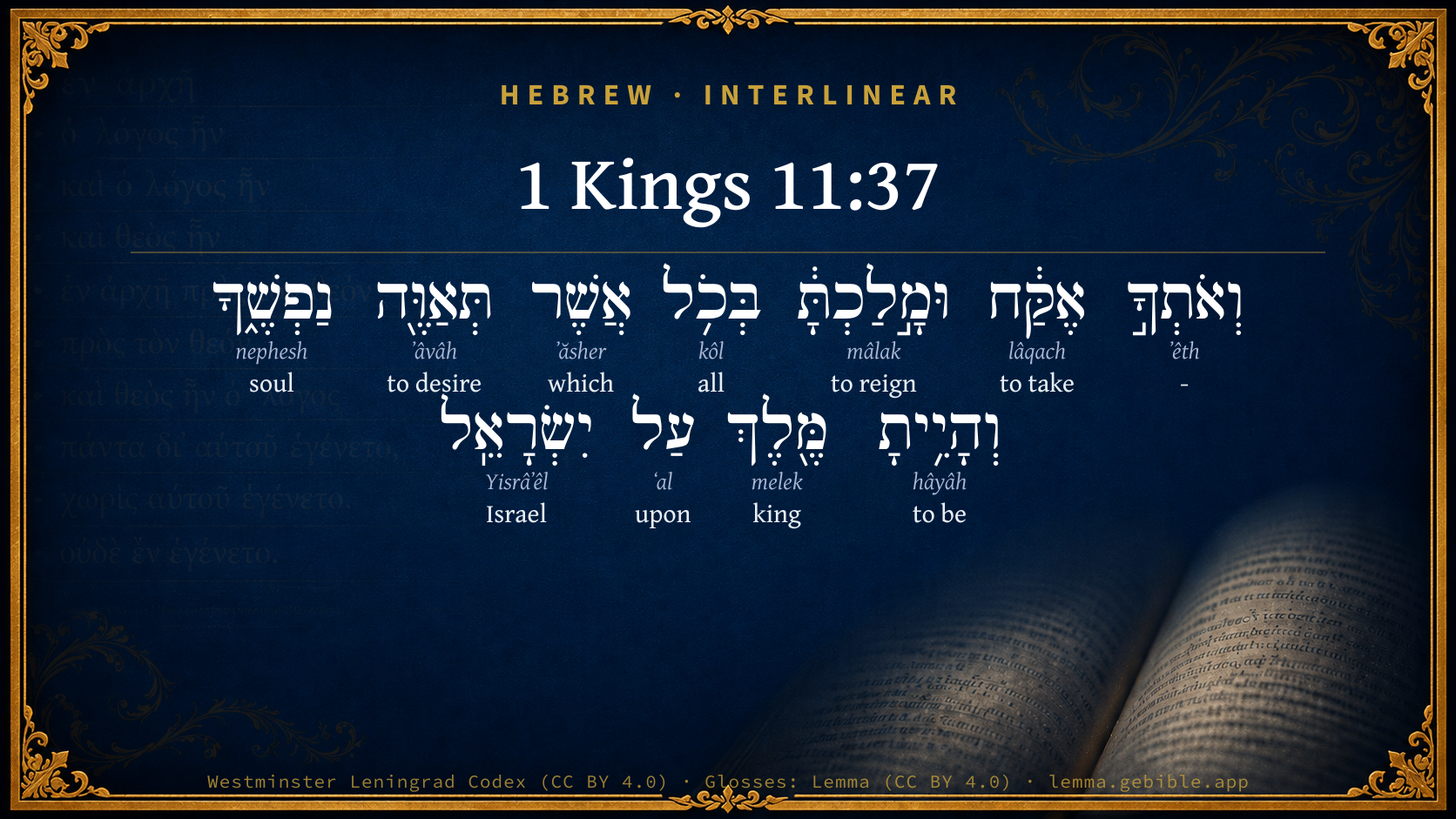
Hebrew (Westminster Leningrad Codex) 1 Kings 11:37 appears in the Hebrew Old Testament. The text above is from the Westminster Leningrad Codex. Each word links to its Strong’s number, a concise gloss, and parsing drawn from the Open Scriptures Hebrew Bible morphology. Click any word for its full Brown-Driver-Briggs (BDB) entry.
Download image
Cite this verse

1 Kings 11:37 (World English Bible). Public Domain. Lemma interlinear Bible study tool, https://lemma.gebible.app/v/1-kings/11/37.

Show BibTeX & RIS
BibTeX
RIS
English Translation
I will take you, and you shall reign according to all that your soul desires, and shall be king over Israel.
World English Bible · Public Domain
Download a study sheet

One document with this verse’s original text, its word-by-word gloss line, the meaning frame, cross-references with their text, attributed commentary, and full source and license credits — printable, and it pastes into notes with its structure intact.

This verse Autodidact and up

Study sheet (.html) Plain text (.txt)

A passage Seminary Student

Up to 50 verses in one chapter. A passage sheet keeps up to 6 commentary sources and 12 cross-references per verse, in the order this page ranks them, and says so on the sheet whenever that leaves anything out. Ask for a single verse and you get the Autodidact verse sheet above.

Everything on this page stays free to read, with no account — the sheet is a download of what is already on screen, not access to it.

Want to remove ads? Support Godless Engineer
Compare translations 3

The same verse in 3 English versions, stacked beneath the original-language interlinear above. Click any original word for its lexicon entry.

Each is an independent rendering of the whole verse — the interlinear is not word-aligned to these translations.

Highlighted words mark where these versions differ — a whole-verse word diff, not a word-by-word alignment.

  • World English Bible Public Domain
    I will take you, and you shall reign according to all that your soul desires, and shall be king over Israel.
  • King James Version Public Domain
    And I will take thee, and thou shalt reign according to all that thy soul desireth, and shalt be king over Israel.
  • unfoldingWord Literal Text CC BY-SA 4.0
    And I will take you, and you will reign over all that your soul desires, and you will be king over Israel.

unfoldingWord Literal Text — © unfoldingWord, licensed CC BY-SA 4.0. Word-aligned USFM3 via Door43 (git.door43.org/unfoldingWord/en_ult).

Versions to compare (up to 4)

3 of 4 selected

Show all 18 translations

Every available English version of this verse, each an independent rendering of the whole verse.

  • World English Bible Public Domain
    I will take you, and you shall reign according to all that your soul desires, and shall be king over Israel.
  • Berean Standard Bible Public Domain
    But as for you, I will take you, and you shall reign over all that your heart desires, and you will be king over Israel.
  • Majority Standard Bible Public Domain
    But as for you, I will take you, and you shall reign over all that your heart desires, and you will be king over Israel.
  • King James Version Public Domain
    And I will take thee, and thou shalt reign according to all that thy soul desireth, and shalt be king over Israel.
  • American Standard Version (1901) Public Domain
    And I will take thee, and thou shalt reign according to all that thy soul desireth, and shalt be king over Israel.
  • Revised Version (1885) Public Domain
    And I will take thee, and thou shalt reign according to all that thy soul desireth, and shalt be king over Israel.
  • Geneva Bible (1599) Public Domain
    And I wil take thee, and thou shalt reigne, euen as thine heart desireth, and shalt be King ouer Israel.
  • Douay-Rheims (1899) Public Domain
    And I will take thee, and thou shalt reign over all that thy soul desireth, and thou shalt be king over Israel.
  • Young's Literal Translation Public Domain
    `And thee I take, and thou hast reigned over all that thy soul desireth, and thou hast been king over Israel;
  • Literal Standard Version CC BY-SA 4.0
    And I take you, and you have reigned over all that your soul desires, and you have been king over Israel;
  • Unlocked Literal Bible CC BY-SA 4.0
    I will take you, and you will rule to fulfill all that you desire, and you will be king over Israel.
  • unfoldingWord Literal Text CC BY-SA 4.0
    And I will take you, and you will reign over all that your soul desires, and you will be king over Israel.
  • Darby Bible Public Domain
    And I will take thee, that thou mayest reign over all that thy soul desireth, and thou shalt be king over Israel.
  • World Messianic Bible Public Domain
    I will take you, and you shall reign according to all that your soul desires, and shall be king over Israel.
  • Webster's Bible Public Domain
    And I will take thee, and thou shalt reign according to all that thy soul desireth, and shalt be king over Israel.
  • Free Bible Version CC BY-SA 4.0
    I will take you, and you shall reign over everything that you want. You will be king over Israel.
  • Bible in Basic English Public Domain
    And you I will take, and you will be king over Israel, ruling over whatever is the desire of your soul.
  • JPS Tanakh (1917) Public Domain
    And I will take thee, and thou shalt reign over all that thy soul desireth, and shalt be king over Israel.

Literal Standard Version (2020), Covenant Press — licensed CC BY-SA 4.0. Text via the HelloAO Bible API (eBible.org). Unlocked Literal Bible (unfoldingWord) — licensed CC BY-SA 4.0. Text via the HelloAO Bible API (eBible.org). unfoldingWord Literal Text — © unfoldingWord, licensed CC BY-SA 4.0. Word-aligned USFM3 via Door43 (git.door43.org/unfoldingWord/en_ult). Free Bible Version, Dr. Jonathan Gallagher — licensed CC BY-SA 4.0. Text via the HelloAO Bible API (eBible.org).

Word by word

More ways to search: Search by grammar → Find every occurrence → Compare this word →

Practice this passage: Drill this verse → Learn its vocabulary →

תְּאַוֶּ֖ה
ʼâvâh
H183
“to desire”
Verb, Piel, Imperfect, 3rd Person, Feminine, Singular
Part of Speech
Verb
Stem
Piel
Form
Imperfect
Person
3rd Person
Gender
Feminine
Number
Singular
Full BDB Definition

Origin: a primitive root

TWOT: 40

desire, incline, covet, wait longingly, wish, sigh, want, be greedy, prefer - (Piel) to desire, crave (food and drink) - (Hithpael) to desire, long for, lust after (of bodily appetites)
  1. וְאֹתְךָ֣ ʼêth H853 “and · - · you” Conjunction + Particle, Direct Object + Suffix, Personal, 2nd Person, Masculine, Singular
  2. אֶקַּ֔ח lâqach H3947 “to take” Verb, Qal, Imperfect, 1st Person, Common, Singular
  3. וּמָ֣לַכְתָּ֔ mâlak H4427 “and · to reign” Conjunction + Verb, Qal, Sequential Perfect, 2nd Person, Masculine, Singular
  4. בְּכֹ֥ל kôl H3605 “in/at · all” Preposition + Noun, Common, Masculine, Singular, Absolute
  5. אֲשֶׁר ʼăsher H834 “which” Particle, Relative
  6. נַפְשֶׁ֑ךָ nephesh H5315 “soul · your” Noun, Common, Both, Singular, Construct + Suffix, Personal, 2nd Person, Masculine, Singular
  7. וְהָיִ֥יתָ hâyâh H1961 “and · to be” Conjunction + Verb, Qal, Sequential Perfect, 2nd Person, Masculine, Singular
  8. מֶּ֖לֶךְ melek H4428 “king” Noun, Common, Masculine, Singular, Absolute
  9. עַל ʻal H5921 “upon” Preposition
  10. יִשְׂרָאֵֽל Yisrâʼêl H3478 “Israel” Noun, Proper

About this verse

These counts appear in no published source. They are computed here, from the morphology-tagged text and Lemma’s own curated glosses. What Lemma adds →

11
words
11
distinct lemmas
Historical
section

Shared distinctive vocabulary

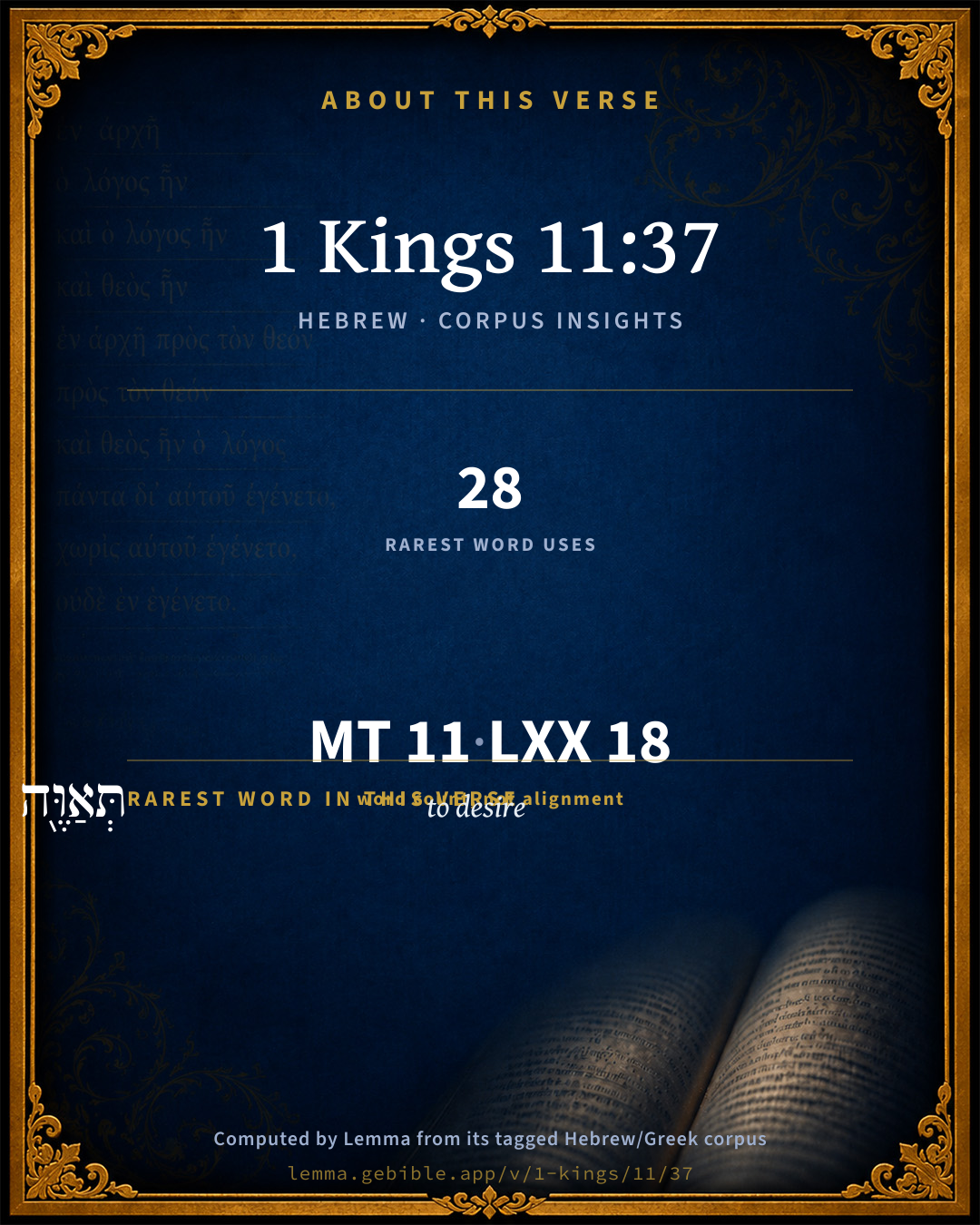
תְּאַוֶּ֖ה to desire H183 occurs in 25 verses of the Hebrew Bible. Also found in:

Grammatical profile

  • 4 verbs
  • 4 nouns
  • 1 preposition
  • 2 particles

Verb forms

  • אֶקַּ֔ח Qal · Imperfect
  • וּמָ֣לַכְתָּ֔ Qal · Sequential Perfect
  • תְּאַוֶּ֖ה Piel · Imperfect
  • וְהָיִ֥יתָ Qal · Sequential Perfect

Hebrew & Septuagint length

In English translation the verse runs 21 words from the Hebrew and 20 from the Septuagint (LXX English) — closely comparable.

A rough comparison of the two English renderings, which tokenize alike — not a word-level alignment.

Word counts can differ between the Hebrew and the Greek without any difference in meaning — e.g. the Hebrew direct-object marker אֵת has no separate Greek word, and Greek often adds the article ὁ.

In the original languages it is 11 Hebrew tokens and 18 Greek tokens — but the two are counted differently (Hebrew bundles its prefixes and suffixes into one token; the Greek is in lemma form), so that isn’t a like-for-like length.

Cross-references

3

Topical passages linked to 1 Kings 11:37 in the Treasury of Scripture Knowledge — connected by theme and wording, ordered by reader-vote popularity; previews shown in the World English Bible.

  • Deuteronomy 14:26 and you shall bestow the money for whatever your soul desires, for oxen, or for sheep, or for wine, or for strong drink, or for whatever your soul asks of you; and you shall eat there before Yahweh your God, and you shall rejoice, you and your household.
  • 2 Samuel 3:21 Abner said to David, I will arise and go, and will gather all Israel to my lord the king, that they may make a covenant with you, and that you may reign over all that your soul desires. David sent Abner away; and he went in peace.
  • 1 Kings 11:26 Jeroboam the son of Nebat, an Ephraimite of Zeredah, a servant of Solomon, whose mother's name was Zeruah, a widow, he also lifted up his hand against the king.

Cross-references courtesy of OpenBible.info (CC BY 4.0).

Hebrew and Greek witnesses Masoretic Hebrew ↔ Greek Septuagint

The same verse in the two great witnesses to the Old Testament, shown verse-for-verse.

These are two independent witnesses, not word-aligned to each other, and the Septuagint is shown in lemma (dictionary) form.

Hebrew 1 Kings 11:37 Masoretic · Westminster Leningrad Codex

וְאֹתְךָ֣ אֶקַּ֔ח וּמָ֣לַכְתָּ֔ בְּכֹ֥ל אֲשֶׁר תְּאַוֶּ֖ה נַפְשֶׁ֑ךָ וְהָיִ֥יתָ מֶּ֖לֶךְ עַל יִשְׂרָאֵֽל

I will take you, and you shall reign according to all that your soul desires, and shall be king over Israel.

World English Bible · Public Domain

Greek LXX 1 Kings 11:37 Septuagint · lemma form

καί σύ λαμβάνω καί βασιλεύω ἐν ὅς ἐπιθυμέω ὁ ψυχή σύ καί σύ εἰμί βασιλεύς ἐπί ὁ ἰσραήλ

And I will take you, and you shall reign as your soul desires, and you shall be king over Israel.

LXX2012 (modern English Septuagint) · Public Domain

Hebrew: Westminster Leningrad Codex (CC BY 4.0). Greek: Septuagint (public domain); English from LXX2012 (modern English Septuagint) (Public Domain). How the Septuagint differs from the Hebrew →

Targum (Aramaic paraphrase)

1

The Targum is the ancient Jewish Aramaic paraphrase of the Hebrew Scriptures — an interpretive translation, not the Hebrew text itself. Onkelos (literal) and Pseudo-Jonathan (expansive) render the Torah, and Jonathan the Prophets. Coverage is partial: where no permissively-licensed English translation exists for a verse, only the Aramaic is shown. This is verse-level text, not a word-by-word alignment to the Hebrew.

  1. Targum Jonathan Prophets (Joshua–Malachi)
    וְיָתָךְ אֱקָרֵיב וְתִמְלוֹךְ בְּכָל דְרַעֲוָא נַפְשָׁךְ וּתְהֵי מַלְכָּא עַל יִשְׂרָאֵל:

    (no public-domain English translation for this verse)

    Targum Jonathan — Aramaic: “Mikraot Gedolot” (public domain). English: “Sefaria Community Translation” (CC0 1.0 (public-domain dedication)); “London "Chaldee Paraphrase," 1871” (public domain). Text via Sefaria.

Commentary

Notes on 1 Kings 11:37 from classic Christian and Jewish commentators (each source and its license shown beneath its notes). The classic Christian expositions comment on the surrounding passage and are grouped to its opening verse, so a note may address several verses; the Jewish commentaries on the Tanakh (Rashi and others) are per-verse, so they appear only where the commentator wrote on this verse.

Lemma curates 59 commentaries, every one of them public domain or Creative Commons licensed, each selected and text-cleaned for this edition rather than reprinted as found. About our sources →

Trapp's Complete Commentary

John Trapp

1Ki 11:37 And I will take thee, and thou shalt reign according to all that thy soul desireth, and shalt be king over Israel.

Ver. 37. And thou shalt reign.] This the bramble held a goodly business, not so the vine and fig tree. {Jdg 9:8-15}

According to all that thy soul desireth.] God oft gratifieth the wicked for a mischief to them; filling their bellies with his hid treasure, {Psa 17:14} which they must afterwards vomit up again with pain enough. {Job 20:15}

John Trapp, A Commentary or Exposition upon All the Books of the Old and New Testament (1647–1656) — public domain. Text from a community e-Sword module.

Joseph Benson's Commentary

1Ki 11:37. I will take thee — From the condition wherein thou art, and place thee on a throne, as here follows. Thou shalt reign according to all thy soul desireth — According to thy utmost wishes and desires. It appears from this that he was a very aspiring and ambitious man, fond of power and pre-eminence; and it is not unlikely but he might at this time be plotting against Solomon, and contriving to rise to the throne. The Jews say, that when he was employed by Solomon in repairing and building Millo, as the expenses attending the work were very great, he took opportunities of reflecting upon Solomon as oppressive to his people, and of suggesting that which he thought would alienate them from his government, and infuse a spirit of sedition and revolt. He complained heavily, especially to his brethren of the tribe of Ephraim, “of the hard labour to which they were forced to submit, and the taxes they were obliged to pay; and to represent the whole affair as a work of vanity, merely to gratify a proud foreign woman, and a silly, doting king; for Solomon filled up a part of the valley of Millo to build a palace for Pharaoh’s daughter. By these insinuations, it is thought, Jeroboam wrought in the people a disaffection to Solomon and his government.” See Calmet’s Dict. under the word MILLO.

Joseph Benson's Commentary on the Old and New Testaments (1811–1818) — public domain. Text from a community e-Sword module.

Geneva Bible (1599)

Geneva Bible translators

Hebrew, in all that thy soul.

Geneva Bible (1599) marginal notes — public domain. Text via Bolls.life.

Adam Clarke's Commentary

Verse 37. According to all that thy soul desireth] It appears from this that Jeroboam had affected the kingdom, and was seeking for an opportunity to seize on the government. God now tells him, by his prophet, what he shall have, and what he shall not have, in order to prevent him from attempting to seize on the whole kingdom, to the prejudice of the spiritual seed of David.

Adam Clarke's Commentary on the Bible (1810–1826) — public domain. Text from a community e-Sword/MySword module.

The Cambridge Bible for Schools and Colleges

gen. ed. J. J. S. Perowne

37. according to all that thy soul desireth] Or (as margin R.V.) ‘over all &c.’ The prophet was, as it appears, aware of Jeroboam’s ambition. Events were leading up to the coming separation of the kingdoms, and there may have been many opportunities for Jeroboam to disclose his desires and aims.

The Cambridge Bible for Schools and Colleges (gen. ed. J. J. S. Perowne; Cambridge University Press, 1878–1918) — public domain. Text from a community e-Sword module.

John Gill's Exposition

Solomon sought therefore to kill Jeroboam,.... Which is another instance of his folly, to seek to detest the counsel of God, when he himself was assured by the Lord the kingdom should be rent, and given to his servant, Kg1 11:11 and especially if he was informed of what passed between Ahijah and Jeroboam, as it should seem by this he was; either through Ahijah's making no secret of it, or through Jeroboam not being able to keep his own counsel, or through the report of the servants what they saw done, Kg1 11:29, which Solomon would easily understand:

and Jeroboam arose and fled into Egypt; the common sanctuary of persons in distress in those days:

unto Shishak king of Egypt; either the father in law or the brother in law of Solomon, or one of another family, on whom the kingdom devolved; and who might not have any good respect for Solomon, and therefore Jeroboam thought himself safe with him: this is the only king of Egypt, in Scripture, that is called by his own name, and not Pharaoh; he is generally supposed to be the same with the Sesostris of Herodotus (t), and the Vexoris or Vexosis of Justin (u); and the rather he may be meant, since, according to Herodotus (w), he was the only king of Egypt that ruled over the Ethiopians: and Strabo says (x) he was the first that subdued Ethiopia and the country of the Troglodytes; also Diodorus Siculus affirms (y), that he fought with the Ethiopians dwelling to the south, and obliged them to pay tribute; out of which countries Shishak brought many with him in his expedition against Jerusalem, Ch2 12:2.

and was in Egypt until the death of Solomon; not daring to return till that time, and then he did.

(t) Euterpe, sive, l. 2. c. 102. (u) E Trogo, l. 1. c. 1. (w) Ut supra, (Euterpe, sive, l. 2.) c. 110. (x) Geograph. l. 16. p. 529. (y) Bibliothec. l. 1. p. 50.

John Gill's Exposition of the Whole Bible (1746–1763) — public domain (CC PDM 1.0). Text via the HelloAO Bible API.

Haydock's Catholic Bible Commentary

Desireth. It seems he was already disposed to revolt. (Calmet)

George Leo Haydock (1774–1849), Haydock's Catholic Family Bible and Commentary, 1859 edition — public domain. Excludes Psalms (Douay-Rheims chapter numbering differs from Protestant) and Deuterocanonical books (Catholic canon only).

Matthew Poole's English Annotations

I will take thee, and place thee in the throne, as it follows.

According to all that thy soul desireth; he secretly taxeth him for his ambitious and aspiring mind.

Matthew Poole's English Annotations on the Holy Bible (1683–1685) — public domain. Text from a community e-Sword/MySword module.

Whedon's Commentary on the Bible

Daniel D. Whedon

37. According to all that thy soul desireth — From this we may infer that Jeroboam already had an eye to the throne, and his soul yearned for regal power. His office of ruler of the house of Joseph (1Ki_11:28) had begotten within him lofty aspirations.

Daniel D. Whedon (gen. ed.), Commentary on the Old and New Testaments (1874–1909) — public domain. Text from a community e-Sword module.

The Pulpit Commentary

And I will take thee, and thou shalt reign according to all that thy soul desireth We are not justified in concluding from these words that Jeroboam then had ambitious designs upon the throne (Keil). They rather mean, "as king, all thy desires shall be gratified" (cf. Deu_12:20 Deu_14:26; 1Sa_2:16; 2Sa_3:21) Bahr paraphrases "thou shalt have the dominion thou now strivest for," but we have absolutely no proof that Jeroboam at that time had ever meditated rebellion. It is quite possible that the idea was inspired by this interview, and shalt be king over Israel.

The Pulpit Commentary (1880–1919), ed. H.D.M. Spence-Jones & Joseph S. Exell — public domain. Text from a community e-Sword module.

unfoldingWord translationNotes

Door43 World Missions Community

General Information:

Ahijah continues to tell Jeroboam what Yahweh has said.

I will take you

Here the word "I" refers to Yahweh and the word "you" refers to Jeroboam.

what is right in my eyes

The word "eyes" here is a metonym for someone's opinion or idea. This is a commonly used idiom. See how you translated this phrase in 1 Kings 11:33. (See: Metonymy and Idiom)

build you a sure house

The clause "build a house" is a metaphor for establishing descendants from that time on. AT: "establish for you a lasting kingdom" (See: Metaphor)

translationWords

fulfill

king

house

punish

descend

eternity

unfoldingWord translationNotes — © Distant Shores Media and the Door43 World Missions Community, licensed CC BY-SA 4.0. Source: git.door43.org/Door43/en_tn.

Lesson kit

Teaching starters — assembled from the data on this page, not authored interpretation. Every prompt links to the verse data it draws on. Edit before teaching.

1 Kings, in the Historical, opens this verse with 11 words (11 distinct Hebrew lemmas). Its most distinctive word is ʼâvâh (“to desire”). A historical commentator’s framing appears above. Read the whole chapter for the surrounding context.

Discussion questions

  1. The word ʼâvâh carries the sense “to desire.” How does it shape the verse?
  2. How does Numbers 11:4, which shares the word «to desire», read alongside this verse?
  3. The translations on this page render this verse differently — a whole-verse word diff, not a word-by-word alignment. What might account for the different wordings?
  4. «אֶקַּ֔ח» is a Qal Imperfect verb. How does that grammatical form shape the action described?
  5. Compare how Trapp's Complete Commentary and Joseph Benson's Commentary read this verse. Where do they agree or differ?

Things to notice

Reading settings

Reading text

Shown beneath each verse's original-language words.

Old Testament
Old Testament edition

Read the OT as the Masoretic Hebrew (MT) or the Greek Septuagint (LXX).

English shown for the Greek Septuagint (in the Hebrew ↔ Greek comparison).

Comparing translations? Open the Compare panel on any verse page to stack up to four side by side.