1 Kings 16:21

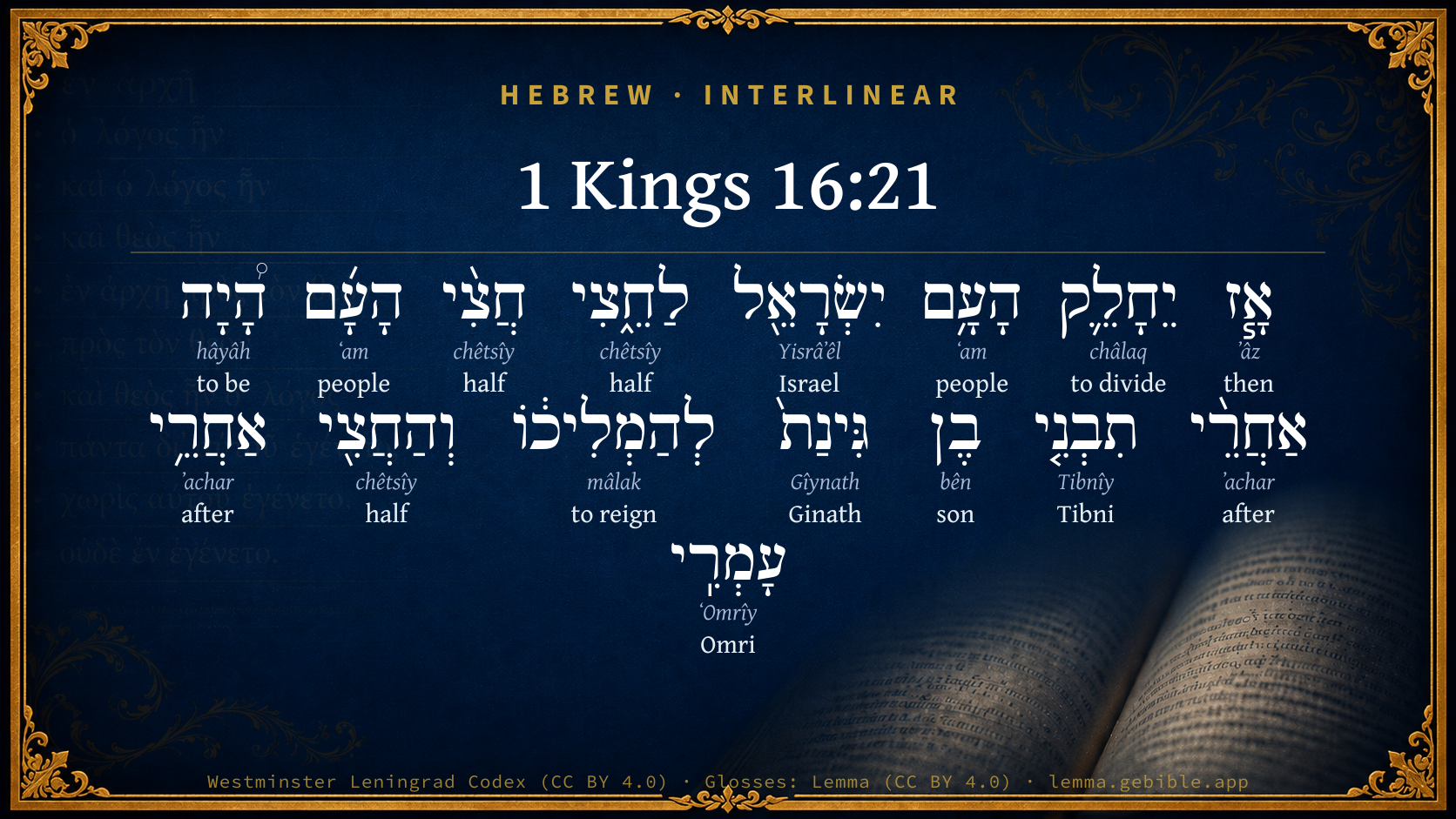
Hebrew (Westminster Leningrad Codex) 1 Kings 16:21 appears in the Hebrew Old Testament. The text above is from the Westminster Leningrad Codex. Each word links to its Strong’s number, a concise gloss, and parsing drawn from the Open Scriptures Hebrew Bible morphology. Click any word for its full Brown-Driver-Briggs (BDB) entry.
Download image
Cite this verse

1 Kings 16:21 (World English Bible). Public Domain. Lemma interlinear Bible study tool, https://lemma.gebible.app/v/1-kings/16/21.

Show BibTeX & RIS
BibTeX
RIS
English Translation
Then were the people of Israel divided into two parts: half of the people followed Tibni the son of Ginath, to make him king; and half followed Omri.
World English Bible · Public Domain
Highlights
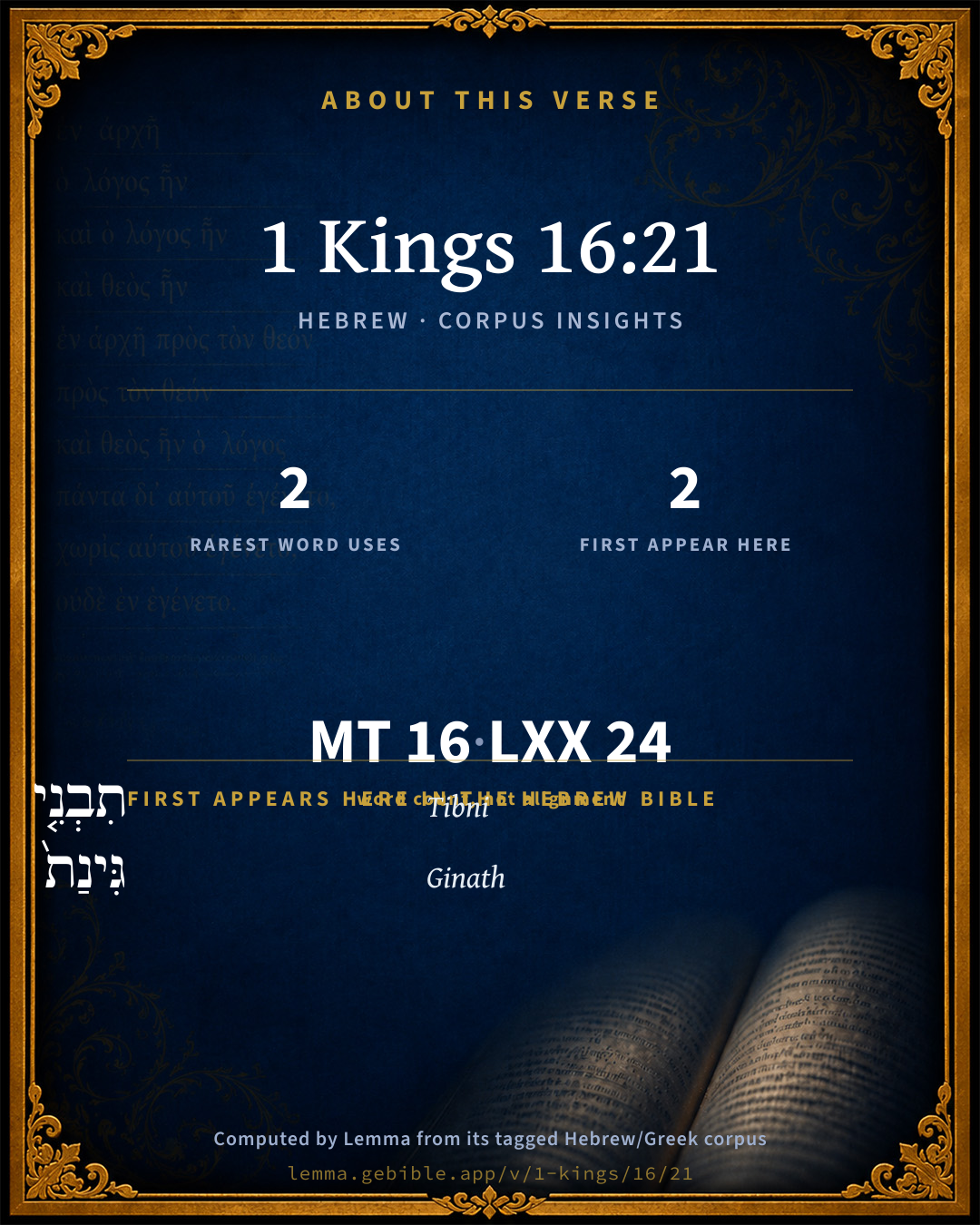
  • 2 first appearances in the Hebrew Bible
Full analysis ↓
Download a study sheet

One document with this verse’s original text, its word-by-word gloss line, the meaning frame, cross-references with their text, attributed commentary, and full source and license credits — printable, and it pastes into notes with its structure intact.

This verse Autodidact and up

Study sheet (.html) Plain text (.txt)

A passage Seminary Student

Up to 50 verses in one chapter. A passage sheet keeps up to 6 commentary sources and 12 cross-references per verse, in the order this page ranks them, and says so on the sheet whenever that leaves anything out. Ask for a single verse and you get the Autodidact verse sheet above.

Everything on this page stays free to read, with no account — the sheet is a download of what is already on screen, not access to it.

Want to remove ads? Support Godless Engineer
Compare translations 3

The same verse in 3 English versions, stacked beneath the original-language interlinear above. Click any original word for its lexicon entry.

Each is an independent rendering of the whole verse — the interlinear is not word-aligned to these translations.

Highlighted words mark where these versions differ — a whole-verse word diff, not a word-by-word alignment.

  • World English Bible Public Domain
    Then were the people of Israel divided into two parts: half of the people followed Tibni the son of Ginath, to make him king; and half followed Omri.
  • King James Version Public Domain
    Then were the people of Israel divided into two parts: half of the people followed Tibni the son of Ginath, to make him king; and half followed Omri.
  • unfoldingWord Literal Text CC BY-SA 4.0
    Then the people of Israel were divided in half. Half of the people were behind Tibni, the son of Ginath, to make him reign, and half behind Omri.

unfoldingWord Literal Text — © unfoldingWord, licensed CC BY-SA 4.0. Word-aligned USFM3 via Door43 (git.door43.org/unfoldingWord/en_ult).

Versions to compare (up to 4)

3 of 4 selected

Show all 18 translations

Every available English version of this verse, each an independent rendering of the whole verse.

  • World English Bible Public Domain
    Then were the people of Israel divided into two parts: half of the people followed Tibni the son of Ginath, to make him king; and half followed Omri.
  • Berean Standard Bible Public Domain
    At that time the people of Israel were divided: Half of the people supported Tibni son of Ginath as king, and half supported Omri.
  • Majority Standard Bible Public Domain
    At that time the people of Israel were divided: Half of the people supported Tibni son of Ginath as king, and half supported Omri.
  • King James Version Public Domain
    Then were the people of Israel divided into two parts: half of the people followed Tibni the son of Ginath, to make him king; and half followed Omri.
  • American Standard Version (1901) Public Domain
    Then were the people of Israel divided into two parts: half of the people followed Tibni the son of Ginath, to make him king; and half followed Omri.
  • Revised Version (1885) Public Domain
    Then were the people of Israel divided into two parts: half of the people followed Tibni the son of Ginath, to make him king; and half followed Omri.
  • Geneva Bible (1599) Public Domain
    Then were the people of Israel deuided into two partes: for halfe the people followed Tibni the sonne of Ginath to make him King, and the other halfe followed Omri.
  • Douay-Rheims (1899) Public Domain
    Then were the people of Israel divided into two parts: one half of the people followed Thebni the son of Gineth, to make him king: and one half followed Amri.
  • Young's Literal Translation Public Domain
    Then are the sons of Israel parted into halves; half of the people hath been after Tibni son of Ginath to cause him to reign, and the half after Omri;
  • Literal Standard Version CC BY-SA 4.0
    Then the sons of Israel are parted into halves; half of the people have been after Tibni son of Ginath to cause him to reign, and the [other] half after Omri;
  • Unlocked Literal Bible CC BY-SA 4.0
    Then the people of Israel were divided into two parts. Half of the people followed Tibni son of Ginath, to make him king, and half followed Omri.
  • unfoldingWord Literal Text CC BY-SA 4.0
    Then the people of Israel were divided in half. Half of the people were behind Tibni, the son of Ginath, to make him reign, and half behind Omri.
  • Darby Bible Public Domain
    Then were the people of Israel divided into two parts: half of the people followed Tibni the son of Ginath, to make him king; and half followed Omri.
  • World Messianic Bible Public Domain
    Then the people of Israel were divided into two parts: half of the people followed Tibni the son of Ginath, to make him king, and half followed Omri.
  • Webster's Bible Public Domain
    Then were the people of Israel divided into two parts: half of the people followed Tibni the son of Ginath, to make him king; and half followed Omri.
  • Free Bible Version CC BY-SA 4.0
    After this the people of Israel were divided. Half supported Tibni, son of Ginath, as king, while the other half supported Omri.
  • Bible in Basic English Public Domain
    Then there was a division among the people of Israel; half the people were for making Tibni, son of Ginath, king, and half were supporting Omri.
  • JPS Tanakh (1917) Public Domain
    Then were the people of Israel divided into two parts: half of the people followed Tibni the son of Ginath, to make him king; and half followed Omri.

Literal Standard Version (2020), Covenant Press — licensed CC BY-SA 4.0. Text via the HelloAO Bible API (eBible.org). Unlocked Literal Bible (unfoldingWord) — licensed CC BY-SA 4.0. Text via the HelloAO Bible API (eBible.org). unfoldingWord Literal Text — © unfoldingWord, licensed CC BY-SA 4.0. Word-aligned USFM3 via Door43 (git.door43.org/unfoldingWord/en_ult). Free Bible Version, Dr. Jonathan Gallagher — licensed CC BY-SA 4.0. Text via the HelloAO Bible API (eBible.org).

Word by word

More ways to search: Search by grammar → Find every occurrence → Compare this word →

Practice this passage: Drill this verse → Learn its vocabulary →

גִּינַת֙
Gîynath
H1527
“Ginath”
Noun, Proper
Part of Speech
Noun
Type
Proper
Full BDB Definition

Origin: of uncertain derivation

TWOT: None

Ginath = "protection" - father of Tibni
  1. אָ֧ז ʼâz H227 “then” Adverb
  2. יֵחָלֵ֛ק châlaq H2505 “to divide” Verb, Niphal, Imperfect, 3rd Person, Masculine, Singular
  3. הָעָ֥ם ʻam H5971 “the · people” Particle, Definite Article + Noun, Common, Masculine, Singular, Absolute
  4. יִשְׂרָאֵ֖ל Yisrâʼêl H3478 “Israel” Noun, Proper
  5. לַחֵ֑צִי chêtsîy H2677 “to/for the · half” Preposition, Determined + Noun, Common, Masculine, Singular, Absolute
  6. חֲצִ֨י chêtsîy H2677 “half of” Noun, Common, Masculine, Singular, Construct
  7. הָעָ֜ם ʻam H5971 “the · people” Particle, Definite Article + Noun, Common, Masculine, Singular, Absolute
  8. הָ֠יָה hâyâh H1961 “to be” Verb, Qal, Perfect, 3rd Person, Masculine, Singular
  9. אַחֲרֵ֨י ʼachar H310 “after” Preposition
  10. תִבְנִ֤י Tibnîy H8402 “Tibni” Noun, Proper
  11. בֶן bên H1121 “son of” Noun, Common, Masculine, Singular, Construct
  12. לְהַמְלִיכ֔וֹ mâlak H4427 “to reign · him” Preposition + Verb, Hiphil, Infinitive Construct + Suffix, Personal, 3rd Person, Masculine, Singular
  13. וְהַחֲצִ֖י chêtsîy H2677 “and · the · half” Conjunction + Particle, Definite Article + Noun, Common, Masculine, Singular, Absolute
  14. אַחֲרֵ֥י ʼachar H310 “after” Preposition
  15. עָמְרִֽי ʻOmrîy H6018 “Omri” Noun, Proper

About this verse

These counts appear in no published source. They are computed here, from the morphology-tagged text and Lemma’s own curated glosses. What Lemma adds →

16
words
12
distinct lemmas
Historical
section

Notable vocabulary

The rarest word here is גִּינַת֙ Ginath H1527 — appearing just 2 times in the whole Hebrew Bible.

First appearance in Scripture

These words make their first canonical appearance in the Hebrew Bible here:

  • תִבְנִ֤י Tibni H8402
  • גִּינַת֙ Ginath H1527

Shared distinctive vocabulary

גִּינַת֙ Ginath H1527 occurs in 2 verses of the Hebrew Bible. Also found in:

Grammatical profile

  • 3 verbs
  • 10 nouns
  • 2 prepositions
  • 1 adverb

Verb forms

  • יֵחָלֵ֛ק Niphal · Imperfect
  • הָ֠יָה Qal · Perfect
  • לְהַמְלִיכ֔וֹ Hiphil · Infinitive Construct

Repetition

Words recur within this verse — often emphatic in Hebrew:

  • לַחֵ֑צִי half H2677 ×3
  • הָעָ֥ם people H5971 ×2
  • אַחֲרֵ֨י after H310 ×2

Hebrew & Septuagint length

In English translation the verse runs 28 words from the Hebrew and 27 from the Septuagint (LXX English) — closely comparable.

A rough comparison of the two English renderings, which tokenize alike — not a word-level alignment.

Word counts can differ between the Hebrew and the Greek without any difference in meaning — e.g. the Hebrew direct-object marker אֵת has no separate Greek word, and Greek often adds the article ὁ.

In the original languages it is 16 Hebrew tokens and 24 Greek tokens — but the two are counted differently (Hebrew bundles its prefixes and suffixes into one token; the Greek is in lemma form), so that isn’t a like-for-like length.

Cross-references

10

Topical passages linked to 1 Kings 16:21 in the Treasury of Scripture Knowledge — connected by theme and wording, ordered by reader-vote popularity; previews shown in the World English Bible.

  • 1 Kings 15:25 Nadab the son of Jeroboam began to reign over Israel in the second year of Asa king of Judah; and he reigned over Israel two years.
  • 1 Kings 15:28 Even in the third year of Asa king of Judah did Baasha kill him, and reigned in his place.
  • 1 Kings 16:8 In the twenty-sixth year of Asa king of Judah began Elah the son of Baasha to reign over Israel in Tirzah, [and reigned] two years.
  • 1 Kings 16:29 In the thirty-eighth year of Asa king of Judah began Ahab the son of Omri to reign over Israel: and Ahab the son of Omri reigned over Israel in Samaria twenty-two years.
  • Proverbs 28:2 In rebellion, a land has many rulers, But order is maintained by a man of understanding and knowledge.
  • Isaiah 9:18–21 For wickedness burns as the fire; it devours the briers and thorns; yes, it kindles in the thickets of the forest, and they roll upward in a column of smoke.
  • Isaiah 19:2 I will stir up the Egyptians against the Egyptians: and they shall fight everyone against his brother, and everyone against his neighbor; city against city, [and] kingdom against kingdom.
  • Matthew 12:25 Knowing their thoughts, Jesus said to them, "Every kingdom divided against itself is brought to desolation, and every city or house divided against itself will not stand.
  • 1 Corinthians 1:12–13 Now I mean this, that each one of you says, "I follow Paul," "I follow Apollos," "I follow Cephas," and, "I follow Christ."
  • Ephesians 4:3–5 being eager to keep the unity of the Spirit in the bond of peace.

Cross-references courtesy of OpenBible.info (CC BY 4.0).

Hebrew and Greek witnesses Masoretic Hebrew ↔ Greek Septuagint

The same verse in the two great witnesses to the Old Testament, shown verse-for-verse.

These are two independent witnesses, not word-aligned to each other, and the Septuagint is shown in lemma (dictionary) form.

Hebrew 1 Kings 16:21 Masoretic · Westminster Leningrad Codex

אָ֧ז יֵחָלֵ֛ק הָעָ֥ם יִשְׂרָאֵ֖ל לַחֵ֑צִי חֲצִ֨י הָעָ֜ם הָ֠יָה אַחֲרֵ֨י תִבְנִ֤י בֶן גִּינַת֙ לְהַמְלִיכ֔וֹ וְהַחֲצִ֖י אַחֲרֵ֥י עָמְרִֽי

Then were the people of Israel divided into two parts: half of the people followed Tibni the son of Ginath, to make him king; and half followed Omri.

World English Bible · Public Domain

Greek LXX 1 Kings 16:21 Septuagint · lemma form

τότε μερίζω ὁ λαός ἰσραήλ ἥμισυς ὁ λαός γίγνομαι ὀπίσω θαμνι υἱός γωναθ ὁ βασιλεύω αὐτός καί ὁ ἥμισυς ὁ λαός γίγνομαι ὀπίσω αμβρι

Then the people of Israel divides; half the people goes after Thamni the son of Gonath to make him king; and half the people goes after Ambri.

LXX2012 (modern English Septuagint) · Public Domain

On this verse, Whedon's Commentary on the Bible discusses the Septuagint’s reading. Read the note in Commentary ↓

Hebrew: Westminster Leningrad Codex (CC BY 4.0). Greek: Septuagint (public domain); English from LXX2012 (modern English Septuagint) (Public Domain). How the Septuagint differs from the Hebrew →

Targum (Aramaic paraphrase)

1

The Targum is the ancient Jewish Aramaic paraphrase of the Hebrew Scriptures — an interpretive translation, not the Hebrew text itself. Onkelos (literal) and Pseudo-Jonathan (expansive) render the Torah, and Jonathan the Prophets. Coverage is partial: where no permissively-licensed English translation exists for a verse, only the Aramaic is shown. This is verse-level text, not a word-by-word alignment to the Hebrew.

  1. Targum Jonathan Prophets (Joshua–Malachi)
    בְּכֵן אִתְפְּלַג עַמָא יִשְׂרָאֵל לְתַרְתֵּי פַּלְגְוָן פַלְגוּת עַמָא הֲוָה בָּתַר תִּבְנִי בַר גִינַת לְאַמְלְכָיוּתֵיהּ וּפַלְגוּת בָּתַר עָמְרִי:

    (no public-domain English translation for this verse)

    Targum Jonathan — Aramaic: “Mikraot Gedolot” (public domain). English: “Sefaria Community Translation” (CC0 1.0 (public-domain dedication)); “London "Chaldee Paraphrase," 1871” (public domain). Text via Sefaria.

Commentary

Notes on 1 Kings 16:21 from classic Christian and Jewish commentators (each source and its license shown beneath its notes). The classic Christian expositions comment on the surrounding passage and are grouped to its opening verse, so a note may address several verses; the Jewish commentaries on the Tanakh (Rashi and others) are per-verse, so they appear only where the commentator wrote on this verse.

Lemma curates 59 commentaries, every one of them public domain or Creative Commons licensed, each selected and text-cleaned for this edition rather than reprinted as found. About our sources →

Trapp's Complete Commentary

John Trapp

1Ki 16:21 Then were the people of Israel divided into two parts: half of the people followed Tibni the son of Ginath, to make him king; and half followed Omri.

Ver. 21. Half of the people followed Tibni, &c.] Both Tibni and Omri should have refused these offered honours: considering what had befallen the kings that had gone before them. Macro, captain of the guard, and Laco, knight of the watch, men that had been active in ruinating Sejanus, had great honours appointed them by the Senate. They refused them: and Dion attributeth the reason of their refusal to the terror of an example so fresh in their memories. {a}

{a} Dion, in Tiberio.

John Trapp, A Commentary or Exposition upon All the Books of the Old and New Testament (1647–1656) — public domain. Text from a community e-Sword module.

Joseph Benson's Commentary

1Ki 16:21. Then were the people of Israel divided into two parts — Which contended, and went to war with each other about the person that should reign over them. For when it is said, (1Ki 16:16,) all Israel made Omri king, the meaning is, only the whole army, and such as attended them. Half of the people followed Tibni — These, it is probable, did not like to have a king imposed upon them by the soldiery: and Tibni had as good a title as the other, being also a valiant man, and the person, perhaps, who succeeded Zimri, in his command, as captain of half the king’s chariots. The contest between him and Omri lasted some years, and, it is likely, cost much blood on both sides. But neither this civil war, nor any other of God’s dreadful judgments, could bring them to repentance, which is an evidence of their prodigious impiety and incorrigibleness, and how ripe they were for ruin.

Joseph Benson's Commentary on the Old and New Testaments (1811–1818) — public domain. Text from a community e-Sword module.

Whedon's Commentary on the Bible

Daniel D. Whedon

INTERREGNUM OF FOUR YEARS, 1Ki_16:21-22.

In these two verses we have the spectacle of the northern kingdom existing for some four years in a state of civil war, with two contending chieftains struggling to gain the vacant throne. Bitterly do the seceding tribes reap the fruits of evil sowing; for not only are they given over to idolatry, but from this record appear half swallowed up in anarchy.

21. Tibni the son of Ginath — He was probably set up by the people of Tirzah, which was besieged by Omri. There was a class of people that did not wish a king set up and maintained by a military despotism. According to the Septuagint, Tibni was assisted by his brother Joram, and both died at that time.

Daniel D. Whedon (gen. ed.), Commentary on the Old and New Testaments (1874–1909) — public domain. Text from a community e-Sword module.

Keil & Delitzsch

C. F. Keil & F. Delitzsch

But Omri did not come into possession of an undisputed sovereignty immediately upon the death of Zimri. The nation divided itself into two halves; one half was behind Tibni, the son of Ginath (i.e., declared in favour of Tibni), to make him king, the other adhered to Omri. Nevertheless Omri's gained the upper hand over the party of Tibni, and the latter died, whereupon Omri became king after four years, as we may see from a comparison of Kg1 16:15, Kg1 16:16 with Kg1 16:23. The "people of Israel" (Kg1 16:21) are probably the fighting people, so that the succession to the throne was decided by the military. אהרי היה as in Sa2 2:10. הזק, with an accusative instead of with על, in the sense of to overpower, as in Jer 20:7. According to Josephus (Ant. viii. 12, 5), Tibni was slain by his opponent; but this is not contained in the words; on the contrary, all that is implied in the connection of ויּמת with וגו ויּחזק וגו/ is that he met with his death in the decisive engagement in which the opposing party triumphed.

Keil & Delitzsch — Biblical Commentary on the Old Testament (1861–1891) — public domain (CC PDM 1.0). Text via the HelloAO Bible API. (Old Testament only.)

Tyndale Open Study Notes

Tyndale Open Resources

16:21-22 Tibni is mentioned only here, and Ginath is unknown. According to the Greek Old Testament, Tibni received help in his failed bid for power from his brother Joram, and both were killed in the confrontation with Omri.

Tyndale Open Study Notes — © Tyndale Open Resources, licensed CC BY-SA 4.0. Text via the HelloAO Bible API.

Geneva Bible (1599)

Geneva Bible translators

That is, the people which were not at the siege of Gibbethon: for there they had chosen Omri.

Geneva Bible (1599) marginal notes — public domain. Text via Bolls.life.

Jamieson, Fausset & Brown

Robert Jamieson, A. R. Fausset & David Brown

Then were the people of Israel divided into two parts--The factions that ensued occasioned a four years' duration (compare Kg1 16:15 with Kg1 16:23), of anarchy or civil war. Whatever might be the public opinion of Omri's merits a large body of the people disapproved of the mode of his election, and declared for Tibni. The army, however, as usual in such circumstances (and they had the will of Providence favoring them), prevailed over all opposition, and Omri became undisputed possessor of the throne.

Jamieson, Fausset & Brown — Commentary Critical and Explanatory on the Whole Bible (1871) — public domain (CC PDM 1.0). Text via the HelloAO Bible API.

Adam Clarke's Commentary

Verse 21. Divided into two parts] Why this division took place we cannot tell; the people appear to have been for Tibni, the army for Omri; and the latter prevailed.

Adam Clarke's Commentary on the Bible (1810–1826) — public domain. Text from a community e-Sword/MySword module.

Ellicott's Commentary for English Readers

(21) Tibni.—Of him we know nothing. No doubt he also was a military chief—possibly Zimri’s colleague, under the supreme command of Omri—and the LXX. speaks of a brother, Joram, who fought and fell with him. There is an ominous significance in the terse description of the alternatives of fortune in this internecine struggle, “so Tibni died, and Omri reigned.” By comparison of 1Ki_16:23 with 1Ki_16:15, it appears that the struggle had lasted four years.

A Bible Commentary for English Readers, edited by Charles John Ellicott (1878–1897) — public domain. Text from a community e-Sword module.

The Cambridge Bible for Schools and Colleges

gen. ed. J. J. S. Perowne

21–28. Two parties in Israel. Omri’s followers prevail. Reign of Omri, and the building of Samaria (Not in Chronicles)

21. divided into two parts] Probably it was the civil population, which at first followed Zimri, and after his death, Tibni, while the military strength declared for their commander-in-chief Omri.

half of the people followed Tibni the son of Ginath] Of Tibni we have no information but what is to be gathered from this passage. Comparing the date of Omri’s accession in 1Ki_16:23, viz. the 31st year of Asa, with that of Zimri’s death in the 27th year of the same king (see 1Ki_16:15) we find that the struggle between the two parties was continued for four years.

The Cambridge Bible for Schools and Colleges (gen. ed. J. J. S. Perowne; Cambridge University Press, 1878–1918) — public domain. Text from a community e-Sword module.

John Gill's Exposition

For he walked in the way of Jeroboam the son of Nebat, in his sin wherewith he made Israel to sin,.... Worshipping the calves;

to provoke the Lord God of Israel to anger with their vanities; these, and whatsoever idols else were worshipped by him, see Kg1 16:13.

John Gill's Exposition of the Whole Bible (1746–1763) — public domain (CC PDM 1.0). Text via the HelloAO Bible API.

Haydock's Catholic Bible Commentary

Parts. Those who had chosen Amri, were mortified at the election made by the army, and therefore set up another king. (Calmet) --- The contest seems to have lasted four years. (Houbigant)

George Leo Haydock (1774–1849), Haydock's Catholic Family Bible and Commentary, 1859 edition — public domain. Excludes Psalms (Douay-Rheims chapter numbering differs from Protestant) and Deuterocanonical books (Catholic canon only).

Matthew Poole's English Annotations

The people of Israel fell into a civil war; yet neither this nor any other of God’s dreadful judgments could win them to repentance; which is an evidence of their prodigious impiety and incorrigibleness, and how ripe they were for ruin.

Half of the people followed Tibni, disdaining that the soldiers should usurp such a power over the whole kingdom.

Half followed Omri, because they approved the person, though not the manner of his election.

Matthew Poole's English Annotations on the Holy Bible (1683–1685) — public domain. Text from a community e-Sword/MySword module.

The Pulpit Commentary

The Interregnum.

Then were the people of Israel divided into two parts: halt of the people followed lit., was after. Same expression 2Sa_2:10; (cf. 1Ki_1:7) Tibni the son of Ginath Who he was, or why he was set up in opposition to Omri, it is impossible to say. It has been supposed that the army was divided in its preferences, and that part of the soldiery wished to make Tibni king, and this is perhaps the most probable conjecture. It is to be considered that the entire army was not encamped before Gibbethon. Nor are vers. 16, 17 fatal to this view, as Bahr maintains, because "all Israel" there clearly means all the army under the command of Omri. It is hardly likely that Tibni was set up by the people of Tirzah, after the death of Zimri, to continue the struggle. The only thing that is certain is that,the hereditary principle being overthrown, the crown appeared to be the legitimate prize of the strongest; and Tibni, who may have occupied a position of importance, or have had, somehow, a considerable following, resolved that Omri should not wear it without a fierce contest, to make him king Omri had been already made king, i.e. , anointed, ver. 16; and half renewed Omri.

HOMILIES BY J. URQUHART Vers. 21-34.

Change without improvement.

I OMRI"S INDEBTEDNESS TO DIVINE GOODNESS.

1. His success against Zimri (vers. 15-25). The traitor fell before him almost without a struggle.

2. Against Tibni. Israel was equally divided, yet his life was preserved and the kingdom given to him. Men pass up to place and means and influence through a pathway which, if it is only looked back upon and considered, is full of power to touch the heart and bow it under the will of God. I) o we read the story of our past, and let it touch us with the tale of God"s marvellous mercy?

II HIS SIN.

1. His hardness of heart. Not only was he blind to God"s mercy. He passed up unawed through the midst of the terriblest judgments and the most marked fulfilment of God"s threatenings. Neither the goodness nor the severity of God was allowed to touch him.

2. He did worse than all that were before him." He was a man of energy and worldly wisdom. Both were bent to strengthen his power. He went further than Jeroboam, who seduced Israel, for he seems to have compelled them (see the mention of Omri"s statutes, (Mic_6:16) to sacrifice before the calves. Great talents, if joined to a selfish, hardened heart, only carry men further away from God.

III HIS SIN"S FRUIT (vers. 29-34).

1. In his son"s character and reign.

(1) "He did evil in the sight of the Lord above all that were before him.

(2) It was possible only to an Ahab to set Jezebel the great enemy of God and His people upon the throne of Israel

(3) It was not enough to worship the calves of Bethel and Daniel He must turn wholly away from the God of Israel and worship Baal.

2. In the people"s contempt of Jehovah. Hiel"s act was done in the face of Israel, yet it was not forbidden; its commission awakened no fear. The man was left childless, yet judgments so harrowing and fulfilments of prophecy so marked had no effect upon his own soul. The legislation that blots out God"s ordinances delivers a people over to darkness and judgment. J.U.

The Pulpit Commentary (1880–1919), ed. H.D.M. Spence-Jones & Joseph S. Exell — public domain. Text from a community e-Sword module.

John Wesley's Explanatory Notes

Were divided - Fell into a civil war: yet neither this, nor any other of God's dreadful judgments could win them to repentance.

John Wesley, Explanatory Notes Upon the Whole Bible (1754–1765) — public domain. Text via the GEBible commentary corpus.

unfoldingWord translationNotes

Door43 World Missions Community

followed Tibni ... followed Omri

Here "followed" represents supporting or wanting to make him king. AT: "supported Tibni son of Ginath, to make him king, and half supported Omri" or "wanted to make Tibni son of Ginath king, and half wanted to make Omri king" (See: Metaphor)

were stronger than the people who followed Tibni

"overpowered the people who followed Tibni"

translationWords

people group

kingdom of Israel

unfoldingWord translationNotes — © Distant Shores Media and the Door43 World Missions Community, licensed CC BY-SA 4.0. Source: git.door43.org/Door43/en_tn.

Lesson kit

Teaching starters — assembled from the data on this page, not authored interpretation. Every prompt links to the verse data it draws on. Edit before teaching.

1 Kings, in the Historical, opens this verse with 16 words (12 distinct Hebrew lemmas). Its most distinctive word is Gîynath (“Ginath”). A historical commentator’s framing appears above. Read the whole chapter for the surrounding context.

Discussion questions

  1. How does “Ginath” (Gîynath) shape what this verse is saying?
  2. 2 words make their first appearance in Scripture here. What does this debut establish?
  3. How does 1 Kings 16:22, which shares the word «Ginath», read alongside this verse?
  4. What does the repetition of “half” (3× in this one verse) do in this verse?
  5. These translations render this verse differently; the difference is in the English rendering, not the original. What questions does that raise?
  6. «יֵחָלֵ֛ק» is a Niphal Imperfect verb. How does that grammatical form shape the action described?
  7. Compare how Trapp's Complete Commentary and Joseph Benson's Commentary read this verse. Where do they agree or differ?

Things to notice

Reading settings

Reading text

Shown beneath each verse's original-language words.

Old Testament
Old Testament edition

Read the OT as the Masoretic Hebrew (MT) or the Greek Septuagint (LXX).

English shown for the Greek Septuagint (in the Hebrew ↔ Greek comparison).

Comparing translations? Open the Compare panel on any verse page to stack up to four side by side.