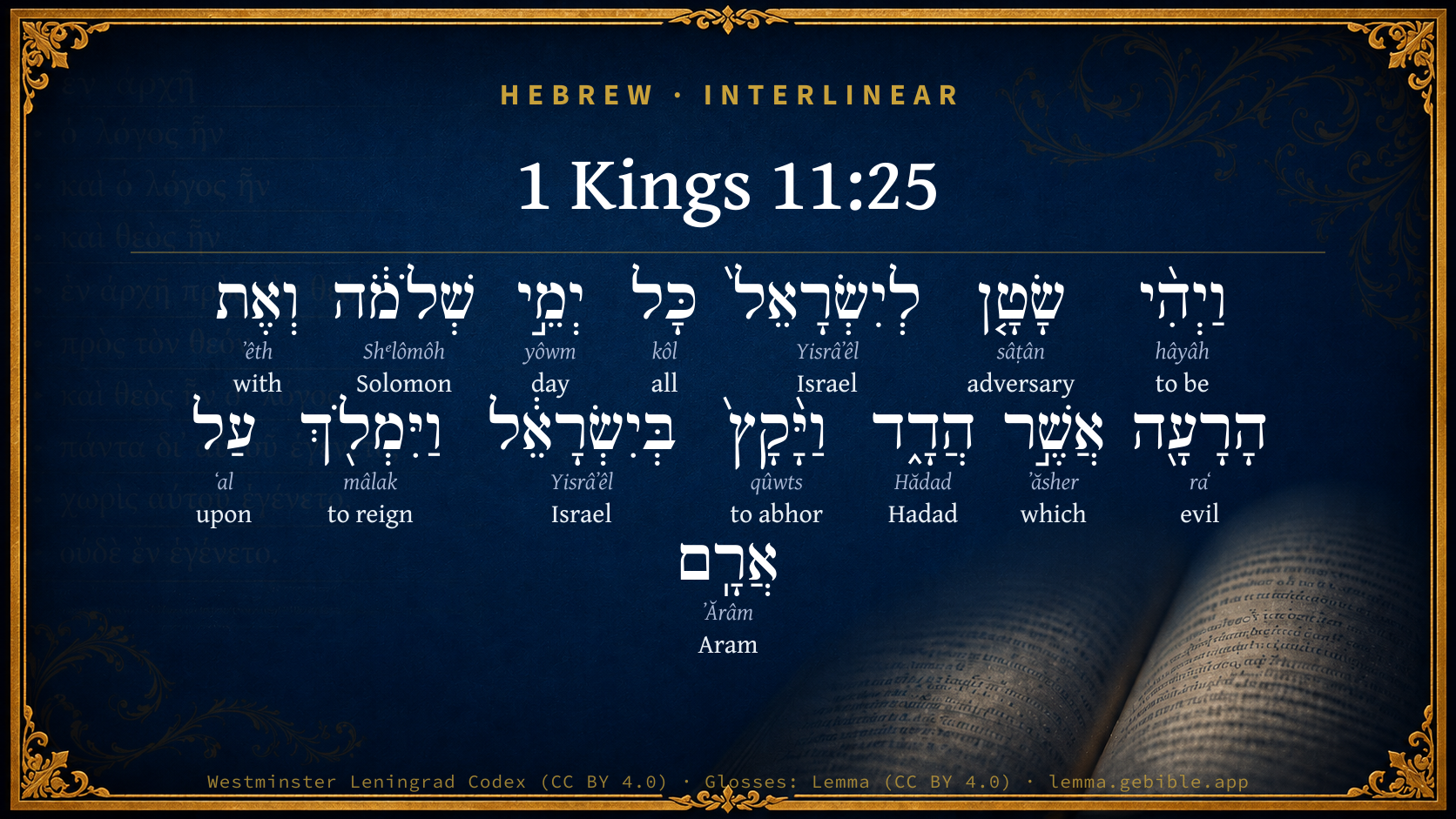
1 Kings 11:25

Hebrew (Westminster Leningrad Codex) 1 Kings 11:25 appears in the Hebrew Old Testament. The text above is from the Westminster Leningrad Codex. Each word links to its Strong’s number, a concise gloss, and parsing drawn from the Open Scriptures Hebrew Bible morphology. Click any word for its full Brown-Driver-Briggs (BDB) entry.
Download image
Cite this verse

1 Kings 11:25 (World English Bible). Public Domain. Lemma interlinear Bible study tool, https://lemma.gebible.app/v/1-kings/11/25.

Show BibTeX & RIS
BibTeX
RIS
English Translation
He was an adversary to Israel all the days of Solomon, besides the mischief that Hadad [did]: and he abhorred Israel, and reigned over Syria.
World English Bible · Public Domain
Download a study sheet

One document with this verse’s original text, its word-by-word gloss line, the meaning frame, cross-references with their text, attributed commentary, and full source and license credits — printable, and it pastes into notes with its structure intact.

This verse Autodidact and up

Study sheet (.html) Plain text (.txt)

A passage Seminary Student

Up to 50 verses in one chapter. A passage sheet keeps up to 6 commentary sources and 12 cross-references per verse, in the order this page ranks them, and says so on the sheet whenever that leaves anything out. Ask for a single verse and you get the Autodidact verse sheet above.

Everything on this page stays free to read, with no account — the sheet is a download of what is already on screen, not access to it.

Want to remove ads? Support Godless Engineer
Compare translations 3

The same verse in 3 English versions, stacked beneath the original-language interlinear above. Click any original word for its lexicon entry.

Each is an independent rendering of the whole verse — the interlinear is not word-aligned to these translations.

Highlighted words mark where these versions differ — a whole-verse word diff, not a word-by-word alignment.

  • World English Bible Public Domain
    He was an adversary to Israel all the days of Solomon, besides the mischief that Hadad [did]: and he abhorred Israel, and reigned over Syria.
  • King James Version Public Domain
    And he was an adversary to Israel all the days of Solomon, beside the mischief that Hadad did: and he abhorred Israel, and reigned over Syria.
  • unfoldingWord Literal Text CC BY-SA 4.0
    And he was an adversary against Israel all of the days of Solomon, and the harm that Hadad. And he loathed Israel, and he reigned over Aram.

unfoldingWord Literal Text — © unfoldingWord, licensed CC BY-SA 4.0. Word-aligned USFM3 via Door43 (git.door43.org/unfoldingWord/en_ult).

Versions to compare (up to 4)

3 of 4 selected

Show all 18 translations

Every available English version of this verse, each an independent rendering of the whole verse.

  • World English Bible Public Domain
    He was an adversary to Israel all the days of Solomon, besides the mischief that Hadad [did]: and he abhorred Israel, and reigned over Syria.
  • Berean Standard Bible Public Domain
    Rezon was Israel’s enemy throughout the days of Solomon, adding to the trouble caused by Hadad. So Rezon ruled over Aram with hostility toward Israel.
  • Majority Standard Bible Public Domain
    Rezon was Israel’s enemy throughout the days of Solomon, adding to the trouble caused by Hadad. So Rezon ruled over Aram with hostility toward Israel.
  • King James Version Public Domain
    And he was an adversary to Israel all the days of Solomon, beside the mischief that Hadad did: and he abhorred Israel, and reigned over Syria.
  • American Standard Version (1901) Public Domain
    And he was an adversary to Israel all the days of Solomon, besides the mischief that Hadad `did': and he abhorred Israel, and reigned over Syria.
  • Revised Version (1885) Public Domain
    And he was an adversary to Israel all the days of Solomon, beside the mischief that Hadad did: and he abhorred Israel, and reigned over Syria.
  • Geneva Bible (1599) Public Domain
    Therefore was he an aduersarie to Israel all the daies of Salomon: besides the euil that Hadad did, he also abhorred Israel, and reigned ouer Aram
  • Douay-Rheims (1899) Public Domain
    And he was an adversary to Israel, all the days of Solomon: and this is the evil of Adad, and his hatred against Israel, and he reigned in Syria.
  • Young's Literal Translation Public Domain
    and he is an adversary to Israel all the days of Solomon, (besides the evil that Hadad `did'), and he cutteth off in Israel, and reigneth over Aram.
  • Literal Standard Version CC BY-SA 4.0
    and he is an adversary against Israel all the days of Solomon (besides the evil that Hadad [did]), and he cuts off in Israel, and reigns over Aram.
  • Unlocked Literal Bible CC BY-SA 4.0
    He was an enemy of Israel all the days of Solomon, along with the trouble that Hadad caused. Rezon abhorred Israel and reigned over Aram.
  • unfoldingWord Literal Text CC BY-SA 4.0
    And he was an adversary against Israel all of the days of Solomon, and the harm that Hadad. And he loathed Israel, and he reigned over Aram.
  • Darby Bible Public Domain
    And he was an adversary to Israel all the days of Solomon, besides the mischief that Hadad [did]; and he abhorred Israel, and reigned over Syria.
  • World Messianic Bible Public Domain
    He was an adversary to Israel all the days of Solomon, in addition to the mischief of Hadad. He abhorred Israel, and reigned over Syria.
  • Webster's Bible Public Domain
    And he was an adversary to Israel all the days of Solomon, besides the mischief that Hadad did: and he abhorred Israel, and reigned over Syria.
  • Free Bible Version CC BY-SA 4.0
    Rezon was Israel's enemy throughout Solomon's lifetime which added to the trouble Hadad caused. Rezon really hated Israel, and was the ruler of Aram.
  • Bible in Basic English Public Domain
    He was a trouble to Israel all through the days of Solomon. And this is the damage Hadad did: he was cruel to Israel while he was ruler over Edom.
  • JPS Tanakh (1917) Public Domain
    And he was an adversary to Israel all the days of Solomon, beside the mischief that Hadad did; and he abhorred Israel, and reigned over Aram.

Literal Standard Version (2020), Covenant Press — licensed CC BY-SA 4.0. Text via the HelloAO Bible API (eBible.org). Unlocked Literal Bible (unfoldingWord) — licensed CC BY-SA 4.0. Text via the HelloAO Bible API (eBible.org). unfoldingWord Literal Text — © unfoldingWord, licensed CC BY-SA 4.0. Word-aligned USFM3 via Door43 (git.door43.org/unfoldingWord/en_ult). Free Bible Version, Dr. Jonathan Gallagher — licensed CC BY-SA 4.0. Text via the HelloAO Bible API (eBible.org).

Word by word

More ways to search: Search by grammar → Find every occurrence → Compare this word →

Practice this passage: Drill this verse → Learn its vocabulary →

וַיָּ֨קָץ֙
qûwts
H6973
“and · to abhor”
Conjunction + Verb, Qal, Sequential Imperfect, 3rd Person, Masculine, Singular
Part of Speech
Conjunction + Verb
Stem
Qal
Form
Sequential Imperfect
Person
3rd Person
Gender
Masculine
Number
Singular
Full BDB Definition

Origin: a primitive root [identical with H6972 through the idea of severing oneself from (compare H6962 )]

TWOT: 2002

to be grieved, loathe, abhor, feel a loathing or abhorrence or sickening dread - (Qal) - to feel a loathing at, abhor - to feel a sickening dread - (Hiphil) - to cause sickening dread - to cause loathing
  1. וַיְהִ֨י hâyâh H1961 “and · to be” Conjunction + Verb, Qal, Sequential Imperfect, 3rd Person, Masculine, Singular
  2. שָׂטָ֤ן sâṭân H7854 “adversary” Noun, Common, Masculine, Singular, Absolute
  3. לְיִשְׂרָאֵל֙ Yisrâʼêl H3478 “to/for · Israel” Preposition + Noun, Proper
  4. כָּל kôl H3605 “all of” Noun, Common, Masculine, Singular, Construct
  5. יְמֵ֣י yôwm H3117 “days of” Noun, Common, Masculine, Plural, Construct
  6. שְׁלֹמֹ֔ה Shᵉlômôh H8010 “Solomon” Noun, Proper
  7. וְאֶת ʼêth H854 “and · with” Conjunction + Preposition
  8. הָרָעָ֖ה raʻ H7451 “the · evil” Particle, Definite Article + Noun, Common, Feminine, Singular, Absolute
  9. אֲשֶׁ֣ר ʼăsher H834 “which” Particle, Relative
  10. הֲדָ֑ד Hădad H1908 “Hadad” Noun, Proper
  11. בְּיִשְׂרָאֵ֔ל Yisrâʼêl H3478 “in/at · Israel” Preposition + Noun, Proper
  12. וַיִּמְלֹ֖ךְ mâlak H4427 “and · to reign” Conjunction + Verb, Qal, Sequential Imperfect, 3rd Person, Masculine, Singular
  13. עַל ʻal H5921 “upon” Preposition
  14. אֲרָֽם ʼĂrâm H758 “Aram” Noun, Proper

About this verse

These counts appear in no published source. They are computed here, from the morphology-tagged text and Lemma’s own curated glosses. What Lemma adds →

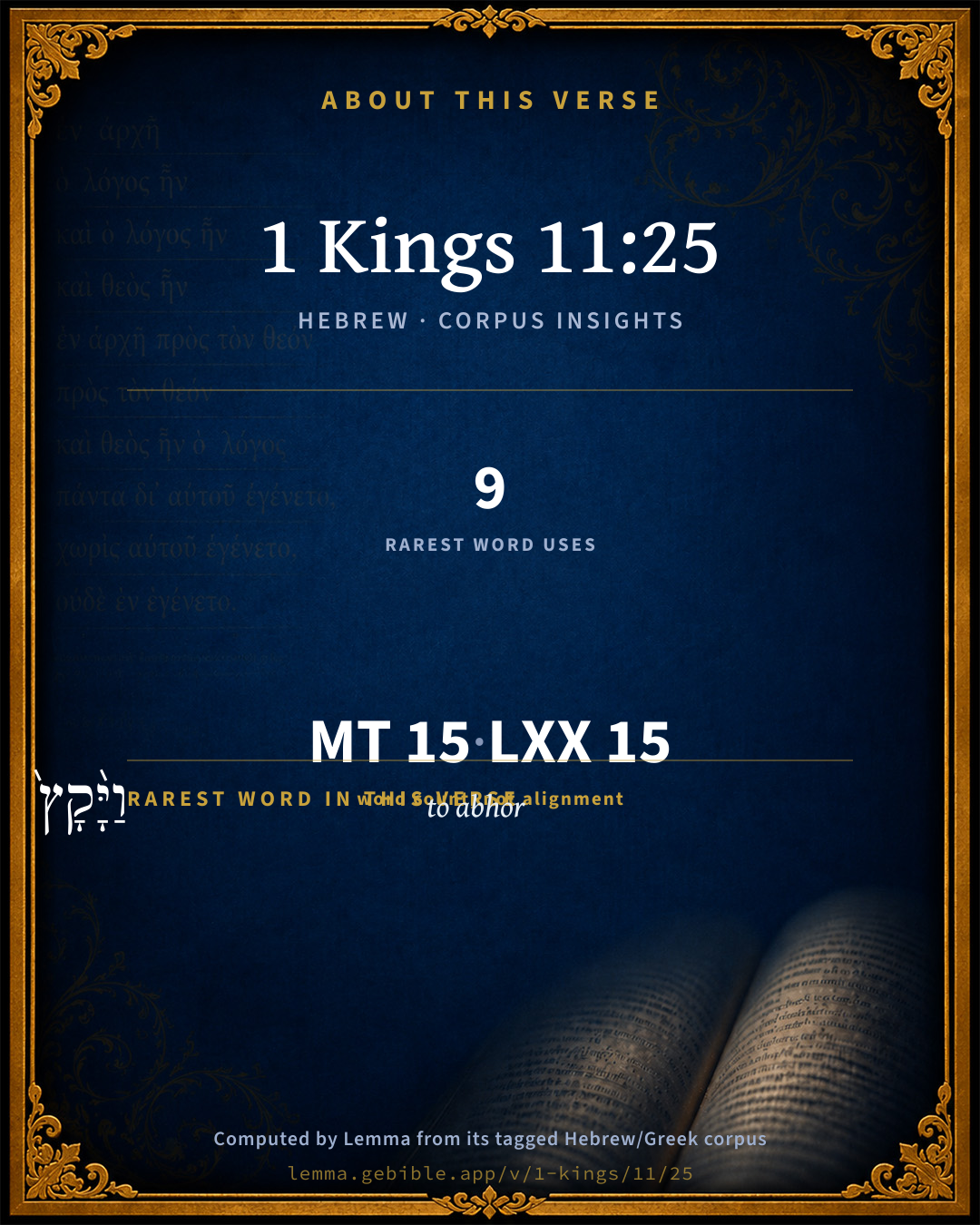
15
words
14
distinct lemmas
Historical
section

Notable vocabulary

The rarest word here is וַיָּ֨קָץ֙ to abhor H6973 — appearing just 9 times in the whole Hebrew Bible.

Shared distinctive vocabulary

וַיָּ֨קָץ֙ to abhor H6973 occurs in 9 verses of the Hebrew Bible. Also found in:

Grammatical profile

  • 3 verbs
  • 9 nouns
  • 2 prepositions
  • 1 particle

Verb forms

  • וַיְהִ֨י Qal · Sequential Imperfect
  • וַיָּ֨קָץ֙ Qal · Sequential Imperfect
  • וַיִּמְלֹ֖ךְ Qal · Sequential Imperfect

Repetition

A word recurs within this verse — often emphatic in Hebrew:

  • לְיִשְׂרָאֵל֙ Israel H3478 ×2

Hebrew & Septuagint length

In the original languages it is 15 Hebrew tokens and 15 Greek tokens — but the two are counted differently (Hebrew bundles its prefixes and suffixes into one token; the Greek is in lemma form), so that isn’t a like-for-like length.

Cross-references

7

Topical passages linked to 1 Kings 11:25 in the Treasury of Scripture Knowledge — connected by theme and wording, ordered by reader-vote popularity; previews shown in the World English Bible.

  • Genesis 34:30 Jacob said to Simeon and Levi, "You have troubled me, to make me odious to the inhabitants of the land, among the Canaanites and the Perizzites. I am few in number. They will gather themselves together against me and strike me, and I will be destroyed, I and my house."
  • Deuteronomy 23:7 You shall not abhor an Edomite; for he is your brother: you shall not abhor an Egyptian, because you lived as a foreigner in his land.
  • 2 Samuel 16:21 Ahithophel said to Absalom, Go in to your father's concubines, that he has left to keep the house; and all Israel will hear that you are abhorred of your father: then will the hands of all who are with you be strong.
  • 1 Kings 5:4 But now Yahweh my God has given me rest on every side; there is neither adversary, nor evil occurrence.
  • 2 Chronicles 15:2 and he went out to meet Asa, and said to him, Hear you me, Asa, and all Judah and Benjamin: Yahweh is with you, while you are with him; and if you seek him, he will be found of you; but if you forsake him, he will forsake you.
  • Psalms 106:40 Therefore Yahweh burned with anger against his people. He abhorred his inheritance.
  • Zechariah 11:8 I cut off the three shepherds in one month; for my soul was weary of them, and their soul also loathed me.

Cross-references courtesy of OpenBible.info (CC BY 4.0).

Hebrew and Greek witnesses Masoretic Hebrew ↔ Greek Septuagint

The same verse in the two great witnesses to the Old Testament, shown verse-for-verse.

These are two independent witnesses, not word-aligned to each other, and the Septuagint is shown in lemma (dictionary) form.

Hebrew 1 Kings 11:25 Masoretic · Westminster Leningrad Codex

וַיְהִ֨י שָׂטָ֤ן לְיִשְׂרָאֵל֙ כָּל יְמֵ֣י שְׁלֹמֹ֔ה וְאֶת הָרָעָ֖ה אֲשֶׁ֣ר הֲדָ֑ד וַיָּ֨קָץ֙ בְּיִשְׂרָאֵ֔ל וַיִּמְלֹ֖ךְ עַל אֲרָֽם

He was an adversary to Israel all the days of Solomon, besides the mischief that Hadad [did]: and he abhorred Israel, and reigned over Syria.

World English Bible · Public Domain

Greek LXX 1 Kings 11:25 Septuagint · lemma form

οὗτος ὁ κακία ὅς ποιέω αδερ καί βαρυθυμέω ἐν ἰσραήλ καί βασιλεύω ἐν γῆ εδωμ

No English rendering of this Greek verse — the small residue in the structurally divergent books.

On this verse, Ellicott's Commentary for English Readers discusses the Septuagint’s reading. Read the note in Commentary ↓

Hebrew: Westminster Leningrad Codex (CC BY 4.0). Greek: Septuagint (public domain); English from a public-domain English Septuagint. How the Septuagint differs from the Hebrew →

Targum (Aramaic paraphrase)

1

The Targum is the ancient Jewish Aramaic paraphrase of the Hebrew Scriptures — an interpretive translation, not the Hebrew text itself. Onkelos (literal) and Pseudo-Jonathan (expansive) render the Torah, and Jonathan the Prophets. Coverage is partial: where no permissively-licensed English translation exists for a verse, only the Aramaic is shown. This is verse-level text, not a word-by-word alignment to the Hebrew.

  1. Targum Jonathan Prophets (Joshua–Malachi)
    וַהֲוָה סָטָן לְיִשְׂרָאֵל כָּל יוֹמֵי שְׁלֹמֹה וְיַת בִּישְׁתָא דַעֲבַד הֲדָד וּמְרִיד בְּיִשְׂרָאֵל וּמְלַךְ עַל אֲרָם:

    (no public-domain English translation for this verse)

    Targum Jonathan — Aramaic: “Mikraot Gedolot” (public domain). English: “Sefaria Community Translation” (CC0 1.0 (public-domain dedication)); “London "Chaldee Paraphrase," 1871” (public domain). Text via Sefaria.

Commentary

Notes on 1 Kings 11:25 from classic Christian and Jewish commentators (each source and its license shown beneath its notes). The classic Christian expositions comment on the surrounding passage and are grouped to its opening verse, so a note may address several verses; the Jewish commentaries on the Tanakh (Rashi and others) are per-verse, so they appear only where the commentator wrote on this verse.

Lemma curates 59 commentaries, every one of them public domain or Creative Commons licensed, each selected and text-cleaned for this edition rather than reprinted as found. About our sources →

Trapp's Complete Commentary

John Trapp

1Ki 11:25 And he was an adversary to Israel all the days of Solomon, beside the mischief that Hadad [did]: and he abhorred Israel, and reigned over Syria.

Ver. 25. All the days of Solomon.] But stirred not much till he saw Solomon effeminate, infatuated and become contemptible. See Hos 13:1, {See Trapp on "Hos 13:1"} Beside the mischief that Hadad did, {1Ki 11:14} see the like in Isa 9:12-13, - "The Syrians before, and the Philistines behind, and both devouring Israel with open mouth: for all this God’s anger is not turned away, but his hand is stretched out still." And why all this? "For the people turneth not unto him that smiteth them, neither do they seek the Lord of hosts."

John Trapp, A Commentary or Exposition upon All the Books of the Old and New Testament (1647–1656) — public domain. Text from a community e-Sword module.

Joseph Benson's Commentary

1Ki 11:25. He was an adversary to Israel all the days of Solomon — This, perhaps, is not to be understood of the whole reign of Solomon, which for the most part was peaceable, but of all the days which remained of his life, from the time that his wives publicly exercised their idolatry, unto the day of his death. Or, it may mean, that he was a secret enemy all that time, and when Solomon had forsaken God, he showed himself openly. Besides the mischief that Hadad did — This infelicity was added to the former; while Hadad molested him in the south, Rezon threatened him in the north. But what hurt could Hadad or Rezon have done to so powerful a king as Solomon, if he had not by sin made himself mean and weak? If God be on our side, we need not fear the greatest adversary; but if he be against us, he can make us fear the least; yea, the grasshopper shall be a burden. And reigned over Syria — Over all that part of Syria, enlarging his empire the more, and thereby laying a foundation for much misery to Solomon’s kingdom.

Joseph Benson's Commentary on the Old and New Testaments (1811–1818) — public domain. Text from a community e-Sword module.

Ellicott's Commentary for English Readers

(25) Beside the mischief that Hadad did.—The expression, as it stands, is curiously abrupt in its recurrence to Hadad. But the text is doubtful. (See Note on 1Ki_11:21-22.) If the general reading of the LXX. be taken, the substitution of Edom for Syria (Aram) (it involves but slight change in the Hebrew) must be accepted; if the explanation of Josephus is correct, then the reading of the text must stand.

A Bible Commentary for English Readers, edited by Charles John Ellicott (1878–1897) — public domain. Text from a community e-Sword module.

The Cambridge Bible for Schools and Colleges

gen. ed. J. J. S. Perowne

25. all the days of Solomon] Probably Rezon was able to establish himself in Damascus even before the death of David. For some time he would be obliged to collect his strength to be ready for future attacks on Israel, but he may well have been a source of anxiety to Solomon from the first. Damascus was near enough, and a band of men such as those who supported Rezon would make a constant thorn for Solomon’s side, even though they attempted no regular warfare.

beside the mischief that Hadad did] This sentence can only be thus translated. There is a similar rendering of the like Hebrew ואת in 1Ki_11:1 ‘together with’ the daughter of Pharaoh (marg. R.V. ‘besides’). But it is very questionable whether this can be so rendered. The LXX. (Vat.) which omits 23, 24, and great part of the present verse renders as if, for ואת, they had read זאת = this. See the LXX. variations above, in note on 1Ki_11:22. These make the whole passage refer not to Rezon but to Hadad, and in consequence the word Syria, ארם, i.e. Aram, is changed into אדם, Edom, and it is certain that we do expect to hear more of the mischief which Hadad wrought. All we are told is that he got permission to come back to Edom. But we hear no word of any armament or invasion by him.

and he abhorred Israel] Though he had deserted Hadadezer this was no reason why he should side with the Israelitish invaders. They had driven him and his troop into the wilderness and no harm which he could work upon them would be left undone. This is just the sort of opponent who might worry Solomon for a long time without being deemed serious, but who might before the end of Solomon’s reign, in the period of that king’s unwise yielding to his wives, become really a dangerous adversary. With Hadad in the south and Rezon on the north, each growing daily stronger, the crippling of Solomon’s power was effectually begun.

The Cambridge Bible for Schools and Colleges (gen. ed. J. J. S. Perowne; Cambridge University Press, 1878–1918) — public domain. Text from a community e-Sword module.

John Gill's Exposition

And Jeroboam the son of Nebat,.... According to some Jewish writers (r), this was Sheba the son of Bichri; but, as Kimchi observes, he was of the tribe of Benjamin, this of Ephraim; and besides, his head was cut off, and thrown over the wall to Joab, Sa2 20:1,

an Ephrathite of Zereda; some where in the tribe of Ephraim, but nowhere else mentioned. There was a famous Jewish doctor, before the times of Christ, of this place, as it seems, who was called Jose ben Joezer, a man of Zereda (s):

Solomon's servant; not only his subject, but one that had been advanced by him to an office, and served under him, Kg1 11:28,

whose mother's name was Zeruah, a widow woman; who very probably was supported by this her son, an industrious and ingenious man:

even he lifted up his hand against the king; either against Solomon, by reproaching and reproving him for some things he did; or rather against Rehoboam his son, which was very ungrateful.

(r) Shalshalet Hakabala, p. 11. (s) Pirke Abot, c. 1. sect. 4.

John Gill's Exposition of the Whole Bible (1746–1763) — public domain (CC PDM 1.0). Text via the HelloAO Bible API.

Haydock's Catholic Bible Commentary

Solomon, after he once began. (Haydock) --- Adad. Hebrew, "and with the evil of Adad, and he detested Israel." (Menochius) --- Razon and Adad conspired to attack Solomon. (Haydock) --- Adad may be the common name of the kings of Damascus. Some copies of the Septuagint do not speak of Razon, but continue the history of Adad, ver. 14. They also read Edom here instead of Aram, or Syria, which would remove the confusion. (Calmet) --- Adad, Razon, and Jeroboam always oppugn Solomon after his fall; and signify the flesh, the world, and the devil. (Worthington)

George Leo Haydock (1774–1849), Haydock's Catholic Family Bible and Commentary, 1859 edition — public domain. Excludes Psalms (Douay-Rheims chapter numbering differs from Protestant) and Deuterocanonical books (Catholic canon only).

Matthew Poole's English Annotations

He was a secret enemy, watching all occasions to do them mischief cunningly and privately all that time; and when Solomon had forsaken God, and was forsaken by God, he showed himself more openly and maliciously.

Beside the mischief that Hadad did; so the sense is, this infelicity was added to the former concerning Hadad, mentioned above, 1Ki 11:14, &c. Whilst Hadad molested him in the south, Rezon threatened him in the north. But some understand this of Hadadezer, who is here called Hadad, by way of abbreviation, (which is not unusual in proper Hebrew names, as is well known,) and that for, or because of, (for the Hebrew particle eth is sometimes put for el, which oft signifies for, or because of, as Hebricians know,) the evil which befell Hadad, or Hadadezer, i.e. he bore a grudge against the Israelites from and ever since the slaughter that Joab made in Hadadezer’s army, whereof he was a member, although he also took that occasion of making a defection from his master.

Reigned over Syria; over all that part of Syria, enlarging his empire more and more, and thereby laying a foundation for much misery to Solomon’s house and kingdom.

Matthew Poole's English Annotations on the Holy Bible (1683–1685) — public domain. Text from a community e-Sword/MySword module.

Whedon's Commentary on the Bible

Daniel D. Whedon

25. All the days of Solomon — Whence it appears that he must have established himself at Damascus before, or soon after, the death of David. In what particular way he acted the part of an adversary does not appear, but perhaps it was, as Josephus states, by making occasional incursions into the land of Israel. His hostility was probably not of sufficient magnitude to cause Solomon, a man who loved peace, and was constitutionally averse to war, to raise an army or make any great effort to oppose him; but his neglect to pay tribute, and his hostile attitude toward Israel, would naturally trouble Solomon with constant apprehension of danger; and once, at least, he led or sent an expedition against Hamath-zobah, (see 2Ch_8:3,) perhaps to put down an insurrection started by this same Rezon.

Besides the mischief that Hadad — Here there seems to be something wanting in the Hebrew text. To say, he was an adversary besides the mischief, etc., is, to say the least, a strange manner of expression. The Septuagint, Vulgate, Syriac, and Arabic versions also vary from the Hebrew. The Septuagint, reading זאתinstead of ואת, has: This is the evil which Adar did. And this is probably the true reading, and may still be made out of the Hebrew text by a simple changing of the Masoretic punctuation, and substituting זfor ו. The meaning then will be, This same kind of mischief (incursions in the land of Israel like those of Rezon) wrought also Hadad. He, like Rezon, became captain of a band, and excited insurrections, and ravaged remote portions of Solomon’s empire.

He abhorred Israel, and reigned over Syria — If the correction above proposed be the true reading of the original Hebrew text, then these sentences should be understood of Hadad and not of Rezon. This would confirm the account of Hadad given by Josephus, (see note on 1Ki_11:22,) that failing to persuade the people of Edom to revolt from Solomon he joined himself to Rezon, and became, first, master of a company of men, and then ruler of a part of Syria. Instead of over Syria, the Septuagint, Syriac, and Arabic read over Edom.

Daniel D. Whedon (gen. ed.), Commentary on the Old and New Testaments (1874–1909) — public domain. Text from a community e-Sword module.

The Pulpit Commentary

And he was an adversary to Israel all the days of Solomon We are not compelled, however, to believe that his reign lasted "all the days of Solomon." This last expression is to be taken with considerable latitude. It is an Orientalism. At the time of, 1Ki_5:4, neither Hadad nor Rezon was giving Solomon any trouble beside the mischief which Hadad did Heb. omits did. The construction of the Hebrew (see Ewald, 277 d (2), 292 b, note) is difficult. Literally, and with the evil which Hadad," etc. (comp. ver. 1 of this chapter, "and with the daughter," etc., with Exo_1:14, Hebrews) The LXX reconstructs the text, making the following words, "and he abhorred," etc., apply to Hadad; and altering Syria ( into Eden ( to suit. But it is far better to understand h (with our Authorized Version); i.e., beside the mischief which Hadad did (or, "beside the mischief of Hadad," Ewald). "And he (Rezon) abhorred," etc. Hadad"s enmity has already been described (vers. 17-22), and the historian has passed on to the case of Rezon. It is extremely unlikely that he should now suddenly recur exclusively to Hadad. It is very natural for him, on the other hand, in his account of Rezon, to remind us that all this was in addition to the mischief wrought by Hadad: and he abhorred Heb. loathed Israel, and reigned over Syria.

The Pulpit Commentary (1880–1919), ed. H.D.M. Spence-Jones & Joseph S. Exell — public domain. Text from a community e-Sword module.

John Wesley's Explanatory Notes

All adversity - He was a secret enemy, all that time; and when Solomon had forsaken God, he shewed himself openly. Beside - This infelicity was added to the former; whilst Hadad molested him in the south, Rezon threatened him in the north. But what hurt could Hadad or Rezon have done, to so powerful a king as Solomon, if he had not by sin made himself mean and weak? If God be on our side, we need not fear the greatest adversary. But if he be against us, he can make us fear the least: yea, the grasshopper shall be a burden. Syria - Over all that part of Syria, enlarging his empire the more, and thereby laying a foundation for much misery to Solomon's kingdom.

John Wesley, Explanatory Notes Upon the Whole Bible (1754–1765) — public domain. Text via the GEBible commentary corpus.

Rashi

Rabbi Shlomo Yitzchaki (Rashi)

In conjunction with the evil of Hadad. Together with the evil that was perpetrated by Hadad, was also this evil of Rezon.

Rashi on the Tanakh — English translations: “The Judaica Press complete Tanach with Rashi, translated by A. J. Rosenberg” (CC BY 4.0); “Pentateuch with Rashi's commentary by M. Rosenbaum and A.M. Silbermann, 1929-1934” (public domain); “The Metsudah Tanach series, Lakewood, N.J” (CC BY 4.0); and “The Book of Joshua, Metsudah Publications, 1997” (CC BY 4.0). Text via Sefaria.

Lesson kit

Teaching starters — assembled from the data on this page, not authored interpretation. Every prompt links to the verse data it draws on. Edit before teaching.

1 Kings, in the Historical, opens this verse with 15 words (14 distinct Hebrew lemmas). Its most distinctive word is qûwts (“to abhor”). A historical commentator’s framing appears above. Read the whole chapter for the surrounding context.

Discussion questions

  1. What does “to abhor” (qûwts) contribute to the verse as a whole?
  2. Genesis 27:46 shares the word «to abhor» with this verse. How do the two illuminate each other?
  3. “Israel” occurs 2× in this one verse. What is the effect of the repetition?
  4. These translations render this verse differently. What is at stake in choosing one wording over another?
  5. The verb «וַיְהִ֨י» is Qal Sequential Imperfect. How does its form color the action?
  6. Reading how Trapp's Complete Commentary and Joseph Benson's Commentary read this verse, where do the two commentators agree and where do they part?

Things to notice

Reading settings

Reading text

Shown beneath each verse's original-language words.

Old Testament
Old Testament edition

Read the OT as the Masoretic Hebrew (MT) or the Greek Septuagint (LXX).

English shown for the Greek Septuagint (in the Hebrew ↔ Greek comparison).

Comparing translations? Open the Compare panel on any verse page to stack up to four side by side.