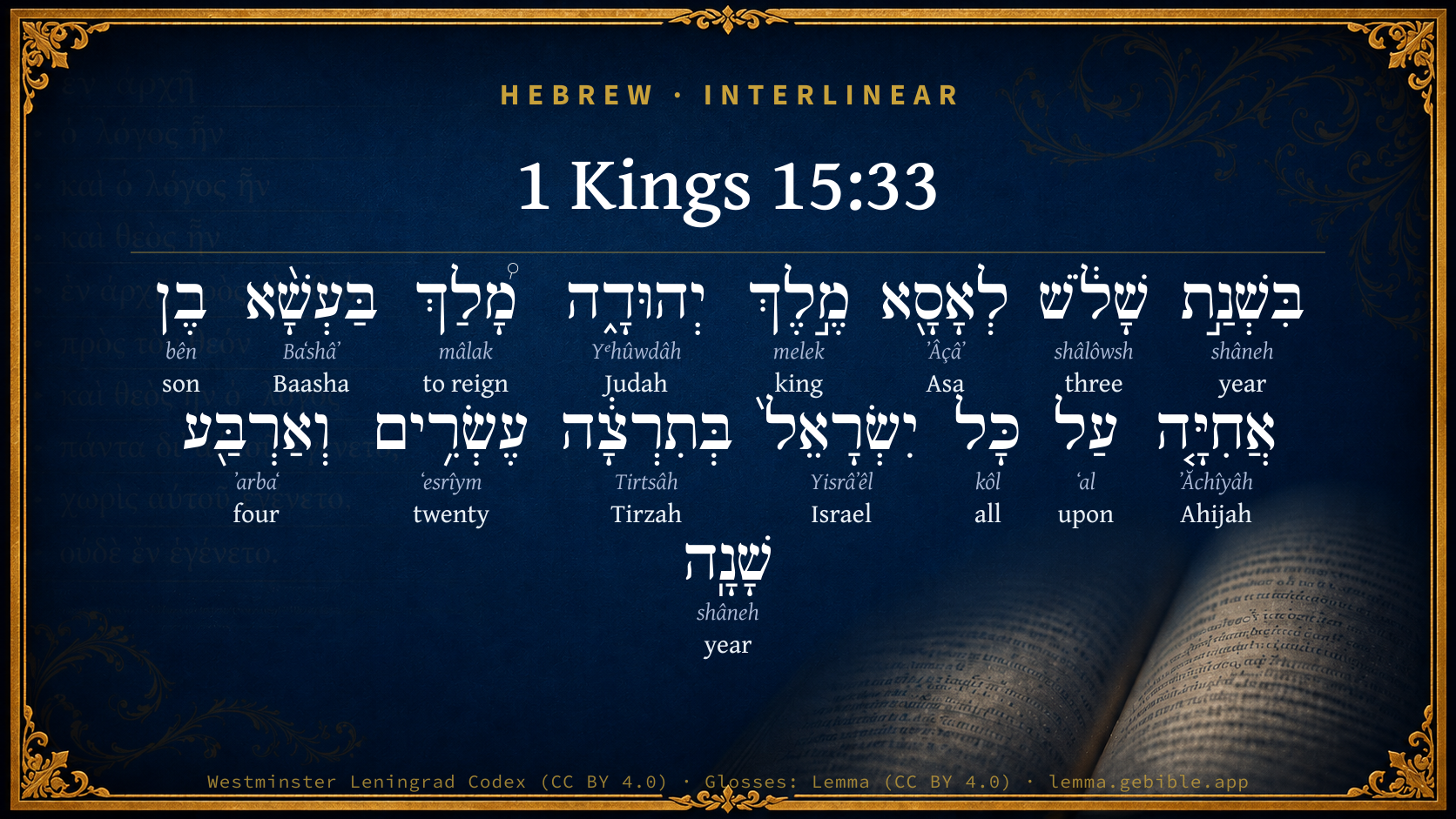
1 Kings 15:33

Hebrew (Westminster Leningrad Codex) 1 Kings 15:33 appears in the Hebrew Old Testament. The text above is from the Westminster Leningrad Codex. Each word links to its Strong’s number, a concise gloss, and parsing drawn from the Open Scriptures Hebrew Bible morphology. Click any word for its full Brown-Driver-Briggs (BDB) entry.
Download image
Cite this verse

1 Kings 15:33 (World English Bible). Public Domain. Lemma interlinear Bible study tool, https://lemma.gebible.app/v/1-kings/15/33.

Show BibTeX & RIS
BibTeX
RIS
English Translation
In the third year of Asa king of Judah began Baasha the son of Ahijah to reign over all Israel in Tirzah, [and reigned] twenty-four years.
World English Bible · Public Domain
Download a study sheet

One document with this verse’s original text, its word-by-word gloss line, the meaning frame, cross-references with their text, attributed commentary, and full source and license credits — printable, and it pastes into notes with its structure intact.

This verse Autodidact and up

Study sheet (.html) Plain text (.txt)

A passage Seminary Student

Up to 50 verses in one chapter. A passage sheet keeps up to 6 commentary sources and 12 cross-references per verse, in the order this page ranks them, and says so on the sheet whenever that leaves anything out. Ask for a single verse and you get the Autodidact verse sheet above.

Everything on this page stays free to read, with no account — the sheet is a download of what is already on screen, not access to it.

Want to remove ads? Support Godless Engineer
Compare translations 3

The same verse in 3 English versions, stacked beneath the original-language interlinear above. Click any original word for its lexicon entry.

Each is an independent rendering of the whole verse — the interlinear is not word-aligned to these translations.

Highlighted words mark where these versions differ — a whole-verse word diff, not a word-by-word alignment.

  • World English Bible Public Domain
    In the third year of Asa king of Judah began Baasha the son of Ahijah to reign over all Israel in Tirzah, [and reigned] twenty-four years.
  • King James Version Public Domain
    In the third year of Asa king of Judah began Baasha the son of Ahijah to reign over all Israel in Tirzah, twenty and four years.
  • unfoldingWord Literal Text CC BY-SA 4.0
    In year three of Asa the king of Judah, Baasha, the son of Ahijah, reigned over all of Israel in Tirzah 24 years.

unfoldingWord Literal Text — © unfoldingWord, licensed CC BY-SA 4.0. Word-aligned USFM3 via Door43 (git.door43.org/unfoldingWord/en_ult).

Versions to compare (up to 4)

3 of 4 selected

Show all 18 translations

Every available English version of this verse, each an independent rendering of the whole verse.

  • World English Bible Public Domain
    In the third year of Asa king of Judah began Baasha the son of Ahijah to reign over all Israel in Tirzah, [and reigned] twenty-four years.
  • Berean Standard Bible Public Domain
    In the third year of Asa’s reign over Judah, Baasha son of Ahijah became king of all Israel, and he reigned in Tirzah twenty-four years.
  • Majority Standard Bible Public Domain
    In the third year of Asa’s reign over Judah, Baasha son of Ahijah became king of all Israel, and he reigned in Tirzah twenty-four years.
  • King James Version Public Domain
    In the third year of Asa king of Judah began Baasha the son of Ahijah to reign over all Israel in Tirzah, twenty and four years.
  • American Standard Version (1901) Public Domain
    In the third year of Asa king of Judah began Baasha the son of Ahijah to reign over all Israel in Tirzah, `and reigned' twenty and four years.
  • Revised Version (1885) Public Domain
    In the third year of Asa king of Judah began Baasha the son of Ahijah to reign over all Israel in Tirzah, and reigned twenty and four years.
  • Geneva Bible (1599) Public Domain
    In the thirde yeere of Asa King of Iudah, began Baasha the sonne of Ahijah to reigne ouer all Israel in Tirzah, and reigned foure and twentie yeeres.
  • Douay-Rheims (1899) Public Domain
    In the third year of Asa king of Juda, Baasa the son of Ahias reigned over all Israel, in Thersa, four and twenty years.
  • Young's Literal Translation Public Domain
    In the third year of Asa king of Judah reigned hath Baasha son of Ahijah over all Israel in Tirzah, twenty and four years,
  • Literal Standard Version CC BY-SA 4.0
    In the third year of Asa king of Judah, Baasha son of Ahijah has reigned over all Israel in Tirzah, twenty-four years,
  • Unlocked Literal Bible CC BY-SA 4.0
    In the third year of Asa king of Judah, Baasha son of Ahijah began to reign over all Israel in Tirzah and he reigned twenty-four years.
  • unfoldingWord Literal Text CC BY-SA 4.0
    In year three of Asa the king of Judah, Baasha, the son of Ahijah, reigned over all of Israel in Tirzah 24 years.
  • Darby Bible Public Domain
    In the third year of Asa king of Judah began Baasha the son of Ahijah to reign over all Israel in Tirzah, for twenty-four years.
  • World Messianic Bible Public Domain
    In the third year of Asa king of Judah, Baasha the son of Ahijah began to reign over all Israel in Tirzah for twenty-four years.
  • Webster's Bible Public Domain
    In the third year of Asa king of Judah began Baasha the son of Ahijah to reign over all Israel in Tirzah, twenty and four years.
  • Free Bible Version CC BY-SA 4.0
    Baasha, son of Ahijah, became king over all of Israel in the third year of the reign of King Asa in Judah. Baasha reigned in Tirzah for twenty-four years.
  • Bible in Basic English Public Domain
    In the third year of the rule of Asa, king of Judah, Baasha, the son of Ahijah, became king over all Israel in Tirzah, and was king for twenty-four years.
  • JPS Tanakh (1917) Public Domain
    In the third year of Asa king of Judah began Baasa the son of Ahijah to reign over all Israel in Tirzah, and reigned twenty and four years.

Literal Standard Version (2020), Covenant Press — licensed CC BY-SA 4.0. Text via the HelloAO Bible API (eBible.org). Unlocked Literal Bible (unfoldingWord) — licensed CC BY-SA 4.0. Text via the HelloAO Bible API (eBible.org). unfoldingWord Literal Text — © unfoldingWord, licensed CC BY-SA 4.0. Word-aligned USFM3 via Door43 (git.door43.org/unfoldingWord/en_ult). Free Bible Version, Dr. Jonathan Gallagher — licensed CC BY-SA 4.0. Text via the HelloAO Bible API (eBible.org).

Word by word

More ways to search: Search by grammar → Find every occurrence → Compare this word →

Practice this passage: Drill this verse → Learn its vocabulary →

בְּתִרְצָ֔ה
Tirtsâh
H8656
“in/at · Tirzah”
Preposition + Noun, Proper
Part of Speech
Preposition + Noun
Type
Proper
Full BDB Definition

Origin: from H7521

TWOT: None

Tirzah = "favourable" - one of the 7 daughters of Zelophehad the son of Hepher of the tribe of Manasseh (noun proper feminine) - one of the kingdoms on the west of the Jordan conquered by Joshua and the Israelites (noun proper locative) - a Canaanite city, later capital of the northern kingdom of Israel (noun proper locative)
  1. בִּשְׁנַ֣ת shâneh H8141 “in/at · year of” Preposition + Noun, Common, Feminine, Singular, Construct
  2. שָׁלֹ֔שׁ shâlôwsh H7969 “three” Adjective, Cardinal number, Feminine, Singular, Absolute
  3. לְאָסָ֖א ʼÂçâʼ H609 “to/for · Asa” Preposition + Noun, Proper
  4. מֶ֣לֶךְ melek H4428 “king of” Noun, Common, Masculine, Singular, Construct
  5. יְהוּדָ֑ה Yᵉhûwdâh H3063 “Judah” Noun, Proper
  6. מָ֠לַךְ mâlak H4427 “to reign” Verb, Qal, Perfect, 3rd Person, Masculine, Singular
  7. בַּעְשָׁ֨א Baʻshâʼ H1201 “Baasha” Noun, Proper
  8. בֶן bên H1121 “son of” Noun, Common, Masculine, Singular, Construct
  9. אֲחִיָּ֤ה ʼĂchîyâh H281 “Ahijah” Noun, Proper
  10. עַל ʻal H5921 “upon” Preposition
  11. כָּל kôl H3605 “all of” Noun, Common, Masculine, Singular, Construct
  12. יִשְׂרָאֵל֙ Yisrâʼêl H3478 “Israel” Noun, Proper
  13. עֶשְׂרִ֥ים ʻesrîym H6242 “twenty” Adjective, Cardinal number, Both, Plural, Absolute
  14. וְאַרְבַּ֖ע ʼarbaʻ H702 “and · four” Conjunction + Adjective, Cardinal number, Feminine, Singular, Absolute
  15. שָׁנָֽה shâneh H8141 “year” Noun, Common, Feminine, Singular, Absolute

About this verse

These counts appear in no published source. They are computed here, from the morphology-tagged text and Lemma’s own curated glosses. What Lemma adds →

16
words
15
distinct lemmas
Historical
section

Notable vocabulary

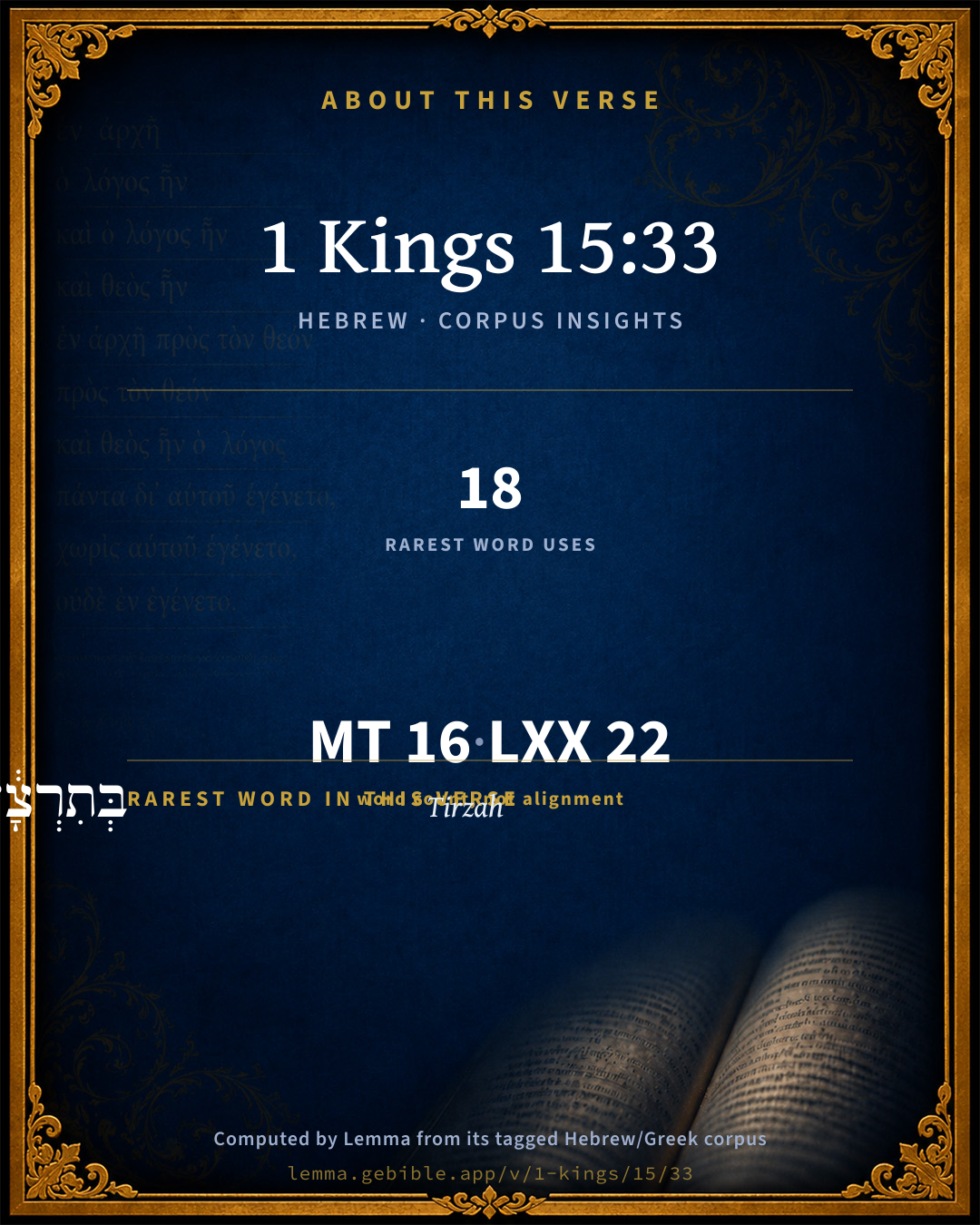
The rarest word here is בְּתִרְצָ֔ה Tirzah H8656 — appearing just 18 times in the whole Hebrew Bible.

Shared distinctive vocabulary

בְּתִרְצָ֔ה Tirzah H8656 occurs in 17 verses of the Hebrew Bible. Also found in:

Grammatical profile

  • 1 verb
  • 11 nouns
  • 3 adjectives
  • 1 preposition

Verb forms

  • מָ֠לַךְ Qal · Perfect

Repetition

A word recurs within this verse — often emphatic in Hebrew:

  • בִּשְׁנַ֣ת year H8141 ×2

Hebrew & Septuagint length

In English translation the verse runs 26 words from the Hebrew and 26 from the Septuagint (LXX English) — the same length.

A rough comparison of the two English renderings, which tokenize alike — not a word-level alignment.

Word counts can differ between the Hebrew and the Greek without any difference in meaning — e.g. the Hebrew direct-object marker אֵת has no separate Greek word, and Greek often adds the article ὁ.

In the original languages it is 16 Hebrew tokens and 22 Greek tokens — but the two are counted differently (Hebrew bundles its prefixes and suffixes into one token; the Greek is in lemma form), so that isn’t a like-for-like length.

Cross-references

1

Topical passages linked to 1 Kings 15:33 in the Treasury of Scripture Knowledge — connected by theme and wording, ordered by reader-vote popularity; previews shown in the World English Bible.

  • 1 Kings 16:8 In the twenty-sixth year of Asa king of Judah began Elah the son of Baasha to reign over Israel in Tirzah, [and reigned] two years.

Cross-references courtesy of OpenBible.info (CC BY 4.0).

Hebrew and Greek witnesses Masoretic Hebrew ↔ Greek Septuagint

The same verse in the two great witnesses to the Old Testament, shown verse-for-verse.

These are two independent witnesses, not word-aligned to each other, and the Septuagint is shown in lemma (dictionary) form.

Hebrew 1 Kings 15:33 Masoretic · Westminster Leningrad Codex

בִּשְׁנַ֣ת שָׁלֹ֔שׁ לְאָסָ֖א מֶ֣לֶךְ יְהוּדָ֑ה מָ֠לַךְ בַּעְשָׁ֨א בֶן אֲחִיָּ֤ה עַל כָּל יִשְׂרָאֵל֙ בְּתִרְצָ֔ה עֶשְׂרִ֥ים וְאַרְבַּ֖ע שָׁנָֽה

In the third year of Asa king of Judah began Baasha the son of Ahijah to reign over all Israel in Tirzah, [and reigned] twenty-four years.

World English Bible · Public Domain

Greek LXX 1 Kings 15:33 Septuagint · lemma form

καί ἐν ὁ ἔτος ὁ τρίτος ὁ ασα βασιλεύς ιουδα βασιλεύω βαασα υἱός αχια ἐπί ἰσραήλ ἐν θερσα εἴκοσι καί τέσσαρες ἔτος

And in the third year of Asa king of Juda, Baasa the son of Achia begins to reign over Israel in Thersa, twenty and four years.

LXX2012 (modern English Septuagint) · Public Domain

Hebrew: Westminster Leningrad Codex (CC BY 4.0). Greek: Septuagint (public domain); English from LXX2012 (modern English Septuagint) (Public Domain). How the Septuagint differs from the Hebrew →

Targum (Aramaic paraphrase)

1

The Targum is the ancient Jewish Aramaic paraphrase of the Hebrew Scriptures — an interpretive translation, not the Hebrew text itself. Onkelos (literal) and Pseudo-Jonathan (expansive) render the Torah, and Jonathan the Prophets. Coverage is partial: where no permissively-licensed English translation exists for a verse, only the Aramaic is shown. This is verse-level text, not a word-by-word alignment to the Hebrew.

  1. Targum Jonathan Prophets (Joshua–Malachi)
    בִּשְׁנַת תְּלַת לְאָסָא מֶלֶךְ שִׁבְטָא דְבֵית יְהוּדָה מְלַךְ בַּעְשָׁא בַר אֲחִיָה עַל כָּל יִשְׂרָאֵל בְּתִרְצָה עַסְרִין וְאַרְבַּע שְׁנִין:

    (no public-domain English translation for this verse)

    Targum Jonathan — Aramaic: “Mikraot Gedolot” (public domain). English: “Sefaria Community Translation” (CC0 1.0 (public-domain dedication)); “London "Chaldee Paraphrase," 1871” (public domain). Text via Sefaria.

Commentary

Notes on 1 Kings 15:33 from classic Christian and Jewish commentators (each source and its license shown beneath its notes). The classic Christian expositions comment on the surrounding passage and are grouped to its opening verse, so a note may address several verses; the Jewish commentaries on the Tanakh (Rashi and others) are per-verse, so they appear only where the commentator wrote on this verse.

Lemma curates 59 commentaries, every one of them public domain or Creative Commons licensed, each selected and text-cleaned for this edition rather than reprinted as found. About our sources →

Trapp's Complete Commentary

John Trapp

1Ki 15:33 In the third year of Asa king of Judah began Baasha the son of Ahijah to reign over all Israel in Tirzah, twenty and four years.

Ver. 33. Over all Israel.] Who soon submitted to the usurper.

John Trapp, A Commentary or Exposition upon All the Books of the Old and New Testament (1647–1656) — public domain. Text from a community e-Sword module.

Geneva Bible (1599)

Geneva Bible translators

Which was the place where the kings of Israel remained.

Geneva Bible (1599) marginal notes — public domain. Text via Bolls.life.

The Cambridge Bible for Schools and Colleges

gen. ed. J. J. S. Perowne

33. in Tirzah, twenty and four years] To complete the sense the R.V. inserts in italics after ‘Tirzah’ the words ‘and reigned.’

Tirzah seems to have become by this time a more common royal residence than Shechem. Perhaps its extreme beauty attracted the kings and their families. Cf. Sol. Son_6:4, ‘Thou art beautiful as Tirzah’.

The Cambridge Bible for Schools and Colleges (gen. ed. J. J. S. Perowne; Cambridge University Press, 1878–1918) — public domain. Text from a community e-Sword module.

Whedon's Commentary on the Bible

Daniel D. Whedon

33. Twenty and four years — That is, he reigned twenty-four years.

Daniel D. Whedon (gen. ed.), Commentary on the Old and New Testaments (1874–1909) — public domain. Text from a community e-Sword module.

The Pulpit Commentary

In the third year of Asa king of Judah began Baasha the son of Ahijah to reign Practically a repetition of ver. 28. These iterations are thoroughly in accord with Eastern usage (cf. vers. 26, 30, 34; 1Ki_16:1, 1Ki_16:7, etc.) over all Israel in Tirzah, twenty and four years.

The Pulpit Commentary (1880–1919), ed. H.D.M. Spence-Jones & Joseph S. Exell — public domain. Text from a community e-Sword module.

Keil & Delitzsch

C. F. Keil & F. Delitzsch

The Reign of Baasha is described very briefly according to its duration (two years) and its spirit, namely, the attitude of Baasha towards the Lord (Kg1 15:34); there then follow in Kg1 16:1-4 the words of the prophet Jehu, the son of Hanani (Ch2 16:7), concerning the extermination of the family of Baasha; and lastly, in Kg1 16:5-7, his death is related with the standing allusion to the annals of the kings. The words of Jehu concerning Baasha (Kg1 16:1-4) coincide exactly mutatis mutandis with the words of Ahijah concerning Jeroboam.

(Note: "There was something very strange in the perversity and stolidity of the kings of Israel, that when they saw that the families of preceding kings were evidently overthrown by the command of God on account of the worship of the calves, and they themselves had overturned them, they nevertheless worshipped the same calves, and placed them before the people for them to worship, that they might not return to the temple and to Asa, king of Jerusalem; though prophets denounced it and threatened their destruction. Truly the devil and the ambition of reigning blinded them and deprived them of their senses. Hence it came to pass, through the just judgment of God, that they all were executioners of one another in turn: Baasha was the executioner of the sons of Jeroboam; Zambri was the executioner of the sons of Baasha; and the executioner of Zambri was Omri." - _C. a Lapide.)

The expression "exalted thee out of the dust," instead of "from among the people" (Kg1 14:7), leads to the conjecture that Baasha had risen to be king from a very low position. גּבוּרתו (his might) in Kg1 16:5 refers, as in the case of Asa (Kg1 15:23), less to brave warlike deeds, than generally to the manifestation of strength and energy in his government.

Keil & Delitzsch — Biblical Commentary on the Old Testament (1861–1891) — public domain (CC PDM 1.0). Text via the HelloAO Bible API. (Old Testament only.)

unfoldingWord translationNotes

Door43 World Missions Community

Connecting Statement

This chapter told about how Baasha became king in 1 Kings 15:27-28. These verses begin to tell about Baasha as king of Israel.

Tirzah

This is the name of a city. See how you translated it in 1 Kings 14:17.

what was evil in the sight of Yahweh

The sight of Yahweh represents Yahweh's judgment. AT: "what was evil in Yahweh's judgment" or "what Yahweh considers to be evil" (See: Metaphor)

walked in the way of Jeroboam

Walking here represents behaving. AT: "did the same things that Jeroboam had done" (See: Metaphor)

in his sin by which he led Israel to sin

Possible meanings are that "his" and "he" refer to 1) Baasha or 2) Jeroboam.

by which he led Israel to sin

Leading people to do something represents influencing them to do it. AT: "and by sinning, he influenced Israel to sin" (See: Metaphor)

translationWords

kingdom of Judah

Ahijah

reign

evil

Yahweh

unfoldingWord translationNotes — © Distant Shores Media and the Door43 World Missions Community, licensed CC BY-SA 4.0. Source: git.door43.org/Door43/en_tn.

Rashi

Rabbi Shlomo Yitzchaki (Rashi)

It was during the third year of Asa king of Yeudah, Bashah son of Achiyoh became king. The third year of Asa is counted for Nodov and Bashah.

Rashi on the Tanakh — English translations: “The Judaica Press complete Tanach with Rashi, translated by A. J. Rosenberg” (CC BY 4.0); “Pentateuch with Rashi's commentary by M. Rosenbaum and A.M. Silbermann, 1929-1934” (public domain); “The Metsudah Tanach series, Lakewood, N.J” (CC BY 4.0); and “The Book of Joshua, Metsudah Publications, 1997” (CC BY 4.0). Text via Sefaria.

Lesson kit

Teaching starters — assembled from the data on this page, not authored interpretation. Every prompt links to the verse data it draws on. Edit before teaching.

1 Kings, in the Historical, opens this verse with 16 words (15 distinct Hebrew lemmas). Its most distinctive word is Tirtsâh (“Tirzah”). A historical commentator’s framing appears above. Read the whole chapter for the surrounding context.

Discussion questions

  1. The word Tirtsâh carries the sense “Tirzah.” How does it shape the verse?
  2. How does Numbers 26:33, which shares the word «Tirzah», read alongside this verse?
  3. What does the repetition of “year” (2× in this one verse) do in this verse?
  4. The translations on this page render this verse differently — a whole-verse word diff, not a word-by-word alignment. What might account for the different wordings?
  5. «מָ֠לַךְ» is a Qal Perfect verb. How does that grammatical form shape the action described?
  6. Compare how Trapp's Complete Commentary and Geneva Bible (1599) read this verse. Where do they agree or differ?

Things to notice

Reading settings

Reading text

Shown beneath each verse's original-language words.

Old Testament
Old Testament edition

Read the OT as the Masoretic Hebrew (MT) or the Greek Septuagint (LXX).

English shown for the Greek Septuagint (in the Hebrew ↔ Greek comparison).

Comparing translations? Open the Compare panel on any verse page to stack up to four side by side.