
1 Kings 22:51

Hebrew (Westminster Leningrad Codex) 1 Kings 22:51 appears in the Hebrew Old Testament. The text above is from the Westminster Leningrad Codex. Each word links to its Strong’s number, a concise gloss, and parsing drawn from the Open Scriptures Hebrew Bible morphology. Click any word for its full Brown-Driver-Briggs (BDB) entry.
Download image
Cite this verse

1 Kings 22:51 (World English Bible). Public Domain. Lemma interlinear Bible study tool, https://lemma.gebible.app/v/1-kings/22/51.

Show BibTeX & RIS
BibTeX
RIS
English Translation
Ahaziah the son of Ahab began to reign over Israel in Samaria in the seventeenth year of Jehoshaphat king of Judah, and he reigned two years over Israel.
World English Bible · Public Domain
Download a study sheet

One document with this verse’s original text, its word-by-word gloss line, the meaning frame, cross-references with their text, attributed commentary, and full source and license credits — printable, and it pastes into notes with its structure intact.

This verse Autodidact and up

Study sheet (.html) Plain text (.txt)

A passage Seminary Student

Up to 50 verses in one chapter. A passage sheet keeps up to 6 commentary sources and 12 cross-references per verse, in the order this page ranks them, and says so on the sheet whenever that leaves anything out. Ask for a single verse and you get the Autodidact verse sheet above.

Everything on this page stays free to read, with no account — the sheet is a download of what is already on screen, not access to it.

Want to remove ads? Support Godless Engineer
Compare translations 3

The same verse in 3 English versions, stacked beneath the original-language interlinear above. Click any original word for its lexicon entry.

Each is an independent rendering of the whole verse — the interlinear is not word-aligned to these translations.

Highlighted words mark where these versions differ — a whole-verse word diff, not a word-by-word alignment.

  • World English Bible Public Domain
    Ahaziah the son of Ahab began to reign over Israel in Samaria in the seventeenth year of Jehoshaphat king of Judah, and he reigned two years over Israel.
  • King James Version Public Domain
    Ahaziah the son of Ahab began to reign over Israel in Samaria the seventeenth year of Jehoshaphat king of Judah, and reigned two years over Israel.
  • unfoldingWord Literal Text CC BY-SA 4.0
    Ahaziah, the son of Ahab, reigned over Israel in Samaria in year 17 of Jehoshaphat, the king of Judah. And he reigned over Israel two years.

unfoldingWord Literal Text — © unfoldingWord, licensed CC BY-SA 4.0. Word-aligned USFM3 via Door43 (git.door43.org/unfoldingWord/en_ult).

Versions to compare (up to 4)

3 of 4 selected

Show all 18 translations

Every available English version of this verse, each an independent rendering of the whole verse.

  • World English Bible Public Domain
    Ahaziah the son of Ahab began to reign over Israel in Samaria in the seventeenth year of Jehoshaphat king of Judah, and he reigned two years over Israel.
  • Berean Standard Bible Public Domain
    In the seventeenth year of Jehoshaphat’s reign over Judah, Ahaziah son of Ahab became king of Israel, and he reigned in Samaria two years.
  • Majority Standard Bible Public Domain
    In the seventeenth year of Jehoshaphat’s reign over Judah, Ahaziah son of Ahab became king of Israel, and he reigned in Samaria two years.
  • King James Version Public Domain
    Ahaziah the son of Ahab began to reign over Israel in Samaria the seventeenth year of Jehoshaphat king of Judah, and reigned two years over Israel.
  • American Standard Version (1901) Public Domain
    Ahaziah the son of Ahab began to reign over Israel in Samaria in the seventeenth year of Jehoshaphat king of Judah, and he reigned two years over Israel.
  • Revised Version (1885) Public Domain
    Ahaziah the son of Ahab began to reign over Israel in Samaria in the seventeenth year of Jehoshaphat king of Judah, and he reigned two years over Israel.
  • Geneva Bible (1599) Public Domain
    Ahaziah the sonne of Ahab began to reigne ouer Israel in Samaria, the seuenteenth yeere of Iehoshaphat King of Iudah, and reigned two yeeres ouer Israel.
  • Douay-Rheims (1899) Public Domain
    And Josaphat slept with his fathers. and was buried with them in the city of David his father: and Joram his son reigned in his stead.
  • Young's Literal Translation Public Domain
    Ahaziah son of Ahab hath reigned over Israel in Samaria in the seventeenth year of Jehoshaphat king of Judah, and reigneth over Israel two years,
  • Literal Standard Version CC BY-SA 4.0
    Ahaziah son of Ahab has reigned over Israel in Samaria in the seventeenth year of Jehoshaphat king of Judah, and reigns over Israel two years,
  • Unlocked Literal Bible CC BY-SA 4.0
    Ahaziah son of Ahab began to reign over Israel in Samaria in the seventeenth year of Jehoshaphat king of Judah, and he reigned two years over Israel.
  • unfoldingWord Literal Text CC BY-SA 4.0
    Ahaziah, the son of Ahab, reigned over Israel in Samaria in year 17 of Jehoshaphat, the king of Judah. And he reigned over Israel two years.
  • Darby Bible Public Domain
    Ahaziah the son of Ahab began to reign over Israel in Samaria the seventeenth year of Jehoshaphat king of Judah; and he reigned two years over Israel.
  • World Messianic Bible Public Domain
    Ahaziah the son of Ahab began to reign over Israel in Samaria in the seventeenth year of Jehoshaphat king of Judah, and he reigned two years over Israel.
  • Webster's Bible Public Domain
    \\22:50\\And Jehoshaphat slept with his fathers, and was buried with his fathers in the city of David his father: and Jehoram his son reigned in his stead.
  • Free Bible Version CC BY-SA 4.0
    Ahaziah, son of Ahab, became king of Israel in Samaria in the seventeenth year of Jehoshaphat, king of Judah, and he reigned over Israel for two years.
  • Bible in Basic English Public Domain
    Ahaziah, the son of Ahab, became king over Israel in Samaria in the seventeenth year of the rule of Jehoshaphat, the king of Judah, and he was king over Israel for two years.
  • JPS Tanakh (1917) Public Domain
    (22-52) Ahaziah the son of Ahab began to reign over Israel in Samaria in the seventeenth year of Jehoshaphat king of Judah, and he reigned two years over Israel.

Literal Standard Version (2020), Covenant Press — licensed CC BY-SA 4.0. Text via the HelloAO Bible API (eBible.org). Unlocked Literal Bible (unfoldingWord) — licensed CC BY-SA 4.0. Text via the HelloAO Bible API (eBible.org). unfoldingWord Literal Text — © unfoldingWord, licensed CC BY-SA 4.0. Word-aligned USFM3 via Door43 (git.door43.org/unfoldingWord/en_ult). Free Bible Version, Dr. Jonathan Gallagher — licensed CC BY-SA 4.0. Text via the HelloAO Bible API (eBible.org).

Word by word

More ways to search: Search by grammar → Find every occurrence → Compare this word →

Practice this passage: Drill this verse → Learn its vocabulary →

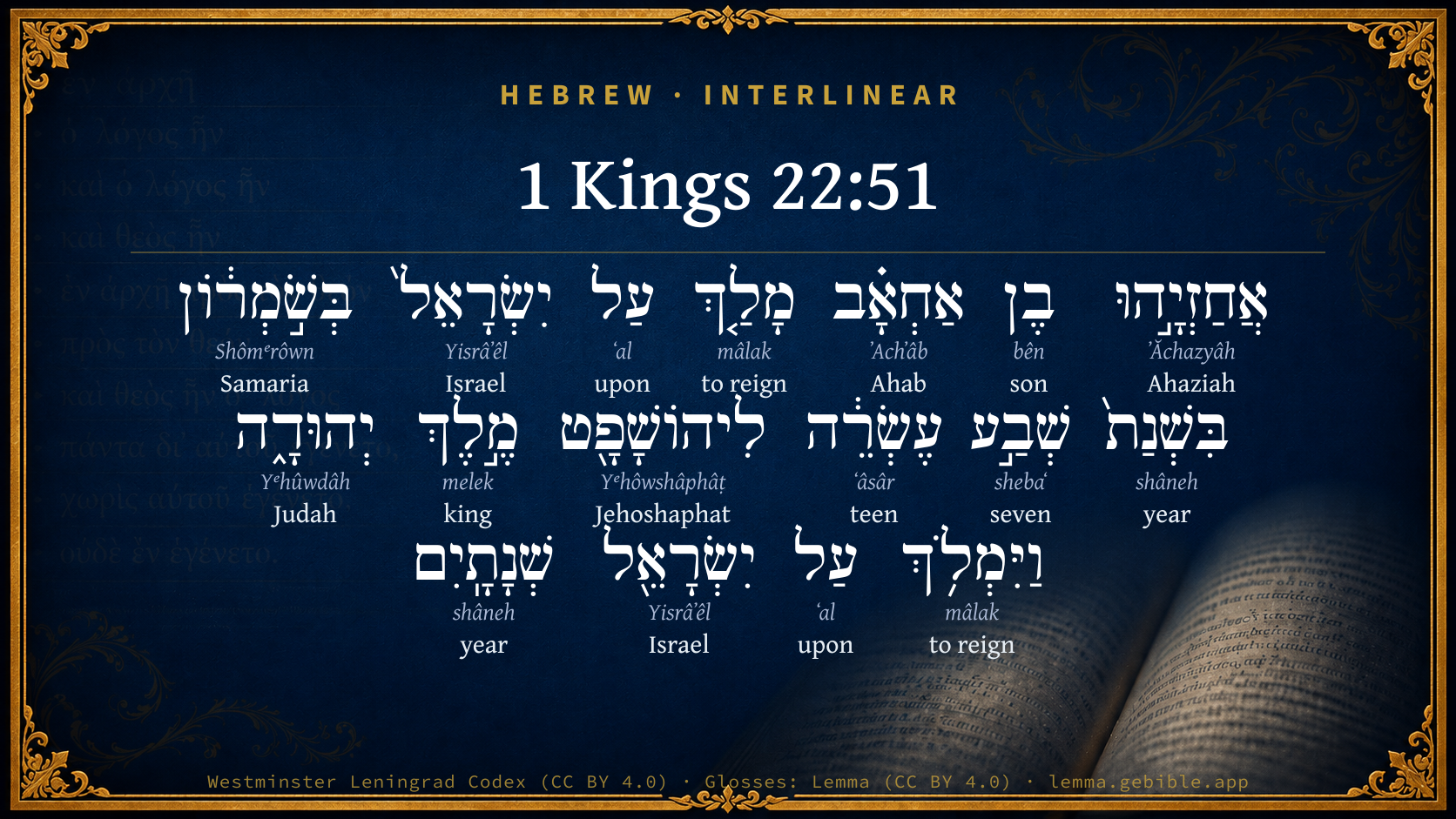
אֲחַזְיָ֣הוּ
ʼĂchazyâh
H274
“Ahaziah”
Noun, Proper
Part of Speech
Noun
Type
Proper
Full BDB Definition

Origin: from H270 and H3050

TWOT: None

Ahaziah = "Jehovah (Yahu) holds (possesses)" - ruler of Israel, son of Ahab - ruler of Judah, son of Jehoram (Joram)
  1. בֶן bên H1121 “son of” Noun, Common, Masculine, Singular, Construct
  2. אַחְאָ֗ב ʼAchʼâb H256 “Ahab” Noun, Proper
  3. מָלַ֤ךְ mâlak H4427 “to reign” Verb, Qal, Perfect, 3rd Person, Masculine, Singular
  4. עַל ʻal H5921 “upon” Preposition
  5. יִשְׂרָאֵל֙ Yisrâʼêl H3478 “Israel” Noun, Proper
  6. בְּשֹׁ֣מְר֔וֹן Shômᵉrôwn H8111 “in/at · Samaria” Preposition + Noun, Proper
  7. בִּשְׁנַת֙ shâneh H8141 “in/at · year of” Preposition + Noun, Common, Feminine, Singular, Construct
  8. שְׁבַ֣ע shebaʻ H7651 “seven” Adjective, Cardinal number, Feminine, Singular, Absolute
  9. עֶשְׂרֵ֔ה ʻâsâr H6240 “teen” Adjective, Cardinal number, Feminine, Singular, Absolute
  10. לִיהוֹשָׁפָ֖ט Yᵉhôwshâphâṭ H3092 “to/for · Jehoshaphat” Preposition + Noun, Proper
  11. מֶ֣לֶךְ melek H4428 “king of” Noun, Common, Masculine, Singular, Construct
  12. יְהוּדָ֑ה Yᵉhûwdâh H3063 “Judah” Noun, Proper
  13. וַיִּמְלֹ֥ךְ mâlak H4427 “and · to reign” Conjunction + Verb, Qal, Sequential Imperfect, 3rd Person, Masculine, Singular
  14. עַל ʻal H5921 “upon” Preposition
  15. יִשְׂרָאֵ֖ל Yisrâʼêl H3478 “Israel” Noun, Proper
  16. שְׁנָתָֽיִם shâneh H8141 “years” Noun, Common, Feminine, Dual, Absolute

About this verse

These counts appear in no published source. They are computed here, from the morphology-tagged text and Lemma’s own curated glosses. What Lemma adds →

17
words
13
distinct lemmas
Historical
section

Shared distinctive vocabulary

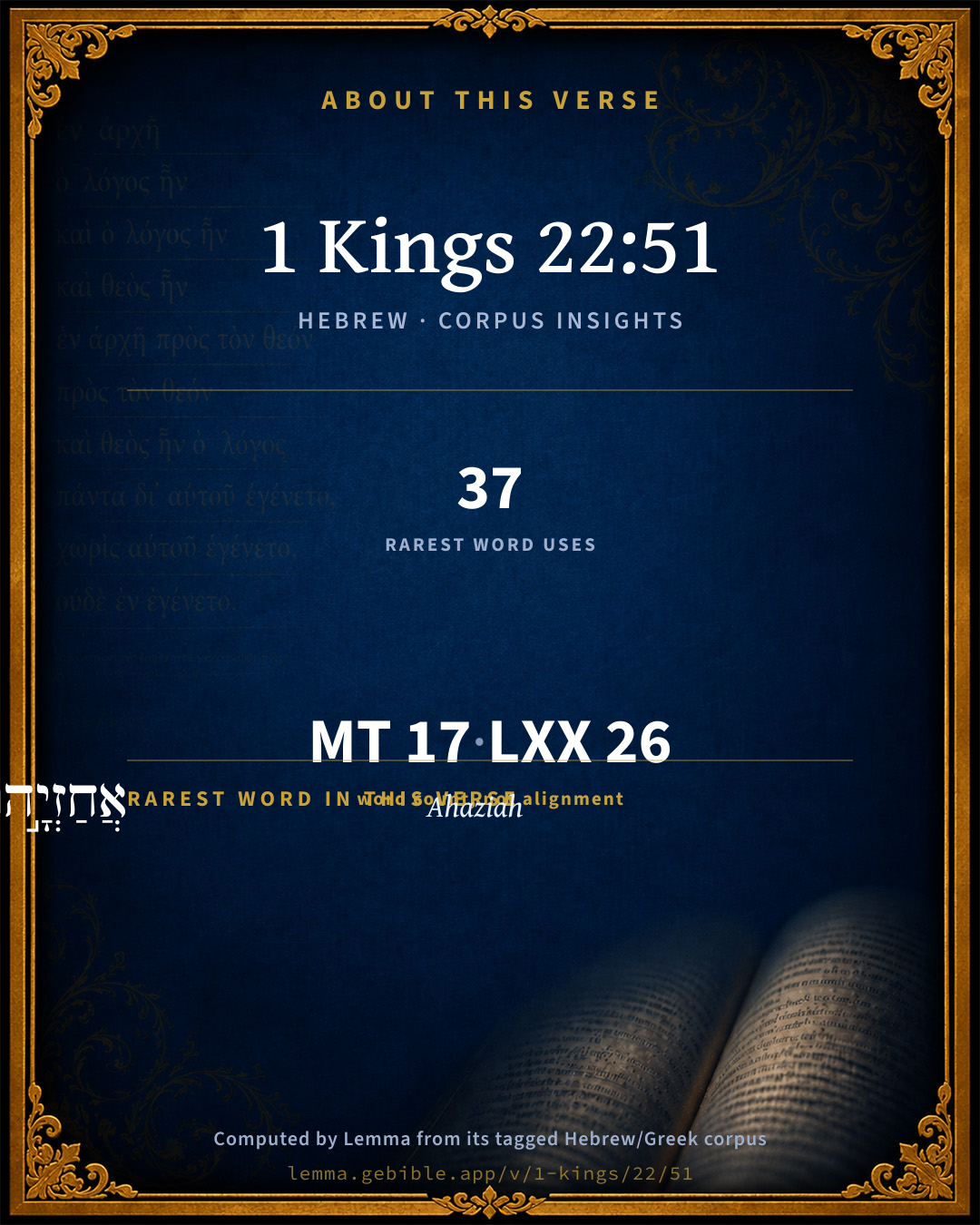
אֲחַזְיָ֣הוּ Ahaziah H274 occurs in 30 verses of the Hebrew Bible. Also found in:

Grammatical profile

  • 2 verbs
  • 11 nouns
  • 2 adjectives
  • 2 prepositions

Verb forms

  • מָלַ֤ךְ Qal · Perfect
  • וַיִּמְלֹ֥ךְ Qal · Sequential Imperfect

Repetition

Words recur within this verse — often emphatic in Hebrew:

  • מָלַ֤ךְ to reign H4427 ×2
  • עַל upon H5921 ×2
  • יִשְׂרָאֵל֙ Israel H3478 ×2
  • בִּשְׁנַת֙ year H8141 ×2

Hebrew & Septuagint length

In English translation the verse runs 28 words from the Hebrew and 27 from the Septuagint (LXX English) — closely comparable.

A rough comparison of the two English renderings, which tokenize alike — not a word-level alignment.

Word counts can differ between the Hebrew and the Greek without any difference in meaning — e.g. the Hebrew direct-object marker אֵת has no separate Greek word, and Greek often adds the article ὁ.

In the original languages it is 17 Hebrew tokens and 26 Greek tokens — but the two are counted differently (Hebrew bundles its prefixes and suffixes into one token; the Greek is in lemma form), so that isn’t a like-for-like length.

Cross-references

3

Topical passages linked to 1 Kings 22:51 in the Treasury of Scripture Knowledge — connected by theme and wording, ordered by reader-vote popularity; previews shown in the World English Bible.

  • 1 Kings 15:25 Nadab the son of Jeroboam began to reign over Israel in the second year of Asa king of Judah; and he reigned over Israel two years.
  • 1 Kings 22:40 So Ahab slept with his fathers; and Ahaziah his son reigned in his place.
  • 2 Kings 1:17 So he died according to the word of Yahweh which Elijah had spoken. Jehoram began to reign in his place in the second year of Jehoram the son of Jehoshaphat king of Judah; because he had no son.

Cross-references courtesy of OpenBible.info (CC BY 4.0).

Hebrew and Greek witnesses Masoretic Hebrew ↔ Greek Septuagint

The same verse in the two great witnesses to the Old Testament, shown verse-for-verse.

These are two independent witnesses, not word-aligned to each other, and the Septuagint is shown in lemma (dictionary) form.

Hebrew 1 Kings 22:51 Masoretic · Westminster Leningrad Codex

אֲחַזְיָ֣הוּ בֶן אַחְאָ֗ב מָלַ֤ךְ עַל יִשְׂרָאֵל֙ בְּשֹׁ֣מְר֔וֹן בִּשְׁנַת֙ שְׁבַ֣ע עֶשְׂרֵ֔ה לִיהוֹשָׁפָ֖ט מֶ֣לֶךְ יְהוּדָ֑ה וַיִּמְלֹ֥ךְ עַל יִשְׂרָאֵ֖ל שְׁנָתָֽיִם

Ahaziah the son of Ahab began to reign over Israel in Samaria in the seventeenth year of Jehoshaphat king of Judah, and he reigned two years over Israel.

World English Bible · Public Domain

Greek LXX 1 Kings 22:51 Septuagint · lemma form

καί κοιμάω ιωσαφατ μετά ὁ πατήρ αὐτός καί θάπτω παρά ὁ πατήρ αὐτός ἐν πόλις δαυίδ ὁ πατήρ αὐτός καί βασιλεύω ιωραμ υἱός αὐτός ἀντί αὐτός

And Josaphat slept with his fathers, and was buried by his fathers in the city of David his father, and Joram his son reigned in his stead.

LXX2012 (modern English Septuagint) · Public Domain

Hebrew: Westminster Leningrad Codex (CC BY 4.0). Greek: Septuagint (public domain); English from LXX2012 (modern English Septuagint) (Public Domain). How the Septuagint differs from the Hebrew →

Targum (Aramaic paraphrase)

1

The Targum is the ancient Jewish Aramaic paraphrase of the Hebrew Scriptures — an interpretive translation, not the Hebrew text itself. Onkelos (literal) and Pseudo-Jonathan (expansive) render the Torah, and Jonathan the Prophets. Coverage is partial: where no permissively-licensed English translation exists for a verse, only the Aramaic is shown. This is verse-level text, not a word-by-word alignment to the Hebrew.

  1. Targum Jonathan Prophets (Joshua–Malachi)
    וּשְׁכִיב יְהוֹשָׁפָט עִם אֲבָהָתוֹהִי וְאִתְקְבַר עִם אֲבָהָתוֹהִי בְּקַרְתָּא דְדָוִד אֲבוּהִי וּמְלַךְ יְהוֹרָם בְּרֵיהּ תְּחוֹתוֹהִי:

    (no public-domain English translation for this verse)

    Targum Jonathan — Aramaic: “Mikraot Gedolot” (public domain). English: “Sefaria Community Translation” (CC0 1.0 (public-domain dedication)); “London "Chaldee Paraphrase," 1871” (public domain). Text via Sefaria.

Commentary

Notes on 1 Kings 22:51 from classic Christian and Jewish commentators (each source and its license shown beneath its notes). The classic Christian expositions comment on the surrounding passage and are grouped to its opening verse, so a note may address several verses; the Jewish commentaries on the Tanakh (Rashi and others) are per-verse, so they appear only where the commentator wrote on this verse.

Lemma curates 59 commentaries, every one of them public domain or Creative Commons licensed, each selected and text-cleaned for this edition rather than reprinted as found. About our sources →

Trapp's Complete Commentary

John Trapp

1Ki 22:51 Ahaziah the son of Ahab began to reign over Israel in Samaria the seventeenth year of Jehoshaphat king of Judah, and reigned two years over Israel.

Ver. 51. Began to reign.] His father Ahab yet living.

And reigned two years.] After his father’s death.

John Trapp, A Commentary or Exposition upon All the Books of the Old and New Testament (1647–1656) — public domain. Text from a community e-Sword module.

Joseph Benson's Commentary

1Ki 22:51-52. And reigned two years over Israel — Not complete, as appears from 2Ki 3:1; but part of two years; for he died before his second year was ended. He walked in the way of his father — Followed the wicked example he had set, especially in worshipping Baal. And in the way of his mother — Jezebel, who was still living; acting according to her wicked counsel. And in the way of Jeroboam — Kept up his idolatry in worshipping the calves. Though he had heard of the ruin of Jeroboam’s family, and had seen his own father drawn to his own destruction by the prophets of Baal, who had been often proved to be false prophets, yet he received no instruction, took no warning, but pursued their wicked courses, not in the least amended by all that had befallen them. And provoked the Lord, according to all that his father had done — Most unhappy parents, that thus help to damn their own children’s souls! We see by all this, how little the example of parents or ancestors is to be valued, where it is opposed to the word and will of God!

Joseph Benson's Commentary on the Old and New Testaments (1811–1818) — public domain. Text from a community e-Sword module.

Whedon's Commentary on the Bible

Daniel D. Whedon

BEGINNING OF AHAZIAH’S REIGN, 1Ki_22:51-53.

51. Reigned two years — More exactly speaking, one year and part of another. Compare 2Ki_3:1, and see note on 2Ki_1:17.

With this account of the beginning of Ahaziah’s reign the next chapter ought to have commenced. It will be seen from these few verses that Ahaziah followed in the footsteps of his wicked father.

Daniel D. Whedon (gen. ed.), Commentary on the Old and New Testaments (1874–1909) — public domain. Text from a community e-Sword module.

The Preacher's Complete Homiletical Commentary

Joseph S. Exell (gen. ed.)

HOMILETICS OF 1Ki_22:51-53

THE POWER OF EVIL TO PERPETUATE ITSELF

I. That evil perpetuates itself by the force of parental training and example (1Ki_22:52). Ahaziah was cursed with a wicked ancestry. The evil wrought by a wicked father may be counteracted by the influences of a pious mother, or vice versa. But where both father and mother are morally bad, and especially where the mother is the superior genius, no wonder that the worst features of their characters are reproduced and perpetuated in their children. It is a fearful calamity for children to be born of the ignorant, the idolatrous, the vicious. Parents have much to answer for who train up their offspring in sin. It is said that Plato, seeing a child doing mischief in the street, went forth and corrected his father for it.

II. That evil perpetuates itself when it is individually sanctioned and practised. “For he served Baal, and worshipped him” (1Ki_22:53). Ahaziah made the sin of his parents his own, by his own free, voluntary act. He rejected the God of Elijah, of Micaiah, and of Jehoshaphat, of whom he must have heard, and he elected to serve Baal and worship him. He threw all the weight of his kingly authority on the side of the national idol. Evil is strengthened and extended by the independent action of every additional votary.

III. That the perpetuation of evil is offensive to God. “Provoked to anger the Lord God of Israel, according to all that his father had done” (1Ki_22:53). Sin is not unnoticed, nor will it long go unpunished. Every act of iniquity provokes the Divine anger, and though God is slow to wrath and reluctant to punish, the day is approaching when terrible and complete vengeance will overtake the evildoer. The judgment which fell on the house of Ahab is a signal example of the ultimate fate of the impenitent wicked.

LESSONS:—

1. Parents are responsible for the moral condition of their children.

2. Sin is a germ that has the alarming power of propagating itself.

3. Evil, though powerful, is not omnipotent, nor will it for ever triumph.

GERM NOTES ON THE VERSES

1Ki_22:51-53. As regards his relation to Jehovah, which was the main point for every Israelitish king, Ahaziah was one of the very worst of them. This is marked, in the general description, by the fact that it is said of him, not only that “he did evil in the sight of the Lord,” and “walked in the ways of Jeroboam,” but that it is also added, “in the way of his father,” nay, even also, which is observed of no other king, “in the way of his mother,” the fanatical, idolatrous, and bloodthirsty Jezebel, who was still living, and perhaps controlled him even more than she had controlled his father. All the acts of God during the reign of his father, of which he had been eye-witness and ear-witness, the proofs of God’s power, long-suffering, and justice, even the tragical end of Ahab, had made no impression upon him. All had passed by him, and left no effect behind. For this very reason, then, in the first place, he is worse than Ahab.—Lange.

1Ki_22:52. The curse of ancestral iniquity. I. Is ever displeasing to God. II. Pollutes succeeding generations. III. Is aggravated by voluntary adoption and individual practice of iniquity.

—It is bad enough, indeed, when one or the other of one’s parents is godless, but how much more when neither fears God? How can we hope for the good nurture of children in that case? The power of example is not greater in any relation than in that of parents to children. The way in which the father or mother walks has more influence upon the children than all the doctrines and teachings which they give them. It is not praiseworthy, nor a thing for which one can satisfactorily answer before God, if the parents and ancestors have been godless, or the adherents of a false religion, that the children should do the same, and follow in their footsteps. It will not suffice before God to say, “I believe what my parents and ancestors believed. They were of this religion, and I will not believe that they have been damned.”—Wurt. Summ.

The Preacher's Complete Homiletical Commentary (gen. ed. Joseph S. Exell; Funk & Wagnalls, c. 1892) — public domain (pre-1929). A full-Bible homiletical/sermon-outline anthology covering 65 of 66 books (2 John is absent from the source module). Text from a community e-Sword module.

Keil & Delitzsch

C. F. Keil & F. Delitzsch

Reign of Ahaziah of Israel. - Kg1 22:51. For the datum "in the seventeenth year of Jehoshaphat," see at Kg2 1:17.

Kg1 22:52-53

Ahaziah walked in the way of his father and his mother, who had introduced the worship of Baal into the kingdom, and in the way of Jeroboam, who had set up the calves (cf. Kg1 16:30-33). - In Kg1 22:53 it is again expressly added, that he adored and worshipped Baal, as in Kg1 16:31. - With this general description of his character not only is the chapter brought to a close, but the first book of Kings also, - very unsuitably, however, since the further account of Ahaziah's reign and of his death is given in 2 Kings 1 of the following book. It would have been incomparably more suitable to commence a fresh chapter with Kg1 22:52, and indeed to commence the second book there also.

Keil & Delitzsch — Biblical Commentary on the Old Testament (1861–1891) — public domain (CC PDM 1.0). Text via the HelloAO Bible API. (Old Testament only.)

Tyndale Open Study Notes

Tyndale Open Resources

22:51-53 The tragic story of the rule of Ahaziah in Israel continues in 2 Kgs 1:1-18. He followed in the evil ways of his parents, Ahab and Jezebel (1 Kgs 21:25-26); he worshiped Baal (2 Kgs 1:2, 16) and supported the state religion instituted by Jeroboam I (1 Kgs 12:28-32). Ahaziah’s accession and statement of character provide closure to the account of Ahab in 1 Kings and a smooth transition to the continuing story of the divided kingdom in 2 Kings.

Tyndale Open Study Notes — © Tyndale Open Resources, licensed CC BY-SA 4.0. Text via the HelloAO Bible API.

Ellicott's Commentary for English Readers

(51) Ahaziah.—In this short reign the influence of Jezebel, evidently in abeyance in the last days of Ahab, revives; and the idolatry of Baal resumes its place side by side with the older idolatry of Jeroboam, and (see 2Ki_1:2) with the worship of the Canaanitish Baalzebub.

A Bible Commentary for English Readers, edited by Charles John Ellicott (1878–1897) — public domain. Text from a community e-Sword module.

The Cambridge Bible for Schools and Colleges

gen. ed. J. J. S. Perowne

51–53. Ahaziah, king of Israel. His wicked reign (Not in Chronicles)

51. the seventeenth year] The R.V. inserts in before these words, and as the preposition is in the original, there is no ground for excluding it in the English. On the chronology see above on 1Ki_22:42.

and reigned] R.V. and he reigned. The main division of the verse in the Hebrew precedes these words, and the pronoun repeated makes somewhat of a like division in the translation.

The Cambridge Bible for Schools and Colleges (gen. ed. J. J. S. Perowne; Cambridge University Press, 1878–1918) — public domain. Text from a community e-Sword module.

John Gill's Exposition

Ahaziah the son of Ahab began to reign over Israel in Samaria the seventeenth year of Jehoshaphat king of Judah,.... It is observed, that Jehoshaphat began to reign in the fourth year of Ahab, and Ahab reigned twenty two years, see Kg1 22:41, and therefore Ahab's son must begin to reign in the eighteenth year of Jehoshaphat; but perhaps he was made king in his father's lifetime, before he went on his expedition to Ramothgilead, or Ahab's reign was not twenty two years complete:

and reigned two years over Israel; not complete, as appears from Kg2 3:1.

John Gill's Exposition of the Whole Bible (1746–1763) — public domain (CC PDM 1.0). Text via the HelloAO Bible API.

Albert Barnes' Notes on the Bible

Two years - According to our reckoning, not much more than a twelve-month year.

Albert Barnes' Notes on the Bible (1834–1885) — public domain. Text from a community e-Sword/MySword module.

Matthew Poole's English Annotations

By comparing this verse with 1Ki 22:41, it appears that Ahaziah was made king by his father, and reigned in conjunction with him, a year or two before Ahab’s death, and as long after it; even as Jehoram the son of Jehoshaphat was made king by his father in his lifetime, as we shall see hereafter; which possibly was done in compliance with Ahab’s desire upon marriage of his daughter to Jehoshaphat’s son; and it may be Ahab, to induce and encourage him to do so, gave him an example of it, and made his son his partner in the kingdom.

Reigned two years; either after his father’s death; or one before it, and another after it.

Matthew Poole's English Annotations on the Holy Bible (1683–1685) — public domain. Text from a community e-Sword/MySword module.

The Pulpit Commentary

Reign of Ahaziah.

Ahaziah the son of Ahab began to reign over Israel in Samaria the seventeenth year of Jehoshaphat king of Judah, and reigned two years over Israel. Parts of two years; 2Ki_3:1; and of. 1:17 and 8:16. It is suggested that Jehoram was associated with his father in the government of Judah from the date of the expedition against Ramoth-Gilead, and this is not improbable. But it has been already remarked that these chronological notices appear to have undergone a revision which has sometimes resulted in confusion.

The Pulpit Commentary (1880–1919), ed. H.D.M. Spence-Jones & Joseph S. Exell — public domain. Text from a community e-Sword module.

John Wesley's Explanatory Notes

Ahaziah, &c. - Ahaziah was made king by his father, and reigned in conjunction with him a year or two before Ahab's death, and as long after it; even as Jehoram the son of Jehoshaphat was made king by his father in his life-time, which possibly was done in compliance with Ahab's desire upon marriage of his daughter to Jehoshaphat's son; and it may be Ahab, to induce him to do so, give him an example of it, and made his son his partner in the kingdom.

John Wesley, Explanatory Notes Upon the Whole Bible (1754–1765) — public domain. Text via the GEBible commentary corpus.

unfoldingWord translationNotes

Door43 World Missions Community

he reigned two years

"he reigned 2 years" (See: Numbers)

what was evil in the sight of Yahweh

Yahweh's opinion regarding something is spoken of as if Yahweh were seeing that thing. AT: "what Yahweh considered to be evil" (See: Metaphor)

walked in the way of his father, in the way of his mother, and in the way of Jeroboam son of Nebat

A person's behavior is spoken of as if that person were walking along a path. AT: "did the same things that his father, mother, and Jeroboam son of Nebat had done" (See: Metaphor)

led Israel to sin

Here the word "Israel" refers to the ten northern tribes that made up the kingdom of Israel.

He served Baal and worshiped him

The words "served" and "worshiped" mean basically the same thing. (See: Doublet)

the God of Israel

Here the word "Israel" refers to all of the twelve tribes descended from Jacob.

translationWords

reign

kingdom of Israel

Samaria

king

kingdom of Judah

Israel

evil

walk

Jeroboam

sin

servant

Baal

worship

anger

unfoldingWord translationNotes — © Distant Shores Media and the Door43 World Missions Community, licensed CC BY-SA 4.0. Source: git.door43.org/Door43/en_tn.

Lesson kit

Teaching starters — assembled from the data on this page, not authored interpretation. Every prompt links to the verse data it draws on. Edit before teaching.

1 Kings, in the Historical, opens this verse with 17 words (13 distinct Hebrew lemmas). Its most distinctive word is ʼĂchazyâh (“Ahaziah”). A historical commentator’s framing appears above. Read the whole chapter for the surrounding context.

Discussion questions

  1. How does “Ahaziah” (ʼĂchazyâh) shape what this verse is saying?
  2. How does 1 Kings 22:40, which shares the word «Ahaziah», read alongside this verse?
  3. What does the repetition of “to reign” (2× in this one verse) do in this verse?
  4. These translations render this verse differently; the difference is in the English rendering, not the original. What questions does that raise?
  5. «מָלַ֤ךְ» is a Qal Perfect verb. How does that grammatical form shape the action described?
  6. Compare how Trapp's Complete Commentary and Joseph Benson's Commentary read this verse. Where do they agree or differ?

Things to notice

Reading settings

Reading text

Shown beneath each verse's original-language words.

Old Testament
Old Testament edition

Read the OT as the Masoretic Hebrew (MT) or the Greek Septuagint (LXX).

English shown for the Greek Septuagint (in the Hebrew ↔ Greek comparison).

Comparing translations? Open the Compare panel on any verse page to stack up to four side by side.