2 Chronicles 33:25

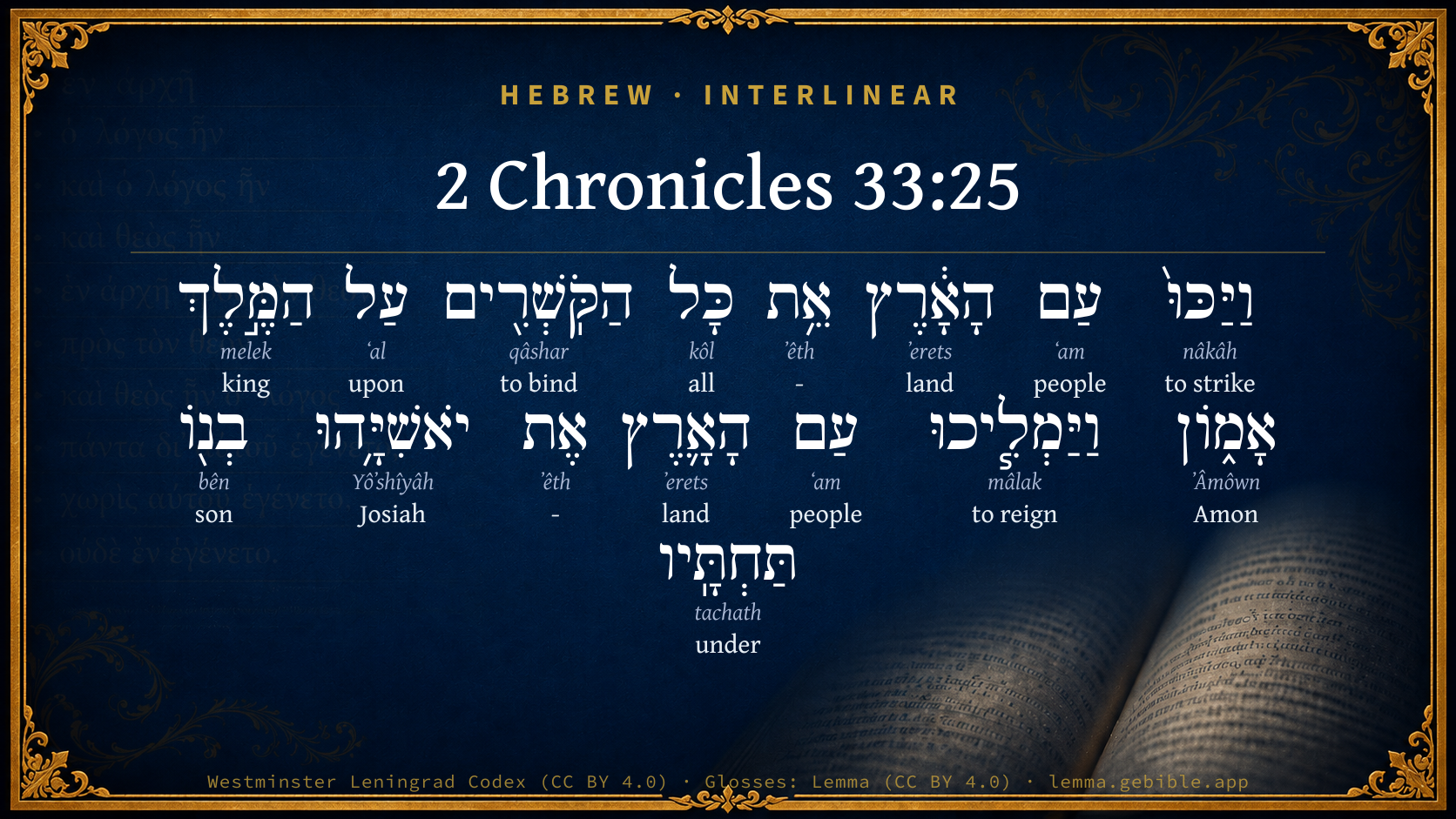
Hebrew (Westminster Leningrad Codex) 2 Chronicles 33:25 appears in the Hebrew Old Testament. The text above is from the Westminster Leningrad Codex. Each word links to its Strong’s number, a concise gloss, and parsing drawn from the Open Scriptures Hebrew Bible morphology. Click any word for its full Brown-Driver-Briggs (BDB) entry.
Download image
Cite this verse

2 Chronicles 33:25 (World English Bible). Public Domain. Lemma interlinear Bible study tool, https://lemma.gebible.app/v/2-chronicles/33/25.

Show BibTeX & RIS
BibTeX
RIS
English Translation
But the people of the land killed all those who had conspired against king Amon; and the people of the land made Josiah his son king in his place.
World English Bible · Public Domain
Download a study sheet

One document with this verse’s original text, its word-by-word gloss line, the meaning frame, cross-references with their text, attributed commentary, and full source and license credits — printable, and it pastes into notes with its structure intact.

This verse Autodidact and up

Study sheet (.html) Plain text (.txt)

A passage Seminary Student

Up to 50 verses in one chapter. A passage sheet keeps up to 6 commentary sources and 12 cross-references per verse, in the order this page ranks them, and says so on the sheet whenever that leaves anything out. Ask for a single verse and you get the Autodidact verse sheet above.

Everything on this page stays free to read, with no account — the sheet is a download of what is already on screen, not access to it.

Want to remove ads? Support Godless Engineer
Compare translations 3

The same verse in 3 English versions, stacked beneath the original-language interlinear above. Click any original word for its lexicon entry.

Each is an independent rendering of the whole verse — the interlinear is not word-aligned to these translations.

Highlighted words mark where these versions differ — a whole-verse word diff, not a word-by-word alignment.

  • World English Bible Public Domain
    But the people of the land killed all those who had conspired against king Amon; and the people of the land made Josiah his son king in his place.
  • King James Version Public Domain
    But the people of the land slew all them that had conspired against king Amon; and the people of the land made Josiah his son king in his stead.
  • unfoldingWord Literal Text CC BY-SA 4.0
    But the people of the land struck down all those who had conspired against King Amon, and the people of the land made Josiah, his son, king in his place.

unfoldingWord Literal Text — © unfoldingWord, licensed CC BY-SA 4.0. Word-aligned USFM3 via Door43 (git.door43.org/unfoldingWord/en_ult).

Versions to compare (up to 4)

3 of 4 selected

Show all 18 translations

Every available English version of this verse, each an independent rendering of the whole verse.

  • World English Bible Public Domain
    But the people of the land killed all those who had conspired against king Amon; and the people of the land made Josiah his son king in his place.
  • Berean Standard Bible Public Domain
    But the people of the land killed all those who had conspired against King Amon, and they made his son Josiah king in his place.
  • Majority Standard Bible Public Domain
    But the people of the land killed all those who had conspired against King Amon, and they made his son Josiah king in his place.
  • King James Version Public Domain
    But the people of the land slew all them that had conspired against king Amon; and the people of the land made Josiah his son king in his stead.
  • American Standard Version (1901) Public Domain
    But the people of the land slew all them that had conspired against king Amon; and the people of the land made Josiah his son king in his stead.
  • Revised Version (1885) Public Domain
    But the people of the land slew all them that had conspired against king Amon; and the people of the land made Josiah his son king in his stead.
  • Geneva Bible (1599) Public Domain
    But the people of the land slewe all them that had conspired against King Amon: and the people of the land made Iosiah his sonne King in his steade.
  • Douay-Rheims (1899) Public Domain
    But the rest of the multitude of the people slew them that had killed Amen, and made Josias his son king in his stead.
  • Young's Literal Translation Public Domain
    and the people of the land smite all those conspiring against king Amon, and the people of the land cause Josiah his son to reign in his stead.
  • Literal Standard Version CC BY-SA 4.0
    and the people of the land strike all those conspiring against King Amon, and the people of the land cause his son Josiah to reign in his stead.
  • Unlocked Literal Bible CC BY-SA 4.0
    But the people of the land killed all those who had conspired against King Amon, and they made Josiah, his son, king in his place.
  • unfoldingWord Literal Text CC BY-SA 4.0
    But the people of the land struck down all those who had conspired against King Amon, and the people of the land made Josiah, his son, king in his place.
  • Darby Bible Public Domain
    But the people of the land smote all them that had conspired against king Amon; and the people of the land made Josiah his son king in his stead.
  • World Messianic Bible Public Domain
    But the people of the land killed all those who had conspired against King Amon; and the people of the land made Josiah his son king in his place.
  • Webster's Bible Public Domain
    But the people of the land slew all them that had conspired against king Amon; and the people of the land made Josiah his son king in his stead.
  • Free Bible Version CC BY-SA 4.0
    But the people of the land killed everyone who had plotted against King Amon, and they made his son Josiah king.
  • Bible in Basic English Public Domain
    But the people of the land put to death all those who had taken part in the design against King Amon, and made his son Josiah king in his place.
  • JPS Tanakh (1917) Public Domain
    But the people of the land slew all them that had conspired against king Amon; and the people of the land made Josiah his son king in his stead.

Literal Standard Version (2020), Covenant Press — licensed CC BY-SA 4.0. Text via the HelloAO Bible API (eBible.org). Unlocked Literal Bible (unfoldingWord) — licensed CC BY-SA 4.0. Text via the HelloAO Bible API (eBible.org). unfoldingWord Literal Text — © unfoldingWord, licensed CC BY-SA 4.0. Word-aligned USFM3 via Door43 (git.door43.org/unfoldingWord/en_ult). Free Bible Version, Dr. Jonathan Gallagher — licensed CC BY-SA 4.0. Text via the HelloAO Bible API (eBible.org).

Word by word

More ways to search: Search by grammar → Find every occurrence → Compare this word →

Practice this passage: Drill this verse → Learn its vocabulary →

אָמ֑וֹן
ʼÂmôwn
H526
“Amon”
Noun, Proper
Part of Speech
Noun
Type
Proper
Full BDB Definition

Origin: the same as H525

TWOT: None

Amon = "skilled workman" or " master workman" - a king of Judah, son of Manasseh - a governor of Samaria - a descendant of a servant of Solomon
  1. וַיַּכּוּ֙ nâkâh H5221 “and · to strike” Conjunction + Verb, Hiphil, Sequential Imperfect, 3rd Person, Masculine, Plural
  2. עַם ʻam H5971 “people of” Noun, Common, Masculine, Singular, Construct
  3. הָאָ֔רֶץ ʼerets H776 “the · land” Particle, Definite Article + Noun, Common, Both, Singular, Absolute
  4. אֵ֥ת ʼêth H853 “-” Particle, Direct Object
  5. כָּל kôl H3605 “all of” Noun, Common, Masculine, Singular, Construct
  6. הַקֹּֽשְׁרִ֖ים qâshar H7194 “the · binding” Particle, Definite Article + Verb, Qal, Participle Active, Masculine, Plural, Absolute
  7. עַל ʻal H5921 “upon” Preposition
  8. הַמֶּ֣לֶךְ melek H4428 “the · king” Particle, Definite Article + Noun, Common, Masculine, Singular, Absolute
  9. וַיַּמְלִ֧יכוּ mâlak H4427 “and · to reign” Conjunction + Verb, Hiphil, Sequential Imperfect, 3rd Person, Masculine, Plural
  10. עַם ʻam H5971 “people of” Noun, Common, Masculine, Singular, Construct
  11. הָאָ֛רֶץ ʼerets H776 “the · land” Particle, Definite Article + Noun, Common, Both, Singular, Absolute
  12. אֶת ʼêth H853 “-” Particle, Direct Object
  13. יֹאשִׁיָּ֥הוּ Yôʼshîyâh H2977 “Josiah” Noun, Proper
  14. בְנ֖וֹ bên H1121 “son · his” Noun, Common, Masculine, Singular, Construct + Suffix, Personal, 3rd Person, Masculine, Singular
  15. תַּחְתָּֽיו tachath H8478 “under · him” Preposition + Suffix, Personal, 3rd Person, Masculine, Singular

About this verse

These counts appear in no published source. They are computed here, from the morphology-tagged text and Lemma’s own curated glosses. What Lemma adds →

16
words
13
distinct lemmas
Historical
section

Notable vocabulary

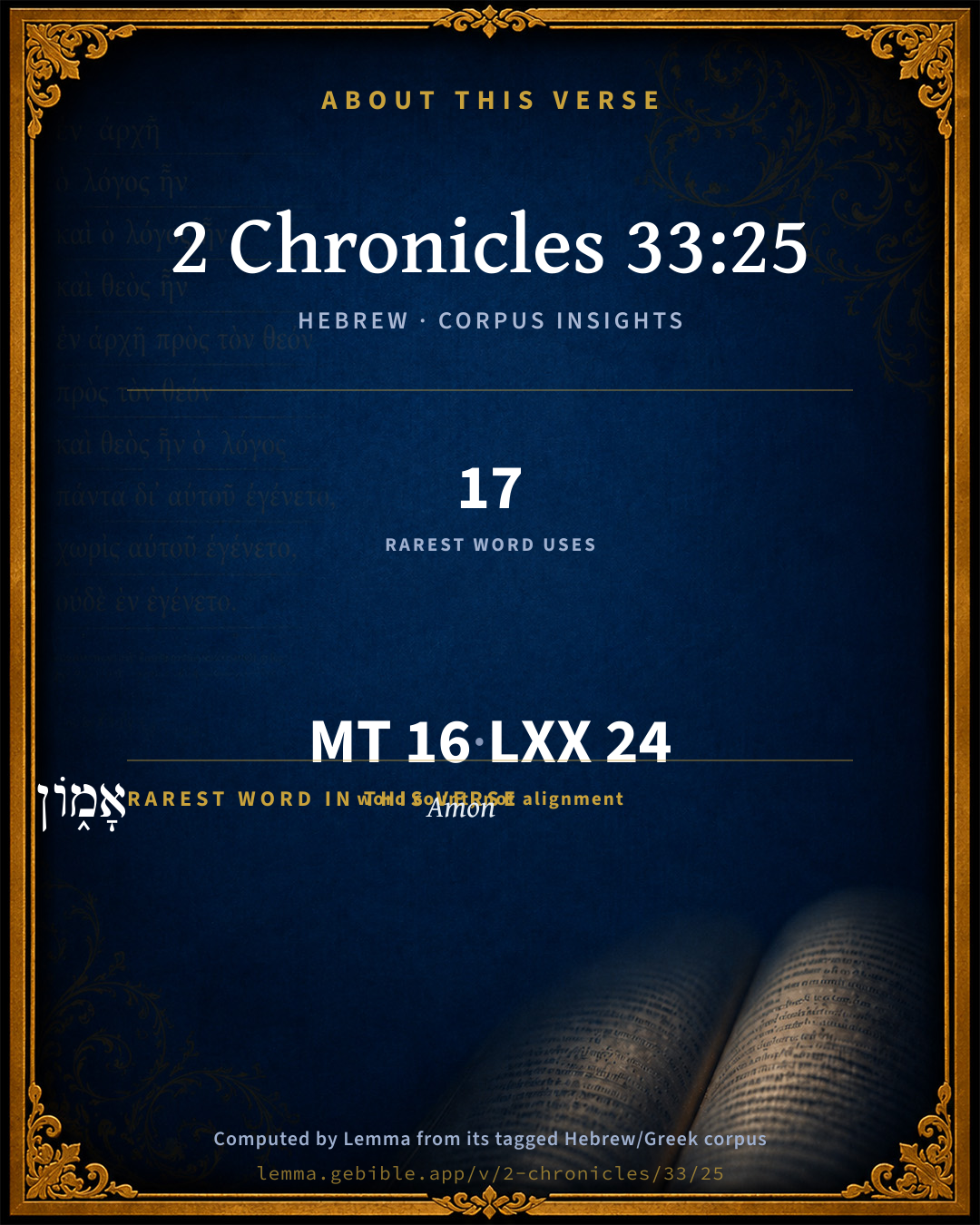
The rarest word here is אָמ֑וֹן Amon H526 — appearing just 17 times in the whole Hebrew Bible.

Shared distinctive vocabulary

אָמ֑וֹן Amon H526 occurs in 17 verses of the Hebrew Bible. Also found in:

Grammatical profile

  • 3 verbs
  • 9 nouns
  • 2 prepositions
  • 2 particles

Verb forms

  • וַיַּכּוּ֙ Hiphil · Sequential Imperfect
  • הַקֹּֽשְׁרִ֖ים Qal · Participle Active
  • וַיַּמְלִ֧יכוּ Hiphil · Sequential Imperfect

Repetition

Words recur within this verse — often emphatic in Hebrew:

  • עַם people H5971 ×2
  • הָאָ֔רֶץ land H776 ×2

Hebrew & Septuagint length

In English translation the verse runs 29 words from the Hebrew and 29 from the Septuagint (LXX English) — the same length.

A rough comparison of the two English renderings, which tokenize alike — not a word-level alignment.

Word counts can differ between the Hebrew and the Greek without any difference in meaning — e.g. the Hebrew direct-object marker אֵת has no separate Greek word, and Greek often adds the article ὁ.

In the original languages it is 16 Hebrew tokens and 24 Greek tokens — but the two are counted differently (Hebrew bundles its prefixes and suffixes into one token; the Greek is in lemma form), so that isn’t a like-for-like length.

Cross-references

6

Topical passages linked to 2 Chronicles 33:25 in the Treasury of Scripture Knowledge — connected by theme and wording, ordered by reader-vote popularity; previews shown in the World English Bible.

  • Genesis 9:5–6 I will surely require your blood of your lives. At the hand of every animal I will require it. At the hand of man, even at the hand of every man's brother, I will require the life of man.
  • Numbers 35:31 Moreover you shall take no ransom for the life of a murderer who is guilty of death; but he shall surely be put to death.
  • Numbers 35:33 So you shall not pollute the land in which you are: for blood, it pollutes the land; and no expiation can be made for the land for the blood that is shed therein, but by the blood of him who shed it.
  • 2 Chronicles 26:1 All the people of Judah took Uzziah, who was sixteen years old, and made him king in the room of his father Amaziah.
  • 2 Chronicles 34:1 Josiah was eight years old when he began to reign; and he reigned thirty-one years in Jerusalem.
  • 2 Chronicles 36:1 Then the people of the land took Jehoahaz the son of Josiah, and made him king in his father's place in Jerusalem.

Cross-references courtesy of OpenBible.info (CC BY 4.0).

Hebrew and Greek witnesses Masoretic Hebrew ↔ Greek Septuagint

The same verse in the two great witnesses to the Old Testament, shown verse-for-verse.

These are two independent witnesses, not word-aligned to each other, and the Septuagint is shown in lemma (dictionary) form.

Hebrew 2 Chronicles 33:25 Masoretic · Westminster Leningrad Codex

וַיַּכּוּ֙ עַם הָאָ֔רֶץ אֵ֥ת כָּל הַקֹּֽשְׁרִ֖ים עַל הַמֶּ֣לֶךְ אָמ֑וֹן וַיַּמְלִ֧יכוּ עַם הָאָ֛רֶץ אֶת יֹאשִׁיָּ֥הוּ בְנ֖וֹ תַּחְתָּֽיו

But the people of the land killed all those who had conspired against king Amon; and the people of the land made Josiah his son king in his place.

World English Bible · Public Domain

Greek LXX 2 Chronicles 33:25 Septuagint · lemma form

καί πατάσσω ὁ λαός ὁ γῆ ὁ ἐπιτίθημι ἐπί ὁ βασιλεύς αμων καί βασιλεύω ὁ λαός ὁ γῆ ὁ ιωσίας υἱός αὐτός ἀντί αὐτός

And the people of the land killed the men who had conspired against king Amon; and the people of the land made Josias his son king in his stead.

LXX2012 (modern English Septuagint) · Public Domain

Hebrew: Westminster Leningrad Codex (CC BY 4.0). Greek: Septuagint (public domain); English from LXX2012 (modern English Septuagint) (Public Domain). How the Septuagint differs from the Hebrew →

Commentary

Notes on 2 Chronicles 33:25 from classic Christian and Jewish commentators (each source and its license shown beneath its notes). The classic Christian expositions comment on the surrounding passage and are grouped to its opening verse, so a note may address several verses; the Jewish commentaries on the Tanakh (Rashi and others) are per-verse, so they appear only where the commentator wrote on this verse.

Lemma curates 59 commentaries, every one of them public domain or Creative Commons licensed, each selected and text-cleaned for this edition rather than reprinted as found. About our sources →

The Biblical Illustrator

Joseph S. Exell

2Ch_33:25

Josiah his son king in his stead.

Far-reaching heredity

Josiah was the son of Amon--which is equal to saying that the greatest sinner of his day was the progenitor of one of the finest saints that ever prayed. If that is not a miracle, what is meant by the term miracle? Read the account and say if it be not the reading of music:--And he did that which was right in the sight of the Lord, and walked in the ways of David his father (2Ch_34:2) and declined neither to the right hand, nor to the left. Then he had more fathers than one. That is the explanation. You are not the son of the man that went immediately before you; you are only his son in a very incidental manner. Josiah was the son of David his father--the larger father, the deeper root, the elect of God; a sun fouled by many a black spot, but a shining orb notwithstanding. We must enlarge our view if we would come to right conclusions regarding many mysteries. Amen was but a link in the chain. The bad man here, or the good man there, taken in his solitariness, is but a comparatively trivial incident in lifes tragedy. Heredity is not from one to two; it is from one to the last; from the beginning to the ending. In every man there lives all the humanity that ever lived. We are fearfully and wonderfully made--not physically only, but morally, religiously, temperamentally. All the kings live in the last king or the reigning monarch. We are one humanity. Solidarity has its lessons as well as individuality. We know not which of our ancestors comes up in us at this moment or that--now the tiger, now the eagle; now the praying mother, now the daring sire; now some mean soul that got into the current by a mystery never to be explained; now the cunning, watchful, patient deceiver, who can wait for nights at a time and never complain of the dark or the cold, and now the hero that never had a fear, the philanthropist that loved the world, the mother that never looked otherwise than God Himself would have her look. We can never tell which of our ancestors is really thinking in us, speaking through us; we cannot tell the accent of the immediate consciousness;--these are mysteries, and when the judgment comes it will be based upon all the ground, and not upon incidental points here and there (J. Parker, D. D.)

.

The Biblical Illustrator, edited by Joseph S. Exell (c. 1880s–1900s) — public domain. Text from a community e-Sword module.

Adam Clarke's Commentary

Verse 25. The people of the land slew all them] His murder was not a popular act, for the people slew the regicides. They were as prone to idolatry as their king was. We may rest satisfied that idolatry was accompanied with great licentiousness and sensual gratifications else it never, as a mere religious system, could have had any sway in the world.

FOR an explanation of the term groves, 2Ch 23:3; 2Kg 21:26.

I have referred to the prayer attributed to Manasseh, and found in what is called the Apocrypha, just before the first book of Maccabees. It was anciently used as a form of confession in the Christian Church, and is still as such received by the Greek Church. It is as follows: -

"O Lord, Almighty God of our fathers, Abraham, Isaac, and Jacob, and of their righteous seed, who hast made heaven and earth, with all the ornament thereof; who hast bound the sea by the word of thy commandment; who hast shut up the deep, and sealed it by thy terrible and glorious name; whom all men fear, and tremble before thy power; for the majesty of thy glory cannot be borne, and thine angry threatening towards sinners is insupportable; but thy merciful promise is unmeasurable and unsearchable; for thou art the most high Lord, of great compassion, long-suffering, very merciful, and repentest of the evils of men. Thou, O Lord, according to thy great goodness, hast promised repentance and forgiveness to them that have sinned against thee, and of thine infinite mercies hast appointed repentance unto sinners, that they may be saved. Thou, therefore, O Lord, that art the God of the just, has not appointed repentance to the just, as to Abraham, and Isaac, and Jacob, which have not sinned against thee; but thou hast appointed repentance unto me that am a sinner: for I have sinned above the number of the sands of the sea. My transgressions, O Lord, are multiplied; my transgressions are multiplied; and I am not worthy to behold and see the height of heaven for the multitude of mine iniquities. I am bowed down with many iron bands, that I cannot lift up mine head, neither have any release; for I have provoked thy wrath, and done evil before thee. I did not thy will, neither kept I thy commandments. I have set up abominations, and have multiplied offences. Now therefore I bow the knee of mine heart, beseeching thee of grace. I have sinned, O Lord, I have sinned, and I acknowledge mine iniquities: wherefore I humbly beseech thee, forgive me, O Lord, forgive me, and destroy me not in mine iniquities. Be not angry with me for ever, by reserving evil for me; neither condemn me into the lower parts of the earth. For thou art the God, the God of them that repent; and in me thou wilt show all thy goodness: for thou wilt save me, that am unworthy, according to thy great mercy. Therefore I will praise thee for ever all the days of my life: for all the powers of the heavens do praise thee, and thine is the glory for ever and ever. - Amen.

The above translation, which is that in our common Bibles, might be mended; but the piece is scarcely worth the pains.

Adam Clarke's Commentary on the Bible (1810–1826) — public domain. Text from a community e-Sword/MySword module.

Ellicott's Commentary for English Readers

(25) Slew.—Smote. The verse is identical with 2Ki_21:24, save that it has “smote” plural instead of singular, which latter is more correct. It may be that the facts thus briefly recorded represent a fierce conflict between the party of religious reform and that of religious reaction, in which the latter was for the time worsted and reduced to a state of suspended activity.

The chronicler has omitted the remarks usual at the end of a reign. See 2Ki_21:25-26 for a reference to sources, and Anion’s burial place (“the garden of Uzza”).

A Bible Commentary for English Readers, edited by Charles John Ellicott (1878–1897) — public domain. Text from a community e-Sword module.

The Cambridge Bible for Schools and Colleges

gen. ed. J. J. S. Perowne

25. slew] Render, smote. The Hebrew word suggests perhaps that there was a conflict between the people and the conspirators.

The Cambridge Bible for Schools and Colleges (gen. ed. J. J. S. Perowne; Cambridge University Press, 1878–1918) — public domain. Text from a community e-Sword module.

Haydock's Catholic Bible Commentary

Them. Heb. "all that had conspired against king Amon." H.

George Leo Haydock (1774–1849), Haydock's Catholic Family Bible and Commentary, 1859 edition — public domain. Excludes Psalms (Douay-Rheims chapter numbering differs from Protestant) and Deuterocanonical books (Catholic canon only).

The Pulpit Commentary

The people of the land. The emphatic expression here used (as also in the parallel), with its repetition in same verse malting it more so, may either betray the unfortunate sympathy that the worse element of the nation felt with the bad king and his evil ways, or it may mean that the healthier element of the people insisted on the right respect being observed to the proper succession. The conduct of Josiah from very tender years, which could not have been entirely his own, but must be credited in part to those who taught and influenced him, throws the balance of probability, perhaps, into this latter and more charitable view. The parallel contains two closing verses (25, 26) additional to what we have, giving the authority as the "book of the chronicles of the kings of Judah," and stating that Amen also "was buried in his sepulchre, in the garden of Uzza."

The Pulpit Commentary (1880–1919), ed. H.D.M. Spence-Jones & Joseph S. Exell — public domain. Text from a community e-Sword module.

Lesson kit

Teaching starters — assembled from the data on this page, not authored interpretation. Every prompt links to the verse data it draws on. Edit before teaching.

2 Chronicles, in the Historical, opens this verse with 16 words (13 distinct Hebrew lemmas). Its most distinctive word is ʼÂmôwn (“Amon”). A historical commentator’s framing appears above. Read the whole chapter for the surrounding context.

Discussion questions

  1. The word ʼÂmôwn carries the sense “Amon.” How does it shape the verse?
  2. How does 1 Kings 22:26, which shares the word «Amon», read alongside this verse?
  3. What does the repetition of “people” (2× in this one verse) do in this verse?
  4. These translations render this verse differently. What is at stake in choosing one wording over another?
  5. «וַיַּכּוּ֙» is a Hiphil Sequential Imperfect verb. How does that grammatical form shape the action described?
  6. Compare how The Biblical Illustrator and Adam Clarke's Commentary read this verse. Where do they agree or differ?

Things to notice

Reading settings

Reading text

Shown beneath each verse's original-language words.

Old Testament
Old Testament edition

Read the OT as the Masoretic Hebrew (MT) or the Greek Septuagint (LXX).

English shown for the Greek Septuagint (in the Hebrew ↔ Greek comparison).

Comparing translations? Open the Compare panel on any verse page to stack up to four side by side.