
1 Kings 15:9

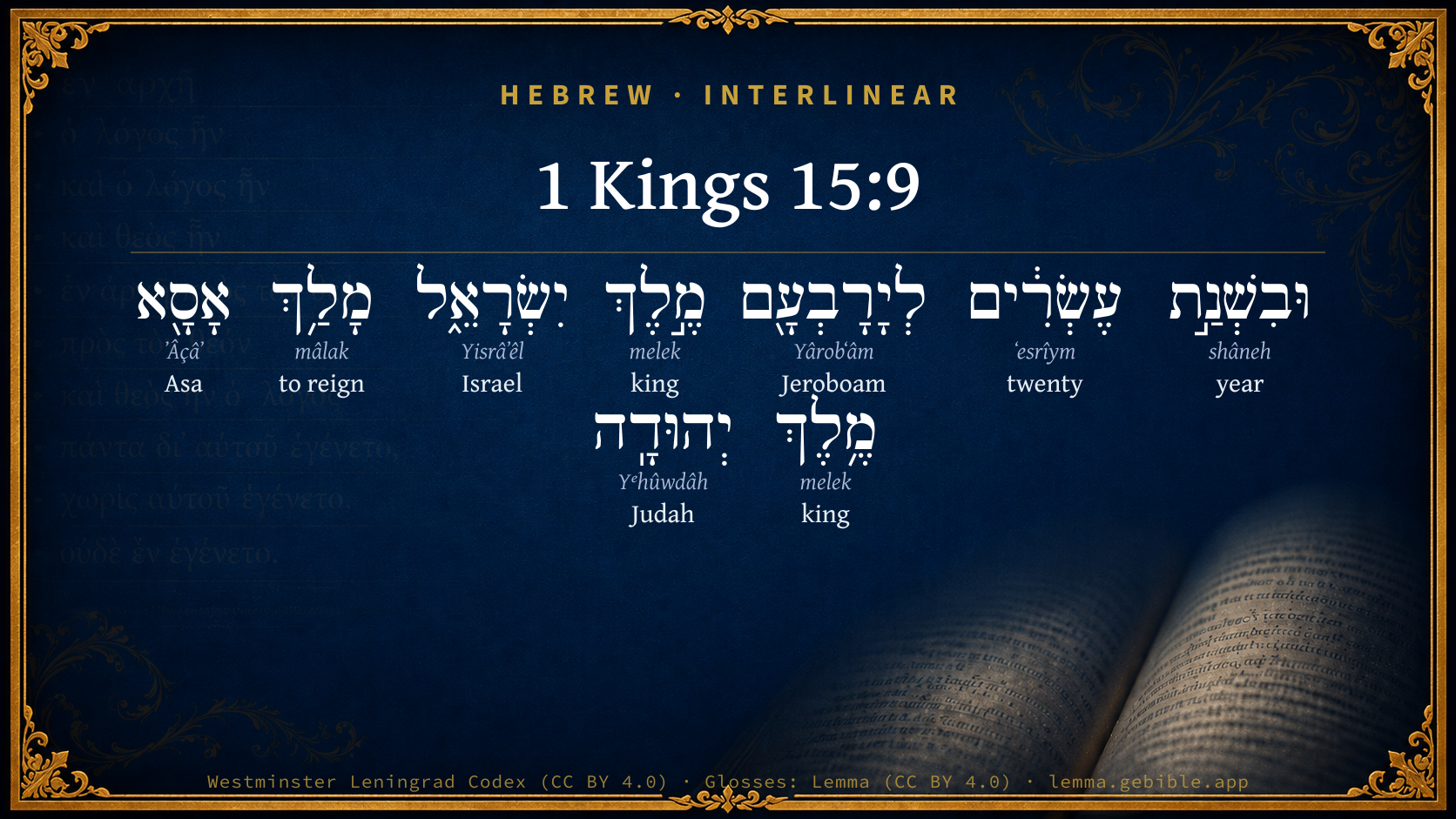
Hebrew (Westminster Leningrad Codex) 1 Kings 15:9 appears in the Hebrew Old Testament. The text above is from the Westminster Leningrad Codex. Each word links to its Strong’s number, a concise gloss, and parsing drawn from the Open Scriptures Hebrew Bible morphology. Click any word for its full Brown-Driver-Briggs (BDB) entry.
Download image
Cite this verse

1 Kings 15:9 (World English Bible). Public Domain. Lemma interlinear Bible study tool, https://lemma.gebible.app/v/1-kings/15/9.

Show BibTeX & RIS
BibTeX
RIS
English Translation
In the twentieth year of Jeroboam king of Israel began Asa to reign over Judah.
World English Bible · Public Domain
Download a study sheet

One document with this verse’s original text, its word-by-word gloss line, the meaning frame, cross-references with their text, attributed commentary, and full source and license credits — printable, and it pastes into notes with its structure intact.

This verse Autodidact and up

Study sheet (.html) Plain text (.txt)

A passage Seminary Student

Up to 50 verses in one chapter. A passage sheet keeps up to 6 commentary sources and 12 cross-references per verse, in the order this page ranks them, and says so on the sheet whenever that leaves anything out. Ask for a single verse and you get the Autodidact verse sheet above.

Everything on this page stays free to read, with no account — the sheet is a download of what is already on screen, not access to it.

Want to remove ads? Support Godless Engineer
Compare translations 3

The same verse in 3 English versions, stacked beneath the original-language interlinear above. Click any original word for its lexicon entry.

Each is an independent rendering of the whole verse — the interlinear is not word-aligned to these translations.

Highlighted words mark where these versions differ — a whole-verse word diff, not a word-by-word alignment.

  • World English Bible Public Domain
    In the twentieth year of Jeroboam king of Israel began Asa to reign over Judah.
  • King James Version Public Domain
    And in the twentieth year of Jeroboam king of Israel reigned Asa over Judah.
  • unfoldingWord Literal Text CC BY-SA 4.0
    Now in the year of 20 to Jeroboam, the king of Israel, Asa reigned the king of Judah.

unfoldingWord Literal Text — © unfoldingWord, licensed CC BY-SA 4.0. Word-aligned USFM3 via Door43 (git.door43.org/unfoldingWord/en_ult).

Versions to compare (up to 4)

3 of 4 selected

Show all 18 translations

Every available English version of this verse, each an independent rendering of the whole verse.

  • World English Bible Public Domain
    In the twentieth year of Jeroboam king of Israel began Asa to reign over Judah.
  • Berean Standard Bible Public Domain
    In the twentieth year of Jeroboam’s reign over Israel, Asa became king of Judah,
  • Majority Standard Bible Public Domain
    In the twentieth year of Jeroboam’s reign over Israel, Asa became king of Judah,
  • King James Version Public Domain
    And in the twentieth year of Jeroboam king of Israel reigned Asa over Judah.
  • American Standard Version (1901) Public Domain
    And in the twentieth year of Jeroboam king of Israel began Asa to reign over Judah.
  • Revised Version (1885) Public Domain
    And in the twentieth year of Jeroboam king of Israel began Asa to reign over Judah.
  • Geneva Bible (1599) Public Domain
    And in the twentie yeere of Ieroboam King of Israel reigned Asa ouer Iudah.
  • Douay-Rheims (1899) Public Domain
    So in the twentieth year of Jeroboam king of Israel, reigned Asa king of Juda,
  • Young's Literal Translation Public Domain
    And in the twentieth year of Jeroboam king of Israel reigned hath Asa over Judah,
  • Literal Standard Version CC BY-SA 4.0
    And in the twentieth year of Jeroboam king of Israel, Asa has reigned over Judah,
  • Unlocked Literal Bible CC BY-SA 4.0
    In the twentieth year of Jeroboam king of Israel, Asa began to reign over Judah.
  • unfoldingWord Literal Text CC BY-SA 4.0
    Now in the year of 20 to Jeroboam, the king of Israel, Asa reigned the king of Judah.
  • Darby Bible Public Domain
    And in the twentieth year of Jeroboam king of Israel, Asa began to reign over Judah;
  • World Messianic Bible Public Domain
    In the twentieth year of Jeroboam king of Israel, Asa began to reign over Judah.
  • Webster's Bible Public Domain
    And in the twentieth year of Jeroboam king of Israel reigned Asa over Judah.
  • Free Bible Version CC BY-SA 4.0
    Asa became king of Judah in the twentieth year of the reign of Jeroboam, king of Israel.
  • Bible in Basic English Public Domain
    In the twentieth year that Jeroboam was king of Israel, Asa became king over Judah.
  • JPS Tanakh (1917) Public Domain
    And in the twentieth year of Jeroboam king of Israel began Asa to reign over Judah.

Literal Standard Version (2020), Covenant Press — licensed CC BY-SA 4.0. Text via the HelloAO Bible API (eBible.org). Unlocked Literal Bible (unfoldingWord) — licensed CC BY-SA 4.0. Text via the HelloAO Bible API (eBible.org). unfoldingWord Literal Text — © unfoldingWord, licensed CC BY-SA 4.0. Word-aligned USFM3 via Door43 (git.door43.org/unfoldingWord/en_ult). Free Bible Version, Dr. Jonathan Gallagher — licensed CC BY-SA 4.0. Text via the HelloAO Bible API (eBible.org).

Word by word

More ways to search: Search by grammar → Find every occurrence → Compare this word →

Practice this passage: Drill this verse → Learn its vocabulary →

About this verse

These counts appear in no published source. They are computed here, from the morphology-tagged text and Lemma’s own curated glosses. What Lemma adds →

9
words
8
distinct lemmas
Historical
section

Shared distinctive vocabulary

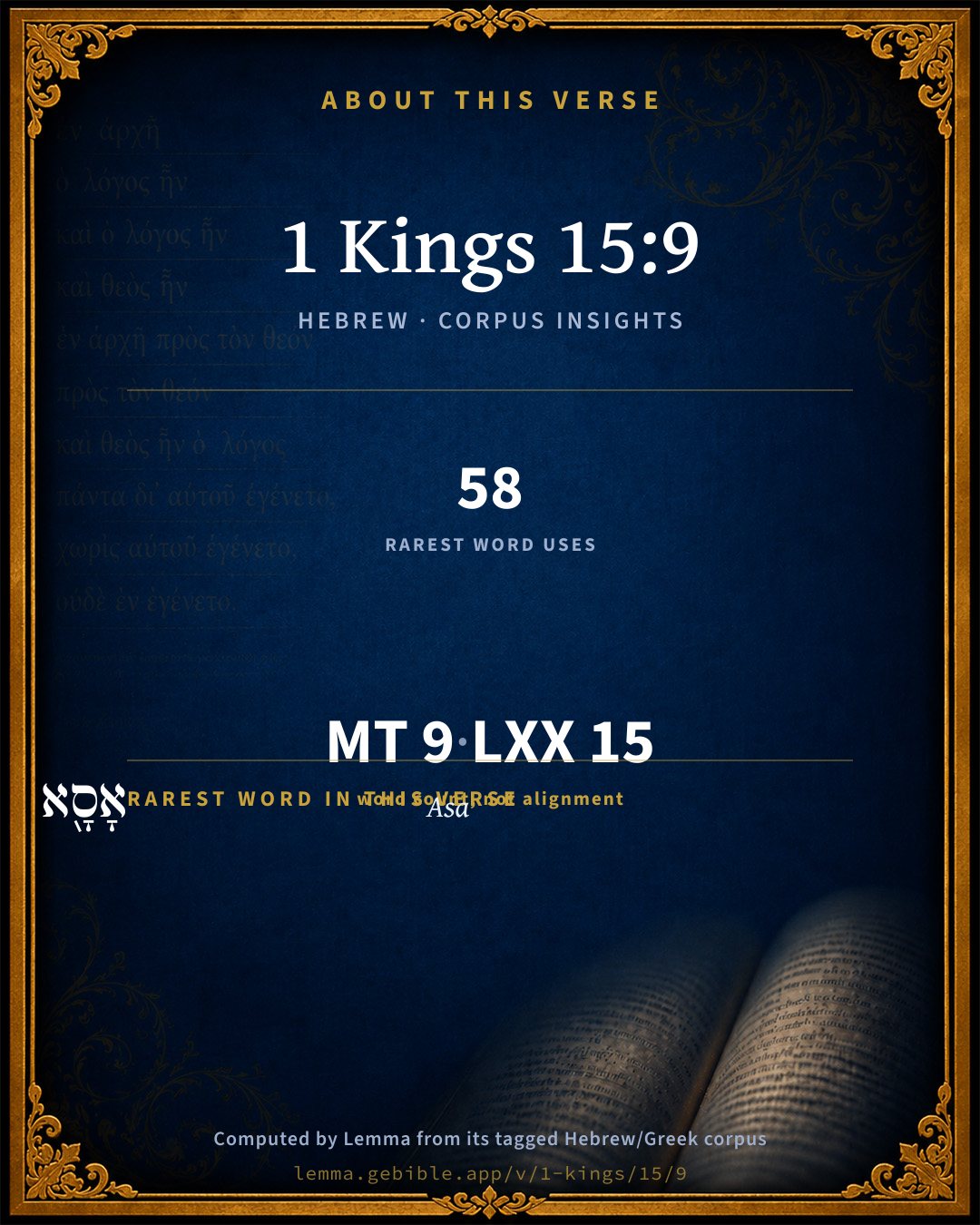
אָסָ֖א Asa H609 occurs in 52 verses of the Hebrew Bible. Also found in:

Grammatical profile

  • 1 verb
  • 7 nouns
  • 1 adjective

Verb forms

  • מָלַ֥ךְ Qal · Perfect

Repetition

A word recurs within this verse — often emphatic in Hebrew:

  • מֶ֣לֶךְ king H4428 ×2

Hebrew & Septuagint length

In English translation the verse runs 15 words from the Hebrew and 17 from the Septuagint (LXX English) — closely comparable.

A rough comparison of the two English renderings, which tokenize alike — not a word-level alignment.

Word counts can differ between the Hebrew and the Greek without any difference in meaning — e.g. the Hebrew direct-object marker אֵת has no separate Greek word, and Greek often adds the article ὁ.

In the original languages it is 9 Hebrew tokens and 15 Greek tokens — but the two are counted differently (Hebrew bundles its prefixes and suffixes into one token; the Greek is in lemma form), so that isn’t a like-for-like length.

Hebrew and Greek witnesses Masoretic Hebrew ↔ Greek Septuagint

The same verse in the two great witnesses to the Old Testament, shown verse-for-verse.

These are two independent witnesses, not word-aligned to each other, and the Septuagint is shown in lemma (dictionary) form.

Hebrew 1 Kings 15:9 Masoretic · Westminster Leningrad Codex

וּבִשְׁנַ֣ת עֶשְׂרִ֔ים לְיָרָבְעָ֖ם מֶ֣לֶךְ יִשְׂרָאֵ֑ל מָלַ֥ךְ אָסָ֖א מֶ֥לֶךְ יְהוּדָֽה

In the twentieth year of Jeroboam king of Israel began Asa to reign over Judah.

World English Bible · Public Domain

Greek LXX 1 Kings 15:9 Septuagint · lemma form

ἐν ὁ ἐνιαυτός ὁ τέταρτος καί εἰκοστός ὁ ιεροβοαμ βασιλεύς ἰσραήλ βασιλεύω ασα ἐπί ἰούδας

In the four and twentieth year of Jeroboam king of Israel, Asa begins to reign over Juda.

LXX2012 (modern English Septuagint) · Public Domain

On this verse, The Cambridge Bible for Schools and Colleges discusses the Septuagint’s reading. Read the note in Commentary ↓

Hebrew: Westminster Leningrad Codex (CC BY 4.0). Greek: Septuagint (public domain); English from LXX2012 (modern English Septuagint) (Public Domain). How the Septuagint differs from the Hebrew →

Targum (Aramaic paraphrase)

1

The Targum is the ancient Jewish Aramaic paraphrase of the Hebrew Scriptures — an interpretive translation, not the Hebrew text itself. Onkelos (literal) and Pseudo-Jonathan (expansive) render the Torah, and Jonathan the Prophets. Coverage is partial: where no permissively-licensed English translation exists for a verse, only the Aramaic is shown. This is verse-level text, not a word-by-word alignment to the Hebrew.

  1. Targum Jonathan Prophets (Joshua–Malachi)
    וּבִשְׁנַת עַסְרִין לְיָרָבְעָם מַלְכָּא דְיִשְׂרָאֵל מְלַךְ אָסָא עַל שִׁבְטָא דְבֵית יְהוּדָה:

    (no public-domain English translation for this verse)

    Targum Jonathan — Aramaic: “Mikraot Gedolot” (public domain). English: “Sefaria Community Translation” (CC0 1.0 (public-domain dedication)); “London "Chaldee Paraphrase," 1871” (public domain). Text via Sefaria.

Commentary

Notes on 1 Kings 15:9 from classic Christian and Jewish commentators (each source and its license shown beneath its notes). The classic Christian expositions comment on the surrounding passage and are grouped to its opening verse, so a note may address several verses; the Jewish commentaries on the Tanakh (Rashi and others) are per-verse, so they appear only where the commentator wrote on this verse.

Lemma curates 59 commentaries, every one of them public domain or Creative Commons licensed, each selected and text-cleaned for this edition rather than reprinted as found. About our sources →

Trapp's Complete Commentary

John Trapp

1Ki 15:9 And in the twentieth year of Jeroboam king of Israel reigned Asa over Judah.

Ver. 9. And in the twentieth year.] See on 1Ki 14:31.

John Trapp, A Commentary or Exposition upon All the Books of the Old and New Testament (1647–1656) — public domain. Text from a community e-Sword module.

The Preacher's Complete Homiletical Commentary

Joseph S. Exell (gen. ed.)

CRITICAL AND EXPLANATORY NOTES.—

1Ki_15:12. The sodomites—vide Notes on 1Ki_14:24. All the idols—גִּלּוּלִים, a word for despicable things. The Rabbins render it mud-gods; Ewald renders it doll-images; Gesenius, idol-blocks.

1Ki_15:13. An idol in a grove—This is a word of far different meaning from that in 1Ki_15:12. מִפְלֶצֶת means horrendum, as from the verb פלץ, to terrify, horrify. It Is conjectured that this was an obscene figure, a phallus image, a symbol of the productive powers of nature, specially (according to the Rabbins) revolting to the Hebrews. “In a grove, may read, unto Asherah; but this “grove” was one of similar scenes of licentious indulgence practised in the name of religion.

HOMILETICS OF 1Ki_15:9-15

RELIGIOUS REFORM

I. That religious reform is a commendable work, in which even a monarch may engage. As the evil which had debased the nation originated from the throne, it was fitting that the remedy should issue from the same potent source. Asa was the first monarch who made a bold and determined stand against the prevalent idolatry. The sin of the nation had grown into colossal proportions, and it required no ordinary courage and strength of will to attack it. Asa threw all the authority of the crown on the side of reform, and was himself the zealous leader of the movement. The king can do himself no greater honour, nor confer upon his people a greater good, than by making the interests of true religion his chief care. If persons in the highest rank refuse to use their influence in the removal of acknowledged abuses, the Lord will raise from obscurity an agent who will faithfully and effectually do the work. The humble peasant may be raised up to rebuke the careless and unfaithful monarch.

II. That religious reform is inspired by a desire to do the right. “Asa did that which was right in the eyes of the Lord; his heart was perfect with the Lord all his days” (1Ki_15:11, comp. with 1Ki_15:14). The need of reform is suggested by the wide divergence observed in the actual state of things from the inner consciousness of right. The man who studies the law of God, and conscientiously strives to keep its commandments, cannot fail to have a sense of what is right; and this sense of right will be the guide and inspiration of all his actions. This was the case with Asa, though the standard of perfection by which we are to measure the perfect ones of the Old Testament history is not the fulness of spiritual light and religious attainment which is set before us in the New Testament. It is rather a singleness and earnestness of pious purpose to obey God and maintain the honour of His name and worship. “All these were noble and excellent acts,” writes Bishop Hall concerning the reform of Asa: “but that which gives true life unto all these is a sound root. ‘Asa’s heart was perfect with the Lord all his days.’ No less laudable works than these have proceeded from hypocrisy, which, while they have carried away applause from men, have lost their thanks with God. All Asa’s gold was but dross to his pure intentions.” Holiness—a perfect heart towards God—is the strongest motive to work, and imparts a courage which no difficulties can daunt.

III. That religious reform aims at the suppression of the most glaring forms of public vice.

1. It uproots gross immorality (1Ki_15:12). In a time of reformation the most flagrant abominations are the first to fall; the rising tide of righteous indignation sweeps them away. No prince or people can prosper while the festering pest-houses of immorality are suffered to exist.

2. It destroys idolatry (1Ki_15:12-13). Asa removed all the idols, demolished their temples, and devastated their groves; and doubtless many of the idol worshippers would take part in this work of destruction. When the mind is once undeceived, its anger against the instrument of its deception is sometimes terrific and unbounded. During the tyranny of the Spanish Inquisition in the Netherlands, in the sixteenth century, a spirit of fury suddenly arose in Antwerp and elsewhere against the images used in the Romish worship: the cathedrals and churches were dismantled, the images and religious relics broken to shivers, and yet not a single coin of the church treasures was appropriated; the destructive mania was wholly confined to objects of idolatrous worship. Terrible, indeed, is the vengeance which will, ere long, overtake the idols and their worshippers (Isa_2:18).

3. It purifies the court (1Ki_15:13). Maachah was deposed from being queen-mother because of her idolatry, and the disgusting image to which she did homage was burnt, and its ashes cast into the river. “The idols which his fathers had made” were all destroyed. All respect for flesh and blood must be subservient to the duty we owe to God. A good king who would promote religion among his subjects must begin by discountenancing all wickedness at court. A pure court is a great safeguard to a nation.

IV. That religious reform is not always thorough and complete. “But the high places were not removed” (1Ki_15:14): such as were set up for the worship of God; for as for those that were set up in honour of idols, he removed them. But he should have done both, as did afterwards zealous Hezekiah and Josiah. It is with the saints as with Jonathan’s signal arrows, two fell short, and but one beyond the mark; so where one shooteth home to the mark of the high calling in Christ Jesus, many fall short.—Trapp. Reformation often proceeds slowly and under great difficulties. It may leave untouched institutions that may become a snare and a source of corruption to future generations. Vested interests in a superstitions system are hard to slay.

V. That religions reform enriches the temple of God (1Ki_15:15). The practical evidence of a genuine reformation is shown in costly free-willing offerings to God. The true riches of a temple are not the silver and gold and superb furniture, but the gratitude, praise, and devotion of which these are but the outward manifestations. The soul is only rich in what it really lays up in the treasury of God. We must not only cast away the idols of our iniquity, but cheerfully dedicate ourselves and our substance to the cause and glory of God.

LESSONS:—

1. Abuses will creep into the best organized religious systems.

2. The work of the reformer is one of great sacrifice and labour.

3. The monarch who is zealous for religious reform deserves the gratitude and support of his people.

GERM NOTES ON THE VERSES

1Ki_15:11. It is to be regarded as a merciful providence of God, when a son who has grown up with evil surroundings and the bad example of a father and mother, yet holds steadily to His word and commandments, and resists firmly all ungodly influences.

—The standard of right. I. Is the will of God. II. By it every act of man is unerringly estimated. III. Is but imperfectly represented by the best human examples.

—In vain should he have hoped to restore God to his kingdom, while these abominations inhabited it. It is justly the main care of worthy and religious princes to clear their coasts of the foullest sins. O, the impartial zeal of Asa! There were idols that challenged a prerogative of favour, the idols that his father had made. All these he defaces: the name of a father cannot protect an idol; the duty to his parent cannot win him to a liking, to a forbearance of his misdevotion: yea, so much the more doth the heart of Asa rise against these puppets for that they were the sin, the shame of his father. He doth not more honour a father than hate an idol. No dearness of person should take off the edge of our detestation of the sin.—Bp. Hall.

1Ki_15:12-13. Against sins of licentiousness no authority can be powerful enough, for where this evil has crept in, there comes a moral corruption which works destructively upon all relations of life. Authority being ordained of God, as the Apostle says, its duty and task is to oppose with severity all godless conduct, without fear or favour of man, and to vindicate the eternal Divine laws. Therefore it is that we have the church prayer for those in authority.—Lange.

1Ki_15:13. There can be no queen-consort where there is more than one wife; and in the East, where there is no more than one, she is not a queen, she is simply the Zan-i-shah, the king’s wife—that is all. There is, however, in most cases, some one in the harem who, on one account or other, is recognised as the chief lady. There was one whose claim to be chief lady, or queen, was superior to all others, and that was the MOTHER of the king. The prevalent usage of the East assigns the first rank in every household, not to the wife of the master, but to his mother, to whom the wife merely becomes another daughter. And so the rank of the king’s mother was the nearest approach to the rank and dignity of a non-regnant queen.—Kitto.

—Nature is worthy of forgetfulness and contempt in opposition to the God of nature: upon the same ground as Asa removed the idols of his father Abijam, so for idols he removed his grandmother Maachah. She would not be removed from her obscene idols; she is therefore removed from the station of her honour. If all the world had been an idolater, he knew how little that precedent could avail for disobedience. Practice must be corrected by law, and not the law yield to practice. Maachah, therefore, goes down from her seat, her idols from their grove; she to retiredness, they to the fire, and from thence to the water. Woeful deities that could both burn and drown!—Bp. Hall.

1Ki_15:12-15. True reformation.

1. Is wrought for the divine glory.

2. Is not to be hindered by family considerations.

3. Should be national in its progress and results.

4. Should destroy every vestige of corruption.

5. Is evidenced by practical generosity.

1Ki_15:14. To remove deep-rooted and long-standing evils suddenly and completely is impossible, even for a well-intentioned and powerful ruler; for in that case he would bring about resistance to the good rather than further it.

—Yet, in 2Ch_14:3, we read that Asa “took away the altars of the strange gods and the high places,” and in 1Ki_15:5 that “he took away out of all the cities of Judah the high places and the images,” which would seem at first sight to imply that he entirely put down the worship. The author of Chronicles, however, himself afterwards allows that “the high places were not taken away out of Israel,” though the heart of Asa was perfect all his days. The explanation would seem to be, either that the idolatry was at one time put down, but crept back afterwards; or that, while Asa endeavoured to sweep it wholly away, his subjects would not be controlled, but found a means of maintaining it in some places—not, perhaps, in the cities, but in remote country districts, where the royal authority was weaker, and secresy more practicable.—Speaker’s Comm.

1Ki_15:15. Hence noble and pious princes should bethink themselves of using their gold and silver, not only for worldly objects, but to enrich churches and schools, necessary to the accomplishment of godly designs.

The Preacher's Complete Homiletical Commentary (gen. ed. Joseph S. Exell; Funk & Wagnalls, c. 1892) — public domain (pre-1929). A full-Bible homiletical/sermon-outline anthology covering 65 of 66 books (2 John is absent from the source module). Text from a community e-Sword module.

Tyndale Open Study Notes

Tyndale Open Resources

15:9 Asa reigned from 910 to 869 BC.

Tyndale Open Study Notes — © Tyndale Open Resources, licensed CC BY-SA 4.0. Text via the HelloAO Bible API.

Matthew Henry's Commentary

We have here a short account of the reign of Asa; we shall find a more copious history of it Ch2 14:1-15, 15, and Ch2 16:1-14. Here is,

I. The length of it: He reigned forty-one years in Jerusalem, Kg1 15:10. In the account we have of the kings of Judah we find the number of the good kings and the bad ones nearly equal; but then we may observe, to our comfort, that the reign of the good kings was generally long, but that of the bad kings short, the consideration of which will make the state of God's church not altogether so bad within that period as it appears at first sight. Length of days is in Wisdom's right hand. Honour thy father, much more thy heavenly Father, that thy days may be long.

II. The general good character of it (Kg1 15:11): Asa did that which was right in the eyes of the Lord, and that is right indeed which is so in God's eyes; those are approved whom he commends. He did as did David his father, kept close to God, and to his instituted worship, was hearty and zealous for that, which gave him this honourable character, that he was like David, though he was not a prophet, or psalmist, as David was. If we come up to the graces of those that have gone before us it will be our praise with God, though we come short of their gifts. Asa was like David, though he was neither such a conqueror nor such an author; for his heart was perfect with the Lord all his days (Kg1 15:14), that is, he was both cordial and constant in his religion. What he did for God he was sincere in, steady and uniform, and did it from a good principle, with a single eye to the glory of God.

III. The particular instances of Asa's piety. His times were times of reformation. For,

1. He removed that which was evil. There reformation begins; and a great deal of work of that kind his hand found to do. For, though it was but twenty years after the death of Solomon that he began to reign, yet very gross corruption had spread far and taken deep root. Immorality he first struck at: He took away the sodomites out of the land, suppressed the brothels; for how can either prince or people prosper while those cages of unclean and filthy birds, more dangerous than pest-houses, are suffered to remain? Then he proceeded against idolatry: He removed all the idols, even those that his father had made, Kg1 15:12. His father having made them, he was the more concerned to remove them, that he might cut off the entail of the curse, and prevent the visiting of that iniquity upon him and his. Nay (which redounds much to his honour, and shows his heart was perfect with God), when he found idolatry in the court, he rooted it out thence, Kg1 15:13. When it appeared that Maachah his mother, or rather his grandmother (but called his mother because she had the educating of him in his childhood), had an idol in a grove, though she was his mother, his grandmother, - though, it is likely, she had a particular fondness for it, - though, being old, she could not live long to patronise it, - though she kept it for her own use only, yet he would by no means connive at her idolatry. Reformation must begin at home. Bad practices will never be suppressed in the country while they are supported in the court. Asa, in every thing else, will honour and respect his mother; he loves her well, but he loves God better, and (like the Levite, Deu 33:9) readily forgets the relation when it comes in competition with his duty. If she be an idolater, (1.) Her idol shall be destroyed, publicly exposed to contempt, defaced, and burnt to ashes by the brook Kidron, on which, it is probable, he strewed the ashes, in imitation of Moses (Exo 32:20) and in token of his detestation of idolatry and his indignation at it wherever he found it. Let no remains of a court-idol appear. (2.) She shall be deposed, He removed her from being queen, or from the queen, that is, from conversing with his wife; he banished her from the court, and confined her to an obscure and private life. Those that have power are happy when thus they have hearts to use it well.

2. He re-established that which was good (Kg1 15:15): He brought into the house of God the dedicated things which he himself had vowed out of the spoils of the Ethiopians he had conquered, and which his father had vowed, but lived not to bring in pursuant to his vow. We must not only cease to do evil, but learn to do well, not only cast away the idols of our iniquity, but dedicate ourselves and our all to God's honour and glory. When those who, in their infancy, were by baptism devoted to God, make it their own act and deed to join themselves to him and vigorously employ themselves in his service, this is bringing in the dedicated things which they and their fathers have dedicated: it is necessary justice - rendering to God the things that are his.

VI. The policy of his reign. He built cities himself, to encourage the increase of his people (Kg1 15:23) and to invite others to him by the conveniences of habitation; and he was very zealous to hinder Baasha from building Ramah, because he designed it for the cutting off of communication between his people and Jerusalem and to hinder those who in obedience to God would come to worship there. An enemy must by no means be suffered to fortify a frontier town.

V. The faults of his reign. In both the things for which he was praised he was found defective. The fairest characters are not without some but or other in them. 1. Did he take away the idols? That was well; but the high places were not removed (Kg1 15:14); therein his reformation fell short. He removed all images which were rivals with the true God or false representations of him; but the altars which were set up in high places, and to which those sacrifices were brought which should have been offered on the altar in the temple, those he suffered to stand, thinking there was no great harm in them, they having been used by good men before the temple was built, and being loth to disoblige the people, who had a kindness to them and were wedded to them both by custom and convenience; whereas in Judah and Benjamin, the only tribes under Asa's government which lay so near Jerusalem and the altars there, there was less pretence for them than in those tribes which lay more remote. They were against the law, which obliged them to worship at one place, Deu 12:11. They lessened men's esteem of the temple and the altars there, and were an open gap for idolatry to enter in at, while the people were so much addicted to it. It was not well that Asa, when his hand was in, did not remove these. Nevertheless his heart was perfect with the Lord. This affords us a comfortable note, That those may be found honest and upright with God, and be accepted of him, who yet, in some instances, come short of doing the good they might and should do. The perfection which is made the indispensable condition of the new covenant is not to be understood of sinlessness (then we were all undone), but sincerity. 2. Did he bring in the dedicated things? That was well; but he afterwards alienated the dedicated things, when he took the gold and silver out of the house of God and sent them as a bribe to Benhadad, to hire him to break his league with Baasha, and, by making an inroad upon his country, to give him a diversion from the building of Ramah, Kg1 15:18, Kg1 15:19. Here he sinned, (1.) In tempting Benhadad to break his league, and so to violate the public faith. If he did wrong in doing it, as certainly he did, Asa did wrong in persuading him to do it. (2.) In that he could not trust God, who had done so much for him, to free him out of this strait, without using such indirect means to help himself. (3.) In taking the gold out of the treasury of the temple, which was not to be made use of but on extraordinary occasions. The project succeeded. Benhadad made a descent upon the land of Israel, which obliged Baasha to retire with his whole force from Ramah (Kg1 15:20, Kg1 15:21), which gave Asa a fair opportunity to demolish his works there, and the timber and stones served him for the building of some cities of his own, Kg1 15:22. But, though the design prospered, we find it was displeasing to God; and though Asa valued himself upon the policy of it, and promised himself that it would effectually secure his peace, he was told by the prophet that he had done foolishly, and that thenceforth he should have wars; see Ch2 16:7-9.

VI. The troubles of his reign. For the most part he prospered; but, 1. Baasha king of Israel was a very troublesome neighbour to him. He reigned twenty-four years, and all his days had war, more or less, with Asa, Kg1 15:16. This was the effect of the division of the kingdoms, that they were continually vexing one another, and so weakened one another, which made them both an easier prey to the common enemy. 2. In his old age he was himself afflicted with the gout: He was diseased in his feet, which made him less fit for business and peevish towards those about him.

VII. The conclusion of his reign. The acts of it were more largely recorded in the common history (to which reference is here had, Kg1 15:23) than in this sacred one. He reigned long, but finished at last with honour, and left his throne to a successor no way inferior to him.

Matthew Henry's Commentary on the Whole Bible (1708–1710) — public domain (CC PDM 1.0). Text via the HelloAO Bible API.

The Cambridge Bible for Schools and Colleges

gen. ed. J. J. S. Perowne

9–15. Asa king of Judah. His reforms (2Ch_14:1-5; 2Ch_15:16-19)

9. In the twentieth year] The LXX. in accordance with the addition in the previous verse says the ‘twenty-fourth.’

reigned Asa] R.V. began Asa to reign. See on 1Ki_15:1 of this chapter.

The Cambridge Bible for Schools and Colleges (gen. ed. J. J. S. Perowne; Cambridge University Press, 1878–1918) — public domain. Text from a community e-Sword module.

John Gill's Exposition

And also Maachah his mother, even her he removed from being queen,.... From the kingdom, as the Targum; from having any share in the government, as she might have had during his minority, his mother being dead, as some conjecture; and not only took away her power and authority, but all the ensigns of it, and perhaps forbid her the court: or he removed her from the queen, his own wife, that she might not be corrupted by her; or rather it was from presiding over the rites of the idol next mentioned, and the worshipping of it:

because she had made an idol in a grove; which had its name from horror and trembling; either because it was of a terrible aspect, or injected horror into its worshippers, or brought terrible calamities and judgments upon them: according to some Jewish writers (r), it was a Priapus, of an obscene figure; and so others (s), who suppose she presided over the sacred rites of this impure deity, the same with Baalpeor; and the Heathens used to place Priapus in their gardens (t), to fright away birds; see Gill on Jer 49:16, others take it to be Pan, from whence the word "Panic", used for any great fright:

and Asa destroyed her idol, and burnt it by the brook Kidron: and cast the ashes of it into it, that none might have any profit by it, the gold and silver on it, and in indignation to it, see Exo 32:20.

(r) T. Bab. Avodah Zarah, fol. 44. 1. (s) Vid. D. Herbert de Cherbury de Relig. Gent. c. 4. p. 34. Lyram in loc. (t) "----custos es pauperis horti", Virgil. Bucol. Ecl. 7. ver. 34. & Georgic. l. 4. ver. 110. "----furum aviumque maxima formido", Horat. Sermon. l. 1. ode 8.

John Gill's Exposition of the Whole Bible (1746–1763) — public domain (CC PDM 1.0). Text via the HelloAO Bible API.

Haydock's Catholic Bible Commentary

Year complete, when the 21st was running on. (Usher) --- Septuagint, "the 24th." (Calmet) --- But Grabe’s edition agrees with the Hebrew. (Haydock)

George Leo Haydock (1774–1849), Haydock's Catholic Family Bible and Commentary, 1859 edition — public domain. Excludes Psalms (Douay-Rheims chapter numbering differs from Protestant) and Deuterocanonical books (Catholic canon only).

Matthew Poole's English Annotations

In or towards the end of the year. See Poole "1Ki 15:1".

Matthew Poole's English Annotations on the Holy Bible (1683–1685) — public domain. Text from a community e-Sword/MySword module.

The Pulpit Commentary

The Reign of Asa.

And in the twentieth year of Jeroboam king of Israel reigned Ass Gesen. interprets the name to mean "physician" over Judah. This reign is related at much greater length in 2Ch 14-16. We are there told of the Ethiopian invasion, of the prophecies ofAzariah and Hanani, of the league with Syria, etc. Vers. 9-15.

Reformation.

The moral condition of Judah was fearful when Asa came to the throne. The apostasy of Solomon had inaugurated a retrogression which was aggravated in the reigns following, so that for three generations the abominations of the heathens were increasing. The condition of Israel was even worse, under the system introduced by Jeroboam, to which the successors of that monarch tenaciously held. When the Holy Land was in such a state of degeneracy, what was the condition of the world at large! There was, therefore, the greatest need for reformation.

I OF THIS ASA BECAME THE SUBJECT AND SPECIMEN. Reformations have ever been inaugurated by individuals who have embodied and exemplified their principles. Witness Luther in Germany, Knox in Scotland, etc. Such also was Asa.

1. He did that which was right in the eyes of the Lord.

(1) To do right in the eyes of the world is praiseworthy. For wicked men "know better;" and they have keen vision to discover inconsistencies in professors of religion. (see Php_2:15; 1Pe_2:11-15)

(2) To do right in the eyes of good men is a higher commendation. They have a purer light, and consequently a finer appreciation of moral qualities. Things which the world will allow they. cannot approve.

(3) But to do right in the "eyes of the Lord" is the highest praise. He reads the heart surveys the motives requires "truth in the inward parts." What a searching vision shall we pass under in the day of judgment I If that vision approve us now we shall then have nothing to fear.

2. In this he is compared with David.

(1) David never followed idols. The one blur of his life was the matter of Uriah, of which he heartily repented. Who amongst us has nothing to repent of?

(2) David"s loyalty to God was sincere and fervent. What a warm spirit of piety breathes in the Psalms I are they not, even in our gospel age, a fine vehicle for spiritual worship?

(3) David was a prophet. This Asa was not. He had the grace, not the gifts, of the founder of his house. Gifts are not equally within the reach of all; graces are.

3. Such commendation was eminently creditable to Asa.

(1) He stands out in remarkable contrast to his father. Abijam was wicked; Asa was good. The influence of the father was vicious; the son resisted it and was virtuous.

(2) Asa"s mother seems to have died early, for Maachah, the daughter of Absalom, who was his grandmother, is here mentioned as his mother. Under the influence of Maachah, Abijah developed badly; notwithstanding that evil influence Asa developed well.

(3) We must not ignore, but fully recognize, individual moral responsibility. The will cannot be compared to a pair of scales which is mechanically moved by weights.

II OF THIS ALSO HE BECAME THE INSTRUMENT. This is God"s. (1Jn_1:3) What he felt he tried to promote.

1. Beginning with his own house.

(1) He removed the idols which his father had made. He felt especially bound to do this in order to cut off the entail of sin from his house.

(2) He frowned also upon the idolatry of his grandmother. "She made an idol in a grove" (hr txlpm) a glory for an Ashere. The word is used for terribleness or majestic glory Jer_49:16. Setting an image in the cloud of glory was setting it on an ark or chariot of cherubim to be worshipped. See Psa_50:3, where hr is used for the cloud of glory about Jehovah. Asa demolished this nimbus, or glory, together with the Ashere, or idol, and probably threw the ashes into the Kedron in contempt (compare Deu_9:21; 2Ki_23:12; 2Ch_15:16)

(3) Furthermore, he removed Maachah from being queen (dowager). He thus merited the commendation of Levi. (see Deu_33:9; see Mat_10:37)

2. Then influencing the nation.

(1) He removed the Sodomites out of the land. What prosperity can there be in any state where public immorality is tolerated by the magistrates?

(2) He destroyed the high places of idolatry with their altars and idols, in the country and in the cities. (see 2Ch_14:3, 2Ch_14:5)

(3) The high places used in the worship of Jehovah after the fashion of the patriarchs, he spared. For this he is but lightly censured; to have limited the ordinances of public worship to the temple would have been the more excellent way.

(4) He encouraged the worship of Jehovah. (see 2Ch_14:4) Not by precept only, but by example also. He dedicated to the Lord the things which his father had vowed, but either neglected to pay or died before he could carry his purpose into effect. Also the spoil which he himself had taken from the Ethiopians. (see 2Ch_15:11, 2Ch_15:12) Where the heart of God"s people is loyal the treasuries of His house will be full. J.A.M.

Vers. 9-24.

Zeal without trust.

AN OPPORTUNITY RECOGNIZED AND USED. The need of the time was manfully met. Brought up in an idolatrous home, he nevertheless saw that this sin was sapping the foundation of the nation"s stability and strength, and he set himself to root it out.

1. The land was cleansed from.filthy abomination, from legalized, and even sanctified, sin ("And he took away the Sodomites," etc.) The nation

2. that legalizes sin will reap corruption and shame: that which suppresses it by righteous enactment will pass up into purity and strength and truest glory.

3. He put down idolatry with unflinching faithfulness. He "removed ALL the idols which his father had made.", " And also Maachah his mother, even her he removed from being queen," etc. Neither reverence for the dead not tear of the living was suffered to stand in the way of his obedience to God. It is easy to condemn sin in the abstract. It is hard to stand face to fete with him who is its servant and say, "Thou art the man." Is our faithfulness afar the pattern of Asa"s?

1. His failure was one of ability, not of will (ver. 14). We may not be able to accomplish all we desire, or that is needful, but if our heart be "perfect with the Lord" all is well.

2. He did not keep back the Lord"s portion. The "silver and gold and vessels," which his father and he himself had vowed, were brought into the Lord"s house. His faithfulness was shown in what he gave as well as in what he condemned.

II THERE MAY BE ZEAL FOR GOD WITHOUT PERFECT TRUST IN GOD. The man of action is not always a man of prayer.

1. Baasha"s attempt (see 2Ch_16:7, etc.) The danger was great, but to the politician there seemed a way out of it. He was not shut up to God"s help, as in the invasion by the Ethiopian king, and therefore God was not sought.

(1) Forsaking the path of trust, he entered the crooked ways of worldly policy. He bribed Ben-hadad to break faith with Baasha. How often is self help stained with meanness and unrighteousness!

(2) God does not always forsake His people when they forsake Him. Asa"s plan succeeded. The fortress that was being built against him became two for him. If unbelief was so blessed, what mercies might have crowned faith!

2. The disease which embittered his latter days. "Nevertheless in the time of his old age he was diseased in his feet." Here, again, his faith was tried and found wanting. "In his disease he sought not to the Lord but to the physicians"; (2Ch_16:12) and he found no relief. There is a limit to God"s forbearance even with His people. How much is there of our weakness and trouble and distress over which the words are written, "Ye have not, because ye ask not"! J.U.

The Pulpit Commentary (1880–1919), ed. H.D.M. Spence-Jones & Joseph S. Exell — public domain. Text from a community e-Sword module.

Keil & Delitzsch

C. F. Keil & F. Delitzsch

Reign of Asa (cf., 2 Chron 14-16). - As Asa ascended the throne in the twentieth year of the reign of Jeroboam, his father Abijam, who began to reign in the eighteenth year of Jeroboam (Kg1 15:1), can only have reigned two years and a few months, and not three full years.

Kg1 15:10

Asa reigned forty-one years. "The name of his mother was Maacah, the daughter of Absalom." This notice, which agrees verbatim with Kg1 15:2, cannot mean that Abijam had his own mother for a wife; though Thenius finds this meaning in the passage, and then proceeds to build up conjectures concerning emendations of the text. We must rather explain it, as Ephr. Syr., the Rabbins, and others have done, as signifying that Maacah, the mother of Abijam, continued during Asa's reign to retain the post of queen-mother or הגּבירה, i.e., sultana valide, till Asa deposed her on account of her idolatry (Kg1 15:13), probably because Asa's own mother had died at an early age.

Kg1 15:11-14

As ruler Asa walked in the ways of his pious ancestor David: he banished the male prostitutes out of the land, abolished all the abominations of idolatry, which his fathers (Abijam and Rehoboam) had introduced, deposed his grandmother Maacah from the rank of a queen, because she had made herself an idol for the Ashera, and had the idol hewn in pieces and burned in the valley of the Kidron. גּלּלים is a contemptuous epithet applied to idols (Lev 26:30); it does not mean stercorei, however, as the Rabbins affirm, but logs, from גּלל, to roll, or masses of stone, after the Chaldee גּלל (Ezr 5:8; Ezr 6:4), generally connected with שׁקּצים. It is so in Deu 29:16. מפלצת, formido, from פּלץ, terrere, timere, hence an idol as an object of fear, and not pudendum, a shameful image, as Movers (Phniz. i. p. 571), who follows the Rabbins, explains it, understanding thereby a Phallus as a symbol of the generative and fructifying power of nature. With regard to the character of this idol, nothing further can be determined than that it was of wood, and possibly a wooden column like the אשׁרים (see at Kg1 14:23). "But the high places departed not," i.e., were not abolished. By the בּמות we are not to understand, according to Kg1 15:12, altars of high places dedicated to idols, but unlawful altars to Jehovah. It is so in the other passages in which this formula recurs (Kg1 22:24; Kg2 12:4; Kg2 14:4; Kg2 15:4; and the parallel passages Ch2 15:17; Ch2 20:33). The apparent discrepancy between the last-mentioned passages and Ch2 14:2, Ch2 14:4, and Ch2 17:6, may be solved very simply on the supposition that the kings (Asa and Jehoshaphat) did indeed abolish the altars on the high places, but did not carry their reforms in the nation thoroughly out; and not by distinguishing between the bamoth dedicated to Jehovah and those dedicated to idols, as Thenius, Bertheau, and Caspari, with many of the earlier commentators, suppose. For although Ch2 14:2 is very favourable to this solution, since both בּמות and הגּכר dna בּמו מזבּחות are mentioned there, it does not accord with Ch2 17:6, where הבּמות cannot be merely idolatrous altars dedicated to the Canaanitish Baal, but unquestionably refer to the unlawful altars of Jehovah, or at any rate include them. Moreover, the next clause in the passage before us, "nevertheless Asa's heart was wholly given to the Lord," shows that the expression סרוּ לא סרוּ nois does not mean that the king allowed the unlawful Jehovah-bamoth to remain, but simply that, notwithstanding his fidelity to Jehovah, the bamoth did not depart, so that he was unable to carry the abolition of them thoroughly out.

Kg1 15:15

He brought the sacred offerings of his father and his own sacred offerings into the house of Jehovah; probably the booty, in silver, gold, and vessels, which his father Abijam had gathered in the war with Jeroboam (Ch2 13:16-17), and he himself on the conquest of the Cushites (Ch2 14:12-13). The Keri וקדשׁי is a bad emendation of the correct reading in the Chethb קדשׁו, i.e., קדשׁו (קדשׁיו); for יהוה בּית is an accusative, and is to be connected with ויּבא.

Kg1 15:16-17

The state of hostility between Judah and Israel continued during the reign of Asa; and Baasha the king of Israel advanced, etc. These statements are completed and elucidated by the Chronicles. After the great victory obtained by Abijam over Jeroboam, the kingdom of Judah enjoyed rest for ten years (Ch2 14:1). Asa employed this time in exterminating idolatry, fortifying different cities, and equipping his army (Ch2 14:1-7). Then the Cushite Zerah invaded the land of Judah with an innumerable army (in the eleventh year of Asa), but was totally defeated by the help of the Lord (Ch2 14:8-14); whereupon Asa, encouraged by the prophet Azariah, the son of Oded, proceeded with fresh zeal to the extermination of such traces of idolatry as still remained in the kingdom, then renewed the altar of burnt-offering in front of the temple-hall, and in the fifteenth year of his reign held, with the whole nation, a great festival of thanksgiving and rejoicing to the Lord at Jerusalem (Ch2 15:1-15). The next year, the sixteenth of his reign and the thirty-sixth from the division of the kingdom (Ch2 16:1), Baasha commenced hostilities, by advancing against Judah, taking possession of Ramah, the present er Rm (see at Jos 18:25), which was only two hours and a quarter from Jerusalem, and fortifying it. The occupation of Ramah is not expressly mentioned indeed, but it is implied in יהוּדה על ויּעל על יה, which affirms the hostile invasion of Judah. For Ramah, from its very situation in the heart of the tribe of Benjamin and the immediate neighbourhood of Jerusalem, can neither have been a border city nor have belonged to the kingdom of Israel. The intention of Baasha, therefore, in fortifying Ramah cannot have been merely to restrain his own subjects from passing over into the kingdom of Judah, but was evidently to cut off from the kingdom of Judah all free communication with the north. וגו תּת לבלתּי, "that they might not give one going out or one coming in to Asa;" i.e., to cut off from the others all connection with Asa, and at the same time to cut off from those with Asa all connection with this side. The main road from Jerusalem to the north passed by Ramah, so that by shutting up this road the line of communication of the kingdom of Judah was of necessity greatly disturbed. Moreover, the fortification of Ramah by Baasha presupposes the reconquest of the cities which Abijam had taken from the kingdom of Israel (Ch2 13:19), and which, according to Ch2 13:19, were still in the possession of Asa.

Kg1 15:18-19

In order to avert the danger with which his kingdom was threatened, Asa endeavoured to induce the Syrian king, Benhadad of Damascus, to break the treaty which he had concluded with Baasha and to become his ally, by sending him such treasures as were left in the temple and palace.

(Note: Asa had sought help from the Lord and obtained it, when the powerful army of the Cushites invaded the land; but when an invasion of the Israelites took place, he sought help from the Syrians. This alteration in his conduct may probably be explained in part from the fact, that notwithstanding the victory, his army had been considerably weakened by the battle which he fought with the Cushites (Ch2 14:9), although this by no means justified his want of confidence in the power of the Lord, and still less his harsh and unjust treatment of the prophet Hanani, whom he caused to be put in the house of the stocks on account of his condemnation of the confidence which he placed in the Syrians instead of Jehovah (Ch2 16:7-10).)

הגּותרים may be explained from the face that the temple and palace treasures had been plundered by Shishak in the reign of Rehoboam (Kg1 14:26); and therefore what Asa had replaced in the temple treasury (Kg1 15:15), and had collected together for his palace, was only a remnant in comparison with the former state of these treasures. The name בּן־הדד, i.e., son of Hadad, the sun-god (according to Macrobius, i. 23; cf., Movers, Phniz. i. p. 196), was borne by three kings of Damascus: the one here named, his son in the time of Ahab (Kg1 20:1, Kg1 20:34), and the son of Hazael (Kg2 13:24). The first was a son of Tabrimmon and grandson of Hezyon. According to Kg1 15:19, his father Tabrimmon (good is Rimmon; see at Kg2 5:18) had also been king, and was the contemporary of Abijam. But that his grandfather Hezyon was also king, and the same person as the Rezon mentioned in Kg1 11:23, cannot be shown to be even probable, since there is no ground for the assumption that Hezyon also bore the name Rezon, and is called by the latter name here and by the former in Kg1 11:23.

Kg1 15:20

Benhadad consented to Asa's request, and directed his captains to advance into the kingdom of Israel: they took several cities in the north of the land, whereby Baasha was compelled to give up fortifying Ramah and withdraw to Thirza. Ijon (עיּון) is to be sought for in all probability in Tell Dibbin, on the eastern border of Merj Ayun; and in Ajun, although Ajun is written with Aleph, the name Ijon is probably preserved, since the situation of this Tell seems thoroughly adapted for a fortress on the northern border of Israel (vid., Robinson, Bibl. Res. p. 375, and Van de Velde, Mem. p. 322). Dan is the present Tell el Kadi; see at Jos 19:47. Abel-Beth-Maachah, the present Abil el Kamh, to the north-west of Lake Huleh (see at Sa2 20:14). "All Chinneroth" is the district of Chinnereth, the tract of land on the western shore of the Lake of Gennesareth (see at Jos 19:35). כּל־ארץ נ על, together with all the land of Naphtali (for this meaning of על fo gninaem compare the Comm. on Gen 32:12). The cities named were the principal fortresses of the land of Naphtali, with which the whole of the country round was also smitten, i.e., laid waste.

Kg1 15:21

ויּשׁב, and remained at Thirza, his place of residence (see at Kg1 14:17).

Kg1 15:22

Asa thereupon summoned all Judah נקי אין, nemine immuni, i.e., excepto, no one being free (cf., Ewald, 286, a.), and had the stones and the wood carried away from Ramah, and Geba and Mizpah in Benjamin built, i.e., fortified, with them. Geba must not be confounded with Gibeah of Benjamin or Saul, but is the present Jeba, three-quarters of an hour to the north-east of Ramah (see at Jos 18:24). Mizpah, the present Nebi Samwil, about three-quarters of a geographical mile to the south-west of Ramah (see at Jos 18:26).

Kg1 15:23-24

Of the other acts of Asa, the building of cities refers to the building of fortifications mentioned in Ch2 14:5-6. The disease in his feet in the time of his old age commenced, according to Ch2 16:12, in the thirty-ninth year of his reign; and he sought help from the physicians, but not from the Lord; from which we may see, that the longer he lived the more he turned his heart away from the Lord (compare Ch2 16:10).

Keil & Delitzsch — Biblical Commentary on the Old Testament (1861–1891) — public domain (CC PDM 1.0). Text via the HelloAO Bible API. (Old Testament only.)

Kretzmann's Popular Commentary

Paul E. Kretzmann

The Rule of Asa in Judah

v. 9. And in the twentieth year of Jeroboam, king of Israel, parts of years being counted as full years by the Jewish chroniclers, reigned Asa over Judah.

v. 10. And forty and one years reigned he in Jerusalem. And his mother’s name was Maachah, the daughter of Abishalom. Maachah was really his grandmother, but she retained her position as most influential person, either as mother of the king who had just died and as one possessed of great energy, or because Asa’s mother was dead and she took her place in the palace.

v. 11. And Asa did that which was right in the eyes of the Lord, as did David, his father, patterning his life after the example of his illustrious ancestor.

v. 12. And he took away the sodomites, the public male prostitutes who had come in under Rehoboam, out of the land, and removed all the idols that his fathers had made.

v. 13. And also Maachah, his mother (grandmother), even her he removed from being queen, from occupying her position of honor and influence at court, because she had made an idol in a grove, erected a monument and a picture to Astarte, the female god of the heathen nations; and Asa destroyed her idol, cutting it down, and burned it by the brook Kidron, the ashes being thrown into the brook, where they were carried away.

v. 14. But the high places, some of which at least, although unlawfully, were dedicated to Jehovah, were not removed; Asa’s reforms were not quite able to accomplish so much; nevertheless, Asa’s heart was perfect with the Lord all his days, he served Jehovah with undivided allegiance.

v. 15. And he brought in the things which his father had dedicated, presents consecrated to Jehovah, probably the spoil of wars, and the things which himself had dedicated, into the house of the Lord, silver and gold and vessels. Thus the treasure-chambers of the Temple, which had been plundered by Shishak, were again partly filled.

v. 16. And there was war between Asa and Baasha, king of Israel, the insurgent against Nadab, Jeroboam’s successor, all their days.

v. 17. And Baasha, king of Israel, went up against Judah and built Raniah, in the tribe of Benjamin, some six to eight miles north of Jerusalem, that he might not suffer any to go out or come in to Asa, king of Judah. He wanted to cut off traffic, obstruct commerce, and thus practically to. blockade Jerusalem from the north.

v. 18. Then Asa took all the silver and the gold that were left in the treasures of the house of the Lord, that which had again been deposited there by his father Abijam, and the treasures of the king’s house, and delivered them into the hand of his servants, his representatives in the embassy which he had planned; and King Asa sent them to Benhadad, the son of Tabrimmon, the son of Hezion, king of Syria, that dwelt at Damascus, saying,

v. 19. There is a league between me and thee, and between my father and thy father; behold, I have sent unto thee a present of silver and gold; come and break thy league with Baasha, king of Israel, both divisions of the former large kingdom having sought an alliance with the mighty Syrian ruler, that he may depart from me.

v. 20. So Benhadad, convinced, no doubt, by the large sum sent by Asa that he was the richer and mightier ally, hearkened unto King Asa, and sent the captains of the hosts which he had against the cities of Israel, and smote Ijon, a fortified city in the extreme northern part of Israel’s territory, and Dan, also in that region, settled by the Danites, and Abelbeth-maachah, and all Cinneroth, the district west and northwest of Lake Gennesaret, with all the land of Naphtali, for this was the territory of that tribe.

v. 21. And it came to pass, when Baasha heard thereof, that he left off building of Ramah, he thought it best to change his hostile attitude, lest he be crushed between two enemies, and dwelt in Tirzah, which was time royal residence at least during a part of the time.

v. 22. Then King Asa, who was now free from the menace which had threatened his country, made a proclamation throughout all Judah, calling upon all able-bodied men to help in this emergency; none was exempted; and they took away the stones of Ramah and the timber thereof wherewith Baasha had builded, the building material which he had gathered there; and King Asa built with them Geba of Benjamin and Mizpah, the former being about two and a quarter and the latter some thirteen miles from Ramah. Thus he fortified this section of his kingdom.

v. 23. The rest of all the acts of Asa and all his might, the conspicuous deeds of his bravery and prowess, and all that he did, and the cities which he built, are they not written in the Book of the Chronicles of the Kings of Judah? Nevertheless, in the time of his old age he was diseased in his feet. Cf 2Ch 16:12.

v. 24. And Asa slept with his fathers, and was buried with his fathers in the city of David, his father, all by the promise of God; and Jehoshapliat, his son, reigned in his stead. It seems that Asa, unlike some of the other kings of that age, always repented of his trespasses. God has patience with the weakness of His children and is glad to help them up when they have stumbled.

Paul E. Kretzmann, Popular Commentary of the Bible (1921–1924) — public domain. Text from a community e-Sword module.

unfoldingWord translationNotes

Door43 World Missions Community

In the twentieth year of Jeroboam king of Israel

This refers to the twentieth year of Jeroboam's reign. AT: "After Jeroboam had been the king of Israel for almost twenty years" (See: Assumed Knowledge and Implicit Information)

In the twentieth year

"In year 20" (See: Numbers)

forty-one years

"41 years" (See: Numbers)

what was right in the eyes of Yahweh

The eyes here represent seeing, and seeing represents judgment. Yahweh saw and approved of Asa's actions. AT: "what Yahweh judges to be right" or "what Yahweh considers to be right" (See: Metaphor)

translationWords

Jeroboam

king

kingdom of Israel

kingdom of Judah

Jerusalem

Yahweh

David

unfoldingWord translationNotes — © Distant Shores Media and the Door43 World Missions Community, licensed CC BY-SA 4.0. Source: git.door43.org/Door43/en_tn.

Lesson kit

Teaching starters — assembled from the data on this page, not authored interpretation. Every prompt links to the verse data it draws on. Edit before teaching.

1 Kings, in the Historical, opens this verse with 9 words (8 distinct Hebrew lemmas). Its most distinctive word is ʼÂçâʼ (“Asa”). A historical commentator’s framing appears above. Read the whole chapter for the surrounding context.

Discussion questions

  1. How does “Asa” (ʼÂçâʼ) shape what this verse is saying?
  2. 1 Kings 15:8 shares the word «Asa» with this verse. How do the two illuminate each other?
  3. “king” occurs 2× in this one verse. What is the effect of the repetition?
  4. These translations render this verse differently; the difference is in the English rendering, not the original. What questions does that raise?
  5. The verb «מָלַ֥ךְ» is Qal Perfect. How does its form color the action?
  6. Reading how Trapp's Complete Commentary and The Preacher's Complete Homiletical Commentary read this verse, where do the two commentators agree and where do they part?

Things to notice

Reading settings

Reading text

Shown beneath each verse's original-language words.

Old Testament
Old Testament edition

Read the OT as the Masoretic Hebrew (MT) or the Greek Septuagint (LXX).

English shown for the Greek Septuagint (in the Hebrew ↔ Greek comparison).

Comparing translations? Open the Compare panel on any verse page to stack up to four side by side.