1 Kings 1:24

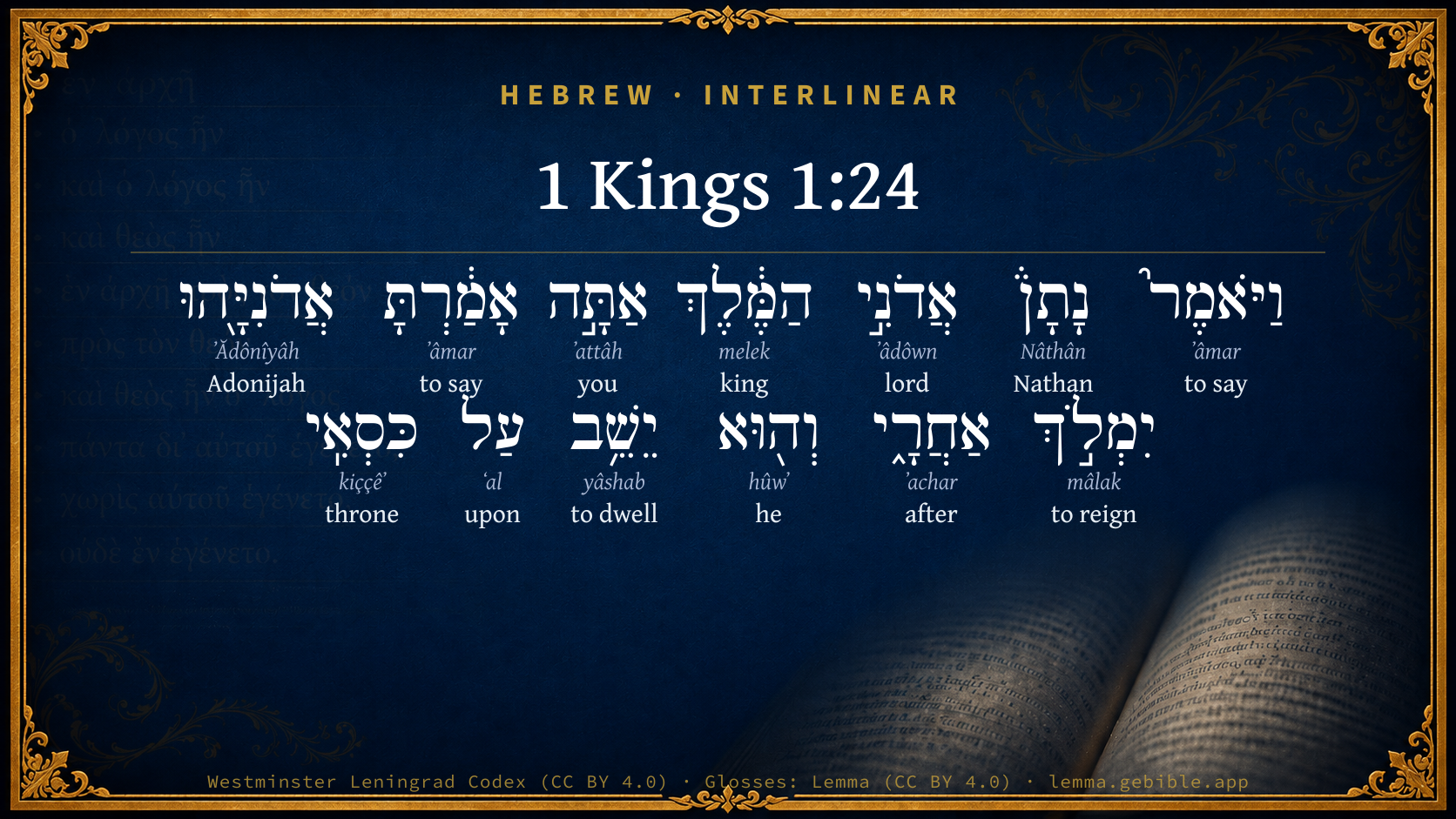
Hebrew (Westminster Leningrad Codex) 1 Kings 1:24 appears in the Hebrew Old Testament. The text above is from the Westminster Leningrad Codex. Each word links to its Strong’s number, a concise gloss, and parsing drawn from the Open Scriptures Hebrew Bible morphology. Click any word for its full Brown-Driver-Briggs (BDB) entry.
Download image
Cite this verse

1 Kings 1:24 (World English Bible). Public Domain. Lemma interlinear Bible study tool, https://lemma.gebible.app/v/1-kings/1/24.

Show BibTeX & RIS
BibTeX
RIS
English Translation
Nathan said, My lord, king, have you said, Adonijah shall reign after me, and he shall sit on my throne?
World English Bible · Public Domain
Download a study sheet

One document with this verse’s original text, its word-by-word gloss line, the meaning frame, cross-references with their text, attributed commentary, and full source and license credits — printable, and it pastes into notes with its structure intact.

This verse Autodidact and up

Study sheet (.html) Plain text (.txt)

A passage Seminary Student

Up to 50 verses in one chapter. A passage sheet keeps up to 6 commentary sources and 12 cross-references per verse, in the order this page ranks them, and says so on the sheet whenever that leaves anything out. Ask for a single verse and you get the Autodidact verse sheet above.

Everything on this page stays free to read, with no account — the sheet is a download of what is already on screen, not access to it.

Want to remove ads? Support Godless Engineer
Compare translations 3

The same verse in 3 English versions, stacked beneath the original-language interlinear above. Click any original word for its lexicon entry.

Each is an independent rendering of the whole verse — the interlinear is not word-aligned to these translations.

Highlighted words mark where these versions differ — a whole-verse word diff, not a word-by-word alignment.

  • World English Bible Public Domain
    Nathan said, My lord, king, have you said, Adonijah shall reign after me, and he shall sit on my throne?
  • King James Version Public Domain
    And Nathan said, My lord, O king, hast thou said, Adonijah shall reign after me, and he shall sit upon my throne?
  • unfoldingWord Literal Text CC BY-SA 4.0
    And Nathan said, “My lord the king, you, have you said, ‘Adonijah will reign after me, and he will sit on my throne’?

unfoldingWord Literal Text — © unfoldingWord, licensed CC BY-SA 4.0. Word-aligned USFM3 via Door43 (git.door43.org/unfoldingWord/en_ult).

Versions to compare (up to 4)

3 of 4 selected

Show all 18 translations

Every available English version of this verse, each an independent rendering of the whole verse.

  • World English Bible Public Domain
    Nathan said, My lord, king, have you said, Adonijah shall reign after me, and he shall sit on my throne?
  • Berean Standard Bible Public Domain
    “My lord the king,” said Nathan, “did you say, ‘Adonijah will reign after me, and he will sit on my throne’?
  • Majority Standard Bible Public Domain
    “My lord the king,” said Nathan, “did you say, ‘Adonijah will reign after me, and he will sit on my throne’?
  • King James Version Public Domain
    And Nathan said, My lord, O king, hast thou said, Adonijah shall reign after me, and he shall sit upon my throne?
  • American Standard Version (1901) Public Domain
    And Nathan said, My lord, O king, hast thou said, Adonijah shall reign after me, and he shall sit upon my throne?
  • Revised Version (1885) Public Domain
    And Nathan said, My lord, O king, hast thou said, Adonijah shall reign after me, and he shall sit upon my throne?
  • Geneva Bible (1599) Public Domain
    And Nathan saide, My lorde, O King, hast thou said, Adoniiah shall reigne after mee, and he shall sit vpon my throne?
  • Douay-Rheims (1899) Public Domain
    Nathan said: My lord O king, hast thou said: Let Adonias reign after me, and let him sit upon my throne?
  • Young's Literal Translation Public Domain
    And Nathan saith, `My lord, O king, thou hast said, Adonijah doth reign after me, and he doth sit on my throne;
  • Literal Standard Version CC BY-SA 4.0
    And Nathan says, “My lord, O king, you have said, Adonijah reigns after me, and he sits on my throne;
  • Unlocked Literal Bible CC BY-SA 4.0
    Nathan said, “My master the king, have you said, 'Adonijah will reign after me, and he will sit on my throne?'
  • unfoldingWord Literal Text CC BY-SA 4.0
    And Nathan said, “My lord the king, you, have you said, ‘Adonijah will reign after me, and he will sit on my throne’?
  • Darby Bible Public Domain
    And Nathan said, My lord, O king, hast thou said, Adonijah shall reign after me, and he shall sit on my throne?
  • World Messianic Bible Public Domain
    Nathan said, “My lord, King, have you said, ‘Adonijah shall reign after me, and he shall sit on my throne’?
  • Webster's Bible Public Domain
    And Nathan said, My lord, O king, hast thou said, Adonijah shall reign after me, and he shall sit upon my throne?
  • Free Bible Version CC BY-SA 4.0
    Nathan asked the king, “Your Majesty, you must have announced, ‘Adonijah will be king after me and will sit on my throne.’
  • Bible in Basic English Public Domain
    And Nathan said, O my lord king, have you said, Adonijah is to be king after me, seated on the seat of my kingdom?
  • JPS Tanakh (1917) Public Domain
    And Nathan said: 'My lord, O king, hast thou said: Adonijah shall reign after me, and he shall sit upon my throne?

Literal Standard Version (2020), Covenant Press — licensed CC BY-SA 4.0. Text via the HelloAO Bible API (eBible.org). Unlocked Literal Bible (unfoldingWord) — licensed CC BY-SA 4.0. Text via the HelloAO Bible API (eBible.org). unfoldingWord Literal Text — © unfoldingWord, licensed CC BY-SA 4.0. Word-aligned USFM3 via Door43 (git.door43.org/unfoldingWord/en_ult). Free Bible Version, Dr. Jonathan Gallagher — licensed CC BY-SA 4.0. Text via the HelloAO Bible API (eBible.org).

Word by word

More ways to search: Search by grammar → Find every occurrence → Compare this word →

Practice this passage: Drill this verse → Learn its vocabulary →

אֲדֹנִיָּ֖הוּ
ʼĂdônîyâh
H138
“Adonijah”
Noun, Proper
Part of Speech
Noun
Type
Proper
Full BDB Definition

Origin: from H113 and H3050

TWOT: None

Adonijah = "my lord is Jehovah" - fourth son of David and Solomon's rival for the throne - Levite sent by Jehoshaphat to teach the Law - a chief of the people who co-operated with Nehemiah
  1. וַיֹּאמֶר֮ ʼâmar H559 “and · to say” Conjunction + Verb, Qal, Sequential Imperfect, 3rd Person, Masculine, Singular
  2. נָתָן֒ Nâthân H5416 “Nathan” Noun, Proper
  3. אֲדֹנִ֣י ʼâdôwn H113 “lord · my” Noun, Common, Masculine, Singular, Construct + Suffix, Personal, 1st Person, Common, Singular
  4. הַמֶּ֔לֶךְ melek H4428 “the · king” Particle, Definite Article + Noun, Common, Masculine, Singular, Absolute
  5. אַתָּ֣ה ʼattâh H859 “you” Pronoun, Personal, 2nd Person, Masculine, Singular
  6. אָמַ֔רְתָּ ʼâmar H559 “to say” Verb, Qal, Perfect, 2nd Person, Masculine, Singular
  7. יִמְלֹ֣ךְ mâlak H4427 “to reign” Verb, Qal, Imperfect, 3rd Person, Masculine, Singular
  8. אַחֲרָ֑י ʼachar H310 “after · me” Preposition + Suffix, Personal, 1st Person, Common, Singular
  9. וְה֖וּא hûwʼ H1931 “and · he” Conjunction + Pronoun, Personal, 3rd Person, Masculine, Singular
  10. יֵשֵׁ֥ב yâshab H3427 “to dwell” Verb, Qal, Imperfect, 3rd Person, Masculine, Singular
  11. עַל ʻal H5921 “upon” Preposition
  12. כִּסְאִֽי kiççêʼ H3678 “throne · my” Noun, Common, Masculine, Singular, Construct + Suffix, Personal, 1st Person, Common, Singular

About this verse

These counts appear in no published source. They are computed here, from the morphology-tagged text and Lemma’s own curated glosses. What Lemma adds →

13
words
12
distinct lemmas
Historical
section

Shared distinctive vocabulary

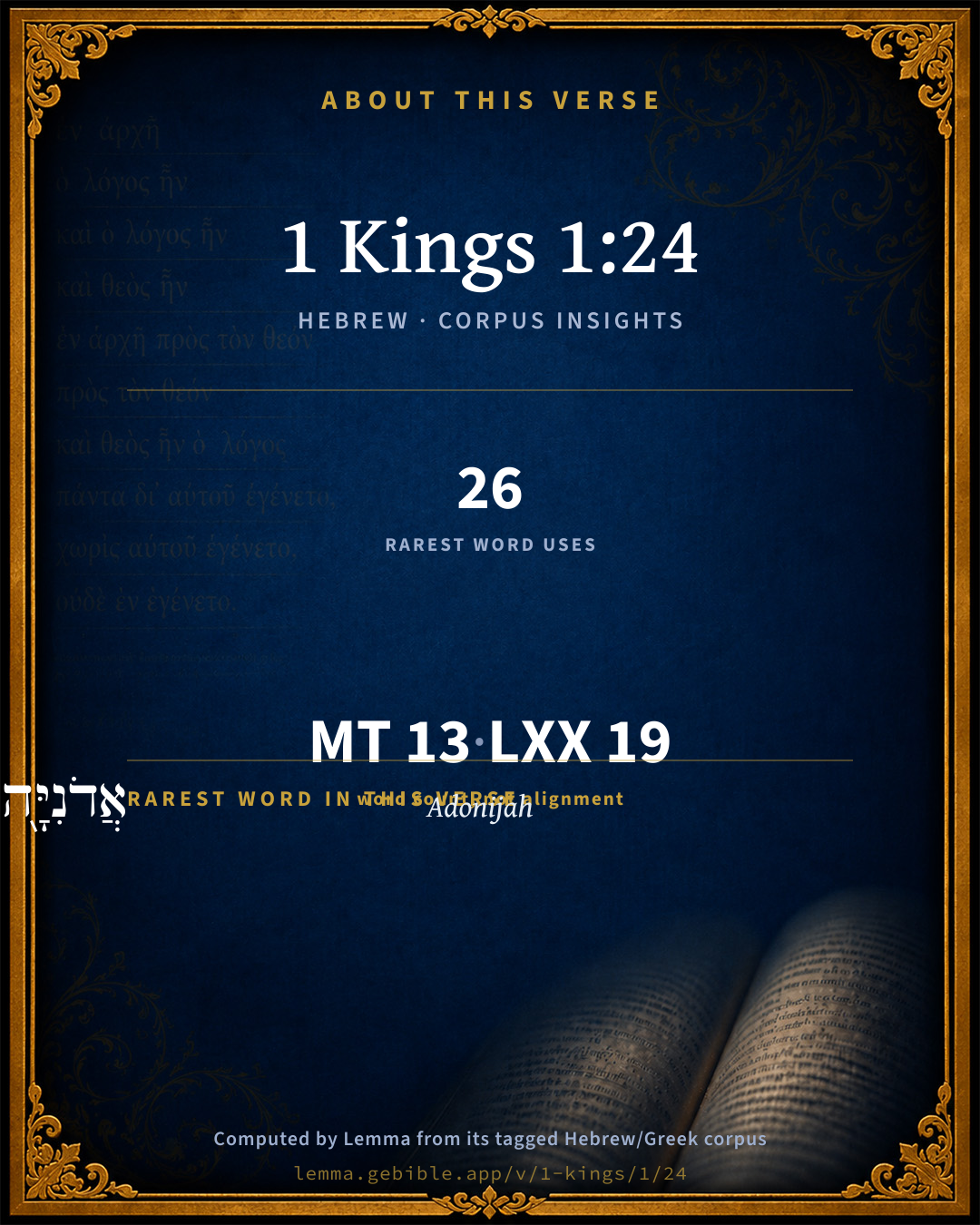
אֲדֹנִיָּ֖הוּ Adonijah H138 occurs in 26 verses of the Hebrew Bible. Also found in:

Grammatical profile

  • 4 verbs
  • 5 nouns
  • 2 pronouns
  • 2 prepositions

Verb forms

  • וַיֹּאמֶר֮ Qal · Sequential Imperfect
  • אָמַ֔רְתָּ Qal · Perfect
  • יִמְלֹ֣ךְ Qal · Imperfect
  • יֵשֵׁ֥ב Qal · Imperfect

Repetition

A word recurs within this verse — often emphatic in Hebrew:

  • וַיֹּאמֶר֮ to say H559 ×2

Hebrew & Septuagint length

In English translation the verse runs 20 words from the Hebrew and 22 from the Septuagint (LXX English) — closely comparable.

A rough comparison of the two English renderings, which tokenize alike — not a word-level alignment.

Word counts can differ between the Hebrew and the Greek without any difference in meaning — e.g. the Hebrew direct-object marker אֵת has no separate Greek word, and Greek often adds the article ὁ.

In the original languages it is 13 Hebrew tokens and 19 Greek tokens — but the two are counted differently (Hebrew bundles its prefixes and suffixes into one token; the Greek is in lemma form), so that isn’t a like-for-like length.

Cross-references

3

Topical passages linked to 1 Kings 1:24 in the Treasury of Scripture Knowledge — connected by theme and wording, ordered by reader-vote popularity; previews shown in the World English Bible.

  • 1 Kings 1:5 Then Adonijah the son of Haggith exalted himself, saying, I will be king: and he prepared him chariots and horsemen, and fifty men to run before him.
  • 1 Kings 1:13–14 Go and get you in to king David, and tell him, Didn't you, my lord, king, swear to your handmaid, saying, Assuredly Solomon your son shall reign after me, and he shall sit on my throne? why then does Adonijah reign?
  • 1 Kings 1:17–18 She said to him, My lord, you swore by Yahweh your God to your handmaid, [saying], Assuredly Solomon your son shall reign after me, and he shall sit on my throne.

Cross-references courtesy of OpenBible.info (CC BY 4.0).

Hebrew and Greek witnesses Masoretic Hebrew ↔ Greek Septuagint

The same verse in the two great witnesses to the Old Testament, shown verse-for-verse.

These are two independent witnesses, not word-aligned to each other, and the Septuagint is shown in lemma (dictionary) form.

Hebrew 1 Kings 1:24 Masoretic · Westminster Leningrad Codex

וַיֹּאמֶר֮ נָתָן֒ אֲדֹנִ֣י הַמֶּ֔לֶךְ אַתָּ֣ה אָמַ֔רְתָּ אֲדֹנִיָּ֖הוּ יִמְלֹ֣ךְ אַחֲרָ֑י וְה֖וּא יֵשֵׁ֥ב עַל כִּסְאִֽי

Nathan said, My lord, king, have you said, Adonijah shall reign after me, and he shall sit on my throne?

World English Bible · Public Domain

Greek LXX 1 Kings 1:24 Septuagint · lemma form

καί εἶπον ναθαν κύριος ἐγώ βασιλεύς σύ εἶπον αδωνίας βασιλεύω ὀπίσω ἐγώ καί αὐτός καταἵημι ἐπί ὁ θρόνος ἐγώ

And Nathan said, My lord, O king, did you say, Adonias shall reign after me, and he shall sit upon my throne?

LXX2012 (modern English Septuagint) · Public Domain

Hebrew: Westminster Leningrad Codex (CC BY 4.0). Greek: Septuagint (public domain); English from LXX2012 (modern English Septuagint) (Public Domain). How the Septuagint differs from the Hebrew →

Targum (Aramaic paraphrase)

1

The Targum is the ancient Jewish Aramaic paraphrase of the Hebrew Scriptures — an interpretive translation, not the Hebrew text itself. Onkelos (literal) and Pseudo-Jonathan (expansive) render the Torah, and Jonathan the Prophets. Coverage is partial: where no permissively-licensed English translation exists for a verse, only the Aramaic is shown. This is verse-level text, not a word-by-word alignment to the Hebrew.

  1. Targum Jonathan Prophets (Joshua–Malachi)
    וַאֲמַר נָתָן רִבּוֹנִי מַלְכָּא אַתְּ אֲמַרְתְּ אֲדֹנִיָה יִמְלוֹךְ בַּתְרַי וְהוּא יִתֵּיב עַל כּוּרְסֵי מַלְכוּתִי:

    (no public-domain English translation for this verse)

    Targum Jonathan — Aramaic: “Mikraot Gedolot” (public domain). English: “Sefaria Community Translation” (CC0 1.0 (public-domain dedication)); “London "Chaldee Paraphrase," 1871” (public domain). Text via Sefaria.

Commentary

Notes on 1 Kings 1:24 from classic Christian and Jewish commentators (each source and its license shown beneath its notes). The classic Christian expositions comment on the surrounding passage and are grouped to its opening verse, so a note may address several verses; the Jewish commentaries on the Tanakh (Rashi and others) are per-verse, so they appear only where the commentator wrote on this verse.

Lemma curates 59 commentaries, every one of them public domain or Creative Commons licensed, each selected and text-cleaned for this edition rather than reprinted as found. About our sources →

Trapp's Complete Commentary

John Trapp

1Ki 1:24 And Nathan said, My lord, O king, hast thou said, Adonijah shall reign after me, and he shall sit upon my throne?

Ver. 24. Hast thou said?] q.d., I think not. Exordium ex abrupto, per admirationem.

John Trapp, A Commentary or Exposition upon All the Books of the Old and New Testament (1647–1656) — public domain. Text from a community e-Sword module.

Ellicott's Commentary for English Readers

(24) Hast thou said.—The question here and in 1Ki_1:27 is, of course, merely intended to draw out denial; but it is singularly true to nature that it does so by the assumption (natural in court language) that nothing of such a kind could be even conceived as done without the king’s will. There is something striking in the contrast of the deference of Nathan as a counsellor on state business with the bold superiority of his tone in the discharge of his true prophetic office (as in 2Sa_7:2-17; 2Sa_12:1-14).

A Bible Commentary for English Readers, edited by Charles John Ellicott (1878–1897) — public domain. Text from a community e-Sword module.

The Cambridge Bible for Schools and Colleges

gen. ed. J. J. S. Perowne

24. hast thou said] There is nothing in the Hebrew to mark the question. It must have been indicated by the tone. It would come with much force from Nathan, as he knew all the circumstances of God’s promise that Solomon should be king after David. He shews by his language in 1Ki_1:27 that any change in the plans for the succession should not have been made without his knowledge. After the divine messages which had been sent to the king through Nathan, the prophet’s relation to David was different from that of other subjects.

The Cambridge Bible for Schools and Colleges (gen. ed. J. J. S. Perowne; Cambridge University Press, 1878–1918) — public domain. Text from a community e-Sword module.

John Gill's Exposition

And Nathan said, my lord, O king,.... He addresses him as with great veneration and respect due to his office, so as if he knew noticing of Bathsheba's application to him; and therefore begins and tells his story, as if the king had never heard anything relative to it:

hast thou said, Adonijah shall reign after me, and he shall sit upon my throne? surely it can never be, because of the notice which he himself had given him from the Lord, that one to be born should succeed him, plainly pointing to Solomon; and also because of the oath which he had sworn, to which Nathan was privy, that Solomon should reign after him; and yet if he had not given such orders, it was exceeding strange that Adonijah should presume to do what he had done.

John Gill's Exposition of the Whole Bible (1746–1763) — public domain (CC PDM 1.0). Text via the HelloAO Bible API.

Albert Barnes' Notes on the Bible

Hast thou said - Thou hast said. In the original no question is asked. Nathan assumes, as far as words go, that the king has made this declaration. He wishes to draw forth a disclaimer.

Albert Barnes' Notes on the Bible (1834–1885) — public domain. Text from a community e-Sword/MySword module.

Matthew Poole's English Annotations

Is this done by thy consent? without which it seems strange that he durst attempt it.

Matthew Poole's English Annotations on the Holy Bible (1683–1685) — public domain. Text from a community e-Sword/MySword module.

The Pulpit Commentary

And Nathan said, My Lord, O king, hast thou said the Hebrews has no question, but a strong affirmation: "thou hast said," i.e., " thou must have said (Du hast wohl gesagt." Bahr). Nathan puts it thus forcibly, in order to draw from the king a disclaimer, Adonijah shall reign after me, and he shall sit upon my throne? Same words as in vers. 13, 17, and possibly designedly so. The coincidence conveys the meaning, "Thou hast sworn Solomon shall reign," etc. "Thou hast said, Adonijah shall reign," etc. And the king said, Bring me a sword. And they brought a Heb. the; the sword, i.e., of the executioner, or the sword for which he asked sword before the king.

The Pulpit Commentary (1880–1919), ed. H.D.M. Spence-Jones & Joseph S. Exell — public domain. Text from a community e-Sword module.

unfoldingWord translationNotes

Door43 World Missions Community

General Information:

Nathan the prophet continues to speak to King David.

have you said, 'Adonijah will reign after me, and he will sit on my throne?'

This can be stated as an indirect quotation. AT: "have you said that Adonijah will reign after you, and he will sit on your throne?" (See: Direct and Indirect Quotations)

he will sit on my throne

Sitting on the throne is a metonym for being king. See how you translated this in 1 Kings 1:13. AT: "he will be king just as I was"

eating and drinking before him

Adonijah probably sat at a table where he could watch all those he had invited as they ate and drank. The main idea is that the people Nathan named were with Adonijah and they were celebrating together. AT: "eating and drinking with him" or "eating and drinking where he can see them" (See: Idiom and Assumed Knowledge and Implicit Information)

translationWords

reign

throne

sacrifice

life

unfoldingWord translationNotes — © Distant Shores Media and the Door43 World Missions Community, licensed CC BY-SA 4.0. Source: git.door43.org/Door43/en_tn.

Rashi

Rabbi Shlomo Yitzchaki (Rashi)

Did you say. In the interrogative.

Rashi on the Tanakh — English translations: “The Judaica Press complete Tanach with Rashi, translated by A. J. Rosenberg” (CC BY 4.0); “Pentateuch with Rashi's commentary by M. Rosenbaum and A.M. Silbermann, 1929-1934” (public domain); “The Metsudah Tanach series, Lakewood, N.J” (CC BY 4.0); and “The Book of Joshua, Metsudah Publications, 1997” (CC BY 4.0). Text via Sefaria.

Lesson kit

Teaching starters — assembled from the data on this page, not authored interpretation. Every prompt links to the verse data it draws on. Edit before teaching.

1 Kings, in the Historical, opens this verse with 13 words (12 distinct Hebrew lemmas). Its most distinctive word is ʼĂdônîyâh (“Adonijah”). A historical commentator’s framing appears above. Read the whole chapter for the surrounding context.

Discussion questions

  1. The word ʼĂdônîyâh carries the sense “Adonijah.” How does it shape the verse?
  2. 2 Samuel 3:4 shares the word «Adonijah» with this verse. How do the two illuminate each other?
  3. “to say” occurs 2× in this one verse. What is the effect of the repetition?
  4. These translations render this verse differently. What is at stake in choosing one wording over another?
  5. The verb «וַיֹּאמֶר֮» is Qal Sequential Imperfect. How does its form color the action?
  6. Reading how Trapp's Complete Commentary and Ellicott's Commentary for English Readers read this verse, where do the two commentators agree and where do they part?

Things to notice

Reading settings

Reading text

Shown beneath each verse's original-language words.

Old Testament
Old Testament edition

Read the OT as the Masoretic Hebrew (MT) or the Greek Septuagint (LXX).

English shown for the Greek Septuagint (in the Hebrew ↔ Greek comparison).

Comparing translations? Open the Compare panel on any verse page to stack up to four side by side.