
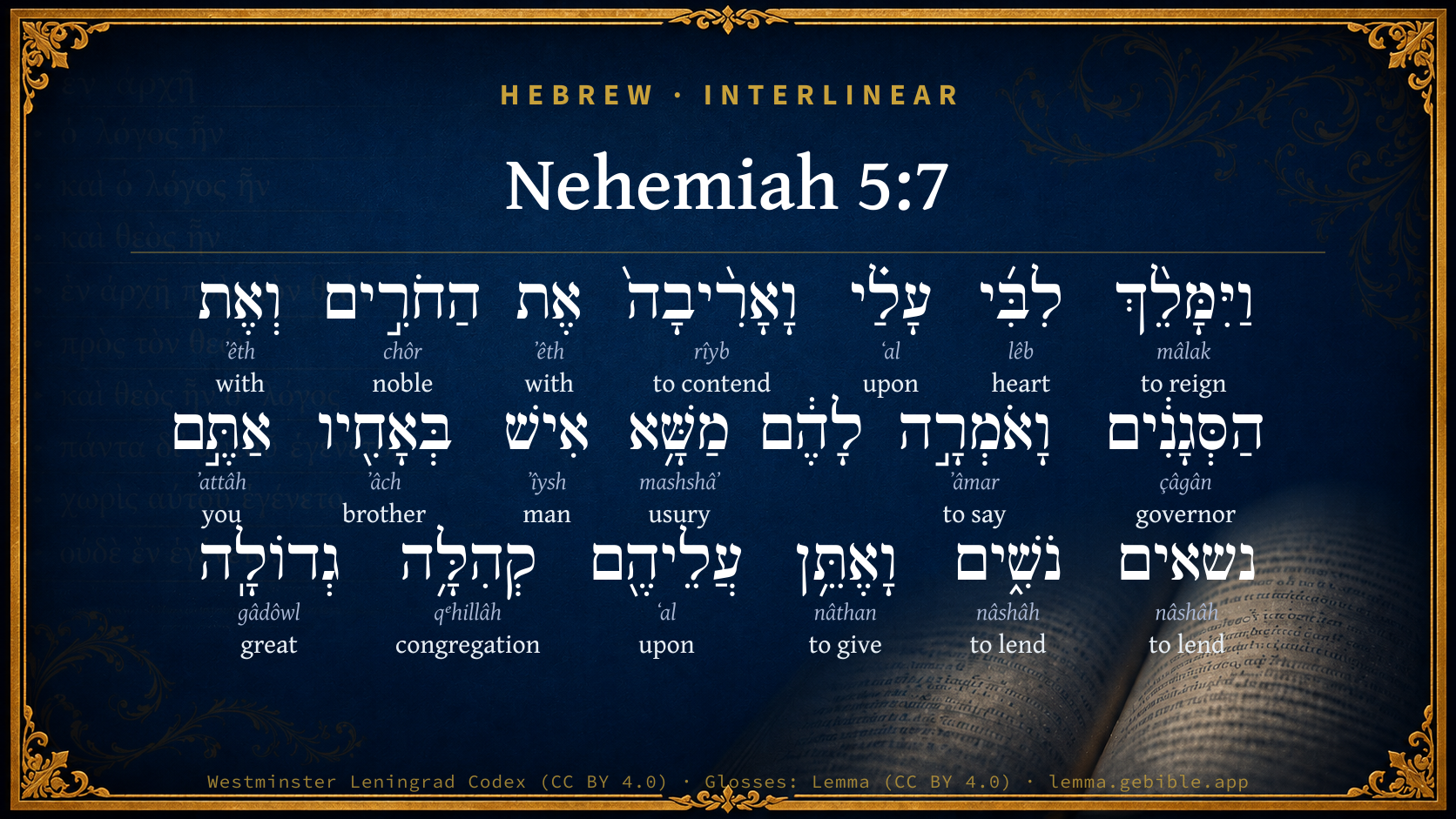
Nehemiah 5:7

Hebrew (Westminster Leningrad Codex) Nehemiah 5:7 appears in the Hebrew Old Testament. The text above is from the Westminster Leningrad Codex. Each word links to its Strong’s number, a concise gloss, and parsing drawn from the Open Scriptures Hebrew Bible morphology. Click any word for its full Brown-Driver-Briggs (BDB) entry.
Download image
Cite this verse

Nehemiah 5:7 (World English Bible). Public Domain. Lemma interlinear Bible study tool, https://lemma.gebible.app/v/nehemiah/5/7.

Show BibTeX & RIS
BibTeX
RIS
English Translation
Then I consulted with myself, and contended with the nobles and the rulers, and said to them, You exact usury, everyone of his brother. I held a great assembly against them.
World English Bible · Public Domain
Highlights
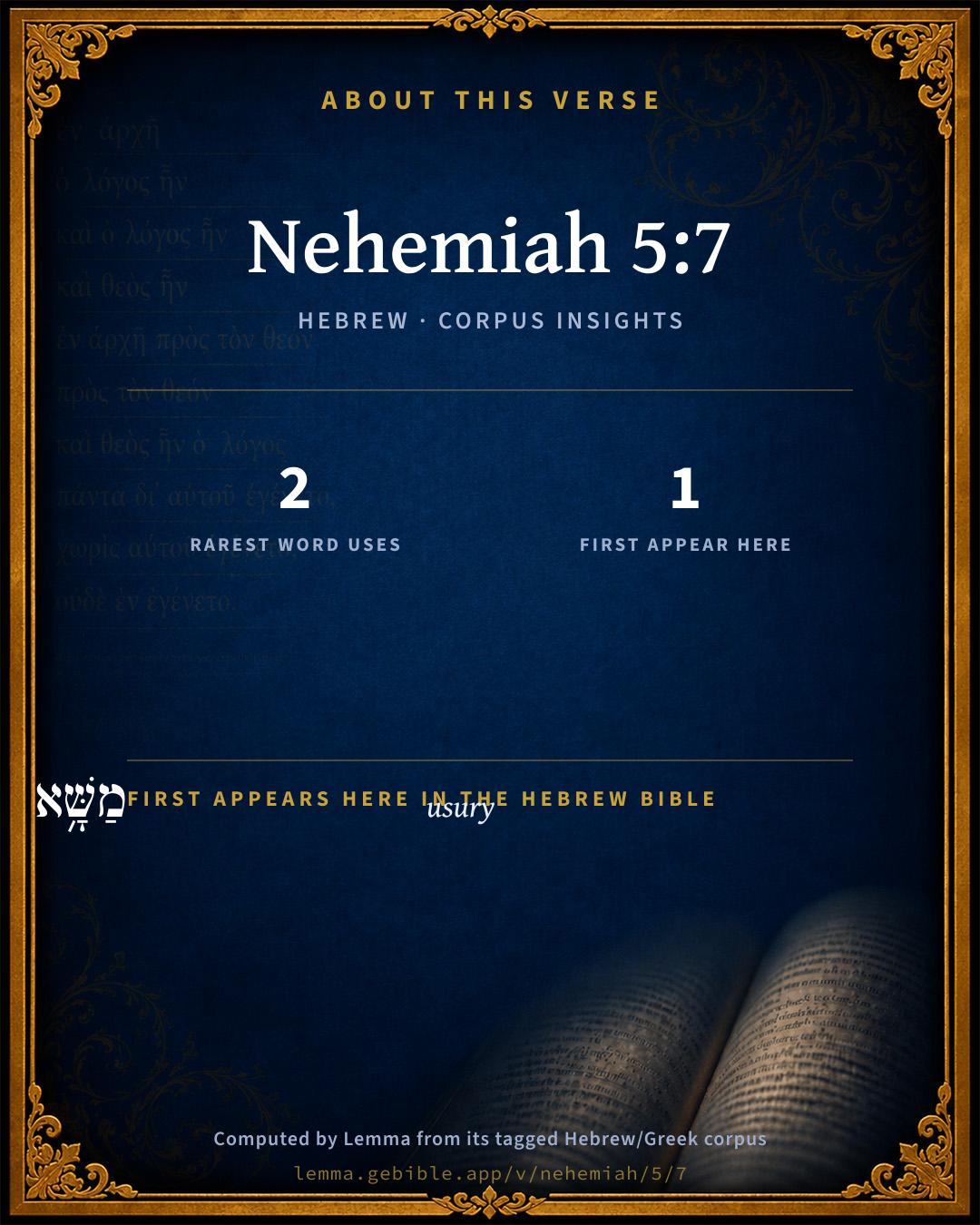
  • 1 first appearance in the Hebrew Bible
Full analysis ↓
Download a study sheet

One document with this verse’s original text, its word-by-word gloss line, the meaning frame, cross-references with their text, attributed commentary, and full source and license credits — printable, and it pastes into notes with its structure intact.

This verse Autodidact and up

Study sheet (.html) Plain text (.txt)

A passage Seminary Student

Up to 50 verses in one chapter. A passage sheet keeps up to 6 commentary sources and 12 cross-references per verse, in the order this page ranks them, and says so on the sheet whenever that leaves anything out. Ask for a single verse and you get the Autodidact verse sheet above.

Everything on this page stays free to read, with no account — the sheet is a download of what is already on screen, not access to it.

Want to remove ads? Support Godless Engineer
Compare translations 3

The same verse in 3 English versions, stacked beneath the original-language interlinear above. Click any original word for its lexicon entry.

Each is an independent rendering of the whole verse — the interlinear is not word-aligned to these translations.

Highlighted words mark where these versions differ — a whole-verse word diff, not a word-by-word alignment.

  • World English Bible Public Domain
    Then I consulted with myself, and contended with the nobles and the rulers, and said to them, You exact usury, everyone of his brother. I held a great assembly against them.
  • King James Version Public Domain
    Then I consulted with myself, and I rebuked the nobles, and the rulers, and said unto them, Ye exact usury, every one of his brother. And I set a great assembly against them.
  • unfoldingWord Literal Text CC BY-SA 4.0
    And my heart reigned over me, and I contended with the nobles and with the prefects. And I said to them, “You are lending interest, a man against his brother!” And I put forth a great assembly against them.

unfoldingWord Literal Text — © unfoldingWord, licensed CC BY-SA 4.0. Word-aligned USFM3 via Door43 (git.door43.org/unfoldingWord/en_ult).

Versions to compare (up to 4)

3 of 4 selected

Show all 18 translations

Every available English version of this verse, each an independent rendering of the whole verse.

  • World English Bible Public Domain
    Then I consulted with myself, and contended with the nobles and the rulers, and said to them, You exact usury, everyone of his brother. I held a great assembly against them.
  • Berean Standard Bible Public Domain
    and after serious thought I rebuked the nobles and officials, saying, “You are exacting usury from your own brothers!” So I called a large assembly against them
  • Majority Standard Bible Public Domain
    and after serious thought I rebuked the nobles and officials, saying, “You are exacting usury from your own brothers!” So I called a large assembly against them
  • King James Version Public Domain
    Then I consulted with myself, and I rebuked the nobles, and the rulers, and said unto them, Ye exact usury, every one of his brother. And I set a great assembly against them.
  • American Standard Version (1901) Public Domain
    Then I consulted with myself, and contended with the nobles and the rulers, and said unto them, Ye exact usury, every one of his brother. And I held a great assembly against them.
  • Revised Version (1885) Public Domain
    Then I consulted with myself, and contended with the nobles and the rulers, and said unto them, Ye exact usury, every one of his brother. And I held a great assembly against them.
  • Geneva Bible (1599) Public Domain
    And I thought in my minde, and I rebuked the princes, and the rulers, and saide vnto them, You lay burthens euery one vpon his brethren: and I set a great assemblie against them,
  • Douay-Rheims (1899) Public Domain
    And my heart thought with myself: and I rebuked the nobles and magistrates, and said to them: Do you every one ex- act usury of your brethren? And I gathered together a great assembly against them,
  • Young's Literal Translation Public Domain
    and my heart reigneth over me, and I strive with the freemen, and with the prefects, and say to them, `Usury one upon another ye are exacting;' and I set against them a great assembly,
  • Literal Standard Version CC BY-SA 4.0
    and my heart reigns over me, and I strive with the nobles, and with the prefects, and say to them, “You are exacting usury on one another”; and I set against them a great assembly,
  • Unlocked Literal Bible CC BY-SA 4.0
    Then I thought about this, and brought charges against the nobles and officials. I said to them, “You are exacting interest, each from his own brother.” I held a great assembly against them
  • unfoldingWord Literal Text CC BY-SA 4.0
    And my heart reigned over me, and I contended with the nobles and with the prefects. And I said to them, “You are lending interest, a man against his brother!” And I put forth a great assembly against them.
  • Darby Bible Public Domain
    And I consulted with myself; and I remonstrated with the nobles and the rulers, and said to them, Ye exact usury, every one of his brother! And I set a great assembly against them.
  • World Messianic Bible Public Domain
    Then I consulted with myself, and contended with the nobles and the rulers, and said to them, “You exact usury, everyone of his brother.” I held a great assembly against them.
  • Webster's Bible Public Domain
    Then I consulted with myself, and I rebuked the nobles, and the rulers, and said to them, Ye exact interest, every one of his brother. And I set a great assembly against them.
  • Free Bible Version CC BY-SA 4.0
    I thought it over and then I went to argue with the nobles and officials, telling them, “You are charging your own brothers interest!” So I called a large meeting to deal with them.
  • Bible in Basic English Public Domain
    And after turning it over in my mind, I made a protest to the chiefs and the rulers, and said to them, Every one of you is taking interest from his countryman. And I got together a great meeting of protest.
  • JPS Tanakh (1917) Public Domain
    Then I consulted with myself, and contended with the nobles and the rulers, and said unto them: 'Ye lend upon pledge, every one to his brother.' And I held a great assembly against them.

Literal Standard Version (2020), Covenant Press — licensed CC BY-SA 4.0. Text via the HelloAO Bible API (eBible.org). Unlocked Literal Bible (unfoldingWord) — licensed CC BY-SA 4.0. Text via the HelloAO Bible API (eBible.org). unfoldingWord Literal Text — © unfoldingWord, licensed CC BY-SA 4.0. Word-aligned USFM3 via Door43 (git.door43.org/unfoldingWord/en_ult). Free Bible Version, Dr. Jonathan Gallagher — licensed CC BY-SA 4.0. Text via the HelloAO Bible API (eBible.org).

Word by word

More ways to search: Search by grammar → Find every occurrence → Compare this word →

Practice this passage: Drill this verse → Learn its vocabulary →

קְהִלָּ֥ה
qᵉhillâh
H6952
“congregation”
Noun, Common, Feminine, Singular, Absolute
Part of Speech
Noun
Type
Common
Gender
Feminine
Number
Singular
State
Absolute
Full BDB Definition

Origin: from H6950

TWOT: 1991b

assembly, congregation
  1. וַיִּמָּלֵ֨ךְ mâlak H4427 “and · to reign” Conjunction + Verb, Niphal, Sequential Imperfect, 3rd Person, Masculine, Singular
  2. לִבִּ֜י lêb H3820 “heart · my” Noun, Common, Masculine, Singular, Construct + Suffix, Personal, 1st Person, Common, Singular
  3. עָלַ֗י ʻal H5921 “upon · me” Preposition + Suffix, Personal, 1st Person, Common, Singular
  4. וָאָרִ֨יבָה֙ rîyb H7378 “and · to contend” Conjunction + Verb, Qal, Sequential Imperfect, 1st Person, Common, Singular + Suffix, h
  5. אֶת ʼêth H854 “with” Preposition
  6. הַחֹרִ֣ים chôr H2715 “the · nobles” Particle, Definite Article + Noun, Common, Masculine, Plural, Absolute
  7. וְאֶת ʼêth H854 “and · with” Conjunction + Preposition
  8. הַסְּגָנִ֔ים çâgân H5461 “the · governors” Particle, Definite Article + Noun, Common, Masculine, Plural, Absolute
  9. וָאֹמְרָ֣ה ʼâmar H559 “and · to say” Conjunction + Verb, Qal, Sequential Imperfect, 1st Person, Common, Singular + Suffix, h
  10. מַשָּׁ֥א mashshâʼ H4855 “usury” Noun, Common, Masculine, Singular, Absolute
  11. אִישׁ ʼîysh H376 “man” Noun, Common, Masculine, Singular, Absolute
  12. בְּאָחִ֖יו ʼâch H251 “in/at · brother · his” Preposition + Noun, Common, Masculine, Singular, Construct + Suffix, Personal, 3rd Person, Masculine, Singular
  13. אַתֶּ֣ם ʼattâh H859 “you” Pronoun, Personal, 2nd Person, Masculine, Plural
  14. נשאים nâshâh H5383 “lending” Verb, Qal, Participle Active, Masculine, Plural, Absolute
  15. נֹשִׁ֑ים nâshâh H5383 “lending” Verb, Qal, Participle Active, Masculine, Plural, Absolute
  16. וָאֶתֵּ֥ן nâthan H5414 “and · to give” Conjunction + Verb, Qal, Sequential Imperfect, 1st Person, Common, Singular
  17. עֲלֵיהֶ֖ם ʻal H5921 “upon · them” Preposition + Suffix, Personal, 3rd Person, Masculine, Plural
  18. גְדוֹלָֽה gâdôwl H1419 “great” Adjective, Adjective, Feminine, Singular, Absolute

About this verse

These counts appear in no published source. They are computed here, from the morphology-tagged text and Lemma’s own curated glosses. What Lemma adds →

20
words
16
distinct lemmas
Historical
section

Notable vocabulary

The rarest word here is קְהִלָּ֥ה congregation H6952 — appearing just 2 times in the whole Hebrew Bible.

First appearance in Scripture

This word makes its first canonical appearance in the Hebrew Bible here:

  • מַשָּׁ֥א usury H4855

Shared distinctive vocabulary

קְהִלָּ֥ה congregation H6952 occurs in 2 verses of the Hebrew Bible. Also found in:

Grammatical profile

  • 6 verbs
  • 7 nouns
  • 1 adjective
  • 1 pronoun
  • 5 prepositions

Verb forms

  • וַיִּמָּלֵ֨ךְ Niphal · Sequential Imperfect
  • וָאָרִ֨יבָה֙ Qal · Sequential Imperfect
  • וָאֹמְרָ֣ה Qal · Sequential Imperfect
  • נשאים Qal · Participle Active
  • נֹשִׁ֑ים Qal · Participle Active
  • וָאֶתֵּ֥ן Qal · Sequential Imperfect

Repetition

Words recur within this verse — often emphatic in Hebrew:

  • עָלַ֗י upon H5921 ×2
  • נשאים to lend H5383 ×2
  • אֶת with H854 ×2

Cross-references

21

Topical passages linked to Nehemiah 5:7 in the Treasury of Scripture Knowledge — connected by theme and wording, ordered by reader-vote popularity; previews shown in the World English Bible.

  • Leviticus 25:36 Take no interest from him or profit, but fear your God; that your brother may live among you.
  • Deuteronomy 23:19–20 You shall not lend on interest to your brother; interest of money, interest of food, interest of anything that is lent on interest:
  • Exodus 22:25 "If you lend money to any of my people with you who is poor, you shall not be to him as a creditor; neither shall you charge him interest.
  • Leviticus 19:15 "'You shall do no injustice in judgment: you shall not be partial to the poor, nor show favoritism to the great; but in righteousness shall you judge your neighbor.
  • Deuteronomy 15:2–3 This is the manner of the release: every creditor shall release that which he has lent to his neighbor; he shall not exact it of his neighbor and his brother; because Yahweh's release has been proclaimed.
  • Deuteronomy 24:10–13 When you do lend your neighbor any manner of loan, you shall not go into his house to get his pledge.
  • 2 Chronicles 19:6–7 and said to the judges, Consider what you do: for you don't judge for man, but for Yahweh; and [he is] with you in the judgment.
  • Psalms 15:5 He who doesn't lend out his money for usury, Nor take a bribe against the innocent. He who does these things shall never be shaken.
  • Ezekiel 22:12 In you have they taken bribes to shed blood; you have taken interest and increase, and you have greedily gained of your neighbors by oppression, and have forgotten me, says the Lord Yahweh.
  • 2 Chronicles 28:9–13 But a prophet of Yahweh was there, whose name was Oded: and he went out to meet the host that came to Samaria, and said to them, Behold, because Yahweh, the God of your fathers, was angry with Judah, he has delivered them into your hand, and you have slain them in a rage which has reached up to heaven.
  • Psalms 4:4 Stand in awe, and don't sin. Search your own heart on your bed, and be still. Selah.
  • Psalms 15:1 Yahweh, who shall dwell in your sanctuary? Who shall live on your holy hill?
  • Psalms 27:8 When you said, "Seek my face," My heart said to you, "I will seek your face, Yahweh."
  • Psalms 82:1–4 God presides in the great assembly. He judges among the gods.
  • Proverbs 27:5 Better is open rebuke Than hidden love.
  • Ezekiel 45:9 Thus says the Lord Yahweh: Let it suffice you, princes of Israel: remove violence and spoil, and execute justice and righteousness; dispossessing my people, says the Lord Yahweh.
  • Matthew 18:17 If he refuses to listen to them, tell it to the assembly. If he refuses to hear the assembly also, let him be to you as a Gentile or a tax collector.
  • 2 Corinthians 5:16 Therefore we know no one after the flesh from now on. Even though we have known Christ after the flesh, yet now we know him so no more.
  • Galatians 2:11 But when Peter came to Antioch, I resisted him to the face, because he stood condemned.
  • 1 Timothy 5:20 Those who sin, reprove in the sight of all, that the rest also may be in fear.
  • Titus 2:15 Say these things and exhort and reprove with all authority. Let no man despise you.

Cross-references courtesy of OpenBible.info (CC BY 4.0).

Hebrew and Greek witnesses Masoretic Hebrew ↔ Greek Septuagint

The same verse in the two great witnesses to the Old Testament, shown verse-for-verse.

These are two independent witnesses, not word-aligned to each other, and the Septuagint is shown in lemma (dictionary) form.

Hebrew Nehemiah 5:7 Masoretic · Westminster Leningrad Codex

וַיִּמָּלֵ֨ךְ לִבִּ֜י עָלַ֗י וָאָרִ֨יבָה֙ אֶת הַחֹרִ֣ים וְאֶת הַסְּגָנִ֔ים וָאֹמְרָ֣ה לָהֶ֔ם מַשָּׁ֥א אִישׁ בְּאָחִ֖יו אַתֶּ֣ם נשאים נֹשִׁ֑ים וָאֶתֵּ֥ן עֲלֵיהֶ֖ם קְהִלָּ֥ה גְדוֹלָֽה

Then I consulted with myself, and contended with the nobles and the rulers, and said to them, You exact usury, everyone of his brother. I held a great assembly against them.

World English Bible · Public Domain

Greek LXX Structure differs

The Septuagint has no separate book of Nehemiah. Its Greek text is the second half of Esdras B (2 Esdras), chapters 11–23; Ezra is the first half (1–10).

A verse-for-verse comparison isn’t shown here because the chapters and verses don’t line up. Switch to the LXX edition with the MT / LXX toggle above to read the Greek directly.

Hebrew: Westminster Leningrad Codex (CC BY 4.0). Greek: Septuagint (public domain); English from a public-domain English Septuagint. How the Septuagint differs from the Hebrew →

Commentary

Notes on Nehemiah 5:7 from classic Christian and Jewish commentators (each source and its license shown beneath its notes). The classic Christian expositions comment on the surrounding passage and are grouped to its opening verse, so a note may address several verses; the Jewish commentaries on the Tanakh (Rashi and others) are per-verse, so they appear only where the commentator wrote on this verse.

Lemma curates 59 commentaries, every one of them public domain or Creative Commons licensed, each selected and text-cleaned for this edition rather than reprinted as found. About our sources →

Trapp's Complete Commentary

John Trapp

Neh 5:7 Then I consulted with myself, and I rebuked the nobles, and the rulers, and said unto them, Ye exact usury, every one of his brother. And I set a great assembly against them.

Ver. 7. Then I consulted with myself] As reason required; he was very angry, but yet he keeps within compass, and practiseth that rule, Be angry, and sin not: which, saith one, is the easiest charge under the hardest condition that can be. He who will be angry and not sin, let him be angry at nothing but at sin; and then see to it also that it become not a sin, by abandoning right reason, Nehemiah was not so angry but that he could consult with himself, and deliberate what was best to be done: his heart consulted within him, or wisely overruled him: so the Hebrew.

And I rebuked the nobles and the elders] Not in his passion, but upon serious deliberation; and having put himself into a fit frame, that he might neither over nor under do. Valete, quoniam vobis irascor, said Archytas to his servants that had offended him, I have nothing to say to you till mine anger is over (Plutarch).

And said unto them, Ye exact usury] This reproof was, as it should be, warm but not scalding. Words of reviling and disgrace do scald as it were. But words that tend to stir up the conscience to a due consideration of the fault these are duly warm, and tend to make the medicine work more kindly.

Every one of his brother] This was a presumptuous violation of the law, Exo 22:25 Lev 25:36-37, and a sin that they had soundly smarted for, Eze 22:12. Usurers are men eaters, Psa 14:4, like pickerels in a pond, or sharks in the sea, that devour the lesser fishes. A.D. 1235, there were spread through England certain Roman usurers, called Caursini ( quasi capientes ursi, devouring bears, quoth Matthew Paris), who had entangled the king, nobles, and all others that had to deal in the court of Rome, in their cunning snares, under colour of supplying with money such as wanted present pay to the pope: so these, to the king of Persia.

And I set a great assembly against them] i.e. I reproved them, first privately, and then publicly: and he doth it severe et ad vivum, roughly and roundly, not going about the bush with them, though they were nobles and rulers. Reprehensiones personatae frigent; cooling rebuking the persons, such as was that of Jehoshaphat to Ahab, "Let not the king say so," 1Ki 22:8. This is to do more harm than good.

John Trapp, A Commentary or Exposition upon All the Books of the Old and New Testament (1647–1656) — public domain. Text from a community e-Sword module.

The Biblical Illustrator

Joseph S. Exell

Neh_5:7

Then I consulted with myself.

Precipitate anger avoided

But, though very angry, he nevertheless consulted with himself. Even righteous indignation is often too precipitate in its expression, and vents itself in a fuming and storming which does little or no good. But the fervid feeling of Nehemiah was blended with practical wisdom. He took counsel with himself as to what was best to be done. (T. C. Finlayson.)

And I set a great assembly against them.

An assembly convoked against sinners

I wish to show impenitent sinners how great an assembly may be set against them. That so large a majority of mankind are on the side of irreligion, tends powerfully to preserve a majority on that side, for a large proportion of the youth in each successive generation will enlist under the banner of the strongest party. The same circumstance operates to weaken the force and prevent the success of those means and arguments which God employs for the conversion of sinners. When the man who neglects religion looks around him and sees wealth, rank, power, and influence all ranged on his side, he secretly says, I must be right, I must be safe. If I fare as well as the great mass of my fellow-creatures, I shall fare well enough. This being the case, it is important that sinners should be made to see what a great assembly may be set against them. Among those who are against them, we mention--

I. The good men now in the world. God has not a servant, Jesus Christ has not a friend on earth who is not against you. Their example is against you, their testimony is against you.

II. All the good men who have ever lived in the world, the spirits of just men made perfect.

III. All the writers of the old and new testaments. With one voice they cry, Woe to the wicked! it shall be ill with him, for the reward of his hands shall be given him.

IV. The Holy Angels.

V. The Lord Jesus Christ. Every doctrine which He promulgated, every precept which He enjoined, every threatening which He uttered, every action of his life, is against you. Christ meets all the impenitent, and says, Except ye repent, ye shall all likewise perish. He meets the unbelieving, and says, He that believeth not shall be damned. He meets all the unholy, and says, Without holiness no man shall see the Lord. He meets all the unregenerate, and exclaims, Verily, verily, I say unto you, Except ye be born again, ye cannot enter the kingdom of heaven.

VI. God the Father. (E. Payson, D. D.)

Witnesses against you

Some persons are deaf to the voice of justice until it is repeated loudly by thousands of their fellow-men. The silent voice of principle and right they will not hear, and the gentle rebuke of some one faithful friend they will despise; but when righteousness enlists public opinion on its side, when many are seen to be its advocates, then these very persons will show that they have relics of conscience left, and they yield to right demands because they see them not only to be just, but to be popular. This is the main point with those of the feebler sort, and we turn the scale if, like Nehemiah, we set a great assembly against them. I set a great assembly against--

I. The unconverted.

1. The great assembly of all the godly that are upon the earth. They all testify against you.

(1) By their consistent life.

(2) By their joy in God.

(3) By their very horror at your sin.

They cannot bear to think of that which awaits you. Holy Whitfield, when he began to touch upon that subject, would, with the tears streaming down his cheeks, cry, The wrath to come! the wrath to come! It was too much for him. He could but repeat those words and there cease.

2. All the inspired writers of the Bible.

3. The departed saints.

4. The whole company of the angels.

5. God Himself. The face of the Lord is against them that do evil, to cut off the remembrance of them from the earth.

6. Jesus Christ, the Son of God.

II. Those who say that sin is a very pleasnt and profitable thing. Oh, what an assembly it would be if I could bring up from the hospitals the wretches who are suffering an earthly hell from their sins I Go over the casual ward, enter the union-house, spend an evening in a low lodging-house, and sit down and hear the tales of sons of ministers, of sons of gentlemen, of sons of noblemen, of men that once were merchants, traders, lawyers, doctors, who have brought themselves down by nothing else than their own extravagance and sin to eat the bread of pauperism.

III. Those who say that true religion makes people miserable. I have suffered as much of bodily pain as most here present, and I know also about as much depression of spirit at times as any one; but my Masters service is a blessed service, and faith in Him makes my soul leap for joy. I would not change with the most healthy man, or the most wealthy man, or the most learned man, or the most eminent man in all the world, if I had to give up my faith in Jesus Christ. It is a blessed thing to be a Christian and all Gods people will tell you so. By the living saints that do rejoice, and by the dying saints who die without a fear, I set an assembly against the man who dares slander true religion by saying that it does not make men happy. (C. H. Spurgeon.)

The Biblical Illustrator, edited by Joseph S. Exell (c. 1880s–1900s) — public domain. Text from a community e-Sword module.

Geneva Bible (1599)

Geneva Bible translators

You press them with usury, and seek how to bring all things into your hands.

Both because they should be moved with pity, seeing how many were by them oppressed, and also hear the judgment of others, which should be as it were witnesses of their dealings toward their brethren.

Geneva Bible (1599) marginal notes — public domain. Text via Bolls.life.

Adam Clarke's Commentary

Verse 7. Ye exact usury] This was expressly contrary to the law of God; and was doubly cruel at this time, when they were just returning out of the land of their captivity, and were suffering from the effects of a dearth. Some think that it was about the time of a Sabbatical year, when their land must have lain at rest without cultivation, and during which they were expressly commanded not to exact any debt. De 15:2.

I set a great assembly against them.] Brought all these delinquents before the rulers of the people.

Adam Clarke's Commentary on the Bible (1810–1826) — public domain. Text from a community e-Sword/MySword module.

Ellicott's Commentary for English Readers

(7) I consulted.—But he mastered himself, and studied his plan of operation. The matter was complicated, as the transgressors had violated rather the spirit than the letter of the law. Hence the rebuke, that they exacted usury each of his brother, failed in its object; and the governor called a general assembly, not “against them,” but “concerning them.”

A Bible Commentary for English Readers, edited by Charles John Ellicott (1878–1897) — public domain. Text from a community e-Sword module.

The Cambridge Bible for Schools and Colleges

gen. ed. J. J. S. Perowne

7. Then I consulted with myself] The word in the original belongs to late Hebrew usage, and is only paralleled in the O. T. by the word rendered ‘my counsel’ in Dan_4:27. Literally the clause runs ‘then my heart took counsel within me.’

and I rebuked the nobles, and the rulers] R.V. and contended with the nobles and the rulers (marg. ‘Or, deputies’). For Nehemiah’s use of the expression ‘contend with,’ see Neh_13:11; Neh_13:17; Neh_13:25. It denotes the conflict of opinion as well as the administration of reproach. Cf. Jer_2:9. ‘The nobles and the rulers,’ as in Neh_2:16.

You exact usury, every one of his brother] The reader should refer to the passages in the Pentateuch bearing upon usury, (a) Exo_22:25. This passage relates to the dealings between Israelites. The purpose of lending is to assist a brother. Interest is not to be exacted but pledges are permitted. The giving of pledges is regulated by principles of charity.

(b) Deu_23:19-20. The Deuteronomic law forbids interest upon loans advanced to Israelites, but permits them with foreigners. The principle of brotherhood is upheld in the nation. The rules regulating ‘the giving of pledges’ are repeated (Deu_24:10-13).

(c) Lev_25:35-37. This law treats only of dealing with Israelites, and prohibits all idea of making gain out of assistance rendered to brethren in distress.

In all three passages, the law contemplates the lending of money to the poor man in distress. The taking of a pledge or security is permitted, but not the exaction of interest from a fellow-countryman. Nehemiah himself exacted interest upon loans (Neh_5:10). We are not therefore to suppose that his indignation was directed against the practice of usury, but against the hard-heartedness and covetousness of the usurers. Mere denunciation against them for these moral failings would have availed nothing. He wisely puts in the forefront of his expostulation the general statement that the Jews were practising ‘usury’ against their brethren. He implies that this was contrary to the spirit of the law and to good fellowship. He himself sought to relieve his brethren (Neh_5:8), but he and his companions had, he confessed, given way to the custom of the time, and had lent on usury, although he had not been exacting in his demands. He and the wealthy professional money-lenders had both done wrong. He had been merciful and they had not This was the only difference. On the general principle he therefore proposed that all taking of interest from needy fellow-countrymen should be abandoned. His manner of approaching the subject conciliated the rulers, as he associated himself with their wrong-doing. He benefited the poor by procuring the abolition of usurious transactions. He upheld the charitable principle of the old Israelite law. The violation of it is the subject of rebuke in very different periods. Amo_2:8; Job_22:6; Job_24:3; Sir_13:22-23.

That the strict law of Israel forbade taking upon usury is shown by a comparison of such passages as Psa_15:5; Psa_37:26; Pro_28:8; Eze_18:8; Eze_18:13; Eze_18:17; Eze_22:12. But that these passages as well as the laws in Ex., Lev., Deut. refer primarily to usury upon charitable loans seems probable. Usury as a legitimate financial transaction between Jews seems to have been recognized by the Jews (cf. Mat_25:27); but in the Talmud it is forbidden.

And I set a great assembly] R.V. And I held a great assembly. ‘Assembly.’ The word here used occurs elsewhere only in Deu_33:4, ‘the assembly of Jacob.’ Nehemiah’s object probably was to give a public hearing to the complaints, and by the largeness and importance of the meeting to establish beyond controversy an arrangement which was calculated to meet with disapprobation from an influential class.

The Cambridge Bible for Schools and Colleges (gen. ed. J. J. S. Perowne; Cambridge University Press, 1878–1918) — public domain. Text from a community e-Sword module.

John Gill's Exposition

And I said unto them,.... The nobles, and rulers, and other rich persons that exacted usury of the poor:

we after our ability; speaking of himself in the plural number, which now obtained in the court of Persia; or of Zerubbabel, Ezra, and others, who, according as their worldly circumstances, having been captives, would admit of:

have redeemed our brethren the Jews, which were sold unto the Heathen; not that they had given a ransom for them to Cyrus, or any other king of Persia, which would be contrary to the prophecies concerning their redemption, Isa 45:13 but such who had sold themselves to particular persons in Babylon, who, without being redeemed, could not take the advantage of the liberty granted by Cyrus, and his successors; and it may be there were others also in the like circumstances, in other neighbouring nations, that had been redeemed this way. The Jewish canon (i) now is, he that sells himself, and his children, to Gentiles, they do not redeem; but they redeem the children after their father's death; which the commentators (k) explain of the third time that he sells himself:

and will you even sell your brethren? their lands and vineyards mortgaged to them, and even their persons:

or shall they be sold unto us? must we be obliged to buy them, and to redeem them:

then they held their peace, and found nothing to answer; being convinced they had done wrong, by the arguments used, to which they could make no reply.

(i) Misn. Gittin, c. 4. sect. 9. (k) Maimon. & Bartenora in ib.

John Gill's Exposition of the Whole Bible (1746–1763) — public domain (CC PDM 1.0). Text via the HelloAO Bible API.

Albert Barnes' Notes on the Bible

Ye exact usury - The phrase is unique to Nehemiah, and is best explained by the context, which shows the practice of the rich Jews at the time to have been not so much to lend on usury as to lend on mortgage and pledge.

Albert Barnes' Notes on the Bible (1834–1885) — public domain. Text from a community e-Sword/MySword module.

Haydock's Catholic Bible Commentary

Against them, as a private rebuke would not suffice. (Tirinus)

George Leo Haydock (1774–1849), Haydock's Catholic Family Bible and Commentary, 1859 edition — public domain. Excludes Psalms (Douay-Rheims chapter numbering differs from Protestant) and Deuterocanonical books (Catholic canon only).

Matthew Poole's English Annotations

Ye exact usury every one of his brother; which was against the plain and positive law of God, Deu 23:19,20; especially in this time of public calamity and dearth.

I set a great assembly against them; I called a public congregation, both of the rulers and people, the greatest part whereof were free from this guilt, and therefore mere impartial judges of the matter, and represented it to them, that the offenders might be convinced, and reform this abuse; if not for fear of God, or love of their brethren, yet at least for the public shame, and the cries of the poor.

Matthew Poole's English Annotations on the Holy Bible (1683–1685) — public domain. Text from a community e-Sword/MySword module.

Whedon's Commentary on the Bible

Daniel D. Whedon

7. I consulted with myself — He would do nothing rashly, but carefully devise and adopt the wisest measures to reform these abuses.

Rebuked — Contended with them; strove with them by words, as the following sentences show.

Nobles… rulers — See note on Neh_2:16.

Ye exact usury — Demand exorbitant and unlawful interest. This the law strictly prohibited. See Exo_22:25; Lev_25:36; Deu_23:19.

I set a great assembly against them — That is, assembled a great congregation of the people to sit in judgment on the deeds of the usurers.

Daniel D. Whedon (gen. ed.), Commentary on the Old and New Testaments (1874–1909) — public domain. Text from a community e-Sword module.

The Pulpit Commentary

I rebuked the nobles, and the rulers, and said unto them, Ye exact usury. So the Vulgate, and most commentators; but Bertheau has shown that the expression used, which is peculiar to Nehemiah, cannot have this meaning, since it is not the taking of usury that has been complained of, or that Nehemiah is especially anxious to stop, but the lending of money upon the security of lands, houses, or children, with its consequences, the forfeiture of the lands and houses, with the enslavement of the children. He therefore translates, "I rebuked the nobles, and the rulers, and said unto them, Ye lend upon pledge." I set a great assembly against them. It is evident that Nehemiah"s rebuke had no effect. The nobles gave him no reason to think that they would change their conduct. He was therefore compelled to bring the matter before the people; not that they had any legal power, but he felt that the nobles might be ashamed or afraid to continue their oppression when it was openly denounced by the chief civil ruler in the hearing of a great assembly of their countrymen.

Self-consultation

"Then I consulted with myself." The power of con-suiting with himself is one of the chief things which distinguish men from brutes. A man can be both the subject and the object of his own thought; as if there were in him two persons one thinking, feeling, suggesting, etc.; the other observing the processes, judging of their worth, and determining accordingly. "My heart consulted with me," says Nehemiah (translating literally). "Commune with your own heart," says the Psalmist. (Psa_4:4) The exercise of this power of self-consultation, or reflection, is of the utmost importance to the wise direction of our lives. "A reflecting mind," says an ancient writer, "is the spring and source of every good thing;" although it must be acknowledged that it may become the source of the worst wickedness. For the evil which is deliberately planned is far worse than that which is unpremeditated.

I ON WHAT WE SHOULD CONSULT OURSELVES.

1. With respect to personal religion. Our condition before God, and in view of eternity. Our sins their peculiar nature, aggravations, etc. Our duty to God and ourselves in view of them repentance, confession of sin, faith in Christ, self-surrender to God, a new life. Or, again, a higher and fuller Christian life than we have hitherto lived. What we must encounter if we adopt the better course. A Christian life growing out of reflection will be richer, nobler, more decided, and more stable than one which springs merely from emotion.

2. With respect to our work. What we are best fitted for, and have opportunity to do. How it can be best done. What are its difficulties, and how they can be surmounted. Motives to its performance. Work thus begun and conducted will be done wisely and confidently, and be likely to succeed.

II THE CONDITIONS OF SUCCESSFUL SELF-CONSULTATION.

1. That it be conducted with the aid of the best advisers. The two within us consulting must call in a third the all-wise God. (comp. Psa_25:4, 5 139:23, 24) And all that can help us to the understanding of his will should be welcomed.

2. That it be accompanied with serious purpose. To do what is seen to be right and wise. "If any man wills to do his will, he shall know," etc.

3. That it be followed by corresponding practice. Consideration may be too prolonged. Some go through life "considering," or pretending to do so, as to the plainest duties; perhaps also they "resolve and re-resolve," yet "die the same."

The Pulpit Commentary (1880–1919), ed. H.D.M. Spence-Jones & Joseph S. Exell — public domain. Text from a community e-Sword module.

John Wesley's Explanatory Notes

Exact - Which was against the plain and positive law of God, Deut. xxiii, 19, 20, especially in this time of publick calamity. I set - I called a publick congregation, both of the rulers and people, the greatest part whereof were free from this guilt, and therefore more impartial Judges of the matter, and represented it to them, that the offenders might be convinced, and reformed; if not for fear of God, or love of their brethren, yet at least for the publick shame and the cries of the poor. Ezra, and Nehemiah were both good and useful men; but of how different tempers? Ezra was a man of a mild tender spirit, and when told of the sin of the rulers, rent his clothes and wept: Nehemiah forced them to reform, being of a warm and eager spirit. So God's work may be done, and yet different methods taken in doing it; which is a good reason why we should not arraign the management of others, nor make our own standard.

John Wesley, Explanatory Notes Upon the Whole Bible (1754–1765) — public domain. Text via the GEBible commentary corpus.

Rashi

Rabbi Shlomo Yitzchaki (Rashi)

And I thought this over to myself Heb. וַיִמָלֵךְ לִבִּי עָלַי, and my heart took counsel within myself.

and I contended I contended with the nobles and the prefects, who were the rich people.

“Are you demanding each other’s loans?” Why are you doing this? You should have supported these poor people, but you are lending them money in order to appropriate their sons and daughters, their fields, vineyards and houses.

and I gathered a large assembly around them I congregated and gathered a large assembly around them to shout at them in order to embarrass them.

Rashi on the Tanakh — English translations: “The Judaica Press complete Tanach with Rashi, translated by A. J. Rosenberg” (CC BY 4.0); “Pentateuch with Rashi's commentary by M. Rosenbaum and A.M. Silbermann, 1929-1934” (public domain); “The Metsudah Tanach series, Lakewood, N.J” (CC BY 4.0); and “The Book of Joshua, Metsudah Publications, 1997” (CC BY 4.0). Text via Sefaria.

Lesson kit

Teaching starters — assembled from the data on this page, not authored interpretation. Every prompt links to the verse data it draws on. Edit before teaching.

Nehemiah, in the Historical, opens this verse with 20 words (16 distinct Hebrew lemmas). Its most distinctive word is qᵉhillâh (“congregation”). A historical commentator’s framing appears above. Read the whole chapter for the surrounding context.

Discussion questions

  1. How does “congregation” (qᵉhillâh) shape what this verse is saying?
  2. This is the first place “usury” appears in Scripture (first appears here). What does its debut here establish?
  3. How does Deuteronomy 33:4, which shares the word «congregation», read alongside this verse?
  4. What does the repetition of “upon” (2× in this one verse) do in this verse?
  5. These translations render this verse differently. What is at stake in choosing one wording over another?
  6. «וַיִּמָּלֵ֨ךְ» is a Niphal Sequential Imperfect verb. How does that grammatical form shape the action described?
  7. Compare how Trapp's Complete Commentary and The Biblical Illustrator read this verse. Where do they agree or differ?

Things to notice

  • 1 word makes its first canonical appearance in Scripture here.
  • These translations choose different wording for 23 words in this verse.
  • “upon” occurs 2× in this single verse.
  • 16 distinct Hebrew lemmas span 20 words in this verse.

Reading settings

Reading text

Shown beneath each verse's original-language words.

Old Testament
Old Testament edition

Read the OT as the Masoretic Hebrew (MT) or the Greek Septuagint (LXX).

English shown for the Greek Septuagint (in the Hebrew ↔ Greek comparison).

Comparing translations? Open the Compare panel on any verse page to stack up to four side by side.