
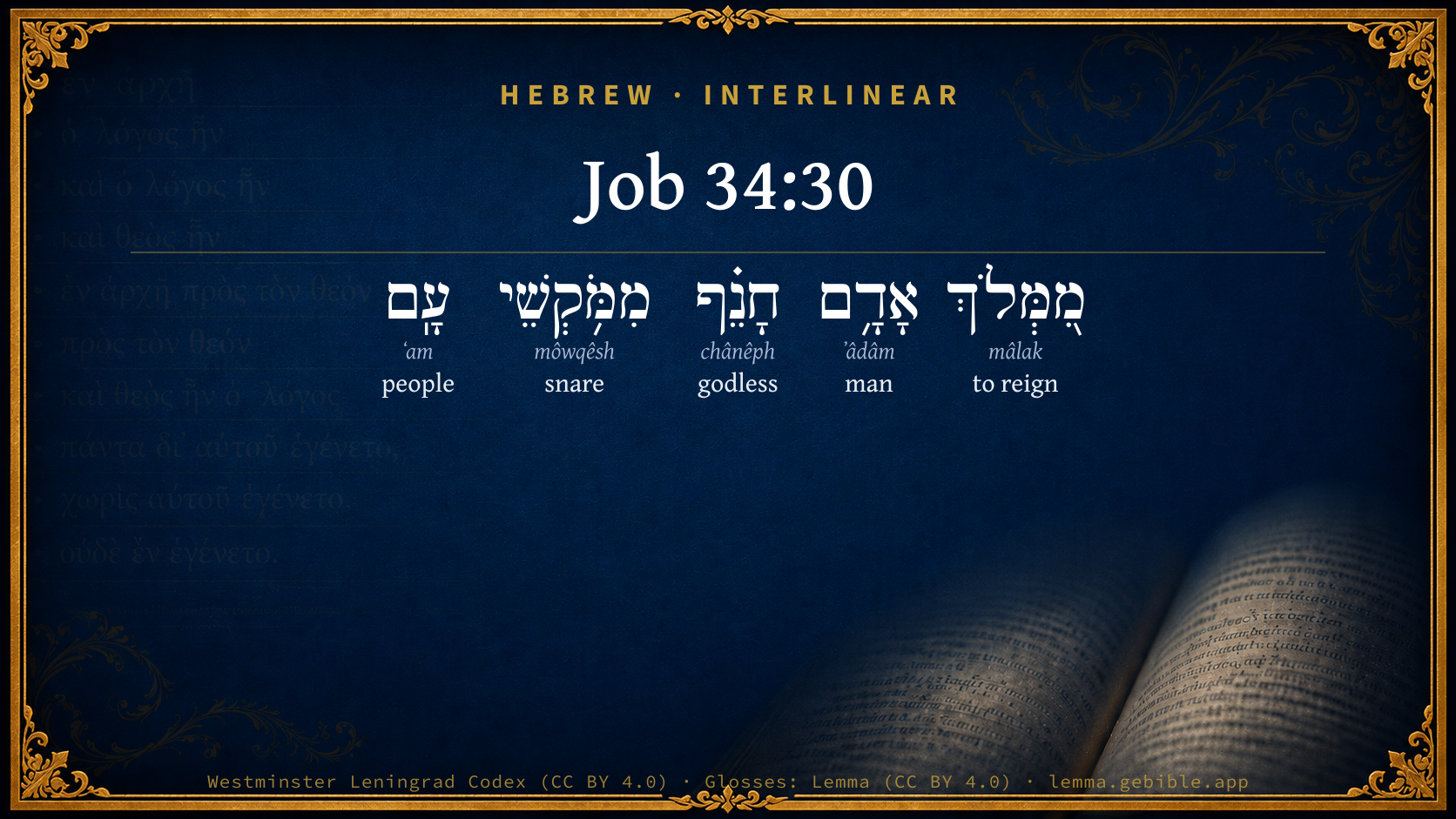
Job 34:30

Hebrew (Westminster Leningrad Codex) Job 34:30 appears in the Hebrew Old Testament. The text above is from the Westminster Leningrad Codex. Each word links to its Strong’s number, a concise gloss, and parsing drawn from the Open Scriptures Hebrew Bible morphology. Click any word for its full Brown-Driver-Briggs (BDB) entry.
Download image
Cite this verse

Job 34:30 (World English Bible). Public Domain. Lemma interlinear Bible study tool, https://lemma.gebible.app/v/job/34/30.

Show BibTeX & RIS
BibTeX
RIS
English Translation
That the godless man may not reign, That there be no one to ensnare the people.
World English Bible · Public Domain
Download a study sheet

One document with this verse’s original text, its word-by-word gloss line, the meaning frame, cross-references with their text, attributed commentary, and full source and license credits — printable, and it pastes into notes with its structure intact.

This verse Autodidact and up

Study sheet (.html) Plain text (.txt)

A passage Seminary Student

Up to 50 verses in one chapter. A passage sheet keeps up to 6 commentary sources and 12 cross-references per verse, in the order this page ranks them, and says so on the sheet whenever that leaves anything out. Ask for a single verse and you get the Autodidact verse sheet above.

Everything on this page stays free to read, with no account — the sheet is a download of what is already on screen, not access to it.

Want to remove ads? Support Godless Engineer
Compare translations 3

The same verse in 3 English versions, stacked beneath the original-language interlinear above. Click any original word for its lexicon entry.

Each is an independent rendering of the whole verse — the interlinear is not word-aligned to these translations.

Highlighted words mark where these versions differ — a whole-verse word diff, not a word-by-word alignment.

  • World English Bible Public Domain
    That the godless man may not reign, That there be no one to ensnare the people.
  • King James Version Public Domain
    That the hypocrite reign not, lest the people be ensnared.
  • unfoldingWord Literal Text CC BY-SA 4.0
    from the reigning of a godless man, from snares of the people.

unfoldingWord Literal Text — © unfoldingWord, licensed CC BY-SA 4.0. Word-aligned USFM3 via Door43 (git.door43.org/unfoldingWord/en_ult).

Versions to compare (up to 4)

3 of 4 selected

Show all 18 translations

Every available English version of this verse, each an independent rendering of the whole verse.

  • World English Bible Public Domain
    That the godless man may not reign, That there be no one to ensnare the people.
  • Berean Standard Bible Public Domain
    that godless men should not rule or lay snares for the people.
  • Majority Standard Bible Public Domain
    that godless men should not rule or lay snares for the people.
  • King James Version Public Domain
    That the hypocrite reign not, lest the people be ensnared.
  • American Standard Version (1901) Public Domain
    That the godless man reign not, That there be none to ensnare the people.
  • Revised Version (1885) Public Domain
    That the godless man reign not, that there be none to ensnare the people.
  • Geneva Bible (1599) Public Domain
    Because the hypocrite doeth reigne, and because the people are snared.
  • Douay-Rheims (1899) Public Domain
    Who maketh a man that is a hypocrite to reign for the sins of the people?
  • Young's Literal Translation Public Domain
    From the reigning of a profane man, From the snares of a people;
  • Literal Standard Version CC BY-SA 4.0
    From the reigning of a profane man, || From the snares of a people;
  • Unlocked Literal Bible CC BY-SA 4.0
    so that a godless man may not rule, so that there may be no one to entrap people.
  • unfoldingWord Literal Text CC BY-SA 4.0
    from the reigning of a godless man, from snares of the people.
  • Darby Bible Public Domain
    That the ungodly man reign not, that the people be not ensnared.
  • World Messianic Bible Public Domain
    that the godless man may not reign, that there be no one to ensnare the people.
  • Webster's Bible Public Domain
    That the hypocrite may not reign, lest the people should be ensnared.
  • Free Bible Version CC BY-SA 4.0
    a person who rejects God should not rule so they don't mislead people.
  • Bible in Basic English Public Domain
    ...
  • JPS Tanakh (1917) Public Domain
    That the godless man reign not, that there be none to ensnare the people.

Literal Standard Version (2020), Covenant Press — licensed CC BY-SA 4.0. Text via the HelloAO Bible API (eBible.org). Unlocked Literal Bible (unfoldingWord) — licensed CC BY-SA 4.0. Text via the HelloAO Bible API (eBible.org). unfoldingWord Literal Text — © unfoldingWord, licensed CC BY-SA 4.0. Word-aligned USFM3 via Door43 (git.door43.org/unfoldingWord/en_ult). Free Bible Version, Dr. Jonathan Gallagher — licensed CC BY-SA 4.0. Text via the HelloAO Bible API (eBible.org).

Word by word

More ways to search: Search by grammar → Find every occurrence → Compare this word →

Practice this passage: Drill this verse → Learn its vocabulary →

About this verse

These counts appear in no published source. They are computed here, from the morphology-tagged text and Lemma’s own curated glosses. What Lemma adds →

5
words
5
distinct lemmas
Wisdom
section

Notable vocabulary

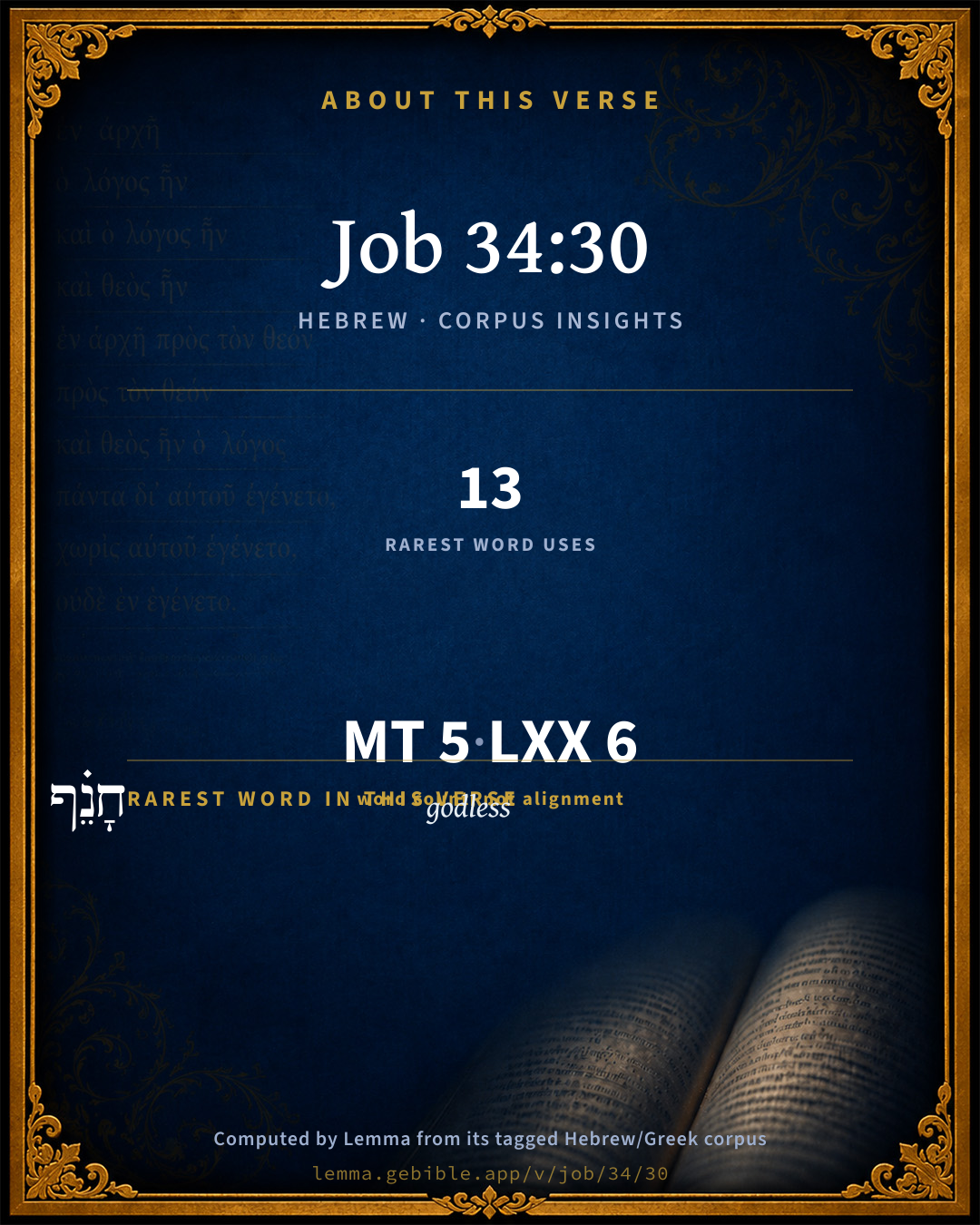
The rarest word here is חָנֵ֗ף godless H2611 — appearing just 13 times in the whole Hebrew Bible.

Shared distinctive vocabulary

חָנֵ֗ף godless H2611 occurs in 13 verses of the Hebrew Bible. Also found in:

Grammatical profile

  • 1 verb
  • 3 nouns
  • 1 adjective

Verb forms

  • מִ֭מְּלֹךְ Qal · Infinitive Construct

Hebrew & Septuagint length

In English translation the verse runs 16 words from the Hebrew and 13 from the Septuagint (LXX English) — closely comparable.

A rough comparison of the two English renderings, which tokenize alike — not a word-level alignment.

Word counts can differ between the Hebrew and the Greek without any difference in meaning — e.g. the Hebrew direct-object marker אֵת has no separate Greek word, and Greek often adds the article ὁ.

In the original languages it is 5 Hebrew tokens and 6 Greek tokens — but the two are counted differently (Hebrew bundles its prefixes and suffixes into one token; the Greek is in lemma form), so that isn’t a like-for-like length.

Cross-references

12

Topical passages linked to Job 34:30 in the Treasury of Scripture Knowledge — connected by theme and wording, ordered by reader-vote popularity; previews shown in the World English Bible.

  • Proverbs 29:2–12 When the righteous thrive, the people rejoice; But when the wicked rule, the people groan.
  • 1 Kings 12:28–30 Whereupon the king took counsel, and made two calves of gold; and he said to them, It is too much for you to go up to Jerusalem: see your gods, Israel, which brought you up out of the land of Egypt.
  • 2 Kings 21:9 But they didn't listen: and Manasseh seduced them to do that which is evil more than did the nations whom Yahweh destroyed before the children of Israel.
  • Job 34:21 "For his eyes are on the ways of a man, He sees all his goings.
  • Psalms 12:8 The wicked walk on every side, When what is vile is exalted among the sons of men.
  • Hosea 5:11 Ephraim is oppressed, He is crushed in judgment; Because he is intent in his pursuit of idols.
  • Hosea 13:11 I have given you a king in my anger, And have taken him away in my wrath.
  • Micah 6:16 For the statutes of Omri are kept, And all the works of the house of Ahab. You walk in their counsels, That I may make you a ruin, And her inhabitants a hissing; And you will bear the reproach of my people."
  • 2 Thessalonians 2:4–11 he who opposes and exalts himself against all that is called God or that is worshiped; so that he sits as God in the temple of God, setting himself up as God.
  • Revelation 13:3–4 One of his heads looked like it had been wounded fatally. His fatal wound was healed, and the whole earth marveled at the beast.
  • Revelation 13:11–14 I saw another beast coming up out of the earth. He had two horns like a lamb, and he spoke like a dragon.
  • Ecclesiastes 9:18 Wisdom is better than weapons of war; but one sinner destroys much good.

Cross-references courtesy of OpenBible.info (CC BY 4.0).

Hebrew and Greek witnesses Masoretic Hebrew ↔ Greek Septuagint

The same verse in the two great witnesses to the Old Testament, shown verse-for-verse.

These are two independent witnesses, not word-aligned to each other, and the Septuagint is shown in lemma (dictionary) form.

Hebrew Job 34:30 Masoretic · Westminster Leningrad Codex

מִ֭מְּלֹךְ אָדָ֥ם חָנֵ֗ף מִמֹּ֥קְשֵׁי עָֽם

That the godless man may not reign, That there be no one to ensnare the people.

World English Bible · Public Domain

Greek LXX Job 34:30 Septuagint · lemma form

βασιλεύω ἄνθρωπος ὑποκριτής ἀπό δυσκολία λαός

causing a hypocrite to be king, because of the waywardness of the people.

LXX2012 (modern English Septuagint) · Public Domain

On this verse, Haydock's Catholic Bible Commentary discusses the Septuagint’s reading. Read the note in Commentary ↓

Hebrew: Westminster Leningrad Codex (CC BY 4.0). Greek: Septuagint (public domain); English from LXX2012 (modern English Septuagint) (Public Domain). How the Septuagint differs from the Hebrew →

Commentary

Notes on Job 34:30 from classic Christian and Jewish commentators (each source and its license shown beneath its notes). The classic Christian expositions comment on the surrounding passage and are grouped to its opening verse, so a note may address several verses; the Jewish commentaries on the Tanakh (Rashi and others) are per-verse, so they appear only where the commentator wrote on this verse.

Lemma curates 59 commentaries, every one of them public domain or Creative Commons licensed, each selected and text-cleaned for this edition rather than reprinted as found. About our sources →

Trapp's Complete Commentary

John Trapp

Job 34:30 That the hypocrite reign not, lest the people be ensnared.

Ver. 30. That the hypocrite reign not] That he reign no longer. Almighty God taketh order, by putting these mighties from their seat, and exalting them of low degree, Luk 1:52. And why? 1. Lest the hypocrite, or the impure and impious man, reign; such as was Jehu, Herod, Julian, our Richard III, Pope Sixtus Quintus, of whom one saith, that he was the most crouching humble cardinal that ever was lodged in an oven, and the most stout proud pope that ever wore crown (Spec. Europ.). What pride equal to his, making kings kiss his pantofles? {a} What humility (pretended) greater than his, shriving himself daily on his knees to an ordinary priest? He calleth himself the servant of God’s servants; and yet stamps in his coin, That nation and country that will not serve thee shall be rooted out; he also suffereth his parasites to style him, Our Lord God the pope. Is not this a notorious hypocrite? and when such a one reigneth and taketh upon him to be Lord of all, both in spirituals and temporals, may not we conclude that God hideth his face (as in the former verse) from his people? May we not cry out, as Basil once did (Epist. 17), Num ecclesias suas dereliquit Dominus? Hath the Lord utterly forsaken his Churches? It is, doubtless, a very great judgment upon a people, when a hypocrite or a profane person is set over them, who pretends the public good to his own designs and self interests, and by his crafty inventions undoes his subjects, robbing them of their lawful liberties, and enslaving them. Some read the words thus, He causeth that the hypocrite reigneth for the sins of the people. It is threatened as a heavy curse, Lev 26:17. If you still trespass against me, I will set princes over you that shall hate you; mischievous, odious princes, odious to God, malignant to the people; such as was Phocas, that bloody tyrant, who, when he had slain his master, Mauritius, and reigned in his stead, there was an honest poor man, saith Cedrenus, who was earnest with God to know a reason why such a thing was suffered? to whom it was answered, That a worse man could not be found; and that the sins of Christians required it. We read of Attilus, king of Swethland, that he made a dog king of the Danes, in revenge of a great many injuries received by them. Gunno, likewise, king of the Danes, made a dog king of Norway; and appointed counsellors to do all things under his title and name. That which these men did spitefully God sometimes doth righteously; setting up tyrants for a punishment to those that were unthankful for better government, and would not have him to reign over them.

Lest the people be ensnared] Heb. For the snares of the people; that is, for the injuries and vexations wherewith that hypocrite oppressed the people; to put an end to those, by taking away the tyrant, who, for his cruel craft and crafty cruelty, is here fitly compared to a hunter or fowler laying snares. Sunt autem leges iniquae et exactiones iniustae principum hypocritarum, laquei et decipulae quibus populum sibi subiectum venantur et capiunt, saith Brentius here; i.e. Bad laws and unjust exactions of hypocritical princes are the snares and traps wherewith they hunt after and catch their subjects.

{a} A slipper; formerly applied very variously, app., at one time or another, to every sort of in-door slippers or loose shoes; esp. to the high-heeled cork-soled chopins; also to out-door overshoes or goloshes; and to all manner of Oriental and non-European slippers, sandals, and the like.

John Trapp, A Commentary or Exposition upon All the Books of the Old and New Testament (1647–1656) — public domain. Text from a community e-Sword module.

Geneva Bible (1599)

Geneva Bible translators

When tyrants sit in the throne of justice which under pretence of executing justice are but hypocrites and oppress the people, it is a sign that God hath drawn back his countenance of favor from that place.

Geneva Bible (1599) marginal notes — public domain. Text via Bolls.life.

Jamieson, Fausset & Brown

Robert Jamieson, A. R. Fausset & David Brown

Ensnared--into sin (Kg1 12:28, Kg1 12:30). Or rather, "enthralled by further oppression," Job 34:26-28.

Jamieson, Fausset & Brown — Commentary Critical and Explanatory on the Whole Bible (1871) — public domain (CC PDM 1.0). Text via the HelloAO Bible API.

Adam Clarke's Commentary

Verse 30. That the hypocrite reign not] The Vulgate translates, Who causes a wicked man to reign because of the sins of the people. This was precisely the defense which Hegiage, the oppressive ruler of the Babylonian Irak, under the caliph Abdul Malec, made when he found the people in a state of insurrection. See at the end of the chapter. See Clarke on Job 34:37.

Adam Clarke's Commentary on the Bible (1810–1826) — public domain. Text from a community e-Sword/MySword module.

Ellicott's Commentary for English Readers

(30) That the hypocrite reign not.—Rather, (whether God is provoked), on account of an ungodly man reigning, or by the snares of a whole people: i.e., the corruption of a nation, e.g., Sodom, &c.

A Bible Commentary for English Readers, edited by Charles John Ellicott (1878–1897) — public domain. Text from a community e-Sword module.

The Cambridge Bible for Schools and Colleges

gen. ed. J. J. S. Perowne

30. His operations are directed by the great purpose of the good of men, that the nations be righteously and mercifully ruled.

The Cambridge Bible for Schools and Colleges (gen. ed. J. J. S. Perowne; Cambridge University Press, 1878–1918) — public domain. Text from a community e-Sword module.

John Gill's Exposition

That which I see not teach thou me,.... Which may be understood either of the chastisements of God, and his dealings with his people in a providential way, and of the design and use of them, which are sometimes unsearchable, and at most but a part of them only seen and known; it is meet to say to God, it is but a small part and portion of thy ways that is known by me; I can see but little into them: teach me more of thy mind and will in them, or else of sins and transgressions, the cause of chastisement; it is proper for an afflicted man to say unto God, I am conscious to myself of many sinful failings and infirmities, but there may be secret sins committed by me which have escaped my notice and observation; point them out to me, that I may be humbled for them, and make a free confession of them;

if I have done iniquity, I will do no more; that is, if I have committed any capital crime, any foul offence or gross enormity, for otherwise no man lives without sin, I sincerely repent of it, and will take care for the future, through divine grace, to do so no more.

John Gill's Exposition of the Whole Bible (1746–1763) — public domain (CC PDM 1.0). Text via the HelloAO Bible API.

Albert Barnes' Notes on the Bible

That the hypocrite reign not - All this is done to prevent wicked men from ruling over the people. The remarks of Elihu had had respect much to princes and kings, and he had shown that however great they were, they were in the hands of God, and were wholly at his disposal. He “now” says that the design of his dealings with them was to prevent their oppressing their fellow-men. The general scope of the remarks of Elihu is, that God is the universal Sovereign; that he has all people under his control, and that there are none so powerful as to be able to resist his will. The remark in this verse is thrown in, not as illustrating this general sentiment, but to show what was “in fact” the aim for which he thus interposed - to save people from being oppressed and crushed by those in authority.

Lest the people be ensnared - Hebrew “From their being snarers of the people.” He thrusts down the mighty, in order that they may not be left to take the people as wild beasts are taken in the toils. They were disposed to make use of their power to oppress others, but God interposes, and the people are saved. For a fuller view of this verse, see the remarks of Rosenmuller.

Albert Barnes' Notes on the Bible (1834–1885) — public domain. Text from a community e-Sword/MySword module.

Haydock's Catholic Bible Commentary

People. A hypocrite denotes one infected with all sorts of crimes. (St. Irenæus v. 24.) Such a king is sometimes given to punish a wicked people, Osee xiii. 11., and Isaias iii. 4. This sense is beautiful, and followed by the Chaldean, Septuagint, &c. We may explain the Hebrew in like manner, by neglecting the Masoretic points. (Calmet) --- Protestants, "That the hypocrite reign not, lest the people be ensnared." (Haydock) --- Hebrew, "He overturns the throne of hypocrites, on account of the scandal of the people," or "he delivers the people from servitude." The sense of the Vulgate seems preferable. (Calmet) --- Eliu insinuates that Job had been a hypocrite and an oppressor; but God exculpates him. (Worthington)

George Leo Haydock (1774–1849), Haydock's Catholic Family Bible and Commentary, 1859 edition — public domain. Excludes Psalms (Douay-Rheims chapter numbering differs from Protestant) and Deuterocanonical books (Catholic canon only).

Matthew Poole's English Annotations

Having said that God could and would carry on his own work and design effectually, whether against one man, or against a whole people, he now proceeds to give a further instance of God’s mighty power above and against the greatest monarchs, in whom their own and the people’s strength seem to be united, yet all together cannot oppose God in his work. God when he pleaseth can and doth so order affairs,

that the hypocrite (i.e. the profane wicked prince, as one of the kings of Judah is called, Eze 21:25; bad princes being called hypocrites, because they do commonly cover all their oppressions, and injuries, and impieties too, with the specious pretence of justice and the public good, and the discharge of their trust and duty) may not reign, (i.e. may not continue his reign and tyranny, that he may and shall by his sovereign power and omnipotent providence be deprived of his kingdom,)

lest the people be insnared, i.e. lest the people should be longer and more and more kept and held in the snares or fetters of tyranny and oppression, i.e. God doth this to free poor oppressed people from the snares which ungodly and unrighteous princes lay for them. Or, that the people be not insnared any longer, Heb. that there be no snares of or for the people. Or, for the snares, or scandals, or sins (which are oft so called) of the people. So the sense is, that such a wicked prince may not continue to reign over that people, although by their sins they had provoked God to give them such a prince, and to continue his power over them.

Matthew Poole's English Annotations on the Holy Bible (1683–1685) — public domain. Text from a community e-Sword/MySword module.

Whedon's Commentary on the Bible

Daniel D. Whedon

30. Hypocrite — Ungodly. Lest, etc. — מן, that not, introduces this as well as the preceding clause. That the people be not ensnared; literally, from snares of the people.

Daniel D. Whedon (gen. ed.), Commentary on the Old and New Testaments (1874–1909) — public domain. Text from a community e-Sword module.

The Pulpit Commentary

That the hypocrite reign not, lest the people be ensnared; rather, that an ungodly man reign not, that a people be not a snare. (So Schultens, Professor Lee, and others.) The passage is obscure from its brevity; but this seems to be the best sense. God withdraws his favour from an ungodly king or from a wicked nation, that the king may cease to injure men by his rule, and the nation cease to be a snare to its neighbours.

The Pulpit Commentary (1880–1919), ed. H.D.M. Spence-Jones & Joseph S. Exell — public domain. Text from a community e-Sword module.

John Wesley's Explanatory Notes

Reign not - May not continue his tyranny, lest the people be ensnared, lest the people should be longer kept in the the snares of oppression; God doth this to free poor oppressed people from the snares which ungodly men lay for them.

John Wesley, Explanatory Notes Upon the Whole Bible (1754–1765) — public domain. Text via the GEBible commentary corpus.

Rashi

Rabbi Shlomo Yitzchaki (Rashi)

And it shall be quiet, that a flattering man shall not reign because of the snares of the people Over the poor, who reigned.

because of the snares of the people [who were guilty] of iniquity, and concerning such a God, you should not have said, ‘scoundrel,’ and ‘wicked.

Rashi on the Tanakh — English translations: “The Judaica Press complete Tanach with Rashi, translated by A. J. Rosenberg” (CC BY 4.0); “Pentateuch with Rashi's commentary by M. Rosenbaum and A.M. Silbermann, 1929-1934” (public domain); “The Metsudah Tanach series, Lakewood, N.J” (CC BY 4.0); and “The Book of Joshua, Metsudah Publications, 1997” (CC BY 4.0). Text via Sefaria.

Lesson kit

Teaching starters — assembled from the data on this page, not authored interpretation. Every prompt links to the verse data it draws on. Edit before teaching.

Job, in the Wisdom, opens this verse with 5 words (5 distinct Hebrew lemmas). Its most distinctive word is chânêph (“godless”). A historical commentator’s framing appears above. Read the whole chapter for the surrounding context.

Discussion questions

  1. The word chânêph carries the sense “godless.” How does it shape the verse?
  2. How does Job 8:13, which shares the word «godless», read alongside this verse?
  3. The translations on this page render this verse differently — a whole-verse word diff, not a word-by-word alignment. What might account for the different wordings?
  4. «מִ֭מְּלֹךְ» is a Qal Infinitive Construct verb. How does that grammatical form shape the action described?
  5. Compare how Trapp's Complete Commentary and Geneva Bible (1599) read this verse. Where do they agree or differ?

Things to notice

Reading settings

Reading text

Shown beneath each verse's original-language words.

Old Testament
Old Testament edition

Read the OT as the Masoretic Hebrew (MT) or the Greek Septuagint (LXX).

English shown for the Greek Septuagint (in the Hebrew ↔ Greek comparison).

Comparing translations? Open the Compare panel on any verse page to stack up to four side by side.