
2 Chronicles 20:31

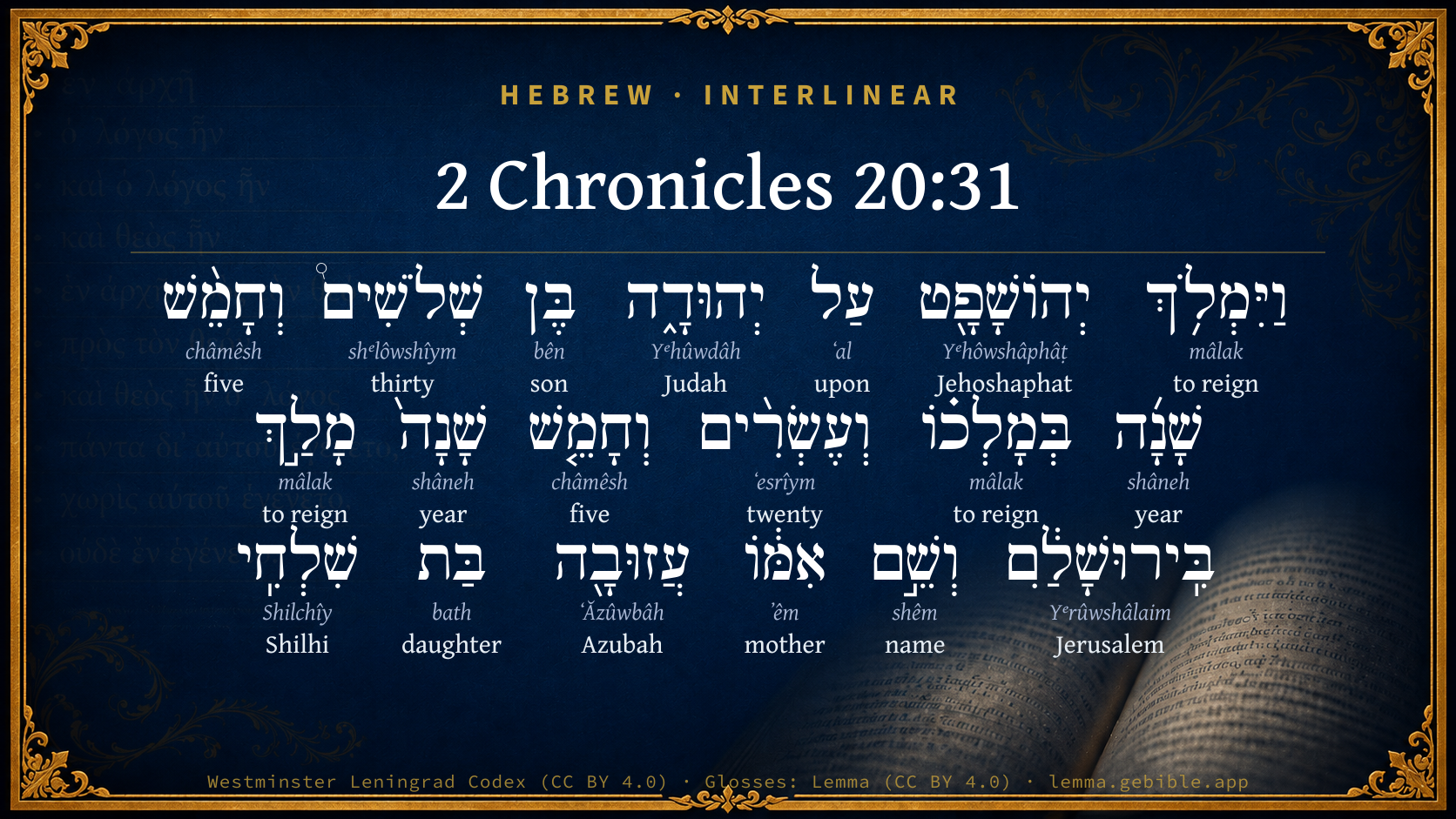
Hebrew (Westminster Leningrad Codex) 2 Chronicles 20:31 appears in the Hebrew Old Testament. The text above is from the Westminster Leningrad Codex. Each word links to its Strong’s number, a concise gloss, and parsing drawn from the Open Scriptures Hebrew Bible morphology. Click any word for its full Brown-Driver-Briggs (BDB) entry.
Download image
Cite this verse

2 Chronicles 20:31 (World English Bible). Public Domain. Lemma interlinear Bible study tool, https://lemma.gebible.app/v/2-chronicles/20/31.

Show BibTeX & RIS
BibTeX
RIS
English Translation
Jehoshaphat reigned over Judah: he was thirty-five years old when he began to reign; and he reigned twenty-five years in Jerusalem: and his mother's name was Azubah the daughter of Shilhi.
World English Bible · Public Domain
Download a study sheet

One document with this verse’s original text, its word-by-word gloss line, the meaning frame, cross-references with their text, attributed commentary, and full source and license credits — printable, and it pastes into notes with its structure intact.

This verse Autodidact and up

Study sheet (.html) Plain text (.txt)

A passage Seminary Student

Up to 50 verses in one chapter. A passage sheet keeps up to 6 commentary sources and 12 cross-references per verse, in the order this page ranks them, and says so on the sheet whenever that leaves anything out. Ask for a single verse and you get the Autodidact verse sheet above.

Everything on this page stays free to read, with no account — the sheet is a download of what is already on screen, not access to it.

Want to remove ads? Support Godless Engineer
Compare translations 3

The same verse in 3 English versions, stacked beneath the original-language interlinear above. Click any original word for its lexicon entry.

Each is an independent rendering of the whole verse — the interlinear is not word-aligned to these translations.

Highlighted words mark where these versions differ — a whole-verse word diff, not a word-by-word alignment.

  • World English Bible Public Domain
    Jehoshaphat reigned over Judah: he was thirty-five years old when he began to reign; and he reigned twenty-five years in Jerusalem: and his mother's name was Azubah the daughter of Shilhi.
  • King James Version Public Domain
    And Jehoshaphat reigned over Judah: he was thirty and five years old when he began to reign, and he reigned twenty and five years in Jerusalem. And his mother's name was Azubah the daughter of Shilhi.
  • unfoldingWord Literal Text CC BY-SA 4.0
    And Jehoshaphat reigned over Judah. The son of 35 years when he became king, and 25 years he reigned in Jerusalem. And the name of his mother, Azubah, the daughter of Shilhi.

unfoldingWord Literal Text — © unfoldingWord, licensed CC BY-SA 4.0. Word-aligned USFM3 via Door43 (git.door43.org/unfoldingWord/en_ult).

Versions to compare (up to 4)

3 of 4 selected

Show all 18 translations

Every available English version of this verse, each an independent rendering of the whole verse.

  • World English Bible Public Domain
    Jehoshaphat reigned over Judah: he was thirty-five years old when he began to reign; and he reigned twenty-five years in Jerusalem: and his mother's name was Azubah the daughter of Shilhi.
  • Berean Standard Bible Public Domain
    So Jehoshaphat reigned over Judah. He was thirty-five years old when he became king, and he reigned in Jerusalem twenty-five years. His mother’s name was Azubah daughter of Shilhi.
  • Majority Standard Bible Public Domain
    So Jehoshaphat reigned over Judah. He was thirty-five years old when he became king, and he reigned in Jerusalem twenty-five years. His mother’s name was Azubah daughter of Shilhi.
  • King James Version Public Domain
    And Jehoshaphat reigned over Judah: he was thirty and five years old when he began to reign, and he reigned twenty and five years in Jerusalem. And his mother's name was Azubah the daughter of Shilhi.
  • American Standard Version (1901) Public Domain
    And Jehoshaphat reigned over Judah: he was thirty and five years old when he began to reign; and he reigned twenty and five years in Jerusalem: and his mother's name was Azubah the daughter of Shilhi.
  • Revised Version (1885) Public Domain
    And Jehoshaphat reigned over Judah: he was thirty and five years old when he began to reign; and he reigned twenty and five years in Jerusalem: and his mother’s name was Azubah the daughter of Shilhi.
  • Geneva Bible (1599) Public Domain
    And Iehoshaphat reigned ouer Iudah, and was fiue and thirtie yeere olde, when he began to reigne: and reigned fiue and twentie yeere in Ierusalem, and his mothers name was Azubah the daughter of Shilhi.
  • Douay-Rheims (1899) Public Domain
    And Josaphat reigned over Juda, and he was five and thirty years old when he began to reign: and he reigned five and twenty years in Jerusalem: and the name of his mother was Azuba the daughter of Selahi.
  • Young's Literal Translation Public Domain
    And Jehoshaphat reigneth over Judah, a son of thirty and five years in his reigning, and twenty and five years he hath reigned in Jerusalem, and the name of his mother `is' Azubah daughter of Shilhi.
  • Literal Standard Version CC BY-SA 4.0
    And Jehoshaphat reigns over Judah, a son of thirty-five years in his reigning, and he has reigned twenty-five years in Jerusalem, and the name of his mother [is] Azubah daughter of Shilhi.
  • Unlocked Literal Bible CC BY-SA 4.0
    Jehoshaphat reigned over Judah: He was thirty-five years old when he began to reign, and he reigned in Jerusalem for twenty-five years. His mother's name was Azubah, the daughter of Shilhi.
  • unfoldingWord Literal Text CC BY-SA 4.0
    And Jehoshaphat reigned over Judah. The son of 35 years when he became king, and 25 years he reigned in Jerusalem. And the name of his mother, Azubah, the daughter of Shilhi.
  • Darby Bible Public Domain
    And Jehoshaphat reigned over Judah: he was thirty-five years old when he began to reign; and he reigned twenty-five years in Jerusalem; and his mother's name was Azubah, daughter of Shilhi.
  • World Messianic Bible Public Domain
    So Jehoshaphat reigned over Judah. He was thirty-five years old when he began to reign. He reigned twenty-five years in Jerusalem. His mother’s name was Azubah the daughter of Shilhi.
  • Webster's Bible Public Domain
    And Jehoshaphat reigned over Judah: he was thirty and five years old when he began to reign, and he reigned twenty and five years in Jerusalem. And his mother's name was Azubah the daughter of Shilhi.
  • Free Bible Version CC BY-SA 4.0
    So Jehoshaphat reigned over Judah, having become king when he was thirty-five years old, and he reigned in Jerusalem for twenty-five years. His mother's name was Azubah, daughter of Shilhi.
  • Bible in Basic English Public Domain
    And Jehoshaphat was king over Judah: he was thirty-five years old when he became king, and he was ruling for twenty-five years in Jerusalem: his mother's name was Azubah, the daughter of Shilhi.
  • JPS Tanakh (1917) Public Domain
    And Jehoshaphat reigned over Judah; he was thirty and five years old when he began to reign; and he reigned twenty and five years in Jerusalem; and his mother's name was Azubah the daughter of Shilhi.

Literal Standard Version (2020), Covenant Press — licensed CC BY-SA 4.0. Text via the HelloAO Bible API (eBible.org). Unlocked Literal Bible (unfoldingWord) — licensed CC BY-SA 4.0. Text via the HelloAO Bible API (eBible.org). unfoldingWord Literal Text — © unfoldingWord, licensed CC BY-SA 4.0. Word-aligned USFM3 via Door43 (git.door43.org/unfoldingWord/en_ult). Free Bible Version, Dr. Jonathan Gallagher — licensed CC BY-SA 4.0. Text via the HelloAO Bible API (eBible.org).

Word by word

More ways to search: Search by grammar → Find every occurrence → Compare this word →

Practice this passage: Drill this verse → Learn its vocabulary →

שִׁלְחִֽי
Shilchîy
H7977
“Shilhi”
Noun, Proper
Part of Speech
Noun
Type
Proper
Full BDB Definition

Origin: from H7973

TWOT: None

Shilhi = "armed" - father of Azubah, the mother of Jehoshaphat
  1. וַיִּמְלֹ֥ךְ mâlak H4427 “and · to reign” Conjunction + Verb, Qal, Sequential Imperfect, 3rd Person, Masculine, Singular
  2. יְהוֹשָׁפָ֖ט Yᵉhôwshâphâṭ H3092 “Jehoshaphat” Noun, Proper
  3. עַל ʻal H5921 “upon” Preposition
  4. יְהוּדָ֑ה Yᵉhûwdâh H3063 “Judah” Noun, Proper
  5. בֶּן bên H1121 “son of” Noun, Common, Masculine, Singular, Construct
  6. שְׁלֹשִׁים֩ shᵉlôwshîym H7970 “thirty” Adjective, Cardinal number, Both, Plural, Absolute
  7. וְחָמֵ֨שׁ châmêsh H2568 “and · five” Conjunction + Adjective, Cardinal number, Feminine, Singular, Absolute
  8. שָׁנָ֜ה shâneh H8141 “year” Noun, Common, Feminine, Singular, Absolute
  9. בְּמָלְכ֗וֹ mâlak H4427 “in/at · to reign · him” Preposition + Verb, Qal, Infinitive Construct + Suffix, Personal, 3rd Person, Masculine, Singular
  10. וְעֶשְׂרִ֨ים ʻesrîym H6242 “and · twenty” Conjunction + Adjective, Cardinal number, Both, Plural, Absolute
  11. וְחָמֵ֤שׁ châmêsh H2568 “and · five” Conjunction + Adjective, Cardinal number, Feminine, Singular, Absolute
  12. שָׁנָה֙ shâneh H8141 “year” Noun, Common, Feminine, Singular, Absolute
  13. מָלַ֣ךְ mâlak H4427 “to reign” Verb, Qal, Perfect, 3rd Person, Masculine, Singular
  14. בִּֽירוּשָׁלִַ֔ם Yᵉrûwshâlaim H3389 “in/at · Jerusalem” Preposition + Noun, Proper
  15. וְשֵׁ֣ם shêm H8034 “and · name of” Conjunction + Noun, Common, Masculine, Singular, Construct
  16. אִמּ֔וֹ ʼêm H517 “mother · his” Noun, Common, Feminine, Singular, Construct + Suffix, Personal, 3rd Person, Masculine, Singular
  17. עֲזוּבָ֖ה ʻĂzûwbâh H5806 “Azubah” Noun, Proper
  18. בַּת bath H1323 “daughter of” Noun, Common, Feminine, Singular, Construct

About this verse

These counts appear in no published source. They are computed here, from the morphology-tagged text and Lemma’s own curated glosses. What Lemma adds →

19
words
15
distinct lemmas
Historical
section

Notable vocabulary

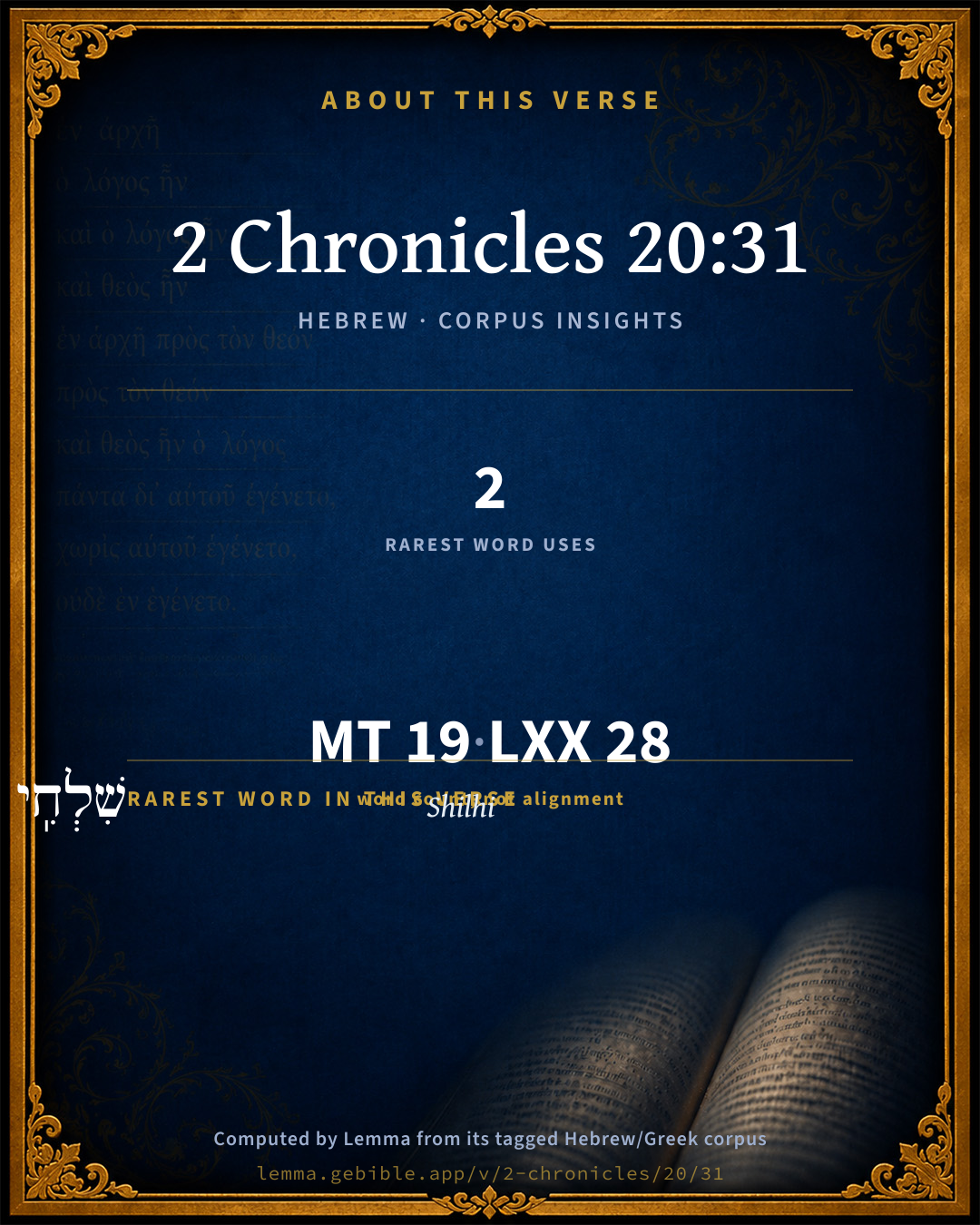
The rarest word here is שִׁלְחִֽי Shilhi H7977 — appearing just 2 times in the whole Hebrew Bible.

Shared distinctive vocabulary

שִׁלְחִֽי Shilhi H7977 occurs in 2 verses of the Hebrew Bible. Also found in:

Grammatical profile

  • 3 verbs
  • 11 nouns
  • 4 adjectives
  • 1 preposition

Verb forms

  • וַיִּמְלֹ֥ךְ Qal · Sequential Imperfect
  • בְּמָלְכ֗וֹ Qal · Infinitive Construct
  • מָלַ֣ךְ Qal · Perfect

Repetition

Words recur within this verse — often emphatic in Hebrew:

  • וַיִּמְלֹ֥ךְ to reign H4427 ×3
  • וְחָמֵ֨שׁ five H2568 ×2
  • שָׁנָ֜ה year H8141 ×2

Hebrew & Septuagint length

In English translation the verse runs 31 words from the Hebrew and 30 from the Septuagint (LXX English) — closely comparable.

A rough comparison of the two English renderings, which tokenize alike — not a word-level alignment.

Word counts can differ between the Hebrew and the Greek without any difference in meaning — e.g. the Hebrew direct-object marker אֵת has no separate Greek word, and Greek often adds the article ὁ.

In the original languages it is 19 Hebrew tokens and 28 Greek tokens — but the two are counted differently (Hebrew bundles its prefixes and suffixes into one token; the Greek is in lemma form), so that isn’t a like-for-like length.

Cross-references

1

Topical passages linked to 2 Chronicles 20:31 in the Treasury of Scripture Knowledge — connected by theme and wording, ordered by reader-vote popularity; previews shown in the World English Bible.

  • 1 Kings 22:41–44 Jehoshaphat the son of Asa began to reign over Judah in the fourth year of Ahab king of Israel.

Cross-references courtesy of OpenBible.info (CC BY 4.0).

Hebrew and Greek witnesses Masoretic Hebrew ↔ Greek Septuagint

The same verse in the two great witnesses to the Old Testament, shown verse-for-verse.

These are two independent witnesses, not word-aligned to each other, and the Septuagint is shown in lemma (dictionary) form.

Hebrew 2 Chronicles 20:31 Masoretic · Westminster Leningrad Codex

וַיִּמְלֹ֥ךְ יְהוֹשָׁפָ֖ט עַל יְהוּדָ֑ה בֶּן שְׁלֹשִׁים֩ וְחָמֵ֨שׁ שָׁנָ֜ה בְּמָלְכ֗וֹ וְעֶשְׂרִ֨ים וְחָמֵ֤שׁ שָׁנָה֙ מָלַ֣ךְ בִּֽירוּשָׁלִַ֔ם וְשֵׁ֣ם אִמּ֔וֹ עֲזוּבָ֖ה בַּת שִׁלְחִֽי

Jehoshaphat reigned over Judah: he was thirty-five years old when he began to reign; and he reigned twenty-five years in Jerusalem: and his mother's name was Azubah the daughter of Shilhi.

World English Bible · Public Domain

Greek LXX 2 Chronicles 20:31 Septuagint · lemma form

καί βασιλεύω ιωσαφατ ἐπί ὁ ἰούδας ἔτος τριάκοντα πέντε ἐν ὁ βασιλεύω αὐτός καί εἴκοσι πέντε ἔτος βασιλεύω ἐν ἰερουσαλήμ καί ὄνομα ὁ μήτηρ αὐτός αζουβα θυγάτηρ σαλι

And Josaphat reigned over Juda, being thirty-five years old when he began to reign, and he reigned twenty-five years in Jerusalem: and his mother's name was Azuba, daughter of Sali.

LXX2012 (modern English Septuagint) · Public Domain

On this verse, Keil & Delitzsch discusses the Septuagint’s reading. Read the note in Commentary ↓

Hebrew: Westminster Leningrad Codex (CC BY 4.0). Greek: Septuagint (public domain); English from LXX2012 (modern English Septuagint) (Public Domain). How the Septuagint differs from the Hebrew →

Commentary

Notes on 2 Chronicles 20:31 from classic Christian and Jewish commentators (each source and its license shown beneath its notes). The classic Christian expositions comment on the surrounding passage and are grouped to its opening verse, so a note may address several verses; the Jewish commentaries on the Tanakh (Rashi and others) are per-verse, so they appear only where the commentator wrote on this verse.

Lemma curates 59 commentaries, every one of them public domain or Creative Commons licensed, each selected and text-cleaned for this edition rather than reprinted as found. About our sources →

Jamieson, Fausset & Brown

Robert Jamieson, A. R. Fausset & David Brown

HIS REIGN. (Ch2 20:31-37)

Jehoshaphat reigned over Judah--(See Ch2 24:1).

Jamieson, Fausset & Brown — Commentary Critical and Explanatory on the Whole Bible (1871) — public domain (CC PDM 1.0). Text via the HelloAO Bible API.

Ellicott's Commentary for English Readers

CONCLUDING NOTICES. END OF THE REIGN

(2Ch_20:31 -2Ch_21:1).

Comp. 1Ki_22:41-50. A brief section, which constitutes the whole account of the reign of Jehoshaphat in the older narrative.

(31) And Jehoshaphat reigned over Judah.—Kings adds: “In the fourth year of Ahab king of Israel.” With this omission, our verse coincides with 1Ki_22:41-42.

A Bible Commentary for English Readers, edited by Charles John Ellicott (1878–1897) — public domain. Text from a community e-Sword module.

Trapp's Complete Commentary

John Trapp

2Ch 20:31 And Jehoshaphat reigned over Judah: [he was] thirty and five years old when he began to reign, and he reigned twenty and five years in Jerusalem. And his mother’s name [was] Azubah the daughter of Shilhi.

Ver. 31-33. {See Trapp on "1Ki 22:41"} {See Trapp on "1Ki 22:42"} {See Trapp on "1Ki 22:43"}

John Trapp, A Commentary or Exposition upon All the Books of the Old and New Testament (1647–1656) — public domain. Text from a community e-Sword module.

Matthew Henry's Commentary

We are now drawing towards the close of the history of Jehoshaphat's reign, for a further account of which those who lived when this book was published were referred to an authentic history of it, written by Jehu the prophet (Ch2 19:2), which was then extant, Ch2 20:34. This was the general character of his reign, that he did that which was right in the sight of the Lord, kept close to the worship of God himself and did what he could to keep his people close to it. But two things are here to be lamented: - 1. The people still retained a partiality for the high places, Ch2 20:33. Those that were erected to the honour of strange gods were taken away (Ch2 17:6); but those where the true God was worshipped, being less culpable, were thought allowable, and Jehoshaphat was loth to disoblige the people so far as to take them away, for as yet they had not prepared their hearts to serve the God of their fathers. They complied with Jehoshaphat's reformation because they could not for shame do otherwise, but they were not hearty in it, did not direct their hearts to God in it, did not act in it from any good principle nor with any zeal or resolution: and the best magistrates cannot bring to pass what they would, in reformation, when the people are cool in it. 2. Jehoshaphat himself still retained a partiality for the house of Ahab, because he had married his son to a daughter of that family, though he had been plainly reproved for it and had like to have smarted for it. He saw and knew that Ahaziah, the son of Ahab, did very wickedly, and therefore could not expect to prosper; yet he joined himself with him, not in war, as with his father, but in trade, became his partner in an East India fleet bound for Ophir, Ch2 20:35, Ch2 20:36. There is an emphasis laid upon the time - after this, after God had done such great things for him, without any such scandalous and pernicious confederacies, given him not only victory, but wealth, yet after this to go and join himself with a wicked king was very ungrateful. After God had given him such a deliverance as this should he again break God's commandments, and join in affinity with the people of these abominations? What could he expect but that God should be angry with him? Ezr 9:13, Ezr 9:14. Yet he sends to him, to show him his error and bring him to repentance, (1.) By a prophet, who foretold the blasting of his project, Ch2 20:37. And, (2.) By a storm, which broke the ships in the port before they set sail, by which he was warned to break off his alliance with Ahaziah; and it seems he took the warning, for, when Ahaziah afterwards pressed him to join with him, he would not, Kg1 22:49. See how pernicious a thing it is to join in friendship and society with evil-doers. It is a hard matter to break off from it. A man may much better keep himself from being taken in the snare than recover himself out of it.

Matthew Henry's Commentary on the Whole Bible (1708–1710) — public domain (CC PDM 1.0). Text via the HelloAO Bible API.

The Cambridge Bible for Schools and Colleges

gen. ed. J. J. S. Perowne

31. reigned over Judah] In Kings, began to reign over Judah in the fourth year of Ahab king of Israel. The Chronicler will not date the accession of a southern king by the year of an ungodly northern king.

31–34 (= 1Ki_22:41-45). The Summary of Jehoshaphat’s Reign

There are several variations of text between Kings and Chron. here; and in particular the Chronicler omits the statement that Jehoshaphat made peace with Israel.

The Cambridge Bible for Schools and Colleges (gen. ed. J. J. S. Perowne; Cambridge University Press, 1878–1918) — public domain. Text from a community e-Sword module.

John Gill's Exposition

And Jehoshaphat reigned over Judah,.... Of these two verses; see Gill on Kg1 22:42. Kg1 22:43.

.

2 Chronicles 20:33

ch2 20:33

ch2 20:33

ch2 20:33Howbeit, the high places were not taken away,.... The high places, where idols were worshipped, were taken away, Ch2 17:6, but not those where sacrifices were offered to the true God:

for as yet the people had not prepared their hearts unto the God of their fathers; to seek and serve him wholly, according to his will, to offer sacrifices to him only at Jerusalem, as the law required, Deu 12:5, they could not as yet be prevailed upon to relinquish the high places, built and made use of before the temple was; partly because they were nearer to some of them than that, and partly out of veneration for them, as being of a long time used.

John Gill's Exposition of the Whole Bible (1746–1763) — public domain (CC PDM 1.0). Text via the HelloAO Bible API.

Whedon's Commentary on the Bible

Daniel D. Whedon

31-37. Compare notes on the parallel passage, 1Ki_22:41-49.

Daniel D. Whedon (gen. ed.), Commentary on the Old and New Testaments (1874–1909) — public domain. Text from a community e-Sword module.

The Pulpit Commentary

With this verse recommences the parallel of 1Ki_22:41-50. In this verse we find the addition in the parallel very naturally to beaccounted for, of "began to reign in the fourth year of Ahab King of Israel." Otherwise the verses are almost identical. Of Azubah nothing more is heard.

Vers. 31-37.

The biography of Jehoshaphat.

I JEHOSHAPHAT"S PARENTAGE.

1. His father. Asa, a good king who enjoyed a long and honoured reign. Though good fathers have sometimes bad sons, as in the case of Jehoshaphat himself, yet there is a presumption in favour of a parent"s piety being reproduced in the son. "Lord! I find the genealogy of my Saviour strangely checkered with four remarkable changes in four immediate generations.

(1) Roboam begat Abia; i.e. a bad father begat a bad son.

(2) Abia begat Asa; i.e. a bad father a good son.

(3) Asa begat Josaphat; i.e. a good father a good son.

(4) Josaphat begat Joram; i.e. a good father a bad son.

I see, Lord, from hence that my father"s piety cannot be entailed: that is bad news for me. But I see also that actual impiety is not always hereditary: that is good news for my son" (Thomas Fuller, " Good Thoughts in Bad Times," p. 43).

2. His mother. Azubah, the daughter of Shilhi. Otherwise unknown, she was, nevertheless, the wife of a good man, the consort of a pious king alas! also the mother of a wicked son. She was probably herself a woman of worth, and to her credit her name has been transmitted to posterity rather as her father"s daughter and her husband"s spouse than as her son"s mother. In her case the hand of Providence has drawn a veil over her misfortune.

II JEHOSHAPHAT"S REIGN.

1. When it began. When he was thirty-five years old. There was no room in this case for the royal preacher"s woe. (Ecc_10:16)

2. How long it continued. Twenty-five years a quarter of a century; during which time he and his people experienced much of the Divine favour and blessing.

3. When it ended. When he was sixty years of age; i.e. before he reached the allotted space of three score years and ten, (Psa_90:10) and after a shorter life than was afterwards enjoyed by some of his less worthy successors, e.g. Uzziah (2Ch_26:3) and Manasseh (2Ch_33:1) a proof that the promise of long life as a reward for piety was not intended, even under the Old Testament, to be accepted universally and without exception.

III JEHOSAPHAT"S REALM.

1. Its extent. He reigned over Judah, the southern kingdom.

2. Its condition. Quiet. With the exception just mentioned it had suffered no invasion. It was disturbed by no internecine feud or civil strife.

3. Its Protector. Jehovah. "God gave him rest round about.

IV JEHOSHAPHAT"S NEIGHBOURS.

1. Their attitude. They stood in awe of Jehoshaphat and his people. Compare the terror of the peoples through the midst of whom Jacob passed on his flight from Shechem to Hebron, (Gen_35:5) and the fear which fell upon the city of Jerusalem on beholding the miracle of Pentecost. (Act_2:43)

2. The reason of it. They heard that the Lord fought against the enemies of Israel (ver. 29). So Miriam expected the report of Jehovah"s victory over Pharaoh would paralyze the surrounding peoples through whom the ransomed host had to pass. (Exo_15:14-16)

V JEHOSHAPHAT"S CHARACTER.

1. Pious. Like his father Asa, he walked in the way of the Lord.

2. Persevering. He departed not from doing right in the sight of Jehovah, i.e. in the matter of worship.

3. Defective. Not perfect in the sense of being faultless, he allowed the high places dedicated to Jehovah to remain, though other similar high places dedicated to idols were removed; (2Ch_17:6) and though he was better than his people, whose hearts were not prepared for a thoroughgoing reformation, he yet in a blameworthy spirit of complaisance yielded to their demands and permitted the unhallowed altars to stand.

VI JEHOSHAPHAT"S ACTS.

1. Those recorded by the Chronicler.

1. The establishment of garrisons throughout the land. (2Ch_17:2)

2. The appointment of an itinerant ministry for the religious education of the people. (2Ch_17:7)

3. The fostering of commerce in the cities of Judah. (2Ch_17:13)

4. The creation of courts of justice. (2Ch_19:5)

5. The reformation of religion. (2Ch_17:6 2Ch_19:4)

6. The marriage of his son with Ahab"s daughter. (2Ch_18:1)

7. The war at Ramoth-Gilead. (2Ch_18:28)

8. Those written in the book of Jehu, Hanani"s son. (2Ch_19:2) These deeds of Judah"s king are lost. How much of every life drops into oblivion, even though set down in a biography! Only that history which God writes lives for ever.

VII JEHOSHAPHAT"S FAULTS.

1. Plentiful. Good as Jehoshaphat was, both as man and sovereign, he committed grievous blunders, and indeed fell into aggravated sins. The three worst were:

(1) The marriage of his son Jehoram with Athaliah, the daughter of Ahab the mating of a lamb with the cub of a tigress.

(2) The war with Benhadad which he entered on to please Ahab, without thinking whether he would thereby please God.

(3) The joining of Ahaziah, Ahab"s successor, in making a fleet to go to Tarshish, or a fleet of Tarshish ships in Ezion-geber.

1. Punished. None of these offences were overlooked by Jehovah. The alliance of Jehoram with Athaliah avenged itself in the depravation of Jehoram"s character. The Syrian war, besides exposing him to imminent peril, brought upon him the Moabitish invasion. The fleet which he and Ahaziah made was wrecked in the Red Sea, and never went to Tarshish. So Eliezer, the son of Dodavah of Mareshah, predicted it would happen because Jehoshaphat had a second time joined himself with the house of Omri.

2. Pardoned. Though chastised for his errors, Jehoshaphat was not abandoned to wrath. A child of the covenant and an heir of the promise, he was rebuked but not rejected, corrected but not condemned. So God deals with believers when they err. (1Co_11:32)

VIII JEHOSHAPHAT"S END.

1. His death was peaceful. "He slept with his fathers". (2Ch_21:1)

2. His burial was honourable. He was entombed in the city of David, in the sepulchre of the kings of Judah.

3. His throne was confirmed. His son Jehoram reigned in his stead.

Learn:

1. The fallibility of good men.

2. The infallibility of God"s Word. W.

The Pulpit Commentary (1880–1919), ed. H.D.M. Spence-Jones & Joseph S. Exell — public domain. Text from a community e-Sword module.

Keil & Delitzsch

C. F. Keil & F. Delitzsch

Concluding notes on Jehoshaphat's reign, which are found also in Kg1 22:41-51, where they, supplemented by some notes (Kg1 22:45, Kg1 22:48, and Kg1 22:49) which are wanting in the Chronicle, form the whole account of his reign. In the statements as to Jehoshaphat's age at his accession, and the length and character of his reign, both accounts agree, except that the author of the Chronicle has, instead of the stereotyped formula, "and the people still sacrificed and offered incense upon the high places," a remark more significant of the state of affairs: "and the people had not yet determinedly turned their heart to the God of their fathers" (Ch2 20:33). The notice that Jehoshaphat made peace with the king of Israel (Kg1 22:45) is not found in the Chronicle, because that would, as a matter of course, follow from Jehoshaphat's having joined affinity with the royal house of Ahab, and had been already sufficiently attested by the narrative in 2 Chron 18, and is so still further by the undertaking spoken of in Ch2 20:35. For the same reason, the clause introduced in Kg1 22:46 about the valiant acts and the wars of Jehoshaphat is omitted in the Chronicle, as these acts have been specially narrated here. As to Jehu's speeches, which were put into the book of Kings, see the Introduction. Further, the remark on the driving out of the remaining Sodomites (קדשׁ) from the land, Kg1 22:47, which refers back to Kg1 15:12, is wanting here, because this speciality is not mentioned in the case of Asa. Finally, the remark that Edom had no king, but only a viceroy or deputy, serves in Kg1 22:48 only as an introduction to the succeeding account of Jehoshaphat's attempt to open up anew the sea traffic with Ophir. But on that subject the author of the Chronicle only recounts in Ch2 20:35-37 that Jehoshaphat allied himself with the godless Ahaziah the king of Israel to build in Ezion-gaber ships to go to Tarshish, was censured for it by the prophet Eliezer, who announced to him that Jahve would destroy his work, and that thereupon the ships were broken, doubtless by a storm, and so could not go upon the voyage. אהרי־כן does not definitely fix the time (cf. Ch2 20:1), but only states that the alliance with Ahaziah took place after the victory over the Ammonites and Moabites. Ahaziah ascended the throne in the seventeenth year of Jehoshaphat, and reigned scarcely two years, and the enterprise under discussion falls in that period. אתחבּר is an Aramaic form for התחבּר.

The last clause of v. 38, "he did wickedly," Bertheau refers to Jehoshaphat: he did wrong; because the context shows that these words are intended to contain a censure on Jehoshaphat for his connection with the king of the northern kingdom. But this remark, though substantially correct, by no means proves that הוּא refers to Jehoshaphat. The words contain a censure on Jehoshaphat on account of his alliance with Ahaziah, even if they describe Ahaziah's conduct. We must, with the older commentators, take the words to refer to Ahaziah, for הרשׁיע is much too strong a word for Jehoshaphat's fault in the matter. The author of the Chronicle does indeed use the word הרשׁיע of Jehoshaphat's grandson Ahaziah, Ch2 22:3, in the clause, "his mother, a daughter of Ahab and Jezebel, was for הרשׁיע his counsellor," but only that he may characterize the acts of the Ahabic house. Jehoshaphat allied himself with the wicked Ahaziah to build ships תּרשׁישׁ ללכת, to go to Tarshish; and they built ships at Ezion-gaber, i.e., on the Red Sea. Instead of this, we have in Kg1 22:49 : Jehoshaphat built Tarshish ships to go to Ophir for gold. Hence it is manifest that in both passages the same undertaking is spoken of, and the expression "Tarshish ships" is paraphrased in the Chronicle by "ships to go to Tarshish." This periphrasis is, however, a mistake; for Tarshish ships are merely ships which, like those going to Tarshish, were built for long sea voyages, for Jehoshaphat merely desired to renew the voyages to Ophir. With the exception of this erroneous interpretation of the words, Tarshish ships, the two narratives agree, if we only keep in mind the fact that both are incomplete extracts from a more detailed account of this enterprise. The Chronicle supplies us with an explanatory commentary on the short account in Kg1 22:49, both in the statement that Jehoshaphat allied himself with Ahaziah of Israel for the preparation of the ships, and also in communicating the word of the prophet Eliezer as to the enterprise, which makes clear to us the reason for the destruction of the ships; while in Kg1 22:49 merely the fact of their destruction is recorded. Of the prophet Eliezer nothing further is known than the saying here communicated. His father's name, Dodavahu, is analogous in form to Hodavya, Joshavya (see on Ch1 3:24), so that there is no good ground to alter it into דּודיּהוּ, friend of Jahve, after the Doodi'a of the lxx. As to Mareshah, see on Ch2 11:8. The perfect פּרץ is prophetic: Jahve will rend thy work asunder. The words which follow record the fulfilment. עצר as in Ch2 13:20; Ch2 14:10. With this the chronicler's account of this enterprise concludes; while in Kg1 22:50 it is further stated that, after the destruction of the ships first built, Ahaziah called upon Jehoshaphat still to undertake the Ophir voyage in common with him, and to build new ships for the purpose, but Jehoshaphat would not. The ground of his refusal may easily be gathered from Ch2 20:37 of the Chronicle.

Keil & Delitzsch — Biblical Commentary on the Old Testament (1861–1891) — public domain (CC PDM 1.0). Text via the HelloAO Bible API. (Old Testament only.)

unfoldingWord translationNotes

Door43 World Missions Community

thirty-five years old ... twenty-five years

"35 years old ... 25 years" (See: Numbers)

Azubah, the daughter of Shilhi

"Azubah" was the name of Jehoshaphat's mother. Shilhi was the name of Azubah's father. (See: How to Translate Names)

He walked in the ways of Asa, his father; he did not turn away from them

This means that he lived in a way that pleased Yahweh as his father had done. Here "walking" is an idiom for the way a person lives and behaves. AT: "He did things that were pleasing to Yahweh, like his father Asa had done, and he did not stop doing those things" (See: Assumed Knowledge and Implicit Information and Idiom)

he did what was right in the eyes of Yahweh

The eyes here represent seeing, and seeing represents judgment. Yahweh saw and approved of Jehoshaphat's actions. See how you translated a similar phrase in 2 Chronicles 14:2. AT: "he did what Yahweh judged to be right" or "he did what Yahweh considered to be right" (See: Metaphor)

the high places were not taken away

This can be stated in active form. AT: "he did not get rid of the high places" (See: Active or Passive)

The people still had not directed their hearts to the God

This means that the people did not desire to obey God and were not devoted to him. Here people's "hearts" represent their will and their desires. AT: "The people were still not devoted to the God" or "The people still were not committed to following the God" (See: Metonymy)

translationWords

reign

Asa

turn

high place

heart

unfoldingWord translationNotes — © Distant Shores Media and the Door43 World Missions Community, licensed CC BY-SA 4.0. Source: git.door43.org/Door43/en_tn.

Lesson kit

Teaching starters — assembled from the data on this page, not authored interpretation. Every prompt links to the verse data it draws on. Edit before teaching.

2 Chronicles, in the Historical, opens this verse with 19 words (15 distinct Hebrew lemmas). Its most distinctive word is Shilchîy (“Shilhi”). A historical commentator’s framing appears above. Read the whole chapter for the surrounding context.

Discussion questions

  1. How does “Shilhi” (Shilchîy) shape what this verse is saying?
  2. 1 Kings 22:42 shares the word «Shilhi» with this verse. How do the two illuminate each other?
  3. “to reign” occurs 3× in this one verse. What is the effect of the repetition?
  4. These translations render this verse differently. What is at stake in choosing one wording over another?
  5. The verb «וַיִּמְלֹ֥ךְ» is Qal Sequential Imperfect. How does its form color the action?
  6. Reading how Jamieson, Fausset & Brown and Ellicott's Commentary for English Readers read this verse, where do the two commentators agree and where do they part?

Things to notice

Reading settings

Reading text

Shown beneath each verse's original-language words.

Old Testament
Old Testament edition

Read the OT as the Masoretic Hebrew (MT) or the Greek Septuagint (LXX).

English shown for the Greek Septuagint (in the Hebrew ↔ Greek comparison).

Comparing translations? Open the Compare panel on any verse page to stack up to four side by side.