1 Kings 1:43

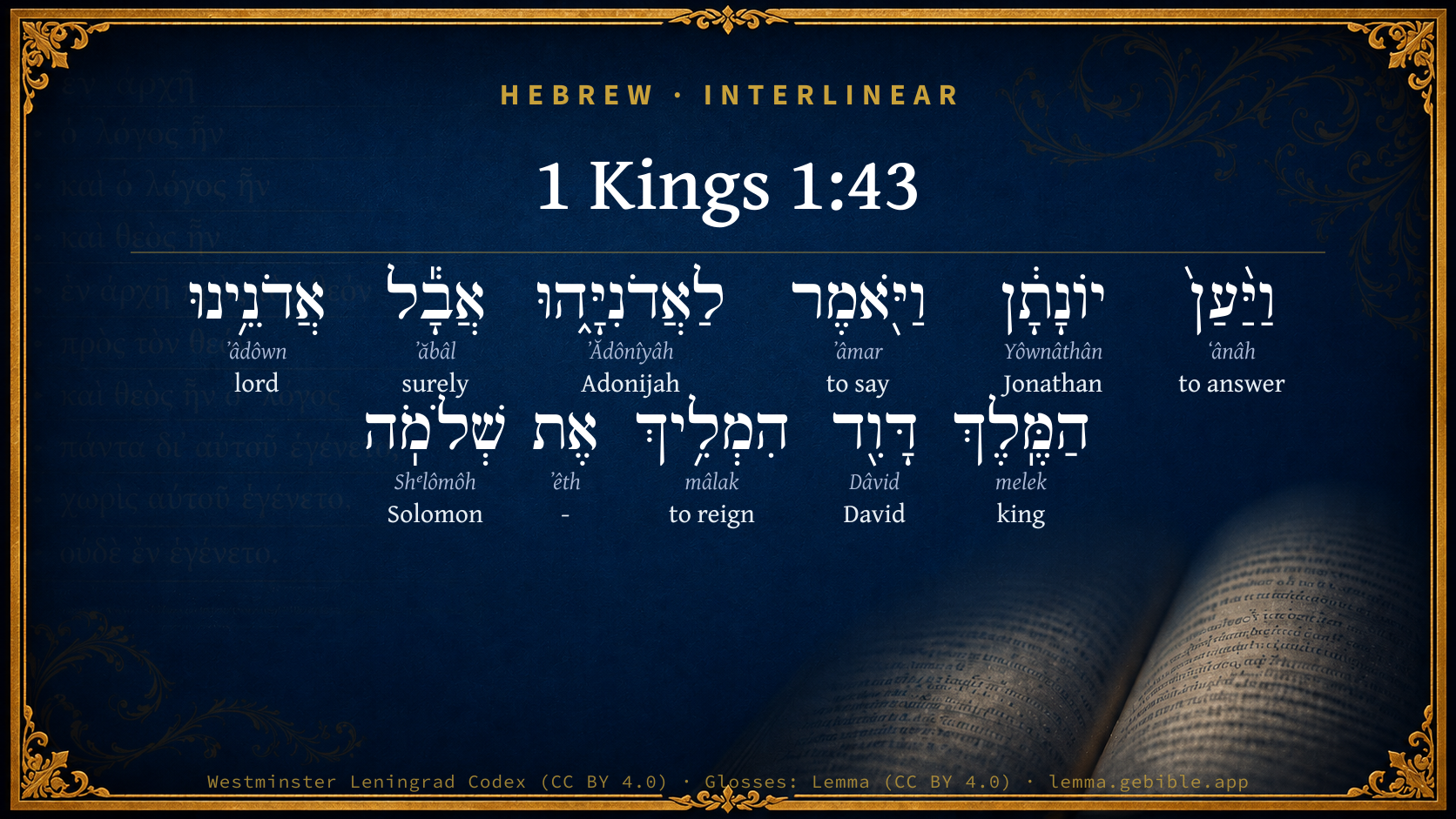
Hebrew (Westminster Leningrad Codex) 1 Kings 1:43 appears in the Hebrew Old Testament. The text above is from the Westminster Leningrad Codex. Each word links to its Strong’s number, a concise gloss, and parsing drawn from the Open Scriptures Hebrew Bible morphology. Click any word for its full Brown-Driver-Briggs (BDB) entry.
Download image
Cite this verse

1 Kings 1:43 (World English Bible). Public Domain. Lemma interlinear Bible study tool, https://lemma.gebible.app/v/1-kings/1/43.

Show BibTeX & RIS
BibTeX
RIS
English Translation
Jonathan answered Adonijah, Most assuredly our lord king David has made Solomon king:
World English Bible · Public Domain
Download a study sheet

One document with this verse’s original text, its word-by-word gloss line, the meaning frame, cross-references with their text, attributed commentary, and full source and license credits — printable, and it pastes into notes with its structure intact.

This verse Autodidact and up

Study sheet (.html) Plain text (.txt)

A passage Seminary Student

Up to 50 verses in one chapter. A passage sheet keeps up to 6 commentary sources and 12 cross-references per verse, in the order this page ranks them, and says so on the sheet whenever that leaves anything out. Ask for a single verse and you get the Autodidact verse sheet above.

Everything on this page stays free to read, with no account — the sheet is a download of what is already on screen, not access to it.

Want to remove ads? Support Godless Engineer
Compare translations 3

The same verse in 3 English versions, stacked beneath the original-language interlinear above. Click any original word for its lexicon entry.

Each is an independent rendering of the whole verse — the interlinear is not word-aligned to these translations.

Highlighted words mark where these versions differ — a whole-verse word diff, not a word-by-word alignment.

  • World English Bible Public Domain
    Jonathan answered Adonijah, Most assuredly our lord king David has made Solomon king:
  • King James Version Public Domain
    And Jonathan answered and said to Adonijah, Verily our lord king David hath made Solomon king.
  • unfoldingWord Literal Text CC BY-SA 4.0
    And Jonathan answered and said to Adonijah, “Truly, our master King David has made Solomon reign.

unfoldingWord Literal Text — © unfoldingWord, licensed CC BY-SA 4.0. Word-aligned USFM3 via Door43 (git.door43.org/unfoldingWord/en_ult).

Versions to compare (up to 4)

3 of 4 selected

Show all 18 translations

Every available English version of this verse, each an independent rendering of the whole verse.

  • World English Bible Public Domain
    Jonathan answered Adonijah, Most assuredly our lord king David has made Solomon king:
  • Berean Standard Bible Public Domain
    “Not at all,” Jonathan replied. “Our lord King David has made Solomon king.
  • Majority Standard Bible Public Domain
    “Not at all,” Jonathan replied. “Our lord King David has made Solomon king.
  • King James Version Public Domain
    And Jonathan answered and said to Adonijah, Verily our lord king David hath made Solomon king.
  • American Standard Version (1901) Public Domain
    And Jonathan answered and said to Adonijah, Verily our lord king David hath made Solomon king:
  • Revised Version (1885) Public Domain
    And Jonathan answered and said to Adonijah, Verily our lord king David hath made Solomon king:
  • Geneva Bible (1599) Public Domain
    And Ionathan answered, and said to Adoniiah, Verely our lord King Dauid hath made Salomon King.
  • Douay-Rheims (1899) Public Domain
    And Jonathan answered Adonias: Not so: for our lord king David hath appointed Solomon king.
  • Young's Literal Translation Public Domain
    And Jonathan answereth and saith to Adonijah, `Verily our lord king David hath caused Solomon to reign,
  • Literal Standard Version CC BY-SA 4.0
    And Jonathan answers and says to Adonijah, “Truly our lord King David has caused Solomon to reign,
  • Unlocked Literal Bible CC BY-SA 4.0
    Jonathan answered and said to Adonijah, “Our master King David has made Solomon the king,
  • unfoldingWord Literal Text CC BY-SA 4.0
    And Jonathan answered and said to Adonijah, “Truly, our master King David has made Solomon reign.
  • Darby Bible Public Domain
    And Jonathan answered and said to Adonijah, Indeed, our lord king David has made Solomon king.
  • World Messianic Bible Public Domain
    Jonathan answered Adonijah, “Most certainly our lord King David has made Solomon king.
  • Webster's Bible Public Domain
    And Jonathan answered and said to Adonijah, Verily our lord king David hath made Solomon king.
  • Free Bible Version CC BY-SA 4.0
    “Absolutely not!” Jonathan replied. “Our lord King David has made Solomon king!
  • Bible in Basic English Public Domain
    And Jonathan, answering, said to Adonijah, Not so, but our lord King David has made Solomon king:
  • JPS Tanakh (1917) Public Domain
    And Jonathan answered and said to Adonijah: 'Verily our lord king David hath made Solomon king.

Literal Standard Version (2020), Covenant Press — licensed CC BY-SA 4.0. Text via the HelloAO Bible API (eBible.org). Unlocked Literal Bible (unfoldingWord) — licensed CC BY-SA 4.0. Text via the HelloAO Bible API (eBible.org). unfoldingWord Literal Text — © unfoldingWord, licensed CC BY-SA 4.0. Word-aligned USFM3 via Door43 (git.door43.org/unfoldingWord/en_ult). Free Bible Version, Dr. Jonathan Gallagher — licensed CC BY-SA 4.0. Text via the HelloAO Bible API (eBible.org).

Word by word

More ways to search: Search by grammar → Find every occurrence → Compare this word →

Practice this passage: Drill this verse → Learn its vocabulary →

About this verse

These counts appear in no published source. They are computed here, from the morphology-tagged text and Lemma’s own curated glosses. What Lemma adds →

11
words
11
distinct lemmas
Historical
section

Notable vocabulary

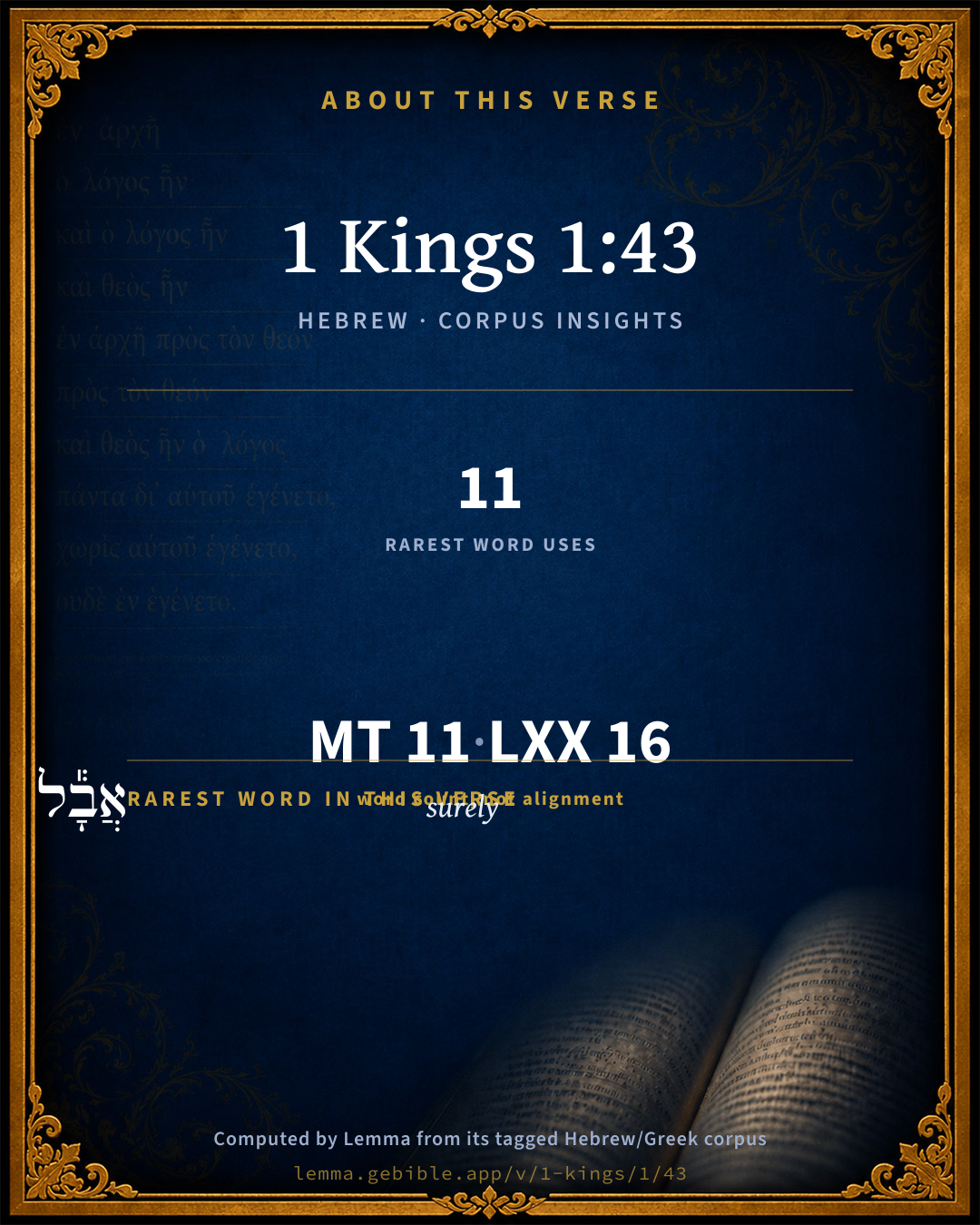
The rarest word here is אֲבָ֕ל surely H61 — appearing just 11 times in the whole Hebrew Bible.

Shared distinctive vocabulary

אֲבָ֕ל surely H61 occurs in 11 verses of the Hebrew Bible. Also found in:

Grammatical profile

  • 3 verbs
  • 6 nouns
  • 1 adverb
  • 1 particle

Verb forms

  • וַיַּ֨עַן֙ Qal · Sequential Imperfect
  • וַיֹּ֖אמֶר Qal · Sequential Imperfect
  • הִמְלִ֥יךְ Hiphil · Perfect

Hebrew & Septuagint length

In English translation the verse runs 13 words from the Hebrew and 14 from the Septuagint (LXX English) — closely comparable.

A rough comparison of the two English renderings, which tokenize alike — not a word-level alignment.

Word counts can differ between the Hebrew and the Greek without any difference in meaning — e.g. the Hebrew direct-object marker אֵת has no separate Greek word, and Greek often adds the article ὁ.

In the original languages it is 11 Hebrew tokens and 16 Greek tokens — but the two are counted differently (Hebrew bundles its prefixes and suffixes into one token; the Greek is in lemma form), so that isn’t a like-for-like length.

Hebrew and Greek witnesses Masoretic Hebrew ↔ Greek Septuagint

The same verse in the two great witnesses to the Old Testament, shown verse-for-verse.

These are two independent witnesses, not word-aligned to each other, and the Septuagint is shown in lemma (dictionary) form.

Hebrew 1 Kings 1:43 Masoretic · Westminster Leningrad Codex

וַיַּ֨עַן֙ יוֹנָתָ֔ן וַיֹּ֖אמֶר לַאֲדֹנִיָּ֑הוּ אֲבָ֕ל אֲדֹנֵ֥ינוּ הַמֶּֽלֶךְ דָּוִ֖ד הִמְלִ֥יךְ אֶת שְׁלֹמֹֽה

Jonathan answered Adonijah, Most assuredly our lord king David has made Solomon king:

World English Bible · Public Domain

Greek LXX 1 Kings 1:43 Septuagint · lemma form

καί ἀποκρίνω ιωναθαν καί εἶπον καί μάλα ὁ κύριος ἐγώ ὁ βασιλεύς δαυίδ βασιλεύω ὁ σαλωμών

And Jonathan answered and said, Verily our lord king David has made Solomon king:

LXX2012 (modern English Septuagint) · Public Domain

Hebrew: Westminster Leningrad Codex (CC BY 4.0). Greek: Septuagint (public domain); English from LXX2012 (modern English Septuagint) (Public Domain). How the Septuagint differs from the Hebrew →

Targum (Aramaic paraphrase)

1

The Targum is the ancient Jewish Aramaic paraphrase of the Hebrew Scriptures — an interpretive translation, not the Hebrew text itself. Onkelos (literal) and Pseudo-Jonathan (expansive) render the Torah, and Jonathan the Prophets. Coverage is partial: where no permissively-licensed English translation exists for a verse, only the Aramaic is shown. This is verse-level text, not a word-by-word alignment to the Hebrew.

  1. Targum Jonathan Prophets (Joshua–Malachi)
    וַאֲתֵיב יוֹנָתָן וַאֲמַר לַאֲדֹנִיָהוּ בְּקוּשְׁטָא רִבּוֹנָנָא מַלְכָּא דָוִד אַמְלִיךְ יַת שְׁלֹמֹה:

    (no public-domain English translation for this verse)

    Targum Jonathan — Aramaic: “Mikraot Gedolot” (public domain). English: “Sefaria Community Translation” (CC0 1.0 (public-domain dedication)); “London "Chaldee Paraphrase," 1871” (public domain). Text via Sefaria.

Commentary

Notes on 1 Kings 1:43 from classic Christian and Jewish commentators (each source and its license shown beneath its notes). The classic Christian expositions comment on the surrounding passage and are grouped to its opening verse, so a note may address several verses; the Jewish commentaries on the Tanakh (Rashi and others) are per-verse, so they appear only where the commentator wrote on this verse.

Lemma curates 59 commentaries, every one of them public domain or Creative Commons licensed, each selected and text-cleaned for this edition rather than reprinted as found. About our sources →

Trapp's Complete Commentary

John Trapp

1Ki 1:43 And Jonathan answered and said to Adonijah, Verily our lord king David hath made Solomon king.

Ver. 43. Verily our lord king David,] q.d., Good news say you? truly not so good as you think, for all is like to be nought on your side: Postea nullus eris. Afterward it will be nothing.

John Trapp, A Commentary or Exposition upon All the Books of the Old and New Testament (1647–1656) — public domain. Text from a community e-Sword module.

Adam Clarke's Commentary

Verse 43. Jonathan answered] He was properly a messenger about the court; we have met with him and Ahimaaz before, 2Sa 15:36. He had now been an observer, if not a spy, on all that was doing, and relates the transactions to Adonijah, in the very order in which they took place.

1. David has nominated Solomon his successor.

2. Zadok, Nathan, and Benaiah, have been appointed to set him on the king's mule.

3. They have taken him to Gihon, and anointed him there.

4. They have brought him up to Jerusalem and placed him on the throne of the kingdom.

Adam Clarke's Commentary on the Bible (1810–1826) — public domain. Text from a community e-Sword/MySword module.

The Cambridge Bible for Schools and Colleges

gen. ed. J. J. S. Perowne

43. Verily our lord, &c.] The adverb implies some such sense as ‘Nay but’. Jonathan wishes to say ‘It is not as you hoped, but on the contrary Solomon is proclaimed and anointed.’ Comp. Gen_17:19, where the word is rendered in A. V. ‘indeed,’ but the sense is ‘Nay but Sarah thy wife shall bear thee a son,’ instead of Ishmael being made the hope of thy family.

The Cambridge Bible for Schools and Colleges (gen. ed. J. J. S. Perowne; Cambridge University Press, 1878–1918) — public domain. Text from a community e-Sword module.

John Gill's Exposition

And Jonathan answered and said to Adonijah, verily,.... Or, "nay, but" (k) it is not so as you imagine; it is not good tidings, but bad tidings to thee I bring:

our lord King David hath made Solomon king; of which he gives the following account in proof of it.

(k) "nequaquam", V. L. Junius & Tremellius, Piscator.

John Gill's Exposition of the Whole Bible (1746–1763) — public domain (CC PDM 1.0). Text via the HelloAO Bible API.

Albert Barnes' Notes on the Bible

Verily - “Nay, but” (or, “Not so”).

Albert Barnes' Notes on the Bible (1834–1885) — public domain. Text from a community e-Sword/MySword module.

Haydock's Catholic Bible Commentary

Not so. Hebrew, "Misfortune or mourning, or verily." A man of character did not willingly deliver a disagreeable message, 2 Kings xviii. 25. (Calmet) --- But Jonathan was concerned for his father. (Haydock)

George Leo Haydock (1774–1849), Haydock's Catholic Family Bible and Commentary, 1859 edition — public domain. Excludes Psalms (Douay-Rheims chapter numbering differs from Protestant) and Deuterocanonical books (Catholic canon only).

Matthew Poole's English Annotations

Verily, or, but, or, nay but, i.e. the matter is not as thou expectest, but quite contrary.

Matthew Poole's English Annotations on the Holy Bible (1683–1685) — public domain. Text from a community e-Sword/MySword module.

The Pulpit Commentary

And Jonathan answered and said to Adonijah, Verily Rather, "nay but," "on the contrary" (immo vero). See. Gen_17:19, Heb., "Nay, but Sarah thy wife," etc., and Gesen., Thesaurus, sub voce lba This particle has not "always an objecting force" (Rawlinson) see Gen_42:21, and especially 2Sa_14:5; 2Ki_4:14 but only in the later Hebrew, e.g. , (2Ch_19:3 2Ch_33:17) our Lord king David hath made Solomon king.

The Pulpit Commentary (1880–1919), ed. H.D.M. Spence-Jones & Joseph S. Exell — public domain. Text from a community e-Sword module.

Keil & Delitzsch

C. F. Keil & F. Delitzsch

Jonathan replied: אבל, "yea but," corresponding to the Latin imo vero, an expression of assurance with a slight doubt, and then related that Solomon had been anointed king by David's command, and the city was in a joyous state of excitement in consequence (תּהם as in Rut 1:19), and that he had even ascended the throne, that the servants of the king had blessed David for it, and that David himself had worshipped and praised Jehovah the God of Israel that he had lived to see his son ascend the throne. The repetition of וגם three times (Kg1 1:46-48) gives emphasis to the words, since every new point which is introduced with וגם raises the thing higher and higher towards absolute certainty. The fact related in Kg1 1:47 refers to the words of Benaiah in Kg1 1:36 and Kg1 1:37. The Chethib אלהיך is the correct reading, and the Keri אלהים an unnecessary emendation. The prayer to God, with thanksgiving for the favour granted to him, was offered by David after the return of his anointed son Solomon to the royal palace; so that it ought strictly to have been mentioned after Kg1 1:40. The worship of grey-headed David upon the bed recalls to mind the worship of the patriarch Jacob after making known his last will (Gen 47:31).

Keil & Delitzsch — Biblical Commentary on the Old Testament (1861–1891) — public domain (CC PDM 1.0). Text via the HelloAO Bible API. (Old Testament only.)

unfoldingWord translationNotes

Door43 World Missions Community

General Information:

Adonijah learns that Solomon is the new king.

Kerethites ... Pelethites

These are names of people groups. (See: How to Translate Names)

translationWords

Jonathan

unfoldingWord translationNotes — © Distant Shores Media and the Door43 World Missions Community, licensed CC BY-SA 4.0. Source: git.door43.org/Door43/en_tn.

Rashi

Rabbi Shlomo Yitzchaki (Rashi)

But our lord. I.e., “Now, my report is not of good [tidings] for you.”

Rashi on the Tanakh — English translations: “The Judaica Press complete Tanach with Rashi, translated by A. J. Rosenberg” (CC BY 4.0); “Pentateuch with Rashi's commentary by M. Rosenbaum and A.M. Silbermann, 1929-1934” (public domain); “The Metsudah Tanach series, Lakewood, N.J” (CC BY 4.0); and “The Book of Joshua, Metsudah Publications, 1997” (CC BY 4.0). Text via Sefaria.

Lesson kit

Teaching starters — assembled from the data on this page, not authored interpretation. Every prompt links to the verse data it draws on. Edit before teaching.

1 Kings, in the Historical, opens this verse with 11 words (11 distinct Hebrew lemmas). Its most distinctive word is ʼăbâl (“surely”). A historical commentator’s framing appears above. Read the whole chapter for the surrounding context.

Discussion questions

  1. What does “surely” (ʼăbâl) contribute to the verse as a whole?
  2. How does Genesis 17:19, which shares the word «surely», read alongside this verse?
  3. The translations on this page render this verse differently — a whole-verse word diff, not a word-by-word alignment. What might account for the different wordings?
  4. «וַיַּ֨עַן֙» is a Qal Sequential Imperfect verb. How does that grammatical form shape the action described?
  5. Compare how Trapp's Complete Commentary and Adam Clarke's Commentary read this verse. Where do they agree or differ?

Things to notice

Reading settings

Reading text

Shown beneath each verse's original-language words.

Old Testament
Old Testament edition

Read the OT as the Masoretic Hebrew (MT) or the Greek Septuagint (LXX).

English shown for the Greek Septuagint (in the Hebrew ↔ Greek comparison).

Comparing translations? Open the Compare panel on any verse page to stack up to four side by side.