
1 Kings 15:2

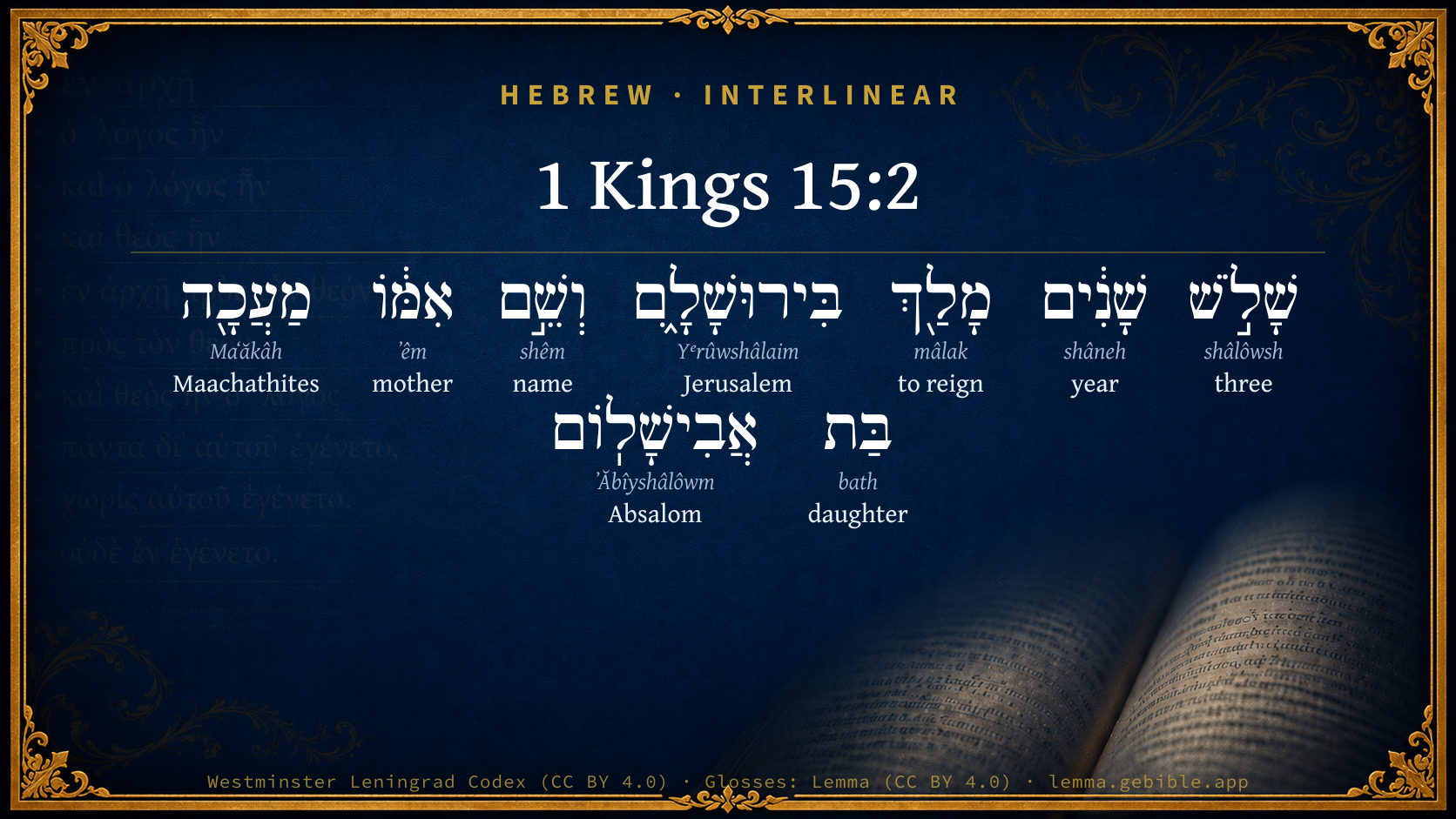
Hebrew (Westminster Leningrad Codex) 1 Kings 15:2 appears in the Hebrew Old Testament. The text above is from the Westminster Leningrad Codex. Each word links to its Strong’s number, a concise gloss, and parsing drawn from the Open Scriptures Hebrew Bible morphology. Click any word for its full Brown-Driver-Briggs (BDB) entry.
Download image
Cite this verse

1 Kings 15:2 (World English Bible). Public Domain. Lemma interlinear Bible study tool, https://lemma.gebible.app/v/1-kings/15/2.

Show BibTeX & RIS
BibTeX
RIS
English Translation
Three years reigned he in Jerusalem: and his mother's name was Maacah the daughter of Abishalom.
World English Bible · Public Domain
Download a study sheet

One document with this verse’s original text, its word-by-word gloss line, the meaning frame, cross-references with their text, attributed commentary, and full source and license credits — printable, and it pastes into notes with its structure intact.

This verse Autodidact and up

Study sheet (.html) Plain text (.txt)

A passage Seminary Student

Up to 50 verses in one chapter. A passage sheet keeps up to 6 commentary sources and 12 cross-references per verse, in the order this page ranks them, and says so on the sheet whenever that leaves anything out. Ask for a single verse and you get the Autodidact verse sheet above.

Everything on this page stays free to read, with no account — the sheet is a download of what is already on screen, not access to it.

Want to remove ads? Support Godless Engineer
Compare translations 3

The same verse in 3 English versions, stacked beneath the original-language interlinear above. Click any original word for its lexicon entry.

Each is an independent rendering of the whole verse — the interlinear is not word-aligned to these translations.

Highlighted words mark where these versions differ — a whole-verse word diff, not a word-by-word alignment.

  • World English Bible Public Domain
    Three years reigned he in Jerusalem: and his mother's name was Maacah the daughter of Abishalom.
  • King James Version Public Domain
    Three years reigned he in Jerusalem. and his mother's name was Maachah, the daughter of Abishalom.
  • unfoldingWord Literal Text CC BY-SA 4.0
    He reigned three years in Jerusalem. And the name of his mother was Maacah, the daughter of Abishalom.

unfoldingWord Literal Text — © unfoldingWord, licensed CC BY-SA 4.0. Word-aligned USFM3 via Door43 (git.door43.org/unfoldingWord/en_ult).

Versions to compare (up to 4)

3 of 4 selected

Show all 18 translations

Every available English version of this verse, each an independent rendering of the whole verse.

  • World English Bible Public Domain
    Three years reigned he in Jerusalem: and his mother's name was Maacah the daughter of Abishalom.
  • Berean Standard Bible Public Domain
    and he reigned in Jerusalem three years. His mother’s name was Maacah daughter of Abishalom.
  • Majority Standard Bible Public Domain
    and he reigned in Jerusalem three years. His mother’s name was Maacah daughter of Abishalom.
  • King James Version Public Domain
    Three years reigned he in Jerusalem. and his mother's name was Maachah, the daughter of Abishalom.
  • American Standard Version (1901) Public Domain
    Three years reigned he in Jerusalem: and his mother's name was Maacah the daughter of Abishalom.
  • Revised Version (1885) Public Domain
    Three years reigned he in Jerusalem: and his mother’s name was Maacah the daughter of Abishalom.
  • Geneva Bible (1599) Public Domain
    Three yeere reigned hee in Ierusalem, and his mothers name was Maachah the daughter of Abishalom.
  • Douay-Rheims (1899) Public Domain
    He reigned three years in Jerusalem: the name of his mother was Maacha the daughter of Abessalom.
  • Young's Literal Translation Public Domain
    three years he hath reigned in Jerusalem, and the name of his mother `is' Maachah daughter of Abishalom;
  • Literal Standard Version CC BY-SA 4.0
    he has reigned three years in Jerusalem, and the name of his mother [is] Maachah daughter of Abishalom;
  • Unlocked Literal Bible CC BY-SA 4.0
    He ruled for three years in Jerusalem. His mother's name was Maacah. She was the daughter of Abishalom.
  • unfoldingWord Literal Text CC BY-SA 4.0
    He reigned three years in Jerusalem. And the name of his mother was Maacah, the daughter of Abishalom.
  • Darby Bible Public Domain
    He reigned three years in Jerusalem; and his mother's name was Maachah, a daughter of Abishalom.
  • World Messianic Bible Public Domain
    He reigned three years in Jerusalem. His mother’s name was Maacah the daughter of Abishalom.
  • Webster's Bible Public Domain
    Three years he reigned in Jerusalem. And his mother's name was Maachah, the daughter of Abishalom.
  • Free Bible Version CC BY-SA 4.0
    He reigned in Jerusalem for three years. His mother's name was Maacah, daughter of Abishalom.
  • Bible in Basic English Public Domain
    For three years he was king in Jerusalem: and his mother's name was Maacah, the daughter of Abishalom.
  • JPS Tanakh (1917) Public Domain
    Three years reigned he in Jerusalem; and his mother's name was Maacah the daughter of Abishalom.

Literal Standard Version (2020), Covenant Press — licensed CC BY-SA 4.0. Text via the HelloAO Bible API (eBible.org). Unlocked Literal Bible (unfoldingWord) — licensed CC BY-SA 4.0. Text via the HelloAO Bible API (eBible.org). unfoldingWord Literal Text — © unfoldingWord, licensed CC BY-SA 4.0. Word-aligned USFM3 via Door43 (git.door43.org/unfoldingWord/en_ult). Free Bible Version, Dr. Jonathan Gallagher — licensed CC BY-SA 4.0. Text via the HelloAO Bible API (eBible.org).

Word by word

More ways to search: Search by grammar → Find every occurrence → Compare this word →

Practice this passage: Drill this verse → Learn its vocabulary →

מַעֲכָ֖ה
Maʻăkâh
H4601
“Maachathites”
Noun, Proper
Part of Speech
Noun
Type
Proper
Full BDB Definition

Origin: from H4600

TWOT: None

Maachathites = "pressure (literally she has pressed)" - father of Achish, king of Gath at the beginning of Solomon's reign (noun proper masculine) - father of Hanan, one of David's mighty warriors (noun proper masculine) - a Simeonite, father of Shephatiah, prince of his tribe in the reign of David (noun proper masculine) - son of Nahor by concubine Reumah (noun proper masculine) - daughter of king Talmai of Geshur, wife of David, and mother of Absalom (noun proper feminine) - daughter of Absalom, wife of king Rehoboam of Judah, and mother of king Abijam of Judah (noun proper feminine) - concubine of Caleb the son of Hezron (noun proper feminine) - wife of Machir of the tribe of Manasseh (noun proper feminine) - wife of Jehiel, father of Gibeon (noun proper feminine) - a mercenary people hired to fight David (noun proper)
  1. שָׁלֹ֣שׁ shâlôwsh H7969 “three” Adjective, Cardinal number, Feminine, Singular, Absolute
  2. שָׁנִ֔ים shâneh H8141 “years” Noun, Common, Feminine, Plural, Absolute
  3. מָלַ֖ךְ mâlak H4427 “to reign” Verb, Qal, Perfect, 3rd Person, Masculine, Singular
  4. בִּירוּשָׁלִָ֑ם Yᵉrûwshâlaim H3389 “in/at · Jerusalem” Preposition + Noun, Proper
  5. וְשֵׁ֣ם shêm H8034 “and · name of” Conjunction + Noun, Common, Masculine, Singular, Construct
  6. אִמּ֔וֹ ʼêm H517 “mother · his” Noun, Common, Feminine, Singular, Construct + Suffix, Personal, 3rd Person, Masculine, Singular
  7. בַּת bath H1323 “daughter of” Noun, Common, Feminine, Singular, Construct
  8. אֲבִישָׁלֽוֹם ʼĂbîyshâlôwm H53 “Absalom” Noun, Proper

About this verse

These counts appear in no published source. They are computed here, from the morphology-tagged text and Lemma’s own curated glosses. What Lemma adds →

9
words
9
distinct lemmas
Historical
section

Notable vocabulary

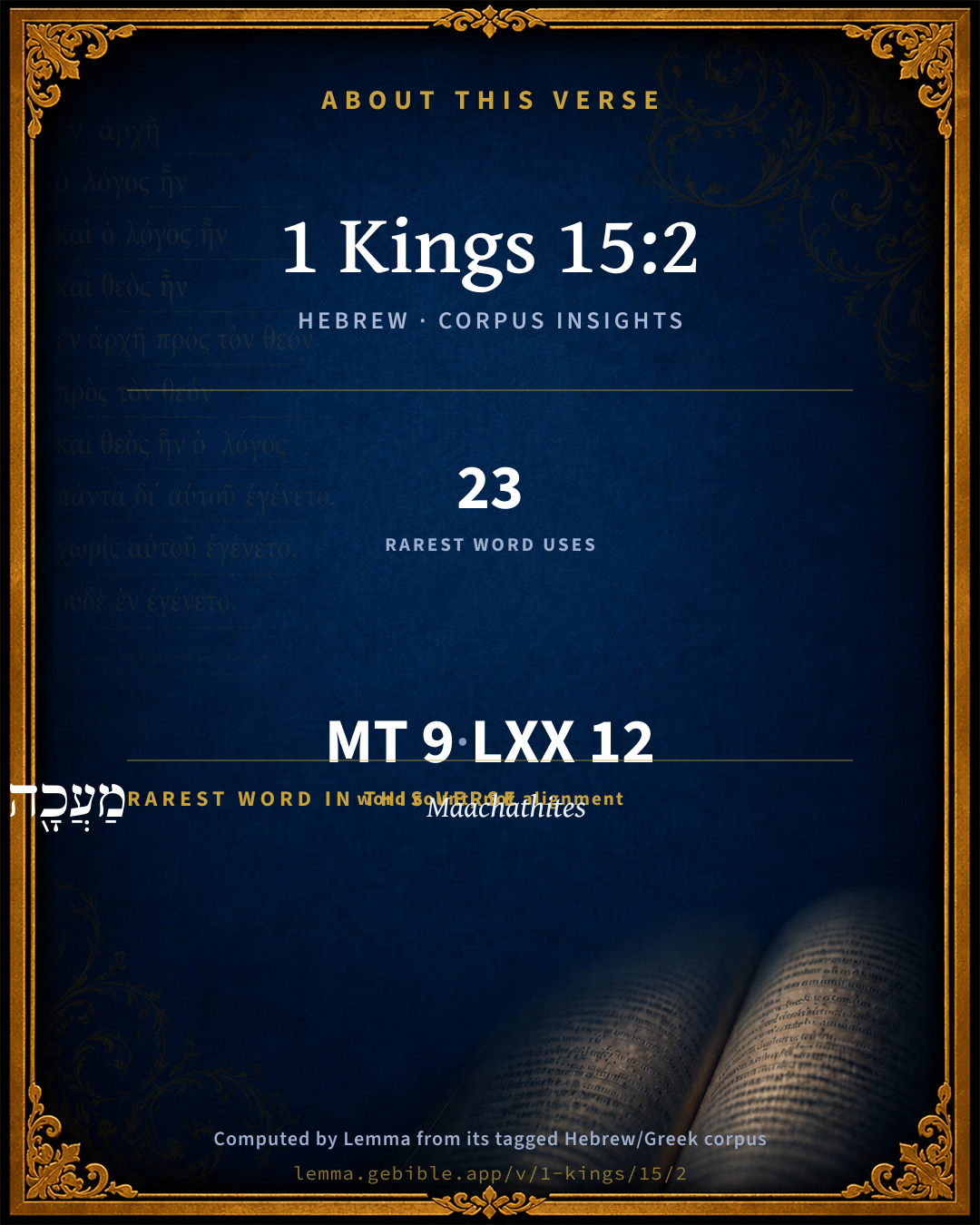
The rarest word here is מַעֲכָ֖ה Maachathites H4601 — appearing just 23 times in the whole Hebrew Bible.

Shared distinctive vocabulary

מַעֲכָ֖ה Maachathites H4601 occurs in 23 verses of the Hebrew Bible. Also found in:

Grammatical profile

  • 1 verb
  • 7 nouns
  • 1 adjective

Verb forms

  • מָלַ֖ךְ Qal · Perfect

Hebrew & Septuagint length

In English translation the verse runs 16 words from the Hebrew and 16 from the Septuagint (LXX English) — the same length.

A rough comparison of the two English renderings, which tokenize alike — not a word-level alignment.

Word counts can differ between the Hebrew and the Greek without any difference in meaning — e.g. the Hebrew direct-object marker אֵת has no separate Greek word, and Greek often adds the article ὁ.

In the original languages it is 9 Hebrew tokens and 12 Greek tokens — but the two are counted differently (Hebrew bundles its prefixes and suffixes into one token; the Greek is in lemma form), so that isn’t a like-for-like length.

Cross-references

3

Topical passages linked to 1 Kings 15:2 in the Treasury of Scripture Knowledge — connected by theme and wording, ordered by reader-vote popularity; previews shown in the World English Bible.

  • 2 Chronicles 13:2 Three years reigned he in Jerusalem: and his mother's name was Micaiah the daughter of Uriel of Gibeah. There was war between Abijah and Jeroboam.
  • 1 Kings 15:13 Also Maacah his mother he removed from being queen, because she had made an abominable image for an Asherah; and Asa cut down her image, and burnt it at the brook Kidron.
  • 2 Chronicles 11:20–22 After her he took Maacah the daughter of Absalom; and she bore him Abijah, and Attai, and Ziza, and Shelomith.

Cross-references courtesy of OpenBible.info (CC BY 4.0).

Hebrew and Greek witnesses Masoretic Hebrew ↔ Greek Septuagint

The same verse in the two great witnesses to the Old Testament, shown verse-for-verse.

These are two independent witnesses, not word-aligned to each other, and the Septuagint is shown in lemma (dictionary) form.

Hebrew 1 Kings 15:2 Masoretic · Westminster Leningrad Codex

שָׁלֹ֣שׁ שָׁנִ֔ים מָלַ֖ךְ בִּירוּשָׁלִָ֑ם וְשֵׁ֣ם אִמּ֔וֹ מַעֲכָ֖ה בַּת אֲבִישָׁלֽוֹם

Three years reigned he in Jerusalem: and his mother's name was Maacah the daughter of Abishalom.

World English Bible · Public Domain

Greek LXX 1 Kings 15:2 Septuagint · lemma form

καί ἕξ ἔτος βασιλεύω καί ὄνομα ὁ μήτηρ αὐτός μααχα θυγάτηρ αβεσσαλωμ

And he reigned three years over Jerusalem: and his mother's name was Maacha, daughter of Abessalom.

LXX2012 (modern English Septuagint) · Public Domain

On this verse, The Pulpit Commentary discusses the Septuagint’s reading. Read the note in Commentary ↓

Hebrew: Westminster Leningrad Codex (CC BY 4.0). Greek: Septuagint (public domain); English from LXX2012 (modern English Septuagint) (Public Domain). How the Septuagint differs from the Hebrew →

Targum (Aramaic paraphrase)

1

The Targum is the ancient Jewish Aramaic paraphrase of the Hebrew Scriptures — an interpretive translation, not the Hebrew text itself. Onkelos (literal) and Pseudo-Jonathan (expansive) render the Torah, and Jonathan the Prophets. Coverage is partial: where no permissively-licensed English translation exists for a verse, only the Aramaic is shown. This is verse-level text, not a word-by-word alignment to the Hebrew.

  1. Targum Jonathan Prophets (Joshua–Malachi)
    תְּלַת שְׁנִין מְלַךְ בִּירוּשְׁלֵם וְשׁוּם אִמֵיהּ מַעֲכָה בַּת אֲבִישָׁלוֹם:

    (no public-domain English translation for this verse)

    Targum Jonathan — Aramaic: “Mikraot Gedolot” (public domain). English: “Sefaria Community Translation” (CC0 1.0 (public-domain dedication)); “London "Chaldee Paraphrase," 1871” (public domain). Text via Sefaria.

Commentary

Notes on 1 Kings 15:2 from classic Christian and Jewish commentators (each source and its license shown beneath its notes). The classic Christian expositions comment on the surrounding passage and are grouped to its opening verse, so a note may address several verses; the Jewish commentaries on the Tanakh (Rashi and others) are per-verse, so they appear only where the commentator wrote on this verse.

Lemma curates 59 commentaries, every one of them public domain or Creative Commons licensed, each selected and text-cleaned for this edition rather than reprinted as found. About our sources →

Trapp's Complete Commentary

John Trapp

1Ki 15:2 Three years reigned he in Jerusalem. And his mother’s name [was] Maachah, the daughter of Abishalom.

Ver. 2. His mother’s name was Maachah.] Called also Micalah; {2Ch 13:2} we read likewise of a woman called Abijah. {2Ch 29:1}

The daughter of Abishalom.] Or, Absalom, whose daughter or niece by his daughter Tamar this Maachah may seem to have been: her husband’s name was Uriel of Gibeah. {2Ch 13:2}

John Trapp, A Commentary or Exposition upon All the Books of the Old and New Testament (1647–1656) — public domain. Text from a community e-Sword module.

Tyndale Open Study Notes

Tyndale Open Resources

15:2 Abijam’s mother was Maacah, Rehoboam’s favorite of his eighteen wives. She was the granddaughter of Absalom. Presumably this Absalom is David’s son. Maacah, an idol worshiper, was an evil spiritual influence in Judah (15:13).

Tyndale Open Study Notes — © Tyndale Open Resources, licensed CC BY-SA 4.0. Text via the HelloAO Bible API.

Geneva Bible (1599)

Geneva Bible translators

Some think that this was Absalom Solomon’s son.

Geneva Bible (1599) marginal notes — public domain. Text via Bolls.life.

Jamieson, Fausset & Brown

Robert Jamieson, A. R. Fausset & David Brown

Three years reigned he--(compare Kg1 15:1 with Kg1 15:9). Parts of years are often counted in Scripture as whole years. The reign began in Jeroboam's eighteenth year, continued till the nineteenth, and ended in the course of the twentieth.

his mother's name was Maachah--or Michaiah (Ch2 13:2), probably altered from the one to the other on her becoming queen, as was very common under a change of circumstances. She is called the daughter of Abishalom, or Absalom (Ch2 11:21), of Uriel (Ch2 13:2). Hence, it has been thought probable that Tamar, the daughter of Absalom (Sa2 14:27; Sa2 18:18), had been married to Uriel, and that Maachah was their daughter.

Jamieson, Fausset & Brown — Commentary Critical and Explanatory on the Whole Bible (1871) — public domain (CC PDM 1.0). Text via the HelloAO Bible API.

Ellicott's Commentary for English Readers

(2) Maachah, the daughter of Abishalom.—The Abishalom of this passage, called, in 2Ch_11:20, Absalom, is in all probability the rebel son of David, whose mother (2Sa_3:3) was also named Maachah. In 2Ch_11:21-22, it seems that of all the wives (“eighteen wives and threescore concubines”) whom Àehoboam, following the evil traditions of his father, took, she was the favourite, and that even in his lifetime Rehoboam exalted Abijam “to be ruler among his brethren.” In 2Ch_13:2 she is called Michaiah, and said to be the daughter of “Uriel of Gibeah.” This shows that, as indeed chronological considerations would suggest, she must have been the granddaughter of Absalom. She is mentioned below (1Ki_15:13) as prominent in the evil propensity to idolatry.

A Bible Commentary for English Readers, edited by Charles John Ellicott (1878–1897) — public domain. Text from a community e-Sword module.

The Cambridge Bible for Schools and Colleges

gen. ed. J. J. S. Perowne

2. Three years reigned he] If he began his reign in the eighteenth year of Jeroboam, and was succeeded by Asa (1Ki_15:9) in the twentieth year of the same king, the three years cannot have been complete. But this must frequently be noted in the chronological records of the two kingdoms, and imports an element of uncertainty into them.

Maachah, the daughter of Abishalom] In 2Ch_13:2 Abijah’s mother is called ‘Michaiah the daughter of Uriel of Gibeah.’ But in 2Ch_11:20 it is said that Rehoboam married ‘Maachah the daughter of Absalom, which bare him Abijah.’ Abishalom is only another form of Absalom and the person here meant may be the well-known son of David. ‘Daughter’ is sometimes used for ‘grand-daughter. Absalom had one daughter, called Tamar (2Sa_14:27) who may have married Uriel, and have had a daughter Maachah. The מיכיהו (Michaiah) of 2Ch_13:2 must then be an error of the scribe for מעכה (Maachah), which is the name found in all other places.

The Cambridge Bible for Schools and Colleges (gen. ed. J. J. S. Perowne; Cambridge University Press, 1878–1918) — public domain. Text from a community e-Sword module.

John Gill's Exposition

And he walked in all the sins of his father, which he had done before him,.... Having such bad examples as both parents to copy after; it chiefly respects idolatrous practices, see Kg1 14:23,

and his heart was not perfect with the Lord his God; he did profess the true God, and worshipped him, but not wholly, and only, and sincerely; he worshipped other gods besides him: and so his heart was not

as the heart of David his father; who was a sole and sincere worshipper of God, never departed from him and his service.

John Gill's Exposition of the Whole Bible (1746–1763) — public domain (CC PDM 1.0). Text via the HelloAO Bible API.

Albert Barnes' Notes on the Bible

Three years - More strictly, not much more than two years (compare 1Ki 15:1, 1Ki 15:9). Any part of a year may, however, in Jewish reckoning, be taken as a year.

His mother’s name was Maachah - Or Michaiah, according to the present reading of marginal reference.

The daughter of Abishalom - Absalom seems to have had but one daughter, Tamar 2Sa 14:27, so that Maachah must have been, not his daughter, but his grand-daughter. Her father (see the margin) was Uriel of Gibeah whom, therefore, Tamar married. Maachah took her name from her great-grandmother 2Sa 3:3.

Albert Barnes' Notes on the Bible (1834–1885) — public domain. Text from a community e-Sword/MySword module.

Haydock's Catholic Bible Commentary

Years, wanting some months. Maacha. She is called elsewhere, Michaia, daughter of Uriel; but is was a common thing, in those days, for a person to have two names. (Challoner) --- Abessalom and Absalom, the son of David are the same, 2 Paralipomenon xi. 21. (Calmet) --- St. Jerome (Trad.) is of a different opinion. (Menochius) --- Josephus ([Antiquities?] viii. 10.) intimates that Maacha was the daughter of Thamar. The eldest daughter, in the kingdom of Gessur, seems to have been usually styled Maacha, ver. 10. (Tirinus)

George Leo Haydock (1774–1849), Haydock's Catholic Family Bible and Commentary, 1859 edition — public domain. Excludes Psalms (Douay-Rheims chapter numbering differs from Protestant) and Deuterocanonical books (Catholic canon only).

Matthew Poole's English Annotations

Three years: See Poole "1Ki 15:1".

Of Abishalom, or, of Absalom, as he is called, 2Ch 11:21. And because he is here mentioned as a known person, without any addition of his kindred or quality, some conceive that this was Absalom’s daughter, called properly Tamar, 2Sa 14:27, and from her royal grandmother, 2Sa 3:3 Maachah; and that she is called Michaiah (which differs not much from Maachah) the daughter of Uriel, 2Ch 13:2, because she was first married to Uriel, as Josephus affirms, Antiq. viii. 3, and afterwards to Rehoboam. Others think this was another person, and that both she and her father had each of them several names, which was not unusual among the Hebrews.

Matthew Poole's English Annotations on the Holy Bible (1683–1685) — public domain. Text from a community e-Sword/MySword module.

The Pulpit Commentary

Three years The Alex. LXX says dekaex, sixteen. The" three years" are not to be interpreted strictly. As he ascended the throne in the eighteenth and died in the twentieth year of Jeroboam"s reign, he cannot have completed three years. But it does not follow that "he cannot have reigned much more than two years" (Rawlinson, and similarly Keil). He may have reigned all but three reigned he in Jerusalem. And his mother"s name was Maachah in 2Ch_13:2 called Michaiah, Heb. Michajahu. That the same person is meant is proved as well by the context as by 2Ch_11:21, where the name is given as here. Keil (cf. Dict. Bib. 2:162) ascribes the discrepancy to an error of the copyist; but the names are so unlike in the original as to discountenance this assumption. I venture to suggest that Michajahu was the significant form the word means "Who is like Jehovah? which the name Maachah, "oppression," borne by the Geshurite princess who married David (2Sa_3:3) assumed when she joined the Lord"s peo ple, and embraced, as no doubt she would do, the religion of Jehovah. Such a change would be quite in accordance with the genius and traditions of the Semitic races Gen_17:5, Gen_17:15. passim; Gen_32:28 Gen_41:45; Exo_6:3, etc. (Cf. 2Ki_23:34 2Ki_24:17; Hos_1:4, Hos_1:6) and there may well have been special reasons in this case, apart from the piety of David, why it should be made. For the name Maachah appears to have been taken Iron the town and district of that name near Geshur a part of Syria was called Syria Maachah (1Ch_19:6; cf. 2Sa_10:6-8) In, 2Sa_20:14, 15 we read of a district of Beth Maachah and it not improbably witnessed to unhappy memories. How natural it would be that David"s bride should take a name of better omen and of a religious import, and how natural that the grand-daughter who bore her name should be called by that name in both its forms. Since writing the above, I find that a somewhat similar idea has occurred long since to others. Both Kimchi and Jarchi hold that she had two names. It is supposed by some that she assumed the name Michaiah, as more dignified, on becoming queen. Wordsworth thinks that Michaiah was her real name, and that it was degraded into Maachah when she was deposed for idolatry. This latter view dovetails with the one suggested above. It would be quite in accordance with Jewish usages and habits of thought that the name which had been changed into Michaiah when the grandmother became a proselyte, should be changed back into Maachah when this princess apostatized the daughter rather, granddaughter. tB includes all female descendants, as (see ver. 10) all anxestresses of Abishalom. We can hardly doubt that Absalom, the son of David, is meant here. We have

(1) the express statement of 2Ch_11:21, "Rehoboam loved Maachah, the daughter of Absalom," etc.

(2) The fact that two of Rehoboam"s other wives were of the family of David, which shows that it was part of his policy to marry the daughters of that house.

(3) The mother of Absalom was named Maachah. (2Sa_3:3)

(4) The name is so uncommon in fact, it is apax leg that another person can hardly be intended. Moreover the variation in spelling is extremely slight. It has been held, however, that a different person is designated by the name, principally because Absalom had hut one daughter whose name was Tamar, (2Sa_14:27) whereas Abijah"s mother is said to have been the daughter of Uriel of Gibeah. (2Ch_13:2) But this difficulty admits of an easy solution. Tamar was doubtless married to Uriel, and Maachah was the fruit of this marriage. And with this explanation agrees the account of Josephus (Ant. 8:10, 1).

The Pulpit Commentary (1880–1919), ed. H.D.M. Spence-Jones & Joseph S. Exell — public domain. Text from a community e-Sword module.

John Wesley's Explanatory Notes

Three years - That is, part of three years. Abishalom - Or, of Absalom, as he is called 2 Chron. xi, 21. And because he is here mentioned as a known person, without any addition of his kindred or quality, some conceive that this was Absalom's daughter, called properly Tamar, 2 Sam. xiv, 27, and from her royal grandmother, 2 Sam. iii, 3, Maacah.

John Wesley, Explanatory Notes Upon the Whole Bible (1754–1765) — public domain. Text via the GEBible commentary corpus.

Lesson kit

Teaching starters — assembled from the data on this page, not authored interpretation. Every prompt links to the verse data it draws on. Edit before teaching.

1 Kings, in the Historical, opens this verse with 9 words (9 distinct Hebrew lemmas). Its most distinctive word is Maʻăkâh (“Maachathites”). A historical commentator’s framing appears above. Read the whole chapter for the surrounding context.

Discussion questions

  1. How does “Maachathites” (Maʻăkâh) shape what this verse is saying?
  2. How does Genesis 22:24, which shares the word «Maachathites», read alongside this verse?
  3. These translations render this verse differently; the difference is in the English rendering, not the original. What questions does that raise?
  4. «מָלַ֖ךְ» is a Qal Perfect verb. How does that grammatical form shape the action described?
  5. Compare how Trapp's Complete Commentary and Tyndale Open Study Notes read this verse. Where do they agree or differ?

Things to notice

Reading settings

Reading text

Shown beneath each verse's original-language words.

Old Testament
Old Testament edition

Read the OT as the Masoretic Hebrew (MT) or the Greek Septuagint (LXX).

English shown for the Greek Septuagint (in the Hebrew ↔ Greek comparison).

Comparing translations? Open the Compare panel on any verse page to stack up to four side by side.