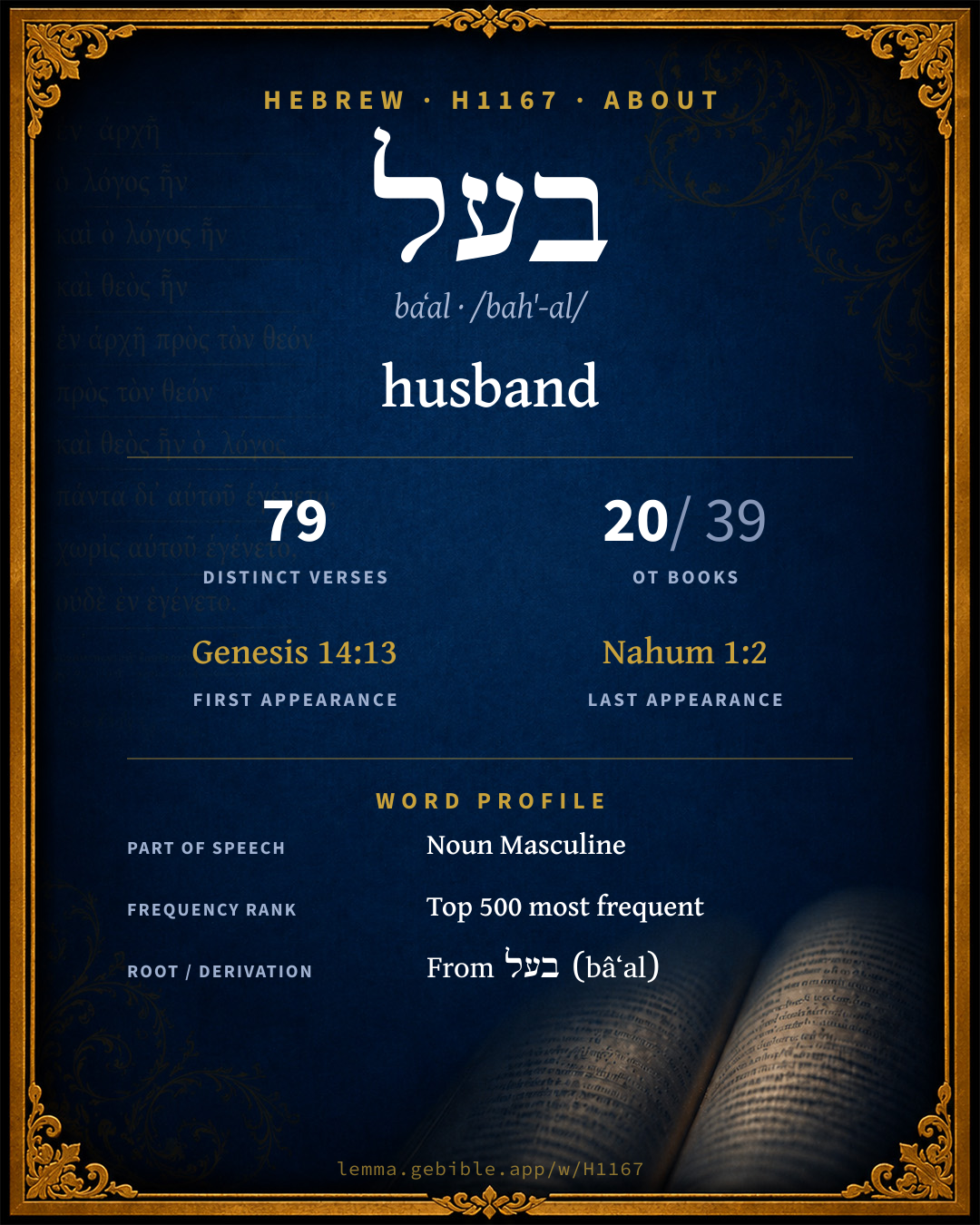
בַּעַל
husband
also: owner, lord fuller range ↓
Full lexicon entry — Brown-Driver-Briggs (BDB)
From Brown-Driver-Briggs (BDB)
Where this word appears
See every Construct-state word in the Hebrew Bible →
Grammar key — what these labels mean
Part of speech
- Noun
- A naming word — a person, place, thing, or idea.
Noun type
- Common
- A common noun — a general class of person, place, or thing (“king,” “city,” “water”), not a specific name.
State
- Construct
- A noun bound to a following noun in a possessive / “of” relationship (the construct chain).
- Absolute
- The independent form of a noun, not bound to a following word.
Gender
- Masculine
- Grammatically masculine.
Number
- Plural
- More than one (in Hebrew, generally three or more).
- Singular
- One.
Grammatical forms
- Noun, Common, Masculine, Plural, Construct 48 times (58%)
- Noun, Common, Masculine, Singular, Construct 31 times (37%)
- Noun, Common, Masculine, Singular, Absolute 4 times (5%)
Parsed forms decoded from the imported morphology (morphhb / Westminster Leningrad Codex — WLC text public domain, morphhb tagging CC BY 4.0), counted across 83 parsed occurrences — not distinct verses.
Every verse where H1167 appears — 79 distinct verses across 20 books. Click any verse to open its interlinear word-by-word view. Verse text shown in the World English Bible for context — . Each verse’s Hebrew form is shown with its reference; the English is not keyword-highlighted, since the data carries no word-level English alignment. Use “Compare translations” on any verse to read it across multiple English versions. This concordance covers the Hebrew Bible; Septuagint (Greek Old Testament) occurrences are not indexed here.
Genesis 4 verses
- Genesis 14:13 בַּעֲלֵ֥י n c mp cs One who had escaped came and told Abram, the Hebrew. Now he lived by the oaks of Mamre, the Amorite, brother of Eshcol, and brother of Aner; and these were allies of Abram.
- Genesis 20:3 בָּֽעַל n c ms But God came to Abimelech in a dream of the night, and said to him, "Behold, you are a dead man, because of the woman whom you have taken. For she is a man's wife."
- Genesis 37:19 בַּ֛עַל n c ms cs They said one to another, "Behold, this dreamer comes.
- Genesis 49:23 בַּעֲלֵ֥י n c mp cs The archers have sorely grieved him, Shot at him, and persecute him:
Exodus 12 verses
- Exodus 21:3 בַּ֤עַל n c ms cs If he comes in by himself, he shall go out by himself. If he is married, then his wife shall go out with him.
- Exodus 21:22 בַּ֣עַל n c ms cs "If men fight and hurt a pregnant woman so that she gives birth prematurely, and yet no harm follows, he shall be surely fined as much as the woman's husband demands and the judges allow.
- Exodus 21:28 וּ/בַ֥עַל conj + n c ms cs "If a bull gores a man or a woman to death, the bull shall surely be stoned, and its flesh shall not be eaten; but the owner of the bull shall not be held responsible.
- Exodus 21:29 בִּ/בְעָלָי/ו֙ בְּעָלָ֖י/ו prep + n c mp cs + sfx pers 3ms n c mp cs + sfx pers 3ms But if the bull had a habit of goring in the past, and it has been testified to its owner, and he has not kept it in, but it has killed a man or a woman, the bull shall be stoned, and its owner shall also be put to death.
- Exodus 21:34 בַּ֤עַל לִ/בְעָלָ֑י/ו n c ms cs prep + n c mp cs + sfx pers 3ms the owner of the pit shall make it good. He shall give money to its owner, and the dead animal shall be his.
- Exodus 21:36 בְּעָלָ֑י/ו n c mp cs + sfx pers 3ms Or if it is known that the bull was in the habit of goring in the past, and its owner has not kept it in, he shall surely pay bull for bull, and the dead animal shall be his own.
- Exodus 22:8 בַּֽעַל n c ms cs If the thief isn't found, then the master of the house shall come near to God, to find out if he hasn't put his hand to his neighbor's goods.
- Exodus 22:11 בְּעָלָ֖י/ו n c mp cs + sfx pers 3ms the oath of Yahweh shall be between them both, whether he hasn't put his hand to his neighbor's goods; and the owner of it shall accept it, and he shall not make restitution.
- Exodus 22:12 לִ/בְעָלָֽי/ו prep + n c mp cs + sfx pers 3ms But if it is stolen from him, he shall make restitution to the owner of it.
- Exodus 22:14 בְּעָלָ֥י/ו n c mp cs + sfx pers 3ms "If a man borrows anything of his neighbor's, and it is injured, or dies, the owner of it not being with it, he shall surely make restitution.
- Exodus 22:15 בְּעָלָ֥י/ו n c mp cs + sfx pers 3ms If the owner of it is with it, he shall not make it good. If it is a leased thing, it came for its lease.
- Exodus 24:14 בַ֥עַל n c ms cs He said to the elders, "Wait here for us, until we come again to you. Behold, Aaron and Hur are with you. Whoever is involved in a dispute can go to them."
Leviticus 1 verse
Numbers 1 verse
Deuteronomy 3 verses
- Deuteronomy 15:2 בַּ֨עַל֙ n c ms This is the manner of the release: every creditor shall release that which he has lent to his neighbor; he shall not exact it of his neighbor and his brother; because Yahweh's release has been proclaimed.
- Deuteronomy 22:22 בַּ֗עַל n c ms If a man be found lying with a woman married to a husband, then they shall both of them die, the man who lay with the woman, and the woman: so shall you put away the evil from Israel.
- Deuteronomy 24:4 בַּעְלָ֣/הּ n c ms cs + sfx pers 3fs her former husband, who sent her away, may not take her again to be his wife, after that she is defiled; for that is abomination before Yahweh: and you shall not cause the land to sin, which Yahweh your God gives you for an inheritance.
Joshua 1 verse
Judges 17 verses
- Judges 9:2 בַּעֲלֵ֣י n c mp cs Please speak in the ears of all the men of Shechem, Whether is better for you, that all the sons of Jerubbaal, who are seventy persons, rule over you, or that one rule over you? Remember also that I am your bone and your flesh.
- Judges 9:3 בַּעֲלֵ֣י n c mp cs His mother's brothers spoke of him in the ears of all the men of Shechem all these words: and their hearts inclined to follow Abimelech; for they said, He is our brother.
- Judges 9:6 בַּעֲלֵ֤י n c mp cs All the men of Shechem assembled themselves together, and all the house of Millo, and went and made Abimelech king, by the oak of the pillar that was in Shechem.
- Judges 9:7 בַּעֲלֵ֣י n c mp cs When they told it to Jotham, he went and stood on the top of Mount Gerizim, and lifted up his voice, and cried, and said to them, Listen to me, you men of Shechem, that God may listen to you.
- Judges 9:18 בַּעֲלֵ֣י n c mp cs and you are risen up against my father's house this day, and have slain his sons, seventy persons, on one stone, and have made Abimelech, the son of his maid-servant, king over the men of Shechem, because he is your brother);
- Judges 9:20 בַּעֲלֵ֥י מִ/בַּעֲלֵ֤י n c mp cs prep + n c mp cs but if not, let fire come out from Abimelech, and devour the men of Shechem, and the house of Millo; and let fire come out from the men of Shechem, and from the house of Millo, and devour Abimelech.
- Judges 9:23 בַּעֲלֵ֣י בַעֲלֵי n c mp cs n c mp cs God sent an evil spirit between Abimelech and the men of Shechem; and the men of Shechem dealt treacherously with Abimelech:
- Judges 9:24 בַּעֲלֵ֣י n c mp cs that the violence done to the seventy sons of Jerubbaal might come, and that their blood might be laid on Abimelech their brother, who killed them, and on the men of Shechem, who strengthened his hands to kill his brothers.
- Judges 9:25 בַעֲלֵ֨י n c mp cs The men of Shechem set liers-in-wait for him on the tops of the mountains, and they robbed all who came along that way by them: and it was told Abimelech.
- Judges 9:26 בַּעֲלֵ֥י n c mp cs Gaal the son of Ebed came with his brothers, and went over to Shechem; and the men of Shechem put their trust in him.
- Judges 9:39 בַּעֲלֵ֣י n c mp cs Gaal went out before the men of Shechem, and fought with Abimelech.
- Judges 9:46 בַּעֲלֵ֖י n c mp cs When all the men of the tower of Shechem heard of it, they entered into the stronghold of the house of Elberith.
- Judges 9:47 בַּעֲלֵ֖י n c mp cs It was told Abimelech that all the men of the tower of Shechem were gathered together.
- Judges 9:51 בַּעֲלֵ֣י n c mp cs But there was a strong tower within the city, and there fled all the men and women, and all they of the city, and shut themselves in, and got them up to the roof of the tower.
- Judges 19:22 בַּ֣עַל n c ms cs As they were making their hearts merry, behold, the men of the city, certain base fellows, beset the house round about, beating at the door; and they spoke to the master of the house, the old man, saying, Bring forth the man who came into your house, that we may know him.
- Judges 19:23 בַּ֣עַל n c ms cs The man, the master of the house, went out to them, and said to them, No, my brothers, please don't act so wickedly; seeing that this man is come into my house, don't do this folly.
- Judges 20:5 בַּעֲלֵ֣י n c mp cs The men of Gibeah rose against me, and beset the house round about me by night; me they thought to have slain, and my concubine they forced, and she is dead.
1 Samuel 2 verses
- 1 Samuel 23:11 בַעֲלֵי֩ n c mp cs Will the men of Keilah deliver me up into his hand? will Saul come down, as your servant has heard? Yahweh, the God of Israel, I beg you, tell your servant. Yahweh said, He will come down.
- 1 Samuel 23:12 בַּעֲלֵ֧י n c mp cs Then said David, Will the men of Keilah deliver up to me and my men into the hand of Saul? Yahweh said, They will deliver you up.
2 Samuel 3 verses
- 2 Samuel 1:6 וּ/בַעֲלֵ֥י conj + n c mp cs The young man who told him said, As I happened by chance on Mount Gilboa, behold, Saul was leaning on his spear; and, behold, the chariots and the horsemen followed hard after him.
- 2 Samuel 11:26 בַּעְלָֽ/הּ n c ms cs + sfx pers 3fs When the wife of Uriah heard that Uriah her husband was dead, she made lamentation for her husband.
- 2 Samuel 21:12 בַּעֲלֵ֖י n c mp cs David went and took the bones of Saul and the bones of Jonathan his son from the men of Jabesh Gilead, who had stolen them from the street of Beth-shan, where the Philistines had hanged them, in the day that the Philistines killed Saul in Gilboa;
2 Kings 1 verse
Nehemiah 1 verse
Esther 2 verses
- Esther 1:17 בַּעְלֵי/הֶ֖ן n c mp cs + sfx pers 3fp For this deed of the queen will come abroad to all women, to make their husbands contemptible in their eyes, when it shall be reported, The king Ahasuerus commanded Vashti the queen to be brought in before him, but she didn't come.
- Esther 1:20 לְ/בַעְלֵי/הֶ֔ן prep + n c mp cs + sfx pers 3fp When the king's decree which he shall make shall be published throughout all his kingdom (for it is great), all the wives will give to their husbands honor, both to great and small.
Job 1 verse
Proverbs 14 verses
- Proverbs 1:17 בַּ֥עַל n c ms cs For in vain is the net spread in the sight of any bird:
- Proverbs 1:19 בְּעָלָ֣י/ו n c mp cs + sfx pers 3ms So are the ways of everyone who is greedy for gain. It takes away the life of its owners.
- Proverbs 3:27 מִ/בְּעָלָ֑י/ו prep + n c mp cs + sfx pers 3ms Don't withhold good from those to whom it is due, When it is in the power of your hand to do it.
- Proverbs 12:4 בַּעְלָ֑/הּ n c ms cs + sfx pers 3fs A worthy woman is the crown of her husband, But a disgraceful wife is as rottenness in his bones.
- Proverbs 16:22 בְּעָלָ֑י/ו n c mp cs + sfx pers 3ms Understanding is a fountain of life to one who has it, But the punishment of fools is their folly.
- Proverbs 17:8 בְעָלָ֑י/ו n c mp cs + sfx pers 3ms A bribe is a precious stone in the eyes of him who gives it; Wherever he turns, he prospers.
- Proverbs 18:9 לְ/בַ֣עַל prep + n c ms cs One who is slack in his work Is brother to him who is a master of destruction.
- Proverbs 22:24 בַּ֣עַל n c ms cs Don't befriend a hot-tempered man, And don't associate with one who harbors anger:
- Proverbs 23:2 בַּ֖עַל n c ms cs Put a knife to your throat, If you are a man given to appetite.
- Proverbs 24:8 בַּֽעַל n c ms cs One who plots to do evil Will be called a schemer.
- Proverbs 29:22 וּ/בַ֖עַל conj + n c ms cs An angry man stirs up strife, And a wrathful man abounds in sin.
- Proverbs 31:11 בַּעְלָ֑/הּ n c ms cs + sfx pers 3fs The heart of her husband trusts in her. He shall have no lack of gain.
- Proverbs 31:23 בַּעְלָ֑/הּ n c ms cs + sfx pers 3fs Her husband is respected in the gates, When he sits among the elders of the land.
- Proverbs 31:28 בַּ֝עְלָ֗/הּ n c ms cs + sfx pers 3fs Her children rise up and call her blessed. Her husband also praises her:
Ecclesiastes 7 verses
- Ecclesiastes 5:11 לִ/בְעָלֶ֔י/הָ prep + n c mp cs + sfx pers 3fs When goods increase, those who eat them are increased; and what advantage is there to its owner, except to feast on them with his eyes?
- Ecclesiastes 5:13 לִ/בְעָלָ֖י/ו prep + n c mp cs + sfx pers 3ms There is a grievous evil which I have seen under the sun: wealth kept by its owner to his harm.
- Ecclesiastes 7:12 בְעָלֶֽי/הָ n c mp cs + sfx pers 3fs For wisdom is a defense, even as money is a defense; but the excellency of knowledge is that wisdom preserves the life of him who has it.
- Ecclesiastes 8:8 בְּעָלָֽי/ו n c mp cs + sfx pers 3ms There is no man who has power over the spirit to contain the spirit; neither does he have power over the day of death. There is no discharge in war; neither shall wickedness deliver those who practice it.
- Ecclesiastes 10:11 לְ/בַ֖עַל prep + n c ms cs If the snake bites before it is charmed, then is there no profit for the charmer's tongue.
- Ecclesiastes 10:20 וּ/בַ֥עַל conj + n c ms cs Don't curse the king, no, not in your thoughts; And don't curse the rich in your bedchamber: For a bird of the sky may carry your voice, And that which has wings may tell the matter.
- Ecclesiastes 12:11 בַּעֲלֵ֣י n c mp cs The words of the wise are like goads; and like nails well fastened are words from the masters of assemblies, which are given from one shepherd.
Isaiah 4 verses
- Isaiah 1:3 בְּעָלָ֑י/ו n c mp cs + sfx pers 3ms The ox knows his owner, And the donkey his master's crib; But Israel doesn't know, My people don't consider.
- Isaiah 16:8 בַּעֲלֵ֤י n c mp cs For the fields of Heshbon languish, [and] the vine of Sibmah; the lords of the nations have broken down the choice branches of it, which reached even to Jazer, which wandered into the wilderness; its shoots were spread abroad, they passed over the sea.
- Isaiah 41:15 בַּ֖עַל n c ms cs Behold, I have made you [to be] a new sharp threshing instrument having teeth; you shall thresh the mountains, and beat them small, and shall make the hills as chaff.
- Isaiah 50:8 בַ֥עַל n c ms cs He is near who justifies me; who will bring charges against me? Let us stand up together: who is my adversary? Let him come near to me.
Jeremiah 1 verse
Daniel 2 verses
Joel 1 verse
Nahum 1 verse
About this entry
At a glance — auto-summarized from this page’s data, not written by a person. Every figure links to its source below. This summary describes the numbers; it doesn’t interpret them.
The Hebrew noun בעל centers on the idea of “husband.” Older and newer Bibles part ways — “men” in the King James Version, “leaders” (Berean Standard Bible) and “lords of” (unfoldingWord Literal Text) in modern versions. See the renderings breakdown. It appears 79 verses across 20 books of the Hebrew Bible, among its moderately common vocabulary. Its earliest occurrence is Genesis 14:13. Beyond “husband” it also covers “owner” and “lord” — see its full sense range. Dig into 79-verse concordance and the renderings breakdown below.
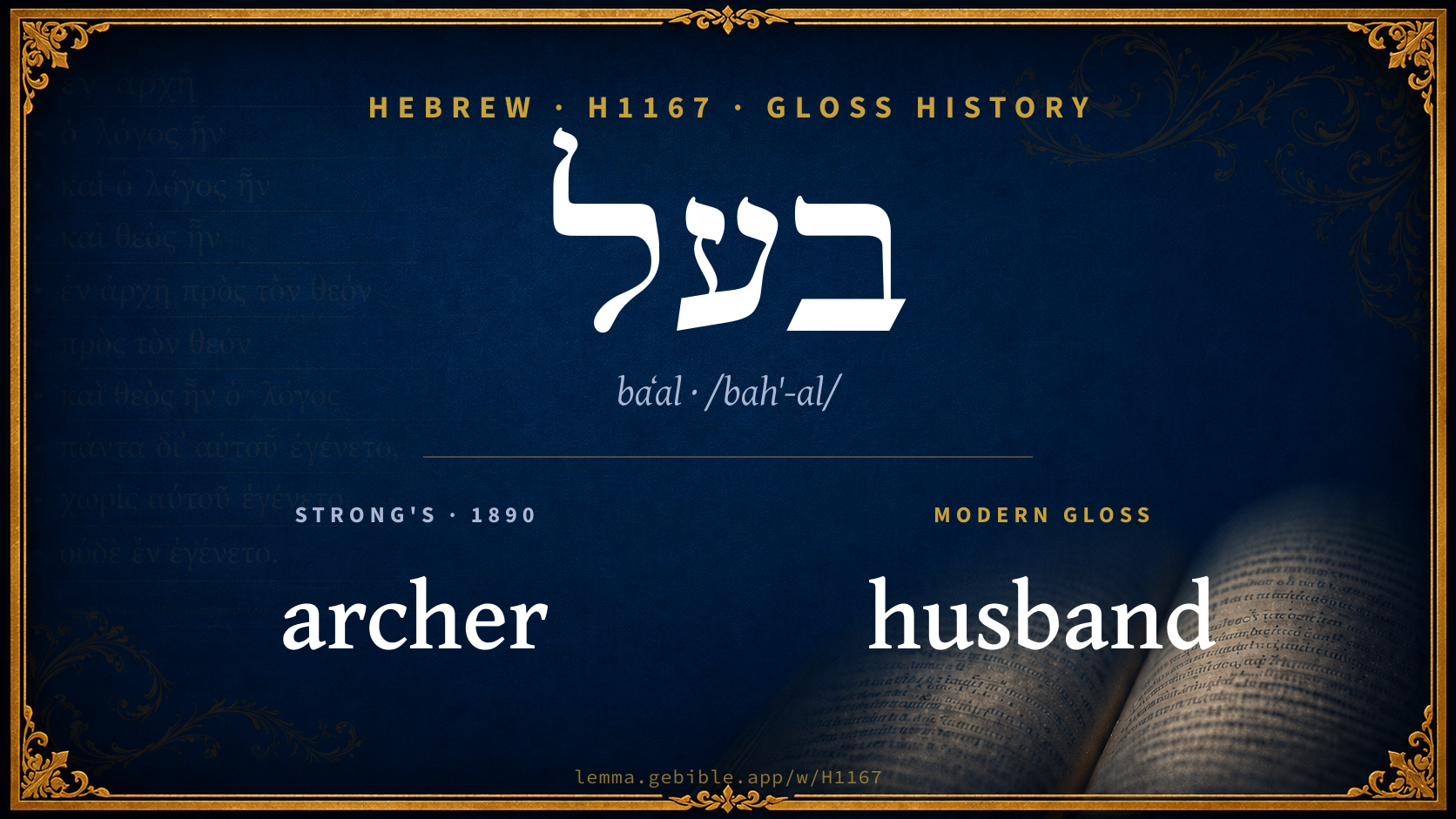
Gloss history
Strong's 1890 vs modern scholarship
About this word
Strong's H1167 catalogs a Hebrew word from the Hebrew Old Testament.
These counts are not copied from any lexicon or concordance. They are computed here, from the morphology-tagged Hebrew Old Testament. What Lemma adds →
- 79
- distinct verses
- The word appears in 79 distinct verses.
- 20 / 39
- OT books
- The word appears in 20 of 39 Old Testament books.
- #485
- by frequency
- Top 500 most frequent Hebrew words (rank 485 of 8,640 Hebrew words by occurrence).
View all 79 occurrences in the concordance →
By section of the Old Testament
By traditional corpus
Conventional, traditional groupings — biblical authorship is debated, so this is a traditional corpus grouping, not an authorship claim. Each share is this word’s portion of its verses in that division of the Hebrew canon. Each figure is a share of the word’s 79 distinct verses.
- Prophets (Nevi'im) 31 verses · 39%
- Writings (Ketuvim) 27 verses · 34%
- Torah (Pentateuch) 21 verses · 27%
How translations render this word
Counts come from each version’s own published word-to-Strong’s tagging or interlinear alignment — an approximate guide to how each version renders this word, not a word-level alignment the data otherwise carries. Because each total is that version’s own tagged count, the per-version totals vary from one another and need not match the appearance or distinct-verse counts above. These counts may also differ from a printed concordance because Lemma counts each distinctly tagged rendering and does not collapse phrase taggings into a single head-word total. This is a fixed set of word-tagged versions (KJV, ASV, BSB, ULT) and does not change with the reading translation you choose elsewhere. Each version’s license is shown beside its name below (and on Sources).
BDB lists this Strong’s number as 2 distinct words (homographs). Each count above pools all of them and is not split by sense — see the Senses section below. A low-frequency rendering may belong to a different one of those words, not the primary meaning.
- King James Version†: Men 11×, Owner 10×, Husband 9×
- American Standard Version†: Men 10×, Owner 10×, Husband 8×
- Berean Standard Bible†: Leaders 15×, Owner 15×, Husband 6×
- unfoldingWord Literal Text†: Lords of 21×, Owner 11×, Husband 9×
King James Version Public Domain
Renders H1167 across 82† tagged occurrences — most commonly:
Plus 31 renderings that appear only once — usually multi-word phrases or single function words the recovered tagging swept in, not distinct renderings. Not rendered by a distinct English word in 1 further occurrence.
American Standard Version Public Domain
Renders H1167 across 81† tagged occurrences — most commonly:
Plus 36 renderings that appear only once — usually multi-word phrases or single function words the recovered tagging swept in, not distinct renderings.
Berean Standard Bible Public Domain
Renders H1167 across 76† tagged occurrences — most commonly:
Plus 26 renderings that appear only once — usually multi-word phrases or single function words the recovered tagging swept in, not distinct renderings. Not rendered by a distinct English word in 7 further occurrences.
unfoldingWord Literal Text CC BY-SA 4.0
Renders H1167 across 83† tagged occurrences — most commonly:
Plus 13 renderings that appear only once — usually multi-word phrases or single function words the recovered tagging swept in, not distinct renderings.
20 senses and sub-senses in the full BDB
Hebrew verbs can shift meaning by stem (binyan): Qal is the basic action, Niphal is often passive or reflexive, Piel often intensifies or makes it factitive, and Hiphil is typically causative. The senses below are grouped under the stem BDB assigns to each.
What do BDB’s symbols mean?
BDB uses these scholarly abbreviations:
| Symbol | Meaning |
|---|---|
| 𝔊 | the Septuagint (the ancient Greek translation, LXX) |
| 𝔙 | the Vulgate (the Latin translation) |
| 𝔖 | the Syriac version (the Peshitta) |
| 𝔗 | the Targum (the Aramaic translation) |
| ψ | the Psalms |
| √ | root (the underlying root or stem) |
| ‖ | parallel passage (a synonymous or contrasted parallel) |
| † | the dagger: every passage where the word occurs is cited |
The 20 senses and sub-senses the full Brown-Driver-Briggs lexicon distinguishes for this word, in lexicon order (not ranked by frequency), with BDB’s own verbatim wording and sub-sense lettering. Shown in Hebrew script with BDB’s own scholarly abbreviations. The condensed entry is in the Lexicon Entry tab. See also the Forms in the corpus table below.
בעל I marry, rule over (cf. Arabic بَعَلَ = own, possess, especially a wife or concubine
Qal
- Pf. Mal 2:11 + 6 times Impf. יִבְעַל Is 62:5(×2); Pt. sf. בֹּעֲלַיִךְ Is 54:5; pass. f. בְּעוּלָה Is 54:1 + 3 times;— e.g. Malachi 2:11
- 1. marry Gn 20:3 (E) Dt 21:13; 22:22; 24:1 Is 54:1, 5; 62:4, 5(×2) Mal 2:11; sq. בְּ Je 3:14; 31:32 be lord (husband) over. Je 3:14; 31:32 AW JosKi Thes, comparing Arabic بَعَلَ be disgusted, derive from II. בָּעַל loathe (sq. בְּ); so Buhl: Gie Du Co in 31:32 read גָּעַלְתִּי (treating 3:14 as I. בָּעַל). e.g. Genesis 20:3
- 2. rule over 1 Ch 4:22 (sq. לְ) Is 26:13. e.g. 1 Chronicles 4:22
Niphal
- Impf. תִּבָּעֵל Pr 30:23 Is 62:4 be married. e.g. Proverbs 30:23
בעל II owner, lord (Ph. בעל
- I.
- 1. owner (often pl. c. sf. in sg. meaning): of ox Ex 21:28, 29(×2); 22:10, 11, 13, 14 (E); ב׳ הבור of pit Ex 21:34, 36 (E), of house Ex 22:7 (E) Ju 19:22, 23, debt Dt 15:2, the land Jb 31:39, the ass Is 1:3, goods Ec 5:10, riches Ec 5:12; ב׳ טוב one to whom good is due Pr 3:27, gain Pr 1:19; ב׳ שׂכל one having understanding Pr 16:22; ב׳ השׁחד receiver of the gift Pr 17:8. e.g. Exodus 21:28
- 2. husband Gn 20:3 Ex 21:3, 32 (E) Dt 22:22; 24:4 2 S 11:26 Jo 1:8 Pr 12:4; 31:11, 23, 28 Est 1:17, 20; בַּעְלִי Ho 2:18 (my Baal, reference to the divine name used in the northern kingdom, here for the first time forbidden). e.g. Genesis 20:3
- 3. citizens, inhabitants: בַּעֲלֵי of Jericho Jos 24:11 (E), of the high places of Arnon Nu 21:28 (E), of Shechem Ju 9:2 + 12 times, of the tower of Shechem Ju 9:46, 47, of the city Ju 9:51, of Gibeah Ju 20:5, of Keilah 1 S 23:11, 12, of Jabesh 2 S 21:12. e.g. Joshua 24:11
- 4. rulers, lords: בַּעֲלֵי גוֹיִם Is 16:8. e.g. Isaiah 16:8
- 5. n. of relation:
- a. בַּעַל: ב׳ החלמות dreamer Gn 37:19 (E); ב׳ דברים whosoever hath cases, complaints Ex 24:14 (E); ב׳ שׂער an hairy man 2 K 1:8; ב׳ חמה wrathful Na 1:2 Pr 29:22; ב׳ אף one given to anger Pr 22:24; ב׳ החכמה one having wisdom Ec 7:12; ב׳ משׁחית destroyer Pr 18:9; ב׳ כנף winged thing, bird Pr 1:17 Ec 10:20; ב׳ נפשׁ one given to appetite Pr 23:2; ב׳ מזמות mischievous person Pr 24:8; ב׳ הלשׁון charmer Ec 10:11; ב׳ רשׁע one given to wickedness Ec 8:8; ב׳ פיפיות double-edged Is 41:15; ב׳ משׁפט adversary Is 50:8; ב׳ פקדת captain of the ward Je 37:13; ב׳ הקרנים two-horned Dn 8:6, 20. e.g. Genesis 37:19
- b. בַּעֲלֵי: בּ׳ בְּרִית confederates Gn 14:13; ב׳ חצים archers Gn 49:23 (poet.) ב׳ הפרשׁים horsemen 2 S 1:6; ב׳ שׁבועה conspirators Ne 6:18; ב׳ אספות members of assemblies; or well-grouped sayings; or collectors (of wise sentences) Ec 12:11.—On 2 S 6:2 v. ii. בַּעֲלָה. (בַּעַל in Hex not J or P; בעל Lv 21:4 𝔊 ἐξάπινα = כבלּע Nu 4:20: Di בְּאֵבֶל). e.g. Genesis 14:13
- II. lord, specif. as divine name, †Baal.
- 1. without article: במות בעל Nu 22:41 (poet. Balaam); בעל פעור Nu 25:3, 5 (E) Dt 4:3 (vid. below). This divine name is not used elsewhere in Hex. It probably originated from the sense of divine ownership, rather than sovereignty (RSSem 92). It seems to have been used in Northern Israel = אדון in the South. It was the special name of the God of the Canaanites, Philistines, etc., = Babylonian בֵּל, cf. SchrSK 1874, 335 ff. In later times scribes substituted בֹּשֶׁת, in n.pr. (ירבשׁת = ירבעל, אשׁבשׁת = אשׁבעל, vid. בֹּשֶׁת, GeiZMG 1862, 728 ff.), & also in the text for בעל Ho 9:10 Je 11:13 (hence ἡ βάαλ Je 2:23; 7:9; 11:13, 17; 19:5 Ho 2:10; 13:1 +, Rom 11:4, see DiBaal mit d. weib. Artikel, MBA 1881, June 16 Dr 2 S 4:4). e.g. Numbers 22:41
- 2. c. art.: הַבַּעַל Ju 2:13; 6:25, 28, 30, 31, 32 1 K 16:31, 32(×2); 18:19, 21, 22, 25, 26(×2), 40; 19:18; 22:54 2 K 3:2; 10:18, 19(×2), 20, 21(×3), 22, 23(×3), 25, 26, 27(×2), 28; 11:18(×2); 17:16; 21:3; 23:4, 5 2 Ch 23:17(×2) Je 2:8; 7:9; 11:13, 17; 12:16; 19:5(×2); 23:13, 27; 32:29, 35 Ho 2:10; 13:1 Zp 1:4. e.g. Judges 2:13
- 3. הַבְּעָלִים emphatic pl. (cf. האלהים, האדונים) the great lord, the sovereign owner Ju 2:11; 3:7; 8:33; 10:6, 10 1 S 7:4; 12:10 1 K 18:18 2 Ch 17:3; 24:7; 28:2; 33:3; 34:4 Je 2:23; 9:13 Ho 2:15, 19; 11:2 (or local special Baʿals, vid. DrSm. p. 50; pillars of Baal MV). e.g. Judges 2:11
- 4. c. attrib.: בַּעַל בְּרִית Lord of covenant Ju 8:33; 9:4 (cf. אל ברית 9:46; NöZMG 1888, 478); ב׳ זְבוּב Lord of flies 2 K 1:2, 3, 6, 16, Philistine god, 𝔊 Βααλ μυῖαν (Beelzebub, Mt 12:24) cf. BaeRel. 25. e.g. Judges 8:33
בעל III
- 1. n.pr.loc. city in the tribe of Simeon 1 Ch 4:33 = בַּעֲלַת בְּאֵר. e.g. 1 Chronicles 4:33
- 2. n.pr.m.
- a. a Reubenite 1 Ch 5:5; e.g. 1 Chronicles 5:5
- b. a Gibeonite 1 Ch 8:30; 9:36. e.g. 1 Chronicles 8:30
Senses from the full Brown-Driver-Briggs lexicon (Brown, Driver, Briggs; Oxford 1906 — public domain), digitized via Sefaria, supplemented by the OpenScriptures HebrewLexicon (CC BY 4.0). Full attribution on Sources.
Word origin
I. vb. marry, rule over (cf. Arabic بَعَلَ = own, possess, especially a wife or concubine; Ethiopic ብዕለ to be rich, Assyrian bâlu, rule COTGloss., Aramaic בְּעַל take possession of wife or concubine)—
I. n.m. owner, lord (Ph. בעל; Palm. id. husband Vog62 cf. BaeRel. 72 ff.; Assyrian bêlu l.c. DlGram. Gloss.; Arabic بعْلٌ husband etc., v. especially NöZMG 1886, 174, Sab. בעל CISiv. 1, 2)—Gn 20:3 + 92 times; sf. בַּעְלִי Ho 2:18; בַּעְלָהּ Dt 24:4 + 5 times; pl. בְּעָלִים Ju 2:11 + 17 times; cstr. בַּעֲלֵי Gn 14:13 + 27 times; sf. בְּעָלָיו Ex 21:29 + 14 times; בְּעָלֶיהָ Jb 31:39 + 2 times; בַּעְלֵיהֶן Est 1:17, 20;—
— Brown-Driver-Briggs (Oxford 1906, public domain), digitized via Sefaria, supplemented by the OpenScriptures HebrewLexicon (CC BY 4.0). See Sources.
Derived from בעל (bâʻal) (H1166) — to marry.
Jastrow Dictionary
A second Hebrew/Aramaic lexicon for comparison, covering Aramaic and post-biblical (Talmudic, Targumic, Midrashic) usage that the biblical-Hebrew BDB does not. Matched by lemma rather than by Strong’s number, so a lemma may carry more than one Jastrow headword (shown separately below), and the entries cover usage well beyond the Bible.
בָּעַל
- , v. בָּעָה, to enter into, take possession) [in b. h. to be master, protect;] to have sexual intercourse (both legal or illicit), to embrace a woman. Kidd. 9ᵇ וּבְעָלָהּ מלמד וכ׳ ‘and he embraced her’ (Deut. XXIV, 1), this intimates that woman can be acquired as wife by intercourse, v. בִּיאָה.—בּוֹעֵל lover, adulterer, contrad. to בַּעַל husband. Sot. V, 1, a. fr. כשם שאסורה לַבַּעַל … לַבּוֹעֵל as well as the woman suspected of adultery is forbidden to her husband (who must separate himself from her), so is she forbidden to the lover (who cannot marry her after leaving her husband). Yeb. 103ᵃ שבע בעילות ב׳ וכ׳ that wicked man had seven sexual connections &c.; a. fr.—Part. pass. f. בְּעוּלָה one no longer a virgin, opp. to בתולה; married woman, opp. to ארוסה, v. אָרַס. Keth. 10ᵇ; a. fr.—Pl. בְּעוּלוֹת. Y. Kidd. I, 58ᵇ bot.; a. fr. e.g. Deuteronomy 24:1
- she had intercourse. Keth. 5ᵃ נישאת … ונִבְעֶלֶת וכ׳ is married on the fourth day and embraced in the night of the fifth day of the week. Ib. 3ᵇ תִּיבָּעֵל לטפסר וכ׳ must first be surrendered to the (Roman) officer (jus primæ noctis); a. fr.—Masc. נִבְעַל (of the hermaphrodite). Tosef. Bicc. II, 5; Y. Yeb. VIII, 9ᵈ bot.
בְּעַל
- Targ. O. Deut. XXI, 13; a. fr.—Keth. 6ᵇ דבעי למִיבְעַל because he is anxious to perform his marital duty. Ib. דטריד דלא בעיל he is excited because he has not &c.; a. fr.
- , part. pass. f. מְבַעֲלָא married, having had intercourse. Targ. Ruth I, 12; a. e.
- as preced. Nif. Yoma 19ᵇ ואִבְּעוּל כמה וכ׳, (Ms. M. ואיבעיל) and how many virgins have been seduced (to-day) in Nahardea!
בַּעַל
- preced.)
- 1. husband. Kidd. I, 1 and she becomes her own master בגט ובמיתת הב׳ through a letter of divorce or on the husband’s death; a. v. fr.
- 2. the idol Baal. Y. Ab. Zar. III, 43ᵃ bot. ב׳ ראש גוייה הוה וכ׳ the Baal was the phallus and had the shape of a bean [read וכאפון].
- 3. [the fructifier,] rain (v. Taan. 6ᵇ; cmp. Is. LV, 10). בֵּית בַּ׳ a field sufficiently watered by rain and requiring no artificial irrigation. Tosef. M. Kat. I, 1 שדה (בית) הב׳. B. Bath. III, 1. Tosef. Succ. II, 7 ערבה של ב׳ (sub. בית) a willow in a naturally watered field. Ib. Shebi. II, 4 בשל ב׳ (= בשדה של ב׳), opp. של שוקי. Num. R. s. 16 the Egyptian gods של שקר הם (read שקי) are gods of artificial drainage, but those of Canaan של ב׳ הם are gods of rain; (Tanḥ. Sh’laḥ 13, through misunderstanding, שקר … בעליכח. e.g. Isaiah 55:10
- 4. (mostly in compounds) owner of, master of, possessed of, given to &c.; e.g. ב׳ אבידה owner of a lost object; ב׳ אגדה master of Agadah, lecturer; ב׳ דין opponent in court; v. infra. Pes. 86ᵇ ב׳ השם אני I am so named.—Pl. בְּעָלִים, בְּעָלִין owners; mostly as sing. owner. B. Mets. VIII, 1; a. fr. [Y. Dem. III, 23ᵇ bot. לבלעין, read לבעלין.]
- He who knows man’s thoughts. Snh. 19ᵇ.—Ib. בעלי מ׳ those entertaining considerations (of fear), hesitating to do justice.—ב׳ שיבה gray-haired. Ned. III, 8.—ב׳ תשובה repentant sinner. Succ. 53ᵃ; a. fr.—ב׳ תשובות a man of many objections or excuses. Gen. R. s. 20 beg.—[For other compounds, not self-evident, see the respective determinants.]
עֹל
- , v. עוֹל
A Dictionary of the Targumim, the Talmud Babli and Yerushalmi, and the Midrashic Literature (Marcus Jastrow; London, Luzac, 1903) — Public Domain. Digitized via Sefaria. Digitized via Sefaria. Full attribution on Sources.
Forms in the corpus
The 46 distinct written forms H1167 takes in the Hebrew Bible, most frequent first — each parse links to that state’s occurrences in the concordance. Hebrew forms include their vowel points and cantillation, so a single lemma takes many written forms.
Same root — word family
Other BDB entries built from the same root as H1167, grouped by Strong’s listed origin. These share a root / origin per the lexicon — not necessarily a shared meaning. Each links to that word’s own entry.
Derives from
Derived from this word
Proper names from this root
People and places named from this root — a name, not an additional meaning of the word.
- בעל Baʻal H1168 Baal
- בעל המון Baʻal Hâmôwn H1174 Baal-hamon
- בעל חנן Baʻal Chânân H1177 Baal-hanan
- בעל חצור Baʻal Châtsôwr H1178 Baal-hazor
- בעל חרמון Baʻal Chermôwn H1179 Baal-hermon
- בעלי Baʻălîy H1180 Baali
- בעליה Bᵉʻalyâh H1183 Bealiah
- בעלי יהודה Baʻălêy Yᵉhûwdâh H1184 Baale-Judah
- בעל פרצים Baʻal Pᵉrâtsîym H1188 Baal-perazim
- בעל תמר Baʻal Tâmâr H1193 Baal-tamar
Compare all same-root words → Showing 4 of 14 — not the complete family. 10 of the same-root words are proper names (people or places). They share a root, not necessarily a meaning.
Septuagint verse parallels
This word appears in 77 verses that also exist in the Greek Old Testament (Septuagint), out of the 79 Hebrew verses it occurs in. You can read those verses in Greek by switching the Old Testament edition to the Septuagint.
Read these verses in the Septuagint
- Genesis 14:13
- Exodus 21:3
- Leviticus 21:4
- Numbers 21:28
- Deuteronomy 15:2
- Joshua 24:11
- Judges 9:2
- 1 Samuel 23:11
- 2 Samuel 1:6
- 2 Kings 1:8
- Esther 1:17
- Job 31:39
This is a verse-level parallel only — the same verses exist in both the Hebrew and Greek Old Testaments. No word-level Hebrew↔Greek correspondence is claimed: the data carries no such alignment, so no Greek word is shown as this Hebrew word’s translation. Coverage is not total — the Septuagint omits the deuterocanon and renumbers the Psalms, so some Hebrew verses have no direct Greek parallel.