
Genesis 49:23

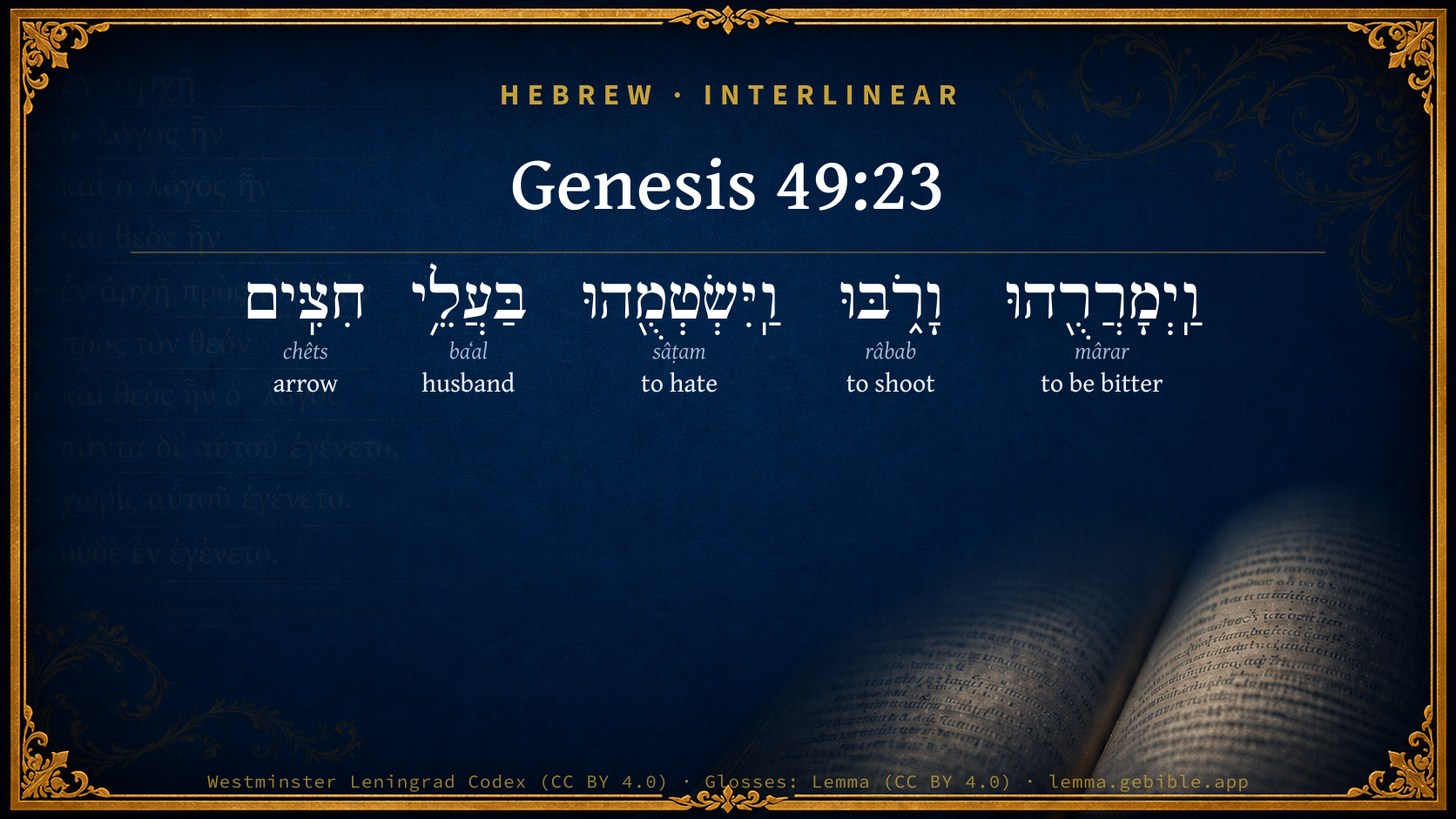
Hebrew (Westminster Leningrad Codex) Genesis 49:23 appears in the Hebrew Old Testament. The text above is from the Westminster Leningrad Codex. Each word links to its Strong’s number, a concise gloss, and parsing drawn from the Open Scriptures Hebrew Bible morphology. Click any word for its full Brown-Driver-Briggs (BDB) entry.
Download image
Cite this verse

Genesis 49:23 (World English Bible). Public Domain. Lemma interlinear Bible study tool, https://lemma.gebible.app/v/genesis/49/23.

Show BibTeX & RIS
BibTeX
RIS
English Translation
The archers have sorely grieved him, Shot at him, and persecute him:
World English Bible · Public Domain
Highlights
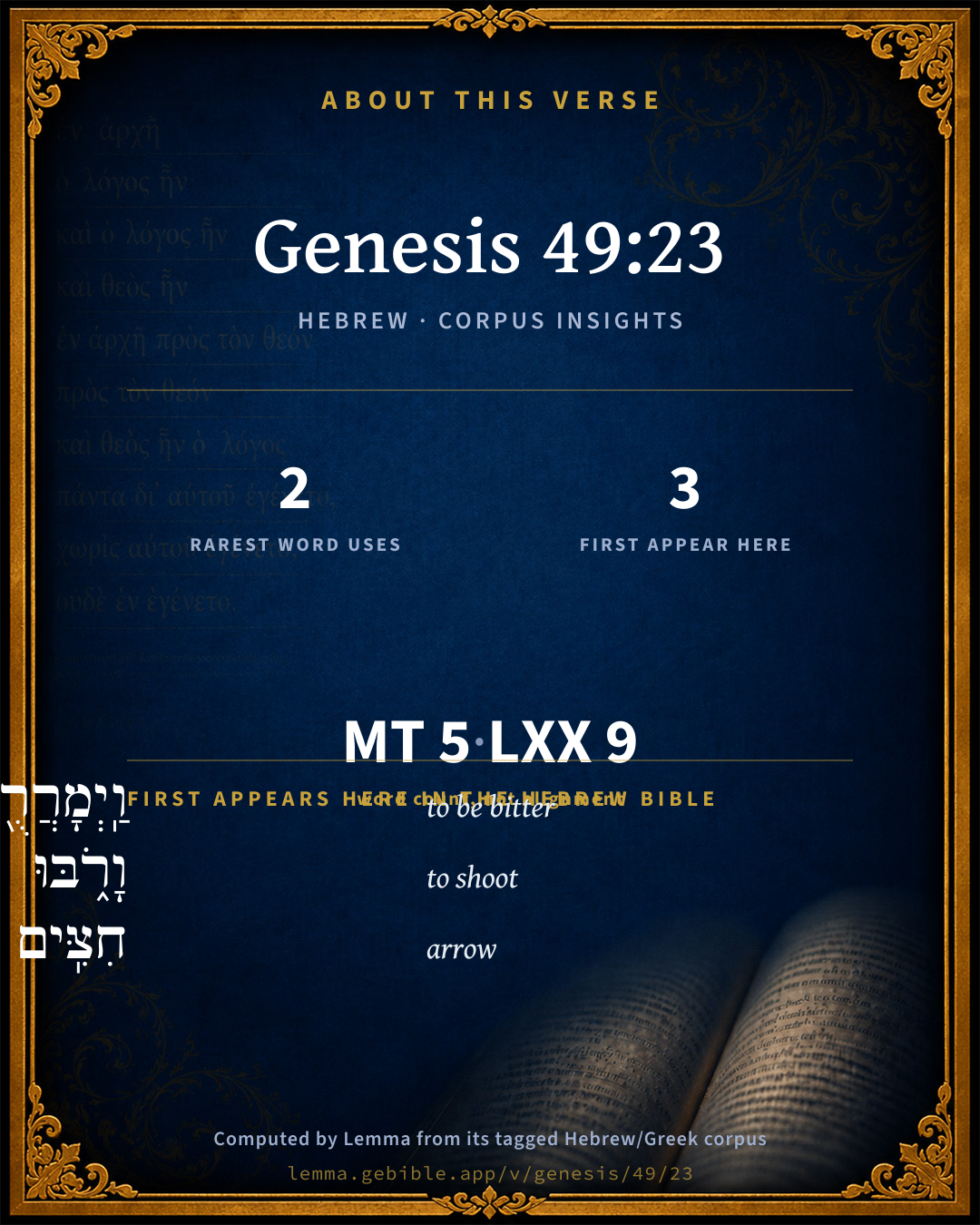
  • 3 first appearances in the Hebrew Bible
Full analysis ↓
Download a study sheet

One document with this verse’s original text, its word-by-word gloss line, the meaning frame, cross-references with their text, attributed commentary, and full source and license credits — printable, and it pastes into notes with its structure intact.

This verse Autodidact and up

Study sheet (.html) Plain text (.txt)

A passage Seminary Student

Up to 50 verses in one chapter. A passage sheet keeps up to 6 commentary sources and 12 cross-references per verse, in the order this page ranks them, and says so on the sheet whenever that leaves anything out. Ask for a single verse and you get the Autodidact verse sheet above.

Everything on this page stays free to read, with no account — the sheet is a download of what is already on screen, not access to it.

Want to remove ads? Support Godless Engineer
Compare translations 3

The same verse in 3 English versions, stacked beneath the original-language interlinear above. Click any original word for its lexicon entry.

Each is an independent rendering of the whole verse — the interlinear is not word-aligned to these translations.

Highlighted words mark where these versions differ — a whole-verse word diff, not a word-by-word alignment.

  • World English Bible Public Domain
    The archers have sorely grieved him, Shot at him, and persecute him:
  • King James Version Public Domain
    The archers have sorely grieved him, and shot at him, and hated him:
  • unfoldingWord Literal Text CC BY-SA 4.0
    And masters of arrows will attack him and shoot and harass him.

unfoldingWord Literal Text — © unfoldingWord, licensed CC BY-SA 4.0. Word-aligned USFM3 via Door43 (git.door43.org/unfoldingWord/en_ult).

Versions to compare (up to 4)

3 of 4 selected

Show all 18 translations

Every available English version of this verse, each an independent rendering of the whole verse.

  • World English Bible Public Domain
    The archers have sorely grieved him, Shot at him, and persecute him:
  • Berean Standard Bible Public Domain
    The archers attacked him with bitterness; they aimed at him in hostility.
  • Majority Standard Bible Public Domain
    The archers attacked him with bitterness; they aimed at him in hostility.
  • King James Version Public Domain
    The archers have sorely grieved him, and shot at him, and hated him:
  • American Standard Version (1901) Public Domain
    The archers have sorely grieved him, And shot at him, and persecute him:
  • Revised Version (1885) Public Domain
    The archers have sorely grieved him, And shot at him, and persecuted him:
  • Geneva Bible (1599) Public Domain
    And the archers grieued him, and shotte against him and hated him.
  • Douay-Rheims (1899) Public Domain
    Nephtali, a hart let loose, and giving words of beauty.
  • Young's Literal Translation Public Domain
    And embitter him -- yea, they have striven, Yea, hate him do archers;
  • Literal Standard Version CC BY-SA 4.0
    And embitter him indeed, they have striven, || Indeed, archers hate him;
  • Unlocked Literal Bible CC BY-SA 4.0
    The archers will attack him and shoot at him and harass him.
  • unfoldingWord Literal Text CC BY-SA 4.0
    And masters of arrows will attack him and shoot and harass him.
  • Darby Bible Public Domain
    The archers have provoked him, And shot at, and hated him;
  • World Messianic Bible Public Domain
    The archers have severely grieved him, shot at him, and persecuted him:
  • Webster's Bible Public Domain
    The archers have sorely grieved him, and shot at him, and hated him:
  • Free Bible Version CC BY-SA 4.0
    The archers viciously attacked him; they shot their arrows at him with hate.
  • Bible in Basic English Public Domain
    He was troubled by the archers; they sent out their arrows against him, cruelly wounding him:
  • JPS Tanakh (1917) Public Domain
    The archers have dealt bitterly with him, and shot at him, and hated him;

Literal Standard Version (2020), Covenant Press — licensed CC BY-SA 4.0. Text via the HelloAO Bible API (eBible.org). Unlocked Literal Bible (unfoldingWord) — licensed CC BY-SA 4.0. Text via the HelloAO Bible API (eBible.org). unfoldingWord Literal Text — © unfoldingWord, licensed CC BY-SA 4.0. Word-aligned USFM3 via Door43 (git.door43.org/unfoldingWord/en_ult). Free Bible Version, Dr. Jonathan Gallagher — licensed CC BY-SA 4.0. Text via the HelloAO Bible API (eBible.org).

Word by word

More ways to search: Search by grammar → Find every occurrence → Compare this word →

Practice this passage: Drill this verse → Learn its vocabulary →

About this verse

These counts appear in no published source. They are computed here, from the morphology-tagged text and Lemma’s own curated glosses. What Lemma adds →

5
words
5
distinct lemmas
Pentateuch
section

Notable vocabulary

The rarest word here is וָרֹ֑בּוּ to shoot H7232 — appearing just 2 times in the whole Hebrew Bible.

First appearance in Scripture

These words make their first canonical appearance in the Hebrew Bible here:

  • וַֽיְמָרֲרֻ֖הוּ to be bitter H4843
  • וָרֹ֑בּוּ to shoot H7232
  • חִצִּֽים arrow H2671

Shared distinctive vocabulary

וָרֹ֑בּוּ to shoot H7232 occurs in 2 verses of the Hebrew Bible. Also found in:

Grammatical profile

  • 3 verbs
  • 2 nouns

Verb forms

  • וַֽיְמָרֲרֻ֖הוּ Piel · Sequential Imperfect
  • וָרֹ֑בּוּ Qal · Perfect
  • וַֽיִּשְׂטְמֻ֖הוּ Qal · Sequential Imperfect

Hebrew & Septuagint length

In English translation the verse runs 12 words from the Hebrew and 15 from the Septuagint (LXX English) — closely comparable.

A rough comparison of the two English renderings, which tokenize alike — not a word-level alignment.

Word counts can differ between the Hebrew and the Greek without any difference in meaning — e.g. the Hebrew direct-object marker אֵת has no separate Greek word, and Greek often adds the article ὁ.

In the original languages it is 5 Hebrew tokens and 9 Greek tokens — but the two are counted differently (Hebrew bundles its prefixes and suffixes into one token; the Greek is in lemma form), so that isn’t a like-for-like length.

Cross-references

10

Topical passages linked to Genesis 49:23 in the Treasury of Scripture Knowledge — connected by theme and wording, ordered by reader-vote popularity; previews shown in the World English Bible.

  • Genesis 37:24 and they took him, and threw him into the pit. The pit was empty. There was no water in it.
  • Psalms 118:13 You pushed me back hard, to make me fall, But Yahweh helped me.
  • Genesis 37:4 His brothers saw that their father loved him more than all his brothers, and they hated him, and couldn't speak peaceably to him.
  • Genesis 37:28 Midianites who were merchants passed by, and they drew and lifted up Joseph out of the pit, and sold Joseph to the Ishmaelites for twenty pieces of silver. They brought Joseph into Egypt.
  • Psalms 64:3 Who sharpen their tongue like a sword, And aim their arrows, deadly words,
  • Genesis 37:18 They saw him afar off, and before he came near to them, they conspired against him to kill him.
  • Genesis 39:7–20 It happened after these things, that his master's wife cast her eyes on Joseph; and she said, "Lie with me."
  • Genesis 42:21 They said one to another, "We are most assuredly guilty concerning our brother, in that we saw the distress of his soul, when he begged us, and we wouldn't listen. Therefore this distress has come on us."
  • John 16:33 I have told you these things, that in me you may have peace. In the world you have oppression; but cheer up! I have overcome the world."
  • Acts 14:22 confirming the souls of the disciples, exhorting them to continue in the faith, and that through many afflictions we must enter into the Kingdom of God.

Cross-references courtesy of OpenBible.info (CC BY 4.0).

Hebrew and Greek witnesses Masoretic Hebrew ↔ Greek Septuagint

The same verse in the two great witnesses to the Old Testament, shown verse-for-verse.

These are two independent witnesses, not word-aligned to each other, and the Septuagint is shown in lemma (dictionary) form.

Hebrew Genesis 49:23 Masoretic · Westminster Leningrad Codex

וַֽיְמָרֲרֻ֖הוּ וָרֹ֑בּוּ וַֽיִּשְׂטְמֻ֖הוּ בַּעֲלֵ֥י חִצִּֽים

The archers have sorely grieved him, Shot at him, and persecute him:

World English Bible · Public Domain

Greek LXX Genesis 49:23 Septuagint · lemma form

εἰς ὅς διαβουλεύω λοιδορέω καί ἐνἔχω αὐτός κύριος τόξευμα

Against whom men taking evil counsel reproached him, and the archers pressed hard upon him.

LXX2012 (modern English Septuagint) · Public Domain

Hebrew: Westminster Leningrad Codex (CC BY 4.0). Greek: Septuagint (public domain); English from LXX2012 (modern English Septuagint) (Public Domain). How the Septuagint differs from the Hebrew →

Targum (Aramaic paraphrase)

2

The Targum is the ancient Jewish Aramaic paraphrase of the Hebrew Scriptures — an interpretive translation, not the Hebrew text itself. Onkelos (literal) and Pseudo-Jonathan (expansive) render the Torah, and Jonathan the Prophets. Coverage is partial: where no permissively-licensed English translation exists for a verse, only the Aramaic is shown. This is verse-level text, not a word-by-word alignment to the Hebrew.

  1. Targum Onkelos Torah (Genesis–Deuteronomy)
    וְאִתְמַרְרוּ יָתֵהּ וְנַקְמוֹהִי וְאָעִיקוּ לֵהּ גֻבְרִין גִּבָּרִין בַּעֲלֵי פַלְגוּתָא

    (no public-domain English translation for this verse)

    Targum Onkelos — Aramaic: “Onkelos Genesis” (public domain); “Onkelos Exodus” (public domain); “Onkelos Leviticus” (public domain); “Onkelos Numbers” (public domain); “Onkelos Deuteronomy” (public domain). English: “Sefaria Community Translation” (CC0 1.0 (public-domain dedication)); “J.W. Etheridge. The Targums of Onkelos and Jonathan Ben Uzziel on the Pentateuch. London: Longmans, Green, 1862” (public domain). Text via Sefaria.

  2. Targum Pseudo-Jonathan Torah (Genesis–Deuteronomy)
    וּמַמְרִירוּ לֵיהּ וְנָצוּ לֵיהּ כָּל חַרְשֵׁי מִצְרָאֵי וְאוּף אָכְלוּ קוּרְצוֹי קֳדָם פַּרְעה סַבָּרִין לְמַחְתָּא יָתֵיהּ מִן יְקָרֵיהּ אָמְרִין עֲלוֹי לִישַׁן תְּלִיתָאֵי דְקָשֵׁי הֵי כְגִירִין

    And all the magicians of Mizraim were bitter and angry against him, and brought accusations against him before Pharoh, expecting to bring him down from his honour They spake against him with the slanderous tongue which is severe as arrows.

    Targum Pseudo-Jonathan — Aramaic: “Targum Jonathan on Genesis” (public domain); “Targum Jonathan on Exodus” (public domain); “Targum Jonathan on Leviticus” (public domain); “Targum Jonathan on Numbers” (public domain); “Targum Jonathan on Deuteronomy” (public domain). English: “The Targum of Jonathan ben Uzziel, trans. J. W. Etheridge, London, 1862” (public domain). Text via Sefaria.

Commentary

Notes on Genesis 49:23 from classic Christian and Jewish commentators (each source and its license shown beneath its notes). The classic Christian expositions comment on the surrounding passage and are grouped to its opening verse, so a note may address several verses; the Jewish commentaries on the Tanakh (Rashi and others) are per-verse, so they appear only where the commentator wrote on this verse.

Lemma curates 59 commentaries, every one of them public domain or Creative Commons licensed, each selected and text-cleaned for this edition rather than reprinted as found. About our sources →

Trapp's Complete Commentary

John Trapp

Gen 49:23 The archers have sorely grieved him, and shot [at him], and hated him:

Ver. 23. The archers have sorely grieved him.] These were his barbarous brethren, that sold him; his adulterous mistress, that, harlot-like, hunted for his precious life; his injurious master, that, without any desert of his, imprisoned him; the tumultuating Egyptians, that, pined with hunger, perhaps, "spoke of stoning him," as 1Sa 30:6; and the envious courtiers and enchanters, that spoke evil of him before Pharaoh, to bring him out of favour, as the Jerusalemy Targum addeth. All these "arrow masters," as the Hebrew here hath it, set against Joseph, and shot at him as their butt-mark; willing to have abused him, but that God’s grace, providence, and unchangeable decree (called here Joseph’s "bow" and "strength," Gen 49:24) would not permit them; as those cruel Turks did one John de Chabas, a Frenchman, at the taking of Tripolis in Barbary. They brought him into the town; and when they had cut off his hands and nose, put him alive into the ground, up to the waist, and there, for their pleasure, shot at him with their arrows, and afterwards cut his throat. {a}

{a} Turk. Hist., fol. 756.

John Trapp, A Commentary or Exposition upon All the Books of the Old and New Testament (1647–1656) — public domain. Text from a community e-Sword module.

Joseph Benson's Commentary

Gen 49:23. The archers have sorely grieved him — Though he now lived in ease and in honour, Jacob reminds him of the difficulties he had formerly waded through. He had had many enemies, here called archers, being skilful to do mischief; they hated him, they shot their poisonous darts at him. His brethren were spiteful toward him, mocked him, stripped him, sold him, thought they had been the death of him. His mistress sorely grieved him, and shot at him, when she solicited his chastity; and then shot at him by her false accusations.

Joseph Benson's Commentary on the Old and New Testaments (1811–1818) — public domain. Text from a community e-Sword module.

MacLaren's Expositions of Holy Scripture

Alexander MacLaren

Genesis

‘THE HANDS OF THE MIGHTY GOD OF JACOB’

Gen 49:23 - Gen 49:24.

These picturesque words are part of what purports to be one of the oldest pieces of poetry in the Bible-the dying Jacob’s prophetic blessing on his sons. Of these sons there are two over whom his heart seems especially to pour itself-Judah the ancestor of the royal tribe, and Joseph. The future fortunes of their descendants are painted in most glowing colours. And of these two, the blessing on the ‘son who was dead and is alive again, who was lost and is found’ is the fuller of tender desire and glad prediction. The words of our text are probably to be taken as prophecy, not as history-as referring to the future conflicts and victories of the tribe, not to the past trials and triumphs of its father. But be that as it may, they contain, in most vivid metaphor, the earliest utterance of a very familiar truth. They are the first hint of that thought which is caught up and expanded in many a later saying of psalmist, and prophet, and apostle. We hear their echoes in the great song ascribed to David ‘in the day that the Lord delivered him from the hand of all his enemies, and from the hand of Saul’: ‘He teacheth my hands to war, so that a bow of steel is broken by mine arms’; and the idea receives its fullest carrying out and noblest setting forth, in the trumpet-call of the apostle, who had seen more formidable weapons and a more terrible military discipline in Rome’s legions than Jacob knew, and who pressed them into his stimulating call: ‘Be strong in the Lord, and in the power of His might.’ ‘Put on the whole armour of God.’ Strength for conflict by contact with the strength of God is the common thought of all these passages-a very familiar thought, which may perhaps be freshened for us by the singular intensity with which this metaphor of our text presents it. Look at the picture.-Here stands the solitary man, ringed all round by enemies full of bitter hate. Their arrows are on the string, their bows drawn to the ear. The shafts fly thick, and when they have whizzed past him, and he can be seen again, he stands unharmed, grasping his unbroken bow. The assault has shivered no weapon, has given no wound. He has been able to stand in the evil day-and look! a pair of great, gentle, strong hands are laid upon his hands and arms, and strength passes into his feebleness from the touch of ‘the hands of the mighty God of Jacob.’ So the enemy have two, not one, to reckon with. By the side of the hunted man stands a mighty figure, and it is His strength, not the mortal’s impotence, that has to be overcome. Some dream of such divine help in the struggle of battle has floated through the minds, and been enshrined in the legends, of many people, as when the panoplied Athene has been descried leading the Grecian armies, or, through the dust of conflict, the gleaming armour and white horses of the Twin Brethren were seen far in advance of the armies of Rome. But the dream is for us a reality. It is true that we go not to warfare at our own charges, nor by our own strength. If we love Him and try to make a brave stand against our own evil, and to strike a manful blow for God in this world, we shall not have to bear the brunt alone. Remember he who fights for God never fights without God.

There is a strange story in a later book of Scripture, which almost reads as if it had been modelled on some reminiscence of these words of the dying Jacob-and is, at any rate, a remarkable illustration of them. The kingdom of Israel, of which the descendants of Joseph were the most conspicuous part, was in the very crisis and agony of one of its Syrian wars. Its principal human helper was ‘fallen sick of the sickness whereof he died.’ And to his death-bed came, in a passion of perplexity and despair, the irresolute weakling who was then king, bewailing the impending withdrawal of the nation’s best defence. The dying Elisha, with curt authority, pays no heed to the tears of Joash, but bids him take bow and arrows. ‘And he said to the king of Israel, Put thine hand upon the bow,’ and he put his hand upon it; and ‘Elisha put his hands upon the king’s hands.’ Then, when the thin, wasted, transparent fingers of the old man were thus laid, guiding and infusing strength, by a strange paradox, into the brown, muscular hands of the young king, he tells him to open the casement that looked eastward towards the lands of the enemy, and, as the blinding sunshine and the warm air streamed into the sick-chamber, he bids him draw the bow. He was obeyed, and, as the arrow whizzed Jordanwards, the dying prophet followed its flight with words brief and rapid like it, ‘the arrow of the Lord’s deliverance.’ Here we have all the elements of our text singularly repeated-the dying seer, the king the representative of Joseph in the royal dignity to which his descendants have come, the arrows and the bow, the strength for conflict by the touch of hands that had the strength of God in them. The lesson of that paradox that the dying gave strength to the living, the feeble to the strong, was the old one which is ever new, that mere human power is weakness when it is strongest, and that power drawn from God is omnipotent when it seems weakest. And the further lesson is the lesson of our text, that our hands are then strengthened, when His hands are laid upon them, of whom it is written: ‘Thou hast a mighty arm: strong is Thy hand, and high is Thy right hand.

As a father in old days might have taken his little boy out to the butts, and put a bow into his hand, and given him his first lesson in archery, directing his unsteady aim by his own firmer finger, and lending the strength of his wrist to his child’s feebler pull, so God does with us. The sure, strong hand is laid on ours, and is ‘profitable to direct.’ A wisdom not our own is ever at our side, and ready for our service. We but dimly perceive the conditions of the conflict, and the mark at which we should aim is ever apt to be obscured to our perceptions. But in all cases where conscience is perplexed, or where the judgment is at fault, we may, if we will, have Him for our teacher. And when we know not where to strike the foes that seem invulnerable, like the warrior who was dipped in the magic stream, or clothed in mail impenetrable as rhinoceros’ hide, He will make us wise to know the one spot where a wound is fatal. We shall not need to fight as he that beats the air; to strike at random; or to draw our bow at a venture, if we will let Him guide us.

Or if ever the work be seen clearly enough, but our poor hands cannot take aim for very trembling, or shoot for fear of striking something very dear to us, He will steady our nerves and make our aim sure and true. We have often, in our fight with ourselves, and in our struggle to get God’s will done in the world, to face as cruel a perplexity as the father who had to split the apple on his son’s head. The evil against which we have to contend is often so closely connected with things very precious to us, that it is hard to smite the one when there is such danger of grazing the other. Many a time our tastes, our likings, our prejudices, our hopes, our loves, make our sight dim, and our pulses too tumultuous to allow of a good, long, steady gaze and a certain aim. It is hard to keep the arrow’s point firm when the heart throbs and the hand shakes. But in all such difficult times He is ready to help us. ‘Behold, we know not what to do, but our eyes are upon Thee,’ is a prayer never offered in vain.

The word that is here rendered ‘made strong,’ might be translated ‘made pliable,’ or ‘flexible’ conveying the notion of deftness and dexterity rather than that of simple strength. It is practised strength that He will give, the educated hand and arm, masters of the manipulation of the weapon. The stiffness and clumsiness of our handling, the obstinate rigidity as well as the throbbing feebleness of our arms, the dimness of our sight, may all be overcome. At His touch the raw recruit is as the disciplined veteran; the prophet who cannot speak because he is a child, gifted with a mouth and wisdom which all the adversaries shall not be able to gainsay nor to resist. Do not be disheartened by your inexperience, or by your ignorance; but as the prophet said to the young king, Take the bow and shoot. God’s strong hand will hold yours, and the arrow will fly true.

That strong hand is laid on ours, and lends its weight to our feeble pull. The bow is often too heavy for us to bend, but we do not need to strain our strength in the vain attempt to do it alone. Tasks seem too much for us. The pressure of our daily work overwhelms us. The burden of our daily anxieties and sorrows is too much. Some huge obstacle starts up in our path. Some great sacrifice for truth, honour, duty, which we feel we cannot make, is demanded of us. Some daring defiance of some evil, which has caught us in its toils, or which it is unfashionable to fight against, seems laid upon us. We cannot rise to the height of the occasion, or bring ourselves to the wrench that is required. Or the wearing recurrence of monotonous duties seems to take ail freshness out of our lives, and all spring out of ourselves; and we are ready to give over struggling any more, and let ourselves drift. Can we not feel that large hand laid on ours; and does not power, more and other than our own, creep into our numb and relaxed fingers? Yes, if we will let Him. His strength is made perfect in our weakness; and every man and woman who will make life a noble struggle against evil, vanity, or sin, may be very sure that God will direct and strengthen their hands to war, and their fingers to fight.

But the remarkable metaphor of the text not only gives the fact of divine strength being bestowed, but also the manner of the gift. What a boldness of reverent familiarity there is in that symbol of the hands of God laid on the hands of the man! How strongly it puts the contact between us and Him as the condition of our reception of power from Him! A true touch, as of hand to hand, conveys the grace. It is as when the prophet laid himself down with his warm lip on the dead boy’s cold mouth, and his heart beating against the still heart of the corpse, till the life passed into the clay, and the lad lived. So, if we may say it, our Quickener bends Himself over all our deadness, and by His own warmth reanimates us.

Perhaps this same thought is one of the lessons which we are meant to learn from the frequency with which our Lord wrought His miracles of healing by the touch of His hand. ‘Come and lay Thy hand on him, and he shall live.’ ‘And He put forth His hand and touched him, and said, I will, be thou clean.’ ‘Many said, He is dead; but Jesus took him by the hand and lifted him up, and he arose.’ The touch of His hand is healing and life. The touch of our hands is faith. In the mystery of His incarnation, in the flow of His sympathy, in the forth-putting of His power, He lays hold not on angels, but He lays hold on the seed of Abraham. By our lowly trust, by the forth-putting of our desires, we stretch ‘lame hands of faith,’ and, blessed be God! we do not ‘grope,’ but we grasp His strong hand and are held up.

The contact of our spirits with His Spirit is a contact far more real than the touch of earthly hands that grasp each other closest. There is ever some film of atmosphere between the palms. But ‘he that is joined to the Lord is one spirit,’ and he that clasps Christ’s outstretched hand of help with his outstretched hand of weakness, holds Him with a closeness to which all unions of earth are gaping gulfs of separation. You remember how Mary cast herself at Christ’s feet on the resurrection morning, and would have flung her arms round them in the passion of her joy. The calm word which checked her has a wonderful promise in it. ‘Touch me not, for I am not yet ascended to my Father’; plainly leading to the inference, ‘When I am ascended, then you may touch Me.’ And that touch will be more reverent, more close, more blessed, than any clasping of His feet, even with such loving hands, and is possible for us all for evermore.

Nothing but such contact will give us strength for conflict and for conquest. And the plain lesson therefore is-see to it, that the contact is not broken by you. Put away the metaphor, and the simple English of the advice is just this:-First, live in the desire and the confidence of His help in all your need, of His strength as all your power. As a part of that confidence-its reverse and under side, so to speak-cherish the profound sense of your own weakness.

‘In our own strength we nothing can;

Full soon were we down-ridden’-

as Luther has taught us to sing. Let there be a constant renewal, in the midst of your duties and trials, of that conscious dependence and feeling of insufficiency. Stretch out the empty hands to Him in that desire and hope, which, spoken or silent, is prayer. Keep the communications open, by which His strength flows into your souls. Let them not be choked with self-confidence, with vanities, with the rubbish of your own nature, or of the world. Do not twitch away your hands from under the strong hands that are laid so gently upon them. But let Him cover, direct, cherish, and strengthen your poor fingers till they are strong and nimble for all your work and warfare. If you go into the fight trusting to your own wit and wisdom, to the vigour of your own arm, or the courage of your own heart, that very foolhardy confidence is itself defeat, for it is sin as well as folly, and nothing can come of it but utter collapse and disaster. But if you will only go to your daily fight with yourself and the world, with your hand grasping God’s hand, you will be able to ‘withstand in the evil day, and having done all, to stand.’ The enemies may compass you about like bees, but in the name of the Lord you can destroy them. Their arrows may fly thick enough to darken the sun, but, as the proud old boast has it, ‘then we can fight in the shade’; and when their harmless points have buried themselves in the ground, you will stand unhurt, your unshivered bow ready for the next assault, and your hands made strong by the hands of the mighty God of Jacob. ‘In all these things we are more than conquerors, through Him that loved us.’

Alexander MacLaren, Expositions of Holy Scripture (1904–1910) — public domain. Text from a community e-Sword module.

Geneva Bible (1599)

Geneva Bible translators

As his brethren when they were his enemies, Potiphar and others.

Geneva Bible (1599) marginal notes — public domain. Text via Bolls.life.

Adam Clarke's Commentary

Verse 23. The chief archers] בעלי חצים baaley chitstsim, the masters of arrows - Joseph's brethren, who either used such weapons, while feeding their flocks in the deserts, for the protection of themselves and cattle, or for the purpose of hunting; and who probably excelled in archery. It may however refer to the bitter speeches and harsh words that they spoke to and of him, for they hated him, and could not speak peaceably to him, Ge 37:4. Thus they sorely afflicted him, and were incessantly scolding or finding fault.

Adam Clarke's Commentary on the Bible (1810–1826) — public domain. Text from a community e-Sword/MySword module.

Ellicott's Commentary for English Readers

(23) The archers.—Naturally Jacob next describes the sorrows of Joseph’s youth, but in poetical terms, so as not to wound the feelings of his brethren, or rouse up thoughts of vengeance in Joseph’s own mind. Thus be compares him to a warrior, too mighty for his enemies to close with in open conflict, but whom they harass from a distance. “Hated him” would be better translated, laid snares for him, were guilty of treachery and deceit.

A Bible Commentary for English Readers, edited by Charles John Ellicott (1878–1897) — public domain. Text from a community e-Sword module.

The Cambridge Bible for Schools and Colleges

gen. ed. J. J. S. Perowne

23. The archers] The simile changes. Joseph’s prosperity has attracted the attacks of jealous foes. He is beset by the archers. This verse used to be explained as containing a reference to the persecution of Joseph by his brethren. But, apart from the question whether such a topic would here be suitably introduced, the allusions throughout the song are tribal, and not personal. The enemies of Ephraim and Manasseh may have been the Canaanites (Jos_17:16), or the Midianites (Jdg_1:6), or the nomad Arab tribes (1Ch_5:19). Or, if Joseph be identified with the tribes of the northern kingdom, and a later date be possible, the reference may be to the attacks delivered from the north by the Syrians, e.g. 1 Kings 20. “Grieved” = Old English for “harassed by hostile action.”

The Cambridge Bible for Schools and Colleges (gen. ed. J. J. S. Perowne; Cambridge University Press, 1878–1918) — public domain. Text from a community e-Sword module.

John Gill's Exposition

The blessings of thy father have prevailed above the blessings of my progenitors,.... Jacob's blessings were greater and more numerous, both those which he himself had, and bestowed upon his offspring, than those that Abraham and Isaac had, he having more children than they, and blessings for everyone of them; whereas they each of them had but two, and one of these two were excluded the blessing: and besides, though these blessings were the same in substance bestowed on his progenitors, and by them on him, yet these were more clearly and distinctly given out by him to his posterity, and were nearer their accomplishment:

unto the utmost bounds of the everlasting hills, they shall be on the head of Joseph: that is, continue on him as long as the everlasting hills continue, particularly those of a spiritual kind, for they endure for ever. The word for "bounds" signifies "desire"; and Onkelos paraphrases the words,"which the princes that were of old desired:''meaning either the angels who desire to look into heavenly things, or the patriarchs, who were desirous of the coming of the Messiah, and salvation by him; and so the Vulgate Latin version is, "until the desire of the everlasting hills should come"; that is, Christ, who is the desire of all nations, in whom all nations of the earth are to be blessed, and therefore desirable; blessings of all kinds are upon the head of the just, as they were on Joseph, Pro 10:6.

and on the crown of the head of him that was separate from his brethren; who shunned company and conversation with him, and at length sold him into Egypt, where he was parted from them, and remained separate for many years; and when they came to dwell in the land of Egypt, they lived in Goshen, and he at Pharaoh's court, where he was distinguished with peculiar honours, and advanced above them. Of Christ his antitype, see Heb 7:26.

John Gill's Exposition of the Whole Bible (1746–1763) — public domain (CC PDM 1.0). Text via the HelloAO Bible API.

Matthew Poole's English Annotations

i.e. His adversaries, as well his own brethren as his master and mistress; with their scoffs, and slanders, and injuries, which in the Scripture are oft compared to arrows.

Matthew Poole's English Annotations on the Holy Bible (1683–1685) — public domain. Text from a community e-Sword/MySword module.

Whedon's Commentary on the Bible

Daniel D. Whedon

23. Imbittered… shot… hated — This verse depicts Joseph as persecuted by his brethren, and by Potiphar’s wife. His soul had been terribly imbittered; he had been a shining mark for archers who hated him, and sought his ruin. Jacob’s knowledge of Joseph’s trials, learned and thought on for seventeen years, was the subjective basis of all these metaphors; but while they had that personal basis and background, they may also point to the future wars and triumphs of Ephraim and Manasseh.

Lords of arrows — That is, masters in the use of bows and arrows. Joseph’s foes are thus compared to skilled and malignant archers.

Daniel D. Whedon (gen. ed.), Commentary on the Old and New Testaments (1874–1909) — public domain. Text from a community e-Sword module.

John Wesley's Explanatory Notes

The archer have sorely grieved him - Tho' he now lived at ease and in honour, Jacob minds him of the difficulties he had formerly waded through. He had many enemies here called archers, being skilful to do mischief; they hated him, they shot their poisonous darts at him. His brethren were spiteful towards him, mocked him, stripped him, sold him, thought they had been the death of him. His mistress sorely grieved him, and shot at him, when she solicited his chastity; and then shot at him by her false accusations.

John Wesley, Explanatory Notes Upon the Whole Bible (1754–1765) — public domain. Text via the GEBible commentary corpus.

Rashi

Rabbi Shlomo Yitzchaki (Rashi)

וימררהו ורבו AND THEY EMBITTERED HIM — His brothers dealt bitterly with him; Potiphar and his wife dealt bitterly with him, putting him into the dungeon. וימררהו is the same metaphor as וימררו 'וגו in (Exodus 1:14) “They made their lives bitter (וימררו )” (Genesis Rabbah 98:19).

ורבו means his brothers became his adversaries (literally, men of strife). This verb is not a Kal form meaning they strove (with him) for were it so it should have been punctuated וְרָבוּ (from the root ריב), as in (Numbers 20:13) “These are the waters of Meribah, where the children of Israel strove (רָבוּ)”. And even if its meaning were “shooting arrows” (from the root רבה) it would have been punctuated in exactly the same way. It really has a passive force like (Jeremiah 2:12) שֹׁׁמּוּ שמים “Be astonished, O ye heavens” which is as much as הושמו; and likewise (Job 24:24) “They are exalted (רֹמּוּ) for a little while” which has the same meaning as הורמו except that הורמו and הושמו mean they are made to be exalted and astonished by others, whilst שמו and רמו and רבו denote that the actions arise out of the persons themselves: they make themselves to be astonished, they are exalted of their own accord, רבו means they became men of strife. A similar form is (Isaiah 23:2) “Be still (דֹּמּוּ) ye inhabitants of the isle” where דמו has the same meaning as the Nipal of נִדְמוּ,דום. In this sense does Onkelos also translate it: ונקמהו “and they avenged themselves on him”.

בעלי חצים THE ARCHERS (literally, men who have arrows) — they were so called because their tongues were as arrows (Genesis Rabbah 98:19) (cf. Psalms 120:4). Onkelos translates it (חצים) by פלגותא taking it to be of the same root as המחצה in (Numbers 31:36) “And the half (המחצה) was” thus he takes בעלי חצים to mean “those who were destined to share with him the inheritance”.

Rashi on the Tanakh — English translations: “The Judaica Press complete Tanach with Rashi, translated by A. J. Rosenberg” (CC BY 4.0); “Pentateuch with Rashi's commentary by M. Rosenbaum and A.M. Silbermann, 1929-1934” (public domain); “The Metsudah Tanach series, Lakewood, N.J” (CC BY 4.0); and “The Book of Joshua, Metsudah Publications, 1997” (CC BY 4.0). Text via Sefaria.

Radak

Rabbi David Kimhi (Radak)

וימררו ורובו, if Yaakov spoke of the past in this verse we must understand his remarks as pertaining to Potiphar and his wife, as well as to the members of his household, but not to Joseph’s brothers. It is quite impossible to conceive of our patriarch Yaakov speaking of the brothers’ shame at the same as he was blessing them. Even though Yaakov had spoken of Reuven’s having disgraced himself, Yaakov had to do this in order to justify why he had deprived him of the privileges of the birthright. The same reasoning applies to his having recalled Shimon and Levi’s acts of violence, for which Yaakov made appropriate precautions for the future by dividing them up so that they could not pose a threat again.

וימררוהו, they embittered his life throwing him into jail for at least two years, as we know from Psalms 105,18 ענו בכבל רגלו ברזל באה נפשו, “his feet were subjected to fetters, an iron collar was put on his neck.”

ורבו, they shot arrows at him. The root of the verb רבו is of the type in which two root letters appear רבב repeated. Yaakov repeats the thought expressed by the word וימררוהו, also a root with a double consonant. The word רומו in Job 24,24 is a parallel construction to our word here.

וישטמהו בעלי חצים, they hated him for no cause, slandering him to his employer. Yaakov summarises all these wicked words with the word חצים, arrows. We find the word חץ used in the same sense in Psalms 120,4 חצי גבור שנונים עם גחלי רתמים, “a warrior’s sharp arrows with hot coals, etc.” [the previous verse speaks of the deceitful tongue, so that this verse is a simile for such deceitful tongues. Ed.]

Radak on the Tanakh — English translations: “Sefaria Community Translation” (CC0 1.0 (public-domain dedication)); “Eliyahu Munk, HaChut Hameshulash” (CC BY 4.0); “Rabbi Mike Feuer, Jerusalem Anthology” (CC BY 4.0); and “R. David Kimhi on the first book of Psalms, Translated by R.G. Finch, London, 1919” (public domain). Text via Sefaria.

Lesson kit

Teaching starters — assembled from the data on this page, not authored interpretation. Every prompt links to the verse data it draws on. Edit before teaching.

Genesis, in the Pentateuch, opens this verse with 5 words (5 distinct Hebrew lemmas). Its most distinctive word is râbab (“to shoot”). A historical commentator’s framing appears above. Read the whole chapter for the surrounding context.

Discussion questions

  1. How does “to shoot” (râbab) shape what this verse is saying?
  2. 3 words here appear for the first time in Scripture. What is being introduced at this debut?
  3. Psalms 18:14 shares the word «to shoot» with this verse. How do the two illuminate each other?
  4. These translations render this verse differently. What is at stake in choosing one wording over another?
  5. The verb «וַֽיְמָרֲרֻ֖הוּ» is Piel Sequential Imperfect. How does its form color the action?
  6. Reading how Trapp's Complete Commentary and Joseph Benson's Commentary read this verse, where do the two commentators agree and where do they part?

Things to notice

Reading settings

Reading text

Shown beneath each verse's original-language words.

Old Testament
Old Testament edition

Read the OT as the Masoretic Hebrew (MT) or the Greek Septuagint (LXX).

English shown for the Greek Septuagint (in the Hebrew ↔ Greek comparison).

Comparing translations? Open the Compare panel on any verse page to stack up to four side by side.