
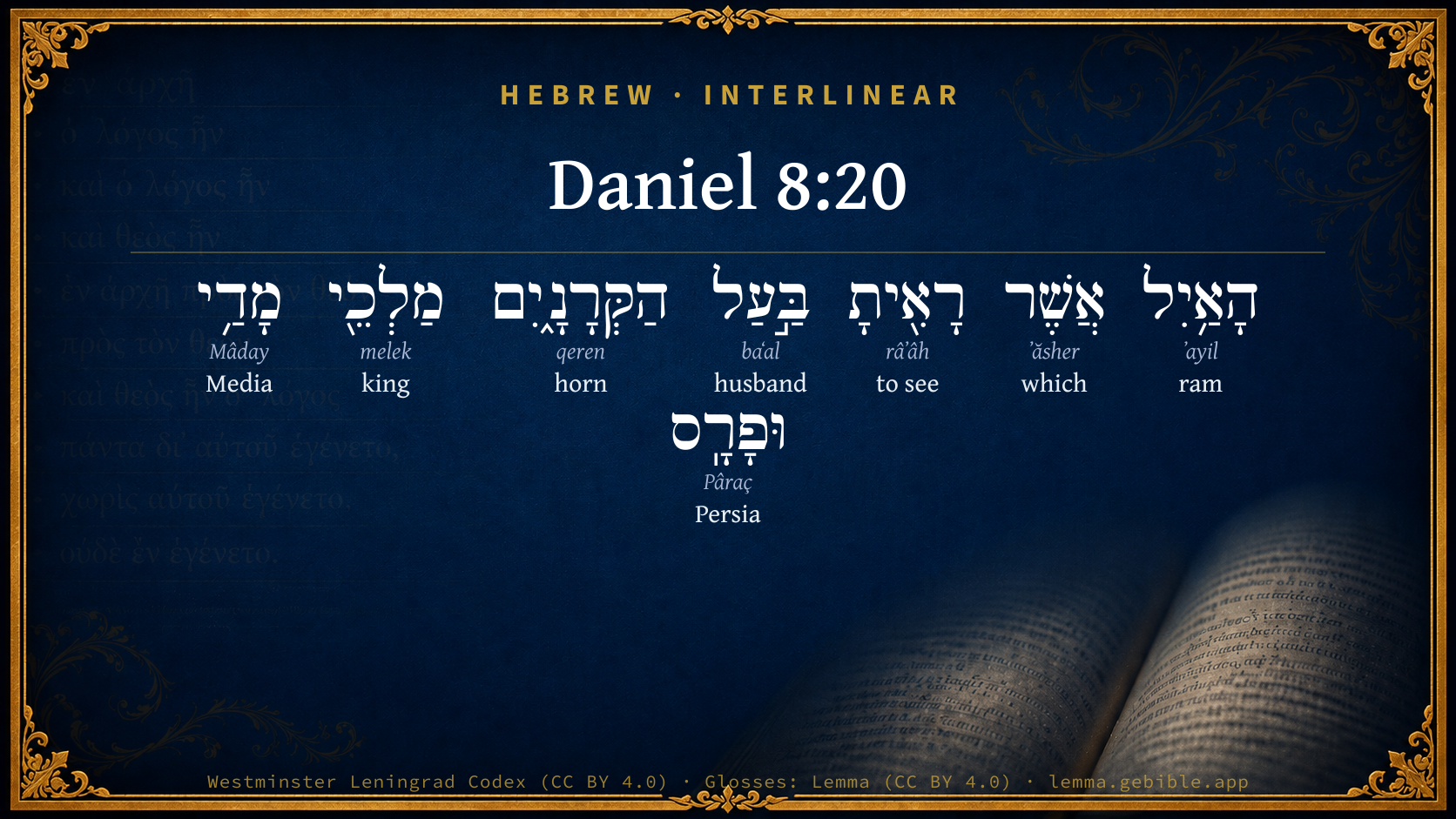
Daniel 8:20

Hebrew (Westminster Leningrad Codex) Daniel 8:20 appears in the Hebrew Old Testament. The text above is from the Westminster Leningrad Codex. Each word links to its Strong’s number, a concise gloss, and parsing drawn from the Open Scriptures Hebrew Bible morphology. Click any word for its full Brown-Driver-Briggs (BDB) entry.
Download image
Cite this verse

Daniel 8:20 (World English Bible). Public Domain. Lemma interlinear Bible study tool, https://lemma.gebible.app/v/daniel/8/20.

Show BibTeX & RIS
BibTeX
RIS
English Translation
The ram which you saw, that had the two horns, they are the kings of Media and Persia.
World English Bible · Public Domain
Download a study sheet

One document with this verse’s original text, its word-by-word gloss line, the meaning frame, cross-references with their text, attributed commentary, and full source and license credits — printable, and it pastes into notes with its structure intact.

This verse Autodidact and up

Study sheet (.html) Plain text (.txt)

A passage Seminary Student

Up to 50 verses in one chapter. A passage sheet keeps up to 6 commentary sources and 12 cross-references per verse, in the order this page ranks them, and says so on the sheet whenever that leaves anything out. Ask for a single verse and you get the Autodidact verse sheet above.

Everything on this page stays free to read, with no account — the sheet is a download of what is already on screen, not access to it.

Want to remove ads? Support Godless Engineer
Compare translations 3

The same verse in 3 English versions, stacked beneath the original-language interlinear above. Click any original word for its lexicon entry.

Each is an independent rendering of the whole verse — the interlinear is not word-aligned to these translations.

Highlighted words mark where these versions differ — a whole-verse word diff, not a word-by-word alignment.

  • World English Bible Public Domain
    The ram which you saw, that had the two horns, they are the kings of Media and Persia.
  • King James Version Public Domain
    The ram which thou sawest having two horns are the kings of Media and Persia.
  • unfoldingWord Literal Text CC BY-SA 4.0
    The ram that you saw with the two horns represents the kings of Media and Persia.

unfoldingWord Literal Text — © unfoldingWord, licensed CC BY-SA 4.0. Word-aligned USFM3 via Door43 (git.door43.org/unfoldingWord/en_ult).

Versions to compare (up to 4)

3 of 4 selected

Show all 18 translations

Every available English version of this verse, each an independent rendering of the whole verse.

  • World English Bible Public Domain
    The ram which you saw, that had the two horns, they are the kings of Media and Persia.
  • Berean Standard Bible Public Domain
    The two-horned ram that you saw represents the kings of Media and Persia.
  • Majority Standard Bible Public Domain
    The two-horned ram that you saw represents the kings of Media and Persia.
  • King James Version Public Domain
    The ram which thou sawest having two horns are the kings of Media and Persia.
  • American Standard Version (1901) Public Domain
    The ram which thou sawest, that had the two horns, they are the kings of Media and Persia.
  • Revised Version (1885) Public Domain
    The ram which thou sawest that had the two horns, they are the kings of Media and Persia.
  • Geneva Bible (1599) Public Domain
    The ramme which thou sawest hauing two hornes, are the Kings of the Medes and Persians.
  • Douay-Rheims (1899) Public Domain
    The ram, which thou sawest with horns, is the king of the Medes and Persians.
  • Young's Literal Translation Public Domain
    `The ram that thou hast seen possessing two horns, `are' the kings of Media and Persia.
  • Literal Standard Version CC BY-SA 4.0
    The ram that you have seen possessing two horns, [are] the kings of Media and Persia.
  • Unlocked Literal Bible CC BY-SA 4.0
    As for the ram you saw, the one that had two horns—they are the kings of Media and Persia.
  • unfoldingWord Literal Text CC BY-SA 4.0
    The ram that you saw with the two horns represents the kings of Media and Persia.
  • Darby Bible Public Domain
    The ram that thou sawest having the two horns: they are the kings of Media and Persia.
  • World Messianic Bible Public Domain
    The ram which you saw, that had the two horns, they are the kings of Media and Persia.
  • Webster's Bible Public Domain
    The ram which thou sawest having two horns are the kings of Media and Persia.
  • Free Bible Version CC BY-SA 4.0
    The ram with two horns that you saw symbolizes the kings of Media and Persia.
  • Bible in Basic English Public Domain
    The sheep which you saw with two horns, they are the kings of Media and Persia.
  • JPS Tanakh (1917) Public Domain
    The ram which thou sawest having the two horns, they are the kings of Media and Persia.

Literal Standard Version (2020), Covenant Press — licensed CC BY-SA 4.0. Text via the HelloAO Bible API (eBible.org). Unlocked Literal Bible (unfoldingWord) — licensed CC BY-SA 4.0. Text via the HelloAO Bible API (eBible.org). unfoldingWord Literal Text — © unfoldingWord, licensed CC BY-SA 4.0. Word-aligned USFM3 via Door43 (git.door43.org/unfoldingWord/en_ult). Free Bible Version, Dr. Jonathan Gallagher — licensed CC BY-SA 4.0. Text via the HelloAO Bible API (eBible.org).

Word by word

More ways to search: Search by grammar → Find every occurrence → Compare this word →

Practice this passage: Drill this verse → Learn its vocabulary →

About this verse

These counts appear in no published source. They are computed here, from the morphology-tagged text and Lemma’s own curated glosses. What Lemma adds →

8
words
8
distinct lemmas
Prophets
section

Notable vocabulary

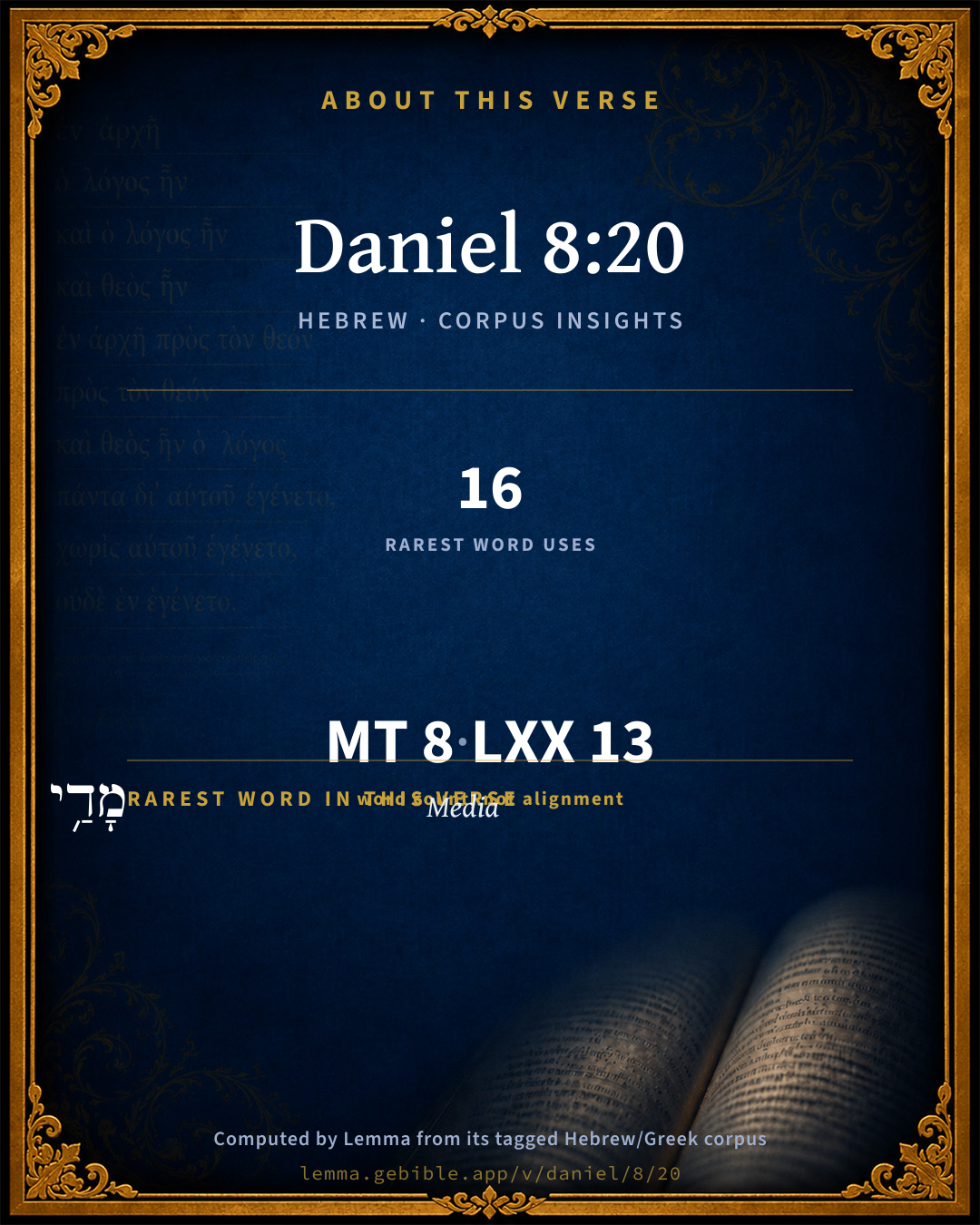
The rarest word here is מָדַ֥י Media H4074 — appearing just 16 times in the whole Hebrew Bible.

Shared distinctive vocabulary

מָדַ֥י Media H4074 occurs in 16 verses of the Hebrew Bible. Also found in:

Grammatical profile

  • 1 verb
  • 6 nouns
  • 1 particle

Verb forms

  • רָאִ֖יתָ Qal · Perfect

Hebrew & Septuagint length

In English translation the verse runs 18 words from the Hebrew and 17 from the Septuagint (LXX English) — closely comparable.

A rough comparison of the two English renderings, which tokenize alike — not a word-level alignment.

Word counts can differ between the Hebrew and the Greek without any difference in meaning — e.g. the Hebrew direct-object marker אֵת has no separate Greek word, and Greek often adds the article ὁ.

In the original languages it is 8 Hebrew tokens and 13 Greek tokens — but the two are counted differently (Hebrew bundles its prefixes and suffixes into one token; the Greek is in lemma form), so that isn’t a like-for-like length.

Cross-references

2

Topical passages linked to Daniel 8:20 in the Treasury of Scripture Knowledge — connected by theme and wording, ordered by reader-vote popularity; previews shown in the World English Bible.

  • Daniel 8:3 Then I lifted up my eyes, and saw, and, behold, there stood before the river a ram which had two horns: and the two horns were high; but one was higher than the other, and the higher came up last.
  • Daniel 11:1–2 "As for me, in the first year of Darius the Mede, I stood up to confirm and strengthen him.

Cross-references courtesy of OpenBible.info (CC BY 4.0).

Hebrew and Greek witnesses Masoretic Hebrew ↔ Greek Septuagint

The same verse in the two great witnesses to the Old Testament, shown verse-for-verse.

These are two independent witnesses, not word-aligned to each other, and the Septuagint is shown in lemma (dictionary) form.

Hebrew Daniel 8:20 Masoretic · Westminster Leningrad Codex

הָאַ֥יִל אֲשֶׁר רָאִ֖יתָ בַּ֣עַל הַקְּרָנָ֑יִם מַלְכֵ֖י מָדַ֥י וּפָרָֽס

The ram which you saw, that had the two horns, they are the kings of Media and Persia.

World English Bible · Public Domain

Greek LXX Daniel 8:20 Septuagint · lemma form

ὁ κριός ὅς ὁράω ὁ ἔχω ὁ κέρας βασιλεύς μῆδος καί πέρσης εἰμί

The ram which you saw that had the horns is the king of the Medes and Persians.

LXX2012 (modern English Septuagint) · Public Domain

On this verse, The Pulpit Commentary discusses the Septuagint’s reading. Read the note in Commentary ↓

Hebrew: Westminster Leningrad Codex (CC BY 4.0). Greek: Septuagint (public domain); English from LXX2012 (modern English Septuagint) (Public Domain). How the Septuagint differs from the Hebrew →

Commentary

Notes on Daniel 8:20 from classic Christian and Jewish commentators (each source and its license shown beneath its notes). The classic Christian expositions comment on the surrounding passage and are grouped to its opening verse, so a note may address several verses; the Jewish commentaries on the Tanakh (Rashi and others) are per-verse, so they appear only where the commentator wrote on this verse.

Lemma curates 59 commentaries, every one of them public domain or Creative Commons licensed, each selected and text-cleaned for this edition rather than reprinted as found. About our sources →

Trapp's Complete Commentary

John Trapp

Dan 8:20 The ram which thou sawest having [two] horns [are] the kings of Media and Persia.

Ver. 20. The ram which thou sawest.] See Dan 8:3.

John Trapp, A Commentary or Exposition upon All the Books of the Old and New Testament (1647–1656) — public domain. Text from a community e-Sword module.

Joseph Benson's Commentary

Dan 8:20-22. The ram, &c., having two horns, are the kings, or kingdoms rather, of Media and Persia. And the rough goat is the king, or kingdom, of Grecia. And the great horn, &c., is the first king — Namely, Alexander the Great, the first Grecian king that reigned over Asia. Now that being broken — That is, this first king being deceased; four kingdoms shall stand up, &c. — Shall arise from it, under the rule of the same nation that the first king was of, namely, the Grecian. But not in his power — They were to be kingdoms of Greeks, not of Alexander’s own family, but only of his nation; neither were they to be equal to him in power and dominion, as an empire united is certainly more powerful than the same empire divided, and the whole is greater than any of its parts.

Joseph Benson's Commentary on the Old and New Testaments (1811–1818) — public domain. Text from a community e-Sword module.

Tyndale Open Study Notes

Tyndale Open Resources

8:20 The smaller horn represents Media, which began as an independent kingdom in 670 BC. The larger horn represents Persia, which dominated Media during Cyrus’s reign (see 7:5).

Tyndale Open Study Notes — © Tyndale Open Resources, licensed CC BY-SA 4.0. Text via the HelloAO Bible API.

Adam Clarke's Commentary

Verse 20. The ram which thou sawest] See this explained under the vision itself, Da 8:3, &c.

Adam Clarke's Commentary on the Bible (1810–1826) — public domain. Text from a community e-Sword/MySword module.

John Calvin's Commentaries

We have previously given a brief explanation of all these subjects. But here the angel removes all doubt, lest we should still anxiously inquire the meaning of the ram which Daniel saw, and of the he-goat which followed and prostrated the ram. The angel, therefore, here pronounces the ram to represent two kingdoms, which coalesced in one. Cyrus, as we have said, granted it for a time to his father-in-law Cyaxares, but yet; drew the whole power to himself, and the Persians began to extend their sway over all the realms of the East. But God in this vision had respect to the beginning of that monarchy. When, however, the Persians and Medes, were united, then the ram bore two horns; then the he-goat succeeded, and he threw down the ram, as we have already seen. In that he-goat there was first one great horn and then four small ones. The angel then answers concerning the he-goat representing the kingdom of the Greeks. There is not the slightest doubt here, since Alexander seized upon the whole East, and thus the Persian monarchy was utterly destroyed. In the he-goat, therefore, the kingdom of Greece or Macedon was displayed, but the horns will mark something special.

That great, horn, says Daniel, was the first king, namely, Alexander; afterwards four smaller horns arose in his place. We have already explained these. For when much blood had been shed, and the greater part of the leaders had been slain, and after the followers of Alexander had mutually attacked and destroyed each other, those who remained divided his dominions among themselves. Cassander the son of Antipater obtained Macedon; Seleueus, Syria; Ptolemy, Egypt; and Antigonus his own fourth share. In this way the smaller horns succeeded Alexander, according to the clear testimony of profane history. From the frequency with which God sets this prophecy before us, we gather his intention of giving us a conspicuous sign of his majesty. For how could Daniel conjecture future events for so long a period before they happened? He does not pronounce mere enigmas, but; narrates things exactly as if they were already fulfilled. At the present time Epicureans despise the Scriptures and laugh at our simplicity, as if we were too ridiculous. But they rather display their own prodigious madness, and blindness, by not acknowledging the prediction of Daniel to be divine. Nay, from this prophecy alone we may prove with certainty the unity of God. If any one was inclined to deny that first principle, and utterly reject the doctrine of his divinity, he might be convinced by this single prophecy. Not only is this subject treated here, but Daniel points with his finger to the God of Israel as the only one in whose hand and will are all things, and from whom nothing either escapes or is concealed. From this prophecy alone the authority of Scripture is established by proofs perfectly sure and undoubted, as the Prophet treats with perfect clearness events at the time unknown, and which no mortal could ever have divined.

First of all he says, The ram which, thou sawest, having two horns, means the kings of the Medes and Persians This had not then occurred, for that ram had not yet risen and seized upon Babylon, as we have stated already. Thus Daniel was raised up as it were to heaven, and observed from that watch-tower things hidden from the minds of men. He afterwards adds, The he-goat is the king of Greece. Philip, the father of Alexander, although a strenuous and a most skillful warrior, who surpassed all the kings of Macedon for cleverness, yet, superior as he was, never dared to cross over the sea. It, was sufficient for him if he could strengthen his power in Greece, and render himself formidable against his neighbors in Asia Minor. But he never dared to attack the power of Persia, or even to harass them, and much less to overcome the whole East. Alexander, inflamed rather by rashness and pride than by good judgment, thought nothing would prove difficult to him. But when Daniel saw this vision, who ever would have thought of any king of Greece invading that most powerful monarchy, and not only seizing upon the whole of Asia, but obtaining sway in Egypt, Syria, and other regions? Although Asia Minor was an extensive region, and well known to be divided into many rich and fertile provinces, yet it was but a small addition to his immense empire. Nay, when Nineveh was conquered by Babylon, and the Chaldeans became masters of Assyria, this also was an addition to the Persian monarchy. We are familiar with the amazing riches of the Medes, and yet they were entirely absorbed. Darius drew with him 800,000 men, and quite buried the earth under his army. Alexander met him at the head of 30,000. What comparison was there between them! When Xerxes came to Greece he brought with him 800,000 men, and threatened to put fetters upon the sea; yet Daniel speaks of his incredible event just as if it had already taken place, and were matter of history. These points must be diligently noticed that the Scriptures may inspire us with the confidence which they deserve.

John Calvin's Commentaries (1540-1563) — public domain. Text from the Calvin Translation Society English edition (1840s-50s) via the Christian Classics Ethereal Library (ccel.org). Calvin's coverage is partial (roughly two-thirds of the Bible); uncommented books and verses are honest gaps, never fabricated. The 19th-century editor's footnotes and remarks are omitted so the notes are faithfully Calvin's own voice.

Ellicott's Commentary for English Readers

(20-22) See Notes on Dan_8:3-8.

A Bible Commentary for English Readers, edited by Charles John Ellicott (1878–1897) — public domain. Text from a community e-Sword module.

The Cambridge Bible for Schools and Colleges

gen. ed. J. J. S. Perowne

20. having the two horns] see on Dan_8:3.

20–26. The explanation of the vision.

The Cambridge Bible for Schools and Colleges (gen. ed. J. J. S. Perowne; Cambridge University Press, 1878–1918) — public domain. Text from a community e-Sword module.

John Gill's Exposition

The ram which thou sawest having two horns,.... Here begins the particular explanation of the above vision, and of the first thing which the prophet saw in it, a ram with two horns: which two horns, he says,

are the kings of Media and Persia; Darius the first king was a Mede, and Cyrus, that succeeded him, or rather reigned with him, was a Persian: or rather the ram with two horns signifies the two kingdoms of the Medes and Persians united in one monarchy, of which the ram was an emblem; See Gill on Dan 8:3 for Darius and Cyrus were dead many years before the time of Alexander; and therefore could not personally be the two horns of the ram broken by him; nor is it to be understood of the kings of two different families, as the one of. Cyrus, and the other of Darius Hystaspes, in whose successors the Persian monarchy continued till destroyed by Alexander, as Theodoret.

John Gill's Exposition of the Whole Bible (1746–1763) — public domain (CC PDM 1.0). Text via the HelloAO Bible API.

Albert Barnes' Notes on the Bible

The ram which thou sawest ... - See the notes at Dan 8:3. This is one of the instances in the Scriptures in which symbols are explained. There can be no doubt, therefore, as to the meaning.

Albert Barnes' Notes on the Bible (1834–1885) — public domain. Text from a community e-Sword/MySword module.

Matthew Poole's English Annotations

Or the kingdom, Dan 7:17.

Matthew Poole's English Annotations on the Holy Bible (1683–1685) — public domain. Text from a community e-Sword/MySword module.

Whedon's Commentary on the Bible

Daniel D. Whedon

20-22. These verses explain Dan_8:3-8. (See notes.) The explanation is brief, because the interest centers not in the great horn (Alexander the Great), but in the “little horn” (Antiochus Epiphanes).

Daniel D. Whedon (gen. ed.), Commentary on the Old and New Testaments (1874–1909) — public domain. Text from a community e-Sword module.

The Pulpit Commentary

The ram which thou sawest having two horns are the kings of Media and Persia. All the versions the Septuagint, Theodotion, the Peshitta, and the Vulgate have read, not ykelm, as we find in the Massoretic text, but dl,m, The ancient construct case in Hebrew was formed by adding y to the root. Possibly this may be a survival of that usage. In this case the change is due to scribal blunder. When we turn to Jer_25:25 and Jer_51:11, we have the same phrases used as here: this is probably the origin of the blunder. For any one to ground an argument, as does Professor Bevan, on this, and maintain that it proves the writer to have held that there were two separate empires one of Media, and the other of Persia is absurd. When the true reading is adopted, this passage proves the very reverse of that for which Professor Bevan contends. The reasoning of Kliefoth, that the distinction between plural and singular points to the fact that, while several kings reigned ever the Persian Empire, only one ruled over the Greek, is very ingenious, but, unfortunately, it has no foundation in fact. "King," it may be observed, stands for dynasty, only that in the crisis of history, when the two powers encountered, each was ruled and represented by one king Persia by Darius Codomannus, and Greece by Alexander.

The Pulpit Commentary (1880–1919), ed. H.D.M. Spence-Jones & Joseph S. Exell — public domain. Text from a community e-Sword module.

Scofield Reference Notes

C. I. Scofield

ram

vs. Dan 8:3; Dan 8:4.

The "higher" horn which "came up last" is Cyrus, the other "Darius the Mede."

The Scofield Reference Bible (1917 edition), notes by C. I. Scofield — public domain. Text from a community e-Sword module.

unfoldingWord translationNotes

Door43 World Missions Community

General Information:

In these verses, the angel explains to Daniel the symbolic meaning of the things he saw in his vision. The animals and horns actually represent human rulers and kingdoms. (See: Symbolic Language)

two horns—they are

"two horns—they represent"

the kings of Media and Persia

Possible meanings are 1) this refers to the kings of Media and Persia or 2) this is a metonym in which the kings represents the kingdoms of Media and Persia. AT: "the kingdoms of Media and Persia" (See: Metonymy)

the king of Greece

Possible meanings are 1) this refers to the king of Greece or 2) this is a metonym in which the king represents the kingdom of Greece. AT: "the kingdom of Greece" (See: Metonymy)

The large horn between his eyes is

"The large horn between his eyes represents"

translationWords

ewe

king

Medes

Persia

goat

Greece

unfoldingWord translationNotes — © Distant Shores Media and the Door43 World Missions Community, licensed CC BY-SA 4.0. Source: git.door43.org/Door43/en_tn.

Rashi

Rabbi Shlomo Yitzchaki (Rashi)

The kings of Media and Persia The two horns represent two ruling nations, as I explained above.

Rashi on the Tanakh — English translations: “The Judaica Press complete Tanach with Rashi, translated by A. J. Rosenberg” (CC BY 4.0); “Pentateuch with Rashi's commentary by M. Rosenbaum and A.M. Silbermann, 1929-1934” (public domain); “The Metsudah Tanach series, Lakewood, N.J” (CC BY 4.0); and “The Book of Joshua, Metsudah Publications, 1997” (CC BY 4.0). Text via Sefaria.

Lesson kit

Teaching starters — assembled from the data on this page, not authored interpretation. Every prompt links to the verse data it draws on. Edit before teaching.

Daniel, in the Prophets, opens this verse with 8 words (8 distinct Hebrew lemmas). Its most distinctive word is Mâday (“Media”). A historical commentator’s framing appears above. Read the whole chapter for the surrounding context.

Discussion questions

  1. What does “Media” (Mâday) contribute to the verse as a whole?
  2. How does Genesis 10:2, which shares the word «Media», read alongside this verse?
  3. These translations render this verse differently; the difference is in the English rendering, not the original. What questions does that raise?
  4. «רָאִ֖יתָ» is a Qal Perfect verb. How does that grammatical form shape the action described?
  5. Compare how Trapp's Complete Commentary and Joseph Benson's Commentary read this verse. Where do they agree or differ?

Things to notice

Reading settings

Reading text

Shown beneath each verse's original-language words.

Old Testament
Old Testament edition

Read the OT as the Masoretic Hebrew (MT) or the Greek Septuagint (LXX).

English shown for the Greek Septuagint (in the Hebrew ↔ Greek comparison).

Comparing translations? Open the Compare panel on any verse page to stack up to four side by side.