
Proverbs 29:22

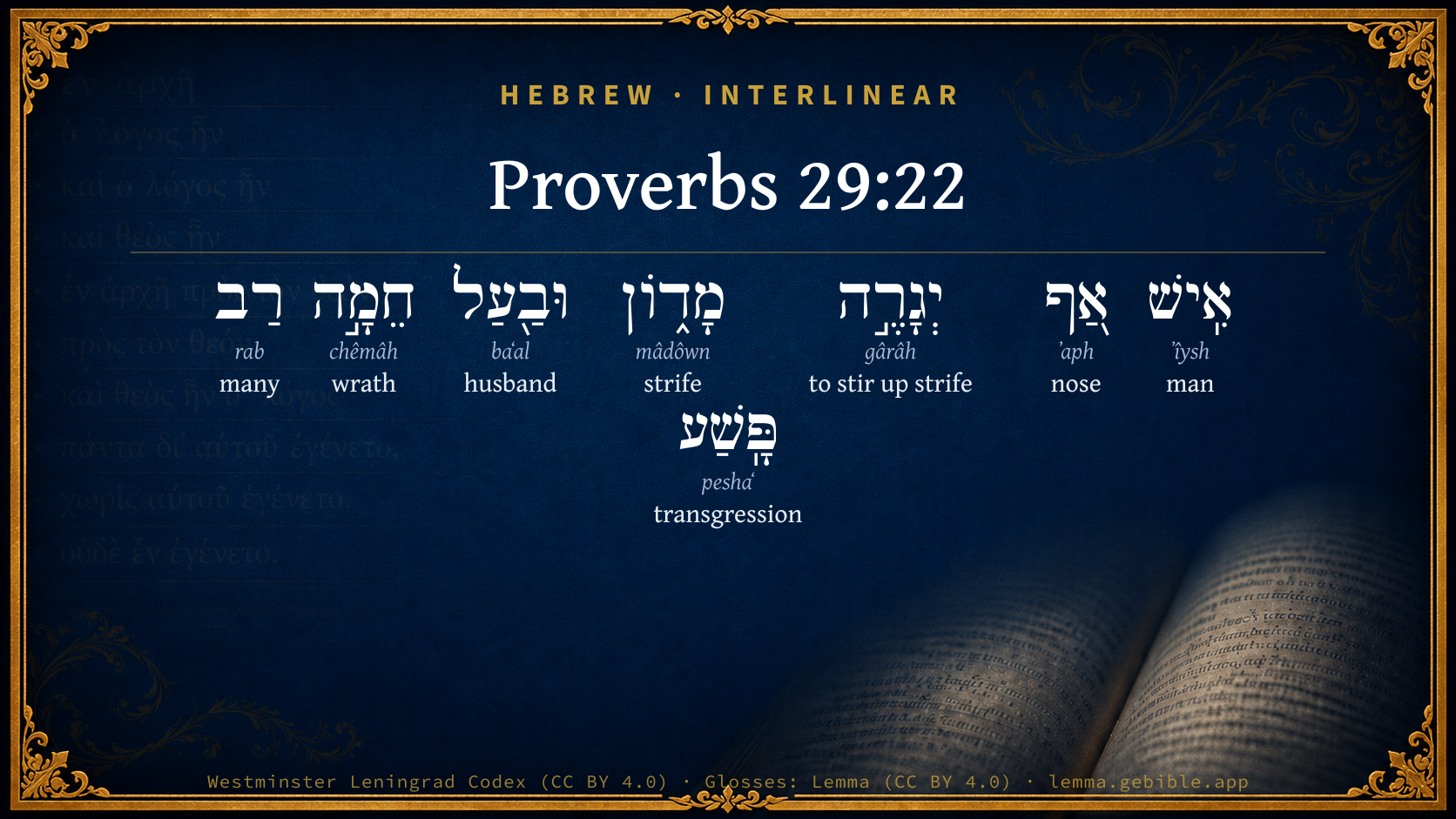
Hebrew (Westminster Leningrad Codex) Proverbs 29:22 appears in the Hebrew Old Testament. The text above is from the Westminster Leningrad Codex. Each word links to its Strong’s number, a concise gloss, and parsing drawn from the Open Scriptures Hebrew Bible morphology. Click any word for its full Brown-Driver-Briggs (BDB) entry.
Download image
Cite this verse

Proverbs 29:22 (World English Bible). Public Domain. Lemma interlinear Bible study tool, https://lemma.gebible.app/v/proverbs/29/22.

Show BibTeX & RIS
BibTeX
RIS
English Translation
An angry man stirs up strife, And a wrathful man abounds in sin.
World English Bible · Public Domain
Download a study sheet

One document with this verse’s original text, its word-by-word gloss line, the meaning frame, cross-references with their text, attributed commentary, and full source and license credits — printable, and it pastes into notes with its structure intact.

This verse Autodidact and up

Study sheet (.html) Plain text (.txt)

A passage Seminary Student

Up to 50 verses in one chapter. A passage sheet keeps up to 6 commentary sources and 12 cross-references per verse, in the order this page ranks them, and says so on the sheet whenever that leaves anything out. Ask for a single verse and you get the Autodidact verse sheet above.

Everything on this page stays free to read, with no account — the sheet is a download of what is already on screen, not access to it.

Want to remove ads? Support Godless Engineer
Compare translations 3

The same verse in 3 English versions, stacked beneath the original-language interlinear above. Click any original word for its lexicon entry.

Each is an independent rendering of the whole verse — the interlinear is not word-aligned to these translations.

Highlighted words mark where these versions differ — a whole-verse word diff, not a word-by-word alignment.

  • World English Bible Public Domain
    An angry man stirs up strife, And a wrathful man abounds in sin.
  • King James Version Public Domain
    An angry man stirreth up strife, and a furious man aboundeth in transgression.
  • unfoldingWord Literal Text CC BY-SA 4.0
    A man of nose stirs up strife, and an owner of heat, much transgression.

unfoldingWord Literal Text — © unfoldingWord, licensed CC BY-SA 4.0. Word-aligned USFM3 via Door43 (git.door43.org/unfoldingWord/en_ult).

Versions to compare (up to 4)

3 of 4 selected

Show all 18 translations

Every available English version of this verse, each an independent rendering of the whole verse.

  • World English Bible Public Domain
    An angry man stirs up strife, And a wrathful man abounds in sin.
  • Berean Standard Bible Public Domain
    An angry man stirs up dissension, and a hot-tempered man abounds in transgression.
  • Majority Standard Bible Public Domain
    An angry man stirs up dissension, and a hot-tempered man abounds in transgression.
  • King James Version Public Domain
    An angry man stirreth up strife, and a furious man aboundeth in transgression.
  • American Standard Version (1901) Public Domain
    An angry man stirreth up strife, And a wrathful man aboundeth in transgression.
  • Revised Version (1885) Public Domain
    An angry man stirreth up strife, and a wrathful man aboundeth in transgression.
  • Geneva Bible (1599) Public Domain
    An angrie man stirreth vp strife, and a furious man aboundeth in transgression.
  • Douay-Rheims (1899) Public Domain
    A passionate man provoketh quarrels: and he that is easily stirred up to wrath, shall be more prone to sin.
  • Young's Literal Translation Public Domain
    An angry man stirreth up contention, And a furious man is multiplying transgression.
  • Literal Standard Version CC BY-SA 4.0
    An angry man stirs up contention, || And a furious man is multiplying transgression.
  • Unlocked Literal Bible CC BY-SA 4.0
    An angry person stirs up strife and a master of rage commits many sins.
  • unfoldingWord Literal Text CC BY-SA 4.0
    A man of nose stirs up strife, and an owner of heat, much transgression.
  • Darby Bible Public Domain
    An angry man exciteth contention; and a furious man aboundeth in transgression.
  • World Messianic Bible Public Domain
    An angry man stirs up strife, and a wrathful man abounds in sin.
  • Webster's Bible Public Domain
    An angry man stirreth up strife, and a furious man aboundeth in transgression.
  • Free Bible Version CC BY-SA 4.0
    Angry people stir up trouble, those with short tempers commit many sins.
  • Bible in Basic English Public Domain
    An angry man is the cause of fighting, and a man given to wrath does much wrong.
  • JPS Tanakh (1917) Public Domain
    An angry man stirreth up strife, and a wrathful man aboundeth in transgression.

Literal Standard Version (2020), Covenant Press — licensed CC BY-SA 4.0. Text via the HelloAO Bible API (eBible.org). Unlocked Literal Bible (unfoldingWord) — licensed CC BY-SA 4.0. Text via the HelloAO Bible API (eBible.org). unfoldingWord Literal Text — © unfoldingWord, licensed CC BY-SA 4.0. Word-aligned USFM3 via Door43 (git.door43.org/unfoldingWord/en_ult). Free Bible Version, Dr. Jonathan Gallagher — licensed CC BY-SA 4.0. Text via the HelloAO Bible API (eBible.org).

Word by word

More ways to search: Search by grammar → Find every occurrence → Compare this word →

Practice this passage: Drill this verse → Learn its vocabulary →

About this verse

These counts appear in no published source. They are computed here, from the morphology-tagged text and Lemma’s own curated glosses. What Lemma adds →

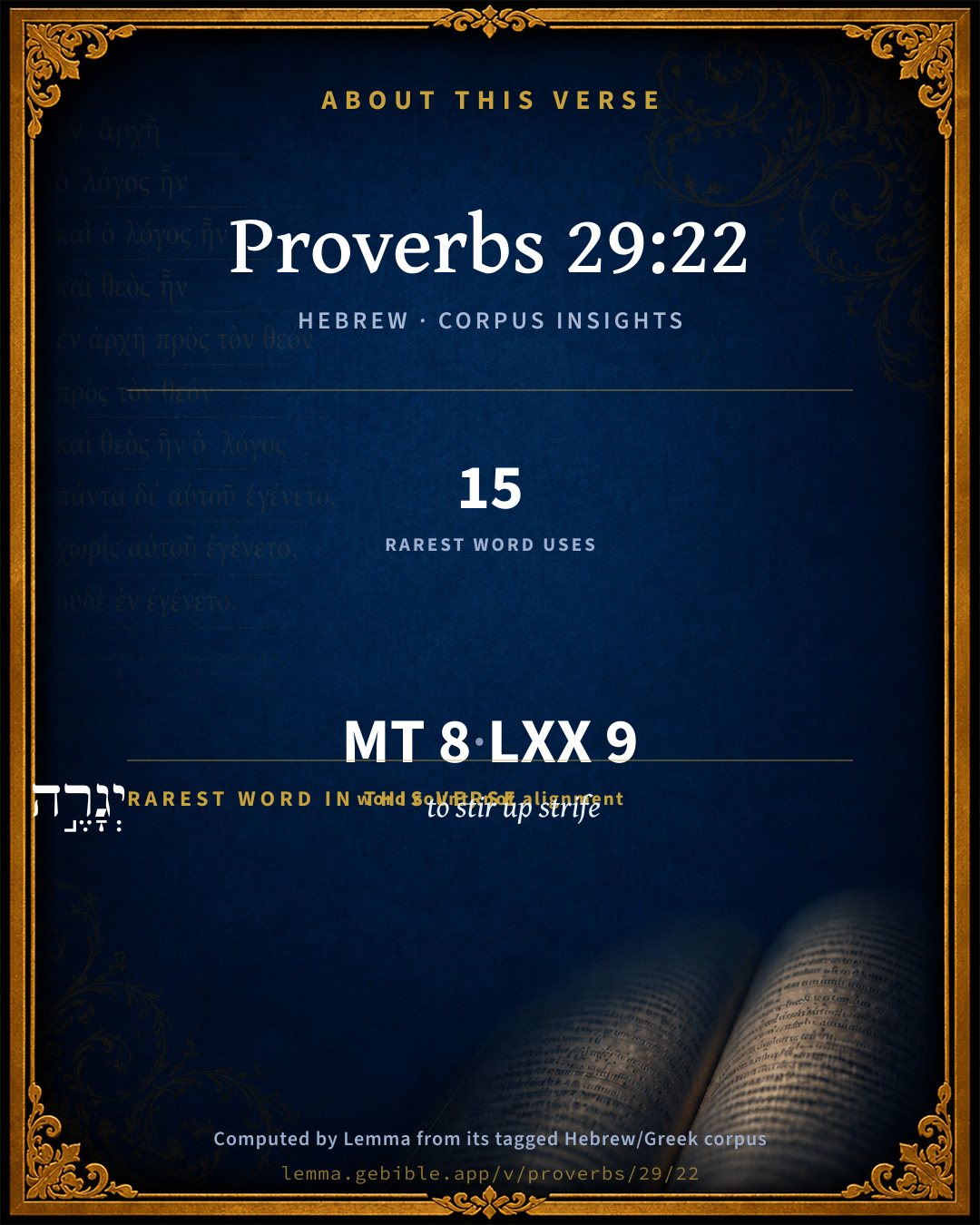
8
words
8
distinct lemmas
Wisdom
section

Notable vocabulary

The rarest word here is יְגָרֶ֣ה to stir up strife H1624 — appearing just 15 times in the whole Hebrew Bible.

Shared distinctive vocabulary

יְגָרֶ֣ה to stir up strife H1624 occurs in 13 verses of the Hebrew Bible. Also found in:

Grammatical profile

  • 1 verb
  • 5 nouns
  • 1 adjective
  • 1 particle

Verb forms

  • יְגָרֶ֣ה Piel · Imperfect

Hebrew & Septuagint length

In English translation the verse runs 13 words from the Hebrew and 13 from the Septuagint (LXX English) — the same length.

A rough comparison of the two English renderings, which tokenize alike — not a word-level alignment.

Word counts can differ between the Hebrew and the Greek without any difference in meaning — e.g. the Hebrew direct-object marker אֵת has no separate Greek word, and Greek often adds the article ὁ.

In the original languages it is 8 Hebrew tokens and 9 Greek tokens — but the two are counted differently (Hebrew bundles its prefixes and suffixes into one token; the Greek is in lemma form), so that isn’t a like-for-like length.

Cross-references

8

Topical passages linked to Proverbs 29:22 in the Treasury of Scripture Knowledge — connected by theme and wording, ordered by reader-vote popularity; previews shown in the World English Bible.

  • Proverbs 15:18 A wrathful man stirs up contention, But one who is slow to anger appeases strife.
  • Proverbs 17:19 He who loves disobedience loves strife. One who builds a high gate seeks destruction.
  • Proverbs 26:21 As coals are to hot embers, And wood to fire, So is a contentious man to kindling strife.
  • Proverbs 10:12 Hatred stirs up strife, But love covers all wrongs.
  • Proverbs 14:17 He who is quick to become angry will commit folly, And a crafty man is hated.
  • Proverbs 22:24 Don't befriend a hot-tempered man, And don't associate with one who harbors anger:
  • Proverbs 30:33 For as the churning of milk brings forth butter, And the wringing of the nose brings forth blood; So the forcing of wrath brings forth strife."
  • James 3:16 For where jealousy and selfish ambition are, there is confusion and every evil deed.

Cross-references courtesy of OpenBible.info (CC BY 4.0).

Hebrew and Greek witnesses Masoretic Hebrew ↔ Greek Septuagint

The same verse in the two great witnesses to the Old Testament, shown verse-for-verse.

These are two independent witnesses, not word-aligned to each other, and the Septuagint is shown in lemma (dictionary) form.

Hebrew Proverbs 29:22 Masoretic · Westminster Leningrad Codex

אִֽישׁ אַ֭ף יְגָרֶ֣ה מָד֑וֹן וּבַ֖עַל חֵמָ֣ה רַב פָּֽשַׁע

An angry man stirs up strife, And a wrathful man abounds in sin.

World English Bible · Public Domain

Greek LXX Proverbs 29:22 Septuagint · lemma form

ἀνήρ θυμώδης ὀρύσσω νεῖκος ἀνήρ δέ ὀργίλος ἐκὀρύσσω ἁμαρτία

A furious man stirs up strife, and a passionate man digs up sin.

LXX2012 (modern English Septuagint) · Public Domain

On this verse, The Pulpit Commentary discusses the Septuagint’s reading. Read the note in Commentary ↓

Hebrew: Westminster Leningrad Codex (CC BY 4.0). Greek: Septuagint (public domain); English from LXX2012 (modern English Septuagint) (Public Domain). How the Septuagint differs from the Hebrew →

Commentary

Notes on Proverbs 29:22 from classic Christian and Jewish commentators (each source and its license shown beneath its notes). The classic Christian expositions comment on the surrounding passage and are grouped to its opening verse, so a note may address several verses; the Jewish commentaries on the Tanakh (Rashi and others) are per-verse, so they appear only where the commentator wrote on this verse.

Lemma curates 59 commentaries, every one of them public domain or Creative Commons licensed, each selected and text-cleaned for this edition rather than reprinted as found. About our sources →

Trapp's Complete Commentary

John Trapp

Pro 29:22 An angry man stirreth up strife, and a furious man aboundeth in transgression.

Ver. 22. An angry man stirreth up strife.] See Pro 15:18; Pro 16:21.

And a furious man.] Heb. A master of fury; or one that is mastered and overmatched by his fury; that hath no command of his passions, but is transported by them, or - as some make the metaphor, and the original will well bear it - is wedded to them as a man is to his wife: commanded by them, as the Persian kings were by their concubines, being captivarum suarum captivi, {a} slaves to their slaves. Such a man being big with wrath, not only breeds contention, but brings forth transgression in great abundance, he "sets his mouth against heaven, and his tongue walketh through the earth," &c., {Psa 73:9} he lets fly on both hands, and lays about him like a madman.

{a} Plutarch.

John Trapp, A Commentary or Exposition upon All the Books of the Old and New Testament (1647–1656) — public domain. Text from a community e-Sword module.

Matthew Henry's Commentary

See here the mischief that flows from an angry, passionate, furious disposition. 1. It makes men provoking to one another: An angry man stirs up strife, is troublesome and quarrelsome in the family and in the neighbourhood, blows the coals, and even forces those to fall out with him that would live peaceable and quietly by him. 2. It makes men provoking to God: A furious man, who is wedded to his humours and passions, cannot but abound in transgressions. Undue anger is a sin which is the cause of many sins; it not only hinders men from calling upon God's name, but it occasions their swearing, and cursing, and profaning God's name.

Matthew Henry's Commentary on the Whole Bible (1708–1710) — public domain (CC PDM 1.0). Text via the HelloAO Bible API.

Jamieson, Fausset & Brown

Robert Jamieson, A. R. Fausset & David Brown

(Compare Pro 15:18). Such are delighted by discord and violence.

Jamieson, Fausset & Brown — Commentary Critical and Explanatory on the Whole Bible (1871) — public domain (CC PDM 1.0). Text via the HelloAO Bible API.

Adam Clarke's Commentary

Verse 22. An angry man stirreth up strife] His spirit begets its like wherever he goes.

And a furious man aboundeth in transgression.] His furious spirit is always carrying him into extremes, and each of these is a transgression.

Adam Clarke's Commentary on the Bible (1810–1826) — public domain. Text from a community e-Sword/MySword module.

Ellicott's Commentary for English Readers

(22) Aboundeth in transgression.—For what will he not say and do when overcome by anger?

A Bible Commentary for English Readers, edited by Charles John Ellicott (1878–1897) — public domain. Text from a community e-Sword module.

The Cambridge Bible for Schools and Colleges

gen. ed. J. J. S. Perowne

22. furious] Rather, wrathful, R.V. Comp. Pro_15:18; Pro_28:25.

The Cambridge Bible for Schools and Colleges (gen. ed. J. J. S. Perowne; Cambridge University Press, 1878–1918) — public domain. Text from a community e-Sword module.

John Gill's Exposition

An angry man stirreth up strife,.... In families, neighbourhoods, communities, churches, and commonwealths; that is, one that is given to anger, and gives way to it, in whom it prevails and rules;

and a furious man aboundeth in transgression; or, "a master of wrath or fury" (y); one much addicted to it: or, "the husband of wrath": wedded to it, as a man to his wife: or, as the Vulgate Latin version renders it, "who is easy to be angry"; is easily provoked, wrath rises up in him at once; this leads him on to many sins, as cursing, swearing, murder,

(y) "dominus furoris", so Vatablus, Piscator, Michaelis.

John Gill's Exposition of the Whole Bible (1746–1763) — public domain (CC PDM 1.0). Text via the HelloAO Bible API.

Matthew Poole's English Annotations

Is by his passion easily transported into grievous and manifold sins against God, and others, and himself, as swearing, and cursing, and violence, yea, sometimes even to murder.

Matthew Poole's English Annotations on the Holy Bible (1683–1685) — public domain. Text from a community e-Sword/MySword module.

Whedon's Commentary on the Bible

Daniel D. Whedon

22. An angry man — An irritable or passionate man makes much trouble, and causes both himself and others to transgress. Comp. Pro_15:18; Pro_26:21; Pro_28:5; Job 22:29, 33; Mat_23:12; Luk_14:11.

Daniel D. Whedon (gen. ed.), Commentary on the Old and New Testaments (1874–1909) — public domain. Text from a community e-Sword module.

The Pulpit Commentary

An angry man stirreth up strife. This is a variation of Pro_15:18 and Pro_28:25 (which see). A furious man aboundeth in transgression. "A furious man" is a passionate person, who gives way to violent fits of anger. (Pro_22:24) Such a man both makes enemies by his conduct and falls into manifold excesses of word and action while under the influence of his wrath. "The wrath of man worketh not the righteousness of God". (Jam_1:20) The Greek gnome says Orgh de polla dran anagkazei kaka . And again Poll estin orghv ex apaideutou kaka "Unchastened anger leads to many ills. Septuagint, "A passionate man diggeth up sin a forcible expression, which is not unusual in reference to quarrels.

The Pulpit Commentary (1880–1919), ed. H.D.M. Spence-Jones & Joseph S. Exell — public domain. Text from a community e-Sword module.

Keil & Delitzsch

C. F. Keil & F. Delitzsch

The following group begins with a proverb which rhymes by מדון, with מנון of the foregoing, and extends on to the end of this Hezekiah collection:

22 A man of anger stirreth up strife;

And a passionate man aboundeth in transgression.

Line first is a variation of Pro 15:18 and Pro 28:25. אישׁ and בּעל as here, but in the reverse order at Pro 22:24.

(Note: For אישׁ־אף (Lwenstein after Norzi) is to be written, with Baer (Thorath Emeth, p. 19), אישׁ אף ,)91. Thus also in Cod. Jaman.)

אף here means anger, not the nose, viz., the expanded nostrils (Schultens). In רב־פּשׁע the פשׁע is, after Pro 14:29; Pro 28:16; Pro 20:27, the governed genitive; Hitzig construes it in the sense of פשׁע רב, Psa 19:2, with יגרה, but one does not say גּרה פשׁע; and that which is true of רבּים, that, after the manner of a numeral, it can precede its substantive (vid., under Ps. 7:26; Psa 89:51), cannot be said of רב. Much (great) in wickedness denotes one who heaps up many wicked actions, and burdens himself with greater guilt (cf. פשׁע, Pro 29:16). The wrathful man stirreth up (vid., under Pro 15:18) strife, for he breaks through the mutual relations of men, which rest on mutual esteem and love, and by means of his passionate conduct he makes enemies of those against whom he thinks that he has reason for being angry; that on account of which he is angry can be settled without producing such hostility, but passion impels him on, and misrepresents the matter; it embitters hearts, and tears them asunder. The lxx has, instead of רב, ἐξώρυξεν, of dreaming, כרה (Pro 16:27).

Keil & Delitzsch — Biblical Commentary on the Old Testament (1861–1891) — public domain (CC PDM 1.0). Text via the HelloAO Bible API. (Old Testament only.)

Bridges on Proverbs

Charles Bridges

Anger is not necessarily a sinful passion. Even furiousness — the overflowing of the torrent — is a property in God. (Nah 1:2 ) We can readily conceive of its energy in the unfallen nature of man. Had Satan appeared to Eve in his own open hatefulness, her anger against him would have been a holy principle. But in a fallen nature, to preserve its purity is a rare and most difficult matter. It must be confined to points, where God’s honor is concerned (Joh 2:15-17 ); and even on these points the rule must be observed — "Let not the sun go down upon your wrath." (Eph 4:26 .) The short period of the day is abundantly sufficient to express right motives, and to accomplish holy purposes.

The general tendency of anger is however here most truly described. Its active energy stirreth up strife.†1 It quarrels even upon trifles,†2 — or matters, which a forbearing consideration might have satisfactorily explained. (Act 15:39 .) And when suppressed, but not laboriously mortified, how often does it become more intense, and break out more furiously — abounding in transgression! Indeed it is difficult to take a full view of the mighty power of this mass of sin. It gives the impetus to every besetting propensity. It may be blasphemy! (Lev 24:10-11 .) It stops at nothing. How many murders do we owe to this paroxysm of the moment!†3 But for the divine restraints, the very foundations of society would be torn up!

Parents! Do we feel the responsibility of early checking this ebullition in our children? And do we diligently watch against the first rising in ourselves, incessantly praying for its subjugation? How beautiful are the instances of Almighty grace — such as Henry Martyn†4 — transforming the furious man into the likeness of his meek and holy Master!

But let us not be satisfied with the outward constraint upon passion. God condemns the deep-rooted principle that gives it birth. Wretched heart! filled with soul-destroying corruption. Every, even the least, indulgence operates fearfully. So much time spent in excitement! So much more in the unquiet waiting for the desired opportunity! And all given to the great Murderer! Oh! for the mystery and doctrine of the cross, to mold our temper into its genuine spirit and influence!

Footnotes:

†1 Pro 15:18; Pro 26:21 ; Pro 30:33 . Jas 3:16 .

†2 1Ti 6:4 . 2Ti 2:23-24 .

†3 1Sa 18:9-10 ; 1Sa 22:6-19 . Mat 2:16 . Act 7:54-59 ; Act 12:19 .

†4 Life, p. 8. Pref. to 10th edit.

Charles Bridges, An Exposition of the Book of Proverbs (1846) — public domain. Text from a community e-Sword module.

Rashi

Rabbi Shlomo Yitzchaki (Rashi)

stirs up strife According to its apparent meaning, מדון is the Divine standard of justice.

Rashi on the Tanakh — English translations: “The Judaica Press complete Tanach with Rashi, translated by A. J. Rosenberg” (CC BY 4.0); “Pentateuch with Rashi's commentary by M. Rosenbaum and A.M. Silbermann, 1929-1934” (public domain); “The Metsudah Tanach series, Lakewood, N.J” (CC BY 4.0); and “The Book of Joshua, Metsudah Publications, 1997” (CC BY 4.0). Text via Sefaria.

Lesson kit

Teaching starters — assembled from the data on this page, not authored interpretation. Every prompt links to the verse data it draws on. Edit before teaching.

Proverbs, in the Wisdom, opens this verse with 8 words (8 distinct Hebrew lemmas). Its most distinctive word is gârâh (“to stir up strife”). A historical commentator’s framing appears above. Read the whole chapter for the surrounding context.

Discussion questions

  1. The word gârâh carries the sense “to stir up strife.” How does it shape the verse?
  2. Deuteronomy 2:5 shares the word «to stir up strife» with this verse. How do the two illuminate each other?
  3. These translations render this verse differently. What is at stake in choosing one wording over another?
  4. The verb «יְגָרֶ֣ה» is Piel Imperfect. How does its form color the action?
  5. Reading how Trapp's Complete Commentary and Matthew Henry's Commentary read this verse, where do the two commentators agree and where do they part?

Things to notice

Reading settings

Reading text

Shown beneath each verse's original-language words.

Old Testament
Old Testament edition

Read the OT as the Masoretic Hebrew (MT) or the Greek Septuagint (LXX).

English shown for the Greek Septuagint (in the Hebrew ↔ Greek comparison).

Comparing translations? Open the Compare panel on any verse page to stack up to four side by side.