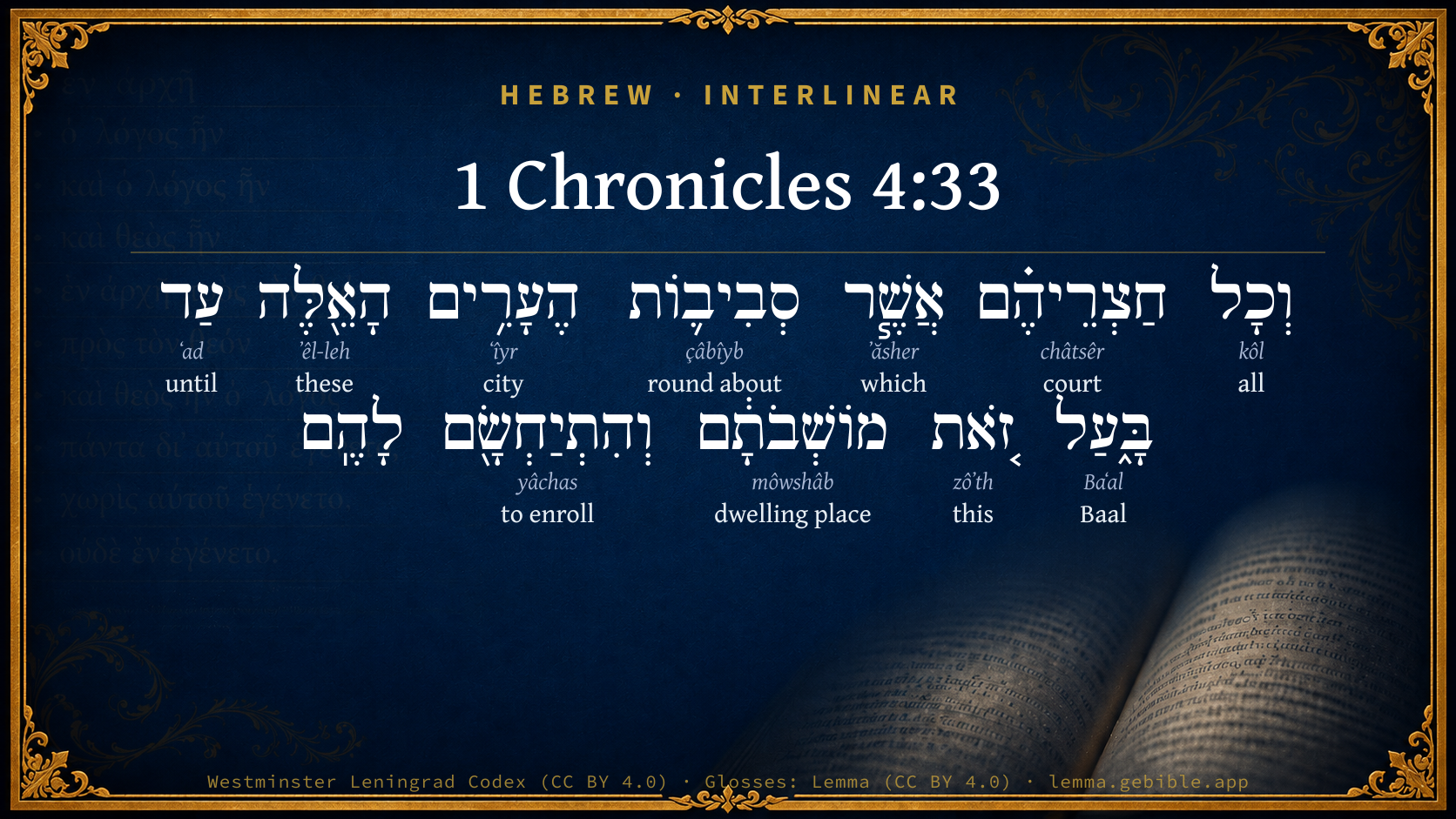
1 Chronicles 4:33

Hebrew (Westminster Leningrad Codex) 1 Chronicles 4:33 appears in the Hebrew Old Testament. The text above is from the Westminster Leningrad Codex. Each word links to its Strong’s number, a concise gloss, and parsing drawn from the Open Scriptures Hebrew Bible morphology. Click any word for its full Brown-Driver-Briggs (BDB) entry.
Download image
Cite this verse

1 Chronicles 4:33 (World English Bible). Public Domain. Lemma interlinear Bible study tool, https://lemma.gebible.app/v/1-chronicles/4/33.

Show BibTeX & RIS
BibTeX
RIS
English Translation
and all their villages that were round about the same cities, to Baal. These were their habitations, and they have their genealogy.
World English Bible · Public Domain
Highlights
  • 1 first appearance in the Hebrew Bible
Full analysis ↓
Download a study sheet

One document with this verse’s original text, its word-by-word gloss line, the meaning frame, cross-references with their text, attributed commentary, and full source and license credits — printable, and it pastes into notes with its structure intact.

This verse Autodidact and up

Study sheet (.html) Plain text (.txt)

A passage Seminary Student

Up to 50 verses in one chapter. A passage sheet keeps up to 6 commentary sources and 12 cross-references per verse, in the order this page ranks them, and says so on the sheet whenever that leaves anything out. Ask for a single verse and you get the Autodidact verse sheet above.

Everything on this page stays free to read, with no account — the sheet is a download of what is already on screen, not access to it.

Want to remove ads? Support Godless Engineer
Compare translations 3

The same verse in 3 English versions, stacked beneath the original-language interlinear above. Click any original word for its lexicon entry.

Each is an independent rendering of the whole verse — the interlinear is not word-aligned to these translations.

Highlighted words mark where these versions differ — a whole-verse word diff, not a word-by-word alignment.

  • World English Bible Public Domain
    and all their villages that were round about the same cities, to Baal. These were their habitations, and they have their genealogy.
  • King James Version Public Domain
    And all their villages that were round about the same cities, unto Baal. These were their habitations, and their genealogy.
  • unfoldingWord Literal Text CC BY-SA 4.0
    and all of their villages that around these cities unto Baal. These their settlements, and their genealogy to them.

unfoldingWord Literal Text — © unfoldingWord, licensed CC BY-SA 4.0. Word-aligned USFM3 via Door43 (git.door43.org/unfoldingWord/en_ult).

Versions to compare (up to 4)

3 of 4 selected

Show all 18 translations

Every available English version of this verse, each an independent rendering of the whole verse.

  • World English Bible Public Domain
    and all their villages that were round about the same cities, to Baal. These were their habitations, and they have their genealogy.
  • Berean Standard Bible Public Domain
    and all their surrounding villages as far as Baal. These were their settlements, and they kept a genealogical record:
  • Majority Standard Bible Public Domain
    and all their surrounding villages as far as Baal. These were their settlements, and they kept a genealogical record:
  • King James Version Public Domain
    And all their villages that were round about the same cities, unto Baal. These were their habitations, and their genealogy.
  • American Standard Version (1901) Public Domain
    and all their villages that were round about the same cities, unto Baal. These were their habitations, and they have their genealogy.
  • Revised Version (1885) Public Domain
    and all their villages that were round about the same cities, unto Baal. These were their habitations, and they have their genealogy.
  • Geneva Bible (1599) Public Domain
    And all their townes that were rounde about these cities vnto Baal, These are their habitations and the declaration of their genealogie,
  • Douay-Rheims (1899) Public Domain
    And all their villages round about these cities as far as Baal. This was their habitation, and the distribution of their dwellings.
  • Young's Literal Translation Public Domain
    and all their villages that `are' round about these cities unto Baal; these `are' their dwellings, and they have their genealogy:
  • Literal Standard Version CC BY-SA 4.0
    and all their villages that [are] around these cities to Ba‘al; these [are] their dwellings, and they have their genealogy:
  • Unlocked Literal Bible CC BY-SA 4.0
    together with the outlying villages as far as Baalath. These were their settlements, and they kept the genealogical records.
  • unfoldingWord Literal Text CC BY-SA 4.0
    and all of their villages that around these cities unto Baal. These their settlements, and their genealogy to them.
  • Darby Bible Public Domain
    and all their villages that were round about these cities, as far as Baal. These were their habitations and their genealogical register.
  • World Messianic Bible Public Domain
    and all their villages that were around the same cities, as far as Baal. These were their settlements, and they kept their genealogy.
  • Webster's Bible Public Domain
    And all their villages that were around the same cities to Baal. These were their habitations, and their genealogy.
  • Free Bible Version CC BY-SA 4.0
    along with all the surrounding villages as far as Baal. These were the places where they lived and they recorded their genealogy.
  • Bible in Basic English Public Domain
    And all the small places round these towns, as far as Baalath-beer, the high place of the South. These were their living-places, and they have lists of their generations.
  • JPS Tanakh (1917) Public Domain
    and all their villages that were round about the same cities, unto Baal. These were their habitations, and they have their genealogy.

Literal Standard Version (2020), Covenant Press — licensed CC BY-SA 4.0. Text via the HelloAO Bible API (eBible.org). Unlocked Literal Bible (unfoldingWord) — licensed CC BY-SA 4.0. Text via the HelloAO Bible API (eBible.org). unfoldingWord Literal Text — © unfoldingWord, licensed CC BY-SA 4.0. Word-aligned USFM3 via Door43 (git.door43.org/unfoldingWord/en_ult). Free Bible Version, Dr. Jonathan Gallagher — licensed CC BY-SA 4.0. Text via the HelloAO Bible API (eBible.org).

Word by word

More ways to search: Search by grammar → Find every occurrence → Compare this word →

Practice this passage: Drill this verse → Learn its vocabulary →

וְהִתְיַחְשָׂ֖ם
yâchas
H3187
“and · to enroll · them”
Conjunction + Verb, Hithpael, Infinitive Construct + Suffix, Personal, 3rd Person, Masculine, Plural
Part of Speech
Conjunction + Verb
Stem
Hithpael
Form
Infinitive Construct
Full BDB Definition

Origin: a primitive root

TWOT: 862

(Hithpael) to reckon genealogically, enroll on a genealogy, enroll, be enrolled
  1. וְכָל kôl H3605 “and · all of” Conjunction + Noun, Common, Masculine, Singular, Construct
  2. חַצְרֵיהֶ֗ם châtsêr H2691 “courts · their” Noun, Common, Both, Plural, Construct + Suffix, Personal, 3rd Person, Masculine, Plural
  3. אֲשֶׁ֧ר ʼăsher H834 “which” Particle, Relative
  4. סְבִיב֛וֹת çâbîyb H5439 “surroundings of” Noun, Common, Both, Plural, Construct
  5. הֶעָרִ֥ים ʻîyr H5892 “the · cities” Particle, Definite Article + Noun, Common, Feminine, Plural, Absolute
  6. הָאֵ֖לֶּה ʼêl-leh H428 “the · these” Particle, Definite Article + Pronoun, Demonstrative, Common, Plural
  7. עַד ʻad H5704 “until” Preposition
  8. בָּ֑עַל Baʻal H1168 “Baal” Noun, Proper
  9. זֹ֚את zôʼth H2063 “this” Pronoun, Demonstrative, Feminine, Singular
  10. מוֹשְׁבֹתָ֔ם môwshâb H4186 “dwelling places · their” Noun, Common, Masculine, Plural, Construct + Suffix, Personal, 3rd Person, Masculine, Plural

About this verse

These counts appear in no published source. They are computed here, from the morphology-tagged text and Lemma’s own curated glosses. What Lemma adds →

12
words
11
distinct lemmas
Historical
section

Notable vocabulary

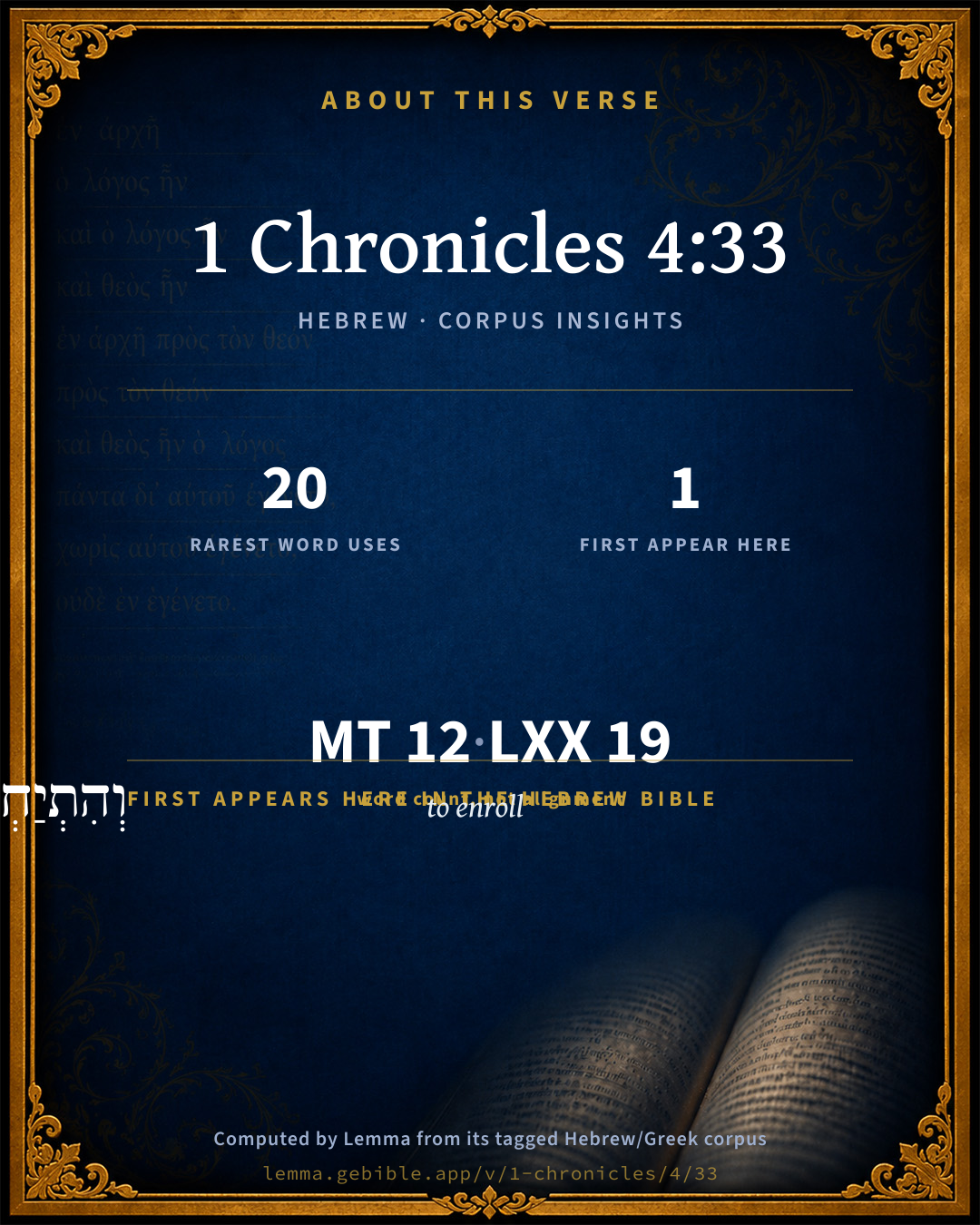
The rarest word here is וְהִתְיַחְשָׂ֖ם to enroll H3187 — appearing just 20 times in the whole Hebrew Bible.

First appearance in Scripture

This word makes its first canonical appearance in the Hebrew Bible here:

  • וְהִתְיַחְשָׂ֖ם to enroll H3187

Shared distinctive vocabulary

וְהִתְיַחְשָׂ֖ם to enroll H3187 occurs in 20 verses of the Hebrew Bible. Also found in:

Grammatical profile

  • 1 verb
  • 6 nouns
  • 2 pronouns
  • 2 prepositions
  • 1 particle

Verb forms

  • וְהִתְיַחְשָׂ֖ם Hithpael · Infinitive Construct

Hebrew & Septuagint length

In English translation the verse runs 22 words from the Hebrew and 20 from the Septuagint (LXX English) — closely comparable.

A rough comparison of the two English renderings, which tokenize alike — not a word-level alignment.

Word counts can differ between the Hebrew and the Greek without any difference in meaning — e.g. the Hebrew direct-object marker אֵת has no separate Greek word, and Greek often adds the article ὁ.

In the original languages it is 12 Hebrew tokens and 19 Greek tokens — but the two are counted differently (Hebrew bundles its prefixes and suffixes into one token; the Greek is in lemma form), so that isn’t a like-for-like length.

Cross-references

1

Topical passages linked to 1 Chronicles 4:33 in the Treasury of Scripture Knowledge — connected by theme and wording, ordered by reader-vote popularity; previews shown in the World English Bible.

  • Joshua 19:8 and all the villages that were round about these cities to Baalath Beer, Ramah of the South. This is the inheritance of the tribe of the children of Simeon according to their families.

Cross-references courtesy of OpenBible.info (CC BY 4.0).

Hebrew and Greek witnesses Masoretic Hebrew ↔ Greek Septuagint

The same verse in the two great witnesses to the Old Testament, shown verse-for-verse.

These are two independent witnesses, not word-aligned to each other, and the Septuagint is shown in lemma (dictionary) form.

Hebrew 1 Chronicles 4:33 Masoretic · Westminster Leningrad Codex

וְכָל חַצְרֵיהֶ֗ם אֲשֶׁ֧ר סְבִיב֛וֹת הֶעָרִ֥ים הָאֵ֖לֶּה עַד בָּ֑עַל זֹ֚את מוֹשְׁבֹתָ֔ם וְהִתְיַחְשָׂ֖ם לָהֶֽם

and all their villages that were round about the same cities, to Baal. These were their habitations, and they have their genealogy.

World English Bible · Public Domain

Greek LXX 1 Chronicles 4:33 Septuagint · lemma form

καί πᾶς ὁ ἔπαυλις αὐτός κύκλος ὁ πόλις οὗτος ἕως βααλ οὗτος ὁ κατάσχεσις αὐτός καί ὁ καταλοχισμός αὐτός

And all their villages were round about these cities, as far as Baal: this was their possession, and their distribution.

LXX2012 (modern English Septuagint) · Public Domain

On this verse, Haydock's Catholic Bible Commentary discusses the Septuagint’s reading. Read the note in Commentary ↓

Hebrew: Westminster Leningrad Codex (CC BY 4.0). Greek: Septuagint (public domain); English from LXX2012 (modern English Septuagint) (Public Domain). How the Septuagint differs from the Hebrew →

Commentary

Notes on 1 Chronicles 4:33 from classic Christian and Jewish commentators (each source and its license shown beneath its notes). The classic Christian expositions comment on the surrounding passage and are grouped to its opening verse, so a note may address several verses; the Jewish commentaries on the Tanakh (Rashi and others) are per-verse, so they appear only where the commentator wrote on this verse.

Lemma curates 59 commentaries, every one of them public domain or Creative Commons licensed, each selected and text-cleaned for this edition rather than reprinted as found. About our sources →

Ellicott's Commentary for English Readers

(33) Unto Baal.—Called in Jos_19:8 Baalathbeer (“lady of the well”). The same passage adds what appears to be the name of this group of villages, viz., Ramath-negeb, or Ramah of the southland. (Comp. 1Sa_30:27.)

These (Heb., this) were their habitations.—A conclusion of the list of towns of Simeon.

And their genealogy.—Heb., and they had their own registration (or, enrolment); that is, though their settlements lay within the territory of Judah, their clans were registered as belonging to a distinct tribe.

A Bible Commentary for English Readers, edited by Charles John Ellicott (1878–1897) — public domain. Text from a community e-Sword module.

The Cambridge Bible for Schools and Colleges

gen. ed. J. J. S. Perowne

33. unto Baal] Baal (“lord”) standing by itself is an unlikely name for a town; the parallel passage. Jos_19:8, reads Baalath-beer, Ramah of the South (“the mistress of the well, the high place of the South”), a better reading.

The Cambridge Bible for Schools and Colleges (gen. ed. J. J. S. Perowne; Cambridge University Press, 1878–1918) — public domain. Text from a community e-Sword module.

John Gill's Exposition

These mentioned by their names were princes in their families,.... The principal men of them, heads of their fathers' houses:

and the house of their fathers increased greatly; by them, so that they were obliged to seek out for new habitations, as follows.

John Gill's Exposition of the Whole Bible (1746–1763) — public domain (CC PDM 1.0). Text via the HelloAO Bible API.

Albert Barnes' Notes on the Bible

And their genealogy - Rather, “and their register was according thereto” - they were registered, i. e. according to the places where they dwelt.

Albert Barnes' Notes on the Bible (1834–1885) — public domain. Text from a community e-Sword/MySword module.

Haydock's Catholic Bible Commentary

Baal, or Ballath, Josue xix. 1. --- Distribution. Hebrew and Septuagint, "and their genealogy." (Menochius) --- Greek: Katalogismos, may as well have the former signification, "their class;" (Haydock) though the sequel seems to determine it in the latter sense. (Du Hamel)

George Leo Haydock (1774–1849), Haydock's Catholic Family Bible and Commentary, 1859 edition — public domain. Excludes Psalms (Douay-Rheims chapter numbering differs from Protestant) and Deuterocanonical books (Catholic canon only).

The Pulpit Commentary

Dwellings and genealogies.

In many instances the chronicler records not only the names of the families of Israel, but the places where they were settled in fixed habitations. When the land of Canaan was conquered, it was parcelled out among the several tribes. In this way family relationships and sentiment were closely connected with territorial possession. Even certain households were attached to estates and villages. And as the Hebrews were an agricultural and pastoral people, it was natural that they should cherish a hereditary regard for the lands tilled by their fathers. The sons of Simeon transmitted to their posterity certain cities and. villages. "These were their habitations, and their genealogy.

I A LOCAL HABITATION IS DIVINELY APPOINTED AND SANCTIONED. There are many who, as travellers and explorers, as soldiers and seamen, etc., may serve society without having any fixed abode; and homelessness may be profitable discipline in youth. But, generally speaking, a home is the best sphere of labour, the best pledge of diligence, the best guarantee of responsibility; and it is well for those who, from generation to generation, can retain the same feelings towards an ancestral abode.

II FAMILY REGISTERS AND PEDIGREES, IN CONNECTION WITH SUCH DWELLING-PLACES, ARE OF UNDOUBTED SERVICE. The public census, the domestic register, the family tree, the civil and ecclesiastical registration of births, deaths, and marriages, are all valuable. They may be abused by pride, but they are more likely to foster humiliation. They are useful for civil purposes, contributive to family feeling, pro-motive of patriotism. The squire, the yeoman, the labourer, are all susceptible to the influence of hereditary feeling and local associations.

III RELIGION DEALS WITH HOMES AND HOUSEHOLDS. Certain places and certain families have been noticeable and memorable for piety. And true religion is not content to deal with the individual; it seeks to leaven families with its influence, and to penetrate villages, cities, and nations with its light and spiritual power and grace. T.

The Pulpit Commentary (1880–1919), ed. H.D.M. Spence-Jones & Joseph S. Exell — public domain. Text from a community e-Sword module.

Keil & Delitzsch

C. F. Keil & F. Delitzsch

These mentioned by their names were princes in their families,.... The principal men of them, heads of their fathers' houses:

and the house of their fathers increased greatly; by them, so that they were obliged to seek out for new habitations, as follows.

Keil & Delitzsch — Biblical Commentary on the Old Testament (1861–1891) — public domain (CC PDM 1.0). Text via the HelloAO Bible API. (Old Testament only.)

Rashi

Rabbi Shlomo Yitzchaki (Rashi)

this was [the account of] their settlements, and they had their genealogical record The meaning is that although he traced part of their lineage here, do not say that there were only those, for there is another genealogical record in which the genealogy of every tribe appears. So it was, i.e. [this record] delineated the genealogy [of each tribe] by itself.

Rashi on the Tanakh — English translations: “The Judaica Press complete Tanach with Rashi, translated by A. J. Rosenberg” (CC BY 4.0); “Pentateuch with Rashi's commentary by M. Rosenbaum and A.M. Silbermann, 1929-1934” (public domain); “The Metsudah Tanach series, Lakewood, N.J” (CC BY 4.0); and “The Book of Joshua, Metsudah Publications, 1997” (CC BY 4.0). Text via Sefaria.

Lesson kit

Teaching starters — assembled from the data on this page, not authored interpretation. Every prompt links to the verse data it draws on. Edit before teaching.

1 Chronicles, in the Historical, opens this verse with 12 words (11 distinct Hebrew lemmas). Its most distinctive word is yâchas (“to enroll”). A historical commentator’s framing appears above. Read the whole chapter for the surrounding context.

Discussion questions

  1. How does “to enroll” (yâchas) shape what this verse is saying?
  2. This is the first place “to enroll” appears in Scripture (first appears here). What does its debut here establish?
  3. How does 1 Chronicles 5:1, which shares the word «to enroll», read alongside this verse?
  4. These translations render this verse differently; the difference is in the English rendering, not the original. What questions does that raise?
  5. «וְהִתְיַחְשָׂ֖ם» is a Hithpael Infinitive Construct verb. How does that grammatical form shape the action described?
  6. Compare how Ellicott's Commentary for English Readers and The Cambridge Bible for Schools and Colleges read this verse. Where do they agree or differ?

Things to notice

Reading settings

Reading text

Shown beneath each verse's original-language words.

Old Testament
Old Testament edition

Read the OT as the Masoretic Hebrew (MT) or the Greek Septuagint (LXX).

English shown for the Greek Septuagint (in the Hebrew ↔ Greek comparison).

Comparing translations? Open the Compare panel on any verse page to stack up to four side by side.