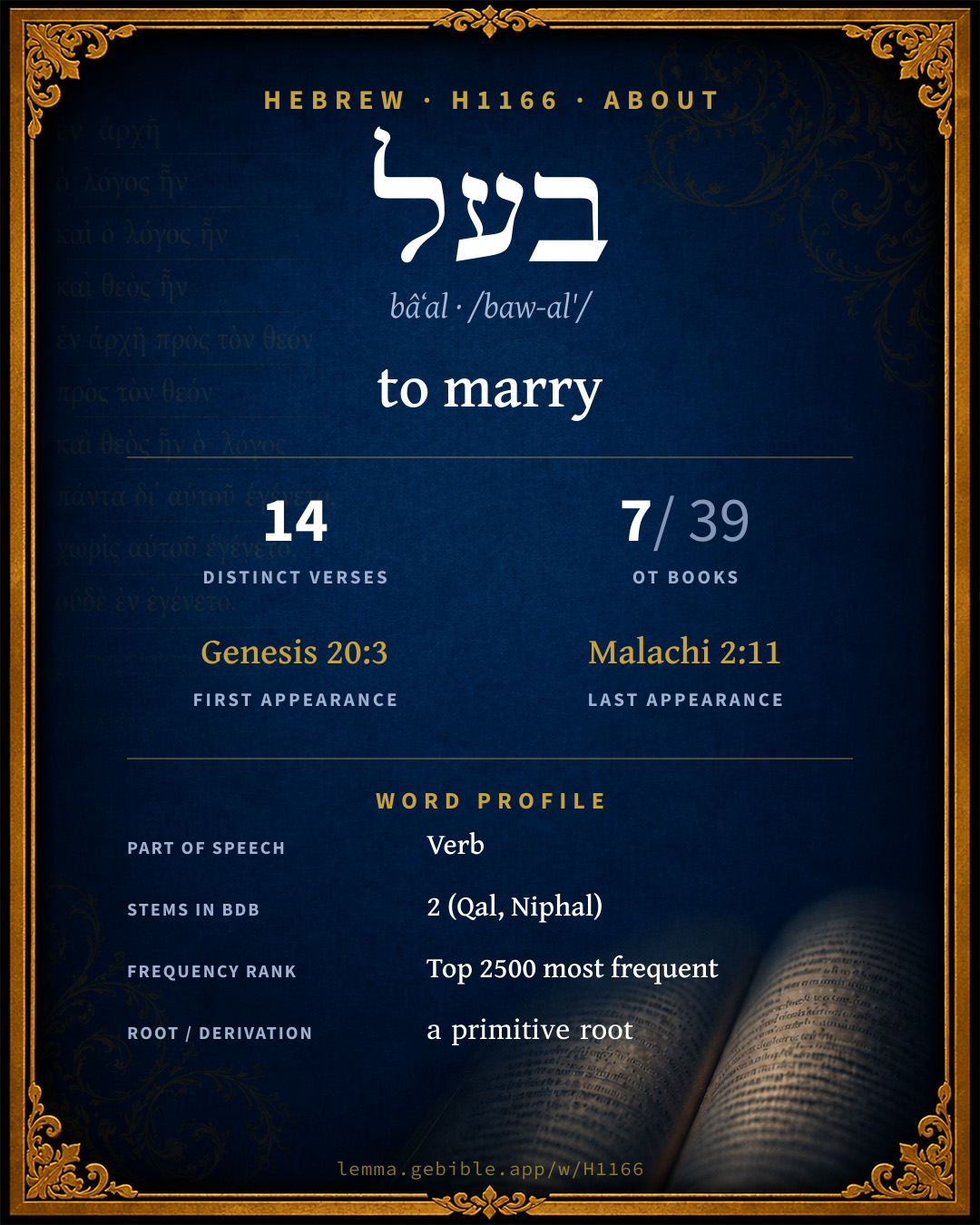
בָּעַל
to marry
also: rule over, possess, own fuller range ↓
Full lexicon entry — Brown-Driver-Briggs (BDB)
From Brown-Driver-Briggs (BDB)
Where this word appears
See every Qal verb in the Hebrew Bible →
Grammar key — what these labels mean
Part of speech
- Verb
- An action or state-of-being word.
Stem
- Niphal
- Usually the simple passive or reflexive of the Qal (“he was written”).
- Qal
- The basic, simple active stem — the plain form of the verb (“he wrote”). Here: ‘marry Gn 20’
Form
- Imperfect
- An incomplete, ongoing, or future action (“he will / would write”).
- Perfect
- A completed action or state — Hebrew marks aspect (completeness) more than strict tense (“he wrote”).
- Participle Passive
- A verbal adjective expressing action received (“written”).
- Sequential Perfect
- A perfect with prefixed waw continuing a preceding imperfect or command (waw-consecutive perfect).
- Participle Active
- A verbal adjective expressing ongoing or characteristic action (“writing / one who writes”).
State
- Absolute
- The independent form of a noun, not bound to a following word.
- Construct
- A noun bound to a following noun in a possessive / “of” relationship (the construct chain).
Person
- 3rd Person
- The one spoken about (“he / she / it / they”).
- 1st Person
- The speaker (“I / we”).
- 2nd Person
- The one addressed (“you”).
Gender
- Feminine
- Grammatically feminine.
- Common
- Either gender — not distinguished for this form.
- Masculine
- Grammatically masculine.
Number
- Singular
- One.
- Plural
- More than one (in Hebrew, generally three or more).
Grammatical forms 11 distinct
- Verb, Niphal, Imperfect, 3rd Person, Feminine, Singular 2 times (13%)
- Verb, Qal, Perfect, 1st Person, Common, Singular 2 times (13%)
- Verb, Qal, Participle Passive, Feminine, Singular, Absolute 2 times (13%)
- Verb, Qal, Participle Passive, Feminine, Singular, Construct 2 times (13%)
- Verb, Qal, Perfect, 3rd Person, Common, Plural 2 times (13%)
- Verb, Qal, Perfect, 3rd Person, Masculine, Singular 1 time (6%)
- Verb, Qal, Sequential Perfect, 2nd Person, Masculine, Singular 1 time (6%)
- Verb, Qal, Sequential Perfect, 3rd Person, Masculine, Singular 1 time (6%)
+3 more forms (3 occurrences)
Parsed forms decoded from the imported morphology (morphhb / Westminster Leningrad Codex — WLC text public domain, morphhb tagging CC BY 4.0), counted across 16 parsed occurrences — not distinct verses.
Every verse where H1166 appears — 14 distinct verses across 7 books. Click any verse to open its interlinear word-by-word view. Verse text shown in the World English Bible for context — . Each verse’s Hebrew form is shown with its reference; the English is not keyword-highlighted, since the data carries no word-level English alignment. Use “Compare translations” on any verse to read it across multiple English versions. This concordance covers the Hebrew Bible; Septuagint (Greek Old Testament) occurrences are not indexed here.
Genesis 1 verse
Deuteronomy 3 verses
- Deuteronomy 21:13 וּ/בְעַלְתָּ֔/הּ conj + Qal wpf 2ms + sfx pers 3fs and she shall put the clothing of her captivity from off her, and shall remain in your house, and bewail her father and her mother a full month: and after that you shall go in to her, and be her husband, and she shall be your wife.
- Deuteronomy 22:22 בְעֻֽלַת Qal ptcp.pass fs cs If a man be found lying with a woman married to a husband, then they shall both of them die, the man who lay with the woman, and the woman: so shall you put away the evil from Israel.
- Deuteronomy 24:1 וּ/בְעָלָ֑/הּ conj + Qal wpf 3ms + sfx pers 3fs When a man takes a wife, and marries her, then it shall be, if she find no favor in his eyes, because he has found some unseemly thing in her, that he shall write her a bill of divorce, and give it in her hand, and send her out of his house.
1 Chronicles 1 verse
Proverbs 1 verse
Isaiah 5 verses
- Isaiah 26:13 בְּעָל֥וּ/נוּ Qal pf 3cp + sfx pers 1cp Yahweh our God, other lords besides you have had dominion over us; but by you only will we make mention of your name.
- Isaiah 54:1 בְעוּלָ֖ה Qal ptcp.pass fs Sing, barren, you who didn't bear; break forth into singing, and cry aloud, you who did not travail with child: for more are the children of the desolate than the children of the married wife, says Yahweh.
- Isaiah 54:5 בֹעֲלַ֨יִ/ךְ֙ Qal ptcp.act mp cs + sfx pers 2fs For your Maker is your husband; Yahweh of Hosts is his name: and the Holy One of Israel is your Redeemer; the God of the whole earth shall he be called.
- Isaiah 62:4 בְּעוּלָ֑ה תִּבָּעֵֽל Qal ptcp.pass fs Niphal impf 3fs You shall no more be termed Forsaken; neither shall your land any more be termed Desolate: but you shall be called Hephzibah, and your land Beulah; for Yahweh delights in you, and your land shall be married.
- Isaiah 62:5 יִבְעַ֤ל יִבְעָל֖וּ/ךְ Qal impf 3ms Qal impf 3mp + sfx pers 2fs For as a young man marries a virgin, so shall your sons marry you; and as the bridegroom rejoices over the bride, so shall your God rejoice over you.
Jeremiah 2 verses
- Jeremiah 3:14 בָּעַ֣לְתִּי Qal pf 1cs Return, backsliding children, says Yahweh; for I am a husband to you: and I will take you one of a city, and two of a family, and I will bring you to Zion:
- Jeremiah 31:32 בָּעַ֥לְתִּי Qal pf 1cs not according to the covenant that I made with their fathers in the day that I took them by the hand to bring them out of the land of Egypt; which my covenant they broke, although I was a husband to them, says Yahweh.
Malachi 1 verse
About this entry
At a glance — auto-summarized from this page’s data, not written by a person. Every figure links to its source below. This summary describes the numbers; it doesn’t interpret them.
The Hebrew verb בעל centers on the idea of “to marry.” Its earliest occurrence is Genesis 20:3. It turns up in 14 verses across 7 books, an uncommon footprint. The word gravitates to Isaiah (36%), then Deuteronomy and Jeremiah. Across 2 stems, its meaning turns on the binyan (Qal, Niphal). For the data behind this summary, explore the sense tree and the renderings breakdown below.
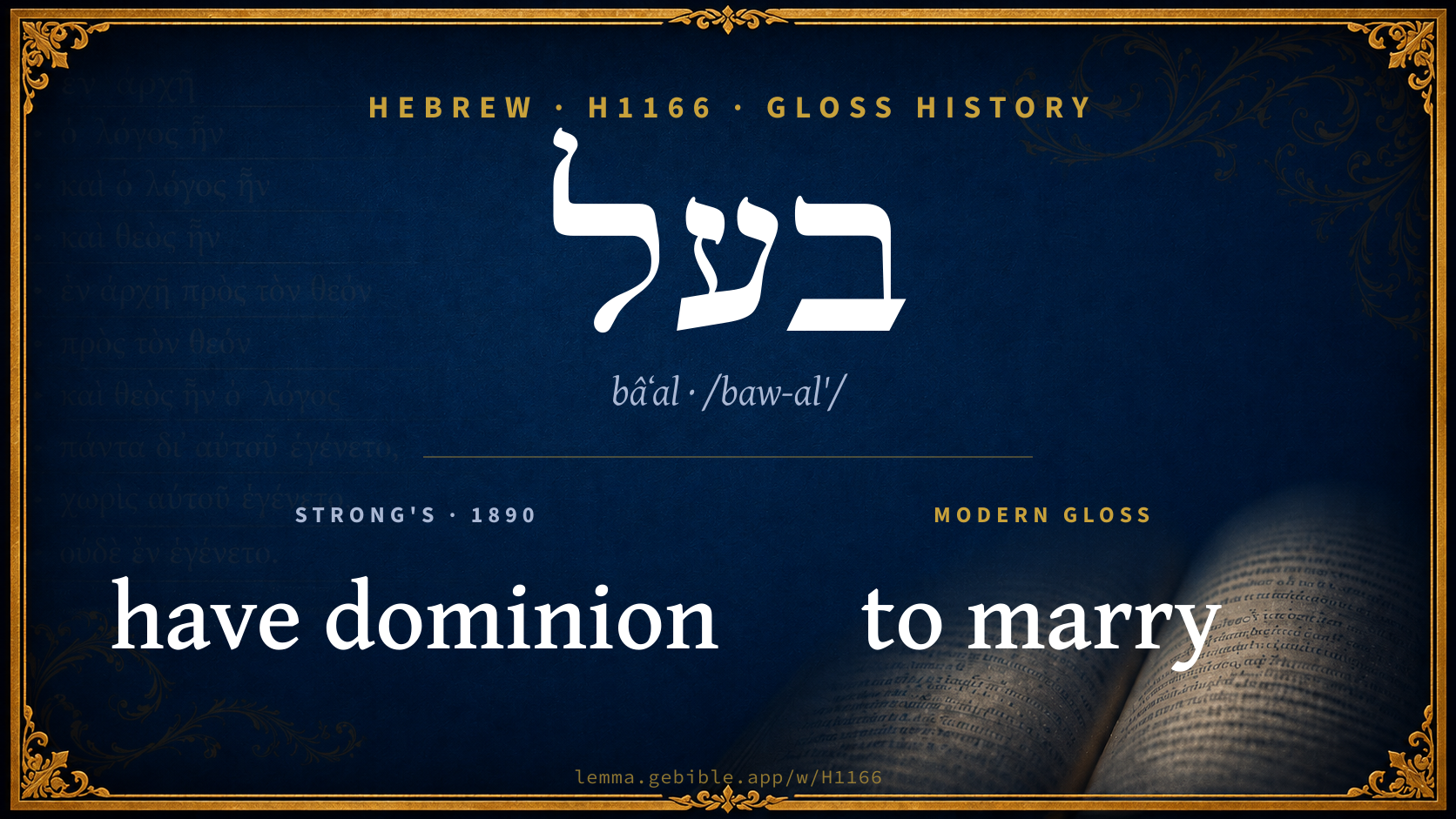
Gloss history
Strong's 1890 vs modern scholarship
About this word
Strong's H1166 catalogs a Hebrew word from the Hebrew Old Testament.
These counts are not copied from any lexicon or concordance. They are computed here, from the morphology-tagged Hebrew Old Testament. What Lemma adds →
- 14
- distinct verses
- The word appears in 14 distinct verses.
- 7 / 39
- OT books
- The word appears in 7 of 39 Old Testament books.
- #1,752
- by frequency
- Top 2500 most frequent Hebrew words (rank 1,752 of 8,640 Hebrew words by occurrence).
View all 14 occurrences in the concordance →
Most concentrated in
- Isaiah 5 verses 36%
- Deuteronomy 3 verses 21%
- Jeremiah 2 verses 14%
By section of the Old Testament
By traditional corpus
Conventional, traditional groupings — biblical authorship is debated, so this is a traditional corpus grouping, not an authorship claim. Each share is this word’s portion of its verses in that division of the Hebrew canon. Each figure is a share of the word’s 14 distinct verses.
- Prophets (Nevi'im) 8 verses · 57%
- Torah (Pentateuch) 4 verses · 29%
- Writings (Ketuvim) 2 verses · 14%
How translations render this word
Counts come from each version’s own published word-to-Strong’s tagging or interlinear alignment — an approximate guide to how each version renders this word, not a word-level alignment the data otherwise carries. Because each total is that version’s own tagged count, the per-version totals vary from one another and need not match the appearance or distinct-verse counts above. These counts may also differ from a printed concordance because Lemma counts each distinctly tagged rendering and does not collapse phrase taggings into a single head-word total. This is a fixed set of word-tagged versions (KJV, ASV, BSB, ULT) and does not change with the reading translation you choose elsewhere. Each version’s license is shown beside its name below (and on Sources).
- King James Version: Married 2×
- American Standard Version: Marrieth 2×
- Berean Standard Bible: Marries 3×
- unfoldingWord Literal Text: Married 3×, Husband 2×
King James Version Public Domain
Renders H1166 across 16 tagged occurrences — most commonly:
Plus 14 renderings that appear only once — usually multi-word phrases or single function words the recovered tagging swept in, not distinct renderings.
American Standard Version Public Domain
Renders H1166 across 16 tagged occurrences — most commonly:
Plus 14 renderings that appear only once — usually multi-word phrases or single function words the recovered tagging swept in, not distinct renderings.
Berean Standard Bible Public Domain
Renders H1166 across 15 tagged occurrences — most commonly:
Plus 12 renderings that appear only once — usually multi-word phrases or single function words the recovered tagging swept in, not distinct renderings. Not rendered by a distinct English word in 1 further occurrence.
unfoldingWord Literal Text CC BY-SA 4.0
Renders H1166 across 18 tagged occurrences — most commonly:
Plus 13 renderings that appear only once — usually multi-word phrases or single function words the recovered tagging swept in, not distinct renderings.
Senses in the full BDB
Hebrew verbs can shift meaning by stem (binyan): Qal is the basic action, Niphal is often passive or reflexive, Piel often intensifies or makes it factitive, and Hiphil is typically causative. The senses below are grouped under the stem BDB assigns to each.
What do BDB’s symbols mean?
BDB uses these scholarly abbreviations:
| Symbol | Meaning |
|---|---|
| 𝔊 | the Septuagint (the ancient Greek translation, LXX) |
| 𝔙 | the Vulgate (the Latin translation) |
| 𝔖 | the Syriac version (the Peshitta) |
| 𝔗 | the Targum (the Aramaic translation) |
| ψ | the Psalms |
| √ | root (the underlying root or stem) |
| ‖ | parallel passage (a synonymous or contrasted parallel) |
| † | the dagger: every passage where the word occurs is cited |
The 4 senses and sub-senses the full Brown-Driver-Briggs lexicon distinguishes for this word, in lexicon order (not ranked by frequency), with BDB’s own verbatim wording and sub-sense lettering. Shown in Hebrew script with BDB’s own scholarly abbreviations. The condensed entry is in the Lexicon Entry tab. See also the Forms in the corpus table below.
Qal
- Pf. Mal 2:11 + 6 times Impf. יִבְעַל Is 62:5(×2); Pt. sf. בֹּעֲלַיִךְ Is 54:5; pass. f. בְּעוּלָה Is 54:1 + 3 times;— e.g. Malachi 2:11
- 1. marry Gn 20:3 (E) Dt 21:13; 22:22; 24:1 Is 54:1, 5; 62:4, 5(×2) Mal 2:11; sq. בְּ Je 3:14; 31:32 be lord (husband) over. Je 3:14; 31:32 AW JosKi Thes, comparing Arabic بَعَلَ be disgusted, derive from II. בָּעַל loathe (sq. בְּ); so Buhl: Gie Du Co in 31:32 read גָּעַלְתִּי (treating 3:14 as I. בָּעַל). e.g. Genesis 20:3
- 2. rule over 1 Ch 4:22 (sq. לְ) Is 26:13. e.g. 1 Chronicles 4:22
Niphal
- Impf. תִּבָּעֵל Pr 30:23 Is 62:4 be married. e.g. Proverbs 30:23
Senses from the full Brown-Driver-Briggs lexicon (Brown, Driver, Briggs; Oxford 1906 — public domain), digitized via Sefaria, supplemented by the OpenScriptures HebrewLexicon (CC BY 4.0). Full attribution on Sources.
Word origin
vb. marry, rule over (cf. Arabic بَعَلَ = own, possess, especially a wife or concubine; Ethiopic ብዕለ to be rich, Assyrian bâlu, rule COTGloss., Aramaic בְּעַל take possession of wife or concubine)—
— Brown-Driver-Briggs (Oxford 1906, public domain), digitized via Sefaria, supplemented by the OpenScriptures HebrewLexicon (CC BY 4.0). See Sources.
Origin: a primitive root
Jastrow Dictionary
A second Hebrew/Aramaic lexicon for comparison, covering Aramaic and post-biblical (Talmudic, Targumic, Midrashic) usage that the biblical-Hebrew BDB does not. Matched by lemma rather than by Strong’s number, so a lemma may carry more than one Jastrow headword (shown separately below), and the entries cover usage well beyond the Bible.
בָּעַל
- , v. בָּעָה, to enter into, take possession) [in b. h. to be master, protect;] to have sexual intercourse (both legal or illicit), to embrace a woman. Kidd. 9ᵇ וּבְעָלָהּ מלמד וכ׳ ‘and he embraced her’ (Deut. XXIV, 1), this intimates that woman can be acquired as wife by intercourse, v. בִּיאָה.—בּוֹעֵל lover, adulterer, contrad. to בַּעַל husband. Sot. V, 1, a. fr. כשם שאסורה לַבַּעַל … לַבּוֹעֵל as well as the woman suspected of adultery is forbidden to her husband (who must separate himself from her), so is she forbidden to the lover (who cannot marry her after leaving her husband). Yeb. 103ᵃ שבע בעילות ב׳ וכ׳ that wicked man had seven sexual connections &c.; a. fr.—Part. pass. f. בְּעוּלָה one no longer a virgin, opp. to בתולה; married woman, opp. to ארוסה, v. אָרַס. Keth. 10ᵇ; a. fr.—Pl. בְּעוּלוֹת. Y. Kidd. I, 58ᵇ bot.; a. fr. e.g. Deuteronomy 24:1
- she had intercourse. Keth. 5ᵃ נישאת … ונִבְעֶלֶת וכ׳ is married on the fourth day and embraced in the night of the fifth day of the week. Ib. 3ᵇ תִּיבָּעֵל לטפסר וכ׳ must first be surrendered to the (Roman) officer (jus primæ noctis); a. fr.—Masc. נִבְעַל (of the hermaphrodite). Tosef. Bicc. II, 5; Y. Yeb. VIII, 9ᵈ bot.
בְּעַל
- Targ. O. Deut. XXI, 13; a. fr.—Keth. 6ᵇ דבעי למִיבְעַל because he is anxious to perform his marital duty. Ib. דטריד דלא בעיל he is excited because he has not &c.; a. fr.
- , part. pass. f. מְבַעֲלָא married, having had intercourse. Targ. Ruth I, 12; a. e.
- as preced. Nif. Yoma 19ᵇ ואִבְּעוּל כמה וכ׳, (Ms. M. ואיבעיל) and how many virgins have been seduced (to-day) in Nahardea!
בַּעַל
- preced.)
- 1. husband. Kidd. I, 1 and she becomes her own master בגט ובמיתת הב׳ through a letter of divorce or on the husband’s death; a. v. fr.
- 2. the idol Baal. Y. Ab. Zar. III, 43ᵃ bot. ב׳ ראש גוייה הוה וכ׳ the Baal was the phallus and had the shape of a bean [read וכאפון].
- 3. [the fructifier,] rain (v. Taan. 6ᵇ; cmp. Is. LV, 10). בֵּית בַּ׳ a field sufficiently watered by rain and requiring no artificial irrigation. Tosef. M. Kat. I, 1 שדה (בית) הב׳. B. Bath. III, 1. Tosef. Succ. II, 7 ערבה של ב׳ (sub. בית) a willow in a naturally watered field. Ib. Shebi. II, 4 בשל ב׳ (= בשדה של ב׳), opp. של שוקי. Num. R. s. 16 the Egyptian gods של שקר הם (read שקי) are gods of artificial drainage, but those of Canaan של ב׳ הם are gods of rain; (Tanḥ. Sh’laḥ 13, through misunderstanding, שקר … בעליכח. e.g. Isaiah 55:10
- 4. (mostly in compounds) owner of, master of, possessed of, given to &c.; e.g. ב׳ אבידה owner of a lost object; ב׳ אגדה master of Agadah, lecturer; ב׳ דין opponent in court; v. infra. Pes. 86ᵇ ב׳ השם אני I am so named.—Pl. בְּעָלִים, בְּעָלִין owners; mostly as sing. owner. B. Mets. VIII, 1; a. fr. [Y. Dem. III, 23ᵇ bot. לבלעין, read לבעלין.]
- He who knows man’s thoughts. Snh. 19ᵇ.—Ib. בעלי מ׳ those entertaining considerations (of fear), hesitating to do justice.—ב׳ שיבה gray-haired. Ned. III, 8.—ב׳ תשובה repentant sinner. Succ. 53ᵃ; a. fr.—ב׳ תשובות a man of many objections or excuses. Gen. R. s. 20 beg.—[For other compounds, not self-evident, see the respective determinants.]
עֹל
- , v. עוֹל
A Dictionary of the Targumim, the Talmud Babli and Yerushalmi, and the Midrashic Literature (Marcus Jastrow; London, Luzac, 1903) — Public Domain. Digitized via Sefaria. Digitized via Sefaria. Full attribution on Sources.
Forms in the corpus
The 16 distinct written forms H1166 takes in the Hebrew Bible, most frequent first — each parse links to that stem’s occurrences in the concordance. Hebrew forms include their vowel points and cantillation, so a single lemma takes many written forms.
Same root — word family
Other BDB entries built from the same root as H1166, grouped by Strong’s listed origin. These share a root / origin per the lexicon — not necessarily a shared meaning. Each links to that word’s own entry.
Derived from this word
Compare all same-root words → They share a root, not necessarily a meaning.
Septuagint verse parallels
This word appears in 14 verses that also exist in the Greek Old Testament (Septuagint), out of the 14 Hebrew verses it occurs in. You can read those verses in Greek by switching the Old Testament edition to the Septuagint.
Read these verses in the Septuagint
- Genesis 20:3
- Deuteronomy 21:13
- 1 Chronicles 4:22
- Proverbs 30:23
- Isaiah 26:13
- Jeremiah 3:14
- Malachi 2:11
This is a verse-level parallel only — the same verses exist in both the Hebrew and Greek Old Testaments. No word-level Hebrew↔Greek correspondence is claimed: the data carries no such alignment, so no Greek word is shown as this Hebrew word’s translation. Coverage is not total — the Septuagint omits the deuterocanon and renumbers the Psalms, so some Hebrew verses have no direct Greek parallel.