1 Samuel 23:12

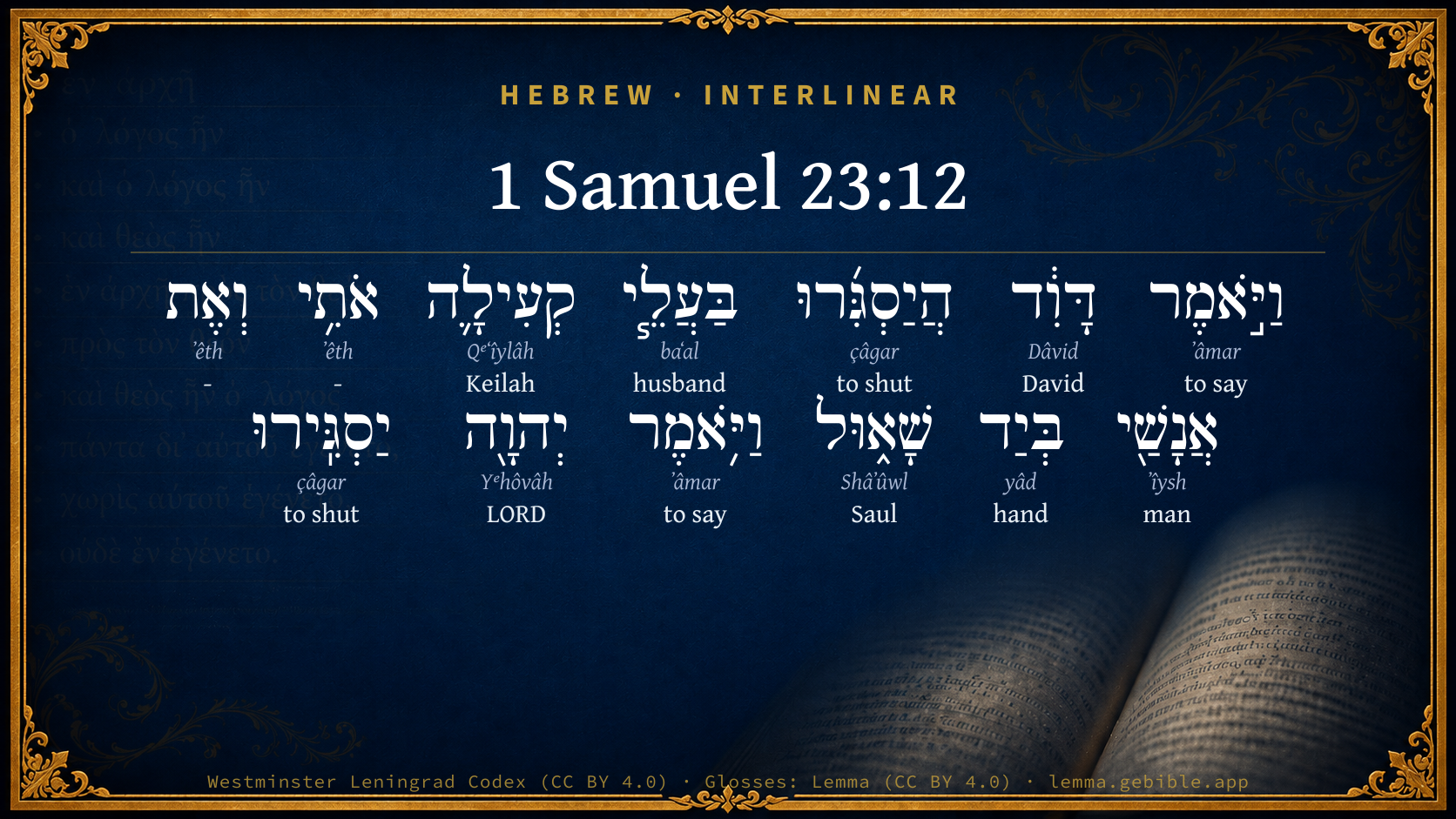
Hebrew (Westminster Leningrad Codex) 1 Samuel 23:12 appears in the Hebrew Old Testament. The text above is from the Westminster Leningrad Codex. Each word links to its Strong’s number, a concise gloss, and parsing drawn from the Open Scriptures Hebrew Bible morphology. Click any word for its full Brown-Driver-Briggs (BDB) entry.
Download image
Cite this verse

1 Samuel 23:12 (World English Bible). Public Domain. Lemma interlinear Bible study tool, https://lemma.gebible.app/v/1-samuel/23/12.

Show BibTeX & RIS
BibTeX
RIS
English Translation
Then said David, Will the men of Keilah deliver up to me and my men into the hand of Saul? Yahweh said, They will deliver you up.
World English Bible · Public Domain
Download a study sheet

One document with this verse’s original text, its word-by-word gloss line, the meaning frame, cross-references with their text, attributed commentary, and full source and license credits — printable, and it pastes into notes with its structure intact.

This verse Autodidact and up

Study sheet (.html) Plain text (.txt)

A passage Seminary Student

Up to 50 verses in one chapter. A passage sheet keeps up to 6 commentary sources and 12 cross-references per verse, in the order this page ranks them, and says so on the sheet whenever that leaves anything out. Ask for a single verse and you get the Autodidact verse sheet above.

Everything on this page stays free to read, with no account — the sheet is a download of what is already on screen, not access to it.

Want to remove ads? Support Godless Engineer
Compare translations 3

The same verse in 3 English versions, stacked beneath the original-language interlinear above. Click any original word for its lexicon entry.

Each is an independent rendering of the whole verse — the interlinear is not word-aligned to these translations.

Highlighted words mark where these versions differ — a whole-verse word diff, not a word-by-word alignment.

  • World English Bible Public Domain
    Then said David, Will the men of Keilah deliver up to me and my men into the hand of Saul? Yahweh said, They will deliver you up.
  • King James Version Public Domain
    Then said David, Will the men of Keilah deliver me and my men into the hand of Saul? And the LORD said, They will deliver thee up.
  • unfoldingWord Literal Text CC BY-SA 4.0
    And David said, “Will the lords of Keilah enclose me and my men in the hand of Saul?” And Yahweh said, “They will enclose.”

unfoldingWord Literal Text — © unfoldingWord, licensed CC BY-SA 4.0. Word-aligned USFM3 via Door43 (git.door43.org/unfoldingWord/en_ult).

Versions to compare (up to 4)

3 of 4 selected

Show all 18 translations

Every available English version of this verse, each an independent rendering of the whole verse.

  • World English Bible Public Domain
    Then said David, Will the men of Keilah deliver up to me and my men into the hand of Saul? Yahweh said, They will deliver you up.
  • Berean Standard Bible Public Domain
    So David asked, “Will the citizens of Keilah surrender me and my men into the hand of Saul?” “They will,” said the LORD.
  • Majority Standard Bible Public Domain
    So David asked, “Will the citizens of Keilah surrender me and my men into the hand of Saul?” “They will,” said the LORD.
  • King James Version Public Domain
    Then said David, Will the men of Keilah deliver me and my men into the hand of Saul? And the LORD said, They will deliver thee up.
  • American Standard Version (1901) Public Domain
    Then said David, Will the men of Keilah deliver up to me and my men into the hand of Saul? And Jehovah said, They will deliver thee up.
  • Revised Version (1885) Public Domain
    Then said David, Will the men of Keilah deliver up me and my men into the hand of Saul? And the LORD said, They will deliver thee up.
  • Geneva Bible (1599) Public Domain
    Then said Dauid, Will the lords of Keilah deliuer me vp, and the men that are with me, into the hand of Saul? And the Lord sayde, They will deliuer thee vp.
  • Douay-Rheims (1899) Public Domain
    And David said: Will the men of Ceila deliver me, and my men, into the hands of Saul? And the Lord said: They will deliver thee up.
  • Young's Literal Translation Public Domain
    And David saith, `Do the possessors of Keilah shut me up, and my men, into the hand of Saul?' And Jehovah saith, `They shut `thee' up.'
  • Literal Standard Version CC BY-SA 4.0
    And David says, “Do the possessors of Keilah shut up me and my men into the hand of Saul?” And YHWH says, “They shut [you] up.”
  • Unlocked Literal Bible CC BY-SA 4.0
    Then David said, “Will the men of Keilah surrender me and my men into the hand of Saul?” Yahweh said, “They will surrender you.”
  • unfoldingWord Literal Text CC BY-SA 4.0
    And David said, “Will the lords of Keilah enclose me and my men in the hand of Saul?” And Yahweh said, “They will enclose.”
  • Darby Bible Public Domain
    And David said, Will the citizens of Keilah deliver up me and my men into the hand of Saul? And Jehovah said, They will deliver [thee] up.
  • World Messianic Bible Public Domain
    Then David said, “Will the men of Keilah deliver me and my men into the hand of Saul?” The LORD said, “They will deliver you up.”
  • Webster's Bible Public Domain
    Then said David, Will the men of Keilah deliver me and my men into the hand of Saul? And the LORD said, They will deliver thee up.
  • Free Bible Version CC BY-SA 4.0
    “And will the town leaders of Keilah hand me and my men over to Saul?” David asked. “Yes, they will,” the Lord replied.
  • Bible in Basic English Public Domain
    Then David said, Will the men of Keilah give me and my men up to Saul? and the Lord said, They will give you up.
  • JPS Tanakh (1917) Public Domain
    Then said David: 'Will the men of Keilah deliver up me and my men into the hand of Saul?' And the LORD said: 'They will deliver thee up.'

Literal Standard Version (2020), Covenant Press — licensed CC BY-SA 4.0. Text via the HelloAO Bible API (eBible.org). Unlocked Literal Bible (unfoldingWord) — licensed CC BY-SA 4.0. Text via the HelloAO Bible API (eBible.org). unfoldingWord Literal Text — © unfoldingWord, licensed CC BY-SA 4.0. Word-aligned USFM3 via Door43 (git.door43.org/unfoldingWord/en_ult). Free Bible Version, Dr. Jonathan Gallagher — licensed CC BY-SA 4.0. Text via the HelloAO Bible API (eBible.org).

Word by word

More ways to search: Search by grammar → Find every occurrence → Compare this word →

Practice this passage: Drill this verse → Learn its vocabulary →

קְעִילָ֛ה
Qᵉʻîylâh
H7084
“Keilah”
Noun, Proper
Part of Speech
Noun
Type
Proper
Full BDB Definition

Origin: perhaps from H7049 in the sense of inclosing

TWOT: None

Keilah = "fortress" - a city in the lowlands of Judah northwest of Hebron
  1. וַיֹּ֣אמֶר ʼâmar H559 “and · to say” Conjunction + Verb, Qal, Sequential Imperfect, 3rd Person, Masculine, Singular
  2. דָּוִ֔ד Dâvid H1732 “David” Noun, Proper
  3. הֲיַסְגִּ֜רוּ çâgar H5462 “to shut” Particle, Interrogative + Verb, Hiphil, Imperfect, 3rd Person, Masculine, Plural
  4. בַּעֲלֵ֧י baʻal H1167 “husbands of” Noun, Common, Masculine, Plural, Construct
  5. אֹתִ֥י ʼêth H853 “- · me” Particle, Direct Object + Suffix, Personal, 1st Person, Common, Singular
  6. וְאֶת ʼêth H853 “and · -” Conjunction + Particle, Direct Object
  7. אֲנָשַׁ֖י ʼîysh H376 “men · my” Noun, Common, Masculine, Plural, Construct + Suffix, Personal, 1st Person, Common, Singular
  8. בְּיַד yâd H3027 “in/at · hand of” Preposition + Noun, Common, Both, Singular, Construct
  9. שָׁא֑וּל Shâʼûwl H7586 “Saul” Noun, Proper
  10. וַיֹּ֥אמֶר ʼâmar H559 “and · to say” Conjunction + Verb, Qal, Sequential Imperfect, 3rd Person, Masculine, Singular
  11. יְהוָ֖ה Yᵉhôvâh H3068 “LORD” Noun, Proper
  12. יַסְגִּֽירוּ çâgar H5462 “to shut” Verb, Hiphil, Imperfect, 3rd Person, Masculine, Plural

About this verse

These counts appear in no published source. They are computed here, from the morphology-tagged text and Lemma’s own curated glosses. What Lemma adds →

13
words
10
distinct lemmas
Historical
section

Notable vocabulary

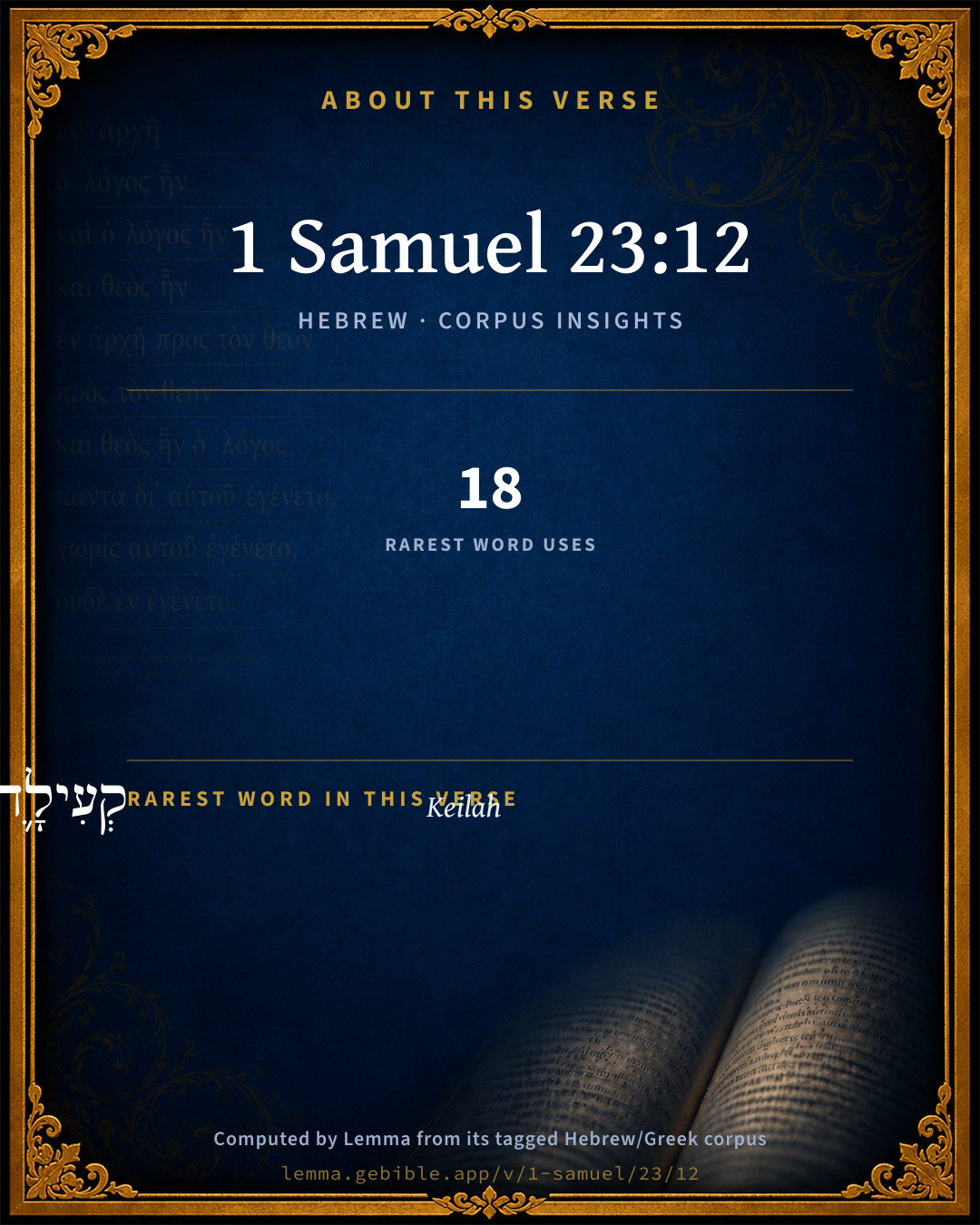
The rarest word here is קְעִילָ֛ה Keilah H7084 — appearing just 18 times in the whole Hebrew Bible.

Shared distinctive vocabulary

קְעִילָ֛ה Keilah H7084 occurs in 16 verses of the Hebrew Bible. Also found in:

Grammatical profile

  • 4 verbs
  • 7 nouns
  • 2 particles

Verb forms

  • וַיֹּ֣אמֶר Qal · Sequential Imperfect
  • הֲיַסְגִּ֜רוּ Hiphil · Imperfect
  • וַיֹּ֥אמֶר Qal · Sequential Imperfect
  • יַסְגִּֽירוּ Hiphil · Imperfect

Repetition

Words recur within this verse — often emphatic in Hebrew:

  • וַיֹּ֣אמֶר to say H559 ×2
  • הֲיַסְגִּ֜רוּ to shut H5462 ×2

Hebrew & Septuagint length

In English translation the verse runs 27 words from the Hebrew and 9 from the Septuagint (LXX English) — the Septuagint runs noticeably shorter here. See the side-by-side →

A rough comparison of the two English renderings, which tokenize alike — not a word-level alignment.

Word counts can differ between the Hebrew and the Greek without any difference in meaning — e.g. the Hebrew direct-object marker אֵת has no separate Greek word, and Greek often adds the article ὁ.

Cross-references

8

Topical passages linked to 1 Samuel 23:12 in the Treasury of Scripture Knowledge — connected by theme and wording, ordered by reader-vote popularity; previews shown in the World English Bible.

  • 1 Samuel 23:20 Now therefore, O king, come down, according to all the desire of your soul to come down; and our part shall be to deliver him up into the king's hand.
  • Psalms 31:8 You have not shut me up into the hand of the enemy. You have set my feet in a large place.
  • Psalms 62:1 My soul rests in God alone. My salvation is from him.
  • 1 Samuel 23:7 It was told Saul that David was come to Keilah. Saul said, God has delivered him into my hand; for he is shut in, by entering into a town that has gates and bars.
  • Psalms 118:8 It is better to take refuge in Yahweh, Than to put confidence in man.
  • Ecclesiastes 9:14–15 There was a little city, and few men within it; and a great king came against it, besieged it, and built great bulwarks against it.
  • Isaiah 29:15 Woe to those who hide deep their counsel from Yahweh, and whose works are in the dark, and who say, Who sees us? and who knows us?
  • Hebrews 4:13 There is no creature that is hidden from his sight, but all things are naked and laid open before the eyes of him with whom we have to do.

Cross-references courtesy of OpenBible.info (CC BY 4.0).

Hebrew and Greek witnesses Masoretic Hebrew ↔ Greek Septuagint

The same verse in the two great witnesses to the Old Testament, shown verse-for-verse.

Here the Septuagint runs noticeably shorter than the Hebrew — LXX2012 (modern English Septuagint) 9 words vs World English Bible 27. A rough length comparison of the two English translations, not a word-level alignment — read both below.

These are two independent witnesses, not word-aligned to each other, and the Septuagint is shown in lemma (dictionary) form.

Hebrew 1 Samuel 23:12 Masoretic · Westminster Leningrad Codex

וַיֹּ֣אמֶר דָּוִ֔ד הֲיַסְגִּ֜רוּ בַּעֲלֵ֧י קְעִילָ֛ה אֹתִ֥י וְאֶת אֲנָשַׁ֖י בְּיַד שָׁא֑וּל וַיֹּ֥אמֶר יְהוָ֖ה יַסְגִּֽירוּ

Then said David, Will the men of Keilah deliver up to me and my men into the hand of Saul? Yahweh said, They will deliver you up.

World English Bible · Public Domain

Greek LXX 1 Samuel 23:12 Septuagint · lemma form
And the Lord said, It will be shut up.

LXX2012 (modern English Septuagint) · Public Domain

Hebrew: Westminster Leningrad Codex (CC BY 4.0). Greek: Septuagint (public domain); English from LXX2012 (modern English Septuagint) (Public Domain). How the Septuagint differs from the Hebrew →

Targum (Aramaic paraphrase)

1

The Targum is the ancient Jewish Aramaic paraphrase of the Hebrew Scriptures — an interpretive translation, not the Hebrew text itself. Onkelos (literal) and Pseudo-Jonathan (expansive) render the Torah, and Jonathan the Prophets. Coverage is partial: where no permissively-licensed English translation exists for a verse, only the Aramaic is shown. This is verse-level text, not a word-by-word alignment to the Hebrew.

  1. Targum Jonathan Prophets (Joshua–Malachi)
    וַאֲמַר דָוִד הַסְבִירִין לְמִמְסְרִי יַתְבֵי קְעִילָה יָתִי וְיַת גַבְרַי בִּידָא דְשָׁאוּל וַאֲמַר יְיָ סְבִירִין לְמִמְסַר:

    (no public-domain English translation for this verse)

    Targum Jonathan — Aramaic: “Mikraot Gedolot” (public domain). English: “Sefaria Community Translation” (CC0 1.0 (public-domain dedication)); “London "Chaldee Paraphrase," 1871” (public domain). Text via Sefaria.

Commentary

Notes on 1 Samuel 23:12 from classic Christian and Jewish commentators (each source and its license shown beneath its notes). The classic Christian expositions comment on the surrounding passage and are grouped to its opening verse, so a note may address several verses; the Jewish commentaries on the Tanakh (Rashi and others) are per-verse, so they appear only where the commentator wrote on this verse.

Lemma curates 59 commentaries, every one of them public domain or Creative Commons licensed, each selected and text-cleaned for this edition rather than reprinted as found. About our sources →

Trapp's Complete Commentary

John Trapp

1Sa 23:12 Then said David, Will the men of Keilah deliver me and my men into the hand of Saul? And the LORD said, They will deliver [thee] up.

Ver. 12. Will the men of Keilah.] Here is a second inquiry. God loveth to be often sought unto by his praying people, {Luk 18:1} and therefore answereth them by degrees, that he may frequently hear from them. Thus the cloud emptieth not itself at a sudden burst, but dissolveth upon the earth drop after drop.

They will deliver thee up.] Trust not to them; lest upon trial they prove treacherous, how well soever thou hast deserved of them. They look upon Nob so recently razed and harassed, and fear to fare accordingly.

John Trapp, A Commentary or Exposition upon All the Books of the Old and New Testament (1647–1656) — public domain. Text from a community e-Sword module.

The Biblical Illustrator

Joseph S. Exell

1Sa_23:12

They will deliver thee up.

The men of Keilah

When first; introduced to us here, David is represented as being reduced to great straits by the malignant hostility of Saul. But although Davids condition seems so desperate, and Sauls power so great--when an emergency arises, and the men of Keilah find themselves in sore straits, it is not from Saul, the king after mans own heart, but from the despised David, that assistance comes. Let us try and picture to ourselves the scene. The country folk are crowding into the little town by hundredth. Their homesteads have been pillaged and burned, and they themselves have only escaped with their lives. The ruthless Philistines have already stripped some of them of everything they possess, and unless unlooked for help arrive there seems no escape from the superior forces of the foe. They have taken refuge for the moment in Keilah, but this temporary shelter affords them no real security. The town is quite unprepared to stand a siege, or even to resist a vigorous assault. On every face you can see sorrow and anxiety only too plainly printed. Suddenly breathless messengers appear approaching the walls of the little city, and it is easy to see that they are the bearers of good tidings. From lip to lip the good news spreads, and all is summed up in a single word, and that word is David. Yes, it is actually true; the conqueror of Goliath of Gath has once again put his life in his hands, and wrought a great deliverance. The Philistines are utterly routed, and Keilah is saved. Imagine if you can the feelings of the eager multitude at that moment, as him good news spreads like wildfire amongst them. See yonder the old men, the fathers of the city, are lifting up their hands to God, and pouring forth praise; mothers are weeping for joy, and strong men have tears in their eyes as they grasp each others hands in heartfelt gratulation. And have not some of us known something of a similar feeling in the course of our own inner life? Was there not a time when we woke up to find ourselves in terrible danger, and indeed were driven to despair of helping ourselves, or escaping by our own futile strugglings out of the hand of the destroyer. Robbed and injured, and threatened with still graver evils, we found ourselves reduced to the sorest straits, and nothing that the world spirit could do for us could relieve us from our misery or our peril. Some of you have known something of all this in your own personal experience. And then there came the moment of deliverance, when you were able to say, I thank God through Jesus Christ my Lord. Not by a Miltonic conflict between winged combatants, not by any display of divine omnipotence crushing down all opposition, but none the less by the most sublime deed of heroism that ever was performed, deliverance came. Our wistful gaze turned at last towards the cross of Calvary, and there we saw our battle fought and won by Him whom man despised, whom the world crucified as a felon outside the gate. A new and not less alarming peril arose, and one they had neither foreseen nor even thought of in their first moments of joyous enthusiasm. It is heard with feelings of consternation that the infuriated king is preparing to march upon the ill-fated town, thus exposed to a new and not less terrible alarm. What was to be done? Their manner towards David becomes cold and restrained, and soon, no doubt, the rulers and elders of the town gather together in secret conclave to discuss bow they were to deal with their former benefactor and friend. Meanwhile David also is making the discovery of his new danger. He has received the information from the Urim and Thummim, Saul will certainly come down. And the sacred historian lets us into the secret cause of this hostile movement. On hearing of Davids entry into Keilah, Saul had exclaimed, God hath delivered him into my hand, etc. There is something very suggestive and instructive in all this. The entrance of Christ into our nature offers Satan his opportunity, and you may depend upon it he will use it. So soon as Jesus Christ is received into our hearts, and when we have admitted His royal claim, or even begun to recognize Him as the anointed Heir of all, the world will begin to marshal its forces against us; and the great object of the prince of the world is to induce us to commit just such an act of perfidy as Saul expected or desired from the men of Keilah. This much is sure, Saul will certainly come down. This spirit of rancorous hatred which animated Saul against David has been reproduced over and over again in the history of the Christian Church. This moved the heathen of old in their persecution of the primitive Christians; and those who confessed Christ in those days, and were true to Him, knew well that in every city bonds and imprisonments, and perhaps even torture and death, awaited them. And when persecution is not thus public and open, it is often none the less cruel. I have known of fathers in affluent circumstances who have threatened to cut their sons off with a shilling if they did not give up their religion, and who have proved as good as their word. Amongst our friends in our home circle, in society, in the workshop, in the regiment, on sea or land, they who are true to their divine Master are exposed to the bitter animosity and relentless persecution of the world. And let us remember that the persecution that takes the form of ribald scorn or refined contempt is less easily tolerated by many natures than more violent measures of persecution. To return to the men of Keilah, whom we left in solemn conclave assembled to consider this new danger, and how it was to be met. I fancy I can see one shrewd and keen-looking old man rising up amongst his neighbours go give his view of the matter--a sort of moral anticipation of the counsel of Caiaphas. It is a very simple and a very practical question that we are about to decide, my friends, and I will put it thus in a single sentence: Is one man to perish, or the city? That is the question in its naked simplicity. Some will, I dare say, talk very sentimentally of the brave thing David has done, and of the debt of gratitude we owe him. Well, that may be all very fine as a matter of sentiment; but this is a business meeting, and our wisdom will lie in taking a calm, dispassionate, business-like view of the matter. We have, of course, to consider our own interests. We are in a work-a-day sort of world, and we must regard everything from a business point of view. Three courses are open to tin. Either to fight Davids battle, and share Davids fate, sacrificing our lives, or flying with him to the mountains of the wild goats, leaving our city to be spared by the conqueror. Our next course is to give David a word of warning, and tell him at our dilemma. That may seem a right thing to do; but if Saul known that we have done it we shall bring down his indignation on our heads, and the probability is that he will vent his fury on the men of Keilah; so that our case will be just as bad as it would be if David were within our walls. The third course, and to my mind it is the only sensible one, is to make up our mind that when the time comes we will deliver David up to his master, and to intimate this our intention at once to Saul. Whatever may come of this, the responsibility will be with Saul, and not with us; we shall only have acted as our circumstances compelled us to do. Of course we are very sorry for David, and of course we all feel profound regret at having to treat a man so, who has been very useful to us. But then, you know, as I have said, we must consider ourselves. This is our only chance of safety, and we must make the most of it. We may not like doing it, but we all have to do a great many things that we dont like. And while they are thus deliberating, there is David alone with God and his priest. The ephod is brought out, and the enquiry is made, Will Saul come down? and the answer is, He will come down. Davids heart sinks within him. O Lord! he asks a second time, will the men of Keilah deliver me up and my men into the hands of Saul? And from the mystic breastplate the inexorable answer is returned, They will deliver thee up. I wonder if that was the moment when David said in his haste, All men are liars. At any rate, I do not suppose he ever entertained a lower estimate of humanity than at that moment. These fervent thanks, expressed with so much emotion, were only empty breath after all. What a miserable world it is! Honour and manliness seem vanished from it, and truth has sped her flight. It must have been a sad moment; and which of us would not have felt for him? But stay. Have we no similar feelings for another Man of Sorrows, and acquainted with grief; another, to whom we ourselves owe far more than the men of Keilah ever owed to David? It comes to pass that not a few Christians who have once known something of the great deliverance, and rejoiced in Gods salvation, prove false to their Master in the hour of trial, that they may escape the worlds hostility. They throw open the gates of Mansoul to the world, and so betray their Master into the hands of His foe by betraying His cause. You may be sure that the first care of the world spirit when thus invited to enter and take possession of our nature will be, so to speak, to assassinate his rival, and Christ will desert the desecrated fane, and leave the soul to its new false friends. (W. Aitken, M. A.)

The Biblical Illustrator, edited by Joseph S. Exell (c. 1880s–1900s) — public domain. Text from a community e-Sword module.

Joseph Benson's Commentary

1Sa 23:12. The Lord said, They will deliver thee up — God saw the base and cowardly disposition of the inhabitants of Keilah, who, though they had been so lately delivered by David, yet would have given him up, had he stayed among them, at the first appearance of Saul’s army coming against them. “And here, methinks,” says Delaney, “is an event that will easily solve that hard question, about the consistency of the divine prescience with human free-will. A good politician, who was let into the course of Saul’s secret practices with the men of Keilah, and had fair opportunities of sifting their dispositions upon the point, might fairly pronounce upon the event; how much more, then, that all-seeing God, who searcheth the secrets of the heart, and seeth the thoughts afar off — seeth them in all their secret workings, tendencies, and temptations, and through all their mazes and masks.” To explain this a little further: the inhabitants of Keilah acted freely, just as their own hearts dictated to them; they were at liberty to behave faithfully to David, had he stayed among them, as well as to betray him. God did not, therefore, pronounce that they would deliver him up to Saul, because he had laid them under any absolute necessity of so doing; but because he saw Saul’s secret designs, on the one hand, and the secret workings of their minds, and their tendency to fear and baseness, on the other. And, therefore, when David inquired of him, he pronounced, They will deliver thee up. If any person could have known as much of their hearts as God, he might have pronounced the same concerning them. It is, however, the property of God only to see the secrets of the heart. And as this power in him extends to every man that cometh into the world, as folly as it did to the people of Keilah, we may easily conceive how God foreknows all the changes of events in this world from the beginning to the end, though he leave the human mind to act of itself freely; and only by his superintending wisdom directs all, to bring about his gracious purposes, and to educe good from evil.

Joseph Benson's Commentary on the Old and New Testaments (1811–1818) — public domain. Text from a community e-Sword module.

Geneva Bible (1599)

Geneva Bible translators

Or, governors.

Geneva Bible (1599) marginal notes — public domain. Text via Bolls.life.

Adam Clarke's Commentary

Verse 12. 1Sa 23:11.

Adam Clarke's Commentary on the Bible (1810–1826) — public domain. Text from a community e-Sword/MySword module.

The Cambridge Bible for Schools and Colleges

gen. ed. J. J. S. Perowne

12. They will deliver thee up] With the cowardice and ingratitude of thorough selfishness. Cp. Jdg_15:10-13.

The Cambridge Bible for Schools and Colleges (gen. ed. J. J. S. Perowne; Cambridge University Press, 1878–1918) — public domain. Text from a community e-Sword module.

John Gill's Exposition

Then said David, will the men of Keilah deliver me and my men into the hand of Saul?.... That is, the lords and great men of the place, the governor of the city, and the heads of it, the chief magistrates in it:

and the Lord said, they will deliver thee up: that is, provided he stayed there; for the Lord knew the dispositions and affections of their minds, that they were inclined to do it, and would do it, if he continues among them till Saul came down; which showed the great ingratitude of this people to their deliverer.

John Gill's Exposition of the Whole Bible (1746–1763) — public domain (CC PDM 1.0). Text via the HelloAO Bible API.

Albert Barnes' Notes on the Bible

The conduct of the men of Keilah would be like that of the men of Judah to Samson their deliverer Jdg 15:10-13.

Albert Barnes' Notes on the Bible (1834–1885) — public domain. Text from a community e-Sword/MySword module.

Haydock's Catholic Bible Commentary

Up. God had only answered the first question before. He now informs David, that it is the intention of the men of Ceila to deliver him into the hands of Saul, who was preparing to attack their city, and that he would inevitably fall into his hands, (Calmet) if he did not retire. (Worthington) --- God sees contingent events with the same certainty as those which will really take place. (Haydock) --- The people of Ceila could not have justly delivered up the innocent David, but they might have insisted that he should quit their city, to save it from destruction; or they might have forced him. (Scholastic) (Tirinus)

George Leo Haydock (1774–1849), Haydock's Catholic Family Bible and Commentary, 1859 edition — public domain. Excludes Psalms (Douay-Rheims chapter numbering differs from Protestant) and Deuterocanonical books (Catholic canon only).

Matthew Poole's English Annotations

To wit, if thou abidest there; for God saw their hearts, their purposes and passions, their aversion from David, and their affections to Saul, and knew better than themselves what they would do in that case.

Matthew Poole's English Annotations on the Holy Bible (1683–1685) — public domain. Text from a community e-Sword/MySword module.

unfoldingWord translationNotes

Door43 World Missions Community

David said

or "David asked" or "David prayed"

surrender me and my men into the hand of Saul

Here "hand" represents power or control. AT: "give me and my men over to Saul" (See: Metonymy)

translationWords

David

Saul (OT)

unfoldingWord translationNotes — © Distant Shores Media and the Door43 World Missions Community, licensed CC BY-SA 4.0. Source: git.door43.org/Door43/en_tn.

Lesson kit

Teaching starters — assembled from the data on this page, not authored interpretation. Every prompt links to the verse data it draws on. Edit before teaching.

1 Samuel, in the Historical, opens this verse with 13 words (10 distinct Hebrew lemmas). Its most distinctive word is Qᵉʻîylâh (“Keilah”). The Greek Septuagint runs shorter here. A historical commentator’s framing appears above. Read the whole chapter for the surrounding context.

Discussion questions

  1. What does “Keilah” (Qᵉʻîylâh) contribute to the verse as a whole?
  2. Joshua 15:44 shares the word «Keilah» with this verse. How do the two illuminate each other?
  3. “to say” occurs 2× in this one verse. What is the effect of the repetition?
  4. Compared with the Hebrew, the Septuagint runs shorter here. What questions does that raise?
  5. The translations on this page render this verse differently — a whole-verse word diff, not a word-by-word alignment. What might account for the different wordings?
  6. The verb «וַיֹּ֣אמֶר» is Qal Sequential Imperfect. How does its form color the action?
  7. Reading how Trapp's Complete Commentary and The Biblical Illustrator read this verse, where do the two commentators agree and where do they part?

Things to notice

Reading settings

Reading text

Shown beneath each verse's original-language words.

Old Testament
Old Testament edition

Read the OT as the Masoretic Hebrew (MT) or the Greek Septuagint (LXX).

English shown for the Greek Septuagint (in the Hebrew ↔ Greek comparison).

Comparing translations? Open the Compare panel on any verse page to stack up to four side by side.