
Judges 8:33

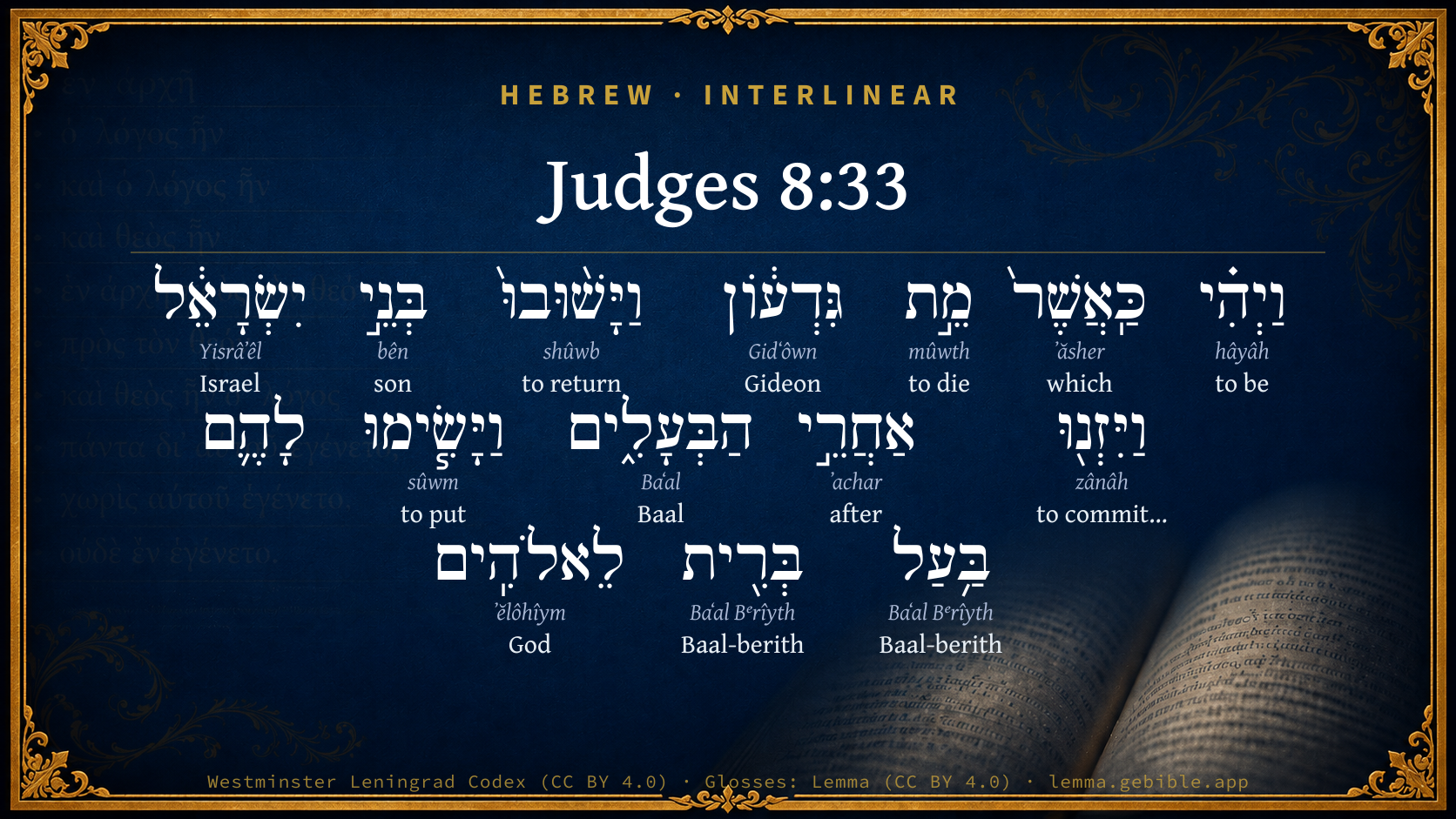
Hebrew (Westminster Leningrad Codex) Judges 8:33 appears in the Hebrew Old Testament. The text above is from the Westminster Leningrad Codex. Each word links to its Strong’s number, a concise gloss, and parsing drawn from the Open Scriptures Hebrew Bible morphology. Click any word for its full Brown-Driver-Briggs (BDB) entry.
Download image
Cite this verse

Judges 8:33 (World English Bible). Public Domain. Lemma interlinear Bible study tool, https://lemma.gebible.app/v/judges/8/33.

Show BibTeX & RIS
BibTeX
RIS
English Translation
It happened, as soon as Gideon was dead, that the children of Israel turned again, and played the prostitute after the Baals, and made Baal Berith their god.
World English Bible · Public Domain
Highlights
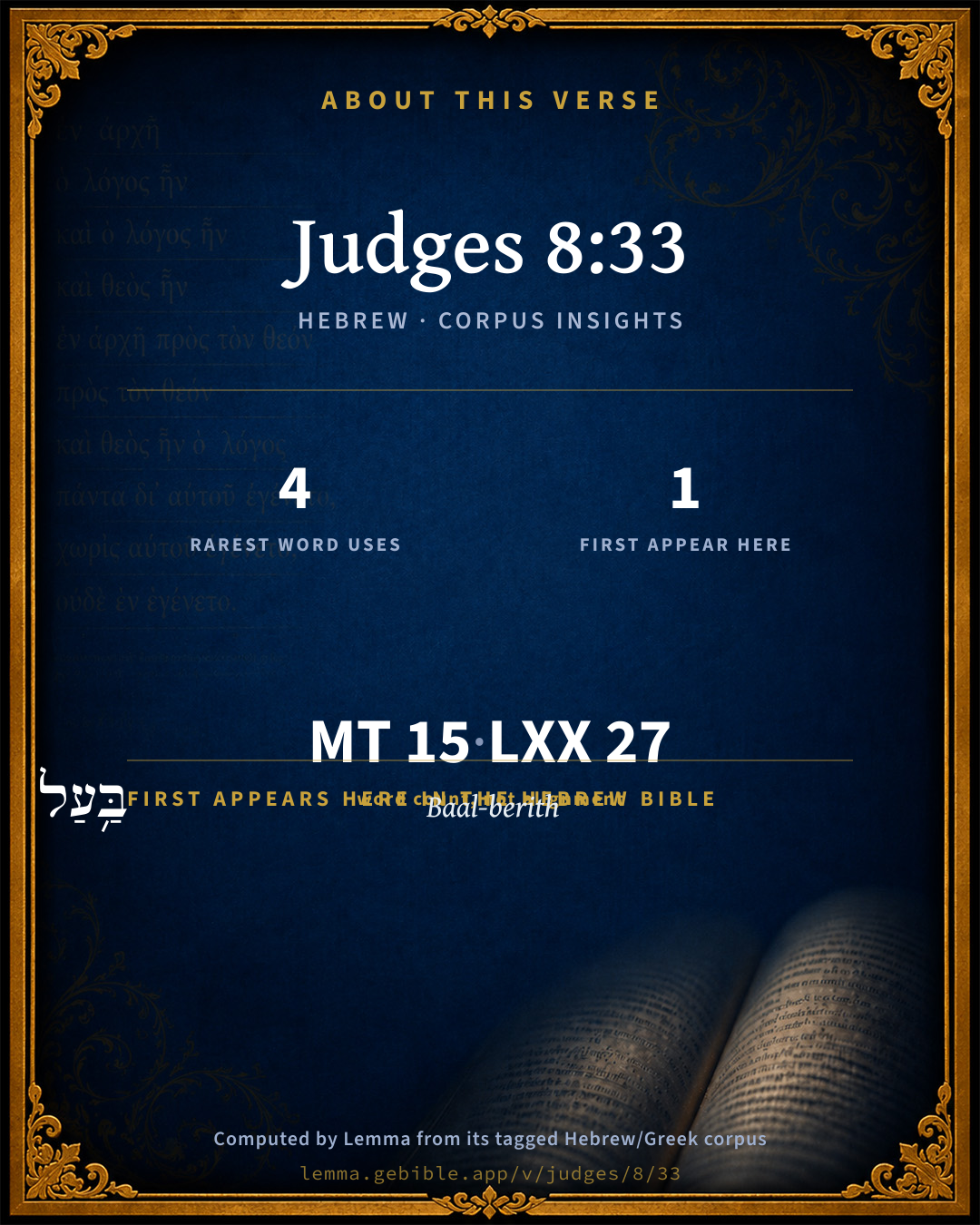
  • 1 first appearance in the Hebrew Bible
Full analysis ↓
Download a study sheet

One document with this verse’s original text, its word-by-word gloss line, the meaning frame, cross-references with their text, attributed commentary, and full source and license credits — printable, and it pastes into notes with its structure intact.

This verse Autodidact and up

Study sheet (.html) Plain text (.txt)

A passage Seminary Student

Up to 50 verses in one chapter. A passage sheet keeps up to 6 commentary sources and 12 cross-references per verse, in the order this page ranks them, and says so on the sheet whenever that leaves anything out. Ask for a single verse and you get the Autodidact verse sheet above.

Everything on this page stays free to read, with no account — the sheet is a download of what is already on screen, not access to it.

Want to remove ads? Support Godless Engineer
Compare translations 3

The same verse in 3 English versions, stacked beneath the original-language interlinear above. Click any original word for its lexicon entry.

Each is an independent rendering of the whole verse — the interlinear is not word-aligned to these translations.

Highlighted words mark where these versions differ — a whole-verse word diff, not a word-by-word alignment.

  • World English Bible Public Domain
    It happened, as soon as Gideon was dead, that the children of Israel turned again, and played the prostitute after the Baals, and made Baal Berith their god.
  • King James Version Public Domain
    And it came to pass, as soon as Gideon was dead, that the children of Israel turned again, and went a whoring after Baalim, and made Baalberith their god.
  • unfoldingWord Literal Text CC BY-SA 4.0
    Now it happened, when Gideon died, that the sons of Israel turned and whored after the Baals. And they made for themselves Baal-Berith as a god.

unfoldingWord Literal Text — © unfoldingWord, licensed CC BY-SA 4.0. Word-aligned USFM3 via Door43 (git.door43.org/unfoldingWord/en_ult).

Versions to compare (up to 4)

3 of 4 selected

Show all 18 translations

Every available English version of this verse, each an independent rendering of the whole verse.

  • World English Bible Public Domain
    It happened, as soon as Gideon was dead, that the children of Israel turned again, and played the prostitute after the Baals, and made Baal Berith their god.
  • Berean Standard Bible Public Domain
    And as soon as Gideon was dead, the Israelites turned and prostituted themselves with the Baals, and they set up Baal-berith as their god.
  • Majority Standard Bible Public Domain
    And as soon as Gideon was dead, the Israelites turned and prostituted themselves with the Baals, and they set up Baal-berith as their god.
  • King James Version Public Domain
    And it came to pass, as soon as Gideon was dead, that the children of Israel turned again, and went a whoring after Baalim, and made Baalberith their god.
  • American Standard Version (1901) Public Domain
    And it came to pass, as soon as Gideon was dead, that the children of Israel turned again, and played the harlot after the Baalim, and made Baal-berith their god.
  • Revised Version (1885) Public Domain
    And it came to pass, as soon as Gideon was dead, that the children of Israel turned again, and went a whoring after the Baalim, and made Baal-berith their god.
  • Geneva Bible (1599) Public Domain
    But when Gideon was dead, the children of Israel turned away and went a whoring after Baalim, and made Baal-berith their God.
  • Douay-Rheims (1899) Public Domain
    But after Gedeon was dead, the children of Israel turned again, and committed fornication with Baalim. And they made a covenant with Baal, that he should be their god:
  • Young's Literal Translation Public Domain
    And it cometh to pass, when Gideon `is' dead, that the sons of Israel turn back and go a-whoring after the Baalim, and set over them Baal-Berith for a god;
  • Literal Standard Version CC BY-SA 4.0
    And it comes to pass, when Gideon [is] dead, that the sons of Israel turn back and go whoring after the Ba‘alim, and set Ba‘al-Berith over them for a god;
  • Unlocked Literal Bible CC BY-SA 4.0
    It came about, as soon as Gideon was dead, the people of Israel turned again and prostituted themselves by worshiping the Baals. They made Baal-Berith their god.
  • unfoldingWord Literal Text CC BY-SA 4.0
    Now it happened, when Gideon died, that the sons of Israel turned and whored after the Baals. And they made for themselves Baal-Berith as a god.
  • Darby Bible Public Domain
    As soon as Gideon died, the people of Israel turned again and played the harlot after the Ba'als, and made Ba'al-be'rith their god.
  • World Messianic Bible Public Domain
    As soon as Gideon was dead, the children of Israel turned again and played the prostitute following the Baals, and made Baal Berith their god.
  • Webster's Bible Public Domain
    And it came to pass as soon as Gideon was dead, that the children of Israel turned again, and went astray after Baalim, and made Baal-berith their god.
  • Free Bible Version CC BY-SA 4.0
    But as soon as Gideon died, the Israelites went back to prostituting themselves, worshiping before the Baals. They made Baal-berith their god.
  • Bible in Basic English Public Domain
    And after the death of Gideon, the children of Israel again went after the gods of Canaan and were false to the Lord, and made Baal-berith their god.
  • JPS Tanakh (1917) Public Domain
    And it came to pass, as soon as Gideon was dead, that the children of Israel again went astray after the Baalim, and made Baal-berith their god.

Literal Standard Version (2020), Covenant Press — licensed CC BY-SA 4.0. Text via the HelloAO Bible API (eBible.org). Unlocked Literal Bible (unfoldingWord) — licensed CC BY-SA 4.0. Text via the HelloAO Bible API (eBible.org). unfoldingWord Literal Text — © unfoldingWord, licensed CC BY-SA 4.0. Word-aligned USFM3 via Door43 (git.door43.org/unfoldingWord/en_ult). Free Bible Version, Dr. Jonathan Gallagher — licensed CC BY-SA 4.0. Text via the HelloAO Bible API (eBible.org).

Word by word

More ways to search: Search by grammar → Find every occurrence → Compare this word →

Practice this passage: Drill this verse → Learn its vocabulary →

בַּ֥עַל
Baʻal Bᵉrîyth
H1170
“Baal-berith”
Noun, Proper
Part of Speech
Noun
Type
Proper
Full BDB Definition

Origin: from H1168 and H1285

TWOT: None

Baal-berith = "lord of the covenant" - a god of the Philistines
  1. וַיְהִ֗י hâyâh H1961 “and · to be” Conjunction + Verb, Qal, Sequential Imperfect, 3rd Person, Masculine, Singular
  2. כַּֽאֲשֶׁר֙ ʼăsher H834 “like/as · which” Preposition + Particle, Relative
  3. מֵ֣ת mûwth H4191 “to die” Verb, Qal, Perfect, 3rd Person, Masculine, Singular
  4. גִּדְע֔וֹן Gidʻôwn H1439 “Gideon” Noun, Proper
  5. וַיָּשׁ֨וּבוּ֙ shûwb H7725 “and · to return” Conjunction + Verb, Qal, Sequential Imperfect, 3rd Person, Masculine, Plural
  6. בְּנֵ֣י bên H1121 “sons of” Noun, Common, Masculine, Plural, Construct
  7. יִשְׂרָאֵ֔ל Yisrâʼêl H3478 “Israel” Noun, Proper
  8. וַיִּזְנ֖וּ zânâh H2181 “and · to commit fornication” Conjunction + Verb, Qal, Sequential Imperfect, 3rd Person, Masculine, Plural
  9. אַחֲרֵ֣י ʼachar H310 “after” Preposition
  10. הַבְּעָלִ֑ים Baʻal H1168 “the · Baal” Particle, Definite Article + Noun, Proper
  11. וַיָּשִׂ֧ימוּ sûwm H7760 “and · to put” Conjunction + Verb, Qal, Sequential Imperfect, 3rd Person, Masculine, Plural
  12. בְּרִ֖ית Baʻal Bᵉrîyth H1170 “Baal-berith” Noun, Proper
  13. לֵאלֹהִֽים ʼĕlôhîym H430 “to/for · God(s)” Preposition + Noun, Common, Masculine, Plural, Absolute

About this verse

These counts appear in no published source. They are computed here, from the morphology-tagged text and Lemma’s own curated glosses. What Lemma adds →

15
words
13
distinct lemmas
Historical
section

Notable vocabulary

The rarest word here is בַּ֥עַל Baal-berith H1170 — appearing just 4 times in the whole Hebrew Bible.

First appearance in Scripture

This word makes its first canonical appearance in the Hebrew Bible here:

  • בַּ֥עַל Baal-berith H1170

Shared distinctive vocabulary

בַּ֥עַל Baal-berith H1170 occurs in 2 verses of the Hebrew Bible. Also found in:

Grammatical profile

  • 5 verbs
  • 7 nouns
  • 2 prepositions
  • 1 particle

Verb forms

  • וַיְהִ֗י Qal · Sequential Imperfect
  • מֵ֣ת Qal · Perfect
  • וַיָּשׁ֨וּבוּ֙ Qal · Sequential Imperfect
  • וַיִּזְנ֖וּ Qal · Sequential Imperfect
  • וַיָּשִׂ֧ימוּ Qal · Sequential Imperfect

Repetition

A word recurs within this verse — often emphatic in Hebrew:

  • בַּ֥עַל Baal-berith H1170 ×2

Hebrew & Septuagint length

In English translation the verse runs 28 words from the Hebrew and 35 from the Septuagint (LXX English) — closely comparable.

A rough comparison of the two English renderings, which tokenize alike — not a word-level alignment.

Word counts can differ between the Hebrew and the Greek without any difference in meaning — e.g. the Hebrew direct-object marker אֵת has no separate Greek word, and Greek often adds the article ὁ.

In the original languages it is 15 Hebrew tokens and 27 Greek tokens — but the two are counted differently (Hebrew bundles its prefixes and suffixes into one token; the Greek is in lemma form), so that isn’t a like-for-like length.

Cross-references

12

Topical passages linked to Judges 8:33 in the Treasury of Scripture Knowledge — connected by theme and wording, ordered by reader-vote popularity; previews shown in the World English Bible.

  • Judges 9:4 They gave him seventy [pieces] of silver out of the house of Baal Berith, with which Abimelech hired vain and light fellows, who followed him.
  • Judges 2:19 But it happened, when the judge was dead, that they turned back, and dealt more corruptly than their fathers, in following other gods to serve them, and to bow down to them; they didn't cease from their doings, nor from their stubborn way.
  • Judges 9:46 When all the men of the tower of Shechem heard of it, they entered into the stronghold of the house of Elberith.
  • Judges 2:17 Yet they didn't listen to their judges; for they played the prostitute after other gods, and bowed themselves down to them: they turned aside quickly out of the way in which their fathers walked, obeying the commandments of Yahweh; [but] they didn't do so.
  • Judges 8:27 Gideon made an ephod of it, and put it in his city, even in Ophrah: and all Israel played the prostitute after it there; and it became a snare to Gideon, and to his house.
  • Exodus 34:15–16 Don't make a covenant with the inhabitants of the land, lest they play the prostitute after their gods, and sacrifice to their gods, and one call you and you eat of his sacrifice;
  • 2 Chronicles 24:17–18 Now after the death of Jehoiada came the princes of Judah, and made obeisance to the king. Then the king listened to them.
  • Jeremiah 3:9 It happened through the lightness of her prostitution, that the land was polluted, and she committed adultery with stones and with stocks.
  • Joshua 24:31 Israel served Yahweh all the days of Joshua, and all the days of the elders who outlived Joshua, and had known all the work of Yahweh, that he had worked for Israel.
  • Judges 2:7–11 The people served Yahweh all the days of Joshua, and all the days of the elders who outlived Joshua, who had seen all the great work of Yahweh that he had worked for Israel.
  • Judges 9:27 They went out into the field, and gathered their vineyards, and trod [the grapes], and held festival, and went into the house of their god, and did eat and drink, and cursed Abimelech.
  • 2 Kings 12:2 Jehoash did that which was right in the eyes of Yahweh all his days in which Jehoiada the priest instructed him.

Cross-references courtesy of OpenBible.info (CC BY 4.0).

Hebrew and Greek witnesses Masoretic Hebrew ↔ Greek Septuagint

The same verse in the two great witnesses to the Old Testament, shown verse-for-verse.

These are two independent witnesses, not word-aligned to each other, and the Septuagint is shown in lemma (dictionary) form.

Hebrew Judges 8:33 Masoretic · Westminster Leningrad Codex

וַיְהִ֗י כַּֽאֲשֶׁר֙ מֵ֣ת גִּדְע֔וֹן וַיָּשׁ֨וּבוּ֙ בְּנֵ֣י יִשְׂרָאֵ֔ל וַיִּזְנ֖וּ אַחֲרֵ֣י הַבְּעָלִ֑ים וַיָּשִׂ֧ימוּ לָהֶ֛ם בַּ֥עַל בְּרִ֖ית לֵאלֹהִֽים

It happened, as soon as Gideon was dead, that the children of Israel turned again, and played the prostitute after the Baals, and made Baal Berith their god.

World English Bible · Public Domain

Greek LXX Judges 8:33 Septuagint · lemma form

καί γίγνομαι καθώς ἀποθνήσκω γεδεων καί ἐπιστρέφω ὁ υἱός ἰσραήλ καί ἐκπορνεύω ὀπίσω ὁ βααλιμ καί τίθημι ἑαυτοῦ ὁ βααλ διαθήκη ὁ εἰμί αὐτός αὐτός εἰς θεός

And it came to pass when Gedeon was dead, that the children of Israel turned, and went a whoring after Baalim, and made for themselves a covenant with Baal that he should be their god.

LXX2012 (modern English Septuagint) · Public Domain

Hebrew: Westminster Leningrad Codex (CC BY 4.0). Greek: Septuagint (public domain); English from LXX2012 (modern English Septuagint) (Public Domain). How the Septuagint differs from the Hebrew →

Targum (Aramaic paraphrase)

1

The Targum is the ancient Jewish Aramaic paraphrase of the Hebrew Scriptures — an interpretive translation, not the Hebrew text itself. Onkelos (literal) and Pseudo-Jonathan (expansive) render the Torah, and Jonathan the Prophets. Coverage is partial: where no permissively-licensed English translation exists for a verse, only the Aramaic is shown. This is verse-level text, not a word-by-word alignment to the Hebrew.

  1. Targum Jonathan Prophets (Joshua–Malachi)
    וַהֲוָה כַּד מִית גִדְעוֹן וְתָבוּ בְּנֵי יִשְׂרָאֵל וְטָעוּ בָּתַר בַּעֲלַיָא וְשַׁוִיאוּ לְהוֹן בָּעֵיל קְיָם לְטַעֲוָתָא:

    (no public-domain English translation for this verse)

    Targum Jonathan — Aramaic: “Mikraot Gedolot” (public domain). English: “Sefaria Community Translation” (CC0 1.0 (public-domain dedication)); “London "Chaldee Paraphrase," 1871” (public domain). Text via Sefaria.

Commentary

Notes on Judges 8:33 from classic Christian and Jewish commentators (each source and its license shown beneath its notes). The classic Christian expositions comment on the surrounding passage and are grouped to its opening verse, so a note may address several verses; the Jewish commentaries on the Tanakh (Rashi and others) are per-verse, so they appear only where the commentator wrote on this verse.

Lemma curates 59 commentaries, every one of them public domain or Creative Commons licensed, each selected and text-cleaned for this edition rather than reprinted as found. About our sources →

Trapp's Complete Commentary

John Trapp

Jdg 8:33 And it came to pass, as soon as Gideon was dead, that the children of Israel turned again, and went a whoring after Baalim, and made Baalberith their god.

Ver. 33. As soon as Gideon was dead.] So great a mischief, many times, is the death of a good governor.

And made Baalberith their god.] To whom they become professed covenanters, as the name importeth. The Greeks called him Jupiter ορκιος, to whom they had sworn themselves.

John Trapp, A Commentary or Exposition upon All the Books of the Old and New Testament (1647–1656) — public domain. Text from a community e-Sword module.

Joseph Benson's Commentary

Jdg 8:33. As soon as, &c. — Whereby we see the temper of this people, who did no longer cleave to God, than they were in a manner constrained to it, by the presence and authority of the judges. Baalim — This was the general name including all their idols, one of which here follows: Baal- berith — That is, the Lord of the covenant; so called, either from the covenant wherewith the worshippers of this god bound themselves to maintain his worship, or defend one another therein; or rather, because he was reputed the god and judge of all covenants, and promises, and contracts, to whom it belonged to maintain them, and to punish the violators of them; and such a god both the Grecians and the Romans had.

Joseph Benson's Commentary on the Old and New Testaments (1811–1818) — public domain. Text from a community e-Sword module.

Keil & Delitzsch

C. F. Keil & F. Delitzsch

Jdg 8:33-35 form the introduction to the history of Gideon's sons.

Jdg 8:33

After Gideon's death the Israelites fell once more into the Baal-worship which Gideon had rooted out of his father's city (Jdg 6:25.), and worshipped Baal-berith as their God. Baal-berith, the covenant Baal (equivalent to El-berith, the covenant god, Jdg 9:46), is not Baal as the god of covenants, but, according to Gen 14:13, Baal as a god in covenant, i.e., Baal with whom they had made a covenant, just as the Israelites had their faithful covenant God in Jehovah (see Movers, Phniz. i. p. 171). The worship of Baal-berith, as performed at Shechem according to Jdg 9:46, was an imitation of the worship of Jehovah, an adulteration of that worship, in which Baal was put in the place of Jehovah (see Hengstenberg, Dissertations on the Pentateuch, vol. ii. p. 81).

Jdg 8:34-35

In this relapse into the worship of Baal they not only forgot Jehovah, their Deliverer from all their foes, but also the benefits which they owed to Gideon, and showed no kindness to his house in return for all the good which he had shown to Israel. The expression Jerubbaal-Gideon is chosen by the historian here, not for the purely outward purpose of laying express emphasis upon the identity of Gideon and Jerubbaal (Bertheau), but to point to what Gideon, the Baal-fighter, had justly deserved from the people of Israel.

Keil & Delitzsch — Biblical Commentary on the Old Testament (1861–1891) — public domain (CC PDM 1.0). Text via the HelloAO Bible API. (Old Testament only.)

Lange's Commentary on the Holy Scriptures

Apostasy from God, and ingratitude to man

Jdg_8:33-35

33And it came to pass as soon as Gideon was dead, that the children [sons] of Israel turned again, and went a whoring after [the] Baalim, and made Baal-berith their god. 34And the children [sons] of Israel remembered not the Lord [Jehovah] their God, who had delivered them out of the hands of all their enemies on every 35side: Neither showed they kindness to the house of Jerubbaal, namely, Gideon [Jerubbaal Gideon],26 according to all the goodness27 which he had showed unto Israel.

TEXTUAL AND GRAMMATICAL

[1 Jdg_8:35.—The word namely is added by the translators, who supposed, as Bertheau does, that the writer designed once more to point out the identity of Gideon with Jerubbaal. Cf. the Com.—Tr.]

[2 Jdg_8:35.—כְּכָל־הַטּוֹבָה: Dr. Cassel: trotz aller Wohlthat, “notwithstanding all the good.” The “notwithstanding” lies perhaps in the thought, but not in the language.—Tr.]

EXEGETICAL AND DOCTRINAL

Jdg_8:33-34. And it came to pass as soon as Gideon was dead. The fact soon became manifest that the people had been raised only by the personal character of Gideon; he is scarcely dead, before they fall back again. The narrator says sharply וַיָּשׁוּבוּ, “they returned.” The same word which elsewhere describes the turning of the people towards God, is here used to indicate their passion for sin. Ad vomitum redierunt, as Serarius well remarks.

And went a whoring after the Baalim, and made Baal-berith their god. Nothing could put the stupid thoughtlessness of the people in a stronger light. They have become great and free through victory over Baal; and now they again run after him. Jerubbaal—the contender with Baal—has just died, and they enter into covenant with Baal (see on Jdg_9:4). That the nations in the Baal-covenant (Baal-berith) kept the peace towards them, was because Jehovah had given them victory,—and lo! they make idols their god! The error of Gideon, in supposing that by setting up his ephod he could preserve the people, now shows itself Since he is dead, in whom they conceived their salvation to be personified, they think neither of the spoils out of which the ephod was made, nor of him who procured them. Ingratitude is the parent of all unbelief. Thankfulness comes from thought.28 Israel thinks not on the God who has delivered it from all its enemies; how then should it think on the human hero when he has passed away. They withhold obedience from the God of their fathers; what recognition can they have for the house of their benefactor. The ephod, to be sure, was still in Ophrah; but who that despises the sanctuary of Moses and Joshua, will respect this private institute of Gideon, when his voice has ceased to be heard.

Jdg_8:35. Neither showed they kindness to the house of Jerubbaal Gideon. In the name Jerubbaal, all the hero’s meritorious service, and its great results, are enunciated. For that reason the narrator mentions it here. It serves to aggravate the sinfulness of Israel’s ingratitude, and to show that he who enters the service of Baal, will also ignore his obligations towards those who contend with Baal. The people are unwilling to be reminded that to fight against Baal brings prosperity. They seek to forget everything that admonishes to repentance. It has always been the case, that those who apostatize from God, do not do well by the “house” of God.—Notwithstanding all the benefits which he had shown unto Israel. The narrator intimates that the endeavor of Gideon to perpetuate, by means of the ephod, the religious and godly memory of his deeds, was altogether vain. For let no one imagine that where God’s own deeds fail to command remembrance and gratitude, those of men, however deserving, can maintain themselves against the sinful sophistry of unbelief.

HOMILETICAL AND PRACTICAL

[Henry: Gideon being dead, the Israelites found themselves under no restraint, and went after Baalim. They went first after another ephod (Jdg_8:27), for which Gideon had himself given them too much occasion, and now they went after another god. False worships made way for false deities.—Scott: As we all need so much mercy from our God, we should learn the more patiently to bear the ingratitude of our fellow-sinners, and the unsuitable returns we meet with for our poor services, and to resolve, after the divine example, “not to be overcome of evil, but to overcome evil with good.”—Tr.]

Footnotes:

[26][Jdg_8:35.—The word namely is added by the translators, who supposed, as Bertheau does, that the writer designed once more to point out the identity of Gideon with Jerubbaal. Cf. the Com.—Tr.]

[27][Jdg_8:35.—כְּכָל־הַטּוֹבָה: Dr. Cassel: trotz aller Wohlthat, “notwithstanding all the good.” The “notwithstanding” lies perhaps in the thought, but not in the language.—Tr.]

[28][The German is, “Dank kommt vom Denken.” It is interesting to observe, whether the author meant to suggest it or not, that the remark is sound etymology as well as psychology. Grimm (Wörterb. ii. pp. 727, 927) derives both dank and denken from “the lost root dinke, danc, dünken,” expressive “of an action of the mind, a movement and up-lifting of the soul.” Thank and think belong, of course, to the same root.—Tr.]

Lange's Commentary on the Holy Scriptures (Critical, Doctrinal, and Homiletical), ed. John Peter Lange, English translation edited by Philip Schaff (1864–1880) — public domain. Text from a community e-Sword module.

Geneva Bible (1599)

Geneva Bible translators

That is, Baal, to whom they had bound themselves by covenant.

Geneva Bible (1599) marginal notes — public domain. Text via Bolls.life.

Adam Clarke's Commentary

Verse 33. A whoring after Baalim] This term has probably a different meaning here from what it has Jdg 8:7; for it is very likely that in most parts of the pagan worship there were many impure rites, so that going a whoring after Baalim may be taken in a literal sense.

Baal-berith] Literally, the lord of the covenant; the same as Jupiter faederis, or Mercury, among the Romans; the deity whose business it was to preside over compacts, leagues, treaties, covenants, c. Some of the versions understand it as if the Israelites had made a covenant or agreement to have Baal for their god so the VULGATE: Percusseruntque cum Baal faedus, ut esset eis in deum.

Adam Clarke's Commentary on the Bible (1810–1826) — public domain. Text from a community e-Sword/MySword module.

Ellicott's Commentary for English Readers

(33) Turned again.—Ad vomitum recdierunt (Serarius) (Psa_106:13; Psa_106:21).

Went a whoring after Baalim.—It was shown again afterwards, in the reign of Ahab, how rapidly unauthorised symbols degenerate into positive idolatry. After all that had occurred it would have been impossible for a Jerubbaal to be a Baal-worshipper, but his little deflection from the appointed ritual soon became a wide divergence from the national faith.

Made Baal-berith their god.—Baal-berith means “Lord of the covenant.” The Hebrew will bear the meaning given it by some of the versions: “They made a covenant with Baal that he should be their god” (comp. Jos_24:25, Heb.), but the E.V. is probably correct. Bochart vainly tries to represent Baal-berith as some female deity of Berytus.

A Bible Commentary for English Readers, edited by Charles John Ellicott (1878–1897) — public domain. Text from a community e-Sword module.

The Cambridge Bible for Schools and Colleges

gen. ed. J. J. S. Perowne

33. made Baal-berith their god] Baal-bĕrîth (Jdg_9:4; Jdg_9:46) was the Covenant-Baal, the god of the league between himself and his worshippers, or the god who presided over the league between the original Canaanite inhabitants of Shechem and the Israelite new-comers; see Genesis 34 The Dtc. editor generalizes the worship of a half-Canaanite city into a defection of all Israel; similarly in Jdg_8:35 he blames Israelites for the ingratitude of the men of Shechem.

The Cambridge Bible for Schools and Colleges (gen. ed. J. J. S. Perowne; Cambridge University Press, 1878–1918) — public domain. Text from a community e-Sword module.

John Gill's Exposition

And the children of Israel remembered not the Lord their God,.... Or, as the Targum, the worship of the Lord their God; they forgot him, and forsook him, which showed base ingratitude:

who had delivered them out of the hands of their enemies on every side; not only out of the hands of Midian, but all other nations round about them, as Edom, Moab, Ammon, &c. not one attempting to oppress them.

John Gill's Exposition of the Whole Bible (1746–1763) — public domain (CC PDM 1.0). Text via the HelloAO Bible API.

Albert Barnes' Notes on the Bible

Turned again - Doubtless Gideon himself had no doubt prepared the way for this apostacy by his unauthorized ephod. The Law of Moses, with its strict unity of priesthood and altar, was the divinely-appointed and only effectual preservative from idolatry.

Baal-bereth - The god of covenants or sworn treaties, corresponding to the Zeus Orkius of the Greeks. The center of this fresh apostacy was at Shechem.

Albert Barnes' Notes on the Bible (1834–1885) — public domain. Text from a community e-Sword/MySword module.

Haydock's Catholic Bible Commentary

After. This is the most solid proof of Gedeon’s piety, since he kept the people in awe, and faithful to the Lord during his life. --- God. Hebrew, "and appointed Baal Berith their god," or goddess; for Berith, "of the covenant," is feminine. In the temple of this idol, the citizens of Sichem kept money, chap ix. 4. The pagans had many gods who presided over treaties; and the parties were, it seems, at liberty to choose whom they thought proper. They commonly pitched upon Jupiter, who is, therefore, styled Zeus orkios, or Dius fidius, or Fistius Jupiter. (Laertius. in Pythag.; Halicar. iv.) A statue "of Jupiter for oaths," was seen at Olympus, holding the thunderbolts in his hands, ready to hurl against those who proved faithless. (Pausan. Eliac.) Philo of Byblos speaks of the Phœnician god Eliun, "the High," and (Calmet) of the goddess "Beruth," which last has a visible connection with Berith. The former title is sometimes given to the true God in Scripture. The city of Berytus was so called, probably in honour of the latter. Nonnus seems to have styled her Beroe. (Bochart; Chanaan ii. 17.) --- Pliny ([Natural History?] xxxi. 1.) mentions the god Briaze, at the foot of whose temple runs the river Olachas, the waters of which are said to burn those who are guilty of perjury. The Chaldean reads, "they chose Beel-kiam for their error." Amos (v. 26.) speaks of the images of Chiun. May he not be the same as Berith or Kiam? Spencer says, that Chiun was Saturn: but Vossius thinks it was the moon. (Idol. ii. 23.) (Calmet)

George Leo Haydock (1774–1849), Haydock's Catholic Family Bible and Commentary, 1859 edition — public domain. Excludes Psalms (Douay-Rheims chapter numbering differs from Protestant) and Deuterocanonical books (Catholic canon only).

Matthew Poole's English Annotations

The children of Israel turned again; whereby we see the wicked temper of this people, who did no longer cleave to God than they were in a manner constrained to it by the presence and authority of their judges.

Baalim: this was the general name, including all their idols, whereof one here follows.

Baal-berith, i.e. The lord of the covenant, so called, either from the covenant wherewith the worshippers of this god bound themselves to maintain his worship, or to defend one another therein; or rather, because he was reputed the god and judge of all covenants, and promises, and contracts, to whom it belonged to maintain them, and to punish the violaters of them; and such a god both the Grecians and the Romans had.

Matthew Poole's English Annotations on the Holy Bible (1683–1685) — public domain. Text from a community e-Sword/MySword module.

Whedon's Commentary on the Bible

Daniel D. Whedon

33. As soon as Gideon was dead — Compare Jdg_2:19, note. Gideon’s own example had been a snare to Israel; but in spite of all that, there was so much of uprightness and goodness in his character that he restrained the people from idolatry all his days. Here mark the downward tendency of a questionable example. False, and even evil, opinions and practices may be held by some great minds with apparent innocence and harmlessness, but prove the ruin of others who presume to follow in their steps.

Baal-berith — The covenant Baal. The name indicates that these Israelites entered into covenant with Baal, just as Israel, under Moses, had entered into covenant with Jehovah. From Jdg_9:4; Jdg_9:46, we learn that there was at Shechem a temple or house for his worship. He thus became to them the most sacred of deities, the god in whose name they might solemnize their oaths, thus corresponding with the Ζευς ορκιος of the Greeks, and the Deus Fidius of the Romans.

Daniel D. Whedon (gen. ed.), Commentary on the Old and New Testaments (1874–1909) — public domain. Text from a community e-Sword module.

The Pulpit Commentary

And it came to pass, etc. Cf. Jud_1:2:11, 12, 19 3:7 4:1 5:1 10:6 13:1. Baal-berith. See Jud_1:2:13, note. He was like the Zeuv Orkiov of the Greeks, the god of covenants.

Vers. 33-35. The consequence of the imperfect recognition of Jehovah.

I AN IMPURE, DEFECTIVE WORSHIP OF THE TRUE GOD PREPARED FOR THE WORSHIP OF FALSE GODS. "False worships make way for false deities.

II UNDUE MAGNIFYING OF HUMAN IMPORTANCE AT THE EXPENSE OF THE HONOUR DUE TO GOD ALONE, DIVERTED FROM THE WORSHIP OF JEHOVAH, AND SO CUT THE ROOTS OF THE PERSONAL RESPECT IN WHICH HIS SERVANT WAS HELD. True religion is the foundation and safeguard of all the esteem and respect due from one to another. The heavenly Father is the key-stone of the whole house of life. M.

The Pulpit Commentary (1880–1919), ed. H.D.M. Spence-Jones & Joseph S. Exell — public domain. Text from a community e-Sword module.

John Wesley's Explanatory Notes

As soon as, &c. - Whereby we see the temper of this people, who did no longer cleave to God, than they were in a manner constrained to it, by the presence and authority of their Judges. Baalim - This was the general name including all their idols, one of which here follows. Baal-berith - That is, the Lord of the covenant; so called, either from the covenant wherewith the worshippers of this God bound themselves to maintain his worship, or to defend one another therein; or rather, because he was reputed the God and judge of all covenants, and promises, and contracts, to whom it belonged to maintain them, and to punish the violaters of them; and such a God both the Grecians and the Roman had.

John Wesley, Explanatory Notes Upon the Whole Bible (1754–1765) — public domain. Text via the GEBible commentary corpus.

Rashi

Rabbi Shlomo Yitzchaki (Rashi)

Baal beris. This was his name.

Rashi on the Tanakh — English translations: “The Judaica Press complete Tanach with Rashi, translated by A. J. Rosenberg” (CC BY 4.0); “Pentateuch with Rashi's commentary by M. Rosenbaum and A.M. Silbermann, 1929-1934” (public domain); “The Metsudah Tanach series, Lakewood, N.J” (CC BY 4.0); and “The Book of Joshua, Metsudah Publications, 1997” (CC BY 4.0). Text via Sefaria.

Lesson kit

Teaching starters — assembled from the data on this page, not authored interpretation. Every prompt links to the verse data it draws on. Edit before teaching.

Judges, in the Historical, opens this verse with 15 words (13 distinct Hebrew lemmas). Its most distinctive word is Baʻal Bᵉrîyth (“Baal-berith”). A historical commentator’s framing appears above. Read the whole chapter for the surrounding context.

Discussion questions

  1. The word Baʻal Bᵉrîyth carries the sense “Baal-berith.” How does it shape the verse?
  2. The word “Baal-berith” first appears here in Scripture. What is being introduced at this debut?
  3. Judges 9:4 shares the word «Baal-berith» with this verse. How do the two illuminate each other?
  4. “Baal-berith” occurs 2× in this one verse. What is the effect of the repetition?
  5. These translations render this verse differently; the difference is in the English rendering, not the original. What questions does that raise?
  6. The verb «וַיְהִ֗י» is Qal Sequential Imperfect. How does its form color the action?
  7. Reading how Trapp's Complete Commentary and Joseph Benson's Commentary read this verse, where do the two commentators agree and where do they part?

Things to notice

Reading settings

Reading text

Shown beneath each verse's original-language words.

Old Testament
Old Testament edition

Read the OT as the Masoretic Hebrew (MT) or the Greek Septuagint (LXX).

English shown for the Greek Septuagint (in the Hebrew ↔ Greek comparison).

Comparing translations? Open the Compare panel on any verse page to stack up to four side by side.