
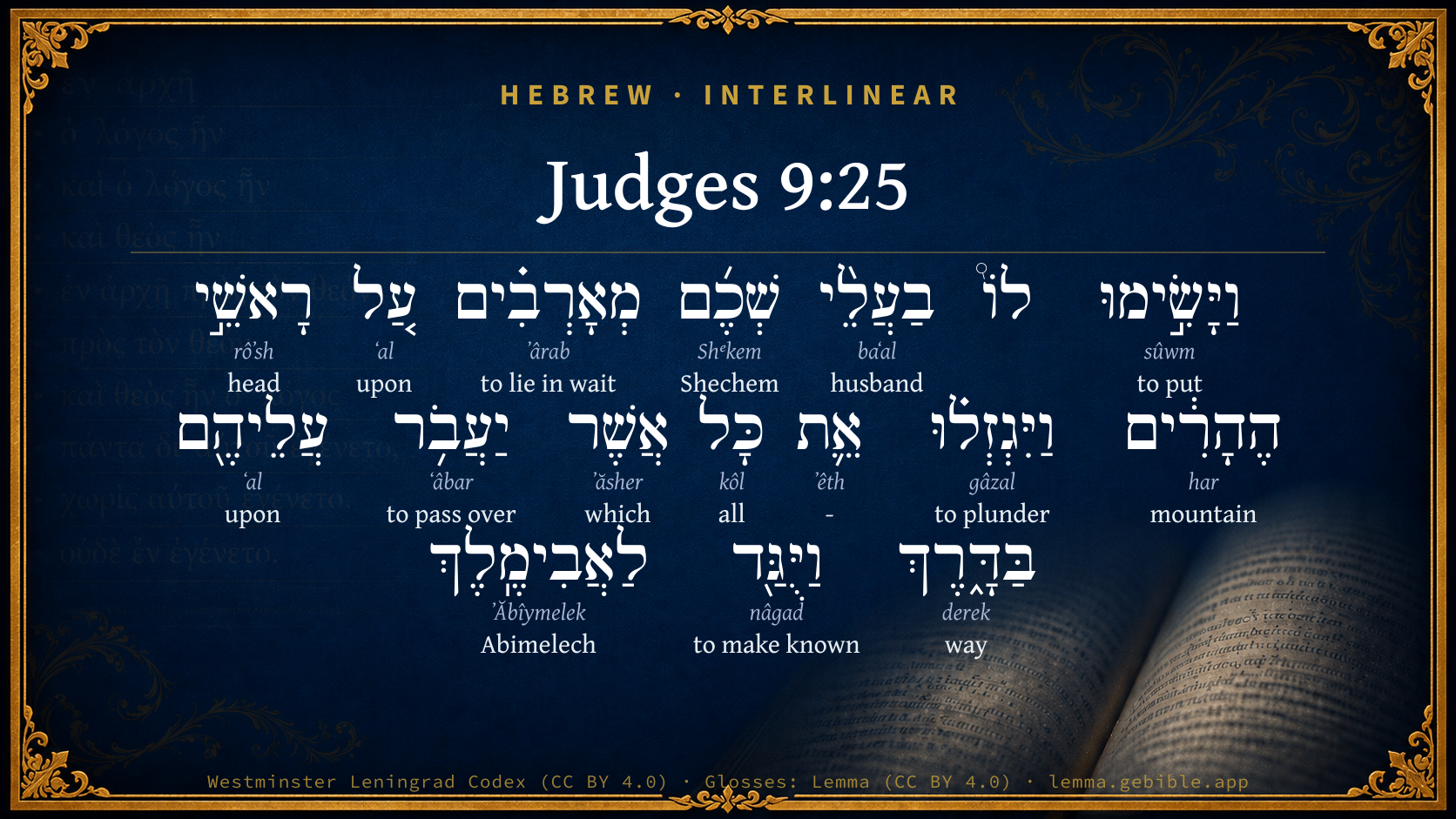
Judges 9:25

Hebrew (Westminster Leningrad Codex) Judges 9:25 appears in the Hebrew Old Testament. The text above is from the Westminster Leningrad Codex. Each word links to its Strong’s number, a concise gloss, and parsing drawn from the Open Scriptures Hebrew Bible morphology. Click any word for its full Brown-Driver-Briggs (BDB) entry.
Download image
Cite this verse

Judges 9:25 (World English Bible). Public Domain. Lemma interlinear Bible study tool, https://lemma.gebible.app/v/judges/9/25.

Show BibTeX & RIS
BibTeX
RIS
English Translation
The men of Shechem set liers-in-wait for him on the tops of the mountains, and they robbed all who came along that way by them: and it was told Abimelech.
World English Bible · Public Domain
Download a study sheet

One document with this verse’s original text, its word-by-word gloss line, the meaning frame, cross-references with their text, attributed commentary, and full source and license credits — printable, and it pastes into notes with its structure intact.

This verse Autodidact and up

Study sheet (.html) Plain text (.txt)

A passage Seminary Student

Up to 50 verses in one chapter. A passage sheet keeps up to 6 commentary sources and 12 cross-references per verse, in the order this page ranks them, and says so on the sheet whenever that leaves anything out. Ask for a single verse and you get the Autodidact verse sheet above.

Everything on this page stays free to read, with no account — the sheet is a download of what is already on screen, not access to it.

Want to remove ads? Support Godless Engineer
Compare translations 3

The same verse in 3 English versions, stacked beneath the original-language interlinear above. Click any original word for its lexicon entry.

Each is an independent rendering of the whole verse — the interlinear is not word-aligned to these translations.

Highlighted words mark where these versions differ — a whole-verse word diff, not a word-by-word alignment.

  • World English Bible Public Domain
    The men of Shechem set liers-in-wait for him on the tops of the mountains, and they robbed all who came along that way by them: and it was told Abimelech.
  • King James Version Public Domain
    And the men of Shechem set liers in wait for him in the top of the mountains, and they robbed all that came along that way by them: and it was told Abimelech.
  • unfoldingWord Literal Text CC BY-SA 4.0
    And the lords of Shechem put ambushers against him on the tops of the hills, and they robbed everyone who passed by them on the road, and it was told to Abimelech.

unfoldingWord Literal Text — © unfoldingWord, licensed CC BY-SA 4.0. Word-aligned USFM3 via Door43 (git.door43.org/unfoldingWord/en_ult).

Versions to compare (up to 4)

3 of 4 selected

Show all 18 translations

Every available English version of this verse, each an independent rendering of the whole verse.

  • World English Bible Public Domain
    The men of Shechem set liers-in-wait for him on the tops of the mountains, and they robbed all who came along that way by them: and it was told Abimelech.
  • Berean Standard Bible Public Domain
    The leaders of Shechem set up an ambush against Abimelech on the hilltops, and they robbed all who passed by them on the road. So this was reported to Abimelech.
  • Majority Standard Bible Public Domain
    The leaders of Shechem set up an ambush against Abimelech on the hilltops, and they robbed all who passed by them on the road. So this was reported to Abimelech.
  • King James Version Public Domain
    And the men of Shechem set liers in wait for him in the top of the mountains, and they robbed all that came along that way by them: and it was told Abimelech.
  • American Standard Version (1901) Public Domain
    And the men of Shechem set liers-in-wait for him on the tops of the mountains, and they robbed all that came along that way by them: and it was told Abimelech.
  • Revised Version (1885) Public Domain
    And the men of Shechem set liers in wait for him on the tops of the mountains, and they robbed all that came along that way by them: and it was told Abimelech.
  • Geneva Bible (1599) Public Domain
    So the men of Shechem set men in wayte for him in the toppes of the mountaines: who robbed all that passed that way by them: and it was tolde Abimelech.
  • Douay-Rheims (1899) Public Domain
    And they set an ambush against him on the top of the mountains: and while they waited for his coming, they committed robberies, taking spoils of all that passed by: and it was told Abimelech.
  • Young's Literal Translation Public Domain
    And the masters of Shechem set for him ambushes on the top of the hills, and rob every one who passeth over by them in the way, and it is declared to Abimelech.
  • Literal Standard Version CC BY-SA 4.0
    And the masters of Shechem set ambushes for him on the top of the hills, and rob everyone who passes over by them in the way, and it is declared to Abimelech.
  • Unlocked Literal Bible CC BY-SA 4.0
    So the leaders of Shechem positioned men to lie in wait on the hilltops that they might ambush him, and they robbed all who passed by them along that road. This was reported to Abimelech.
  • unfoldingWord Literal Text CC BY-SA 4.0
    And the lords of Shechem put ambushers against him on the tops of the hills, and they robbed everyone who passed by them on the road, and it was told to Abimelech.
  • Darby Bible Public Domain
    And the men of Shechem put men in ambush against him on the mountain tops, and they robbed all who passed by them along that way; and it was told Abim'elech.
  • World Messianic Bible Public Domain
    The men of Shechem set an ambush for him on the tops of the mountains, and they robbed all who came along that way by them; and Abimelech was told about it.
  • Webster's Bible Public Domain
    And the men of Shechem set liers in wait for him on the top of the mountains, and they robbed all that came along that way by them: and it was told Abimelech.
  • Free Bible Version CC BY-SA 4.0
    The leaders of Shechem sent men to the hill passes to lie in wait and attack Abimelech, and, in the meantime, they robbed everyone who passed by on the road. Abimelech found out what was happening.
  • Bible in Basic English Public Domain
    And the townsmen of Shechem put secret watchers on the tops of the mountains, and they made attacks on all who went by on the road and took their goods; and word of this came to Abimelech.
  • JPS Tanakh (1917) Public Domain
    And the men of Shechem set liers-in-wait for him on the tops of the mountains, and they robbed all that came along that way by them; and it was told Abimelech.

Literal Standard Version (2020), Covenant Press — licensed CC BY-SA 4.0. Text via the HelloAO Bible API (eBible.org). Unlocked Literal Bible (unfoldingWord) — licensed CC BY-SA 4.0. Text via the HelloAO Bible API (eBible.org). unfoldingWord Literal Text — © unfoldingWord, licensed CC BY-SA 4.0. Word-aligned USFM3 via Door43 (git.door43.org/unfoldingWord/en_ult). Free Bible Version, Dr. Jonathan Gallagher — licensed CC BY-SA 4.0. Text via the HelloAO Bible API (eBible.org).

Word by word

More ways to search: Search by grammar → Find every occurrence → Compare this word →

Practice this passage: Drill this verse → Learn its vocabulary →

וַיִּגְזְל֗וּ
gâzal
H1497
“and · to plunder”
Conjunction + Verb, Qal, Sequential Imperfect, 3rd Person, Masculine, Plural
Part of Speech
Conjunction + Verb
Stem
Qal
Form
Sequential Imperfect
Person
3rd Person
Gender
Masculine
Number
Plural
Full BDB Definition

Origin: a primitive root

TWOT: 337

to tear away, seize, plunder, tear off, pull off, rob, take away by force - (Qal) - to tear away, rob - to seize, plunder (with acc cognate) - (Niphal) - to be robbed - to be taken away
  1. וַיָּשִׂ֣ימוּ sûwm H7760 “and · to put” Conjunction + Verb, Qal, Sequential Imperfect, 3rd Person, Masculine, Plural
  2. בַעֲלֵ֨י baʻal H1167 “husbands of” Noun, Common, Masculine, Plural, Construct
  3. שְׁכֶ֜ם Shᵉkem H7927 “Shechem” Noun, Proper
  4. מְאָרְבִ֗ים ʼârab H693 “lying in wait” Verb, Piel, Participle Active, Masculine, Plural, Absolute
  5. עַ֚ל ʻal H5921 “upon” Preposition
  6. רָאשֵׁ֣י rôʼsh H7218 “heads of” Noun, Common, Masculine, Plural, Construct
  7. הֶהָרִ֔ים har H2022 “the · mountains” Particle, Definite Article + Noun, Common, Masculine, Plural, Absolute
  8. אֵ֛ת ʼêth H853 “-” Particle, Direct Object
  9. כָּל kôl H3605 “all of” Noun, Common, Masculine, Singular, Construct
  10. אֲשֶׁר ʼăsher H834 “which” Particle, Relative
  11. יַעֲבֹ֥ר ʻâbar H5674 “to pass over” Verb, Qal, Imperfect, 3rd Person, Masculine, Singular
  12. עֲלֵיהֶ֖ם ʻal H5921 “upon · them” Preposition + Suffix, Personal, 3rd Person, Masculine, Plural
  13. בַּדָּ֑רֶךְ derek H1870 “in/at the · way” Preposition, Determined + Noun, Common, Both, Singular, Absolute
  14. וַיֻּגַּ֖ד nâgad H5046 “and · to make known” Conjunction + Verb, Hophal, Sequential Imperfect, 3rd Person, Masculine, Singular
  15. לַאֲבִימֶֽלֶךְ ʼĂbîymelek H40 “to/for · Abimelech” Preposition + Noun, Proper

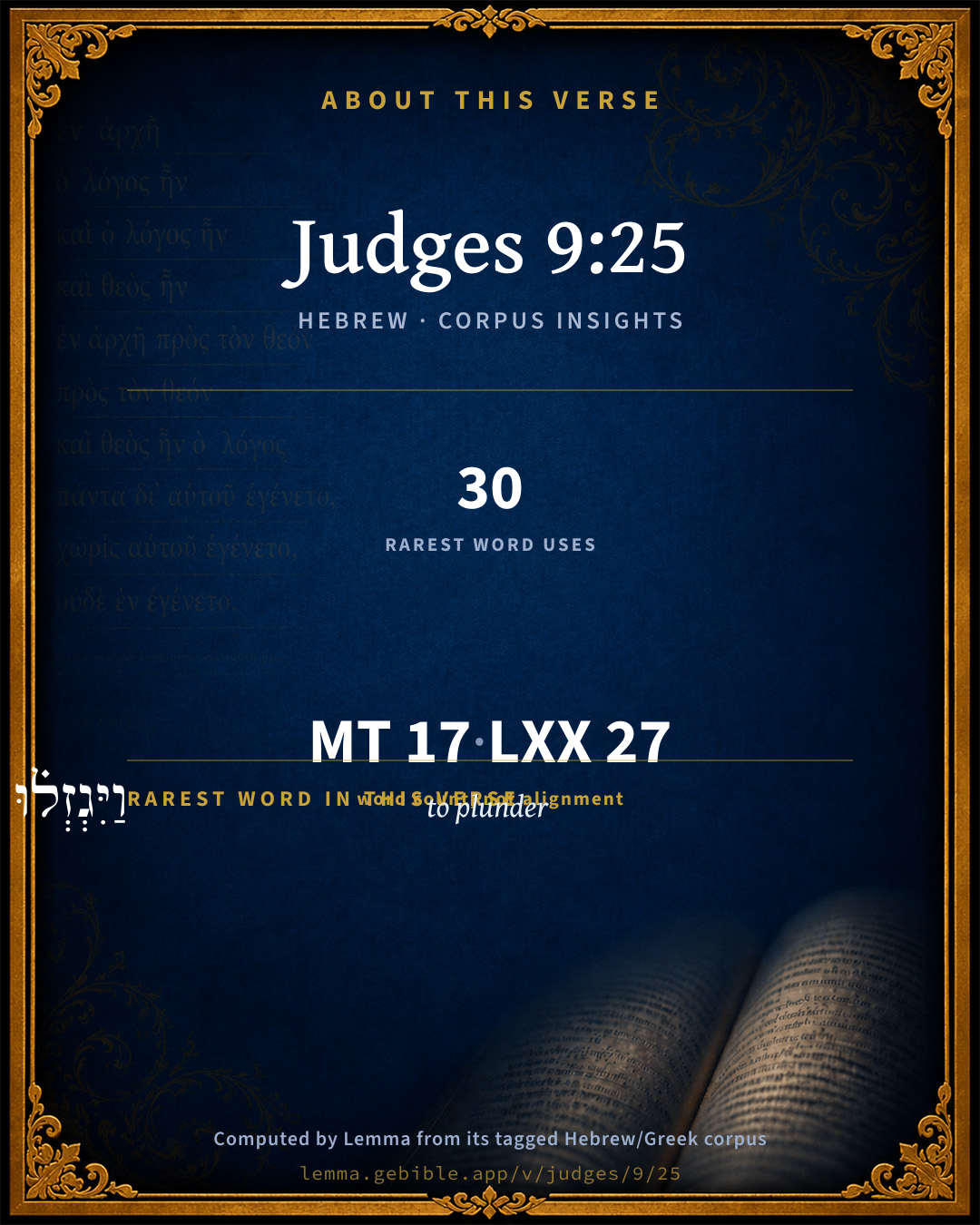
About this verse

These counts appear in no published source. They are computed here, from the morphology-tagged text and Lemma’s own curated glosses. What Lemma adds →

17
words
15
distinct lemmas
Historical
section

Shared distinctive vocabulary

וַיִּגְזְל֗וּ to plunder H1497 occurs in 30 verses of the Hebrew Bible. Also found in:

Grammatical profile

  • 5 verbs
  • 7 nouns
  • 3 prepositions
  • 2 particles

Verb forms

  • וַיָּשִׂ֣ימוּ Qal · Sequential Imperfect
  • מְאָרְבִ֗ים Piel · Participle Active
  • וַיִּגְזְל֗וּ Qal · Sequential Imperfect
  • יַעֲבֹ֥ר Qal · Imperfect
  • וַיֻּגַּ֖ד Hophal · Sequential Imperfect

Repetition

A word recurs within this verse — often emphatic in Hebrew:

  • עַ֚ל upon H5921 ×2

Hebrew & Septuagint length

In English translation the verse runs 30 words from the Hebrew and 36 from the Septuagint (LXX English) — closely comparable.

A rough comparison of the two English renderings, which tokenize alike — not a word-level alignment.

Word counts can differ between the Hebrew and the Greek without any difference in meaning — e.g. the Hebrew direct-object marker אֵת has no separate Greek word, and Greek often adds the article ὁ.

In the original languages it is 17 Hebrew tokens and 27 Greek tokens — but the two are counted differently (Hebrew bundles its prefixes and suffixes into one token; the Greek is in lemma form), so that isn’t a like-for-like length.

Cross-references

3

Topical passages linked to Judges 9:25 in the Treasury of Scripture Knowledge — connected by theme and wording, ordered by reader-vote popularity; previews shown in the World English Bible.

  • Proverbs 1:11–12 If they say, "Come with us, Let's lay in wait for blood; Let's lurk secretly for the innocent without cause;
  • Joshua 8:12–13 He took about five thousand men, and set them in ambush between Bethel and Ai, on the west side of the city.
  • Joshua 8:4 He commanded them, saying, Behold, you shall lie in ambush against the city, behind the city; don't go very far from the city, but be all ready:

Cross-references courtesy of OpenBible.info (CC BY 4.0).

Hebrew and Greek witnesses Masoretic Hebrew ↔ Greek Septuagint

The same verse in the two great witnesses to the Old Testament, shown verse-for-verse.

These are two independent witnesses, not word-aligned to each other, and the Septuagint is shown in lemma (dictionary) form.

Hebrew Judges 9:25 Masoretic · Westminster Leningrad Codex

וַיָּשִׂ֣ימוּ לוֹ֩ בַעֲלֵ֨י שְׁכֶ֜ם מְאָרְבִ֗ים עַ֚ל רָאשֵׁ֣י הֶהָרִ֔ים וַיִּגְזְל֗וּ אֵ֛ת כָּל אֲשֶׁר יַעֲבֹ֥ר עֲלֵיהֶ֖ם בַּדָּ֑רֶךְ וַיֻּגַּ֖ד לַאֲבִימֶֽלֶךְ

The men of Shechem set liers-in-wait for him on the tops of the mountains, and they robbed all who came along that way by them: and it was told Abimelech.

World English Bible · Public Domain

Greek LXX Judges 9:25 Septuagint · lemma form

καί τίθημι αὐτός ὁ ἀνήρ σικιμα ἐνεδρεύω ἐπί ὁ κεφαλή ὁ ὄρος καί διαἁρπάζω πᾶς ὅς παραπορεύομαι ἐπί αὐτός ἐν ὁ ὁδός καί ἀποἀγγέλλω ὁ βασιλεύς αβιμελεχ

And the men of Sicima set liers in wait against him on the top of the mountains, and robbed every one who passed by them on the way; and it was reported to the king Abimelech.

LXX2012 (modern English Septuagint) · Public Domain

Hebrew: Westminster Leningrad Codex (CC BY 4.0). Greek: Septuagint (public domain); English from LXX2012 (modern English Septuagint) (Public Domain). How the Septuagint differs from the Hebrew →

Targum (Aramaic paraphrase)

1

The Targum is the ancient Jewish Aramaic paraphrase of the Hebrew Scriptures — an interpretive translation, not the Hebrew text itself. Onkelos (literal) and Pseudo-Jonathan (expansive) render the Torah, and Jonathan the Prophets. Coverage is partial: where no permissively-licensed English translation exists for a verse, only the Aramaic is shown. This is verse-level text, not a word-by-word alignment to the Hebrew.

  1. Targum Jonathan Prophets (Joshua–Malachi)
    וְשַׁוִיאוּ לֵיהּ יַתְבֵי שְׁכֶם כְּמַנִין עַל רֵישֵׁי טוּרַיָא וְאַנְסִין יַת כָּל דִי עֲבַר עֲלֵיהוֹן בְּאוֹרְחָא וְאִתְחַוָא לַאֲבִימֶלֶךְ:

    (no public-domain English translation for this verse)

    Targum Jonathan — Aramaic: “Mikraot Gedolot” (public domain). English: “Sefaria Community Translation” (CC0 1.0 (public-domain dedication)); “London "Chaldee Paraphrase," 1871” (public domain). Text via Sefaria.

Commentary

Notes on Judges 9:25 from classic Christian and Jewish commentators (each source and its license shown beneath its notes). The classic Christian expositions comment on the surrounding passage and are grouped to its opening verse, so a note may address several verses; the Jewish commentaries on the Tanakh (Rashi and others) are per-verse, so they appear only where the commentator wrote on this verse.

Lemma curates 59 commentaries, every one of them public domain or Creative Commons licensed, each selected and text-cleaned for this edition rather than reprinted as found. About our sources →

Trapp's Complete Commentary

John Trapp

Jdg 9:25 And the men of Shechem set liers in wait for him in the top of the mountains, and they robbed all that came along that way by them: and it was told Abimelech.

Ver. 25. Set liers in wait for him.] Attempting thereby secretly to have slain him, or at least to have seized his person.

And it was told Abimelech.] These robbers going beyond their commission discovered the plot, and so Abimelech escaped. But this preservation was but a reservation.

John Trapp, A Commentary or Exposition upon All the Books of the Old and New Testament (1647–1656) — public domain. Text from a community e-Sword module.

Joseph Benson's Commentary

Jdg 9:25. Set liers in wait for him — To seize his person. Robbed all — Such as favoured or served Abimelech; for to such only their commission reached, though it may be they went beyond their bounds, and robbed all passengers promiscuously.

Joseph Benson's Commentary on the Old and New Testaments (1811–1818) — public domain. Text from a community e-Sword module.

Adam Clarke's Commentary

Verse 25. The men of Shechem set liers in wait] It pleased God to punish this bad man by the very persons who had contributed to his iniquitous elevation. So God often makes the instruments of men's sins the means of their punishment. It is likely that although Abimelech had his chief residence at Shechem, yet he frequently went to Ophrah, the city of his father; his claim to which there was none to oppose, as he had slain all his brethren. It was probably in his passage between those two places that the Shechemites had posted cut-throats, in order to assassinate him; as such men had no moral principle, they robbed and plundered all who came that way.

Adam Clarke's Commentary on the Bible (1810–1826) — public domain. Text from a community e-Sword/MySword module.

Ellicott's Commentary for English Readers

(25) Set liers in wait for him.—The “for him” does not necessarily mean “to seize him,” but to his disadvantage. The disaffection began to show itself, as has so often been the case in Palestine from the days of Saul to those of Herod, by the rise of brigandage, rendering all government precarious, and providing a refuge tor all dangerous and discontented spirits. Josephus says that Abimelech was expelled from Shechem, and even from the tribe of Ephraim (Antt. v. 1, § 3).

In the top of the mountains.—Especially Ebal and Gerizim.

A Bible Commentary for English Readers, edited by Charles John Ellicott (1878–1897) — public domain. Text from a community e-Sword module.

The Cambridge Bible for Schools and Colleges

gen. ed. J. J. S. Perowne

25. liers in wait for him] They hoped to catch A., who apparently was non-resident, and failing him, they plundered his friends. From the heights round Shechem the roads are easily watched. Probably in their original context Jdg_9:22-25 were followed by Jdg_9:42-45; on being told of the treason, A. at once (Jdg_9:43) took measures.

The Cambridge Bible for Schools and Colleges (gen. ed. J. J. S. Perowne; Cambridge University Press, 1878–1918) — public domain. Text from a community e-Sword module.

John Gill's Exposition

And Gaal the son or Ebed came with his brethren, and went over to Shechem,.... Who this Gaal was, and who his brethren, and from whence he came, and the place he went over, are all uncertain. Jarchi thinks he was a Gentile, and it looks, by some speeches of his afterwards, as if he was a descendant of Hamor, prince of Shechem, in the times of Jacob, who, since the expulsion of the Canaanites, his family had retired to some distant parts; but hearing of a difference between Abimelech and the Shechemites, Gaal, with some of the family, came over, perhaps over Jordan, to make what advantage he could of it:

and the men of Shechem put their confidence in him; freely told him their mind, the ill opinion they had of Abimelech, and what was their design against him; and he assuring them he would take their part, and defend them to the uttermost, they depended on him, and therefore very securely went about their business in the fields, as follows.

John Gill's Exposition of the Whole Bible (1746–1763) — public domain (CC PDM 1.0). Text via the HelloAO Bible API.

Haydock's Catholic Bible Commentary

Coming. Abimelech resided at Ephra, having appointed Zebul governor of Sichem, from whom he received information of what was doing. The malcontents began to plunder his adherents; (Calmet) and as it was the time of vintage, they gave way to all the sallies which fury, heated by wine, can suggest; particularly after Gaal, a powerful man of the neighbourhood, came to put himself at their head, ver. 28. (Haydock)

George Leo Haydock (1774–1849), Haydock's Catholic Family Bible and Commentary, 1859 edition — public domain. Excludes Psalms (Douay-Rheims chapter numbering differs from Protestant) and Deuterocanonical books (Catholic canon only).

Matthew Poole's English Annotations

Liers in wait for him, to seize his person.

All that came along that way by them, to wit, such as favoured or served Abimelech; for to such only their commission reached, though it may be they went beyond their bounds, and by military license robbed all passengers promiscuously.

It was told Abimelech; who, as it is here implied, exercised hostility towards the men of Shechem.

Matthew Poole's English Annotations on the Holy Bible (1683–1685) — public domain. Text from a community e-Sword/MySword module.

Whedon's Commentary on the Bible

Daniel D. Whedon

25. Liers in wait for him — Ambushed warriors, who watched particularly for an opportunity of assassinating the king when he should chance to pass out of the city, but meantime robbed all that came along… by them, innocent travellers, and thus brought the government itself into disrepute; for the people would feel that a worthless king was the occasion of the troubles.

It was told Abimelech — And it seems he at once took measures to put down the banditti, but before he had moved far the matter assumed the proportions of a fierce rebellion.

Daniel D. Whedon (gen. ed.), Commentary on the Old and New Testaments (1874–1909) — public domain. Text from a community e-Sword module.

The Pulpit Commentary

The men of Shechem, etc. The narrative now gives the details of that "treacherous dealing" on the part of the Shechemites which was spoken of in the gross in ver. 23. Their disaffection first showed itself in acts of brigandage "against the peace of their lord the king," to use the language of our own mediaeval lawyers. The road to Shechem was no longer safe; lawless freebooters, in defiance of Abimelech"s authority, stopped and robbed all travellers that passed that way, probably including Abimelech"s own officers and servants. For him. It may have been their intention even to lay violent hands upon Abimelech himself should he come to Shechem.

The Pulpit Commentary (1880–1919), ed. H.D.M. Spence-Jones & Joseph S. Exell — public domain. Text from a community e-Sword module.

John Wesley's Explanatory Notes

For him - To seize his person. Robbed all - Such as favoured or served Abimelech; for to such only their commission reached, though it may be, they went beyond their bounds, and robbed all passengers promiscuously.

John Wesley, Explanatory Notes Upon the Whole Bible (1754–1765) — public domain. Text via the GEBible commentary corpus.

Keil & Delitzsch

C. F. Keil & F. Delitzsch

The faithlessness of the Shechemites towards Abimelech commenced by their placing liers in wait for him (לו, dat. incomm., to his disadvantage) upon the tops of the mountains (Ebal and Gerizim, between which Shechem was situated), who plundered every one who passed by them on the road. In what way they did harm to Abimelech by sending out liers in wait to plunder the passers-by, is not very clear from the brevity of the narrative. The general effect may have been, that they brought his government into discredit with the people by organizing a system of robbery and plunder, and thus aroused a spirit of discontent and rebellion. Possibly, however, these highway robbers were to watch for Abimelech himself, if he should come to Shechem, not only to plunder him, but, if possible, to despatch him altogether. This was made known to Abimelech. But before he had put down the brigandage, the treachery broke out into open rebellion.

Jdg 9:26

Gaal, the son of Ebed, came to Shechem with his brethren. עבר with בּ, to pass over into a place. Who Gaal was, and whence he came, we are not informed. Many of the MSS and early editions, e.g., the Syriac and Arabic, read "son of Eber," instead of "son of Ebed." Judging from his appearance in Shechem, he was a knight-errant, who went about the country with his brethren, i.e., as captain of a company of freebooters, and was welcomed in Shechem, because the Shechemites, who were dissatisfied with the rule of Abimelech, hoped to find in him a man who would be able to render them good service in their revolt from Abimelech. This may be gathered from the words "and the lords of Shechem trusted in him."

Jdg 9:27

At the vintage they prepared הלּוּלים, "praise-offerings," with the grapes which they had gathered and pressed, eating and drinking in the house of their god, i.e., the temple of Baal-berith, and cursing Abimelech at these sacrificial meals, probably when they were excited with wine. הלּוּלים signifies, according to Lev 19:24, praise-offerings of the fruits which newly-planted orchards or vineyards bore in the fourth years. The presentation of these fruits, by which the vineyard or orchard was sanctified to the Lord, was associated, as we may learn from the passage before us, with sacrificial meals. The Shechemites held a similar festival in the temple of their covenant Baal, and in his honour, to that which the law prescribes for the Israelites in Lev 19:23-25.

Jdg 9:28-29

At this feast Gaal called upon the Shechemites to revolt from Abimelech. "Who is Abimelech," he exclaimed, "and who Shechem, that we serve him? Is he not the son of Jerubbaal, and Zebul his officer? Serve the men of Hamor, the father of Shechem! and why should we, we serve him (Abimelech)?" The meaning of these words, which have been misinterpreted in several different ways, is very easily seen, if we bear in mind (1) that מי (who is?) in this double question cannot possibly be used in two different and altogether opposite senses, such as "how insignificant or contemptible is Abimelech," and "how great and mighty is Shechem," but that in both instances it must be expressive of disparagement and contempt, as in Sa1 25:10; and (2) that Gaal answers his own questions. Abimelech was regarded by him as contemptible, not because he was the son of a maid-servant or of very low birth, nor because he was ambitious and cruel, a patricide and the murderer of his brethren (Rosenmller), but because he was a son of Jerubbaal, a son of the man who destroyed the altar of Baal at Shechem and restored the worship of Jehovah, for which the Shechemites themselves had endeavoured to slay him (Jdg 6:27.). So also the meaning of the question, Who is Shechem? may be gathered from the answer, "and Zebul his officer." The use of the personal מי (how) in relation to Shechem may be explained on the ground that Gaal is speaking not so much of the city as of its inhabitants. The might and greatness of Shechem did not consist in the might and authority of its prefect, Zebul, who had been appointed by Abimelech, and whom the Shechemites had no need to serve. Accordingly there is no necessity either for the arbitrary paraphrase of Shechem, given in the Sept., viz., υἱὸς Συχέμ (son of Shechem); or for the perfectly arbitrary assumption of Bertheau, that Shechem is only a second name for Abimelech, who was a descendant of Shechem; or even for the solution proposed by Rosenmller, that Zebul was "a man of low birth and obscure origin," which is quite incapable of proof. To Zebul, that one man whom Abimelech had appointed prefect of the city, Gaal opposes "the men of Hamor, the father of Shechem," as those whom the Shechemites should serve (i.e., whose followers they should be). Hamor was the name of the Hivite prince who had founded the city of Shechem (Gen 33:19; Gen 34:2; compare Jos 24:32). The "men of Hamor" were the patricians of the city, who "derived their origin from the noblest and most ancient stock of Hamor" (Rosenmller). Gaal opposes them to Abimelech and his representative Zebul.

(Note: Bertheau maintains, though quite erroneously, that serving the men of Hamor is synonymous with serving Abimelech. But the very opposite of this is so clearly implied in the words, that there cannot be any doubt on the question. All that can be gathered from the words is that there were remnants of the Hivite (or Canaanitish) population still living in Shechem, and therefore that the Canaanites had not been entirely exterminated-a fact which would sufficiently explain the revival of the worship of Baal there.)

In the last clause, "why should we serve him" (Abimelech or his officer Zebul)? Gall identifies himself with the inhabitants of Shechem, that he may gain them fully over to his plans.

Jdg 9:29

"O that this people," continued Gaal, "were in my hand," i.e., could I but rule over the inhabitants of Shechem, "then would I remove (drive away) Abimelech. " He then exclaimed with regard to Abimelech (ל אמר, as in Jdg 9:54, Gen 20:13, etc.), "Increase thine army and come out!" Heated as he was with wine, Gaal was so certain of victory that he challenged Abimelech boldly to make war upon Shechem. תּבּה, imper. Piel with Seghol. צאה, imperative, with ה of motion or emphasis.

Keil & Delitzsch — Biblical Commentary on the Old Testament (1861–1891) — public domain (CC PDM 1.0). Text via the HelloAO Bible API. (Old Testament only.)

unfoldingWord translationNotes

Door43 World Missions Community

positioned men to lie in wait on the hilltops that they might ambush him

"sent men to hide on the hilltops and wait to attack Abimelech"

This was reported to Abimelech

This can be stated in active form. AT: "Someone told Abimelech about the men waiting to attack him" (See: Active or Passive)

translationWords

Shechem

Abimelech

unfoldingWord translationNotes — © Distant Shores Media and the Door43 World Missions Community, licensed CC BY-SA 4.0. Source: git.door43.org/Door43/en_tn.

Lesson kit

Teaching starters — assembled from the data on this page, not authored interpretation. Every prompt links to the verse data it draws on. Edit before teaching.

Judges, in the Historical, opens this verse with 17 words (15 distinct Hebrew lemmas). Its most distinctive word is gâzal (“to plunder”). A historical commentator’s framing appears above. Read the whole chapter for the surrounding context.

Discussion questions

  1. How does “to plunder” (gâzal) shape what this verse is saying?
  2. Genesis 21:25 shares the word «to plunder» with this verse. How do the two illuminate each other?
  3. “upon” occurs 2× in this one verse. What is the effect of the repetition?
  4. These translations render this verse differently. What is at stake in choosing one wording over another?
  5. The verb «וַיָּשִׂ֣ימוּ» is Qal Sequential Imperfect. How does its form color the action?
  6. Reading how Trapp's Complete Commentary and Joseph Benson's Commentary read this verse, where do the two commentators agree and where do they part?

Things to notice

Reading settings

Reading text

Shown beneath each verse's original-language words.

Old Testament
Old Testament edition

Read the OT as the Masoretic Hebrew (MT) or the Greek Septuagint (LXX).

English shown for the Greek Septuagint (in the Hebrew ↔ Greek comparison).

Comparing translations? Open the Compare panel on any verse page to stack up to four side by side.