
Proverbs 24:8

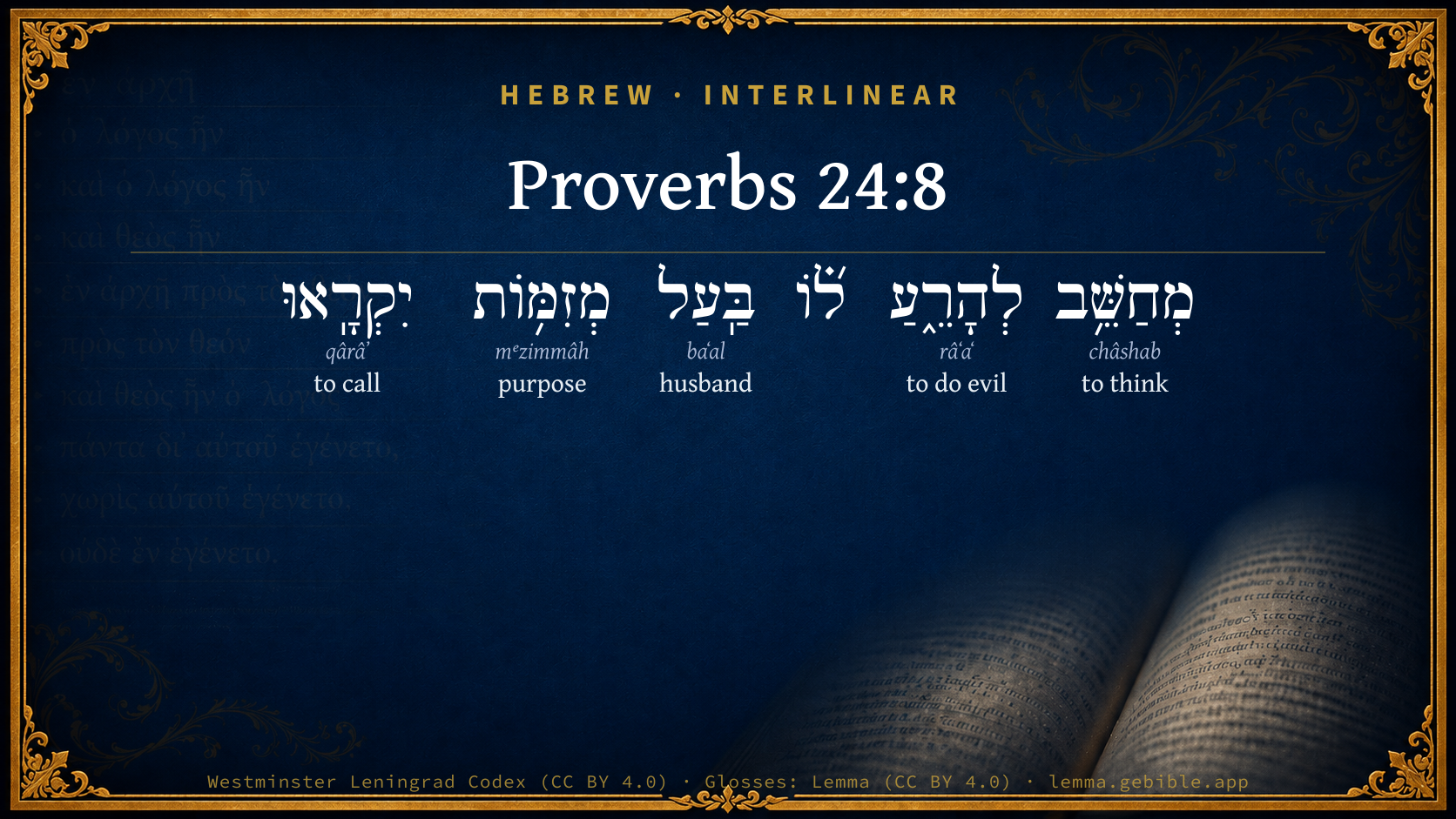
Hebrew (Westminster Leningrad Codex) Proverbs 24:8 appears in the Hebrew Old Testament. The text above is from the Westminster Leningrad Codex. Each word links to its Strong’s number, a concise gloss, and parsing drawn from the Open Scriptures Hebrew Bible morphology. Click any word for its full Brown-Driver-Briggs (BDB) entry.
Download image
Cite this verse

Proverbs 24:8 (World English Bible). Public Domain. Lemma interlinear Bible study tool, https://lemma.gebible.app/v/proverbs/24/8.

Show BibTeX & RIS
BibTeX
RIS
English Translation
One who plots to do evil Will be called a schemer.
World English Bible · Public Domain
Download a study sheet

One document with this verse’s original text, its word-by-word gloss line, the meaning frame, cross-references with their text, attributed commentary, and full source and license credits — printable, and it pastes into notes with its structure intact.

This verse Autodidact and up

Study sheet (.html) Plain text (.txt)

A passage Seminary Student

Up to 50 verses in one chapter. A passage sheet keeps up to 6 commentary sources and 12 cross-references per verse, in the order this page ranks them, and says so on the sheet whenever that leaves anything out. Ask for a single verse and you get the Autodidact verse sheet above.

Everything on this page stays free to read, with no account — the sheet is a download of what is already on screen, not access to it.

Want to remove ads? Support Godless Engineer
Compare translations 3

The same verse in 3 English versions, stacked beneath the original-language interlinear above. Click any original word for its lexicon entry.

Each is an independent rendering of the whole verse — the interlinear is not word-aligned to these translations.

Highlighted words mark where these versions differ — a whole-verse word diff, not a word-by-word alignment.

  • World English Bible Public Domain
    One who plots to do evil Will be called a schemer.
  • King James Version Public Domain
    He that deviseth to do evil shall be called a mischievous person.
  • unfoldingWord Literal Text CC BY-SA 4.0
    One who plans to do evil, they will call him an owner of schemes.

unfoldingWord Literal Text — © unfoldingWord, licensed CC BY-SA 4.0. Word-aligned USFM3 via Door43 (git.door43.org/unfoldingWord/en_ult).

Versions to compare (up to 4)

3 of 4 selected

Show all 18 translations

Every available English version of this verse, each an independent rendering of the whole verse.

  • World English Bible Public Domain
    One who plots to do evil Will be called a schemer.
  • Berean Standard Bible Public Domain
    He who plots evil will be called a schemer.
  • Majority Standard Bible Public Domain
    He who plots evil will be called a schemer.
  • King James Version Public Domain
    He that deviseth to do evil shall be called a mischievous person.
  • American Standard Version (1901) Public Domain
    He that deviseth to do evil, Men shall call him a mischief-maker.
  • Revised Version (1885) Public Domain
    He that deviseth to do evil, men shall call him a mischievous person.
  • Geneva Bible (1599) Public Domain
    Hee that imagineth to doe euill, men shall call him an autour of wickednes.
  • Douay-Rheims (1899) Public Domain
    He that deviseth to do evils, shall be called a fool.
  • Young's Literal Translation Public Domain
    Whoso is devising to do evil, Him they call a master of wicked thoughts.
  • Literal Standard Version CC BY-SA 4.0
    Whoever is devising to do evil, || They call him a master of wicked thoughts.
  • Unlocked Literal Bible CC BY-SA 4.0
    There is one who plans to do evil— people call him a master of schemes.
  • unfoldingWord Literal Text CC BY-SA 4.0
    One who plans to do evil, they will call him an owner of schemes.
  • Darby Bible Public Domain
    He that deviseth to do evil shall be called a master of intrigues.
  • World Messianic Bible Public Domain
    One who plots to do evil will be called a schemer.
  • Webster's Bible Public Domain
    He that deviseth to do evil shall be called a mischievous person.
  • Free Bible Version CC BY-SA 4.0
    Anyone who plans to do evil will be seen as a troublemaker.
  • Bible in Basic English Public Domain
    He whose purposes are bad will be named a man of evil designs.
  • JPS Tanakh (1917) Public Domain
    He that deviseth to do evil, men shall call him a mischievous person.

Literal Standard Version (2020), Covenant Press — licensed CC BY-SA 4.0. Text via the HelloAO Bible API (eBible.org). Unlocked Literal Bible (unfoldingWord) — licensed CC BY-SA 4.0. Text via the HelloAO Bible API (eBible.org). unfoldingWord Literal Text — © unfoldingWord, licensed CC BY-SA 4.0. Word-aligned USFM3 via Door43 (git.door43.org/unfoldingWord/en_ult). Free Bible Version, Dr. Jonathan Gallagher — licensed CC BY-SA 4.0. Text via the HelloAO Bible API (eBible.org).

Word by word

More ways to search: Search by grammar → Find every occurrence → Compare this word →

Practice this passage: Drill this verse → Learn its vocabulary →

About this verse

These counts appear in no published source. They are computed here, from the morphology-tagged text and Lemma’s own curated glosses. What Lemma adds →

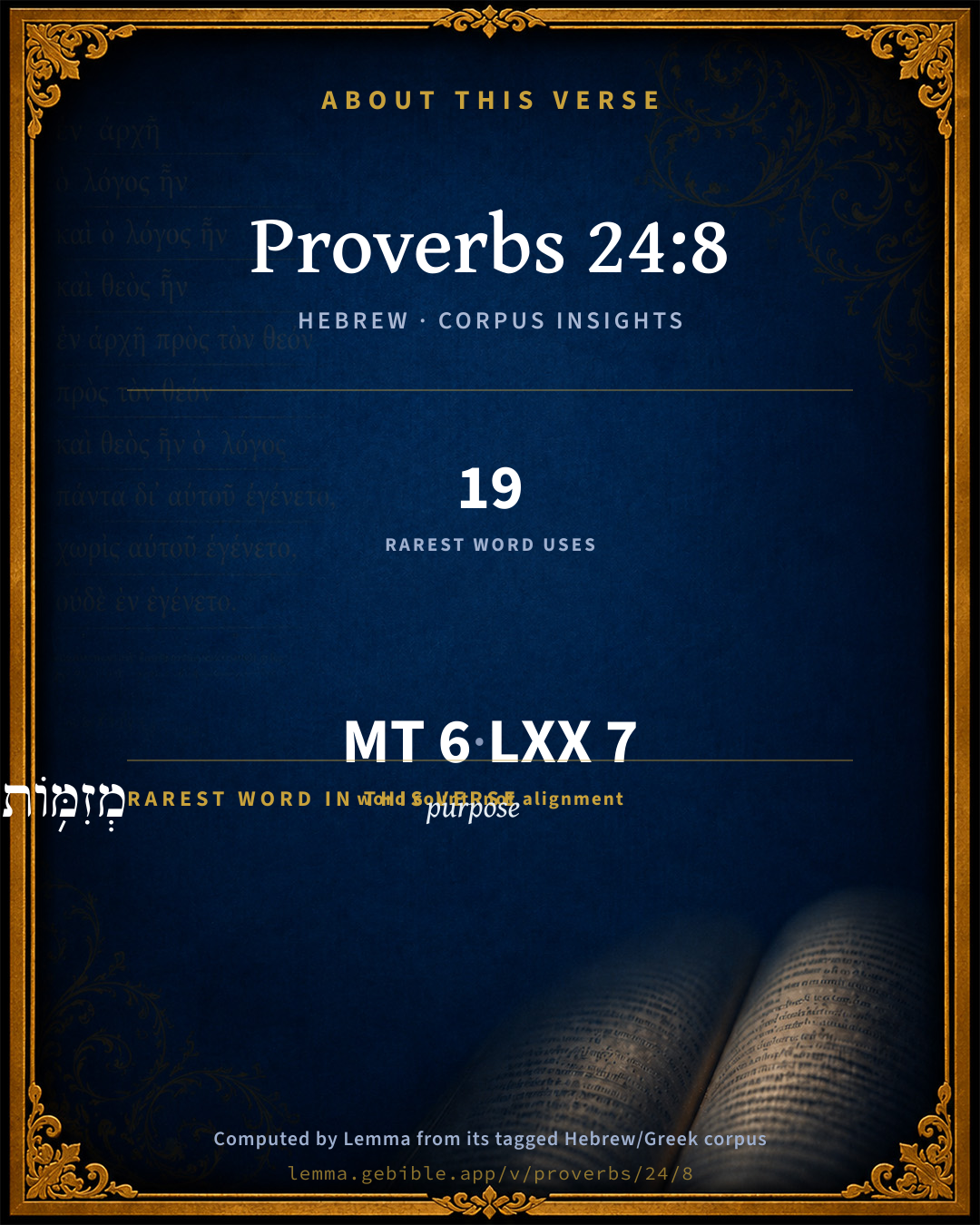
6
words
5
distinct lemmas
Wisdom
section

Notable vocabulary

The rarest word here is מְזִמּ֥וֹת purpose H4209 — appearing just 19 times in the whole Hebrew Bible.

Shared distinctive vocabulary

מְזִמּ֥וֹת purpose H4209 occurs in 19 verses of the Hebrew Bible. Also found in:

Grammatical profile

  • 3 verbs
  • 2 nouns
  • 1 preposition

Verb forms

  • מְחַשֵּׁ֥ב Piel · Participle Active
  • לְהָרֵ֑עַ Hiphil · Infinitive Construct
  • יִקְרָֽאוּ Qal · Imperfect

Hebrew & Septuagint length

In English translation the verse runs 11 words from the Hebrew and 8 from the Septuagint (LXX English) — closely comparable.

A rough comparison of the two English renderings, which tokenize alike — not a word-level alignment.

Word counts can differ between the Hebrew and the Greek without any difference in meaning — e.g. the Hebrew direct-object marker אֵת has no separate Greek word, and Greek often adds the article ὁ.

In the original languages it is 6 Hebrew tokens and 7 Greek tokens — but the two are counted differently (Hebrew bundles its prefixes and suffixes into one token; the Greek is in lemma form), so that isn’t a like-for-like length.

Cross-references

12

Topical passages linked to Proverbs 24:8 in the Treasury of Scripture Knowledge — connected by theme and wording, ordered by reader-vote popularity; previews shown in the World English Bible.

  • Psalms 21:11 For they intended evil against you. They plotted evil against you which cannot succeed.
  • Proverbs 6:14 In whose heart is perverseness, Who devises evil continually, Who always sows discord.
  • Proverbs 6:18 A heart that devises wicked schemes, Feet that are swift in running to mischief,
  • Proverbs 14:22 Don't they go astray who plot evil? But love and faithfulness belong to those who plan good.
  • Ezekiel 38:10–11 Thus says the Lord Yahweh: It shall happen in that day, that things shall come into your mind, and you shall devise an evil device:
  • Romans 1:30 backbiters, hateful to God, insolent, haughty, boastful, inventors of evil things, disobedient to parents,
  • 1 Kings 2:44 The king said moreover to Shimei, You know all the wickedness which your heart is privy to, that you did to David my father: therefore Yahweh shall return your wickedness on your own head.
  • Proverbs 24:2 For their hearts plot violence, And their lips talk about mischief.
  • Proverbs 24:9 The schemes of folly are sin. The mocker is detested by men.
  • Isaiah 10:7–13 However he doesn't mean so, neither does his heart think so; but it is in his heart to destroy, and to cut off not a few nations.
  • Nahum 1:11 There is one gone forth out of you, who devises evil against Yahweh, who counsels wickedness.
  • Isaiah 32:7 The instruments of the churl are evil: he devises wicked devices to destroy the humble with lying words, even when the needy speaks right.

Cross-references courtesy of OpenBible.info (CC BY 4.0).

Hebrew and Greek witnesses Masoretic Hebrew ↔ Greek Septuagint

The same verse in the two great witnesses to the Old Testament, shown verse-for-verse.

These are two independent witnesses, not word-aligned to each other, and the Septuagint is shown in lemma (dictionary) form.

Hebrew Proverbs 24:8 Masoretic · Westminster Leningrad Codex

מְחַשֵּׁ֥ב לְהָרֵ֑עַ ל֝֗וֹ בַּֽעַל מְזִמּ֥וֹת יִקְרָֽאוּ

One who plots to do evil Will be called a schemer.

World English Bible · Public Domain

Greek LXX Proverbs 24:8 Septuagint · lemma form

ἀλλά λογίζομαι ἐν συνέδριον ἀπαίδευτος συνἀντάω θάνατος

but deliberate in council. Death befalls uninstructed men.

LXX2012 (modern English Septuagint) · Public Domain

On this verse, The Pulpit Commentary discusses the Septuagint’s reading. Read the note in Commentary ↓

Hebrew: Westminster Leningrad Codex (CC BY 4.0). Greek: Septuagint (public domain); English from LXX2012 (modern English Septuagint) (Public Domain). How the Septuagint differs from the Hebrew →

Commentary

Notes on Proverbs 24:8 from classic Christian and Jewish commentators (each source and its license shown beneath its notes). The classic Christian expositions comment on the surrounding passage and are grouped to its opening verse, so a note may address several verses; the Jewish commentaries on the Tanakh (Rashi and others) are per-verse, so they appear only where the commentator wrote on this verse.

Lemma curates 59 commentaries, every one of them public domain or Creative Commons licensed, each selected and text-cleaned for this edition rather than reprinted as found. About our sources →

Trapp's Complete Commentary

John Trapp

Pro 24:8 He that deviseth to do evil shall be called a mischievous person.

Ver. 8. Shall be called a mischievous person.] Heb., A master of sinful musings, an artist at any evil. Josephus saith of Antipater, that his course of life might fitly be called a mystery of mischief, {a} quae altissimas egerat radices, &c.

{a} κακιας μυστηριον.

John Trapp, A Commentary or Exposition upon All the Books of the Old and New Testament (1647–1656) — public domain. Text from a community e-Sword module.

Joseph Benson's Commentary

Pro 24:8-9. He that deviseth, &c., shall be called mischievous — Hebrew, בעל מזמות, a master of crafts or mischiefs. Though he cover his wicked devices with fair pretences, and wishes to be better esteemed, he shall be branded with that infamy which is due to him. The thought of foolishness is sin — The very inward thought or contrivance of evil, of which he spake Pro 24:8, even before it break forth into action, is a sin in God’s sight, and is hateful to God; and the scorner — He who not only deviseth and practiseth wickedness, but obstinately persists in it, and rejects all admonitions against it; is an abomination to men — Is abominable not only to God, as all sinners are, but to all sober men.

Joseph Benson's Commentary on the Old and New Testaments (1811–1818) — public domain. Text from a community e-Sword module.

Tyndale Open Study Notes

Tyndale Open Resources

24:8-9 Saying 23: Fools are alienated from the community because of their evil actions.

Tyndale Open Study Notes — © Tyndale Open Resources, licensed CC BY-SA 4.0. Text via the HelloAO Bible API.

Jamieson, Fausset & Brown

Robert Jamieson, A. R. Fausset & David Brown

So called even if he fails to do evil.

Jamieson, Fausset & Brown — Commentary Critical and Explanatory on the Whole Bible (1871) — public domain (CC PDM 1.0). Text via the HelloAO Bible API.

The Cambridge Bible for Schools and Colleges

gen. ed. J. J. S. Perowne

8. shall be called] Lit. they (men) shall call him. However secretly he works (comp. Psa_64:6 [Hebrews 7]), his true character shall be found out, and his reputation shall accord with it.

The Cambridge Bible for Schools and Colleges (gen. ed. J. J. S. Perowne; Cambridge University Press, 1878–1918) — public domain. Text from a community e-Sword module.

John Gill's Exposition

The thoughts of foolishness is sin,.... The thought of sin is sin (e), before it comes into action; the motions of sin in the mind, the workings of corrupt nature in the heart, the sinful desires of the flesh and of the mind: these are forbidden and condemned by the law of God as sin, which says, "Thou shall not covet", Exo 20:17, and stand in need of pardoning grace and mercy; see Rom 7:5. Or, "the thoughts of a foolish man are sin" (f); that is, of a wicked man; in all whose thoughts God is not, but sin is; the imagination of the thoughts of his heart is evil, and that continually; he thinks of nothing else but sin, Gen 6:5;

and the scorner is an abomination to men; who not only thinks ill of divine things, and despises them in his heart, which is only known to God; but scoffs at them with his lips, makes a jest of all that is good, derides religion and religious men; and to such he is an abomination: and indeed one that is proud and haughty, scorner is his name, and that deals in proud wrath, and scorns all around him, in whatsoever company he comes, and that ridicules every person, and every thing that is said in conversation, is usually hated and abhorred by all sorts of men.

(e) "Nam scelus intra se tacitum qui cogitat ullum, facti crimen habet", Juvenal. Satyr. 13. v. 209, 210. (f) "stulti", Pagninus, Junius & Tremellius, Mercerus, Piscator, Gejerus.

John Gill's Exposition of the Whole Bible (1746–1763) — public domain (CC PDM 1.0). Text via the HelloAO Bible API.

Matthew Poole's English Annotations

Heb. a master of mischief. The sense is, Though he cover his wicked devices with fair pretences, and would be better esteemed, yet he shall be noted and branded with that infamy which is due to him.

Matthew Poole's English Annotations on the Holy Bible (1683–1685) — public domain. Text from a community e-Sword/MySword module.

Whedon's Commentary on the Bible

Daniel D. Whedon

8. He that deviseth to do evil — A master of mischief. “Mischief and wrong are his ownership and property.” — Wordsworth. “Inventors of evil things.” Rom_1:30. The inventor or discoverer of a good thing is a benefactor of the race; but he who spends his time in inventing that which will injure his fellow man is the greatest of curses — a fiend incarnate. The same is true of those who follow, though they may not invent, a business or calling which is destructive to the health, life, and morals of their fellow beings. Such is the manufacture and traffic in intoxicating drinks, the making and vending of obscene literature, etc.

Daniel D. Whedon (gen. ed.), Commentary on the Old and New Testaments (1874–1909) — public domain. Text from a community e-Sword module.

The Pulpit Commentary

He that deviseth to do evil. He who shows a certain kind of misapplied cleverness (in contrast to the true wisdom) in planning and pursuing evil schemes. Shall be called. Defined and explained, as Pro_16:21. (comp. Pro_21:24) A mischievous person; literally, lord of mischief; i.e. owner, possessor of mischief. One must not be led by such a man"s apparent astuteness to attribute; to him wisdom; he is an impostor, a mere intriguer, who is sure to be exposed ere long. Septuagint, "Death befalls the undisciplined."

The Pulpit Commentary (1880–1919), ed. H.D.M. Spence-Jones & Joseph S. Exell — public domain. Text from a community e-Sword module.

John Wesley's Explanatory Notes

Shall be called - Though he cover his wicked devices with fair pretenses, he shall be branded with that infamy which is due to him.

John Wesley, Explanatory Notes Upon the Whole Bible (1754–1765) — public domain. Text via the GEBible commentary corpus.

Keil & Delitzsch

C. F. Keil & F. Delitzsch

From wisdom, which is a moral good, the following proverb passes over to a kind of σοφία δαιμονιώδης:

He that meditateth to do evil,

We call such an one an intriguer.

A verbal explanation and definition like Pro 21:24 (cf. p. 29), formed like Pro 16:21 from נבון. Instead of בּעל־מזמּות [lord of mischief] in Pro 12:2, the expression is 'אישׁ מ (cf. at Pro 22:24). Regarding מזמות in its usual sense, vid., Pro 5:2. Such definitions have of course no lexicographical, but only a moral aim. That which is here given is designed to warn one against gaining for himself this ambiguous title of a refined (cunning, versutus) man; one is so named whose schemes and endeavours are directed to the doing of evil. One may also inversely find the turning-point of the warning in 8b: "he who projects deceitful plans against the welfare of others, finds his punishment in this, that he falls under public condemnation as a worthless intriguer" (Elster). But מזמות is a ῥῆμα μέσον, vid., Pro 5:2; the title is thus equivocal, and the turning-point lies in the bringing out of his kernel: מחשּׁב להרע = meditating to do evil.

Keil & Delitzsch — Biblical Commentary on the Old Testament (1861–1891) — public domain (CC PDM 1.0). Text via the HelloAO Bible API. (Old Testament only.)

Bridges on Proverbs

Charles Bridges

What a picture is here of human depravity, in its active working, its corrupt fountain, and its fearful end! Talent, imagination, active mind, is so debased, as to be all concentrated upon Satan’s own work — devising to do evil.†1 He was the first deviser (Gen 3:1 ), and he practices his children, till he makes them, like himself, masters of mischief; contriving new modes of sinning, ways of trickery and deceit; like the degraded heathen, "inventors of evil things." (Rom 1:30 .) To do evil is the principle; devising to do evil is the energy, of his service. In this craft of evil, Balaam was a mischievous person.†2 Abimelech has earned for himself the same reputation. (Jdg 9:1-55 .) Jeroboam’s subtle mischief has stamped his name with the black mark of reprobation — "who made Israel to sin."†3 Jezebel,†4 and others of less note, equally industrious in evil, will appear in the same ranks at the great day.

Even when it is not brought out into action, the thought of foolishness — giving it lodgment (Jer 4:14 ), instead of casting it out as loathsome — is sin. ’But what guilt’ — it is asked — ’can there be in a thought? It is but an airy notion; next to nothing. It can make no impression. A malicious thought cannot hurt. A covetous thought cannot rob. What guilt or danger can belong to so minute a being?’ Perhaps did we deal with man, these might be trifling evils. But as the thought is the fountain of the act, God counts it in the act, and holds us responsible for it.†5 The smallest sin involves us in the breach of the whole law. (Jas 2:10-11 .) This is his decision; and who can answer against it? The most spiritual Christians lay their hands upon their mouths, "and their mouths in the dust."†6

The awakened sinner admits his total depravity upon the same demonstration as his own existence — consciousness. One sin gives birth to another. Countless multitudes follow in rapid and continuous succession. "Every imagination of the thoughts of the heart is only evil continually." (Gen 6:5 .) Did we fully realize this apprehension, the flitting moments of the day, each bringing with it an increase of guilt, could not slide away so pleasantly from us; not at least without shame and humiliation; without habitual application of the divine remedy. Job’s sensitive conscience carried his sons continually to the atoning sacrifice. (Job 1:5 .) Bunyan (unlike many loose professors, who are never troubled about their thoughts) was deeply afflicted in the remembrance of one sinful thought. Nor let this be condemned as a morbid temperament. Is it not rather the tender sensibility of a heart humbled by the continual view of the great sin-offering? Our sensibilities rise in proportion to our spiritual apprehensions. Even a passing shade of sin, did we suitably realize it — it might well be a matter of poignant bitterness. A believing sorrow for heart-sins — however involuntary — is a clear mark of divine grace and teaching: issuing in deep humiliation, not with despondency. (Rom 7:15-25 .)

But let us follow out this thought of foolishness unrestrained. It commits an immensity of folly. The thinking faculty is never wearied out. It is the fruitful principle of sin, which, ’the more it is committed’ (as it has been no less truly than philosophically remarked), ’the more it acquireth in the quality of evil.’†7 The thought therefore gathers strength in every acting, till its full influence is developed in the "scorner’s seat" (Psa 1:1 ) — an abomination, not only to God, but to man.†8 For however misused wit and talent may gain for the fool a bad pre-eminence; he secures no respect, and is generally avoided or dreaded, and ultimately brought to shame.†9

Footnotes:

†1 Pro 24:2. Psa 36:3-4 .

†2 Num 31:16. Rev 2:14 .

†3 1Ki 12:26-33 ; 1Ki 15:30 .

†4 1Ki 21:25 . Rev 2:20 .

†5 Compare Pro 15:26 . Psa 94:11 . Mat 9:3-4 ; Mat 15:19 . Act 8:22 . Rom 2:15 .

Even an Heathen moralist could write —

Nam scelus intra se tacitum qui cogitat ullum,

Facti crimen habet. — Juv. xiii. 209, 210.

†6 Pro 30:32. Job 40:4 . Lam 3:29 .

†7 Sir T. Browne, Rel. Med. p. 101. Edit. 1642.

†8 Pro 21:24. Mal 2:8-9 .

†9 Jer 36:23, with Jer 22:19 .

Charles Bridges, An Exposition of the Book of Proverbs (1846) — public domain. Text from a community e-Sword module.

Kretzmann's Popular Commentary

Paul E. Kretzmann

v. 8. He that deviseth to do evil, with whom mischief and wrong is self-evident, who is the master of wickedness, shall be called a mischievous person, his evil reputation will soon be well established.

Paul E. Kretzmann, Popular Commentary of the Bible (1921–1924) — public domain. Text from a community e-Sword module.

unfoldingWord translationNotes

Door43 World Missions Community

General Information:

These verses continue the "thirty sayings" (Proverbs 22:20).

a master of schemes

one who is skillful at making evil plans. AT: "a mischievous person" or "a troublemaker"

translationWords

evil

lord

fool

sin

mock

unfoldingWord translationNotes — © Distant Shores Media and the Door43 World Missions Community, licensed CC BY-SA 4.0. Source: git.door43.org/Door43/en_tn.

Rashi

Rabbi Shlomo Yitzchaki (Rashi)

He who plots to do evil He plans strategies of wickedness.

is called a man of wicked designs He brings harm to himself, for people call him a man of wicked designs, a counsel of the wicked.

Rashi on the Tanakh — English translations: “The Judaica Press complete Tanach with Rashi, translated by A. J. Rosenberg” (CC BY 4.0); “Pentateuch with Rashi's commentary by M. Rosenbaum and A.M. Silbermann, 1929-1934” (public domain); “The Metsudah Tanach series, Lakewood, N.J” (CC BY 4.0); and “The Book of Joshua, Metsudah Publications, 1997” (CC BY 4.0). Text via Sefaria.

Lesson kit

Teaching starters — assembled from the data on this page, not authored interpretation. Every prompt links to the verse data it draws on. Edit before teaching.

Proverbs, in the Wisdom, opens this verse with 6 words (5 distinct Hebrew lemmas). Its most distinctive word is mᵉzimmâh (“purpose”). A historical commentator’s framing appears above. Read the whole chapter for the surrounding context.

Discussion questions

  1. What does “purpose” (mᵉzimmâh) contribute to the verse as a whole?
  2. How does Job 21:27, which shares the word «purpose», read alongside this verse?
  3. The translations on this page render this verse differently — a whole-verse word diff, not a word-by-word alignment. What might account for the different wordings?
  4. «מְחַשֵּׁ֥ב» is a Piel Participle Active verb. How does that grammatical form shape the action described?
  5. Compare how Trapp's Complete Commentary and Joseph Benson's Commentary read this verse. Where do they agree or differ?

Things to notice

Reading settings

Reading text

Shown beneath each verse's original-language words.

Old Testament
Old Testament edition

Read the OT as the Masoretic Hebrew (MT) or the Greek Septuagint (LXX).

English shown for the Greek Septuagint (in the Hebrew ↔ Greek comparison).

Comparing translations? Open the Compare panel on any verse page to stack up to four side by side.