Judges 9:46

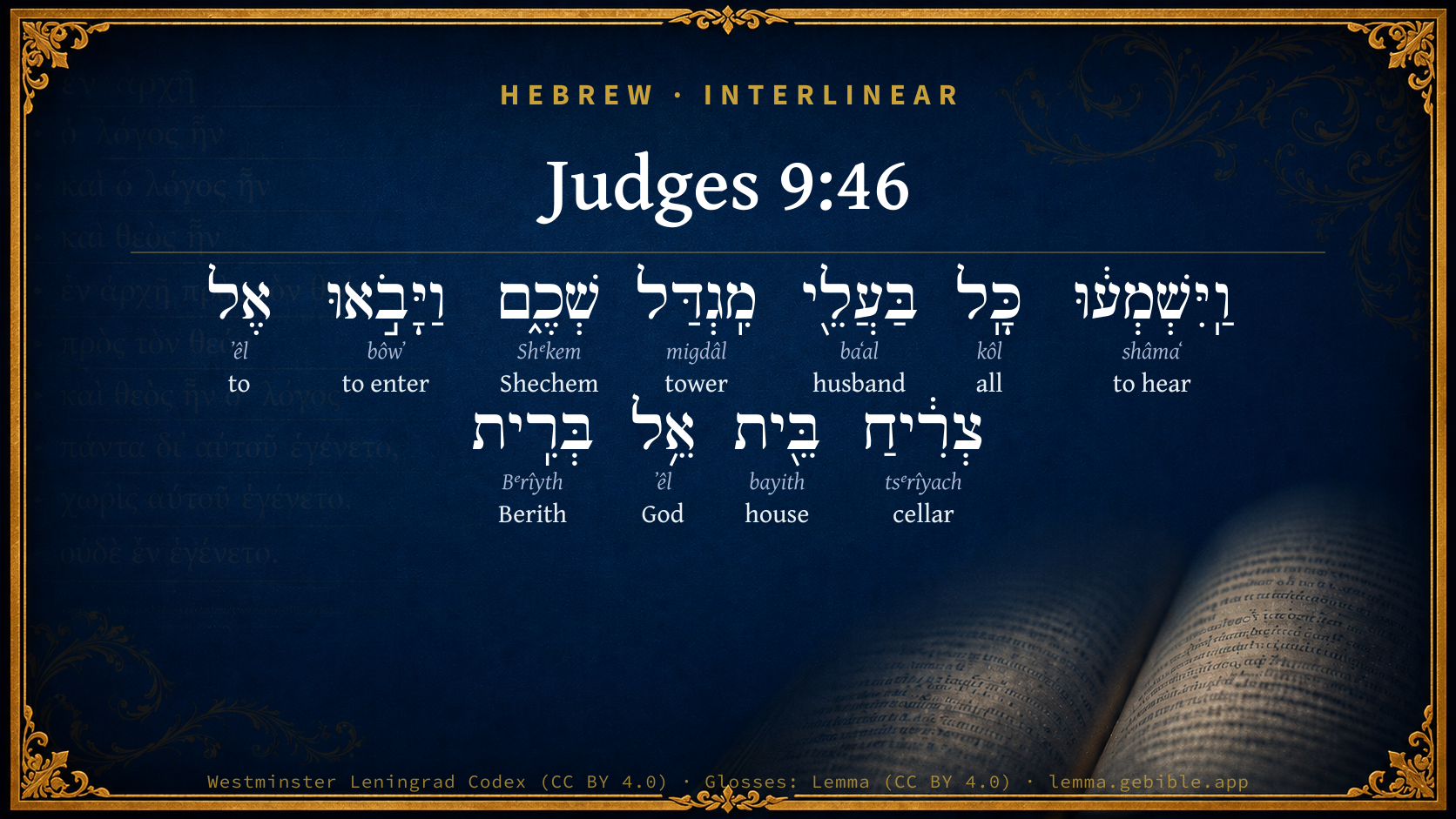
Hebrew (Westminster Leningrad Codex) Judges 9:46 appears in the Hebrew Old Testament. The text above is from the Westminster Leningrad Codex. Each word links to its Strong’s number, a concise gloss, and parsing drawn from the Open Scriptures Hebrew Bible morphology. Click any word for its full Brown-Driver-Briggs (BDB) entry.
Download image
Cite this verse

Judges 9:46 (World English Bible). Public Domain. Lemma interlinear Bible study tool, https://lemma.gebible.app/v/judges/9/46.

Show BibTeX & RIS
BibTeX
RIS
English Translation
When all the men of the tower of Shechem heard of it, they entered into the stronghold of the house of Elberith.
World English Bible · Public Domain
Highlights
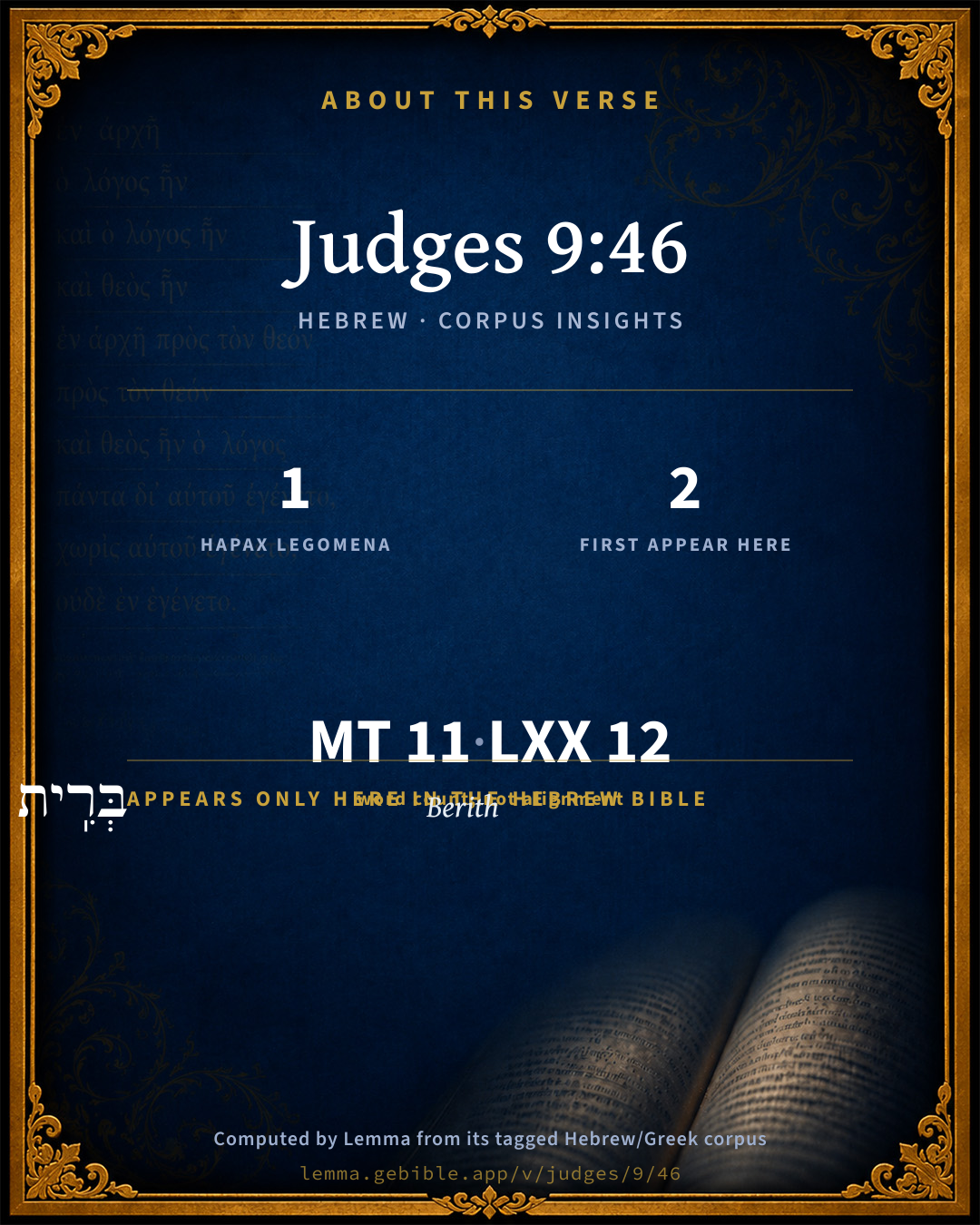
  • 1 hapax legomenon — only here in the Hebrew Bible
  • 2 first appearances in the Hebrew Bible
Full analysis ↓
Download a study sheet

One document with this verse’s original text, its word-by-word gloss line, the meaning frame, cross-references with their text, attributed commentary, and full source and license credits — printable, and it pastes into notes with its structure intact.

This verse Autodidact and up

Study sheet (.html) Plain text (.txt)

A passage Seminary Student

Up to 50 verses in one chapter. A passage sheet keeps up to 6 commentary sources and 12 cross-references per verse, in the order this page ranks them, and says so on the sheet whenever that leaves anything out. Ask for a single verse and you get the Autodidact verse sheet above.

Everything on this page stays free to read, with no account — the sheet is a download of what is already on screen, not access to it.

Want to remove ads? Support Godless Engineer
Compare translations 3

The same verse in 3 English versions, stacked beneath the original-language interlinear above. Click any original word for its lexicon entry.

Each is an independent rendering of the whole verse — the interlinear is not word-aligned to these translations.

Highlighted words mark where these versions differ — a whole-verse word diff, not a word-by-word alignment.

  • World English Bible Public Domain
    When all the men of the tower of Shechem heard of it, they entered into the stronghold of the house of Elberith.
  • King James Version Public Domain
    And when all the men of the tower of Shechem heard that, they entered into an hold of the house of the god Berith.
  • unfoldingWord Literal Text CC BY-SA 4.0
    And all of the lords of the tower of Shechem heard, and they entered into the citadel of the house of El-Berith.

unfoldingWord Literal Text — © unfoldingWord, licensed CC BY-SA 4.0. Word-aligned USFM3 via Door43 (git.door43.org/unfoldingWord/en_ult).

Versions to compare (up to 4)

3 of 4 selected

Show all 18 translations

Every available English version of this verse, each an independent rendering of the whole verse.

  • World English Bible Public Domain
    When all the men of the tower of Shechem heard of it, they entered into the stronghold of the house of Elberith.
  • Berean Standard Bible Public Domain
    On hearing of this, all the leaders in the tower of Shechem entered the inner chamber of the temple of El-berith.
  • Majority Standard Bible Public Domain
    On hearing of this, all the leaders in the tower of Shechem entered the inner chamber of the temple of El-berith.
  • King James Version Public Domain
    And when all the men of the tower of Shechem heard that, they entered into an hold of the house of the god Berith.
  • American Standard Version (1901) Public Domain
    And when all the men of the tower of Shechem heard thereof, they entered into the stronghold of the house of Elberith.
  • Revised Version (1885) Public Domain
    And when all the men of the tower of Shechem heard thereof, they entered into the hold of the house of El-berith.
  • Geneva Bible (1599) Public Domain
    And when all the men of the towre of Shechem heard it, they entred into an holde of the house of the god Berith.
  • Douay-Rheims (1899) Public Domain
    And when they who dwelt in the tower of Sichem had heard this, they went into the temple of their god Berith where they had made a covenant with him, and from thence the place had taken its name, and it was exceeding strong.
  • Young's Literal Translation Public Domain
    And all the masters of the tower of Shechem hear, and go in unto the high place of the house of the god Berith,
  • Literal Standard Version CC BY-SA 4.0
    And all the masters of the Tower of Shechem hear, and go into the high place of the house of the god Berith,
  • Unlocked Literal Bible CC BY-SA 4.0
    When all the leaders of the tower of Shechem heard of it, they entered the stronghold of the house of El-Berith.
  • unfoldingWord Literal Text CC BY-SA 4.0
    And all of the lords of the tower of Shechem heard, and they entered into the citadel of the house of El-Berith.
  • Darby Bible Public Domain
    When all the people of the Tower of Shechem heard of it, they entered the stronghold of the house of El-be'rith.
  • World Messianic Bible Public Domain
    When all the men of the tower of Shechem heard of it, they entered into the stronghold of the house of Elberith.
  • Webster's Bible Public Domain
    And when all the men of the tower of Shechem heard that, they entered into a hold of the house of the god Berith.
  • Free Bible Version CC BY-SA 4.0
    When all the leaders of the tower of Shechem realized what had happened, they took refuge in the strongroom of the temple of El-berith.
  • Bible in Basic English Public Domain
    Then all the townsmen of the tower of Shechem, hearing of it, went into the inner room of the house of El-berith.
  • JPS Tanakh (1917) Public Domain
    And when all the men of the tower of Shechem heard thereof, they entered into the hold of the house of El-berith.

Literal Standard Version (2020), Covenant Press — licensed CC BY-SA 4.0. Text via the HelloAO Bible API (eBible.org). Unlocked Literal Bible (unfoldingWord) — licensed CC BY-SA 4.0. Text via the HelloAO Bible API (eBible.org). unfoldingWord Literal Text — © unfoldingWord, licensed CC BY-SA 4.0. Word-aligned USFM3 via Door43 (git.door43.org/unfoldingWord/en_ult). Free Bible Version, Dr. Jonathan Gallagher — licensed CC BY-SA 4.0. Text via the HelloAO Bible API (eBible.org).

Word by word

More ways to search: Search by grammar → Find every occurrence → Compare this word →

Practice this passage: Drill this verse → Learn its vocabulary →

About this verse

These counts appear in no published source. They are computed here, from the morphology-tagged text and Lemma’s own curated glosses. What Lemma adds →

11
words
11
distinct lemmas
Historical
section

Notable vocabulary

1 hapax legomenon — a word that appears only here in the entire Hebrew Bible:

  • בְּרִֽית Berith H1286

First appearance in Scripture

These words make their first canonical appearance in the Hebrew Bible here:

  • צְרִ֔יחַ cellar H6877
  • בְּרִֽית Berith H1286

Shared distinctive vocabulary

צְרִ֔יחַ cellar H6877 occurs in 3 verses of the Hebrew Bible. Also found in:

Grammatical profile

  • 2 verbs
  • 8 nouns
  • 1 preposition

Verb forms

  • וַֽיִּשְׁמְע֔וּ Qal · Sequential Imperfect
  • וַיָּבֹ֣אוּ Qal · Sequential Imperfect

Hebrew & Septuagint length

In English translation the verse runs 22 words from the Hebrew and 17 from the Septuagint (LXX English) — closely comparable.

A rough comparison of the two English renderings, which tokenize alike — not a word-level alignment.

Word counts can differ between the Hebrew and the Greek without any difference in meaning — e.g. the Hebrew direct-object marker אֵת has no separate Greek word, and Greek often adds the article ὁ.

In the original languages it is 11 Hebrew tokens and 12 Greek tokens — but the two are counted differently (Hebrew bundles its prefixes and suffixes into one token; the Greek is in lemma form), so that isn’t a like-for-like length.

Cross-references

8

Topical passages linked to Judges 9:46 in the Treasury of Scripture Knowledge — connected by theme and wording, ordered by reader-vote popularity; previews shown in the World English Bible.

  • Judges 8:33 It happened, as soon as Gideon was dead, that the children of Israel turned again, and played the prostitute after the Baals, and made Baal Berith their god.
  • Judges 9:4 They gave him seventy [pieces] of silver out of the house of Baal Berith, with which Abimelech hired vain and light fellows, who followed him.
  • Psalms 115:8 Those who make them will be like them; Yes, everyone who trusts in them.
  • Judges 9:27 They went out into the field, and gathered their vineyards, and trod [the grapes], and held festival, and went into the house of their god, and did eat and drink, and cursed Abimelech.
  • 1 Kings 8:26 Now therefore, God of Israel, Please let your word be verified, which you spoke to your servant David my father.
  • 2 Kings 1:2–4 Ahaziah fell down through the lattice in his upper chamber that was in Samaria, and was sick: and he sent messengers, and said to them, Go, inquire of Baal Zebub, the god of Ekron, whether I shall recover of this sickness.
  • Isaiah 28:15–18 Because you have said, We have made a covenant with death, and with Sheol are we at agreement; when the overflowing scourge shall pass through, it shall not come to us; for we have made lies our refuge, and under falsehood have we hid ourselves:
  • Isaiah 37:38 It happened, as he was worshipping in the house of Nisroch his god, that Adrammelech and Sharezer his sons struck him with the sword; and they escaped into the land of Ararat. Esar Haddon his son reigned in his place.

Cross-references courtesy of OpenBible.info (CC BY 4.0).

Hebrew and Greek witnesses Masoretic Hebrew ↔ Greek Septuagint

The same verse in the two great witnesses to the Old Testament, shown verse-for-verse.

These are two independent witnesses, not word-aligned to each other, and the Septuagint is shown in lemma (dictionary) form.

Hebrew Judges 9:46 Masoretic · Westminster Leningrad Codex

וַֽיִּשְׁמְע֔וּ כָּֽל בַּעֲלֵ֖י מִֽגְדַּל שְׁכֶ֑ם וַיָּבֹ֣אוּ אֶל צְרִ֔יחַ בֵּ֖ית אֵ֥ל בְּרִֽית

When all the men of the tower of Shechem heard of it, they entered into the stronghold of the house of Elberith.

World English Bible · Public Domain

Greek LXX Judges 9:46 Septuagint · lemma form

καί ἀκούω πᾶς ὁ ἀνήρ πύργος συχεμ καί ἔρχομαι εἰς συνέλευσις βαιθηλβεριθ

And all the men of the tower of Sychem heard, and came to the gathering of Baethel-berith.

LXX2012 (modern English Septuagint) · Public Domain

On this verse, Ellicott's Commentary for English Readers discusses the Septuagint’s reading. Read the note in Commentary ↓

Hebrew: Westminster Leningrad Codex (CC BY 4.0). Greek: Septuagint (public domain); English from LXX2012 (modern English Septuagint) (Public Domain). How the Septuagint differs from the Hebrew →

Targum (Aramaic paraphrase)

1

The Targum is the ancient Jewish Aramaic paraphrase of the Hebrew Scriptures — an interpretive translation, not the Hebrew text itself. Onkelos (literal) and Pseudo-Jonathan (expansive) render the Torah, and Jonathan the Prophets. Coverage is partial: where no permissively-licensed English translation exists for a verse, only the Aramaic is shown. This is verse-level text, not a word-by-word alignment to the Hebrew.

  1. Targum Jonathan Prophets (Joshua–Malachi)
    וּשְׁמָעוּ כָּל יַתְבֵי מִגְדַל שְׁכֶם וַאֲתוֹ לִצְרִיחַ בֵּית אֵל לְמִגְזַר קְיָם:

    (no public-domain English translation for this verse)

    Targum Jonathan — Aramaic: “Mikraot Gedolot” (public domain). English: “Sefaria Community Translation” (CC0 1.0 (public-domain dedication)); “London "Chaldee Paraphrase," 1871” (public domain). Text via Sefaria.

Commentary

Notes on Judges 9:46 from classic Christian and Jewish commentators (each source and its license shown beneath its notes). The classic Christian expositions comment on the surrounding passage and are grouped to its opening verse, so a note may address several verses; the Jewish commentaries on the Tanakh (Rashi and others) are per-verse, so they appear only where the commentator wrote on this verse.

Lemma curates 59 commentaries, every one of them public domain or Creative Commons licensed, each selected and text-cleaned for this edition rather than reprinted as found. About our sources →

Trapp's Complete Commentary

John Trapp

Jdg 9:46 And when all the men of the tower of Shechem heard [that], they entered into an hold of the house of the god Berith.

Ver. 46. Into an hold of the house of the god Berith.] This was as if a man should run into a stack of straw or barrel of gunpowder, to secure himself from a raging fire. Their covenant with Baal, that image of jealousy, {Eze 8:3} was the cause of their ruin. They looked upon this hold as both a fort and a sanctuary; but it saved them not.

John Trapp, A Commentary or Exposition upon All the Books of the Old and New Testament (1647–1656) — public domain. Text from a community e-Sword module.

Joseph Benson's Commentary

Jdg 9:46. When the men of the tower heard — Either a strong place belonging to the city of Shechem, and made for its defence without the city, or perhaps a town at some distance from Shechem, but probably inhabited by Shechemites. When these people heard of the fate of the city, they retired to a strong hold adjoining to one of their temples, which used to be built on eminences, and to be fortified by nature as well as art. Hither they fled, fearing the same destruction which had befallen Shechem, and here they hoped to be secure, partly by the strength of the place, and partly by the religion of it, thinking that either their god Baal-berith would protect them there, or that Abimelech would spare them out of regard to that god.

Joseph Benson's Commentary on the Old and New Testaments (1811–1818) — public domain. Text from a community e-Sword module.

Geneva Bible (1599)

Geneva Bible translators

That is, of Baal-Berith, as Judg. 8:33.

Geneva Bible (1599) marginal notes — public domain. Text via Bolls.life.

Adam Clarke's Commentary

Verse 46. A hold of the house of the god Berith.] This must mean the precincts of the temple, as we find there were a thousand men and women together in that place.

Adam Clarke's Commentary on the Bible (1810–1826) — public domain. Text from a community e-Sword/MySword module.

Ellicott's Commentary for English Readers

(46) The men of the tower of Shechem.—Evidently the garrison of the house of Millo (Jdg_9:6).

Entered into an hold.—The word for “hold” occurs in 1Sa_13:6 (“high place”). The LXX. render it “a fortress” (ochuroma); Luther, “Festung.” In the Æthiopic Version of Mar_16:15 a similar word is used for “upper room.” The Vulg. has, “They entered the fane of their god Berith, where they had made their league with him, and from this the place had received its name, and it was strongly fortified.”

Of the house of the god Berith.—Similarly. Arcesilas burnt the Cyrenæns in a tower (Herod. iv. 164), and in 1Ma_5:43 the defeated enemy fly for refuge to the temple of Ashtaroth in Karnaim, which Judas takes and burns.

A Bible Commentary for English Readers, edited by Charles John Ellicott (1878–1897) — public domain. Text from a community e-Sword module.

The Cambridge Bible for Schools and Colleges

gen. ed. J. J. S. Perowne

46. the tower of Shechem] Migdal-Shechem or Tower of Shechem, not the citadel of S., but an unwalled village in the neighbourhood, marked by a tower, cf. Jdg_8:9; Jdg_8:17.

the hold of the house of El-berith) The rendering hold Jdg_9:49, i.e. an underground excavation, suits the only other place where the word (ṣerîaḥ) occurs, 1Sa_13:6; in Nabataean Aramaic the word is used for the vault of a grave (NSI., pp. 237, 241); it is frequently found in Arabic epitaphs from Egypt with the sense of tomb (Clermont Ganneau, Recueil d’Arch. Or., vii. p. 200). So in Jdg_9:49; they laid the faggots upon the vault, set the vault on fire over the heads of the people within. For El-bĕrîth cf. Jdg_9:4, Jdg_8:33 Baal-bĕrîth.

The Cambridge Bible for Schools and Colleges (gen. ed. J. J. S. Perowne; Cambridge University Press, 1878–1918) — public domain. Text from a community e-Sword module.

John Gill's Exposition

And it was told Abimelech,.... Who had his spies about, and particularly to observe the motions of the men in this tower:

that all the men of the tower of Shechem were gathered together; in the hold of the temple of Baalberith.

John Gill's Exposition of the Whole Bible (1746–1763) — public domain (CC PDM 1.0). Text via the HelloAO Bible API.

Albert Barnes' Notes on the Bible

An hold of the house of the god Berith - As combining the advantages of a “sanctuary” (compare 1Ki 2:28) and a fortress. The word rendered “hold” occurs elsewhere only in 1Sa 13:6, where it is rendered “high-place.” Its exact signification is uncertain.

Albert Barnes' Notes on the Bible (1834–1885) — public domain. Text from a community e-Sword/MySword module.

Haydock's Catholic Bible Commentary

Tower. Serarius thinks it was the house of Mello, out of the city, ver. 6. (Menochius) --- It was the citadel, large enough to contain 1000 soldiers. They durst not, however, stop here to encounter Abimelech, but retired to the temple, either because it was still stronger and higher, or in hopes that they would be secure, on account of the veneration (Calmet) to which the place was entitled among the idolaters. --- Berith. Protestants, "they entered into an hold of the house of the god Berith." Septuagint, "of the covenant." (Haydock) --- Where, &c., is added by way of explanation, (Calmet) except the word strong, which the Septuagint render ochuroma, "a fortress." The tower and temple seem to have been contiguous, since Abimelech, by setting fire to the tower, destroyed these people at the same time, ver. 49. (Haydock)

George Leo Haydock (1774–1849), Haydock's Catholic Family Bible and Commentary, 1859 edition — public domain. Excludes Psalms (Douay-Rheims chapter numbering differs from Protestant) and Deuterocanonical books (Catholic canon only).

Matthew Poole's English Annotations

The tower of Shechem; a strong place belonging to the city of Shechem, and made for its defence or security, but without the city. It is thought this was that Milo which was confederate with Shechem in their design for Abimelech, Jdg 9:6, which also Jotham cursed with Shechem, Jdg 9:20, and that curse is noted to have its effect, Jdg 9:57. And this place may be called the tower of Shechem, either because those who possessed and defended it were sent from Shechem, or because it was built and kept for the safeguard of Shechem.

The house of the god Berith; or, Baal-berith, Jdg 9:4. Hither they fled out of the town belonging to it, fearing the same event with Shechem; and here they thought to be secure; partly by the strength of the place, as the temples of idols were ofttimes built in the highest and strongest places, as the capitol at Rome, and the temple at Jerusalem; and such this place seems to have been, because they laid their treasure here, Jdg 9:4, partly by the religion of it, thinking that either their god would protect them there, or that Abimelech would spare them there, if not out of piety to that god, yet out of thankfulness for the benefit which he received thence, Jdg 9:4.

Matthew Poole's English Annotations on the Holy Bible (1683–1685) — public domain. Text from a community e-Sword/MySword module.

Whedon's Commentary on the Bible

Daniel D. Whedon

46. Men of the tower — These were the same as the house of Millo. Jdg_9:6; Jdg_9:20. Fire had already come out from Abimelech and devoured the men of Shechem, but the lords of the castle are yet more literally to feel its burnings.

A hold — צריח, a pit, a cellar, a hole for concealment, a deep covered place. (Furst, Lex.) The word occurs again only at 1Sa_13:6. The lords of the tower of Shechem, feeling no longer secure in their citadel, fled for refuge into a covered hold in the sanctuary of their god, but fire came out from Abimelech and devoured them even there.

Daniel D. Whedon (gen. ed.), Commentary on the Old and New Testaments (1874–1909) — public domain. Text from a community e-Sword module.

The Pulpit Commentary

The men of the tower of Sechem. The tower of Shechem is no doubt the same fortified building as was spoken of in vers. 6 and 20 by the name of the house of Millo (see note to ver. 6). An, or rather the, hold. The word so rendered occurs elsewhere only in 1Sa_13:6, where it is rendered high places, and is coupled with caves, thickets, rocks, and pits, as one of the hiding-places of the Israelites from the Philistines. It was probably some kind of keep built on an eminence, and the place where the treasure of the temple was kept (ver. 4). It appears from the narrative that the tower of Shechem, or house of Millo, was not actually part of Shechem, nor immediately contiguous, since the report of the capture of Shechem had to be carried thither. The god Berith. It should rather be Elberith, the same as Baal-berith in ver. 4El, i.e. god, being substituted for Baal.

The Pulpit Commentary (1880–1919), ed. H.D.M. Spence-Jones & Joseph S. Exell — public domain. Text from a community e-Sword module.

John Wesley's Explanatory Notes

The tower - A strong place belonging to the city of Shechem, made for its defense without the city. Berith - Or, Baal-berith, ver. 4. Hither they fled out of the town belonging to it, fearing the same event with Shechem; and here they thought to be secure; partly by the strength of the place, partly by the religion of it, thinking that either their God would protect them there, or that Abimelech would spare them out of pity to that God.

John Wesley, Explanatory Notes Upon the Whole Bible (1754–1765) — public domain. Text via the GEBible commentary corpus.

Keil & Delitzsch

C. F. Keil & F. Delitzsch

When the inhabitants of the castle of Shechem ("lords of the tower of Shechem" = "all the house of Millo," Jdg 9:6) heard of the fate of the town of Shechem, they betook themselves to the hold of the house (temple) of the covenant god (Baal-berith), evidently not for the purpose of defending themselves there, but to seek safety at the sanctuary of their god from fear of the vengeance of Abimelech, towards whom they also had probably acted treacherously. The meaning of the word צריח, which answers to an Arabic word signifying arx, palatium, omnis structura elatior, cannot be exactly determined, as it only occurs again in Sa1 13:6 in connection with caves and clefts of the rock. According to v. 49, it had a roof which could be set on fire. The meaning "tower" is only a conjecture founded upon the context, and does not suit, as צריח is distinguished from מגדּל.

Jdg 9:47-49

As soon as this was announced to Abimelech, he went with all his men to Mount Zalmon, took hatchets in his hand, cut down branches from the trees, and laid them upon his shoulders, and commanded his people to do the same. These branches they laid upon the hold, and set the hold on fire over them (the inhabitants of the tower who had taken refuge there), so that all the people of the tower of Shechem (about one thousand persons) perished, both men and women. Mount Zalmon, which is mentioned again in Psa 68:15, was a dark, thickly-wooded mountain near Shechem, - a kind of "Black Forest," as Luther has rendered the name. The plural kardumoth, "axes," may be explained on the ground that Abimelech took axes not only for himself but for his people also. מה in a relative sense, as in Num 23:3 (see Ewald, 331, b.).

Keil & Delitzsch — Biblical Commentary on the Old Testament (1861–1891) — public domain (CC PDM 1.0). Text via the HelloAO Bible API. (Old Testament only.)

Kretzmann's Popular Commentary

Paul E. Kretzmann

The End of Abimelech

v. 46. And when all the men of the tower of Shechem, probably the same as Beth-Millo, the fortress of the city, heard that, they entered into an hold of the house of the god Berith, thinking they would be safe in the sanctuary,

v. 47. And it was told Abimelech that all the men of the tower of Shechem were gathered together.

v. 48. And Abimelech gat him up to Mount Zalmon, so called from its wooded heights, he and all the people that were with him; and Abimelech took an ax in his hand, and cut down a bough from the trees, and took it, and laid it on his shoulder, all this being told with the details noted by an eye-witness, and said unto the people that were with him, What ye have seen me do, make haste and do as I have done.

v. 49. And all the people, in obedience to his command. likewise cut down every man his bough, and followed Abimelech, and put them to the hold, which the men of the tower had considered a refuge, and set the hold on fire upon them, so that all the men of the tower of Shechem died also, about a thousand men and women, suffocated by the smoke and consumed by the flames.

v. 50. Then went Abimelech to Thebez, evidently not far from Shechem, and encamped against Thebez, and took it, the city proper.

v. 51. But there was a strong tower within the city, and thither fled all the men and women and all they of the city, and shut it to them, locked and barred it securely, and gat them up to the top of the tower.

v. 52. And Abimelech came unto the tower, and fought against it, and went hard unto the door of the tower to burn it with fire, thereby stepping closely to the wall.

v. 53. And a certain woman cast a piece of a millstone, the upper stone, known as the runner, upon Abimelech’s head, and all to (wholly) brake his skull, crushing its bones.

v. 54. And he called hastily unto the young man, his armor-bearer, and said unto him, Draw thy sword and slay me, that men say not of me, A woman slew him. Thus he was fierce and warlike to the end, determined not to have appearances against him. And his young man thrust him through, and he died.

v. 55. And when the men of Israel saw that Abimelech was dead, they departed every man unto his place. The siege was raised and the dead chieftain forsaken.

v. 56. Thus God rendered the wickedness of Abimelech which he did unto his father in slaying his seventy brethren;

v. 57. and all the evil of the men of Shechem did God render upon their heads; and upon them came the curse of Jotham, the son of Jerubbaal. God often pursues that course, punishing wicked people by wicked people, overthrowing rebels by rebels. His avenging hand finds both the seducers and the seduced.

Paul E. Kretzmann, Popular Commentary of the Bible (1921–1924) — public domain. Text from a community e-Sword module.

unfoldingWord translationNotes

Door43 World Missions Community

the house

Here this represents a temple. (See: Metonymy)

El-Berith

The word "El" means "god." This is the same false god as "Baal-Berith" in Judges 8:33. (See: How to Translate Names)

Abimelech was told

This can be stated in active form. AT: "Someone told Abimelech" (See: Active or Passive)

translationWords

watchtower

Shechem

stronghold

house

Abimelech

unfoldingWord translationNotes — © Distant Shores Media and the Door43 World Missions Community, licensed CC BY-SA 4.0. Source: git.door43.org/Door43/en_tn.

Rashi

Rabbi Shlomo Yitzchaki (Rashi)

Forest stockade. A forest encircled by twisted trees and branches, called "plisse" in old French.

Of the temple of the god Beris. The stockade belonged to Baal Beris, the name of their deity. Tzalmon, too, owned a forest there. Others interpret צֽרִיחַ as "voutes" in old French, "bunker," dug into the ground.

Rashi on the Tanakh — English translations: “The Judaica Press complete Tanach with Rashi, translated by A. J. Rosenberg” (CC BY 4.0); “Pentateuch with Rashi's commentary by M. Rosenbaum and A.M. Silbermann, 1929-1934” (public domain); “The Metsudah Tanach series, Lakewood, N.J” (CC BY 4.0); and “The Book of Joshua, Metsudah Publications, 1997” (CC BY 4.0). Text via Sefaria.

Lesson kit

Teaching starters — assembled from the data on this page, not authored interpretation. Every prompt links to the verse data it draws on. Edit before teaching.

Judges, in the Historical, opens this verse with 11 words (11 distinct Hebrew lemmas). Its most distinctive word is Bᵉrîyth (“Berith”). A historical commentator’s framing appears above. Read the whole chapter for the surrounding context.

Discussion questions

  1. What does “Berith” (Bᵉrîyth) contribute to the verse as a whole?
  2. 1 word here appears nowhere else in the Hebrew Bible. Why might the author reach for such rare wording?
  3. 2 words make their first appearance in Scripture here. What does this debut establish?
  4. How does Judges 9:49, which shares the word «cellar», read alongside this verse?
  5. The translations on this page render this verse differently — a whole-verse word diff, not a word-by-word alignment. What might account for the different wordings?
  6. «וַֽיִּשְׁמְע֔וּ» is a Qal Sequential Imperfect verb. How does that grammatical form shape the action described?
  7. Compare how Trapp's Complete Commentary and Joseph Benson's Commentary read this verse. Where do they agree or differ?

Things to notice

Reading settings

Reading text

Shown beneath each verse's original-language words.

Old Testament
Old Testament edition

Read the OT as the Masoretic Hebrew (MT) or the Greek Septuagint (LXX).

English shown for the Greek Septuagint (in the Hebrew ↔ Greek comparison).

Comparing translations? Open the Compare panel on any verse page to stack up to four side by side.