
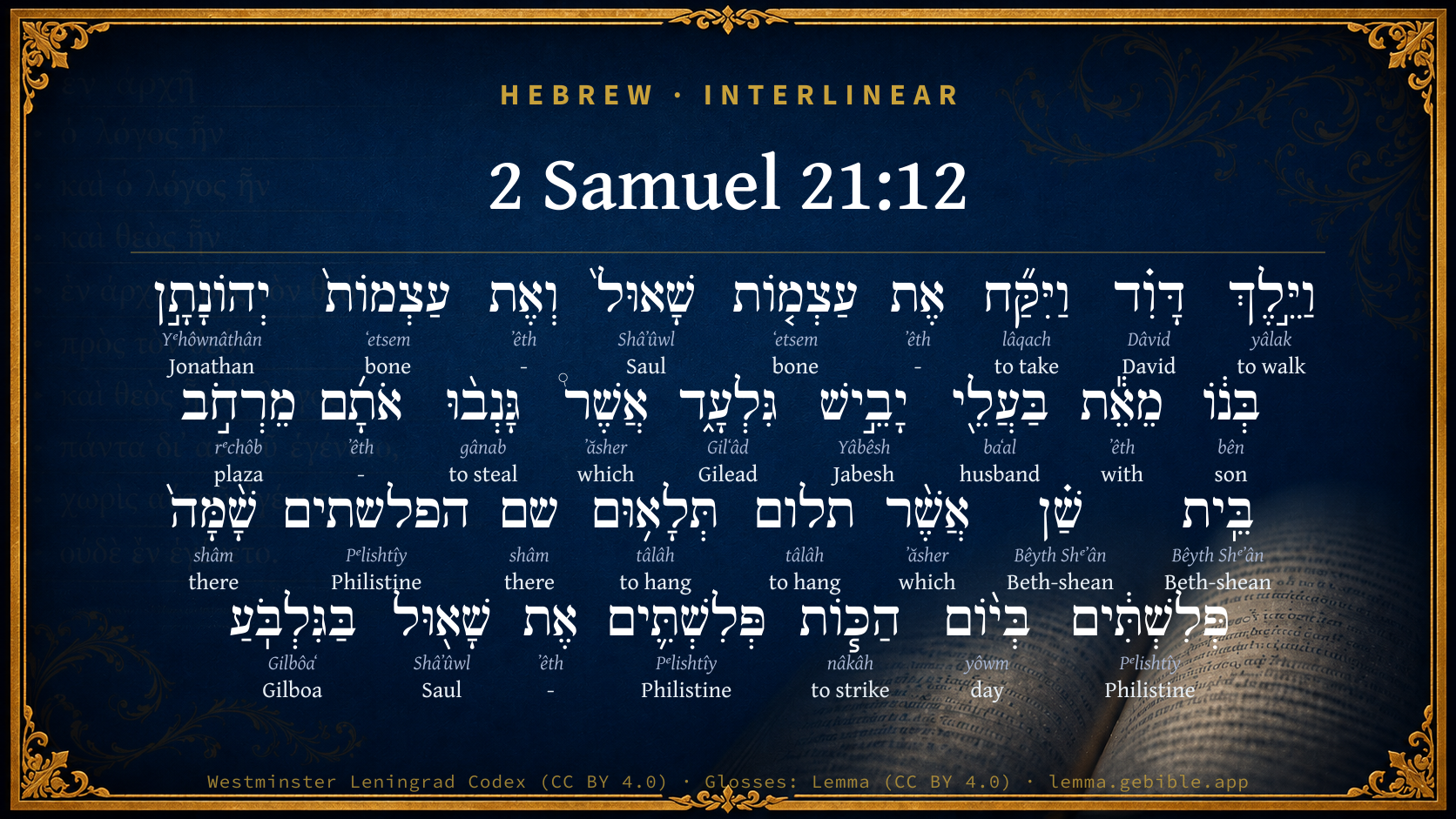
2 Samuel 21:12

Hebrew (Westminster Leningrad Codex) 2 Samuel 21:12 appears in the Hebrew Old Testament. The text above is from the Westminster Leningrad Codex. Each word links to its Strong’s number, a concise gloss, and parsing drawn from the Open Scriptures Hebrew Bible morphology. Click any word for its full Brown-Driver-Briggs (BDB) entry.
Download image
Cite this verse

2 Samuel 21:12 (World English Bible). Public Domain. Lemma interlinear Bible study tool, https://lemma.gebible.app/v/2-samuel/21/12.

Show BibTeX & RIS
BibTeX
RIS
English Translation
David went and took the bones of Saul and the bones of Jonathan his son from the men of Jabesh Gilead, who had stolen them from the street of Beth-shan, where the Philistines had hanged them, in the day that the Philistines killed Saul in Gilboa;
World English Bible · Public Domain
Download a study sheet

One document with this verse’s original text, its word-by-word gloss line, the meaning frame, cross-references with their text, attributed commentary, and full source and license credits — printable, and it pastes into notes with its structure intact.

This verse Autodidact and up

Study sheet (.html) Plain text (.txt)

A passage Seminary Student

Up to 50 verses in one chapter. A passage sheet keeps up to 6 commentary sources and 12 cross-references per verse, in the order this page ranks them, and says so on the sheet whenever that leaves anything out. Ask for a single verse and you get the Autodidact verse sheet above.

Everything on this page stays free to read, with no account — the sheet is a download of what is already on screen, not access to it.

Want to remove ads? Support Godless Engineer
Compare translations 3

The same verse in 3 English versions, stacked beneath the original-language interlinear above. Click any original word for its lexicon entry.

Each is an independent rendering of the whole verse — the interlinear is not word-aligned to these translations.

Highlighted words mark where these versions differ — a whole-verse word diff, not a word-by-word alignment.

  • World English Bible Public Domain
    David went and took the bones of Saul and the bones of Jonathan his son from the men of Jabesh Gilead, who had stolen them from the street of Beth-shan, where the Philistines had hanged them, in the day that the Philistines killed Saul in Gilboa;
  • King James Version Public Domain
    And David went and took the bones of Saul and the bones of Jonathan his son from the men of Jabeshgilead, which had stolen them from the street of Bethshan, where the Philistines had hanged them, when the Philistines had slain Saul in Gilboa:
  • unfoldingWord Literal Text CC BY-SA 4.0
    And David went, and he took the bones of Saul and the bones of Jonathan his son from the lords of Jabesh Gilead, who had stolen them from the open area of Beth Shan, where the Philistines had hanged them there on the day the Philistines struck Saul at Gilboa.

unfoldingWord Literal Text — © unfoldingWord, licensed CC BY-SA 4.0. Word-aligned USFM3 via Door43 (git.door43.org/unfoldingWord/en_ult).

Versions to compare (up to 4)

3 of 4 selected

Show all 18 translations

Every available English version of this verse, each an independent rendering of the whole verse.

  • World English Bible Public Domain
    David went and took the bones of Saul and the bones of Jonathan his son from the men of Jabesh Gilead, who had stolen them from the street of Beth-shan, where the Philistines had hanged them, in the day that the Philistines killed Saul in Gilboa;
  • Berean Standard Bible Public Domain
    he went and took the bones of Saul and his son Jonathan from the men of Jabesh-gilead, who had stolen them from the public square of Beth-shan where the Philistines had hung the bodies after they had struck down Saul at Gilboa.
  • Majority Standard Bible Public Domain
    he went and took the bones of Saul and his son Jonathan from the men of Jabesh-gilead, who had stolen them from the public square of Beth-shan where the Philistines had hung the bodies after they had struck down Saul at Gilboa.
  • King James Version Public Domain
    And David went and took the bones of Saul and the bones of Jonathan his son from the men of Jabeshgilead, which had stolen them from the street of Bethshan, where the Philistines had hanged them, when the Philistines had slain Saul in Gilboa:
  • American Standard Version (1901) Public Domain
    And David went and took the bones of Saul and the bones of Jonathan his son from the men of Jabesh-gilead, who had stolen them from the street of Beth-shan, where the Philistines had hanged them, in the day that the Philistines slew Saul in Gilboa;
  • Revised Version (1885) Public Domain
    And David went and took the bones of Saul and the bones of Jonathan his son from the men of Jabesh-gilead, which had stolen them from the street of Beth-shan, where the Philistines had hanged them, in the day that the Philistines slew Saul in Gilboa:
  • Geneva Bible (1599) Public Domain
    And Dauid went and tooke the bones of Saul and the bones of Ionathan his sonne from the citizens of Iabesh Gilead, which had stollen them from the streete of Beth-shan, where the Philistims had hanged them, when the Philistims had slaine Saul in Gilboa.
  • Douay-Rheims (1899) Public Domain
    And David went, and took the bones of Saul, and the bones of Jonathan his son from the men of Jabes Galaad, who had stolen them from the street of Bethsan, where the Philistines had hanged them when they had slain Saul in Gelboe.
  • Young's Literal Translation Public Domain
    and David goeth and taketh the bones of Saul, and the bones of Jonathan his son, from the possessors of Jabesh-Gilead, who had stolen them from the broad place of Beth-Shan, where the Philistines hanged them, in the day of the Philistines smiting Saul in Gilboa;
  • Literal Standard Version CC BY-SA 4.0
    and David goes and takes the bones of Saul, and the bones of his son Jonathan, from the possessors of Jabesh-Gilead, who had stolen them from the broad place of Beth-Shan, where the Philistines hanged them, in the day of the Philistines striking Saul in Gilboa;
  • Unlocked Literal Bible CC BY-SA 4.0
    So David went and took the bones of Saul and the bones of Jonathan his son from the men of Jabesh Gilead, who had stolen them from the public square of Beth Shan, where the Philistines had hanged them, after the Philistines had killed Saul in Gilboa.
  • unfoldingWord Literal Text CC BY-SA 4.0
    And David went, and he took the bones of Saul and the bones of Jonathan his son from the lords of Jabesh Gilead, who had stolen them from the open area of Beth Shan, where the Philistines had hanged them there on the day the Philistines struck Saul at Gilboa.
  • Darby Bible Public Domain
    And David went and took the bones of Saul and the bones of Jonathan his son from the men of Jabesh-Gilead, who had stolen them from the open place of Beth-shan, where the Philistines had hanged them, the day the Philistines had smitten Saul in Gilboa;
  • World Messianic Bible Public Domain
    So David went and took the bones of Saul and the bones of Jonathan his son from the men of Jabesh Gilead, who had stolen them from the street of Beth Shan, where the Philistines had hanged them in the day that the Philistines killed Saul in Gilboa;
  • Webster's Bible Public Domain
    And David went and took the bones of Saul and the bones of Jonathan his son from the men of Jabesh-gilead, who had stolen them from the street of Beth-shan, where the Philistines had hanged them, when the Philistines had slain Saul in Gilboa:
  • Free Bible Version CC BY-SA 4.0
    he retrieved the bones of Saul and his son Jonathan from the men of Jabesh-gilead, who had taken them from the public square of Beth-shan where the Philistines had hung the bodies after they had killed Saul at Gilboa.
  • Bible in Basic English Public Domain
    And David went and took the bones of Saul and his son Jonathan from the men of Jabesh-gilead, who had taken them away secretly from the public place of Beth-shan, where the Philistines had put them, hanging up the bodies there on the day when they put Saul to death in Gilboa:
  • JPS Tanakh (1917) Public Domain
    And David went and took the bones of Saul and the bones of Jonathan his son from the men of Jabesh-gilead, who had stolen them from the broad place of Beth-shan, where the Philistines had hanged them, in the day that the Philistines slew Saul in Gilboa;

Literal Standard Version (2020), Covenant Press — licensed CC BY-SA 4.0. Text via the HelloAO Bible API (eBible.org). Unlocked Literal Bible (unfoldingWord) — licensed CC BY-SA 4.0. Text via the HelloAO Bible API (eBible.org). unfoldingWord Literal Text — © unfoldingWord, licensed CC BY-SA 4.0. Word-aligned USFM3 via Door43 (git.door43.org/unfoldingWord/en_ult). Free Bible Version, Dr. Jonathan Gallagher — licensed CC BY-SA 4.0. Text via the HelloAO Bible API (eBible.org).

Word by word

More ways to search: Search by grammar → Find every occurrence → Compare this word →

Practice this passage: Drill this verse → Learn its vocabulary →

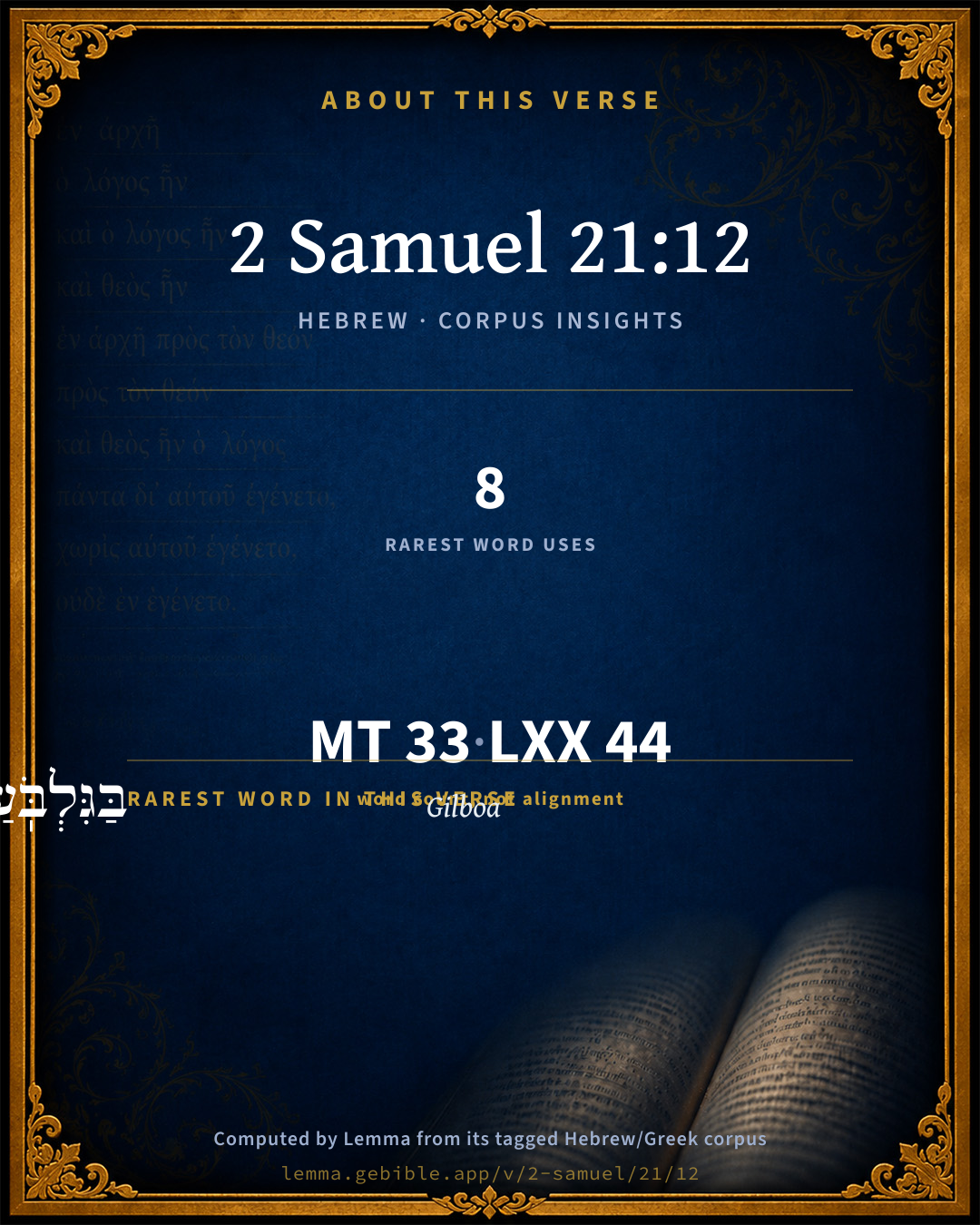
בַּגִּלְבֹּֽעַ
Gilbôaʻ
H1533
“in/at the · Gilboa”
Preposition, Determined + Noun, Proper
Part of Speech
Preposition + Noun
Type
Proper
Full BDB Definition

Origin: from H1530 and H1158

TWOT: None

Gilboa = "swollen heap" - a mountain-ridge at the southeastern end of the plain of Jezreel, site of the death of Saul and Jonathan
  1. וַיֵּ֣לֶךְ yâlak H3212 “and · to walk” Conjunction + Verb, Qal, Sequential Imperfect, 3rd Person, Masculine, Singular
  2. דָּוִ֗ד Dâvid H1732 “David” Noun, Proper
  3. וַיִּקַּ֞ח lâqach H3947 “and · to take” Conjunction + Verb, Qal, Sequential Imperfect, 3rd Person, Masculine, Singular
  4. אֶת ʼêth H853 “-” Particle, Direct Object
  5. עַצְמ֤וֹת ʻetsem H6106 “bones of” Noun, Common, Feminine, Plural, Construct
  6. שָׁאוּל֙ Shâʼûwl H7586 “Saul” Noun, Proper
  7. וְאֶת ʼêth H853 “and · -” Conjunction + Particle, Direct Object
  8. עַצְמוֹת֙ ʻetsem H6106 “bones of” Noun, Common, Feminine, Plural, Construct
  9. יְהוֹנָתָ֣ן Yᵉhôwnâthân H3083 “Jonathan” Noun, Proper
  10. בְּנ֔וֹ bên H1121 “son · his” Noun, Common, Masculine, Singular, Construct + Suffix, Personal, 3rd Person, Masculine, Singular
  11. מֵאֵ֕ת ʼêth H854 “from · with” Preposition + Preposition
  12. בַּעֲלֵ֖י baʻal H1167 “husbands of” Noun, Common, Masculine, Plural, Construct
  13. יָבֵ֣ישׁ Yâbêsh H3003 “Jabesh” Noun, Proper
  14. גִּלְעָ֑ד Gilʻâd H1568 “Gilead” Noun, Proper
  15. אֲשֶׁר֩ ʼăsher H834 “which” Particle, Relative
  16. גָּנְב֨וּ gânab H1589 “to steal” Verb, Qal, Perfect, 3rd Person, Common, Plural
  17. אֹתָ֜ם ʼêth H853 “- · them” Particle, Direct Object + Suffix, Personal, 3rd Person, Masculine, Plural
  18. מֵרְחֹ֣ב rᵉchôb H7339 “from · plaza of” Preposition + Noun, Common, Feminine, Singular, Construct
  19. בֵּֽית Bêyth Shᵉʼân H1052 “Beth-shean” Noun, Proper
  20. שַׁ֗ן Bêyth Shᵉʼân H1052 “Beth-shean” Noun, Proper
  21. אֲשֶׁ֨ר ʼăsher H834 “which” Particle, Relative
  22. תלום tâlâh H8518 “to hang · them” Verb, Qal, Perfect, 3rd Person, Common, Plural + Suffix, Personal, 3rd Person, Masculine, Plural
  23. תְּלָא֥וּם tâlâh H8518 “to hang · them” Verb, Qal, Perfect, 3rd Person, Common, Plural + Suffix, Personal, 3rd Person, Masculine, Plural
  24. שם shâm H8033 “there” Adverb
  25. הפלשתים Pᵉlishtîy H6430 “the · Philistines” Particle, Definite Article + Noun, Gentilic, Masculine, Plural, Absolute
  26. שָׁ֨מָּה֙ shâm H8033 “there · toward” Adverb + Suffix, Demonstrative
  27. פְּלִשְׁתִּ֔ים Pᵉlishtîy H6430 “Philistines” Noun, Gentilic, Masculine, Plural, Absolute
  28. בְּי֨וֹם yôwm H3117 “in/at · day of” Preposition + Noun, Common, Masculine, Singular, Construct
  29. הַכּ֧וֹת nâkâh H5221 “to strike” Verb, Hiphil, Infinitive Construct
  30. פְּלִשְׁתִּ֛ים Pᵉlishtîy H6430 “Philistines” Noun, Gentilic, Masculine, Plural, Absolute
  31. אֶת ʼêth H853 “-” Particle, Direct Object
  32. שָׁא֖וּל Shâʼûwl H7586 “Saul” Noun, Proper

About this verse

These counts appear in no published source. They are computed here, from the morphology-tagged text and Lemma’s own curated glosses. What Lemma adds →

33
words
22
distinct lemmas
Historical
section

Notable vocabulary

The rarest word here is בַּגִּלְבֹּֽעַ Gilboa H1533 — appearing just 8 times in the whole Hebrew Bible.

Shared distinctive vocabulary

בַּגִּלְבֹּֽעַ Gilboa H1533 occurs in 8 verses of the Hebrew Bible. Also found in:

Grammatical profile

  • 6 verbs
  • 18 nouns
  • 1 preposition
  • 2 adverbs
  • 6 particles

Verb forms

  • וַיֵּ֣לֶךְ Qal · Sequential Imperfect
  • וַיִּקַּ֞ח Qal · Sequential Imperfect
  • גָּנְב֨וּ Qal · Perfect
  • תלום Qal · Perfect
  • תְּלָא֥וּם Qal · Perfect
  • הַכּ֧וֹת Hiphil · Infinitive Construct

Repetition

Words recur within this verse — often emphatic in Hebrew:

  • הפלשתים Philistine H6430 ×3
  • עַצְמ֤וֹת bone H6106 ×2
  • שָׁאוּל֙ Saul H7586 ×2
  • בֵּֽית Beth-shean H1052 ×2
  • תלום to hang H8518 ×2
  • שם there H8033 ×2
  • אֲשֶׁר֩ which H834 ×2

Hebrew & Septuagint length

In English translation the verse runs 46 words from the Hebrew and 50 from the Septuagint (LXX English) — closely comparable.

A rough comparison of the two English renderings, which tokenize alike — not a word-level alignment.

Word counts can differ between the Hebrew and the Greek without any difference in meaning — e.g. the Hebrew direct-object marker אֵת has no separate Greek word, and Greek often adds the article ὁ.

In the original languages it is 33 Hebrew tokens and 44 Greek tokens — but the two are counted differently (Hebrew bundles its prefixes and suffixes into one token; the Greek is in lemma form), so that isn’t a like-for-like length.

Cross-references

8

Topical passages linked to 2 Samuel 21:12 in the Treasury of Scripture Knowledge — connected by theme and wording, ordered by reader-vote popularity; previews shown in the World English Bible.

  • Joshua 17:11 Manasseh had in Issachar and in Asher Beth-shean and its towns, and Ibleam and its towns, and the inhabitants of Dor and its towns, and the inhabitants of En-dor and its towns, and the inhabitants of Taanach and its towns, and the inhabitants of Megiddo and its towns, even the three heights.
  • 1 Samuel 31:10–13 They put his armor in the house of the Ashtaroth; and they fastened his body to the wall of Beth-shan.
  • 1 Samuel 28:4 The Philistines gathered themselves together, and came and encamped in Shunem: and Saul gathered all Israel together, and they encamped in Gilboa.
  • 1 Samuel 31:1 Now the Philistines fought against Israel: and the men of Israel fled from before the Philistines, and fell down slain on Mount Gilboa.
  • 2 Samuel 1:6 The young man who told him said, As I happened by chance on Mount Gilboa, behold, Saul was leaning on his spear; and, behold, the chariots and the horsemen followed hard after him.
  • 2 Samuel 1:21 You mountains of Gilboa, Let there be no dew nor rain on you, neither fields of offerings: For there the shield of the mighty was vilely cast away, The shield of Saul, not anointed with oil.
  • 2 Samuel 2:5–7 David sent messengers to the men of Jabesh Gilead, and said to them, Blessed be you of Yahweh, that you have shown this kindness to your lord, even to Saul, and have buried him.
  • 1 Chronicles 10:1 Now the Philistines fought against Israel: and the men of Israel fled from before the Philistines, and fell down slain on Mount Gilboa.

Cross-references courtesy of OpenBible.info (CC BY 4.0).

Hebrew and Greek witnesses Masoretic Hebrew ↔ Greek Septuagint

The same verse in the two great witnesses to the Old Testament, shown verse-for-verse.

These are two independent witnesses, not word-aligned to each other, and the Septuagint is shown in lemma (dictionary) form.

Hebrew 2 Samuel 21:12 Masoretic · Westminster Leningrad Codex

וַיֵּ֣לֶךְ דָּוִ֗ד וַיִּקַּ֞ח אֶת עַצְמ֤וֹת שָׁאוּל֙ וְאֶת עַצְמוֹת֙ יְהוֹנָתָ֣ן בְּנ֔וֹ מֵאֵ֕ת בַּעֲלֵ֖י יָבֵ֣ישׁ גִּלְעָ֑ד אֲשֶׁר֩ גָּנְב֨וּ אֹתָ֜ם מֵרְחֹ֣ב בֵּֽית שַׁ֗ן אֲשֶׁ֨ר תלום תְּלָא֥וּם שם הפלשתים שָׁ֨מָּה֙ פְּלִשְׁתִּ֔ים בְּי֨וֹם הַכּ֧וֹת פְּלִשְׁתִּ֛ים אֶת שָׁא֖וּל בַּגִּלְבֹּֽעַ

David went and took the bones of Saul and the bones of Jonathan his son from the men of Jabesh Gilead, who had stolen them from the street of Beth-shan, where the Philistines had hanged them, in the day that the Philistines killed Saul in Gilboa;

World English Bible · Public Domain

Greek LXX 2 Samuel 21:12 Septuagint · lemma form

καί πορεύομαι δαυίδ καί λαμβάνω ὁ ὀστέον σαούλ καί ὁ ὀστέον ιωναθαν ὁ υἱός αὐτός παρά ὁ ἀνήρ υἱός ιαβις γαλαάδ ὅς κλέπτω αὐτός ἐκ ὁ πλατύς βαιθσαν ὅτι ἵστημι αὐτός ἐκεῖ ὁ ἀλλόφυλος ἐν ἡμέρα ὅς πατάσσω ὁ ἀλλόφυλος ὁ σαούλ ἐν γελβουε

And David went and took the bones of Saul, and the bones of Jonathan his son, from the men of the sons of Jabis Galaad, who stole them from the street of Baethsan; for the Philistines set them there in the day in which the Philistines struck Saul in Gelbue.

LXX2012 (modern English Septuagint) · Public Domain

On this verse, Ellicott's Commentary for English Readers discusses the Septuagint’s reading. Read the note in Commentary ↓

Hebrew: Westminster Leningrad Codex (CC BY 4.0). Greek: Septuagint (public domain); English from LXX2012 (modern English Septuagint) (Public Domain). How the Septuagint differs from the Hebrew →

Targum (Aramaic paraphrase)

1

The Targum is the ancient Jewish Aramaic paraphrase of the Hebrew Scriptures — an interpretive translation, not the Hebrew text itself. Onkelos (literal) and Pseudo-Jonathan (expansive) render the Torah, and Jonathan the Prophets. Coverage is partial: where no permissively-licensed English translation exists for a verse, only the Aramaic is shown. This is verse-level text, not a word-by-word alignment to the Hebrew.

  1. Targum Jonathan Prophets (Joshua–Malachi)
    וַאֲזַל דָוִד וּנְסִיב יַת גַרְמֵי שָׁאוּל וְיַת גַרְמֵי יְהוֹנָתָן בְּרֵיהּ מִלְוַת יַתְבֵי יָבֵשׁ גִלְעָד דִגְנַבוּ יַתְהוֹן מִשׁוּרָא דְבֵית שַׁן דְצַלְבוּנוּן תַּמָן פְלִשְׁתָּאֵי בְּיוֹמָא דִקְטָלוּ פְּלִשְׁתָּאֵי יַת שָׁאוּל בְּגִלְבּוֹעַ:

    (no public-domain English translation for this verse)

    Targum Jonathan — Aramaic: “Mikraot Gedolot” (public domain). English: “Sefaria Community Translation” (CC0 1.0 (public-domain dedication)); “London "Chaldee Paraphrase," 1871” (public domain). Text via Sefaria.

Commentary

Notes on 2 Samuel 21:12 from classic Christian and Jewish commentators (each source and its license shown beneath its notes). The classic Christian expositions comment on the surrounding passage and are grouped to its opening verse, so a note may address several verses; the Jewish commentaries on the Tanakh (Rashi and others) are per-verse, so they appear only where the commentator wrote on this verse.

Lemma curates 59 commentaries, every one of them public domain or Creative Commons licensed, each selected and text-cleaned for this edition rather than reprinted as found. About our sources →

Jamieson, Fausset & Brown

Robert Jamieson, A. R. Fausset & David Brown

DAVID BURIES THE BONES OF SAUL AND JONATHAN IN THEIR FATHER'S SEPULCHER. (Sa2 21:12-22)

David went and took the bones of Saul and the bones of Jonathan his son, &c.--Before long, the descent of copious showers, or perhaps an order of the king, gave Rizpah the satisfaction of releasing the corpses from their ignominious exposure; and, incited by her pious example, David ordered the remains of Saul and his sons to be transferred from their obscure grave in Jabesh-gilead to an honorable interment in the family vault at Zelah or Zelzah (Sa1 10:2), now Beit-jala.

Jamieson, Fausset & Brown — Commentary Critical and Explanatory on the Whole Bible (1871) — public domain (CC PDM 1.0). Text via the HelloAO Bible API.

Trapp's Complete Commentary

John Trapp

2Sa 21:12 And David went and took the bones of Saul and the bones of Jonathan his son from the men of Jabeshgilead, which had stolen them from the street of Bethshan, where the Philistines had hanged them, when the Philistines had slain Saul in Gilboa:

Ver. 12. And David went and took the bones of Saul, &c.] To show that he loved his enemies, which is no small conquest: it is an act of heroical charity. Full ill might Joab have told David that he hated his friends, for he loved his enemies.

John Trapp, A Commentary or Exposition upon All the Books of the Old and New Testament (1647–1656) — public domain. Text from a community e-Sword module.

Joseph Benson's Commentary

2Sa 21:12. He defended it — So that the Philistines could neither burn the corn, nor carry it away, nor tread it down. The Lord wrought a great victory — By his hand. How great soever the bravery of the instruments is, the praise of the achievement is to be given to God. These fought, but God wrought the victory. It must be observed that this Shammah, although one of the three most mighty men, is not particularly named in the book of Chronicles; it being the manner of the Scriptures, as the Jews observe, to notice that briefly in one place, which hath been explained at large in another; as this action of Shammah is here in this book.

Joseph Benson's Commentary on the Old and New Testaments (1811–1818) — public domain. Text from a community e-Sword module.

Adam Clarke's Commentary

Verse 12. Took the bones of Saul] The reader will recollect that the men of Jabesh-gilead burned the bodies of Saul and his sons, and buried the remaining bones under a tree at Jabesh. See 1Sa 31:12-13. These David might have digged up again, in order to bury them in the family sepulchre.

Adam Clarke's Commentary on the Bible (1810–1826) — public domain. Text from a community e-Sword/MySword module.

Ellicott's Commentary for English Readers

(12) Took the bones of Saul.—Moved by the story of Rizpah’s tender care, and wishing to show that he cherished no enmity against the house of Saul, David buried honourably the remains of Saul and of his descendants. In 1Sa_31:10 it is said that the Philistines fastened the body of Saul “to the wall of Beth-shan;” here, that the men of Jabesh-gilead took them secretly from the street. The two statements are quite consistent, for the exact place where the Philistines hung up to public view the body of the slain and defeated monarch was the broad space or square, just inside the gate, where the people were wont to gather; and it was from the same place that they were taken. Most MSS. of the LXX. add to the previous verse: “And they were taken down, and Dan the son of Joa, of the descendants of the giant, took them down.”

A Bible Commentary for English Readers, edited by Charles John Ellicott (1878–1897) — public domain. Text from a community e-Sword module.

The Cambridge Bible for Schools and Colleges

gen. ed. J. J. S. Perowne

12. David went] Touched by Rizpah’s maternal devotion, and wishing to shew that he had no personal enmity to the house of Saul.

the men of Jabesh-gilead] The citizens, lit. lords or possessors of Jabesh-Gilead; a term peculiar to the books of Joshua, Judges, and Samuel (Jos_24:11; Jdg_9:2 ff; Jdg_20:5; 1Sa_23:11-12). For their bold rescue of the bodies see 1Sa_31:11-13. Cp. 2Sa_2:4.

the street] The bodies were hung on the wall (1Sa_31:10) in the square or open place just inside the gate, the public meeting-place of all the citizens. Cp. 2Ch_32:6; Neh_8:1; Neh_8:3; Neh_8:16.

Beth-shan] Now Beisân, four miles west of the Jordan in the Wady Jâlûd. See note on 1Sa_31:10.

The Cambridge Bible for Schools and Colleges (gen. ed. J. J. S. Perowne; Cambridge University Press, 1878–1918) — public domain. Text from a community e-Sword module.

John Gill's Exposition

And he brought up from thence the bones of Saul, and the bones of Jonathan his son,.... Which had been buried there under an oak, Ch1 10:12,

and they gathered the bones of them that were hanged; the seven sons of Saul, who had been lately hanged; who either had hung so long that their flesh was consumed, and the bones dropped upon the ground, from whence they gathered them; or they took them down and burnt the flesh off of them, and took the bones to bury them, which was not usually done (u).

(u) Lipsins de Cruce, l. 2. c. 16.

John Gill's Exposition of the Whole Bible (1746–1763) — public domain (CC PDM 1.0). Text via the HelloAO Bible API.

Albert Barnes' Notes on the Bible

From the street of Beth-shan - This was the wide place just inside the gate of an Oriental city, bounded therefore by the city wall (compare the marginal reference). Here, as the place of concourse, the Philistines had fastened the bodies.

Albert Barnes' Notes on the Bible (1834–1885) — public domain. Text from a community e-Sword/MySword module.

Whedon's Commentary on the Bible

Daniel D. Whedon

12. Took the bones — See 1Sa_31:10-13, and notes there.

Daniel D. Whedon (gen. ed.), Commentary on the Old and New Testaments (1874–1909) — public domain. Text from a community e-Sword module.

The Pulpit Commentary

The street of Beth-shan; Hebrew, the broad place, or square, just inside the gate, where the citizens met for business. It was upon the wall of this square that the Philistines had hanged the bodies of Saul and of his sons. (1Sa_31:12) The men of Jabesh-Gilead; Hebrew, the lords or owners of Jabesh-Gilead. The phrase occurs also in 1Sa_23:11, 12 of the citizens of Keilah, and is found also in the Books of Joshua and Judges. (For the brave exploit of these men in rescuing the bodies of their king and his sons, see 1Sa_31:11-13; and for David"s generous approval, 2Sa_2:5)

The Pulpit Commentary (1880–1919), ed. H.D.M. Spence-Jones & Joseph S. Exell — public domain. Text from a community e-Sword module.

Scofield Reference Notes

C. I. Scofield

Philistines

Cf. 1Sa 31:3-5 (See Scofield "1Sa 31:3")

The Scofield Reference Bible (1917 edition), notes by C. I. Scofield — public domain. Text from a community e-Sword module.

unfoldingWord translationNotes

Door43 World Missions Community

Jabesh Gilead

Jabesh is a town in the region of Gilead. See how you translated this in 2 Samuel 2:4.

the public square

This is an area near the city gate where people did various kinds of business.

Beth Shan

This is the name of a place. (See: How to Translate Names)

Gilboa

See how you translated the name of this place in 2 Samuel 1:6.

who had been hanged

This can be translated in active form. AT: "whom the Gibeonites executed by hanging" (See: Active or Passive)

translationWords

Gilead

Philistines

unfoldingWord translationNotes — © Distant Shores Media and the Door43 World Missions Community, licensed CC BY-SA 4.0. Source: git.door43.org/Door43/en_tn.

Rashi

Rabbi Shlomo Yitzchaki (Rashi)

He took Shaul's bones. He [Dovid] was told concerning them, "Because of Shaul" who was not eulogized according to halachah.

Rashi on the Tanakh — English translations: “The Judaica Press complete Tanach with Rashi, translated by A. J. Rosenberg” (CC BY 4.0); “Pentateuch with Rashi's commentary by M. Rosenbaum and A.M. Silbermann, 1929-1934” (public domain); “The Metsudah Tanach series, Lakewood, N.J” (CC BY 4.0); and “The Book of Joshua, Metsudah Publications, 1997” (CC BY 4.0). Text via Sefaria.

Lesson kit

Teaching starters — assembled from the data on this page, not authored interpretation. Every prompt links to the verse data it draws on. Edit before teaching.

2 Samuel, in the Historical, opens this verse with 33 words (22 distinct Hebrew lemmas). Its most distinctive word is Gilbôaʻ (“Gilboa”). A historical commentator’s framing appears above. Read the whole chapter for the surrounding context.

Discussion questions

  1. How does “Gilboa” (Gilbôaʻ) shape what this verse is saying?
  2. How does 1 Samuel 28:4, which shares the word «Gilboa», read alongside this verse?
  3. What does the repetition of “Philistine” (3× in this one verse) do in this verse?
  4. The translations on this page render this verse differently — a whole-verse word diff, not a word-by-word alignment. What might account for the different wordings?
  5. «וַיֵּ֣לֶךְ» is a Qal Sequential Imperfect verb. How does that grammatical form shape the action described?
  6. Compare how Jamieson, Fausset & Brown and Trapp's Complete Commentary read this verse. Where do they agree or differ?

Things to notice

Reading settings

Reading text

Shown beneath each verse's original-language words.

Old Testament
Old Testament edition

Read the OT as the Masoretic Hebrew (MT) or the Greek Septuagint (LXX).

English shown for the Greek Septuagint (in the Hebrew ↔ Greek comparison).

Comparing translations? Open the Compare panel on any verse page to stack up to four side by side.