
Joshua 24:11

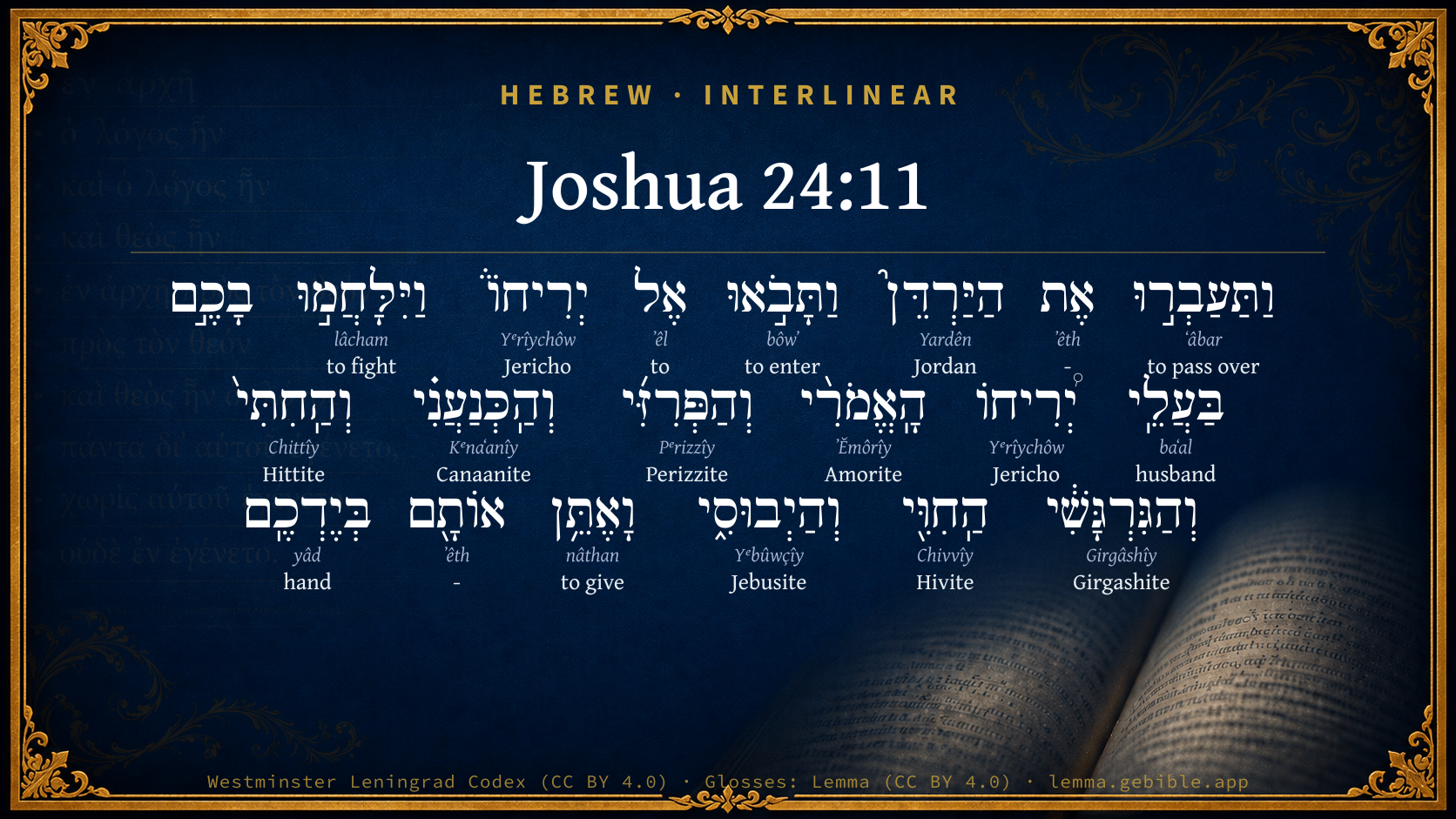
Hebrew (Westminster Leningrad Codex) Joshua 24:11 appears in the Hebrew Old Testament. The text above is from the Westminster Leningrad Codex. Each word links to its Strong’s number, a concise gloss, and parsing drawn from the Open Scriptures Hebrew Bible morphology. Click any word for its full Brown-Driver-Briggs (BDB) entry.
Download image
Cite this verse

Joshua 24:11 (World English Bible). Public Domain. Lemma interlinear Bible study tool, https://lemma.gebible.app/v/joshua/24/11.

Show BibTeX & RIS
BibTeX
RIS
English Translation
You went over the Jordan, and came to Jericho: and the men of Jericho fought against you, the Amorite, and the Perizzite, and the Canaanite, and the Hittite, and the Girgashite, the Hivite, and the Jebusite; and I delivered them into your hand.
World English Bible · Public Domain
Download a study sheet

One document with this verse’s original text, its word-by-word gloss line, the meaning frame, cross-references with their text, attributed commentary, and full source and license credits — printable, and it pastes into notes with its structure intact.

This verse Autodidact and up

Study sheet (.html) Plain text (.txt)

A passage Seminary Student

Up to 50 verses in one chapter. A passage sheet keeps up to 6 commentary sources and 12 cross-references per verse, in the order this page ranks them, and says so on the sheet whenever that leaves anything out. Ask for a single verse and you get the Autodidact verse sheet above.

Everything on this page stays free to read, with no account — the sheet is a download of what is already on screen, not access to it.

Want to remove ads? Support Godless Engineer
Compare translations 3

The same verse in 3 English versions, stacked beneath the original-language interlinear above. Click any original word for its lexicon entry.

Each is an independent rendering of the whole verse — the interlinear is not word-aligned to these translations.

Highlighted words mark where these versions differ — a whole-verse word diff, not a word-by-word alignment.

  • World English Bible Public Domain
    You went over the Jordan, and came to Jericho: and the men of Jericho fought against you, the Amorite, and the Perizzite, and the Canaanite, and the Hittite, and the Girgashite, the Hivite, and the Jebusite; and I delivered them into your hand.
  • King James Version Public Domain
    And you went over Jordan, and came unto Jericho: and the men of Jericho fought against you, the Amorites, and the Perizzites, and the Canaanites, and the Hittites, and the Girgashites, the Hivites, and the Jebusites; and I delivered them into your hand.
  • unfoldingWord Literal Text CC BY-SA 4.0
    And you crossed the Jordan and came to Jericho. And the men of Jericho fought with you, the Amorite and the Perizzite and the Canaanite and the Hittite and the Girgashite and the Hivite and the Jebusite. And I gave them into your hand.

unfoldingWord Literal Text — © unfoldingWord, licensed CC BY-SA 4.0. Word-aligned USFM3 via Door43 (git.door43.org/unfoldingWord/en_ult).

Versions to compare (up to 4)

3 of 4 selected

Show all 18 translations

Every available English version of this verse, each an independent rendering of the whole verse.

  • World English Bible Public Domain
    You went over the Jordan, and came to Jericho: and the men of Jericho fought against you, the Amorite, and the Perizzite, and the Canaanite, and the Hittite, and the Girgashite, the Hivite, and the Jebusite; and I delivered them into your hand.
  • Berean Standard Bible Public Domain
    After this, you crossed the Jordan and came to Jericho. The people of Jericho fought against you, as did the Amorites, Perizzites, Canaanites, Hittites, Girgashites, Hivites, and Jebusites, and I delivered them into your hand.
  • Majority Standard Bible Public Domain
    After this, you crossed the Jordan and came to Jericho. The people of Jericho fought against you, as did the Amorites, Perizzites, Canaanites, Hittites, Girgashites, Hivites, and Jebusites, and I delivered them into your hand.
  • King James Version Public Domain
    And you went over Jordan, and came unto Jericho: and the men of Jericho fought against you, the Amorites, and the Perizzites, and the Canaanites, and the Hittites, and the Girgashites, the Hivites, and the Jebusites; and I delivered them into your hand.
  • American Standard Version (1901) Public Domain
    And ye went over the Jordan, and came unto Jericho: and the men of Jericho fought against you, the Amorite, and the Perizzite, and the Canaanite, and the Hittite, and the Girgashite, the Hivite, and the Jebusite; and I delivered them into your hand.
  • Revised Version (1885) Public Domain
    And ye went over Jordan, and came unto Jericho: and the men of Jericho fought against you, the Amorite, and the Perizzite, and the Canaanite, and the Hittite, and the Girgashite, the Hivite, and the Jebusite; and I delivered them into your hand.
  • Geneva Bible (1599) Public Domain
    And ye went ouer Iorden, and came vnto Iericho, and the men of Iericho fought against you, the Amorites, and the Perizzites, and the Canaanites, and the Hittites, and the Girgashites, the Hiuites and the Iebusites, and I deliuered them into your hand.
  • Douay-Rheims (1899) Public Domain
    And you passed over the Jordan, and you came to Jericho. And the men of that city fought against you, the Amorrhite, and the Pherezite, and the Chanaanite, and the Hethite, and the Gergesite, and the Hevite, and the Jebusite: and I delivered them into your hands.
  • Young's Literal Translation Public Domain
    `And ye pass over the Jordan, and come in unto Jericho, and fight against you do the possessors of Jericho -- the Amorite, and the Perizzite, and the Canaanite, and the Hittite, and the Girgashite, the Hivite, and the Jebusite -- and I give them into your hand.
  • Literal Standard Version CC BY-SA 4.0
    And you pass over the Jordan, and come to Jericho, and the possessors of Jericho fight against you—the Amorite, and the Perizzite, and the Canaanite, and the Hittite, and the Girgashite, the Hivite, and the Jebusite—and I give them into your hand.
  • Unlocked Literal Bible CC BY-SA 4.0
    You went over the Jordan and came to Jericho. The leaders of Jericho fought against you, along with the Amorites, the Perizzites, the Canaanites, the Hittites, the Girgashites, the Hivites, and the Jebusites. I gave you victory over them and put them under your control.
  • unfoldingWord Literal Text CC BY-SA 4.0
    And you crossed the Jordan and came to Jericho. And the men of Jericho fought with you, the Amorite and the Perizzite and the Canaanite and the Hittite and the Girgashite and the Hivite and the Jebusite. And I gave them into your hand.
  • Darby Bible Public Domain
    And ye went over the Jordan, and came unto Jericho, and the men of Jericho fought against you, the Amorites, and the Perizzites, and the Canaanites, and the Hittites, and the Girgashites, the Hivites, and the Jebusites; and I delivered them into your hand.
  • World Messianic Bible Public Domain
    “‘You went over the Jordan, and came to Jericho. The men of Jericho fought against you, the Amorite, the Perizzite, the Canaanite, the Hittite, the Girgashite, the Hivite, and the Jebusite; and I delivered them into your hand.
  • Webster's Bible Public Domain
    And ye went over Jordan, and came to Jericho: and the men of Jericho fought against you, the Amorites, and the Perizzites, and the Canaanites, and the Hittites, and the Girgashites, the Hivites, and the Jebusites, and I delivered them into your hand.
  • Free Bible Version CC BY-SA 4.0
    You crossed the Jordan and arrived at Jericho where the men of Jericho fought against you. So did the Amorites, the Perizzites, the Canaanites, the Hittites, the Girgashites, the Hivites, and the Jebusites.
  • Bible in Basic English Public Domain
    Then you went over Jordan and came to Jericho: and the men of Jericho made war on you, the Amorites and the Perizzites and the Canaanites and the Hittites and the Girgashites and the Hivites and the Jebusites: and I gave them up into your hands.
  • JPS Tanakh (1917) Public Domain
    And ye went over the Jordan, and came unto Jericho; and the men of Jericho fought against you, the Amorite, and the Perizzite, and the Canaanite, and the Hittite, and the Girgashite, the Hivite, and the Jebusite; and I delivered them into your hand.

Literal Standard Version (2020), Covenant Press — licensed CC BY-SA 4.0. Text via the HelloAO Bible API (eBible.org). Unlocked Literal Bible (unfoldingWord) — licensed CC BY-SA 4.0. Text via the HelloAO Bible API (eBible.org). unfoldingWord Literal Text — © unfoldingWord, licensed CC BY-SA 4.0. Word-aligned USFM3 via Door43 (git.door43.org/unfoldingWord/en_ult). Free Bible Version, Dr. Jonathan Gallagher — licensed CC BY-SA 4.0. Text via the HelloAO Bible API (eBible.org).

Word by word

More ways to search: Search by grammar → Find every occurrence → Compare this word →

Practice this passage: Drill this verse → Learn its vocabulary →

וְהַגִּרְגָּשִׁ֔י
Girgâshîy
H1622
“and · the · Girgashite”
Conjunction + Particle, Definite Article + Noun, Gentilic, Masculine, Singular, Absolute
Part of Speech
Conjunction + Particle + Noun
Type
Gentilic
Gender
Masculine
Number
Singular
State
Absolute
Full BDB Definition

Origin: patrial from an unused name [of uncertain derivation]

TWOT: None

Girgashite or Girgasite = "dwelling on a clayey soil" - descendants of Canaan and one of the nations living east of the sea of Galilee when the Israelites entered the promised land
  1. וַתַּעַבְר֣וּ ʻâbar H5674 “and · to pass over” Conjunction + Verb, Qal, Sequential Imperfect, 2nd Person, Masculine, Plural
  2. אֶת ʼêth H853 “-” Particle, Direct Object
  3. הַיַּרְדֵּן֮ Yardên H3383 “the · Jordan” Particle, Definite Article + Noun, Proper
  4. וַתָּבֹ֣אוּ bôwʼ H935 “and · to enter” Conjunction + Verb, Qal, Sequential Imperfect, 2nd Person, Masculine, Plural
  5. אֶל ʼêl H413 “to” Preposition
  6. יְרִיחוֹ֒ Yᵉrîychôw H3405 “Jericho” Noun, Proper
  7. וַיִּלָּחֲמ֣וּ lâcham H3898 “and · to fight” Conjunction + Verb, Niphal, Sequential Imperfect, 3rd Person, Masculine, Plural
  8. בַּעֲלֵֽי baʻal H1167 “husbands of” Noun, Common, Masculine, Plural, Construct
  9. יְ֠רִיחוֹ Yᵉrîychôw H3405 “Jericho” Noun, Proper
  10. הָֽאֱמֹרִ֨י ʼĔmôrîy H567 “the · Amorite” Particle, Definite Article + Noun, Gentilic, Masculine, Singular, Absolute
  11. וְהַפְּרִזִּ֜י Pᵉrizzîy H6522 “and · the · Perizzite” Conjunction + Particle, Definite Article + Noun, Gentilic, Masculine, Singular, Absolute
  12. וְהַֽכְּנַעֲנִ֗י Kᵉnaʻanîy H3669 “and · the · Canaanite” Conjunction + Particle, Definite Article + Noun, Gentilic, Masculine, Singular, Absolute
  13. וְהַֽחִתִּי֙ Chittîy H2850 “and · the · Hittite” Conjunction + Particle, Definite Article + Noun, Gentilic, Masculine, Singular, Absolute
  14. הַֽחִוִּ֖י Chivvîy H2340 “the · Hivite” Particle, Definite Article + Noun, Gentilic, Masculine, Singular, Absolute
  15. וְהַיְבוּסִ֑י Yᵉbûwçîy H2983 “and · the · Jebusite” Conjunction + Particle, Definite Article + Noun, Gentilic, Masculine, Singular, Absolute
  16. וָאֶתֵּ֥ן nâthan H5414 “and · to give” Conjunction + Verb, Qal, Sequential Imperfect, 1st Person, Common, Singular
  17. אוֹתָ֖ם ʼêth H853 “- · them” Particle, Direct Object + Suffix, Personal, 3rd Person, Masculine, Plural
  18. בְּיֶדְכֶֽם yâd H3027 “in/at · hand · your” Preposition + Noun, Common, Both, Singular, Construct + Suffix, Personal, 2nd Person, Masculine, Plural

About this verse

These counts appear in no published source. They are computed here, from the morphology-tagged text and Lemma’s own curated glosses. What Lemma adds →

20
words
17
distinct lemmas
Historical
section

Notable vocabulary

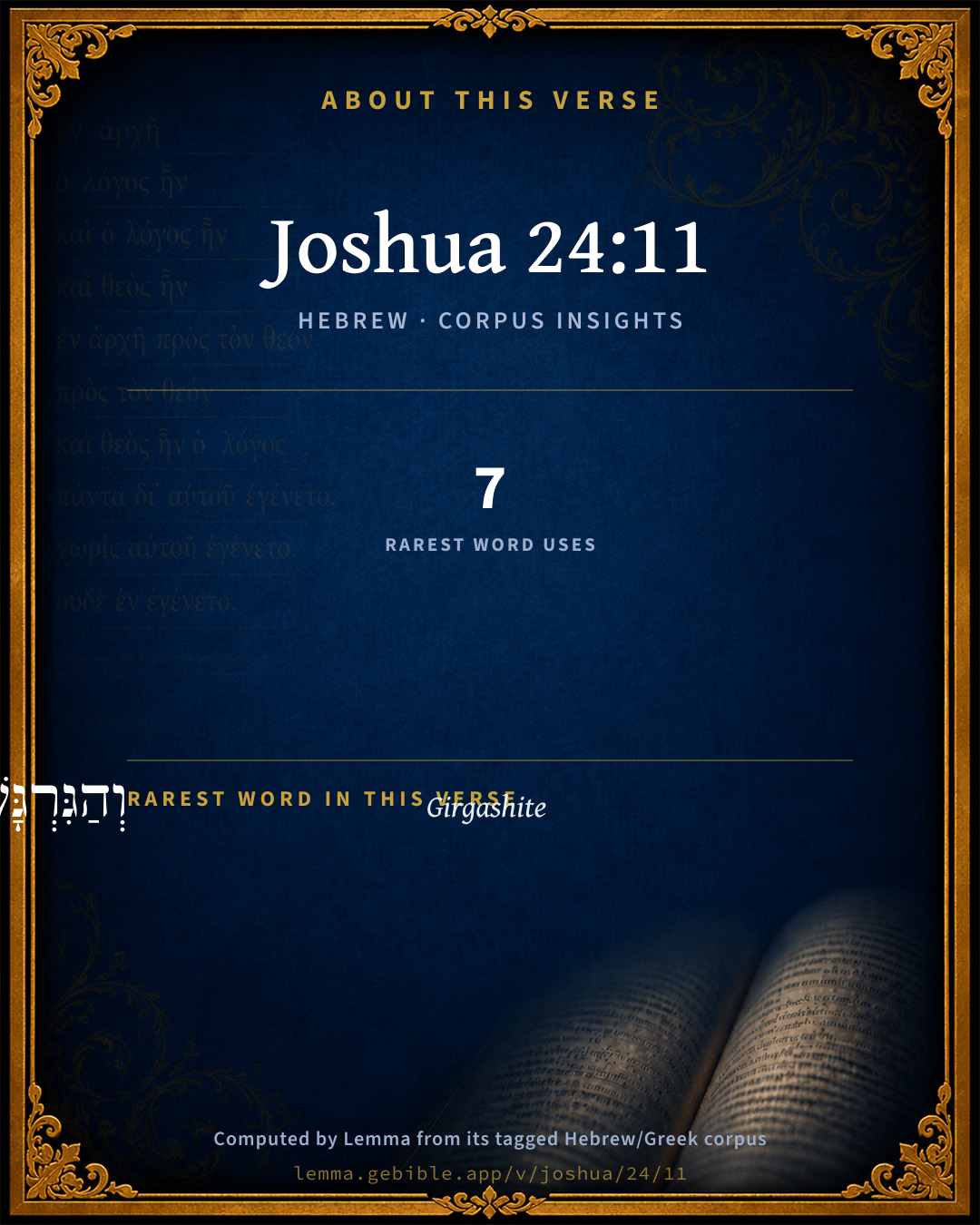
The rarest word here is וְהַגִּרְגָּשִׁ֔י Girgashite H1622 — appearing just 7 times in the whole Hebrew Bible.

Shared distinctive vocabulary

וְהַגִּרְגָּשִׁ֔י Girgashite H1622 occurs in 7 verses of the Hebrew Bible. Also found in:

Grammatical profile

  • 4 verbs
  • 12 nouns
  • 2 prepositions
  • 2 particles

Verb forms

  • וַתַּעַבְר֣וּ Qal · Sequential Imperfect
  • וַתָּבֹ֣אוּ Qal · Sequential Imperfect
  • וַיִּלָּחֲמ֣וּ Niphal · Sequential Imperfect
  • וָאֶתֵּ֥ן Qal · Sequential Imperfect

Repetition

A word recurs within this verse — often emphatic in Hebrew:

  • יְרִיחוֹ֒ Jericho H3405 ×2

Hebrew & Septuagint length

In English translation the verse runs 43 words from the Hebrew and 45 from the Septuagint (LXX English) — closely comparable.

A rough comparison of the two English renderings, which tokenize alike — not a word-level alignment.

Word counts can differ between the Hebrew and the Greek without any difference in meaning — e.g. the Hebrew direct-object marker אֵת has no separate Greek word, and Greek often adds the article ὁ.

Cross-references

14

Topical passages linked to Joshua 24:11 in the Treasury of Scripture Knowledge — connected by theme and wording, ordered by reader-vote popularity; previews shown in the World English Bible.

  • Joshua 3:14–17 It happened, when the people removed from their tents, to pass over the Jordan, the priests who bore the ark of the covenant being before the people;
  • Joshua 4:10–12 For the priests who bore the ark stood in the midst of the Jordan, until everything was finished that Yahweh commanded Joshua to speak to the people, according to all that Moses commanded Joshua: and the people hurried and passed over.
  • Exodus 23:23 For my angel shall go before you, and bring you in to the Amorite, the Hittite, the Perizzite, the Canaanite, the Hivite, and the Jebusite; and I will cut them off.
  • Deuteronomy 7:1 When Yahweh your God shall bring you into the land where you go to possess it, and shall cast out many nations before you, the Hittite, and the Girgashite, and the Amorite, and the Canaanite, and the Perizzite, and the Hivite, and the Jebusite, seven nations greater and mightier than you;
  • Joshua 4:23 For Yahweh your God dried up the waters of the Jordan from before you, until you were passed over, as Yahweh your God did to the Red Sea, which he dried up from before us, until we were passed over;
  • Joshua 6:1–27 Now Jericho was tightly shut up because of the children of Israel: none went out, and none came in.
  • Joshua 10:1–11 Now it happened, when Adoni-zedek king of Jerusalem heard how Joshua had taken Ai, and had utterly destroyed it; as he had done to Jericho and her king, so he had done to Ai and her king; and how the inhabitants of Gibeon had made peace with Israel, and were among them;
  • Nehemiah 9:24–25 So the children went in and possessed the land, and you subdued before them the inhabitants of the land, the Canaanites, and gave them into their hands, with their kings, and the peoples of the land, that they might do with them as they would.
  • Psalms 78:54–55 He brought them to the border of his sanctuary, To this mountain, which his right hand had taken.
  • Psalms 105:44 He gave them the lands of the nations. They took the labor of the peoples in possession,
  • Psalms 114:3 The sea saw it, and fled. The Jordan was driven back.
  • Psalms 114:5 What was it, you sea, that you fled? You Jordan, that you turned back?
  • Acts 7:45 which also our fathers, in their turn, brought in with Joshua when they entered into the possession of the nations, whom God drove out before the face of our fathers, to the days of David,
  • Acts 13:19 When he had destroyed seven nations in the land of Canaan, he gave them their land for an inheritance, for about four hundred fifty years.

Cross-references courtesy of OpenBible.info (CC BY 4.0).

Hebrew and Greek witnesses Masoretic Hebrew ↔ Greek Septuagint

The same verse in the two great witnesses to the Old Testament, shown verse-for-verse.

These are two independent witnesses, not word-aligned to each other, and the Septuagint is shown in lemma (dictionary) form.

Hebrew Joshua 24:11 Masoretic · Westminster Leningrad Codex

וַתַּעַבְר֣וּ אֶת הַיַּרְדֵּן֮ וַתָּבֹ֣אוּ אֶל יְרִיחוֹ֒ וַיִּלָּחֲמ֣וּ בָכֶ֣ם בַּעֲלֵֽי יְ֠רִיחוֹ הָֽאֱמֹרִ֨י וְהַפְּרִזִּ֜י וְהַֽכְּנַעֲנִ֗י וְהַֽחִתִּי֙ וְהַגִּרְגָּשִׁ֔י הַֽחִוִּ֖י וְהַיְבוּסִ֑י וָאֶתֵּ֥ן אוֹתָ֖ם בְּיֶדְכֶֽם

You went over the Jordan, and came to Jericho: and the men of Jericho fought against you, the Amorite, and the Perizzite, and the Canaanite, and the Hittite, and the Girgashite, the Hivite, and the Jebusite; and I delivered them into your hand.

World English Bible · Public Domain

Greek LXX Joshua 24:11 Septuagint · lemma form

καί διαβαίνω ὁ ἰορδάνης καί παραγίγνομαι εἰς ιεριχω καί πολεμέω πρός σύ ὁ καταοἰκέω ιεριχω ὁ ἀμορραῖος καί ὁ χαναναῖος καί ὁ φερεζαῖος καί ὁ ευαῖος καί ὁ ιεβουσαῖος καί ὁ χετταῖος καί ὁ γεργεσαῖος καί παραδίδωμι αὐτός κύριος εἰς ὁ χείρ σύ

And you⌃ crossed over Jordan, and came to Jericho; and the inhabitants of Jericho fought against us, the Amorite, and the Chananite, and the Pherezite, and the Evite, and the Jebusite, and the Chettite, and the Gergesite, and the Lord delivered them into our hands.

LXX2012 (modern English Septuagint) · Public Domain

Hebrew: Westminster Leningrad Codex (CC BY 4.0). Greek: Septuagint (public domain); English from LXX2012 (modern English Septuagint) (Public Domain). How the Septuagint differs from the Hebrew →

Targum (Aramaic paraphrase)

1

The Targum is the ancient Jewish Aramaic paraphrase of the Hebrew Scriptures — an interpretive translation, not the Hebrew text itself. Onkelos (literal) and Pseudo-Jonathan (expansive) render the Torah, and Jonathan the Prophets. Coverage is partial: where no permissively-licensed English translation exists for a verse, only the Aramaic is shown. This is verse-level text, not a word-by-word alignment to the Hebrew.

  1. Targum Jonathan Prophets (Joshua–Malachi)
    וַעֲבַרְתּוּן יַת יַרְדְנָא וַאֲתֵיתוּן לִירִיחוֹ וְאַגִיחוּ קְרָבָא בְּכוֹן יַתְבֵי יְרִיחוֹ אֱמוֹרָאֵי וּפְּרִזָאֵי וּכְנַעֲנָאֵי וְחִתָּאֵי וְגִרְגָשָׁאֵי חִוָאֵי וִיבוּסָאֵי וּמַסְרֵית יַתְהוֹן בְּיֶדְכוֹן:

    (no public-domain English translation for this verse)

    Targum Jonathan — Aramaic: “Mikraot Gedolot” (public domain). English: “Sefaria Community Translation” (CC0 1.0 (public-domain dedication)); “London "Chaldee Paraphrase," 1871” (public domain). Text via Sefaria.

Commentary

Notes on Joshua 24:11 from classic Christian and Jewish commentators (each source and its license shown beneath its notes). The classic Christian expositions comment on the surrounding passage and are grouped to its opening verse, so a note may address several verses; the Jewish commentaries on the Tanakh (Rashi and others) are per-verse, so they appear only where the commentator wrote on this verse.

Lemma curates 59 commentaries, every one of them public domain or Creative Commons licensed, each selected and text-cleaned for this edition rather than reprinted as found. About our sources →

Trapp's Complete Commentary

John Trapp

Jos 24:11 And ye went over Jordan, and came unto Jericho: and the men of Jericho fought against you, the Amorites, and the Perizzites, and the Canaanites, and the Hittites, and the Girgashites, the Hivites, and the Jebusites; and I delivered them into your hand.

Ver. 11. And the men of Jericho fought against you.] Non pugnarunt, sed clausis portis propugnarunt et restiterunt, saith Vatablus. They shut up their gates and fortified themselves against you; and when their town was taken, it is probable they sold their lives at as dear a rate as they could.

John Trapp, A Commentary or Exposition upon All the Books of the Old and New Testament (1647–1656) — public domain. Text from a community e-Sword module.

Joseph Benson's Commentary

Jos 24:11-12. I delivered them into your hand — Namely, successively; for in these few words he seems to comprise all their wars, which, being fresh in their memories, he thought it needless particularly to mention. I sent the hornet before you — This may signify, either that before the Israelites came into those parts, God sent hornets, which so infested the inhabitants, that many of them were compelled to leave their country; or that, when they were actually engaged in battle with their enemies, these dreadful swarms, which first appeared in their war with Sihon and Og, tormented the Canaanites with their stings, and terrified them with their noise, so that they became an easy prey to Israel. God had promised to do this for them, Exo 23:27-28; and here Joshua reminds them of the fulfilment of the promise.

Joseph Benson's Commentary on the Old and New Testaments (1811–1818) — public domain. Text from a community e-Sword module.

Tyndale Open Study Notes

Tyndale Open Resources

24:11 See study note on 3:10.

Tyndale Open Study Notes — © Tyndale Open Resources, licensed CC BY-SA 4.0. Text via the HelloAO Bible API.

Geneva Bible (1599)

Geneva Bible translators

Because it was the chief city, under it he containeth all the country: else they of the city fought not.

Geneva Bible (1599) marginal notes — public domain. Text via Bolls.life.

Adam Clarke's Commentary

Verse 11. The men of Jericho fought against you] See the notes on Jos 3:1-16 and Jos 6:1, &c. The people of Jericho are said to have fought against the Israelites, because they opposed them by shutting their gates, &c., though they did not attempt to meet them in the field.

Adam Clarke's Commentary on the Bible (1810–1826) — public domain. Text from a community e-Sword/MySword module.

The Cambridge Bible for Schools and Colleges

gen. ed. J. J. S. Perowne

11. And ye went over Jordan] The fourth proof of the Divine favour: (a) the Passage of the Jordan, and (b) capture of Jericho; and the fifth (c) the victory over the Canaanites.

the men of Jericho] i. e. the citizens of Jericho. Comp. Jdg_9:2-3, “the men of Shechem;” Jdg_20:5, “the men of Gibeah;” 2Sa_21:12, “the men of Jabesh-gilead.”

the Amorites] On this enumeration of the nations, see above, ch. Jos_3:10.

The Cambridge Bible for Schools and Colleges (gen. ed. J. J. S. Perowne; Cambridge University Press, 1878–1918) — public domain. Text from a community e-Sword module.

John Gill's Exposition

And ye went over Jordan,.... In a miraculous manner, the waters parting to make way for the host of Israel:

and came unto Jericho; the first city of any size and strength in the land, which was about seven or eight miles from Jordan; See Gill on Num 22:1,

and the men of Jericho fought against you; by endeavouring to intercept their spies, and cut them off; by shutting up the gates of their city against Israel; and it may be throwing darts, arrows, and stones, from off the walls of it at them. Kimchi thinks that some of the great men of Jericho went out from thence, to give notice and warning to the kings of Canaan of the approach of the Israelites, and in the mean time the city was taken; and that these afterwards joined with the kings in fighting against Joshua and the people of Israel:

the Amorites, and the Perizzites, and the Canaanites, and the Hittites, and the Girgashites, the Hivites and the Jebusites; the seven nations of Canaan; this they did at different times, and in different places:

and I delivered them into your hand; these nations and their kings.

John Gill's Exposition of the Whole Bible (1746–1763) — public domain (CC PDM 1.0). Text via the HelloAO Bible API.

Haydock's Catholic Bible Commentary

Men. Hebrew, "the masters of Jericho," which may denote either the king or the inhabitants. It is thought that people of the different nations were come to defend the city, or the text may signify that not only Jericho, but these different people, (Calmet) fought successively against the people of God, but all in vain. (Haydock) --- The fighting of the inhabitants of Jericho was only intentional; a miracle rendered all their efforts abortive. Yet this is called fighting in scripture (ver. 9,) as well as in other authors. "We judge of actions by the intention, says St. Isidore: (Pelus. ii. ep. 289,) the person who intended to murder is punished, though he only inflicted a wound; and on the other hand, he who dills undesignedly receives a pardon." So Orion was said to have violated Diana, because he wished to do it; and Virgin, (Æneid viii.) speaking of some who already thought they were in possession of the capital, says, Galli per dumos aderant, arcemque tenebant, "they seized the citadel," though they never entered it. (Calmet) --- Yet it is probable that the inhabitants of Jericho would defend themselves. (Menochius)

George Leo Haydock (1774–1849), Haydock's Catholic Family Bible and Commentary, 1859 edition — public domain. Excludes Psalms (Douay-Rheims chapter numbering differs from Protestant) and Deuterocanonical books (Catholic canon only).

Matthew Poole's English Annotations

Fought against you; made opposition against you, by shutting their gates, by endeavouring to cut off your spies, &c.; they warred against you, if not by an offensive, yet by a defensive war. In the names of these nations he seems to comprise all their wars, which being so fresh in their memory, he thought it needless particularly to mention.

Matthew Poole's English Annotations on the Holy Bible (1683–1685) — public domain. Text from a community e-Sword/MySword module.

Whedon's Commentary on the Bible

Daniel D. Whedon

11. The men of Jericho — Hebrews, lords or property-holders.

Fought — No active warfare is intended, but a standing on the defensive, with closed gates.

Daniel D. Whedon (gen. ed.), Commentary on the Old and New Testaments (1874–1909) — public domain. Text from a community e-Sword module.

The Pulpit Commentary

And ye went over Jordan. This epitome of Joshua"s deals with his own narrative just as it does with that of Moses. The miraculous portions of the history are passed over, or lightly touched, but there is not the slightest discrepancy between the speech and the history, and the miraculous element is presupposed throughout the former. The men of Jericho. Literally, the lords or possessors of Jericho. The seven Canaanitish tribes that follow are not identical with, but supplementary to, the lords of Jericho. Fought against you. The word is the same as that translated "warred" in ver. 9. The people of Jericho did not fight actively.

They confined themselves to defensive operations. But these, of course, constitute war.

The Pulpit Commentary (1880–1919), ed. H.D.M. Spence-Jones & Joseph S. Exell — public domain. Text from a community e-Sword module.

John Wesley's Explanatory Notes

Deliver them - Namely, successively; for in these few words he seems to comprise all their wars, which being so fresh in their memory, he thought it needless particularly to mention.

John Wesley, Explanatory Notes Upon the Whole Bible (1754–1765) — public domain. Text via the GEBible commentary corpus.

unfoldingWord translationNotes

Door43 World Missions Community

General Information:

Joshua continues quoting what Yahweh said about his dealings with his people.

You

The word "you" is plural throughout this speech and refers to the entire nation of Israel. (See: Forms of You)

the Jordan

This is a short name for the Jordan River.

the hornet

A small fast flying stinging insect that lives in colonies. Here, many "hornets" are spoken of as only one.

translationWords

Jordan River

Jericho

Amorite

Perizzite

Canaan

Hittite

Girgashites

Hivite

Jebus

sword

bow and arrow

unfoldingWord translationNotes — © Distant Shores Media and the Door43 World Missions Community, licensed CC BY-SA 4.0. Source: git.door43.org/Door43/en_tn.

Rashi

Rabbi Shlomo Yitzchaki (Rashi)

The people of Yericho went to war against you. As did the Emorites, the Perezites etc. All these seven nations are mentioned here because Yericho is on the border, and was the bolt and lock of Eretz Yisroel. Therefore, all these seven nations were gathered there, represented by their elite soldiers.

Rashi on the Tanakh — English translations: “The Judaica Press complete Tanach with Rashi, translated by A. J. Rosenberg” (CC BY 4.0); “Pentateuch with Rashi's commentary by M. Rosenbaum and A.M. Silbermann, 1929-1934” (public domain); “The Metsudah Tanach series, Lakewood, N.J” (CC BY 4.0); and “The Book of Joshua, Metsudah Publications, 1997” (CC BY 4.0). Text via Sefaria.

Lesson kit

Teaching starters — assembled from the data on this page, not authored interpretation. Every prompt links to the verse data it draws on. Edit before teaching.

Joshua, in the Historical, opens this verse with 20 words (17 distinct Hebrew lemmas). Its most distinctive word is Girgâshîy (“Girgashite”). A historical commentator’s framing appears above. Read the whole chapter for the surrounding context.

Discussion questions

  1. How does “Girgashite” (Girgâshîy) shape what this verse is saying?
  2. Genesis 10:16 shares the word «Girgashite» with this verse. How do the two illuminate each other?
  3. “Jericho” occurs 2× in this one verse. What is the effect of the repetition?
  4. The translations on this page render this verse differently — a whole-verse word diff, not a word-by-word alignment. What might account for the different wordings?
  5. The verb «וַתַּעַבְר֣וּ» is Qal Sequential Imperfect. How does its form color the action?
  6. Reading how Trapp's Complete Commentary and Joseph Benson's Commentary read this verse, where do the two commentators agree and where do they part?

Things to notice

Reading settings

Reading text

Shown beneath each verse's original-language words.

Old Testament
Old Testament edition

Read the OT as the Masoretic Hebrew (MT) or the Greek Septuagint (LXX).

English shown for the Greek Septuagint (in the Hebrew ↔ Greek comparison).

Comparing translations? Open the Compare panel on any verse page to stack up to four side by side.