
Proverbs 31:28

Hebrew (Westminster Leningrad Codex) Proverbs 31:28 appears in the Hebrew Old Testament. The text above is from the Westminster Leningrad Codex. Each word links to its Strong’s number, a concise gloss, and parsing drawn from the Open Scriptures Hebrew Bible morphology. Click any word for its full Brown-Driver-Briggs (BDB) entry.
Download image
Cite this verse

Proverbs 31:28 (World English Bible). Public Domain. Lemma interlinear Bible study tool, https://lemma.gebible.app/v/proverbs/31/28.

Show BibTeX & RIS
BibTeX
RIS
English Translation
Her children rise up and call her blessed. Her husband also praises her:
World English Bible · Public Domain
Download a study sheet

One document with this verse’s original text, its word-by-word gloss line, the meaning frame, cross-references with their text, attributed commentary, and full source and license credits — printable, and it pastes into notes with its structure intact.

This verse Autodidact and up

Study sheet (.html) Plain text (.txt)

A passage Seminary Student

Up to 50 verses in one chapter. A passage sheet keeps up to 6 commentary sources and 12 cross-references per verse, in the order this page ranks them, and says so on the sheet whenever that leaves anything out. Ask for a single verse and you get the Autodidact verse sheet above.

Everything on this page stays free to read, with no account — the sheet is a download of what is already on screen, not access to it.

Want to remove ads? Support Godless Engineer
Compare translations 3

The same verse in 3 English versions, stacked beneath the original-language interlinear above. Click any original word for its lexicon entry.

Each is an independent rendering of the whole verse — the interlinear is not word-aligned to these translations.

Highlighted words mark where these versions differ — a whole-verse word diff, not a word-by-word alignment.

  • World English Bible Public Domain
    Her children rise up and call her blessed. Her husband also praises her:
  • King James Version Public Domain
    Her children arise up, and call her blessed; her husband also, and he praiseth her.
  • unfoldingWord Literal Text CC BY-SA 4.0
    Her sons rise up and call her blessed; her husband also praises her.

unfoldingWord Literal Text — © unfoldingWord, licensed CC BY-SA 4.0. Word-aligned USFM3 via Door43 (git.door43.org/unfoldingWord/en_ult).

Versions to compare (up to 4)

3 of 4 selected

Show all 18 translations

Every available English version of this verse, each an independent rendering of the whole verse.

  • World English Bible Public Domain
    Her children rise up and call her blessed. Her husband also praises her:
  • Berean Standard Bible Public Domain
    Her children rise up and call her blessed; her husband praises her as well:
  • Majority Standard Bible Public Domain
    Her children rise up and call her blessed; her husband praises her as well:
  • King James Version Public Domain
    Her children arise up, and call her blessed; her husband also, and he praiseth her.
  • American Standard Version (1901) Public Domain
    Her children rise up, and call her blessed; Her husband `also', and he praiseth her, `saying':
  • Revised Version (1885) Public Domain
    Her children rise up, and call her blessed; her husband also, and he praiseth her, saying:
  • Geneva Bible (1599) Public Domain
    Her children rise vp, and call her blessed: her husband also shall prayse her, saying,
  • Douay-Rheims (1899) Public Domain
    Her children rose up, and called her blessed: her husband, and he praised her.
  • Young's Literal Translation Public Domain
    Her sons have risen up, and pronounce her happy, Her husband, and he praiseth her,
  • Literal Standard Version CC BY-SA 4.0
    Her sons have risen up, and pronounce her blessed, || Her husband, and he praises her,
  • Unlocked Literal Bible CC BY-SA 4.0
    Her children rise up and call her blessed, and her husband praises her, saying,
  • unfoldingWord Literal Text CC BY-SA 4.0
    Her sons rise up and call her blessed; her husband also praises her.
  • Darby Bible Public Domain
    Her children rise up and call her blessed; her husband [also], and he praiseth her:
  • World Messianic Bible Public Domain
    Her children rise up and call her blessed. Her husband also praises her:
  • Webster's Bible Public Domain
    Her children rise up, and call her blessed; her husband also, and he praiseth her.
  • Free Bible Version CC BY-SA 4.0
    Her children are quick to bless her. Her husband praises her too, saying,
  • Bible in Basic English Public Domain
    Her children get up and give her honour, and her husband gives her praise, saying,
  • JPS Tanakh (1917) Public Domain
    Her children rise up, and call her blessed; her husband also, and he praiseth her:

Literal Standard Version (2020), Covenant Press — licensed CC BY-SA 4.0. Text via the HelloAO Bible API (eBible.org). Unlocked Literal Bible (unfoldingWord) — licensed CC BY-SA 4.0. Text via the HelloAO Bible API (eBible.org). unfoldingWord Literal Text — © unfoldingWord, licensed CC BY-SA 4.0. Word-aligned USFM3 via Door43 (git.door43.org/unfoldingWord/en_ult). Free Bible Version, Dr. Jonathan Gallagher — licensed CC BY-SA 4.0. Text via the HelloAO Bible API (eBible.org).

Word by word

More ways to search: Search by grammar → Find every occurrence → Compare this word →

Practice this passage: Drill this verse → Learn its vocabulary →

וַֽיְאַשְּׁר֑וּהָ
ʼâshar
H833
“and · to go straight · her”
Conjunction + Verb, Piel, Sequential Imperfect, 3rd Person, Masculine, Plural + Suffix, Personal, 3rd Person, Feminine, Singular
Part of Speech
Conjunction + Verb
Stem
Piel
Form
Sequential Imperfect
Person
3rd Person
Gender
Masculine
Number
Plural
Full BDB Definition

Origin: a primitive root

TWOT: 183

to go straight, walk, go on, advance, make progress - (Qal) to go straight on, make progress - (Piel) - to go straight on, advance - to lead on (causative) - to set right, righten - to pronounce happy, call blessed - (Pual) - to be advanced, be led on - to be made happy, be blessed
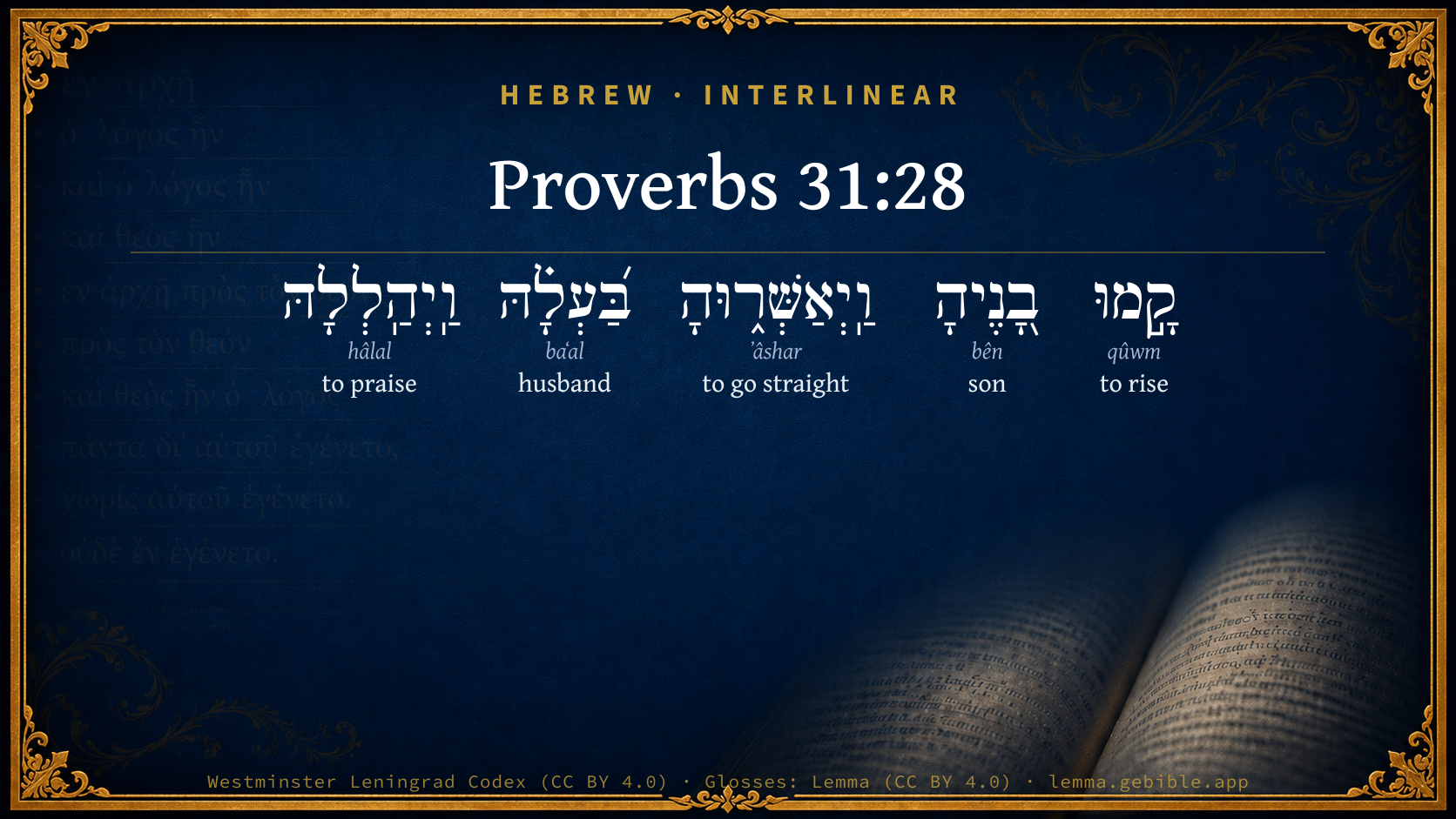
  1. קָ֣מוּ qûwm H6965 “to rise” Verb, Qal, Perfect, 3rd Person, Common, Plural
  2. בָ֭נֶיהָ bên H1121 “sons · her” Noun, Common, Masculine, Plural, Construct + Suffix, Personal, 3rd Person, Feminine, Singular
  3. בַּ֝עְלָ֗הּ baʻal H1167 “husband · her” Noun, Common, Masculine, Singular, Construct + Suffix, Personal, 3rd Person, Feminine, Singular
  4. וַֽיְהַֽלְלָהּ hâlal H1984 “and · to praise · her” Conjunction + Verb, Piel, Sequential Imperfect, 3rd Person, Masculine, Singular + Suffix, Personal, 3rd Person, Feminine, Singular

About this verse

These counts appear in no published source. They are computed here, from the morphology-tagged text and Lemma’s own curated glosses. What Lemma adds →

5
words
5
distinct lemmas
Wisdom
section

Notable vocabulary

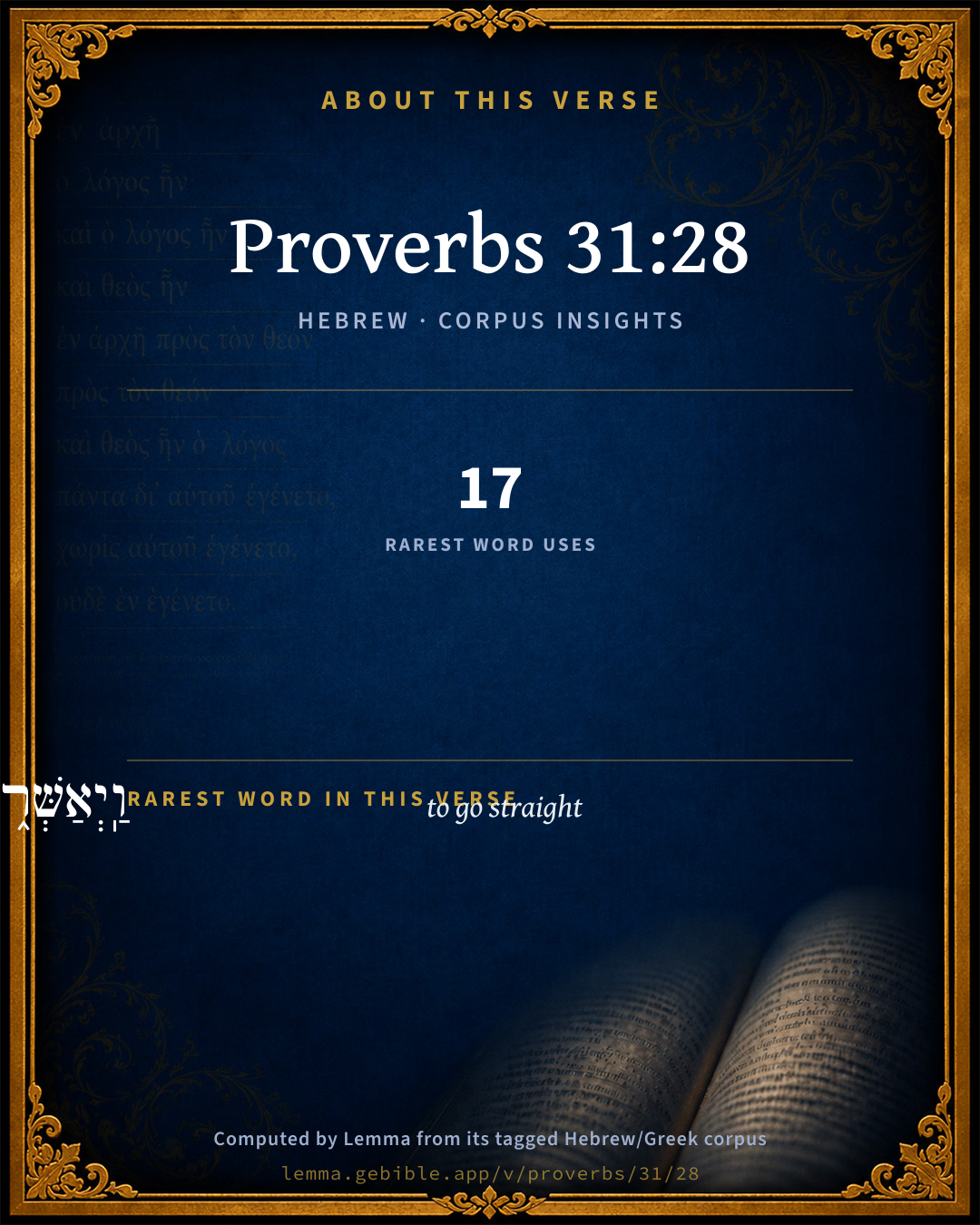
The rarest word here is וַֽיְאַשְּׁר֑וּהָ to go straight H833 — appearing just 17 times in the whole Hebrew Bible.

Shared distinctive vocabulary

וַֽיְאַשְּׁר֑וּהָ to go straight H833 occurs in 15 verses of the Hebrew Bible. Also found in:

Grammatical profile

  • 3 verbs
  • 2 nouns

Verb forms

  • קָ֣מוּ Qal · Perfect
  • וַֽיְאַשְּׁר֑וּהָ Piel · Sequential Imperfect
  • וַֽיְהַֽלְלָהּ Piel · Sequential Imperfect

Hebrew & Septuagint length

In English translation the verse runs 13 words from the Hebrew and 20 from the Septuagint (LXX English) — the Septuagint runs noticeably longer here. See the side-by-side →

A rough comparison of the two English renderings, which tokenize alike — not a word-level alignment.

Word counts can differ between the Hebrew and the Greek without any difference in meaning — e.g. the Hebrew direct-object marker אֵת has no separate Greek word, and Greek often adds the article ὁ.

Cross-references

7

Topical passages linked to Proverbs 31:28 in the Treasury of Scripture Knowledge — connected by theme and wording, ordered by reader-vote popularity; previews shown in the World English Bible.

  • 2 Timothy 1:5 having been reminded of the unfeigned faith that is in you; which lived first in your grandmother Lois, and your mother Eunice, and, I am persuaded, in you also.
  • 2 Timothy 3:15–17 From infancy, you have known the sacred writings which are able to make you wise for salvation through faith, which is in Christ Jesus.
  • 1 Kings 2:19 Bathsheba therefore went to king Solomon, to speak to him for Adonijah. The king rose up to meet her, and bowed himself to her, and sat down on his throne, and caused a throne to be set for the king's mother; and she sat on his right hand.
  • Psalms 116:16 Yahweh, truly I am your servant. I am your servant, the son of your handmaid. You have freed me from my chains.
  • Proverbs 31:1 The words of king Lemuel; the oracle which his mother taught him.
  • Song of Solomon 7:1–9 How beautiful are your feet in sandals, prince's daughter! Your rounded thighs are like jewels, The work of the hands of a skillful workman.
  • Isaiah 62:4–5 You shall no more be termed Forsaken; neither shall your land any more be termed Desolate: but you shall be called Hephzibah, and your land Beulah; for Yahweh delights in you, and your land shall be married.

Cross-references courtesy of OpenBible.info (CC BY 4.0).

Hebrew and Greek witnesses Masoretic Hebrew ↔ Greek Septuagint

The same verse in the two great witnesses to the Old Testament, shown verse-for-verse.

Here the Septuagint runs noticeably longer than the Hebrew — LXX2012 (modern English Septuagint) 20 words vs World English Bible 13. A rough length comparison of the two English translations, not a word-level alignment — read both below.

These are two independent witnesses, not word-aligned to each other, and the Septuagint is shown in lemma (dictionary) form.

Hebrew Proverbs 31:28 Masoretic · Westminster Leningrad Codex

קָ֣מוּ בָ֭נֶיהָ וַֽיְאַשְּׁר֑וּהָ בַּ֝עְלָ֗הּ וַֽיְהַֽלְלָהּ

Her children rise up and call her blessed. Her husband also praises her:

World English Bible · Public Domain

Greek LXX Proverbs 31:28 Septuagint · lemma form

ὁ στόμα δέ ἀναοἴγω σοφῶς καί νομοθέσμως ὁ δέ ἐλεημοσύνη αὐτός ἀναἵστημι ὁ τέκνον αὐτός καί πλουτέω καί ὁ ἀνήρ αὐτός αἰνέω αὐτός

And her kindness to them sets up her children for them, and they grow rich, and her husband praises her.

LXX2012 (modern English Septuagint) · Public Domain

On this verse, The Pulpit Commentary discusses the Septuagint’s reading. Read the note in Commentary ↓

Hebrew: Westminster Leningrad Codex (CC BY 4.0). Greek: Septuagint (public domain); English from LXX2012 (modern English Septuagint) (Public Domain). How the Septuagint differs from the Hebrew →

Commentary

Notes on Proverbs 31:28 from classic Christian and Jewish commentators (each source and its license shown beneath its notes). The classic Christian expositions comment on the surrounding passage and are grouped to its opening verse, so a note may address several verses; the Jewish commentaries on the Tanakh (Rashi and others) are per-verse, so they appear only where the commentator wrote on this verse.

Lemma curates 59 commentaries, every one of them public domain or Creative Commons licensed, each selected and text-cleaned for this edition rather than reprinted as found. About our sources →

Trapp's Complete Commentary

John Trapp

Pro 31:28 Her children arise up, and call her blessed; her husband [also], and he praiseth her.

Ver. 28. Her children arise up, and call her blessed.] As they grow to any height, and consider their beholdingness, so they bless her, and bless God for her: they bless the time that ever they were born of her, and so virtuously bred by her; being ready to say of her, as once Deborah said of Jael, "Blessed above women shall Jael the wife of Heber be; blessed shall she be above women in the tent." {Jdg 5:24} Blessed be the womb that bare us, and the paps that gave us suck.

Her husband also.] Whom she commanded by obeying, as Livia did her husband Augustus.

And he shall praise her.] Praise is due to virtue. And albeit, landis non indiga virtus, ilia sed est proprio plane contenta theatro; virtue is her own reward, and she is the best woman, and best to be liked, saith Thucydides, de cuius laude vel vituperio minimus sit sermo, of whose praise or dispraise there is least said abroad; yet forasmuch as praise is a spur. and virtue grows by it, why should it be denied to those who deserve it? {a} Is not a garland here made up by the hand of the Holy Ghost, and set upon the head of this excellent housewife? Neither is it any disparagement that her own husband and children commend her; for her business lying most within doors, who so fit to praise her as those that were ever present with her? and yet neither do they more praise her by their words than by their lives, formed by her to a right posture.

{a} Honos alit artes. Virtus laudata crescit. Omnes laudis studio incenduntur.

John Trapp, A Commentary or Exposition upon All the Books of the Old and New Testament (1647–1656) — public domain. Text from a community e-Sword module.

The Biblical Illustrator

Joseph S. Exell

Pro_31:28

Her children arise up, and call her blessed.

The childrens praise

This is part of the just debt owing to the virtuous woman. It is enough to make virtuous people happy that they are blessed of God. Yet this is thrown in as the reward of virtue, that among men also ordinarily it hath its praise. The praise that attends the virtuous woman comes from her own children.

1. It is a great comfort to those who are good themselves to see their children rising up. Here rising up means, stir up themselves to pursue the same course as their good mother.

2. The children of the virtuous woman call her blessed. It is her honour that she shall be praised by them that are best acquainted with her and most indebted to her.

I. The character of those parents to whom honour is due from their children.

1. Those that are truly wise deserve praise.

2. Those that are truly kind.

3. Those that are industrious and careful.

4. Those that are charitable.

5. Those that are virtuous; that is, sober and temperate, just and righteous in their conversation, exemplary in integrity and uprightness.

6. Those that are pious and religious towards God.

II. The duty of children in discharging their debt to their parents.

1. Maintain a grateful remembrance, and, on occasion, make honourable mention of our godly parents.

2. Give thanks to God for them.

3. We ought to be very sensible of our loss when such parents are removed from us. (Philip Henry, M.A.)

The blessing of the pious mother

The family is the profoundest and most sacred of all our social relationships. It is a type of spiritual relationships, and a means of realising them. In this delineation of the excellent woman the influence of the mother is more especially recognised. The distinctive honour of the pious mother is that she receives the benediction of her own children. They do her honour, speak of her with reverence and love and blessing. What must a mother be in order to inherit such benediction of her children? Notice her prudent regulation of the affairs of her household; her kindness, gentleness, and benignity; her piety. The religiousness that influences a child is the religiousness of common life, the religiousness that is the life that imbues all things with its feeling and sanctifies all things with its presence. Urge upon young women the present cultivation of such a character as will make them wise and holy mothers. (Henry Allon, D.D.)

Gratitude for a good mother

Mrs. Susannah Wesley was a model mother. The wife of a country curate, she brought up her large family so well that all Christendom has cause to bless her name. At her death her children gathered around her bed and sang a hymn of praise in gratitude to God for such a mother. She is called the Mother of Methodism, so much did her famous sons John and Charles Wesley owe to her influence and training. General Garfield said that his was a model mother. When young and headstrong he obtained work on a canal boat against her wishes. One dark night, when alone on the boat, he fell overboard. It was in a lock, where the water was deepest. He could not swim, and was sinking when his hand touched a rope hanging over the side, apparently by accident. He climbed on deck and found that the rope was only held by the slightest twist round a block. He felt it was Gods hand which had saved him, and resolved to start for home at once. He found his mother and described his miraculous escape. What hour was it? she asked. He told her, and she said, At that very moment I was praying for you, my son, that God would protect and bless you. And in after-life Garfield used to say, I owe everything to my mother.

Her husband also, and he praiseth her.

Gratitude for a good wife

The Earl of Beaconsfield said, Every step in my life to honour and success I owe to my good and faithful wife. President Lincoln, on receiving a presentation, said, I will hand this to the lady who, by her counsel and help, has made it possible in anywise for me to serve my country. A working man at a great meeting said recently, My wife was a good woman before her conversion, but now she is worth her weight in diamonds. When Jonathan Edwards was discharged from his appointment he came home in despair. But his wife smiled bravely and said, My dear, you have often longed for leisure to write your book, and now it has come. I have lighted a fire in your room, and set the table with pens and paper. He was so cheered that he set to work at once, and wrote the book that made him famous. (S. M. Evans.)

A wife praised by her husband

The late Robert Moffat had a wife of rare excellence. For more than fifty years she shared his toils in South Africa. The Secretary of the London Missionary Society says, After their return from Africa, while talking over their labours at the Mission House, Mrs. Moffat said, Robert affirms that I do not hinder him in his work. No, indeed, replied Dr. Moffat, but I can affirm that she has often sent me out to missionary work for months together, and in my absence has managed the station better than I could have done myself. Her husbands first exclamation on finding her gone was, For forty-three years I have had her to pray for me.

The Biblical Illustrator, edited by Joseph S. Exell (c. 1880s–1900s) — public domain. Text from a community e-Sword module.

Joseph Benson's Commentary

Pro 31:28. Her children arise up — Whose testimony is the more considerable, because they have been constant eye-witnesses of her whole conduct, and, therefore, must have seen her misdemeanours, if there had been any, as well as her virtues; and call her blessed — Both for her own excellences, and for many happy fruits which they have gathered from her wise and godly education of them. Her husband also — Ariseth to bear witness to her excellence; and he praiseth her — Namely, in the following words.

Joseph Benson's Commentary on the Old and New Testaments (1811–1818) — public domain. Text from a community e-Sword module.

Tyndale Open Study Notes

Tyndale Open Resources

31:28-29 Those most important to the woman testify to her character, abilities, and achievements.

Tyndale Open Study Notes — © Tyndale Open Resources, licensed CC BY-SA 4.0. Text via the HelloAO Bible API.

Geneva Bible (1599)

Geneva Bible translators

That is, do her reverence.

Geneva Bible (1599) marginal notes — public domain. Text via Bolls.life.

Jamieson, Fausset & Brown

Robert Jamieson, A. R. Fausset & David Brown

She is honored by those who best know her.

Jamieson, Fausset & Brown — Commentary Critical and Explanatory on the Whole Bible (1871) — public domain (CC PDM 1.0). Text via the HelloAO Bible API.

Adam Clarke's Commentary

Verse 28. Her children arise up, and call her blessed]

20. She considers a good education next to Divine influence; and she knows also that if she train up a child in the way he should go, when he is old he will not depart from it.

1) Her children are well bred; they rise up and pay due respect.

2) They are taught the fear of the Lord, and obedience to his testimonies; therefore they call her blessed. So they are of a decent, orderly, respectable, religious behaviour.

3) Her husband is so satisfied with her conduct towards himself, his household, his business, and their children, that he praiseth her. He shows himself sensible of her excellence, and encourages her, in her work, by the commendations he bestows.

Adam Clarke's Commentary on the Bible (1810–1826) — public domain. Text from a community e-Sword/MySword module.

John Gill's Exposition

Her children arise up,.... As olive plants around her table; grow up to maturity of age, and ripeness of judgment, and so capable of observing things, and doing the work here ascribed to them: or they rise up in reverence of her, and respect to her, suitable to the relation they stand in to her: or rather it signifies their readiness to show a regard unto her, and their setting about the work of commendation of her in earnest: or else their earliness in doing it; they rise in the morning, as Aben Ezra's note is; her lamp not being extinct in the night. Jarchi interprets these "children" of disciples; but they are to be understood of regenerate persons, young converts, born in Zion, and brought up by her; the children of that Jerusalem that is the mother of us all, Isa 54:1;

and call her blessed; bless God for her, for such a mother, and wish themselves as happy as she is; they pray for her blessedness, peace, and prosperity, as all Zion's children should, Psa 122:6; they pronounce her blessed, as well they may, since she is blessed with all spiritual blessings in Christ; and so are all in her family that truly belong to her, her children and her servants, Psa 84:4; see Sol 6:9;

her husband also, and he praiseth her; that is, he is ready also to rise up and speak in her praise and commendation. Jarchi says this is the holy blessed God. Christ is the church's husband, who is her Maker; See Gill on Pro 31:23; he praises her for her beauty, though she owes it all to him; for her comely parts and gracefulness, which he describes with wonder; for her dress, her garments, though they are his own; for her faith, love, humility, and other graces, though they are his gifts; see Sol 1:8.

John Gill's Exposition of the Whole Bible (1746–1763) — public domain (CC PDM 1.0). Text via the HelloAO Bible API.

Haydock's Catholic Bible Commentary

Her. They were best able to judge of her merit.

George Leo Haydock (1774–1849), Haydock's Catholic Family Bible and Commentary, 1859 edition — public domain. Excludes Psalms (Douay-Rheims chapter numbering differs from Protestant) and Deuterocanonical books (Catholic canon only).

Matthew Poole's English Annotations

Her children; whose testimony is the more considerable, because they have been constant eye-witnesses of her whole carriage, and therefore must have seen her misdemeanours, if there had been any, as well as her virtues.

Arise up; either,

1. In token of reverence to her, which agrees not to the following clause, wherein the same phrase is understood concerning her husband. Or rather,

2. That they may seriously and industriously apply themselves to the work of setting forth her praises, as this phrase is used, Gen 37:25; Exo 2:17, and oft elsewhere. For sitting being commonly the posture of idleness, men that set about any work are said to rise in order thereunto.

Call her blessed, both for her own excellency, and for many happy fruits which they have gathered from her wise and godly education.

He praiseth her, in the following words.

Matthew Poole's English Annotations on the Holy Bible (1683–1685) — public domain. Text from a community e-Sword/MySword module.

Whedon's Commentary on the Bible

Daniel D. Whedon

28. Her children… call her blessed — As a consequence of the above ordering and control of her family, her children grow up in virtuous habits, regularity of life, and respectfulness of demeanour. They rise up to do her honour, and pronounce blessings on such a mother.

Her husband… praiseth — She also commands the respect and homage of her husband, as well she may. Even good husbands are not always as careful to recognise the services and virtues of their wives as they ought to be. A good wife looks for and deserves expressions of approbation and encouragement.

Daniel D. Whedon (gen. ed.), Commentary on the Old and New Testaments (1874–1909) — public domain. Text from a community e-Sword module.

The Pulpit Commentary

KUPH. Her children arise up, and call her blessed. She is a fruitful mother of children, who, seeing her sedulity and prudence, and experiencing her affectionate care, celebrate and praise her, and own that she has rightly won the blessing of the Lord. Her husband also, and he praiseth her; in the words given in the next verse. Having the approbation of her husband and children, who know her best, and have the best opportunities of judging her conduct, she is contented and happy. Septuagint, "Her mercy (elehmosunh ) raises up her children, and they grow rich, and her husband praises her."

The Pulpit Commentary (1880–1919), ed. H.D.M. Spence-Jones & Joseph S. Exell — public domain. Text from a community e-Sword module.

Keil & Delitzsch

C. F. Keil & F. Delitzsch

Now begins the finale of this song in praise of the virtuous woman:

28 ק Her sons rise up and bless her,

Her husband (riseth up) and praiseth her.

The Piel אשּׁר in such a connection is denom. of אשׁר (אשׁרי). Her children rise up (קוּם, like e.g., Jer 26:17, but here, perhaps, with the associated idea of reverential honour) and bless her, that she has on her part brought the house and them to such prosperity, such a position of respect, and to a state where love (חסד) reigns, and her husband rises up and sings her praise.

Keil & Delitzsch — Biblical Commentary on the Old Testament (1861–1891) — public domain (CC PDM 1.0). Text via the HelloAO Bible API. (Old Testament only.)

Bridges on Proverbs

Charles Bridges

The virtuous woman is obviously subserving her own interest. For what greater earthly happiness could she know, than her children’s reverence, and her husband’s blessing? We may picture to ourselves her condition — crowned with years; her children grown up; perhaps themselves surrounded with families, and endeavoring to train them, as themselves had been trained. Their mother is constantly before their eyes. Her tender guidance, her wise counsels, her loving discipline, her holy example, are vividly kept in remembrance. They cease not to call her blessed, and to bless the Lord for her, as his invaluable gift. No less warmly does her husband praise her. His attachment to her was grounded, not on the deceitful and vain charms of beauty, but on the fear of the LORD. She is therefore in his eyes to the end, the stay of his declining years, the soother of his cares, the counselor of his perplexities, the comforter of his sorrows, the sunshine of his earthly joys. (Sir 36:23-24 .) Both children and husband combine in the grateful acknowledgment — Many daughters have done virtuously; but thou excellest them all.

But why — it may be asked — do external recommendations form no part of this portrait? All that is described is solid excellence; and favor is deceitful. A graceful form and mien often end in disappointment, more bitter then words can tell. Often do they furnish a cover for the vilest corruptions. And then beauty — what a fading vanity it is!†1 One fit of sickness sweeps it away. (Psa 39:11 .) Sorrow and care wither its charms. (Psa 6:7 . P.T.) And even while it remains, it is little connected with happiness.†2 It proves itself the fruitful occasion of trouble, the source of many hurtful temptations and snares;†3 and, without substantial principle, to a well-judging mind it becomes and object of disgust rather than of attraction. (Pro 11:22 .)

The portrait, here penciled by divine inspiration, begins with the touch of a virtuous woman, and fills up the sketch with the lineaments of a woman, that feareth the LORD. (Pro 31:10, Pro 31:30 .) For the lovely features described — her fidelity to her husband, her active personal habits, her good management and diligence in her family, her consideration for the necessities and comforts of others, her watchfulness of conduct, her tenderness for the poor and afflicted, her kind and courteous behavior to all — this completeness of character and grace could only flow from that virtue, which is identified with vital godliness. They are the good fruit, that "prove the tree good." (Mat 7:17 .) They are such fruit, flowing from a right principle, as the natural corrupt stock of man could never produce.

The virtuous woman seeks not the praise of men. Content to be known and loved within her own circle, she never presses herself into notice. But as a public blessing, she cannot be hid. (Act 9:39 .) And if she has no herald to sound her praise, all will say — Give her of the fruit of her hands, and let her own works praise her in the gates. ’Let every one’ — says Bishop Patrick — ’extol her virtue. Let her not want the just commendation of her pious labors. But while some are magnified for the nobleness of the stock, from whence they sprung; others for their fortune; others for their beauty; others for other things; let the good deeds, which she herself hath done, be publicly praised in the greatest assemblies; where, if all men should be silent, her own works will declare her excellent worth.’†4 Add to this — as her works praise her in the gates, so will they "follow her. The memory of the just is blessed." (Rev 14:13 . Pro 10:7 .) All will see in her the light and luster of a sound and practical profession; that the promises of godliness are the richest gain, the grace of God the best portion, and his favor the highest honor.

If this picture be viewed as an exhibition of godliness, we observe that religion does not slacken attention to temporal duties. It rather renders a woman scrupulously exact in all her household obligations, in everything within her province; careful not by her negligence to bring reproach upon her holy profession. Why should she be careless or slovenly, putting her important duties out of time and out of place? Of her it is specially expected, as the summing up of all her practical exercises, that "she should have diligently followed every good work." (1Ti 5:10 .)

How valuable also is this picture, as a directory for the marriage choice! Let virtue, not beauty, be the primary object. Set against the vanity of beauty the true happiness, connected with a woman that feareth the LORD. Here is the solid basis of happiness. ’If’ — says Bp. Beveridge — ’I choose her for her beauty, I shall love her no longer than while that continues; and then farewell at once both duty and delight. But if I love her for her virtues; then, though all other sandy foundations fail, yet will my happiness remain entire.’†5 The external choice was the cause of the destruction of the world. (Gen 6:2-7 .) A flood of iniquity came into a godly man’s family from the self-pleasing delusion. (2Ch 18:1 ; 2Ch 21:5-6 .) The godly choice is uniformly stamped with the seal of divine acceptance.

In fine — ’if women’ — says pious Bishop Pilkington — ’would learn what God will plague them for, and how; let them read the third chapter of the prophet Esay. And if they will learn what God willeth them to do, and be occupied withal, though they be of the best sort, let them read the last chapter of the Proverbs. It is enough to note it, and point it out to them that will learn.’†6 ’That which is last to be done’ — concludes an old Expositor — ’is to mark it well, and let every woman strive to make it agree to herself as much as she can. Let every man be ashamed, that any woman shall excel him in virtue and godliness.’†7

’Thus — and once more’ — says pious Matthew Henry, in his quaint style — ’is shut up this looking-glass for ladies, which they are desired to open and dress themselves by; and if they do so, their adorning will be found to praise, and honor, and glory, at the appearing of Jesus Christ.’†8

Footnotes:

†1 Gen 12:14, with Gen 23:4 . 1Pe 1:24 . Compare Virg. Ecolog. ii. 17, 18.

†2 Gen 29:17; Gen 30:1-2 .

†3 Pro 4:25-26. Gen 12:11-19 ; Gen 20:1-2, Gen 20:11 ; Gen 26:7 . 2Sa 11:2 ; 2Sa 13:1 .

†4 In loco.

†5 Works, Parker Society Edit. p. 387.

†6 Resolution ii.

†7 Jermin in loco.

†8 In loco.

Charles Bridges, An Exposition of the Book of Proverbs (1846) — public domain. Text from a community e-Sword module.

unfoldingWord translationNotes

Door43 World Missions Community

rise up and

Possible meanings are 1) literally "stand up and" or 2) as a metonym, "actively." (See: Metonymy)

call her blessed

saying that good things have happened to her because she has done good things. This can be translated as a direct quote. AT: "congratulate her" or "say, 'Yay, Mom!'" (See: Direct and Indirect Quotations)

you surpassed

"you have done better than"

translationWords

praise

unfoldingWord translationNotes — © Distant Shores Media and the Door43 World Missions Community, licensed CC BY-SA 4.0. Source: git.door43.org/Door43/en_tn.

Lesson kit

Teaching starters — assembled from the data on this page, not authored interpretation. Every prompt links to the verse data it draws on. Edit before teaching.

Proverbs, in the Wisdom, opens this verse with 5 words (5 distinct Hebrew lemmas). Its most distinctive word is ʼâshar (“to go straight”). The Greek Septuagint runs longer here. A historical commentator’s framing appears above. Read the whole chapter for the surrounding context.

Discussion questions

  1. The word ʼâshar carries the sense “to go straight.” How does it shape the verse?
  2. How does Genesis 30:13, which shares the word «to go straight», read alongside this verse?
  3. The Septuagint runs longer here than the Hebrew. What might account for the difference?
  4. The translations on this page render this verse differently — a whole-verse word diff, not a word-by-word alignment. What might account for the different wordings?
  5. «קָ֣מוּ» is a Qal Perfect verb. How does that grammatical form shape the action described?
  6. Compare how Trapp's Complete Commentary and The Biblical Illustrator read this verse. Where do they agree or differ?

Things to notice

Reading settings

Reading text

Shown beneath each verse's original-language words.

Old Testament
Old Testament edition

Read the OT as the Masoretic Hebrew (MT) or the Greek Septuagint (LXX).

English shown for the Greek Septuagint (in the Hebrew ↔ Greek comparison).

Comparing translations? Open the Compare panel on any verse page to stack up to four side by side.