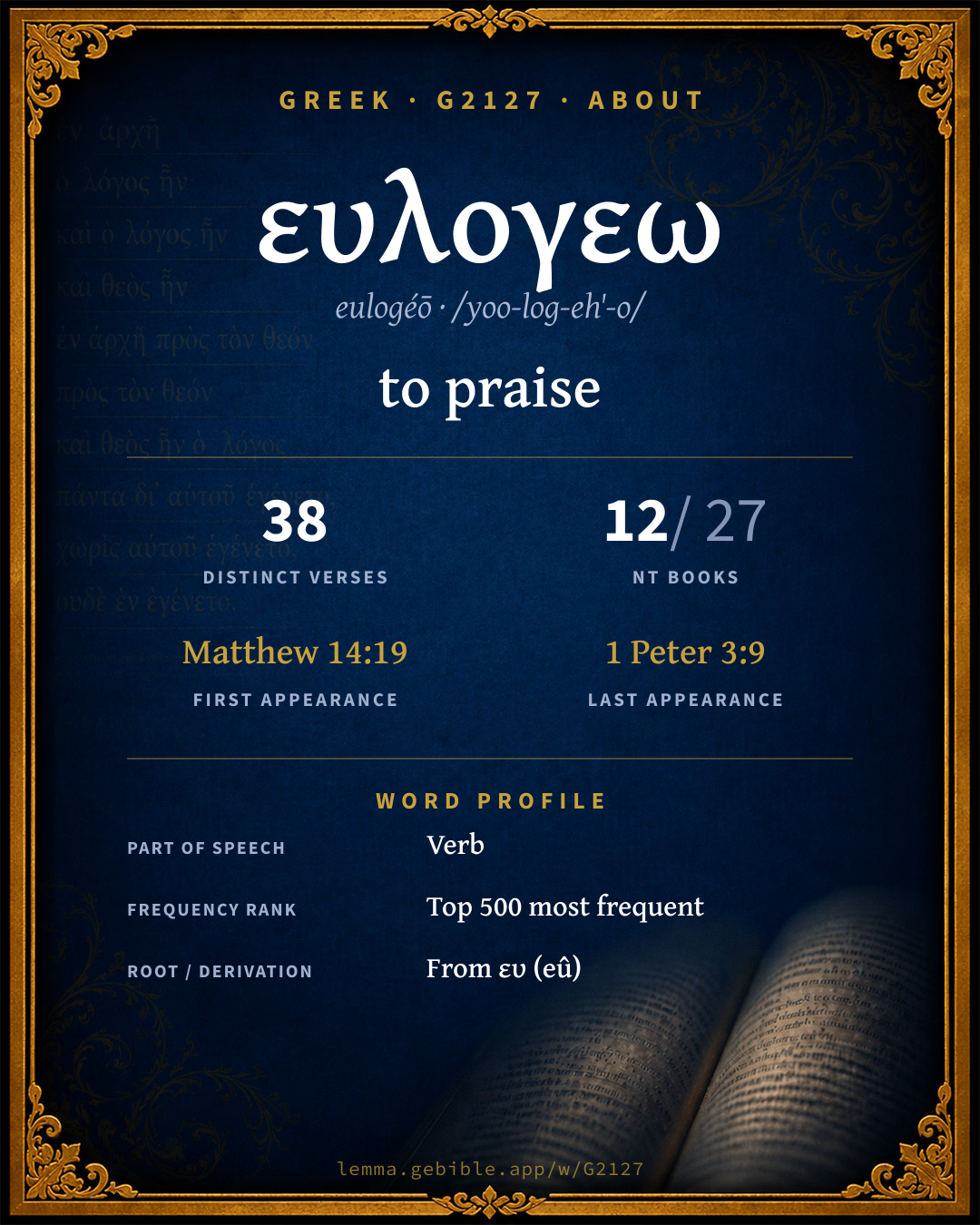
εὐλογέω
to praise
‘to praise’ is one of 5 main senses fuller range ↓
Full lexicon entry — Thayer's Greek Lexicon
From Thayer's Greek Lexicon
Where this word appears
See every Aorist-tense verb in the Greek New Testament →
Grammar key — what these labels mean
Part of speech
- Verb
- An action or state-of-being word.
Tense
- Aorist
- Action viewed as a simple whole, without regard to duration — often past (perfective aspect).
- Perfect
- A completed past action with continuing present results.
- Present
- Ongoing or general action in present time (imperfective aspect).
- Future
- Action expected in future time.
- Imperfect
- Continuous or repeated action in past time (“was writing”).
Voice
- Active
- The subject performs the action.
- Passive
- The subject receives the action.
Mood
- Indicative
- States a fact or asks a factual question (the mood of reality).
- Participle
- A verbal adjective (“writing,” “having written”).
- Imperative
- Expresses a command or request.
- Infinitive
- A verbal noun (“to write”), unmarked for person or number.
- Subjunctive
- Expresses probability, purpose, or possibility (the mood of contingency).
Case
- Nominative
- The case of the subject (and the predicate nominative).
- Accusative
- The case of the direct object and of extent.
Person
- 3rd person
- The one spoken about (“he / she / it / they”).
- 1st person
- The speaker (“I / we”).
- 2nd person
- The one addressed (“you”).
Gender
- Masculine
- Grammatically masculine.
- Feminine
- Grammatically feminine.
Number
- Singular
- One.
- Plural
- More than one.
Grammatical forms 17 distinct
- Verb, Aorist, Active, Indicative, 3rd person, Singular 9 times (22%)
- Verb, Perfect, Passive, Participle, Nominative, Singular, Masculine 7 times (17%)
- Verb, Aorist, Active, Participle, Nominative, Singular, Masculine 5 times (12%)
- Verb, Present, Active, Indicative, 1st person, Plural 3 times (7%)
- Verb, Present, Active, Imperative, 2nd person, Plural 3 times (7%)
- Verb, Present, Active, Participle, Nominative, Singular, Masculine 2 times (5%)
- Verb, Perfect, Passive, Participle, Nominative, Singular, Feminine 2 times (5%)
- Verb, Future, Active, Indicative, 1st person, Singular 1 time (2%)
+9 more forms (9 occurrences)
Parsed forms decoded from the imported morphology (Robinson–Tischendorf, public domain), counted across 41 parsed occurrences — not distinct verses.
Every verse where G2127 appears — 38 distinct verses across 12 books. Click any verse to open its interlinear word-by-word view. Verse text shown in the World English Bible for context — . Each verse’s Greek form is shown with its reference; the English is not keyword-highlighted, since the data carries no word-level English alignment. Use “Compare translations” on any verse to read it across multiple English versions. This concordance covers the Greek New Testament; Septuagint (Greek Old Testament) occurrences of this word are not indexed here.
Matthew 5 verses
- Matthew 14:19 εὐλόγησεν aor act ind 3sg He commanded the multitudes to sit down on the grass; and he took the five loaves and the two fish, and looking up to heaven, he blessed, broke and gave the loaves to the disciples, and the disciples gave to the multitudes.
- Matthew 21:9 εὐλογημένος perf pass ptcp nom sg masc The multitudes who went before him, and who followed kept shouting, "Hosanna to the son of David! Blessed is he who comes in the name of the Lord! Hosanna in the highest!"
- Matthew 23:39 εὐλογημένος perf pass ptcp nom sg masc For I tell you, you will not see me from now on, until you say, 'Blessed is he who comes in the name of the Lord!'"
- Matthew 25:34 εὐλογημένοι perf pass ptcp nom pl masc Then the King will tell those on his right hand, 'Come, blessed of my Father, inherit the Kingdom prepared for you from the foundation of the world;
- Matthew 26:26 εὐλογήσας aor act ptcp nom sg masc As they were eating, Jesus took bread, gave thanks for it, and broke it. He gave to the disciples, and said, "Take, eat; this is my body."
Mark 6 verses
- Mark 6:41 εὐλόγησεν aor act ind 3sg He took the five loaves and the two fish, and looking up to heaven, he blessed and broke the loaves, and he gave to his disciples to set before them, and he divided the two fish among them all.
- Mark 8:7 εὐλογήσας aor act ptcp nom sg masc They had a few small fish. Having blessed them, he said to serve these also.
- Mark 10:16 κατευλόγει impf act ind 3sg He took them in his arms, and blessed them, laying his hands on them.
- Mark 11:9 εὐλογημένος perf pass ptcp nom sg masc Those who went in front, and those who followed, cried out, "Hosanna! Blessed is he who comes in the name of the Lord!
- Mark 11:10 εὐλογημένη perf pass ptcp nom sg fem Blessed is the kingdom of our father David that is coming in the name of the Lord! Hosanna in the highest!"
- Mark 14:22 εὐλογήσας aor act ptcp nom sg masc As they were eating, Jesus took bread, and when he had blessed, he broke it, and gave to them, and said, "Take, eat. This is my body."
Luke 11 verses
- Luke 1:42 εὐλογημένη εὐλογημένος perf pass ptcp nom sg fem perf pass ptcp nom sg masc She called out with a loud voice, and said, "Blessed are you among women, and blessed is the fruit of your womb!
- Luke 1:64 εὐλογῶν pres act ptcp nom sg masc His mouth was opened immediately, and his tongue freed, and he spoke, blessing God.
- Luke 2:28 εὐλόγησεν aor act ind 3sg then he received him into his arms, and blessed God, and said,
- Luke 2:34 εὐλόγησεν aor act ind 3sg and Simeon blessed them, and said to Mary, his mother, "Behold, this child is set for the falling and the rising of many in Israel, and for a sign which is spoken against.
- Luke 6:28 εὐλογεῖτε pres act impv 2pl bless those who curse you, and pray for those who mistreat you.
- Luke 9:16 εὐλόγησεν aor act ind 3sg He took the five loaves and the two fish, and looking up to the sky, he blessed them, and broke them, and gave them to the disciples to set before the multitude.
- Luke 13:35 εὐλογημένος perf pass ptcp nom sg masc Behold, your house is left to you desolate. I tell you, you will not see me, until you say, 'Blessed is he who comes in the name of the Lord!'"
- Luke 19:38 εὐλογημένος perf pass ptcp nom sg masc saying, "Blessed is the King who comes in the name of the Lord! Peace in heaven, and glory in the highest!"
- Luke 24:30 εὐλόγησεν aor act ind 3sg It happened, that when he had sat down at the table with them, he took the bread and gave thanks. Breaking it, he gave to them.
- Luke 24:50 εὐλόγησεν aor act ind 3sg He led them out as far as Bethany, and he lifted up his hands, and blessed them.
- Luke 24:51 εὐλογεῖν pres act inf It happened, while he blessed them, that he withdrew from them, and was carried up into heaven.
John 1 verse
Acts 1 verse
Romans 1 verse
1 Corinthians 3 verses
- 1 Corinthians 4:12 εὐλογοῦμεν pres act ind 1pl We toil, working with our own hands. When people curse us, we bless. Being persecuted, we endure.
- 1 Corinthians 10:16 εὐλογοῦμεν pres act ind 1pl The cup of blessing which we bless, isn't it a communion of the blood of Christ? The bread which we break, isn't it a communion of the body of Christ?
- 1 Corinthians 14:16 εὐλογῇς pres act subj 2sg Otherwise if you bless with the spirit, how will he who fills the place of the unlearned say the "Amen" at your giving of thanks, seeing he doesn't know what you say?
Galatians 1 verse
Ephesians 1 verse
Hebrews 6 verses
- Hebrews 6:14 εὐλογῶν εὐλογήσω pres act ptcp nom sg masc fut act ind 1sg saying, "Most surely I will bless you, and I will surely multiply you."
- Hebrews 7:1 εὐλογήσας aor act ptcp nom sg masc For this Melchizedek, king of Salem, priest of God Most High, who met Abraham returning from the slaughter of the kings and blessed him,
- Hebrews 7:6 εὐλόγηκεν perf act ind 3sg but he whose genealogy is not counted from them has taken tithes of Abraham, and has blessed him who has the promises.
- Hebrews 7:7 εὐλογεῖται pres pass ind 3sg But without any dispute the less is blessed by the better.
- Hebrews 11:20 εὐλόγησεν aor act ind 3sg By faith, Isaac blessed Jacob and Esau, even concerning things to come.
- Hebrews 11:21 εὐλόγησεν aor act ind 3sg By faith, Jacob, when he was dying, blessed each of the sons of Joseph, and worshiped, leaning on the top of his staff.
James 1 verse
1 Peter 1 verse
About this entry
At a glance — auto-summarized from this page’s data, not written by a person. Every figure links to its source below. This summary describes the numbers; it doesn’t interpret them.
At its core, ευλογεω (eulogéō) means “to praise.” Older and newer Bibles part ways — “blessed” in the King James Version, “blessed is” (unfoldingWord Literal Text) in modern versions. See the renderings breakdown. It appears 38 verses across 12 books of the Greek New Testament, among its moderately common vocabulary. The word gravitates to Luke (29%), then Mark and Hebrews. Ranging over 5 senses, it is not a single-sense word. Dig into 38-verse concordance and the renderings breakdown below.
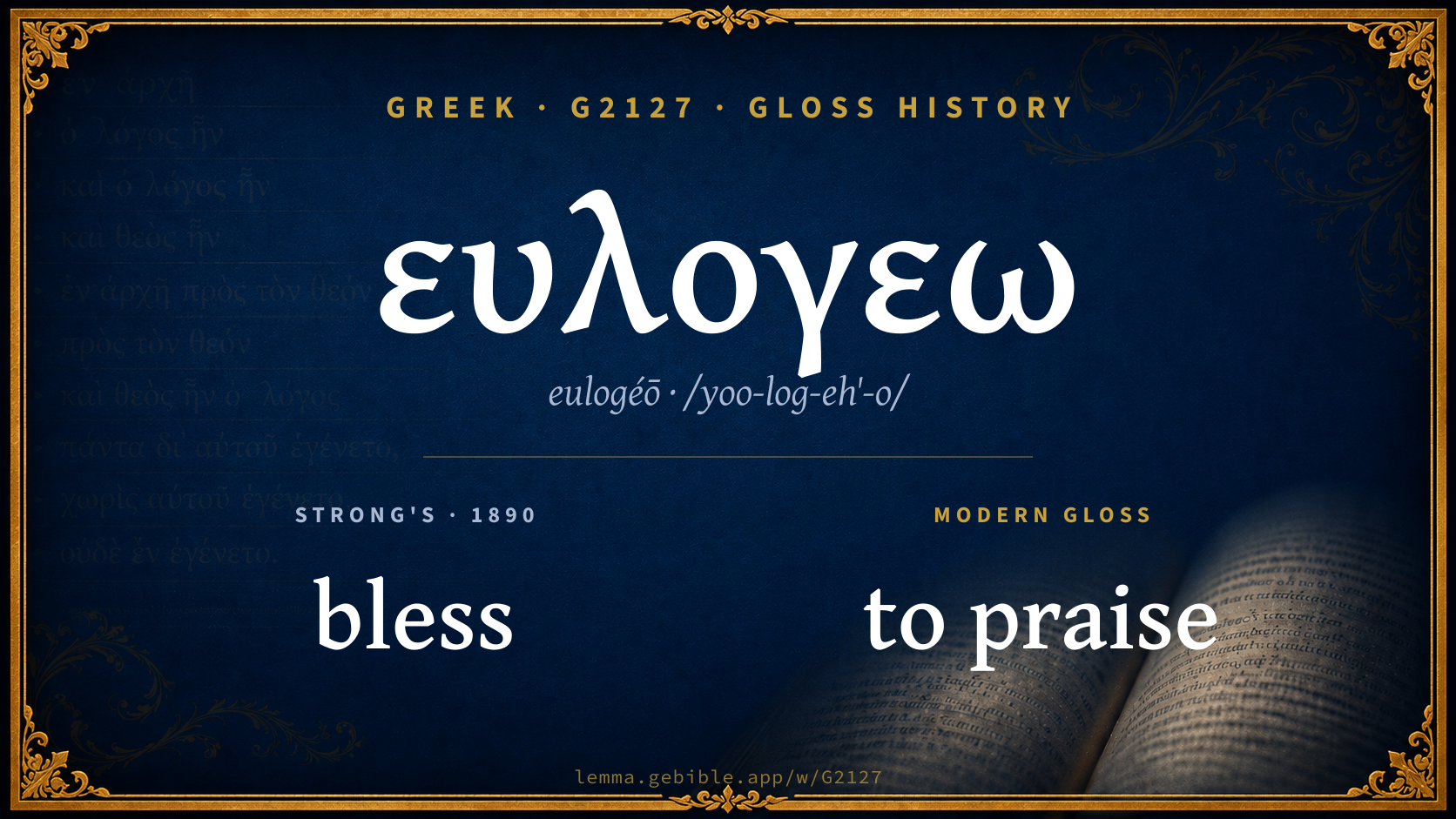
Gloss history
Strong's 1890 vs modern scholarship
About this word
Strong's G2127 catalogs a Greek word from the Greek New Testament.
These counts are not copied from any lexicon or concordance. They are computed here, from the morphology-tagged Greek New Testament. What Lemma adds →
- 38
- distinct verses
- The word appears in 38 distinct verses.
- 12 / 27
- NT books
- The word appears in 12 of 27 New Testament books.
- #364
- by frequency
- Top 500 most frequent Greek words (rank 364 of 5,347 Greek words by occurrence).
View all 38 occurrences in the concordance →
By section of the New Testament
By traditional corpus
Conventional, traditional groupings — biblical authorship is debated, so this is a traditional corpus grouping, not an authorship claim. Some books belong to more than one corpus (Luke is in both the Gospels and the Lukan corpus, and so on), so these shares overlap and need not total 100%. Each figure is a share of the word’s 38 distinct verses.
- Gospels 23 verses · 61%
- Lukan (Luke–Acts) 12 verses · 32%
- Pauline corpus 6 verses · 16%
- Hebrews 6 verses · 16%
- General (Catholic) Epistles 2 verses · 5%
- Johannine 1 verse · 3%
How translations render this word
Counts come from each version’s own published word-to-Strong’s tagging or interlinear alignment — an approximate guide to how each version renders this word, not a word-level alignment the data otherwise carries. Because each total is that version’s own tagged count, the per-version totals vary from one another and need not match the appearance or distinct-verse counts above. These counts may also differ from a printed concordance because Lemma counts each distinctly tagged rendering and does not collapse phrase taggings into a single head-word total. This is a fixed set of word-tagged versions (KJV, ASV, BSB, ULT) and does not change with the reading translation you choose elsewhere. Each version’s license is shown beside its name below (and on Sources).
- King James Version: Blessed 23×, Bless 5×, Blessing 3×
- American Standard Version: Blessed 18×, Bless 4×, Blessing 4×
- Berean Standard Bible: Blessed 12×, Blessed is 6×, Bless 5×
- unfoldingWord Literal Text: Blessed is 7×, Blessed 6×, Bless 5×
King James Version Public Domain
Renders G2127 across 44 tagged occurrences — most commonly:
Plus 8 renderings that appear only once — usually multi-word phrases or single function words the recovered tagging swept in, not distinct renderings.
American Standard Version Public Domain
Renders G2127 across 45 tagged occurrences — most commonly:
Plus 12 renderings that appear only once — usually multi-word phrases or single function words the recovered tagging swept in, not distinct renderings.
Berean Standard Bible Public Domain
Renders G2127 across 41 tagged occurrences — most commonly:
Plus 8 renderings that appear only once — usually multi-word phrases or single function words the recovered tagging swept in, not distinct renderings.
unfoldingWord Literal Text CC BY-SA 4.0
Renders G2127 across 45 tagged occurrences — most commonly:
Plus 9 renderings that appear only once — usually multi-word phrases or single function words the recovered tagging swept in, not distinct renderings.
Senses in Thayer's
The 5 senses Thayer's distinguishes for this word, in lexicon order (not ranked by frequency or importance). The full entry — with sub-senses — is in the Lexicon Entry tab.
- to praise, celebrate with praises
- to invoke blessings
- to consecrate a thing with solemn prayers
- to cause to prosper, to make happy, to bestow blessings on
- favoured of God, blessed
Word origin
Derived from ευ (eû) (G2095) — to prosper.
Forms in the corpus
The 17 distinct written forms G2127 takes in the Greek New Testament, most frequent first — each parse links to that tense’s occurrences in the concordance.
Same root — word family
Other Thayer's entries built from the same root as G2127, grouped by Strong’s listed origin. These share a root / origin per the lexicon — not necessarily a shared meaning. Each links to that word’s own entry.
Derives from
Shares the same root
- ευαγγελιζω euangelízō G2097 to evangelize
- ευαρεστος euárestos G2101 pleasing
- ευγενης eugenḗs G2104 noble
- ευδια eudía G2105 fair weather
- ευδοκεω eudokéō G2106 to be pleased
- ευδοκια eudokía G2107 pleasure
- ευεργετης euergétēs G2110 benefactor
- ευθετος eúthetos G2111 well situated
- ευθυμος eúthymos G2115 courageous
- ευθυς euthýs G2117 straight
- ευκαιρος eúkairos G2121 opportune
- ευκοπωτερος eukopṓteros G2123 easy
- ευλαβης eulabḗs G2126 devout
- ευμεταδοτος eumetádotos G2130 generous
- ευνοεω eunoéō G2132 to wish well
- ευοδοω euodóō G2137 to prosper
- ευπειθης eupeithḗs G2138 obedient
- ευπεριστατος euperístatos G2139 besetting
- ευποιΐα eupoiḯa G2140 doing good
- ευπρεπεια euprépeia G2143 beauty
- ευπροσδεκτος euprósdektos G2144 acceptable
- ευπροσεδρος euprósedros G2145 devoted
- ευπροσωπεω euprosōpéō G2146 to please
- ευσεβης eusebḗs G2152 pious
+13 more words share this root (not shown).
Derived from this word
Proper names from this root
People and places named from this root — a name, not an additional meaning of the word.
Compare all same-root words → Showing 4 of 44 — not the complete family. 3 of the same-root words are proper names (people or places). They share a root, not necessarily a meaning.
Septuagint usage
The same Greek word ευλογεω appears 329 times in the Greek Old Testament (Septuagint), across 287 verses in 23 books.
- 329
- LXX occurrences
- Tagged occurrences of this Greek word in the Septuagint.
- 287
- verses
- Distinct Septuagint verses containing this word.
- 23 / 39
- OT books
- The word appears in 23 of the 39 Old Testament books.
Sample Septuagint occurrences
- Genesis 1:22 εὐλογέω
- Exodus 12:32 εὐλογέω
- Leviticus 9:22 εὐλογέω
- Numbers 6:23 εὐλογέω
- Deuteronomy 1:11 εὐλογέω
- Joshua 9:2 εὐλογέω
- Judges 5:2 εὐλογέω
- Ruth 2:4 εὐλογέω
- 1 Samuel 2:9 εὐλογέω
- 2 Samuel 2:5 εὐλογέω
- 1 Kings 1:47 εὐλογέω
- 2 Kings 4:29 εὐλογέω
Septuagint occurrences (same lexeme)
Every verse where the same Strong’s number (G2127) appears in the Greek Septuagint — showing the first 50 of 287. Verse text shown in the World English Bible for context; the Greek form is the matched word — the English is not keyword-highlighted.
- Genesis 1:22 εὐλογέω God blessed them, saying, "Be fruitful, and multiply, and fill the waters in the seas, and let birds multiply on the earth."
- Genesis 1:28 εὐλογέω God blessed them. God said to them, "Be fruitful, multiply, fill the earth, and subdue it. Have dominion over the fish of the sea, over the birds of the sky, and over every living thing that moves on the earth."
- Genesis 2:3 εὐλογέω God blessed the seventh day, and made it holy, because he rested in it from all his work which he had created and made.
- Genesis 5:2 εὐλογέω He created them male and female, and blessed them, and called their name Adam, in the day when they were created.
- Genesis 9:1 εὐλογέω God blessed Noah and his sons, and said to them, "Be fruitful, and multiply, and replenish the earth.
- Genesis 12:2 εὐλογέω I will make of you a great nation. I will bless you, and make your name great. You will be a blessing.
- Genesis 12:3 εὐλογέω I will bless those who bless you, and I will curse him who curses you. In you will all of the families of the earth be blessed."
- Genesis 14:19 εὐλογέω He blessed him, and said, "Blessed be Abram of God Most High, possessor of heaven and earth:
- Genesis 17:16 εὐλογέω I will bless her, and moreover I will give you a son by her. Yes, I will bless her, and she will be a mother of nations. Kings of peoples will come from her."
- Genesis 17:20 εὐλογέω As for Ishmael, I have heard you. Behold, I have blessed him, and will make him fruitful, and will multiply him exceedingly. He will become the father of twelve princes, and I will make him a great nation.
- Genesis 22:17 εὐλογέω that in blessing I will bless you, and in multiplying I will multiply your seed as the stars of the heavens, and as the sand which is on the seashore. Your seed will possess the gate of his enemies.
- Genesis 24:1 εὐλογέω Abraham was old, and well stricken in age. Yahweh had blessed Abraham in all things.
- Genesis 24:35 εὐλογέω Yahweh has blessed my master greatly. He has become great. He has given him flocks and herds, silver and gold, men-servants and maid-servants, and camels and donkeys.
- Genesis 24:48 εὐλογέω I bowed my head, and worshiped Yahweh, and blessed Yahweh, the God of my master Abraham, who had led me in the right way to take my master's brother's daughter for his son.
- Genesis 24:60 εὐλογέω They blessed Rebekah, and said to her, "Our sister, may you be the mother of thousands of ten thousands, and let your seed possess the gate of those who hate them."
- Genesis 25:11 εὐλογέω It happened after the death of Abraham, that God blessed Isaac, his son. Isaac lived by Beer Lahai Roi.
- Genesis 26:3 εὐλογέω Sojourn in this land, and I will be with you, and will bless you. For to you, and to your seed, I will give all these lands, and I will establish the oath which I swore to Abraham your father.
- Genesis 26:12 εὐλογέω Isaac sowed in that land, and reaped in the same year one hundred times what he planted. Yahweh blessed him.
- Genesis 26:24 εὐλογέω Yahweh appeared to him the same night, and said, "I am the God of Abraham your father. Don't be afraid, for I am with you, and will bless you, and multiply your seed for my servant Abraham's sake."
- Genesis 27:4 εὐλογέω Make me savory food, such as I love, and bring it to me, that I may eat, and that my soul may bless you before I die."
- Genesis 27:7 εὐλογέω 'Bring me venison, and make me savory food, that I may eat, and bless you before Yahweh before my death.'
- Genesis 27:10 εὐλογέω You shall bring it to your father, that he may eat, so that he may bless you before his death."
- Genesis 27:19 εὐλογέω Jacob said to his father, "I am Esau your firstborn. I have done what you asked me to do. Please arise, sit and eat of my venison, that your soul may bless me."
- Genesis 27:23 εὐλογέω He didn't recognize him, because his hands were hairy, like his brother, Esau's hands. So he blessed him.
- Genesis 27:25 εὐλογέω He said, "Bring it near to me, and I will eat of my son's venison, that my soul may bless you." He brought it near to him, and he ate. He brought him wine, and he drank.
- Genesis 27:27 εὐλογέω He came near, and kissed him. He smelled the smell of his clothing, and blessed him, and said, "Behold, the smell of my son Is as the smell of a field which Yahweh has blessed.
- Genesis 27:29 εὐλογέω Let peoples serve you, Nations bow down to you. Be lord over your brothers, Let your mother's sons bow down to you. Cursed be everyone who curses you, Blessed be everyone who blesses you."
- Genesis 27:30 εὐλογέω It happened, as soon as Isaac had made an end of blessing Jacob, and Jacob had just gone out from the presence of Isaac his father, that Esau his brother came in from his hunting.
- Genesis 27:31 εὐλογέω He also made savory food, and brought it to his father. He said to his father, "Let my father arise, and eat of his son's venison, that your soul may bless me."
- Genesis 27:33 εὐλογέω Isaac trembled violently, and said, "Who, then, is he who has taken venison, and brought it me, and I have eaten of all before you came, and have blessed him? Yes, he will be blessed."
- Genesis 27:34 εὐλογέω When Esau heard the words of his father, he cried with an exceeding great and bitter cry, and said to his father, "Bless me, even me also, my father."
- Genesis 27:38 εὐλογέω Esau said to his father, "Have you but one blessing, my father? Bless me, even me also, my father." Esau lifted up his voice, and wept.
- Genesis 27:41 εὐλογέω Esau hated Jacob because of the blessing with which his father blessed him. Esau said in his heart, "The days of mourning for my father are at hand. Then I will kill my brother Jacob."
- Genesis 28:1 εὐλογέω Isaac called Jacob, blessed him, and commanded him, "You shall not take a wife of the daughters of Canaan.
- Genesis 28:3 εὐλογέω May God Almighty bless you, and make you fruitful, and multiply you, that you may be a company of peoples,
- Genesis 28:6 εὐλογέω Now Esau saw that Isaac had blessed Jacob and sent him away to Paddan Aram, to take him a wife from there, and that as he blessed him he gave him a charge, saying, "You shall not take a wife of the daughters of Canaan,"
- Genesis 30:27 εὐλογέω Laban said to him, "If now I have found favor in your eyes, stay here, for I have divined that Yahweh has blessed me for your sake."
- Genesis 30:30 εὐλογέω For it was little which you had before I came, and it has increased to a multitude. Yahweh has blessed you wherever I turned. Now when will I provide for my own house also?"
- Genesis 32:1 εὐλογέω Jacob went on his way, and the angels of God met him.
- Genesis 32:27 εὐλογέω He said to him, "What is your name?" He said, "Jacob."
- Genesis 32:30 εὐλογέω Jacob called the name of the place Peniel: for, he said, "I have seen God face to face, and my life is preserved."
- Genesis 35:9 εὐλογέω God appeared to Jacob again, when he came from Paddan Aram, and blessed him.
- Genesis 39:5 εὐλογέω It happened from the time that he made him overseer in his house, and over all that he had, that Yahweh blessed the Egyptian's house for Joseph's sake; and the blessing of Yahweh was on all that he had, in the house and in the field.
- Genesis 47:7 εὐλογέω Joseph brought in Jacob, his father, and set him before Pharaoh, and Jacob blessed Pharaoh.
- Genesis 47:10 εὐλογέω Jacob blessed Pharaoh, and went out from the presence of Pharaoh.
- Genesis 48:3 εὐλογέω Jacob said to Joseph, "God Almighty appeared to me at Luz in the land of Canaan, and blessed me,
- Genesis 48:9 εὐλογέω Joseph said to his father, "They are my sons, whom God has given me here." He said, "Please bring them to me, and I will bless them."
- Genesis 48:15 εὐλογέω He blessed Joseph, and said, "The God before whom my fathers Abraham and Isaac did walk, the God who has fed me all my life long to this day,
- Genesis 48:16 εὐλογέω the angel who has redeemed me from all evil, bless the lads, and let my name be named on them, and the name of my fathers Abraham and Isaac. Let them grow into a multitude in the midst of the earth."
- Genesis 48:20 εὐλογέω He blessed them that day, saying, "In you will Israel bless, saying, 'God make you as Ephraim and as Manasseh'" He set Ephraim before Manasseh.
These are occurrences of the same Greek lexeme (G2127) in the Septuagint — not a translation of any one Hebrew word. The store carries no word-level Hebrew↔Greek alignment, so no Hebrew original is asserted here. Counts come from the recovered LXX Strong's tagging — high-frequency vocabulary is well covered, while rare or late forms may be untagged — so they reflect tagged occurrences and may slightly undercount.