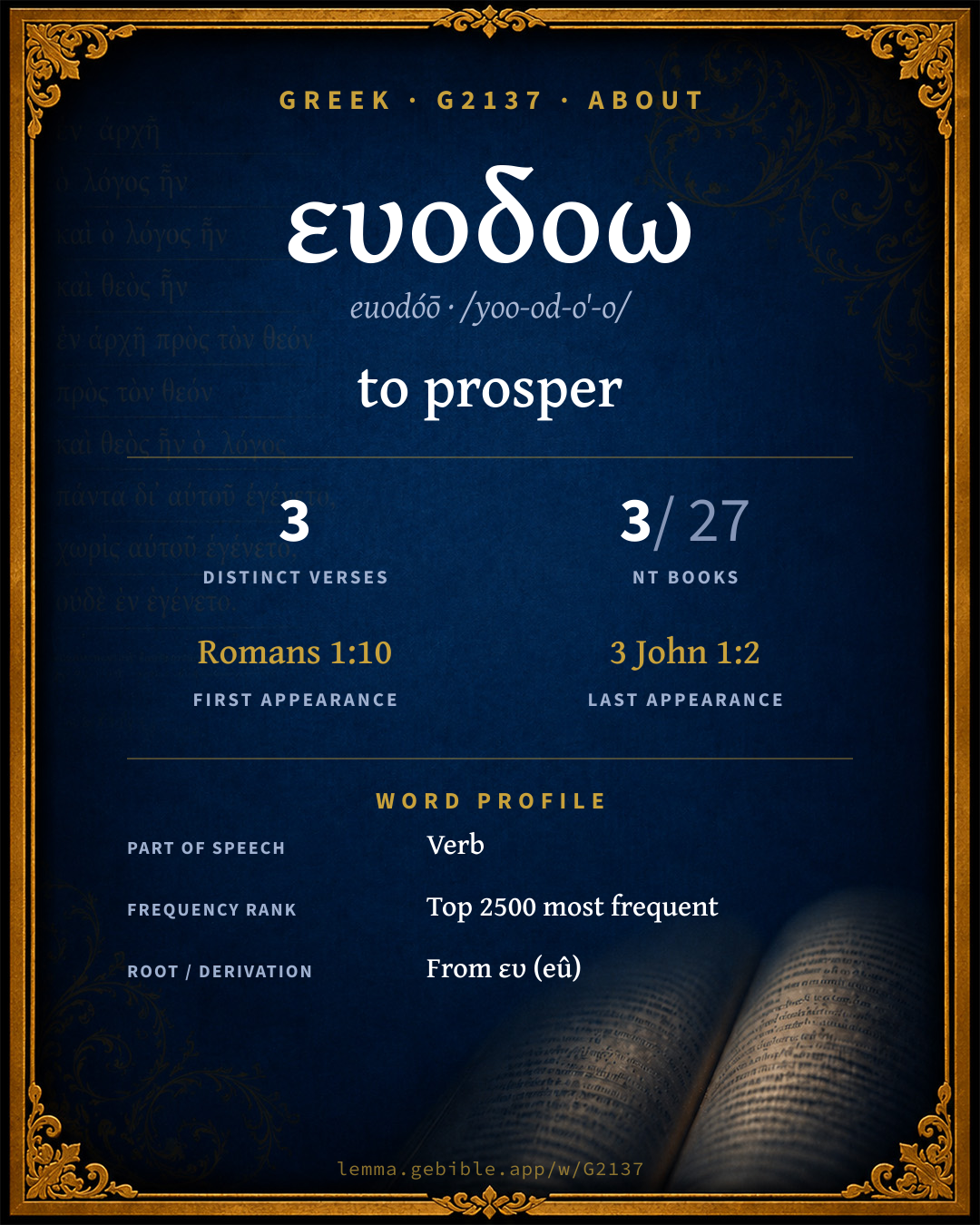
εὐοδόω
to prosper
‘to prosper’ is one of 3 main senses fuller range ↓
Full lexicon entry — Thayer's Greek Lexicon
From Thayer's Greek Lexicon
Where this word appears
See every Present-tense verb in the Greek New Testament →
Grammar key — what these labels mean
Part of speech
- Verb
- An action or state-of-being word.
Tense
- Future
- Action expected in future time.
- Present
- Ongoing or general action in present time (imperfective aspect).
Voice
- Passive
- The subject receives the action.
Mood
- Indicative
- States a fact or asks a factual question (the mood of reality).
- Infinitive
- A verbal noun (“to write”), unmarked for person or number.
- Subjunctive
- Expresses probability, purpose, or possibility (the mood of contingency).
Person
- 1st person
- The speaker (“I / we”).
- 3rd person
- The one spoken about (“he / she / it / they”).
Number
- Singular
- One.
Grammatical forms
- Verb, Future, Passive, Indicative, 1st person, Singular 1 time (25%)
- Verb, Present, Passive, Indicative, 3rd person, Singular 1 time (25%)
- Verb, Present, Passive, Infinitive 1 time (25%)
- Verb, Present, Passive, Subjunctive, 3rd person, Singular 1 time (25%)
Parsed forms decoded from the imported morphology (Robinson–Tischendorf, public domain), counted across 4 parsed occurrences — not distinct verses.
Every verse where G2137 appears — 3 distinct verses across 3 books. Click any verse to open its interlinear word-by-word view. Verse text shown in the World English Bible for context — . Each verse’s Greek form is shown with its reference; the English is not keyword-highlighted, since the data carries no word-level English alignment. Use “Compare translations” on any verse to read it across multiple English versions. This concordance covers the Greek New Testament; Septuagint (Greek Old Testament) occurrences of this word are not indexed here.
Romans 1 verse
1 Corinthians 1 verse
3 John 1 verse
About this entry
At a glance — auto-summarized from this page’s data, not written by a person. Every figure links to its source below. This summary describes the numbers; it doesn’t interpret them.
ευοδοω — transliterated euodóō — is a Greek verb carrying the sense “to prosper.” With only 3 verses it sits in the long tail of Greek New Testament vocabulary. More than a third of its appearances fall in Romans. Debuting at Romans 1:10, it then recurs through the corpus. Its lexical range runs to 3 senses. Each statement above links to its evidence; the full detail follows below.
Gloss history
Strong's 1890 vs modern scholarship
About this word
Strong's G2137 catalogs a Greek word from the Greek New Testament.
These counts are not copied from any lexicon or concordance. They are computed here, from the morphology-tagged Greek New Testament. What Lemma adds →
- 3
- distinct verses
- The word appears in 3 distinct verses.
- 3 / 27
- NT books
- The word appears in 3 of 27 New Testament books.
- #1,877
- by frequency
- Top 2500 most frequent Greek words (rank 1,877 of 5,347 Greek words by occurrence).
View all 3 occurrences in the concordance →
Most concentrated in
- Romans 1 verse 33%
- 1 Corinthians 1 verse 33%
- 3 John 1 verse 33%
By section of the New Testament
By traditional corpus
Conventional, traditional groupings — biblical authorship is debated, so this is a traditional corpus grouping, not an authorship claim. Some books belong to more than one corpus (Luke is in both the Gospels and the Lukan corpus, and so on), so these shares overlap and need not total 100%. Each figure is a share of the word’s 3 distinct verses.
- Pauline corpus 2 verses · 67%
- Johannine 1 verse · 33%
- General (Catholic) Epistles 1 verse · 33%
How translations render this word
Counts come from each version’s own published word-to-Strong’s tagging or interlinear alignment — an approximate guide to how each version renders this word, not a word-level alignment the data otherwise carries. Because each total is that version’s own tagged count, the per-version totals vary from one another and need not match the appearance or distinct-verse counts above. These counts may also differ from a printed concordance because Lemma counts each distinctly tagged rendering and does not collapse phrase taggings into a single head-word total. This is a fixed set of word-tagged versions (KJV, ASV, BSB, ULT) and does not change with the reading translation you choose elsewhere. Each version’s license is shown beside its name below (and on Sources).
- King James Version: God hath prospered him 1×, I might have a prosperous journey 1×, Mayest prosper 1×
- American Standard Version: I may be prospered 1×, Leviticus he may prosper 1×, Mayest prosper 1×
- Berean Standard Bible: I may succeed 1×, Income 1×, May prosper 1×
- unfoldingWord Literal Text: Devoted 1×, He might have prospered 1×, I will be successful 1×
King James Version Public Domain
Renders G2137 across 4 tagged occurrences — most commonly:
American Standard Version Public Domain
Renders G2137 across 5 tagged occurrences — most commonly:
Berean Standard Bible Public Domain
Renders G2137 across 4 tagged occurrences — most commonly:
unfoldingWord Literal Text CC BY-SA 4.0
Renders G2137 across 5 tagged occurrences — most commonly:
Senses in Thayer's
The 3 senses Thayer's distinguishes for this word, in lexicon order (not ranked by frequency or importance). The full entry — with sub-senses — is in the Lexicon Entry tab.
- to grant a prosperous and expeditious journey, to lead by a direct and easy way
- to grant a successful issue, to cause to prosper
- to prosper, be successful
Word origin
Derived from ευ (eû) (G2095) — to prosper.
Forms in the corpus
The 4 distinct written forms G2137 takes in the Greek New Testament, most frequent first — each parse links to that tense’s occurrences in the concordance.
| Form | Parsing | Example | Uses |
|---|---|---|---|
| εὐοδοῦσθαι euodoûsthai | Verb, Present, Passive, Infinitive | 3 John 1:2 | 1 |
| εὐοδοῦταί euodoûtaí | Verb, Present, Passive, Indicative, 3rd person, Singular | 3 John 1:2 | 1 |
| εὐοδωθήσομαι euodōthḗsomai | Verb, Future, Passive, Indicative, 1st person, Singular | Romans 1:10 | 1 |
| εὐοδῶται euodō̂tai | Verb, Present, Passive, Subjunctive, 3rd person, Singular | 1 Corinthians 16:2 | 1 |
Same root — word family
Other Thayer's entries built from the same root as G2137, grouped by Strong’s listed origin. These share a root / origin per the lexicon — not necessarily a shared meaning. Each links to that word’s own entry.
Derives from
Shares the same root
- ευαγγελιζω euangelízō G2097 to evangelize
- ευαρεστος euárestos G2101 pleasing
- ευγενης eugenḗs G2104 noble
- ευδια eudía G2105 fair weather
- ευδοκεω eudokéō G2106 to be pleased
- ευδοκια eudokía G2107 pleasure
- ευεργετης euergétēs G2110 benefactor
- ευθετος eúthetos G2111 well situated
- ευθυμος eúthymos G2115 courageous
- ευθυς euthýs G2117 straight
- ευκαιρος eúkairos G2121 opportune
- ευκοπωτερος eukopṓteros G2123 easy
- ευλαβης eulabḗs G2126 devout
- ευλογεω eulogéō G2127 to praise
- ευμεταδοτος eumetádotos G2130 generous
- ευνοεω eunoéō G2132 to wish well
- ευπειθης eupeithḗs G2138 obedient
- ευπεριστατος euperístatos G2139 besetting
- ευποιΐα eupoiḯa G2140 doing good
- ευπρεπεια euprépeia G2143 beauty
- ευπροσδεκτος euprósdektos G2144 acceptable
- ευπροσεδρος euprósedros G2145 devoted
- ευπροσωπεω euprosōpéō G2146 to please
- ευσεβης eusebḗs G2152 pious
+13 more words share this root (not shown).
Proper names from this root
People and places named from this root — a name, not an additional meaning of the word.
- Ευβουλος Eúboulos G2103 Euodias
- Ευνικη Euníkē G2131 Eunice
- Ευτυχος Eútychos G2161 Eutychus
- Ευοδια Euodía G2136 Euodia
Compare all same-root words → Showing 4 of 43 — not the complete family. 4 of the same-root words are proper names (people or places). They share a root, not necessarily a meaning.
Septuagint usage
The same Greek word ευοδοω appears 49 times in the Greek Old Testament (Septuagint), across 48 verses in 13 books.
- 49
- LXX occurrences
- Tagged occurrences of this Greek word in the Septuagint.
- 48
- verses
- Distinct Septuagint verses containing this word.
- 13 / 39
- OT books
- The word appears in 13 of the 39 Old Testament books.
Sample Septuagint occurrences
- Genesis 24:12 εὐοδόω
- Deuteronomy 28:29 εὐοδόω
- Joshua 1:8 εὐοδόω
- Judges 4:8 εὐοδόω
- 1 Kings 22:12 εὐοδόω
- 1 Chronicles 13:2 εὐοδόω
- 2 Chronicles 7:11 εὐοδόω
- Ezra 5:8 εὐοδόω
- Psalms 117:25 εὐοδόω
- Proverbs 17:8 εὐοδόω
- Isaiah 46:11 εὐοδόω
- Jeremiah 2:37 εὐοδόω
Septuagint occurrences (same lexeme)
Every verse where the same Strong’s number (G2137) appears in the Greek Septuagint. Verse text shown in the World English Bible for context; the Greek form is the matched word — the English is not keyword-highlighted.
- Genesis 24:12 εὐοδόω He said, "Yahweh, the God of my master Abraham, please give me success this day, and show kindness to my master Abraham.
- Genesis 24:21 εὐοδόω The man looked steadfastly at her, holding his peace, to know whether Yahweh had made his journey prosperous or not.
- Genesis 24:27 εὐοδόω He said, "Blessed be Yahweh, the God of my master Abraham, who has not forsaken his loving kindness and his truth toward my master. As for me, Yahweh has led me in the way to the house of my master's relatives."
- Genesis 24:40 εὐοδόω He said to me, 'Yahweh, before whom I walk, will send his angel with you, and prosper your way. You shall take a wife for my son of my relatives, and of my father's house.
- Genesis 24:42 εὐοδόω I came this day to the spring, and said, 'Yahweh, the God of my master Abraham, if now you do prosper my way which I go.
- Genesis 24:48 εὐοδόω I bowed my head, and worshiped Yahweh, and blessed Yahweh, the God of my master Abraham, who had led me in the right way to take my master's brother's daughter for his son.
- Genesis 24:56 εὐοδόω He said to them, "Don't hinder me, seeing Yahweh has prospered my way. Send me away that I may go to my master."
- Genesis 39:3 εὐοδόω His master saw that Yahweh was with him, and that Yahweh made all that he did prosper in his hand.
- Genesis 39:23 εὐοδόω The keeper of the prison didn't look after anything that was under his hand, because Yahweh was with him; and that which he did, Yahweh made it prosper.
- Deuteronomy 28:29 εὐοδόω and you shall grope at noonday, as the blind gropes in darkness, and you shall not prosper in your ways: and you shall be only oppressed and robbed always, and there shall be none to save you.
- Joshua 1:8 εὐοδόω This book of the law shall not depart out of your mouth, but you shall meditate thereon day and night, that you may observe to do according to all that is written therein: for then you shall make your way prosperous, and then you shall have good success.
- Judges 4:8 εὐοδόω Barak said to her, If you will go with me, then I will go; but if you will not go with me, I will not go.
- Judges 18:5 εὐοδόω They said to him, Ask counsel, we pray you, of God, that we may know whether our way which we go shall be prosperous.
- 1 Kings 22:12 εὐοδόω All the prophets prophesied so, saying, Go up to Ramoth-gilead, and prosper; for Yahweh will deliver it into the hand of the king.
- 1 Kings 22:15 εὐοδόω When he was come to the king, the king said to him, Micaiah, shall we go to Ramoth-gilead to battle, or shall we forbear? He answered him, Go up and prosper; and Yahweh will deliver it into the hand of the king.
- 1 Chronicles 13:2 εὐοδόω David said to all the assembly of Israel, If it seem good to you, and if it be of Yahweh our God, let us send abroad everywhere to our brothers who are left in all the land of Israel, with whom the priests and Levites are in their cities that have suburbs, that they may gather themselves to us;
- 1 Chronicles 22:11 εὐοδόω Now, my son, Yahweh be with you; and prosper you, and build the house of Yahweh your God, as he has spoken concerning you.
- 1 Chronicles 22:13 εὐοδόω Then shall you prosper, if you observe to do the statutes and the ordinances which Yahweh gave Moses concerning Israel. Be strong, and of good courage. Don't be afraid, neither be dismayed.
- 2 Chronicles 7:11 εὐοδόω Thus Solomon finished the house of Yahweh, and the king's house: and all that came into Solomon's heart to make in the house of Yahweh, and in his own house, he prosperously effected.
- 2 Chronicles 13:12 εὐοδόω Behold, God is with us at our head, and his priests with the trumpets of alarm to sound an alarm against you. Children of Israel, don't you fight against Yahweh, the God of your fathers; for you shall not prosper.
- 2 Chronicles 14:6 εὐοδόω He built fortified cities in Judah; for the land was quiet, and he had no war in those years, because Yahweh had given him rest.
- 2 Chronicles 18:11 εὐοδόω All the prophets prophesied so, saying, Go up to Ramoth-gilead, and prosper; for Yahweh will deliver it into the hand of the king.
- 2 Chronicles 18:14 εὐοδόω When he was come to the king, the king said to him, Micaiah, shall we go to Ramoth-gilead to battle, or shall I forbear? He said, Go up, and prosper; and they shall be delivered into your hand.
- 2 Chronicles 20:20 εὐοδόω They rose early in the morning, and went forth into the wilderness of Tekoa: and as they went forth, Jehoshaphat stood and said, Hear me, Judah, and you inhabitants of Jerusalem: believe in Yahweh your God, so shall you be established; believe his prophets, so shall you prosper.
- 2 Chronicles 24:20 εὐοδόω The Spirit of God came on Zechariah the son of Jehoiada the priest; and he stood above the people, and said to them, Thus says God, Why disobey you the commandments of Yahweh, so that you can't prosper? because you have forsaken Yahweh, he has also forsaken you.
- 2 Chronicles 26:5 εὐοδόω He set himself to seek God in the days of Zechariah, who had understanding in the vision of God: and as long as he sought Yahweh, God made him to prosper.
- 2 Chronicles 31:21 εὐοδόω In every work that he began in the service of the house of God, and in the law, and in the commandments, to seek his God, he did it with all his heart, and prospered.
- 2 Chronicles 32:30 εὐοδόω This same Hezekiah also stopped the upper spring of the waters of Gihon, and brought them straight down on the west side of the city of David. Hezekiah prospered in all his works.
- 2 Chronicles 35:13 εὐοδόω They roasted the Passover with fire according to the ordinance: and the holy offerings boiled they in pots, and in caldrons, and in pans, and carried them quickly to all the children of the people.
- Ezra 5:8 εὐοδόω Be it known to the king, that we went into the province of Judah, to the house of the great God, which is built with great stones, and timber is laid in the walls; and this work goes on with diligence and prospers in their hands.
- Ezra 11:11 εὐοδόω
- Ezra 12:20 εὐοδόω
- Psalms 117:25 εὐοδόω
- Proverbs 17:8 εὐοδόω A bribe is a precious stone in the eyes of him who gives it; Wherever he turns, he prospers.
- Proverbs 28:13 εὐοδόω He who conceals his sins doesn't prosper, But whoever confesses and renounces them finds mercy.
- Isaiah 46:11 εὐοδόω calling a ravenous bird from the east, the man of my counsel from a far country; yes, I have spoken, I will also bring it to pass; I have purposed, I will also do it.
- Isaiah 48:15 εὐοδόω I, even I, have spoken; yes, I have called him; I have brought him, and he shall make his way prosperous.
- Isaiah 54:17 εὐοδόω No weapon that is formed against you shall prosper; and every tongue that shall rise against you in judgment you shall condemn. This is the heritage of the servants of Yahweh, and their righteousness which is of me, says Yahweh.
- Isaiah 55:11 εὐοδόω so shall my word be that goes forth out of my mouth: it shall not return to me void, but it shall accomplish that which I please, and it shall prosper in the thing whereto I sent it.
- Jeremiah 2:37 εὐοδόω From there also shall you go forth, with your hands on your head: for Yahweh has rejected those in whom you trust, and you shall not prosper with them.
- Jeremiah 12:1 εὐοδόω Righteous are you, Yahweh, when I contend with you; yet would I reason the cause with you: why does the way of the wicked prosper? why are all they at ease who deal very treacherously?
- Daniel 6:4 εὐοδόω Then the presidents and the satraps sought to find occasion against Daniel as touching the kingdom; but they could find no occasion nor fault, because he was faithful, neither was there any error or fault found in him.
- Daniel 8:11 εὐοδόω Yes, it magnified itself, even to the prince of the host; and it took away from him the continual [burnt offering], and the place of his sanctuary was cast down.
- Daniel 8:12 εὐοδόω The host was given over [to it] together with the continual [burnt offering] through disobedience; and it cast down truth to the ground, and it did [its pleasure] and prospered.
- Daniel 8:24 εὐοδόω His power shall be mighty, but not by his own power; and he shall destroy wonderfully, and shall prosper and do [his pleasure]; and he shall destroy the mighty ones and the holy people.
- Daniel 8:25 εὐοδόω Through his policy he shall cause craft to prosper in his hand; and he shall magnify himself in his heart, and in [their] security shall he destroy many: he shall also stand up against the prince of princes; but he shall be broken without hand.
- Daniel 11:27 εὐοδόω As for both these kings, their hearts shall be to do mischief, and they shall speak lies at one table: but it shall not prosper; for yet the end shall be at the time appointed.
- Daniel 11:36 εὐοδόω The king shall do according to his will; and he shall exalt himself, and magnify himself above every god, and shall speak marvelous things against the God of gods; and he shall prosper until the indignation be accomplished; for that which is determined shall be done.
These are occurrences of the same Greek lexeme (G2137) in the Septuagint — not a translation of any one Hebrew word. The store carries no word-level Hebrew↔Greek alignment, so no Hebrew original is asserted here. Counts come from the recovered LXX Strong's tagging — high-frequency vocabulary is well covered, while rare or late forms may be untagged — so they reflect tagged occurrences and may slightly undercount.