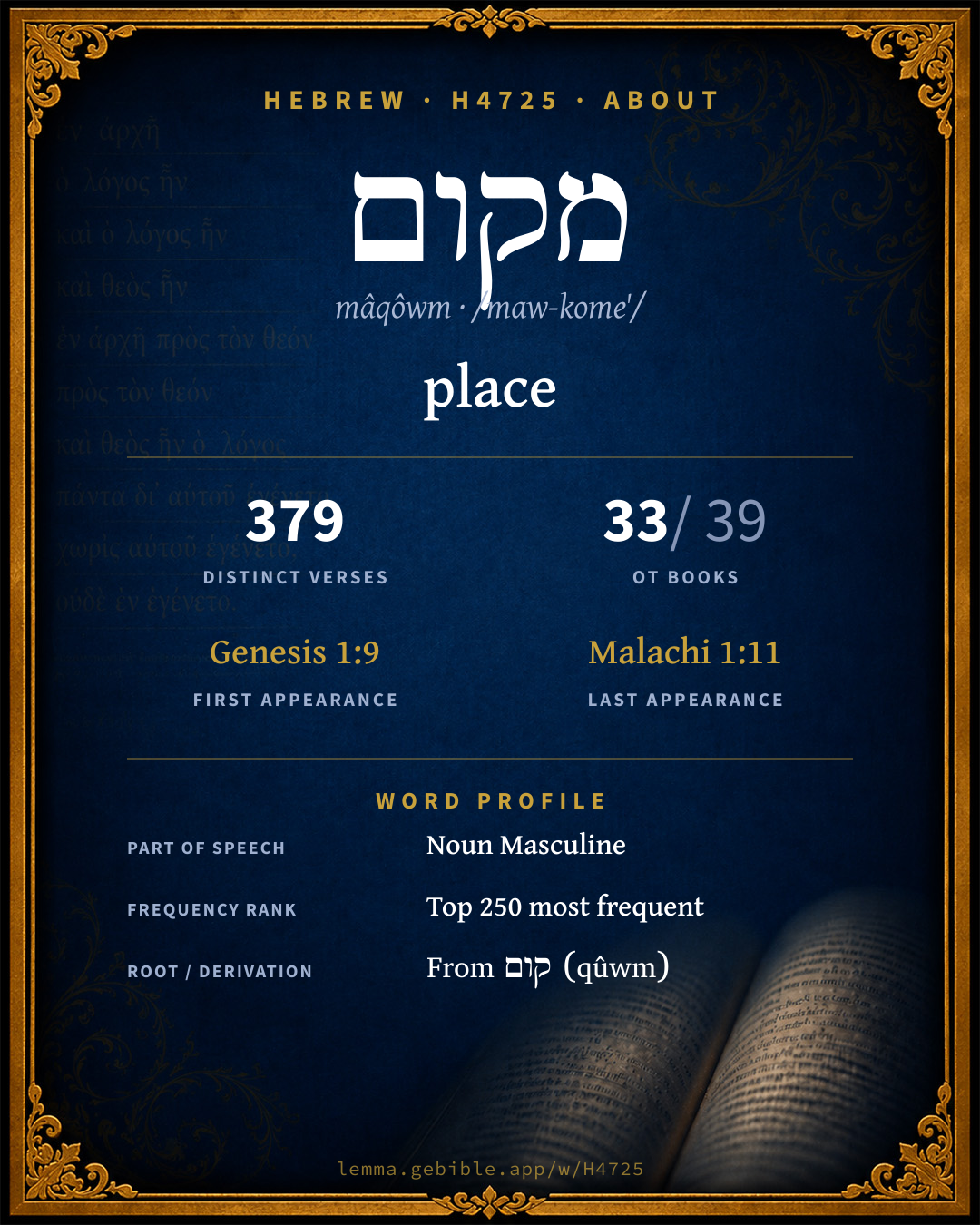
מָקוֹם
place
‘place’ is one of 8 main senses fuller range ↓
Full lexicon entry — Brown-Driver-Briggs (BDB)
From Brown-Driver-Briggs (BDB)
Where this word appears
See every Construct-state word in the Hebrew Bible →
Grammar key — what these labels mean
Part of speech
- Noun
- A naming word — a person, place, thing, or idea.
Noun type
- Common
- A common noun — a general class of person, place, or thing (“king,” “city,” “water”), not a specific name.
State
- Absolute
- The independent form of a noun, not bound to a following word.
- Construct
- A noun bound to a following noun in a possessive / “of” relationship (the construct chain).
Gender
- Masculine
- Grammatically masculine.
Number
- Singular
- One.
- Plural
- More than one (in Hebrew, generally three or more).
Every verse where H4725 appears in the Book of Ezekiel — 15 distinct verses. Click any verse to open its interlinear word-by-word view. Verse text shown in the World English Bible for context — . Each verse’s Hebrew form is shown with its reference; the English is not keyword-highlighted, since the data carries no word-level English alignment. Use “Compare translations” on any verse to read it across multiple English versions. This concordance covers the Hebrew Bible; Septuagint (Greek Old Testament) occurrences are not indexed here.
Ezekiel
- Ezekiel 3:12 מִ/מְּקוֹמֽ/וֹ prep + n c ms cs + sfx pers 3ms Then the Spirit lifted me up, and I heard behind me the voice of a great rushing, [saying], Blessed be the glory of Yahweh from his place.
- Ezekiel 6:13 מְק֗וֹם n c ms cs You shall know that I am Yahweh, when their slain men shall be among their idols round about their altars, on every high hill, on all the tops of the mountains, and under every green tree, and under every thick oak, the places where they offered sweet savor to all their idols.
- Ezekiel 10:11 הַ/מָּק֞וֹם ptcl def.art + n c ms When they went, they went in their four directions: they didn't turn as they went, but to the place where the head looked they followed it; they didn't turn as they went.
- Ezekiel 12:3 מִ/מְּקוֹמְ/ךָ֜ מָק֤וֹם prep + n c ms cs + sfx pers 2ms n c ms Therefore, you son of man, prepare you stuff for removing, and remove by day in their sight; and you shall remove from your place to another place in their sight: it may be they will consider, though they are a rebellious house.
- Ezekiel 17:16 בִּ/מְקוֹם֙ prep + n c ms cs As I live, says the Lord Yahweh, surely in the place where the king dwells who made him king, whose oath he despised, and whose covenant he broke, even with him in the midst of Babylon he shall die.
- Ezekiel 21:30 בִּ/מְק֧וֹם prep + n c ms cs Cause it to return into its sheath. In the place where you were created, in the land of your birth, will I judge you.
- Ezekiel 34:12 הַ/מְּקוֹמֹת֙ ptcl def.art + n c mp As a shepherd seeks out his flock in the day that he is among his sheep that are scattered abroad, so will I seek out my sheep; and I will deliver them out of all places where they have been scattered in the cloudy and dark day.
- Ezekiel 38:15 מִ/מְּקֽוֹמְ/ךָ֙ prep + n c ms cs + sfx pers 2ms You shall come from your place out of the uttermost parts of the north, you, and many peoples with you, all of them riding on horses, a great company and a mighty army;
- Ezekiel 39:11 מְקֽוֹם n c ms cs It shall happen in that day, that I will give to Gog a place for burial in Israel, the valley of those who pass through on the east of the sea; and it shall stop those who pass through: and there shall they bury Gog and all his multitude; and they shall call it The valley of Hamon Gog.
- Ezekiel 41:11 מְק֣וֹם n c ms cs The doors of the side-chambers were toward [the place] that was left, one door toward the north, and another door toward the south: and the breadth of the place that was left was five cubits round about.
- Ezekiel 42:13 הַ/מָּק֖וֹם ptcl def.art + n c ms Then said he to me, The north chambers and the south chambers, which are before the separate place, they are the holy chambers, where the priests who are near to Yahweh shall eat the most holy things: there shall they lay the most holy things, and the meal-offering, and the sin-offering, and the trespass-offering; for the place is holy.
- Ezekiel 43:7 מְק֣וֹם מְקוֹם֙ n c ms cs n c ms cs He said to me, Son of man, [this is] the place of my throne, and the place of the soles of my feet, where I will dwell in the midst of the children of Israel forever. The house of Israel shall no more defile my holy name, neither they, nor their kings, by their prostitution, and by the dead bodies of their kings [in] their high places;
- Ezekiel 45:4 מָקוֹם֙ n c ms It is a holy portion of the land; it shall be for the priests, the ministers of the sanctuary, who come near to minister to Yahweh; and it shall be a place for their houses, and a holy place for the sanctuary.
- Ezekiel 46:19 מָק֔וֹם n c ms Then he brought me through the entry, which was at the side of the gate, into the holy chambers for the priests, which looked toward the north: and, behold, there was a place on the hinder part westward.
- Ezekiel 46:20 הַ/מָּק֗וֹם ptcl def.art + n c ms He said to me, This is the place where the priests shall boil the trespass-offering and the sin-offering, [and] where they shall bake the meal-offering; that they not bring them forth into the outer court, to sanctify the people.
About this entry
At a glance — auto-summarized from this page’s data, not written by a person. Every figure links to its source below. This summary describes the numbers; it doesn’t interpret them.
מקום — transliterated mâqôwm — is a Hebrew noun carrying the sense “place.” The lexicon spreads it across several senses; see its full sense range. Spanning 379 verses in 33 books, it ranks among the common words of the Hebrew Bible. Its earliest occurrence is Genesis 1:9. Sharing its root, it stands alongside קום, יקום and קום. Each statement above links to its evidence; the full detail follows below.
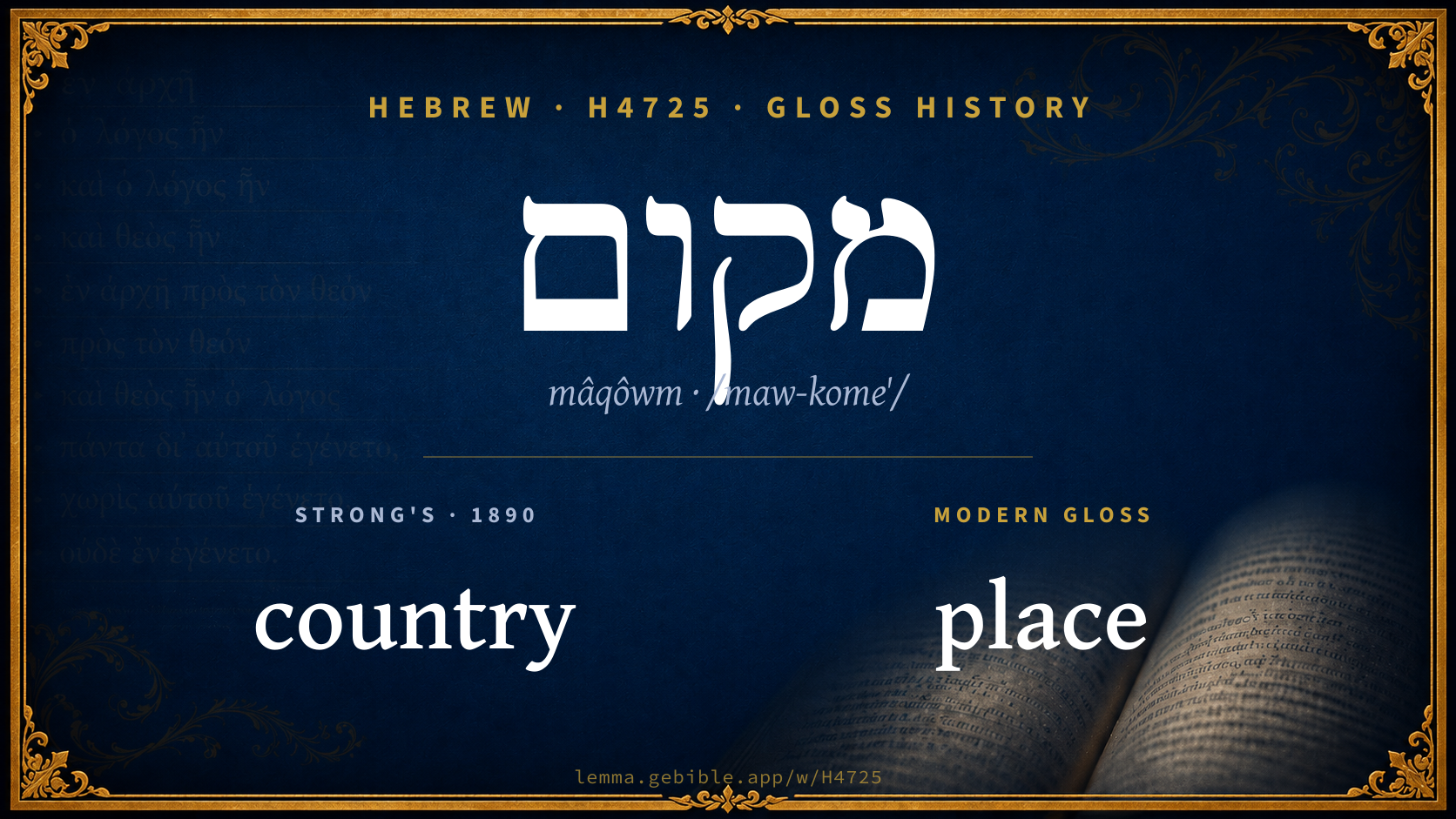
Gloss history
Strong's 1890 vs modern scholarship
About this word
Strong's H4725 catalogs a Hebrew word from the Hebrew Old Testament.
These counts are not copied from any lexicon or concordance. They are computed here, from the morphology-tagged Hebrew Old Testament. What Lemma adds →
- 379
- distinct verses
- The word appears in 379 distinct verses.
- 33 / 39
- OT books
- The word appears in 33 of 39 Old Testament books.
- #126
- by frequency
- Top 250 most frequent Hebrew words (rank 126 of 8,640 Hebrew words by occurrence).
View all 379 occurrences in the concordance →
Most concentrated in
- Genesis 44 verses 12%
- Jeremiah 43 verses 11%
- Deuteronomy 33 verses 9%
By section of the Old Testament
By traditional corpus
Conventional, traditional groupings — biblical authorship is debated, so this is a traditional corpus grouping, not an authorship claim. Each share is this word’s portion of its verses in that division of the Hebrew canon. Each figure is a share of the word’s 379 distinct verses.
- Prophets (Nevi'im) 171 verses · 45%
- Torah (Pentateuch) 127 verses · 34%
- Writings (Ketuvim) 81 verses · 21%
How translations render this word
Counts come from each version’s own published word-to-Strong’s tagging or interlinear alignment — an approximate guide to how each version renders this word, not a word-level alignment the data otherwise carries. Because each total is that version’s own tagged count, the per-version totals vary from one another and need not match the appearance or distinct-verse counts above. These counts may also differ from a printed concordance because Lemma counts each distinctly tagged rendering and does not collapse phrase taggings into a single head-word total. This is a fixed set of word-tagged versions (KJV, ASV, BSB, ULT) and does not change with the reading translation you choose elsewhere. Each version’s license is shown beside its name below (and on Sources).
BDB lists this Strong’s number as 2 distinct words (homographs). Each count above pools all of them and is not split by sense — see the Senses section below. A low-frequency rendering may belong to a different one of those words, not the primary meaning.
- King James Version†: Place 286×, Every place 8×, All places 7×
- American Standard Version†: Place 254×, Every place 8×, All places 6×
- Berean Standard Bible†: Place 268×, Home 16×, Places 10×
- unfoldingWord Literal Text†: Place 313×, Place of 33×, In 18×
King James Version Public Domain
Renders H4725 across 402† tagged occurrences — most commonly:
Plus other, less common renderings. Plus 50 renderings that appear only once — usually multi-word phrases or single function words the recovered tagging swept in, not distinct renderings.
American Standard Version Public Domain
Renders H4725 across 402† tagged occurrences — most commonly:
Plus other, less common renderings. Plus 82 renderings that appear only once — usually multi-word phrases or single function words the recovered tagging swept in, not distinct renderings.
Berean Standard Bible Public Domain
Renders H4725 across 381† tagged occurrences — most commonly:
Plus other, less common renderings. Plus 34 renderings that appear only once — usually multi-word phrases or single function words the recovered tagging swept in, not distinct renderings. Not rendered by a distinct English word in 19 further occurrences.
unfoldingWord Literal Text CC BY-SA 4.0
Renders H4725 across 435† tagged occurrences — most commonly:
Plus other, less common renderings. Plus 21 renderings that appear only once — usually multi-word phrases or single function words the recovered tagging swept in, not distinct renderings.
17 senses and sub-senses in the full BDB
What do BDB’s symbols mean?
BDB uses these scholarly abbreviations:
| Symbol | Meaning |
|---|---|
| 𝔊 | the Septuagint (the ancient Greek translation, LXX) |
| 𝔙 | the Vulgate (the Latin translation) |
| 𝔖 | the Syriac version (the Peshitta) |
| 𝔗 | the Targum (the Aramaic translation) |
| ψ | the Psalms |
| √ | root (the underlying root or stem) |
| ‖ | parallel passage (a synonymous or contrasted parallel) |
| † | the dagger: every passage where the word occurs is cited |
The 17 senses and sub-senses the full Brown-Driver-Briggs lexicon distinguishes for this word, in lexicon order (not ranked by frequency), with BDB’s own verbatim wording and sub-sense lettering. Shown in Hebrew script with BDB’s own scholarly abbreviations. The condensed entry is in the Lexicon Entry tab. See also the Forms in the corpus table below.
- 1.
- a. standing-place Ex 3:5 (E), Jos 5:15; Ex 33:21; Nu 23:13, 27; (all JE), Gn 19:27 (J), Jos 3:3 (D), of מַצֵּבוֹת, etc., 2 K 23:14, of ark (place where it is set, stands) 1 K 8:7 = 2 Ch 5:8, earth Is 13:13 Jb 9:6, rock Jb 14:18; 18:4; cf. 38:12, 19. e.g. Exodus 3:5
- b. station, where soldiers are placed Jos 8:19 (JE), Ju 20:33(×2); post in battle 2 S 11:16. e.g. Joshua 8:19
- c. post, office Gn 40:13; 41:13; 1 K 20:24; Ec 10:4. e.g. Genesis 40:13
- 2.
- a. place of anything Gn 29:3 (J), Jos 4:18 (JE), 1 S 5:3 Is 46:7 Jb 6:17; 37:1 (of the heart), Ec 1:5; especially of ark 1 S 5:11 + 9 times; of pers. = destination Ju 11:19. e.g. Genesis 29:3
- b. especially (1) place of human abode Gn 13:14; 20:13 Ju 7:7 1 S 2:20 + 42 times, + מְקוֹם אָהֳלֵךְ Is 54:2. (2) of י׳’s abode Ho 5:15, in heaven Mi 1:3 Is 26:21 1 K 8:30 = 2 Ch 6:21. (3) lair of lion (fig.) Je 4:7. e.g. Genesis 13:14
- 3. place =
- a. city Gn 18:24, 26; 20:11; Dt 21:19 (‖ עִיר) 2 K 18:25 + 39 times (1 S 7:16 הַמִּקְדָּשִׁים 𝔊, cf. We HPS). e.g. Genesis 18:24
- b. of land: Canaan Ex 23:20 1 S 12:8 Je 16:2, 3 (‖ אֶרֶץ) + 17 times (12 times Je); Philistia 1 S 14:46; Egypt Je 44:29; appos. מְדִינָה Est 4:3, = מְדִינָה + עִיר 8:17. e.g. Exodus 23:20
- c. plot, parcel, of ground Is 7:23; מְקוֹם הַגֹּרֶן 1 Ch 21:22, cf. v 25; 2 Ch 3:1. e.g. Isaiah 7:23
- d. land, region Nu 20:5; 32:1; Che (privately) proposes בִּמְקֹם בְּקָעוֹת ψ 84:7 (for בְּעֵמֶק הַבָּכָא; cf. Is 41:18). e.g. Numbers 20:5
- 4. in gen., place locality, spot Gn 28:16, 17 Ju 2:5 Am 4:6 Ne 4:6, 7, 14 + (221 times in all); מְקוֹם פְּלֹנִי אַלְמֹנִי place of such a one †1 S 21:3 2 K 6:8; בְּכָל־הַמָּקוֹם אֲשֶׁר Ex 20:24 (E; Gi v 21) in all places that; בְּכָל־מ׳ Nu 18:31 = anywhere, cf. Dt 12:13; = everywhere Pr 15:3 Mal 1:11, cf. Am 8:3; מ׳ צָר Nu 22:26 narrow place; מ׳ Ne 2:14 (passable) place; in partic.: place at banquet †1 S 9:22; 20:25, 27; sleeping-place, couch, †1 S 3:2, 9; Ru 4:10; מְקוֹם הַחֵ֑צִי 1 S 20:37 i.e. where arrow fell; = haunt, lurking-place 1 S 23:22 2 S 17:9, 12; מְקוֹם תַּנִּים ψ 44:20 place of jackals, i.e. desert; מְ׳ הַמֻּנָּח Ez 41:11b place of the uncovered space, portion (cf. הַמֻּנָּח alone v 11a); מְ׳ הַשֶּׁבֶת of seat of Sol.’s throne 1 K 10:19 = 2 Ch 9:18; מ׳ אֶחָד where waters were collected Gn 1:9 (𝔊 Ball מִקְוֶה), ψ 104:8; destination of dead Ec 3:30; 6:6; מ׳ = resting-place Jb 16:18; מ׳ נֶאֱמָן sure place, for a peg (securely fastened) Is 22:23, 25 (fig., cf. Ezr 9:8); of places, spots, on the body: leprous spot †2 K 5:11; מְ׳ הַשְּׁחִין †Lv 13:19 place of the boil; especially of shrine, sanctuary (cf. We 1 S 7:16), מְקוֹם שְׁכֶם Gn 12:6 (J; v. Di Holz), so of Bethel Gn 13:3 (J), v 4 (J; מְקוֹם הַמִּזְבֵּחַ), 28:19 (J), v 11(×3) (E), 22:3, 4, 9, 14 (E), +; of idolatrous shrines Dt 12:2, 3; Ez 6:13; 2 Ch 33:19; especially of temple: י׳) הַמּ׳ אֲשֶׁר יִבְחַר (אֱלֹהֵיכֶם בּוֹ Dt 12:5, 14; 14:23, 25; 15:20; 16:2, 6; 17:8; 18:6 + 13 times Dt + Jos 9:27 (D), Ne 1:9; מ׳ 1 K 8:29(×2), 30, 35 = 2 Ch 6:20(×2), 21, 26 Je 27:22 +; מְ׳ שֵׁם־י׳ צְבָאוֹת הַר־צִיּוֹן Is 18:7; מְ׳ כִּסְאִי Ez 43:7; מְ׳ מִקְדָּשֵׁנוּ Je 17:12; מְ׳ מִקְדָּשִׁי Is 60:13; מְ׳ קָדְשׁוֹ † Ezr 9:8 ψ 24:3, etc.; of tabern. מְ׳ הַקֹּדֶשׁ Lv 10:17; 14:30; מ׳ קָדוֹשׁ in or about tabern., Ex 29:31 Lv 6:9, 19, 20 + (all P), מְ׳ קָדוֹשׁ Ec 8:10. Note especially †מְקוֹם before rel.cl., c. אֲשֶׁר Gn 39:20; 40:3 Ez 6:13 Est 4:3; 8:17, c. שֶׁ Ec 1:7; 3:16, rel. om. Jb 18:21; also בִּמְ׳ אֲשֶׁר Ho 2:1; 2 S 15:21; 1 K 21:19; Je 22:12; Ez 21:35; Ne 4:14; Lv 4:24, 33; 6:18; 7:2; 14:13; Nu 9:17 (Ges§ 130 c). e.g. Genesis 28:16
- 5.
- a. space, room, Gn 24:23, 25, 31 (J), Is 5:8 cf. 28:8; Je 7:32; 19:11. e.g. Genesis 24:23
- b. space, distance, between (בֵּין) 1 S 26:13. e.g. 1 Samuel 26:13
- 6. region, quarter, direction Ez 10:11; מִמּ׳ אַחֵר Est 4:14 from another quarter, source. e.g. Ezekiel 10:11
- 7. peculiar uses are:
- a. נָתַן מ׳ לְ Ju 20:36 give place (yield ground) to. Perhaps e.g. Judges 20:36
- b. בִּמְ׳ אֲשֶׁר יֵאָמֵר Ho 2:1 instead of its being said (cf. תַּחַת); מְקוֹם נְהָרִים Is 33:21 instead of rivers (i.e. a substitute for them).—מְקוֹמָהּ Na 1:8 (‖ אֹיְבָיו) read מִקָּמָיו or בְּק׳ BuhlZAW v (1885), 181, מִתְקוֹמְמָו We, בְּקָמָיו Now (all = his adversaries, cf. GASm). e.g. Hosea 2:1
Senses from the full Brown-Driver-Briggs lexicon (Brown, Driver, Briggs; Oxford 1906 — public domain), digitized via Sefaria, supplemented by the OpenScriptures HebrewLexicon (CC BY 4.0). Full attribution on Sources.
Word origin
(Ex 29:31, etc.)399 n.m. Gn 19:13 (but v. infr.), standing-place, place;—abs. מ׳ Ex 21:13 +; cstr. מְקוֹם Gn 12:6 + (often before אֲשֶׁר 39:20 +); sf. מְקוֹמוֹ 1 S 3:2 +, מְקֹמוֹ Gn 18:33 +, etc.; pl. usually מְקֹמוֹת Ju 19:13 +, מְקוֹמוֹת 1 S 7:16; Je 29:14; -מֹת 2 S 17:9 + 2 times; sf. מְקוֹמֹתֵיכֶם Am 4:6, etc. [appar. f. (not Gn 18:24, where עִיר is in mind, not) Jb 20:9 (מְקוֹמוֹ = ‘in his place’), but Codd. (either Kt or Qr) Ju 19:13 2 S 17:9, 12; mostly expl. away by AlbrZAW xvi (1896), 53];—
— Brown-Driver-Briggs (Oxford 1906, public domain), digitized via Sefaria, supplemented by the OpenScriptures HebrewLexicon (CC BY 4.0). See Sources.
Derived from קום (qûwm) (H6965) — to rise.
Jastrow Dictionary
A second Hebrew/Aramaic lexicon for comparison, covering Aramaic and post-biblical (Talmudic, Targumic, Midrashic) usage that the biblical-Hebrew BDB does not. Matched by lemma rather than by Strong’s number, so a lemma may carry more than one Jastrow headword (shown separately below), and the entries cover usage well beyond the Bible.
מָקוֹם
- 1. place. Ab. Zar. 8ᵇ; Snh. 14ᵇ המ׳ גורם, v. גָּרַם. Yoma 38ᵃ bot. בשמך יקראוך ובמְקוֹמְךָ וכ׳ thou shalt be called by what name thou deservest, and given the place due to thee &c., i.e. be not afraid of human envy. Shebu. VII, 4 חזרה השבועה למְקוֹמָהּ the oath goes back to its home, expl. ib. 47ᵃ חזרה שבועה לסיני the oath goes back to Sinai, i.e. no oath is demanded and no decision rendered, the case being surrendered to him who proclaimed on Sinai, ‘thou shalt not rob’; oth. opin. חזרה שבועה למחוייב לה the oath goes back to him who by right should have been asked to make oath but could not be permitted to swear on account of disqualification, i.e. he must pay; a. v. fr.—כל מ׳, בכל מ׳ (abbr. כ"מ, בכ"מ) everywhere. Sabb. 40ᵇ; a. fr.—כל מ׳ ש־, בכ"מ wherever. Erub. 81ᵇ. Meg. 29ᵃ; a. fr.—אותו מ׳, v. אוֹת III.
- 2. existence, substance; הַמָּ׳ the Existence, the Lord (cmp. מָעוֹן). Gen. R. s. 68 מפני מה מכנין שמו של הקב"ה וקוראין אותו מ׳ in circumscribing the name of the Lord, why do we call him Maḳom? שהוא מְקוֹמוֹ של עולם ואין עולמו מקומו because He is the existence (the preserver) of the world, but His world is not His existence; Pesik. R. s. 21; a. e.—Ab. Zar. 40ᵇ ברוך המ׳ שמסר עולמו לשומרים blessed be the Lord who has given his world over to preservers (who has created remedies). Nidd. 49ᵇ המ׳ יהיה בעזרו the Lord be with him. Ber. 16ᵇ; Lev. R. s. 5, v. חֶסְרוֹן; a. v. fr.
מקום
- , Treat. Sof’rim XXI, 7 ברבי מ׳, v. מֵרוֹם
A Dictionary of the Targumim, the Talmud Babli and Yerushalmi, and the Midrashic Literature (Marcus Jastrow; London, Luzac, 1903) — Public Domain. Digitized via Sefaria. Digitized via Sefaria. Full attribution on Sources.
Forms in the corpus
The 152 distinct written forms H4725 takes in the Hebrew Bible, most frequent first — each parse links to that state’s occurrences in the concordance. Hebrew forms include their vowel points and cantillation, so a single lemma takes many written forms.
The 60 most common forms are shown; 92 rarer forms follow in the full concordance.
Same root — word family
Other BDB entries built from the same root as H4725, grouped by Strong’s listed origin. These share a root / origin per the lexicon — not necessarily a shared meaning. Each links to that word’s own entry.
Derives from
Shares the same root
- יקום yᵉqûwm H3351 substance
- קום qûwm H6966 to arise
- קומה qôwmâh H6967 height
- קוממיות qôwmᵉmîyûwth H6968 uprightness
- קים qîym H7009 adversary
- קימה qîymâh H7012 rising up
- קמה qâmâh H7054 standing grain
- תקומה tᵉqûwmâh H8617 standing
- תקומם tᵉqôwmêm H8618 rising against
Proper names from this root
People and places named from this root — a name, not an additional meaning of the word.
- יקים Yâqîym H3356 Jakim
- יקמיה Yᵉqamyâh H3359 Jecamiah
- יקמעם Yᵉqamʻâm H3360 Jekameam
- יקמעם Yoqmᵉʻâm H3361 Jokmeam
- קמואל Qᵉmûwʼêl H7055 Kemuel
- קמון Qâmôwn H7056 Camon
Compare all same-root words → Showing 4 of 17 — not the complete family. 6 of the same-root words are proper names (people or places). They share a root, not necessarily a meaning.
Septuagint verse parallels
This word appears in 358 verses that also exist in the Greek Old Testament (Septuagint), out of the 379 Hebrew verses it occurs in. You can read those verses in Greek by switching the Old Testament edition to the Septuagint.
Read these verses in the Septuagint
- Genesis 1:9
- Exodus 3:5
- Leviticus 1:16
- Numbers 9:17
- Deuteronomy 1:31
- Joshua 1:3
- Judges 2:5
- Ruth 1:7
- 1 Samuel 2:20
- 2 Samuel 2:16
- 1 Kings 5:9
- 2 Kings 5:11
This is a verse-level parallel only — the same verses exist in both the Hebrew and Greek Old Testaments. No word-level Hebrew↔Greek correspondence is claimed: the data carries no such alignment, so no Greek word is shown as this Hebrew word’s translation. Coverage is not total — the Septuagint omits the deuterocanon and renumbers the Psalms, so some Hebrew verses have no direct Greek parallel.