

Job 8:18

Hebrew (Westminster Leningrad Codex) Job 8:18 appears in the Hebrew Old Testament. The text above is from the Westminster Leningrad Codex. Each word links to its Strong’s number, a concise gloss, and parsing drawn from the Open Scriptures Hebrew Bible morphology. Click any word for its full Brown-Driver-Briggs (BDB) entry.
Download image
Cite this verse

Job 8:18 (World English Bible). Public Domain. Lemma interlinear Bible study tool, https://lemma.gebible.app/v/job/8/18.

Show BibTeX & RIS
BibTeX
RIS
English Translation
If he is destroyed from his place, Then it shall deny him, saying, 'I have not seen you.'
World English Bible · Public Domain
Download a study sheet

One document with this verse’s original text, its word-by-word gloss line, the meaning frame, cross-references with their text, attributed commentary, and full source and license credits — printable, and it pastes into notes with its structure intact.

This verse Autodidact and up

Study sheet (.html) Plain text (.txt)

A passage Seminary Student

Up to 50 verses in one chapter. A passage sheet keeps up to 6 commentary sources and 12 cross-references per verse, in the order this page ranks them, and says so on the sheet whenever that leaves anything out. Ask for a single verse and you get the Autodidact verse sheet above.

Everything on this page stays free to read, with no account — the sheet is a download of what is already on screen, not access to it.

Want to remove ads? Support Godless Engineer
Compare translations 3

The same verse in 3 English versions, stacked beneath the original-language interlinear above. Click any original word for its lexicon entry.

Each is an independent rendering of the whole verse — the interlinear is not word-aligned to these translations.

Highlighted words mark where these versions differ — a whole-verse word diff, not a word-by-word alignment.

  • World English Bible Public Domain
    If he is destroyed from his place, Then it shall deny him, saying, 'I have not seen you.'
  • King James Version Public Domain
    If he destroy him from his place, then it shall deny him, saying, I have not seen thee.
  • unfoldingWord Literal Text CC BY-SA 4.0
    When one destroys it from its place, then it will deny him, ‘I did not see you.’

unfoldingWord Literal Text — © unfoldingWord, licensed CC BY-SA 4.0. Word-aligned USFM3 via Door43 (git.door43.org/unfoldingWord/en_ult).

Versions to compare (up to 4)

3 of 4 selected

Show all 18 translations

Every available English version of this verse, each an independent rendering of the whole verse.

  • World English Bible Public Domain
    If he is destroyed from his place, Then it shall deny him, saying, 'I have not seen you.'
  • Berean Standard Bible Public Domain
    If he is uprooted from his place, it will disown him, saying, ‘I never saw you.’
  • Majority Standard Bible Public Domain
    If he is uprooted from his place, it will disown him, saying, ‘I never saw you.’
  • King James Version Public Domain
    If he destroy him from his place, then it shall deny him, saying, I have not seen thee.
  • American Standard Version (1901) Public Domain
    If he be destroyed from his place, Then it shall deny him, `saying', I have not seen thee.
  • Revised Version (1885) Public Domain
    If he be destroyed from his place, then it shall deny him, saying, I have not seen thee.
  • Geneva Bible (1599) Public Domain
    If any plucke it from his place, and it denie, saying, I haue not seene thee,
  • Douay-Rheims (1899) Public Domain
    If one swallow him up out of his place, he shall deny him, and shall say: I know thee not.
  • Young's Literal Translation Public Domain
    If `one' doth destroy him from his place, Then it hath feigned concerning him, I have not seen thee!
  • Literal Standard Version CC BY-SA 4.0
    If [one] destroys him from his place, || Then it has feigned concerning him, || I have not seen you!
  • Unlocked Literal Bible CC BY-SA 4.0
    But if this person is destroyed out of his place, then that place will deny him and say, 'I never saw you.'
  • unfoldingWord Literal Text CC BY-SA 4.0
    When one destroys it from its place, then it will deny him, ‘I did not see you.’
  • Darby Bible Public Domain
    If he destroy him from his place, then it shall deny him: I have not seen thee!
  • World Messianic Bible Public Domain
    If he is destroyed from his place, then it will deny him, saying, ‘I have not seen you.’
  • Webster's Bible Public Domain
    If he shall destroy him from his place, then it shall deny him, saying, I have not seen thee.
  • Free Bible Version CC BY-SA 4.0
    But when it's cut down, the place where it was disowns it, saying, ‘I never even saw you.’
  • Bible in Basic English Public Domain
    If he is taken away from his place, then it will say, I have not seen you.
  • JPS Tanakh (1917) Public Domain
    If he be destroyed from his place, then it shall deny him: 'I have not seen thee.'

Literal Standard Version (2020), Covenant Press — licensed CC BY-SA 4.0. Text via the HelloAO Bible API (eBible.org). Unlocked Literal Bible (unfoldingWord) — licensed CC BY-SA 4.0. Text via the HelloAO Bible API (eBible.org). unfoldingWord Literal Text — © unfoldingWord, licensed CC BY-SA 4.0. Word-aligned USFM3 via Door43 (git.door43.org/unfoldingWord/en_ult). Free Bible Version, Dr. Jonathan Gallagher — licensed CC BY-SA 4.0. Text via the HelloAO Bible API (eBible.org).

Word by word

More ways to search: Search by grammar → Find every occurrence → Compare this word →

Practice this passage: Drill this verse → Learn its vocabulary →

וְכִ֥חֶשׁ
kâchash
H3584
“and · to deceive”
Conjunction + Verb, Piel, Sequential Perfect, 3rd Person, Masculine, Singular
Part of Speech
Conjunction + Verb
Stem
Piel
Form
Sequential Perfect
Person
3rd Person
Gender
Masculine
Number
Singular
Full BDB Definition

Origin: a primitive root

TWOT: 975

to deceive, lie, fail, grow lean, be disappointing, be untrue, be insufficient, be found liars, belie, deny, dissemble, deal falsely - (Qal) to become lean - (Niphal) to cringe, feign obedience - (Piel) - to deceive, deny falsely - to act deceptively - to cringe - to disappoint, fail - (Hithpael) to cringe, feign obedience
  1. אִם ʼim H518 “if” Conjunction
  2. יְבַלְּעֶ֥נּוּ bâlaʻ H1104 “to swallow up · him” Verb, Piel, Imperfect, 3rd Person, Masculine, Singular + Suffix, Personal, 3rd Person, Masculine, Singular
  3. מִמְּקוֹמ֑וֹ mâqôwm H4725 “from · place · his” Preposition + Noun, Common, Masculine, Singular, Construct + Suffix, Personal, 3rd Person, Masculine, Singular
  4. לֹ֣א lôʼ H3808 “not” Particle, Negative
  5. רְאִיתִֽיךָ râʼâh H7200 “to see · you” Verb, Qal, Perfect, 1st Person, Common, Singular + Suffix, Personal, 2nd Person, Masculine, Singular

About this verse

These counts appear in no published source. They are computed here, from the morphology-tagged text and Lemma’s own curated glosses. What Lemma adds →

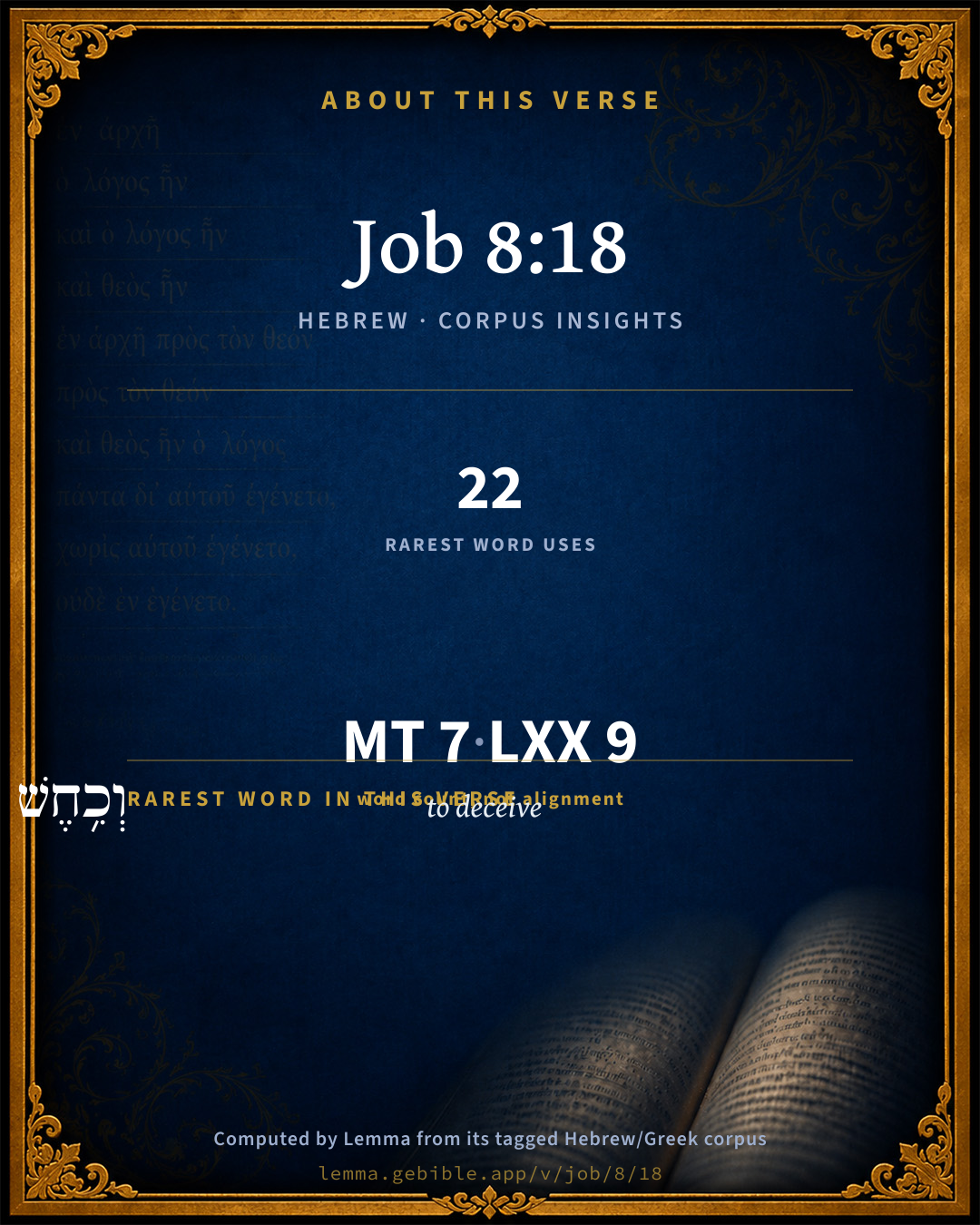
7
words
6
distinct lemmas
Wisdom
section

Notable vocabulary

The rarest word here is וְכִ֥חֶשׁ to deceive H3584 — appearing just 22 times in the whole Hebrew Bible.

Shared distinctive vocabulary

וְכִ֥חֶשׁ to deceive H3584 occurs in 22 verses of the Hebrew Bible. Also found in:

Grammatical profile

  • 3 verbs
  • 1 noun
  • 1 preposition
  • 1 conjunction
  • 1 particle

Verb forms

  • יְבַלְּעֶ֥נּוּ Piel · Imperfect
  • וְכִ֥חֶשׁ Piel · Sequential Perfect
  • רְאִיתִֽיךָ Qal · Perfect

Hebrew & Septuagint length

In English translation the verse runs 18 words from the Hebrew and 16 from the Septuagint (LXX English) — closely comparable.

A rough comparison of the two English renderings, which tokenize alike — not a word-level alignment.

Word counts can differ between the Hebrew and the Greek without any difference in meaning — e.g. the Hebrew direct-object marker אֵת has no separate Greek word, and Greek often adds the article ὁ.

In the original languages it is 7 Hebrew tokens and 9 Greek tokens — but the two are counted differently (Hebrew bundles its prefixes and suffixes into one token; the Greek is in lemma form), so that isn’t a like-for-like length.

Cross-references

7

Topical passages linked to Job 8:18 in the Treasury of Scripture Knowledge — connected by theme and wording, ordered by reader-vote popularity; previews shown in the World English Bible.

  • Job 7:10 He shall return no more to his house, Neither shall his place know him any more.
  • Job 7:8 The eye of him who sees me shall see me no more. Your eyes shall be on me, but I shall not be.
  • Psalms 37:36 But he passed away, and, behold, he was not. Yes, I sought him, but he could not be found.
  • Job 20:9 The eye which saw him shall see him no more, Neither shall his place any more see him.
  • Psalms 37:10 For yet a little while, and the wicked will be no more. Yes, though you look for his place, he isn't there.
  • Psalms 73:18–19 Surely you set them in slippery places. You throw them down to destruction.
  • Psalms 92:7 Though the wicked spring up as the grass, And all the evil-doers flourish, They will be destroyed forever.

Cross-references courtesy of OpenBible.info (CC BY 4.0).

Hebrew and Greek witnesses Masoretic Hebrew ↔ Greek Septuagint

The same verse in the two great witnesses to the Old Testament, shown verse-for-verse.

These are two independent witnesses, not word-aligned to each other, and the Septuagint is shown in lemma (dictionary) form.

Hebrew Job 8:18 Masoretic · Westminster Leningrad Codex

אִם יְבַלְּעֶ֥נּוּ מִמְּקוֹמ֑וֹ וְכִ֥חֶשׁ בּ֝֗וֹ לֹ֣א רְאִיתִֽיךָ

If he is destroyed from his place, Then it shall deny him, saying, 'I have not seen you.'

World English Bible · Public Domain

Greek LXX Job 8:18 Septuagint · lemma form

ἐάν καταπίνω ὁ τόπος ψεύδω αὐτός οὐ ὁράω τοιοῦτος

If God should destroy him, his place shall deny him. Have you not seen such things,

LXX2012 (modern English Septuagint) · Public Domain

Hebrew: Westminster Leningrad Codex (CC BY 4.0). Greek: Septuagint (public domain); English from LXX2012 (modern English Septuagint) (Public Domain). How the Septuagint differs from the Hebrew →

Commentary

Notes on Job 8:18 from classic Christian and Jewish commentators (each source and its license shown beneath its notes). The classic Christian expositions comment on the surrounding passage and are grouped to its opening verse, so a note may address several verses; the Jewish commentaries on the Tanakh (Rashi and others) are per-verse, so they appear only where the commentator wrote on this verse.

Lemma curates 59 commentaries, every one of them public domain or Creative Commons licensed, each selected and text-cleaned for this edition rather than reprinted as found. About our sources →

Trapp's Complete Commentary

John Trapp

Job 8:18 If he destroy him from his place, then [it] shall deny him, [saying], I have not seen thee.

Ver. 18. If he destroy him from his place] If he stub up this green tree, no better surely than the cyparit, of which Pliny writeth that it beareth fruit to no purpose, small berries, bitter leaves, that it yields an ill smell, and no pleasant shade; or as the boxtree, green indeed all the year about, but of an offensive smell, no fruit, and such a seed as all living creatures hate. Now if he, that is, Almighty God, destroy him, that is, the hypocrite, as he will do questionless (totally and speedily swallowing him up), what then?

Then it shall deny him, saying, I have not seen thee] Heb. It shall tell a lie of him, &c., the place, as ashamed to own him, shall feign and say, We have not seen him, we know not what is become of him. So Psa 37:35-36. As they have denied the Lord that bought them, 2Pe 2:1, so they shall one day be denied by the places they have bought or builded, by the people that once clawed them, and cried them up.

John Trapp, A Commentary or Exposition upon All the Books of the Old and New Testament (1647–1656) — public domain. Text from a community e-Sword module.

Joseph Benson's Commentary

Job 8:18. If he, &c. — Namely, God, who is the saviour of good men and the destroyer of the wicked; destroy him from his place — When God blasts him and plucks him up; then it shall deny him — That is, the place shall deny him; saying, I have not seen thee — The reader will easily observe, that denying him and seeing him are here ascribed to the place figuratively, and the meaning is, that he shall be so utterly extirpated and destroyed, that there shall be no memorial of him left, nor any remembrance that such a man ever lived in that place. He shall no more recover himself than a tree which is plucked out of the ground, and left to wither.

Joseph Benson's Commentary on the Old and New Testaments (1811–1818) — public domain. Text from a community e-Sword module.

Geneva Bible (1599)

Geneva Bible translators

That is, so that there remain nothing there to prove whether the tree had grown there or no.

Geneva Bible (1599) marginal notes — public domain. Text via Bolls.life.

Jamieson, Fausset & Brown

Robert Jamieson, A. R. Fausset & David Brown

If He (God) tear him away (properly, "to tear away rapidly and violently") from his place, "then it [the place personified] shall deny him" (Psa 103:16). The very soil is ashamed of the weeds lying withered on its surface, as though it never had been connected with them. So, when the godless falls from prosperity, his nearest friends disown him.

Jamieson, Fausset & Brown — Commentary Critical and Explanatory on the Whole Bible (1871) — public domain (CC PDM 1.0). Text via the HelloAO Bible API.

Adam Clarke's Commentary

Verse 18. If he destroy him from his place] Is not this a plain reference to the alienation of his inheritance? God destroys him from it; it becomes the property of another; and on his revisiting it, the place, by a striking prosopopoeia, says, "I know thee not; I have never seen thee." This also have I witnessed; I looked on it, felt regret, received instruction, and hasted away.

Adam Clarke's Commentary on the Bible (1810–1826) — public domain. Text from a community e-Sword/MySword module.

The Cambridge Bible for Schools and Colleges

gen. ed. J. J. S. Perowne

18. if he destroy him] The subject is God. The words might be rendered, if he be (when he is) destroyed. This is perhaps better, as the plant is spoken of. The point of the verse is not who destroys him, but that he is destroyed, and when destroyed utterly disappears, so that his place says, I never saw thee. In spite of his luxuriance and hold of the soil he is suddenly and wholly swept away and his place denies ever having known him.

The Cambridge Bible for Schools and Colleges (gen. ed. J. J. S. Perowne; Cambridge University Press, 1878–1918) — public domain. Text from a community e-Sword module.

John Gill's Exposition

Behold, this is the joy of his way,.... Of the state and condition of the hypocrite, who, while he is in outward prosperity, exults and rejoices, but his joy is but short, it is but for a moment, Job 20:5; and this is what it comes to at last, and issues in, even entire destruction from his place; which, because it may seem strange and wonderful, and is worthy of notice and consideration, as well as to express a certainty of it, the word "behold" is prefixed; though this also is understood, by some, of good men who have much spiritual joy in their present state and condition, be it what it will; they have joy and peace in believing, even joy unspeakable, and full of glory; they have joy in the Lord, and in his ways in which they walk, when they have trouble in the world; they rejoice and even glory in tribulation, and are cheerful be they where they will, though removed from their native place and country; and especially this will be their case when they are transplanted from earth to heaven, the better and heavenly country:

and out of the earth shall others grow; in their room and stead; where the tall flourishing tree once stood, but now utterly destroyed, other trees should grow; signifying, either the children of the hypocrites and wicked men, that should spring up in their place and imitate them, and come to the same end; or rather such as were strangers to them, that should inherit their substance and estates; and it may be good men that should succeed them, and come into the possession of all their wealth, even such as were before in mean circumstances, and so may be said to come "out of the earth": it may be rendered, "out of another dust" or "earth shall they grow" (q); signifying, that the wicked should be utterly destroyed, they and theirs; and that such as were of another family, and as it were of another earth and country, should stand in their place; see Job 27:16; this may be interpreted of good men, who, though they die, others are raised up in their stead; God will have a seed to serve him as long as the sun and moon endure; though they are forced to fly from their native place, being persecuted, to strange cities, or removed into the heavenly regions, yet God raises up others to till up their places, and oftentimes out of other families, even of the ungodly, to support his cause and interest; and understanding the whole of truly righteous persons seems best to connect the sense with the following words.

(q) "de pulvere alio", Montanus, Bolducius, Cocceius; so the Targum; "de terra alia", Pagninus, Mercerus.

John Gill's Exposition of the Whole Bible (1746–1763) — public domain (CC PDM 1.0). Text via the HelloAO Bible API.

Albert Barnes' Notes on the Bible

If he destroy him from his place - The particle here which is rendered “if (אם 'ı̂m) is often used to denote emphasis, and means here “certainly” - “he shall be certainly destroyed.” The word rendered destroy, from בלע bela‛, means literally to swallow Job 7:19, to swallow up, to absorb; and hence, to consume, lay waste, destroy. The sense is, that the wicked or the hypocrite shall be wholly destroyed from his place, but the image or figure of the tree is still retained. Some suppose that it means that God would destroy him from his place; others, as Rosenmuller and Dr. Good, suppose that the reference is to the soil in which the tree was planted, that it would completely absorb all nutriment, and leave the tree to die; that is, that the dry and thirsty soil in which the tree is planted, instead of affording nutriment, acts as a “sucker,” and absorbs itself all the juices which would otherwise give support to the tree. This seems to me to be probably the true interpretation. It is one drawn from nature, and one that preserves the concinnity of the passage.

Then it shall deny him - That is, the soil, the earth, or the place where it stood. This represents a wicked man under the image of a tree. The figure is beautiful. The earth will be ashamed of it; ashamed that it sustained the tree; ashamed that it ever ministered any nutriment, and will refuse to own it. So with the hypocrite. He shall pass away as if the earth refused to own him, or to retain any recollection of him.

I have not seen thee - I never knew thee. It shall utterly deny any acquaintance with it. There is a striking resemblance here to the language which the Savior says he will use respecting the hypocrite in the day of judgment: “and then will I profess to them, I never knew you;” Mat 7:23. The hypocrite has never been known as a pious man. The earth will refuse to own him as such, and so will the heavens.

Albert Barnes' Notes on the Bible (1834–1885) — public domain. Text from a community e-Sword/MySword module.

Matthew Poole's English Annotations

If he; either God, who is the Saviour of good men, and the Destroyer of the wicked; or the owner; or any other man; for this is an indefinite speech, and may be taken passively and impersonally; which is very common in the holy text and language.

From his place, in which he was planted.

Then it, i.e. the place; to which denying him and seeing him are here ascribed figuratively, as we have oft seen.

I have not seen thee, i.e. I do not know nor remember that ever thou wast planted here. He shall be so utterly extirpated and destroyed, that there shall be no footstep, nor name, nor memorial of him left there.

Matthew Poole's English Annotations on the Holy Bible (1683–1685) — public domain. Text from a community e-Sword/MySword module.

Whedon's Commentary on the Bible

Daniel D. Whedon

18. If he (God) destroy — Or the subject of the verb may be indefinite. The plant was apparently a useless growth, which any one would do well to destroy,

Him — Or, It. The interweaving of the image and its object throughout this entire citation is a sign, not only of its great antiquity, but also of its foreign origin. The Hebrew mind wielded an imagination which was always clear and distinct.

Deny him — The earth that had given the plant its life is moved with such a sense of shame as to deny that it had seen him, (or it.) A powerful personification. For nature’s abhorrence of human fungi, see Job_27:21-23.

Daniel D. Whedon (gen. ed.), Commentary on the Old and New Testaments (1874–1909) — public domain. Text from a community e-Sword module.

The Pulpit Commentary

If he destroy him from his place; or, if he be destroyed. The verb seems to be best taken as impersonal. If he be destroyed in any way, suddenly or gradually, by a Divine stroke, or by human agency, or by the comparatively slow process of nature, in any ease the result is one, the flourishing plant is clean swept away, and the place of it knows it no more. Bildad"s words are very dramatic and expressive. Then it shall deny him, saying, I have not seen thee. The place shall be ashamed of having ever nurtured anything so vile, and shall declare that it never held such a growth.

The Pulpit Commentary (1880–1919), ed. H.D.M. Spence-Jones & Joseph S. Exell — public domain. Text from a community e-Sword module.

John Wesley's Explanatory Notes

He - God, who is the saviour of good men, and the destroyer of the wicked. It - The place; to which denying him, and seeing him, are here ascribed figuratively. Not seen - He shall be so utterly extirpated and destroyed, that there shall be no memorial of him left.

John Wesley, Explanatory Notes Upon the Whole Bible (1754–1765) — public domain. Text via the GEBible commentary corpus.

Rashi

Rabbi Shlomo Yitzchaki (Rashi)

If one destroys him from his place the one who requites him, and this is an elliptical verse.

then it shall deny him his place [shall deny him].

‘I have not seen you,’ For neither root nor branch shall remain of him, and it will be as though he had never existed, for his fall shall not ascend like the downfall of the righteous—for the righteous will fall and rise, but this one will fall without rising.

Rashi on the Tanakh — English translations: “The Judaica Press complete Tanach with Rashi, translated by A. J. Rosenberg” (CC BY 4.0); “Pentateuch with Rashi's commentary by M. Rosenbaum and A.M. Silbermann, 1929-1934” (public domain); “The Metsudah Tanach series, Lakewood, N.J” (CC BY 4.0); and “The Book of Joshua, Metsudah Publications, 1997” (CC BY 4.0). Text via Sefaria.

Lesson kit

Teaching starters — assembled from the data on this page, not authored interpretation. Every prompt links to the verse data it draws on. Edit before teaching.

Job, in the Wisdom, opens this verse with 7 words (6 distinct Hebrew lemmas). Its most distinctive word is kâchash (“to deceive”). A historical commentator’s framing appears above. Read the whole chapter for the surrounding context.

Discussion questions

  1. What does “to deceive” (kâchash) contribute to the verse as a whole?
  2. Genesis 18:15 shares the word «to deceive» with this verse. How do the two illuminate each other?
  3. The translations on this page render this verse differently — a whole-verse word diff, not a word-by-word alignment. What might account for the different wordings?
  4. The verb «יְבַלְּעֶ֥נּוּ» is Piel Imperfect. How does its form color the action?
  5. Reading how Trapp's Complete Commentary and Joseph Benson's Commentary read this verse, where do the two commentators agree and where do they part?

Things to notice

Reading settings

Reading text

Shown beneath each verse's original-language words.

Old Testament
Old Testament edition

Read the OT as the Masoretic Hebrew (MT) or the Greek Septuagint (LXX).

English shown for the Greek Septuagint (in the Hebrew ↔ Greek comparison).

Comparing translations? Open the Compare panel on any verse page to stack up to four side by side.