1 Chronicles 13:11

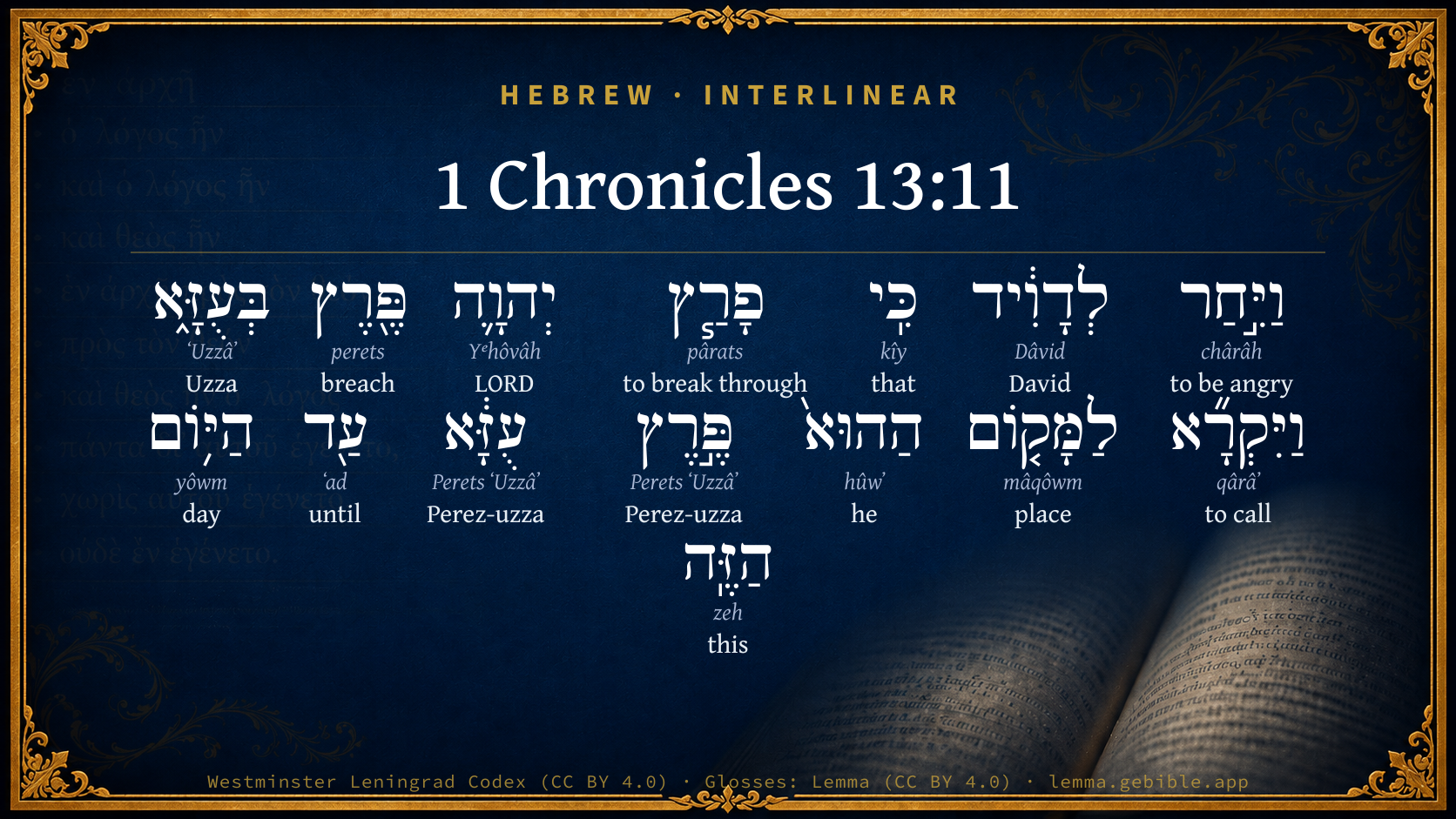
Hebrew (Westminster Leningrad Codex) 1 Chronicles 13:11 appears in the Hebrew Old Testament. The text above is from the Westminster Leningrad Codex. Each word links to its Strong’s number, a concise gloss, and parsing drawn from the Open Scriptures Hebrew Bible morphology. Click any word for its full Brown-Driver-Briggs (BDB) entry.
Download image
Cite this verse

1 Chronicles 13:11 (World English Bible). Public Domain. Lemma interlinear Bible study tool, https://lemma.gebible.app/v/1-chronicles/13/11.

Show BibTeX & RIS
BibTeX
RIS
English Translation
David was displeased, because Yahweh had broken forth on Uzza; and he called that place Perez Uzza, to this day.
World English Bible · Public Domain
Download a study sheet

One document with this verse’s original text, its word-by-word gloss line, the meaning frame, cross-references with their text, attributed commentary, and full source and license credits — printable, and it pastes into notes with its structure intact.

This verse Autodidact and up

Study sheet (.html) Plain text (.txt)

A passage Seminary Student

Up to 50 verses in one chapter. A passage sheet keeps up to 6 commentary sources and 12 cross-references per verse, in the order this page ranks them, and says so on the sheet whenever that leaves anything out. Ask for a single verse and you get the Autodidact verse sheet above.

Everything on this page stays free to read, with no account — the sheet is a download of what is already on screen, not access to it.

Want to remove ads? Support Godless Engineer
Compare translations 3

The same verse in 3 English versions, stacked beneath the original-language interlinear above. Click any original word for its lexicon entry.

Each is an independent rendering of the whole verse — the interlinear is not word-aligned to these translations.

Highlighted words mark where these versions differ — a whole-verse word diff, not a word-by-word alignment.

  • World English Bible Public Domain
    David was displeased, because Yahweh had broken forth on Uzza; and he called that place Perez Uzza, to this day.
  • King James Version Public Domain
    And David was displeased, because the LORD had made a breach upon Uzza: wherefore that place is called Perezuzza to this day.
  • unfoldingWord Literal Text CC BY-SA 4.0
    And it burned to David because Yahweh had broken out a breaking out against Uzzah. And he called to that place Perez Uzzah, to this day.

unfoldingWord Literal Text — © unfoldingWord, licensed CC BY-SA 4.0. Word-aligned USFM3 via Door43 (git.door43.org/unfoldingWord/en_ult).

Versions to compare (up to 4)

3 of 4 selected

Show all 18 translations

Every available English version of this verse, each an independent rendering of the whole verse.

  • World English Bible Public Domain
    David was displeased, because Yahweh had broken forth on Uzza; and he called that place Perez Uzza, to this day.
  • Berean Standard Bible Public Domain
    Then David became angry because the LORD had burst forth against Uzzah; so he named that place Perez-uzzah, as it is called to this day.
  • Majority Standard Bible Public Domain
    Then David became angry because the LORD had burst forth against Uzzah. So he named that place Perez-uzzah, as it is called to this day.
  • King James Version Public Domain
    And David was displeased, because the LORD had made a breach upon Uzza: wherefore that place is called Perezuzza to this day.
  • American Standard Version (1901) Public Domain
    And David was displeased, because Jehovah had broken forth upon Uzza; and he called that place Perez-uzza, unto this day.
  • Revised Version (1885) Public Domain
    And David was displeased, because the LORD had broken forth upon Uzza: and he called that place Perez-uzza, unto this day.
  • Geneva Bible (1599) Public Domain
    And Dauid was angrie, because the Lord had made a breach in Vzza, and he called the name of that place Perez-vzza vnto this day.
  • Douay-Rheims (1899) Public Domain
    And David was troubled because the Lord had divided Oza: and he called that place the Breach of Oza to this day.
  • Young's Literal Translation Public Domain
    And it is displeasing to David, because Jehovah hath made a breach upon Uzza, and one calleth that place `Breach of Uzza' unto this day.
  • Literal Standard Version CC BY-SA 4.0
    And it is displeasing to David, because YHWH has made a breach on Uzza, and one calls that place “Breach of Uzza” to this day.
  • Unlocked Literal Bible CC BY-SA 4.0
    David was angry because Yahweh had attacked Uzzah. That place is called Perez Uzzah to this day.
  • unfoldingWord Literal Text CC BY-SA 4.0
    And it burned to David because Yahweh had broken out a breaking out against Uzzah. And he called to that place Perez Uzzah, to this day.
  • Darby Bible Public Domain
    And David was indignant; for Jehovah had made a breach upon Uzza; and he called that place Perez-Uzza to this day.
  • World Messianic Bible Public Domain
    David was displeased, because the LORD had broken out against Uzza. He called that place Perez Uzza, to this day.
  • Webster's Bible Public Domain
    And David was displeased, because the LORD had made a breach upon Uzza: wherefore that place is called Perez-uzza to this day.
  • Free Bible Version CC BY-SA 4.0
    David became angry with the Lord for his violent outburst against Uzzah. He named the place Perez-uzzah, and it is still called that today.
  • Bible in Basic English Public Domain
    And David was angry because of the Lord's outburst of wrath against Uzza, and he gave that place the name Perez-uzza, to this day.
  • JPS Tanakh (1917) Public Domain
    And David was displeased, because the LORD had broken forth upon Uzza; and that place was called Perez-uzza unto this day.

Literal Standard Version (2020), Covenant Press — licensed CC BY-SA 4.0. Text via the HelloAO Bible API (eBible.org). Unlocked Literal Bible (unfoldingWord) — licensed CC BY-SA 4.0. Text via the HelloAO Bible API (eBible.org). unfoldingWord Literal Text — © unfoldingWord, licensed CC BY-SA 4.0. Word-aligned USFM3 via Door43 (git.door43.org/unfoldingWord/en_ult). Free Bible Version, Dr. Jonathan Gallagher — licensed CC BY-SA 4.0. Text via the HelloAO Bible API (eBible.org).

Word by word

More ways to search: Search by grammar → Find every occurrence → Compare this word →

Practice this passage: Drill this verse → Learn its vocabulary →

פֶּ֣רֶץ
Perets ʻUzzâʼ
H6560
“Perez-uzza”
Noun, Proper
Part of Speech
Noun
Type
Proper
Full BDB Definition

Origin: from H6556 and H5798

TWOT: None

Perez-uzza = "breach of Uzza" - the place where Uzzah was slain by God for touching the Ark; located close to Jerusalem
  1. וַיִּ֣חַר chârâh H2734 “and · to be angry” Conjunction + Verb, Qal, Sequential Imperfect, 3rd Person, Masculine, Singular
  2. לְדָוִ֔יד Dâvid H1732 “to/for · David” Preposition + Noun, Proper
  3. כִּֽי kîy H3588 “that” Conjunction
  4. פָרַ֧ץ pârats H6555 “to break through” Verb, Qal, Perfect, 3rd Person, Masculine, Singular
  5. יְהוָ֛ה Yᵉhôvâh H3068 “LORD” Noun, Proper
  6. פֶּ֖רֶץ perets H6556 “breach” Noun, Common, Masculine, Singular, Absolute
  7. בְּעֻזָּ֑א ʻUzzâʼ H5798 “in/at · Uzza” Preposition + Noun, Proper
  8. וַיִּקְרָ֞א qârâʼ H7121 “and · to call” Conjunction + Verb, Qal, Sequential Imperfect, 3rd Person, Masculine, Singular
  9. לַמָּק֤וֹם mâqôwm H4725 “to/for the · place” Preposition, Determined + Noun, Common, Masculine, Singular, Absolute
  10. הַהוּא֙ hûwʼ H1931 “the · he” Particle, Definite Article + Pronoun, Personal, 3rd Person, Masculine, Singular
  11. עֻזָּ֔א Perets ʻUzzâʼ H6560 “Perez-uzza” Noun, Proper
  12. עַ֖ד ʻad H5704 “until” Preposition
  13. הַיּ֥וֹם yôwm H3117 “the · day” Particle, Definite Article + Noun, Common, Masculine, Singular, Absolute
  14. הַזֶּֽה zeh H2088 “the · this” Particle, Definite Article + Pronoun, Demonstrative, Masculine, Singular

About this verse

These counts appear in no published source. They are computed here, from the morphology-tagged text and Lemma’s own curated glosses. What Lemma adds →

15
words
14
distinct lemmas
Historical
section

Notable vocabulary

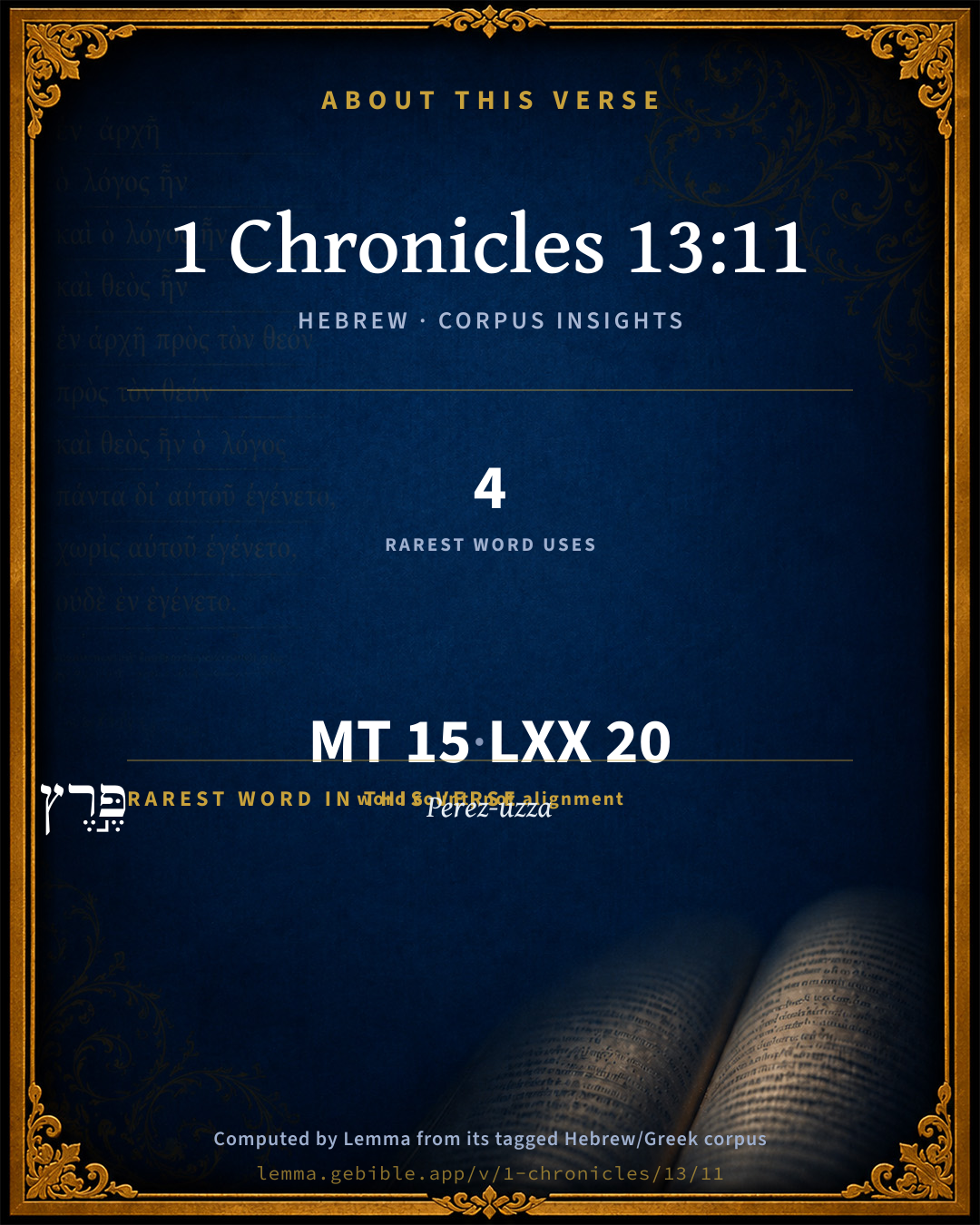
The rarest word here is פֶּ֣רֶץ Perez-uzza H6560 — appearing just 4 times in the whole Hebrew Bible.

Shared distinctive vocabulary

פֶּ֣רֶץ Perez-uzza H6560 occurs in 2 verses of the Hebrew Bible. Also found in:

Grammatical profile

  • 3 verbs
  • 8 nouns
  • 2 pronouns
  • 1 preposition
  • 1 conjunction

Verb forms

  • וַיִּ֣חַר Qal · Sequential Imperfect
  • פָרַ֧ץ Qal · Perfect
  • וַיִּקְרָ֞א Qal · Sequential Imperfect

Repetition

A word recurs within this verse — often emphatic in Hebrew:

  • פֶּ֣רֶץ Perez-uzza H6560 ×2

Hebrew & Septuagint length

In English translation the verse runs 20 words from the Hebrew and 25 from the Septuagint (LXX English) — closely comparable.

A rough comparison of the two English renderings, which tokenize alike — not a word-level alignment.

Word counts can differ between the Hebrew and the Greek without any difference in meaning — e.g. the Hebrew direct-object marker אֵת has no separate Greek word, and Greek often adds the article ὁ.

In the original languages it is 15 Hebrew tokens and 20 Greek tokens — but the two are counted differently (Hebrew bundles its prefixes and suffixes into one token; the Greek is in lemma form), so that isn’t a like-for-like length.

Cross-references

7

Topical passages linked to 1 Chronicles 13:11 in the Treasury of Scripture Knowledge — connected by theme and wording, ordered by reader-vote popularity; previews shown in the World English Bible.

  • 2 Samuel 6:7 The anger of Yahweh was kindled against Uzzah; and God struck him there for his error; and there he died by the ark of God.
  • 2 Samuel 6:9 David was afraid of Yahweh that day; and he said, How shall the ark of Yahweh come to me?
  • Genesis 32:32 Therefore the children of Israel don't eat the sinew of the hip, which is on the hollow of the thigh, to this day, because he touched the hollow of Jacob's thigh in the sinew of the hip.
  • Deuteronomy 34:6 He buried him in the valley in the land of Moab over against Beth Peor: but no man knows of his tomb to this day.
  • Joshua 4:9 Joshua set up twelve stones in the midst of the Jordan, in the place where the feet of the priests who bore the ark of the covenant stood: and they are there to this day.
  • Jonah 4:4 Yahweh said, "Is it right for you to be angry?"
  • Jonah 4:9 God said to Jonah, "Is it right for you to be angry about the vine?" He said, "I am right to be angry, even to death."

Cross-references courtesy of OpenBible.info (CC BY 4.0).

Hebrew and Greek witnesses Masoretic Hebrew ↔ Greek Septuagint

The same verse in the two great witnesses to the Old Testament, shown verse-for-verse.

These are two independent witnesses, not word-aligned to each other, and the Septuagint is shown in lemma (dictionary) form.

Hebrew 1 Chronicles 13:11 Masoretic · Westminster Leningrad Codex

וַיִּ֣חַר לְדָוִ֔יד כִּֽי פָרַ֧ץ יְהוָ֛ה פֶּ֖רֶץ בְּעֻזָּ֑א וַיִּקְרָ֞א לַמָּק֤וֹם הַהוּא֙ פֶּ֣רֶץ עֻזָּ֔א עַ֖ד הַיּ֥וֹם הַזֶּֽה

David was displeased, because Yahweh had broken forth on Uzza; and he called that place Perez Uzza, to this day.

World English Bible · Public Domain

Greek LXX 1 Chronicles 13:11 Septuagint · lemma form

καί ἀθυμέω δαυίδ ὅτι διακόπτω κύριος διακοπή ἐν οζα καί καλέω ὁ τόπος ἐκεῖνος διακοπή οζα ἕως ὁ ἡμέρα οὗτος

And David was dispirited, because the Lord had made a breach on Oza: and he called that place the Breach of Oza until this day.

LXX2012 (modern English Septuagint) · Public Domain

Hebrew: Westminster Leningrad Codex (CC BY 4.0). Greek: Septuagint (public domain); English from LXX2012 (modern English Septuagint) (Public Domain). How the Septuagint differs from the Hebrew →

Commentary

Notes on 1 Chronicles 13:11 from classic Christian and Jewish commentators (each source and its license shown beneath its notes). The classic Christian expositions comment on the surrounding passage and are grouped to its opening verse, so a note may address several verses; the Jewish commentaries on the Tanakh (Rashi and others) are per-verse, so they appear only where the commentator wrote on this verse.

Lemma curates 59 commentaries, every one of them public domain or Creative Commons licensed, each selected and text-cleaned for this edition rather than reprinted as found. About our sources →

Trapp's Complete Commentary

John Trapp

1Ch 13:11 And David was displeased, because the LORD had made a breach upon Uzza: wherefore that place is called Perezuzza to this day.

Ver. 11. And David was displeased.] At himself, I think; at his own and the people’s error in carting the ark: else he was much mistaken. See on 2Sa 6:8.

Wherefore that place was called Perezuzza.] To perpetuate the memory of that signal judgment. So Num 9:3; Num 22:3 Jos 7:26. For this end also, the brazen censors of those presumptuous sinners against their own souls, were nailed as broad plates upon the altar, {Num 16:39-40} for a warning to others.

John Trapp, A Commentary or Exposition upon All the Books of the Old and New Testament (1647–1656) — public domain. Text from a community e-Sword module.

Ellicott's Commentary for English Readers

(11) Made a breach.—Ɓrokenforh against. The same verb recurs in 1Ch_14:11. (Comp. Exo_19:22.)

Wherefore that place is called.—Heb., and he (one) called that place.

To this day.—It is not implied necessarily that the place was known by this name in the days of the Chronicles. The same phrase occurs in the parallel verse of Samuel, and the chronicler has merely given a exact transcript of his source.

A Bible Commentary for English Readers, edited by Charles John Ellicott (1878–1897) — public domain. Text from a community e-Sword module.

The Cambridge Bible for Schools and Colleges

gen. ed. J. J. S. Perowne

11. was displeased] Rather, was wroth, presumably against his advisers for not warning him that the method adopted for the removal of the ark was wrong; cp. 1Ch_15:13.

had made a breach] R.V. had broken forth; cp. Exo_19:22.

The Cambridge Bible for Schools and Colleges (gen. ed. J. J. S. Perowne; Cambridge University Press, 1878–1918) — public domain. Text from a community e-Sword module.

Haydock's Catholic Bible Commentary

Divided. Slain. See chap. xiv. 11., 1 Kings xv. 32., and 2 Kings vi. 7. (Haydock) --- The soul of brutes perishes; that of man is only divided from the body by death.

George Leo Haydock (1774–1849), Haydock's Catholic Family Bible and Commentary, 1859 edition — public domain. Excludes Psalms (Douay-Rheims chapter numbering differs from Protestant) and Deuterocanonical books (Catholic canon only).

The Pulpit Commentary

Displeased. The Hebrew root. (hr; j;) betokens a mixture of anger and grief. It is the word used of Jonah (iv. 1, 9), and perhaps our English word "vexed" or "hurt," would convey its meaning. Had made a breach; literally, had broken forth a breaking forth on Uzza; i.e. had fiercely broken forth on Uzza. There are many exactly analogous uses of both verb and noun in the Hebrew. To this day. This phrase, also found in the parallel place, indicates the lapse of time from the historical point of time to the point of record.

The Pulpit Commentary (1880–1919), ed. H.D.M. Spence-Jones & Joseph S. Exell — public domain. Text from a community e-Sword module.

John Wesley's Explanatory Notes

Perez-uzza - That is, the breach of Uzza. Let David's displeasure on this occasion caution us, to watch over our spirit, lest when God reproves us, instead of submitting to God, we quarrel with him. If God be angry with us, shall we dare to be angry with him?

John Wesley, Explanatory Notes Upon the Whole Bible (1754–1765) — public domain. Text via the GEBible commentary corpus.

Scofield Reference Notes

C. I. Scofield

Perezuzza

i.e. the breach of Uzza.

The Scofield Reference Bible (1917 edition), notes by C. I. Scofield — public domain. Text from a community e-Sword module.

Lesson kit

Teaching starters — assembled from the data on this page, not authored interpretation. Every prompt links to the verse data it draws on. Edit before teaching.

1 Chronicles, in the Historical, opens this verse with 15 words (14 distinct Hebrew lemmas). Its most distinctive word is Perets ʻUzzâʼ (“Perez-uzza”). A historical commentator’s framing appears above. Read the whole chapter for the surrounding context.

Discussion questions

  1. How does “Perez-uzza” (Perets ʻUzzâʼ) shape what this verse is saying?
  2. How does 2 Samuel 6:8, which shares the word «Perez-uzza», read alongside this verse?
  3. What does the repetition of “Perez-uzza” (2× in this one verse) do in this verse?
  4. These translations render this verse differently. What is at stake in choosing one wording over another?
  5. «וַיִּ֣חַר» is a Qal Sequential Imperfect verb. How does that grammatical form shape the action described?
  6. Compare how Trapp's Complete Commentary and Ellicott's Commentary for English Readers read this verse. Where do they agree or differ?

Things to notice

Reading settings

Reading text

Shown beneath each verse's original-language words.

Old Testament
Old Testament edition

Read the OT as the Masoretic Hebrew (MT) or the Greek Septuagint (LXX).

English shown for the Greek Septuagint (in the Hebrew ↔ Greek comparison).

Comparing translations? Open the Compare panel on any verse page to stack up to four side by side.