
Jeremiah 24:9

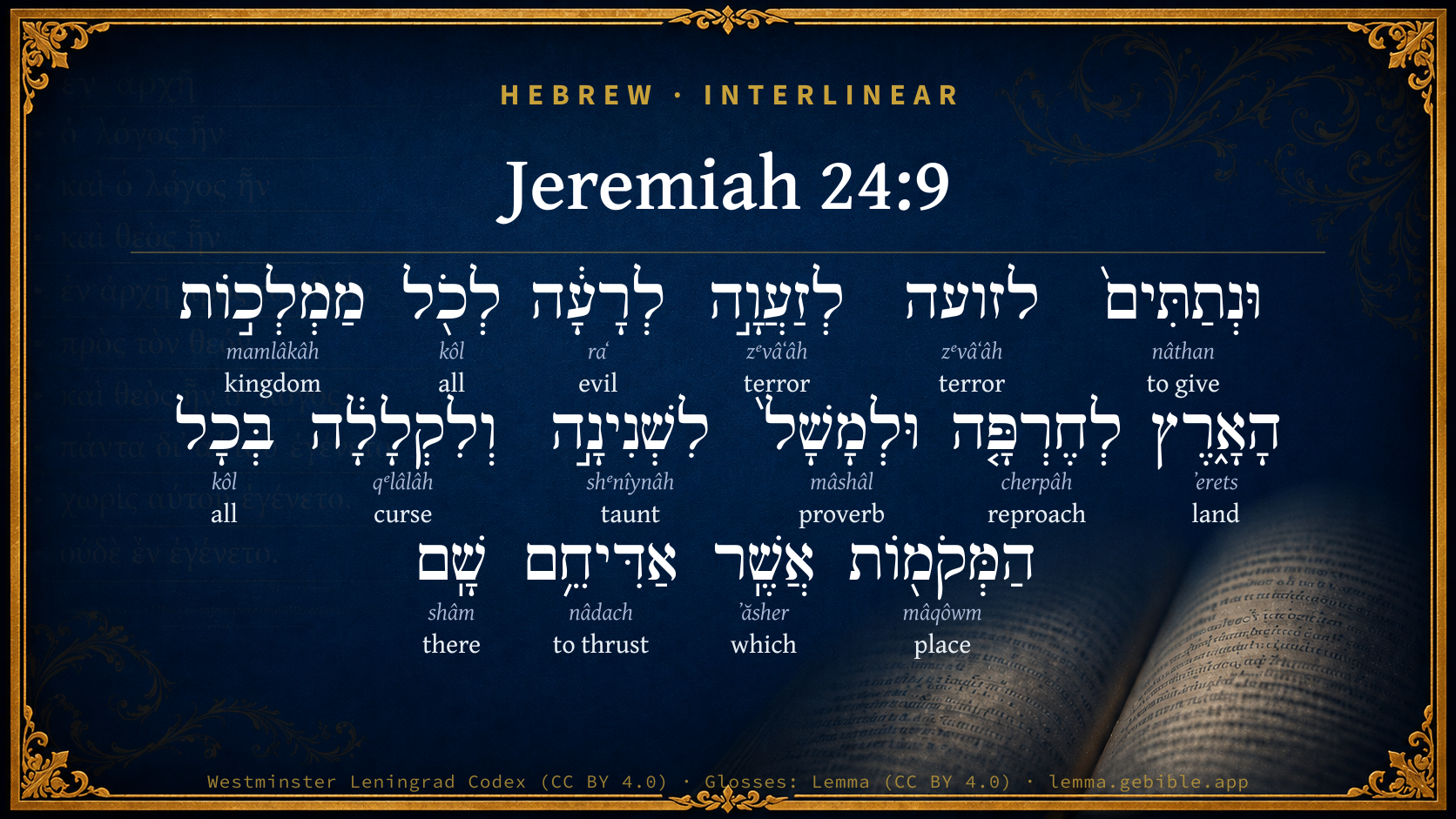
Hebrew (Westminster Leningrad Codex) Jeremiah 24:9 appears in the Hebrew Old Testament. The text above is from the Westminster Leningrad Codex. Each word links to its Strong’s number, a concise gloss, and parsing drawn from the Open Scriptures Hebrew Bible morphology. Click any word for its full Brown-Driver-Briggs (BDB) entry.
Download image
Cite this verse

Jeremiah 24:9 (World English Bible). Public Domain. Lemma interlinear Bible study tool, https://lemma.gebible.app/v/jeremiah/24/9.

Show BibTeX & RIS
BibTeX
RIS
English Translation
I will even give them up to be tossed back and forth among all the kingdoms of the earth for evil; to be a reproach and a proverb, a taunt and a curse, in all places where I shall drive them.
World English Bible · Public Domain
Download a study sheet

One document with this verse’s original text, its word-by-word gloss line, the meaning frame, cross-references with their text, attributed commentary, and full source and license credits — printable, and it pastes into notes with its structure intact.

This verse Autodidact and up

Study sheet (.html) Plain text (.txt)

A passage Seminary Student

Up to 50 verses in one chapter. A passage sheet keeps up to 6 commentary sources and 12 cross-references per verse, in the order this page ranks them, and says so on the sheet whenever that leaves anything out. Ask for a single verse and you get the Autodidact verse sheet above.

Everything on this page stays free to read, with no account — the sheet is a download of what is already on screen, not access to it.

Want to remove ads? Support Godless Engineer
Compare translations 3

The same verse in 3 English versions, stacked beneath the original-language interlinear above. Click any original word for its lexicon entry.

Each is an independent rendering of the whole verse — the interlinear is not word-aligned to these translations.

Highlighted words mark where these versions differ — a whole-verse word diff, not a word-by-word alignment.

  • World English Bible Public Domain
    I will even give them up to be tossed back and forth among all the kingdoms of the earth for evil; to be a reproach and a proverb, a taunt and a curse, in all places where I shall drive them.
  • King James Version Public Domain
    And I will deliver them to be removed into all the kingdoms of the earth for their hurt, to be a reproach and a proverb, a taunt and a curse, in all places whither I shall drive them.
  • unfoldingWord Literal Text CC BY-SA 4.0
    And I will give them to horror, for evil, to all of the kingdoms of the earth, for a reproach and for a proverb, for a taunt and for a curse, in all of the places where I will drive them.

unfoldingWord Literal Text — © unfoldingWord, licensed CC BY-SA 4.0. Word-aligned USFM3 via Door43 (git.door43.org/unfoldingWord/en_ult).

Versions to compare (up to 4)

3 of 4 selected

Show all 18 translations

Every available English version of this verse, each an independent rendering of the whole verse.

  • World English Bible Public Domain
    I will even give them up to be tossed back and forth among all the kingdoms of the earth for evil; to be a reproach and a proverb, a taunt and a curse, in all places where I shall drive them.
  • Berean Standard Bible Public Domain
    I will make them a horror and an offense to all the kingdoms of the earth, a disgrace and an object of scorn, ridicule, and cursing wherever I have banished them.
  • Majority Standard Bible Public Domain
    I will make them a horror and an offense to all the kingdoms of the earth, a disgrace and an object of scorn, ridicule, and cursing wherever I have banished them.
  • King James Version Public Domain
    And I will deliver them to be removed into all the kingdoms of the earth for their hurt, to be a reproach and a proverb, a taunt and a curse, in all places whither I shall drive them.
  • American Standard Version (1901) Public Domain
    I will even give them up to be tossed to and fro among all the kingdoms of the earth for evil; to be a reproach and a proverb, a taunt and a curse, in all places whither I shall drive them.
  • Revised Version (1885) Public Domain
    I will even give them up to be tossed to and fro among all the kingdoms of the earth for evil; to be a reproach and a proverb, a taunt and a curse, in all places whither I shall drive them.
  • Geneva Bible (1599) Public Domain
    I will euen giue them for a terrible plague to all the kingdomes of the earth, and for a reproche, and for a prouerbe, for a common talke, and for a curse, in all places where I shall cast them.
  • Douay-Rheims (1899) Public Domain
    And I will deliver them up to vexation, and affliction, to all the kingdoms of the earth: to be a reproach, and a byword, and a proverb, and to be a curse in all places, to which I have cast them out.
  • Young's Literal Translation Public Domain
    And I have given them for a trembling, For evil -- to all kingdoms of the earth, For a reproach, and for a simile, For a byword, and for a reviling, In all the places whither I drive them.
  • Literal Standard Version CC BY-SA 4.0
    And I have given them for a trembling, || For evil—to all kingdoms of the earth, || For a reproach, and for an allegory, || For a byword, and for a reviling, || In all the places to where I drive them.
  • Unlocked Literal Bible CC BY-SA 4.0
    I will turn them into a frightening thing, a disaster, in the sight of all the kingdoms on earth, a disgrace and a subject for proverbs, taunts, and curses in every place where I will have driven them.
  • unfoldingWord Literal Text CC BY-SA 4.0
    And I will give them to horror, for evil, to all of the kingdoms of the earth, for a reproach and for a proverb, for a taunt and for a curse, in all of the places where I will drive them.
  • Darby Bible Public Domain
    And I will give them over to be driven hither and thither unto all the kingdoms of the earth for evil, to be a reproach and a proverb, a taunt and a curse, in all places whither I shall drive them;
  • World Messianic Bible Public Domain
    I will even give them up to be tossed back and forth among all the kingdoms of the earth for evil, to be a reproach and a proverb, a taunt and a curse, in all places where I will drive them.
  • Webster's Bible Public Domain
    And I will deliver them to be removed into all the kingdoms of the earth for their hurt, to be a reproach and a proverb, a taunt and a curse, in all places whither I shall drive them.
  • Free Bible Version CC BY-SA 4.0
    I'm going to make an example of them that will horrify and offend everyone on earth. They will be disgraced, mocked, ridiculed, and cursed everywhere I've exiled them.
  • Bible in Basic English Public Domain
    I will give them up to be a cause of fear and of trouble among all the kingdoms of the earth; to be a name of shame and common talk and a cutting word and a curse in all the places wherever I will send them wandering.
  • JPS Tanakh (1917) Public Domain
    I will even make them a horror among all the kingdoms of the earth for evil; a reproach and a proverb, a taunt and a curse, in all places whither I shall drive them.

Literal Standard Version (2020), Covenant Press — licensed CC BY-SA 4.0. Text via the HelloAO Bible API (eBible.org). Unlocked Literal Bible (unfoldingWord) — licensed CC BY-SA 4.0. Text via the HelloAO Bible API (eBible.org). unfoldingWord Literal Text — © unfoldingWord, licensed CC BY-SA 4.0. Word-aligned USFM3 via Door43 (git.door43.org/unfoldingWord/en_ult). Free Bible Version, Dr. Jonathan Gallagher — licensed CC BY-SA 4.0. Text via the HelloAO Bible API (eBible.org).

Word by word

More ways to search: Search by grammar → Find every occurrence → Compare this word →

Practice this passage: Drill this verse → Learn its vocabulary →

לִשְׁנִינָ֣ה
shᵉnîynâh
H8148
“to/for · taunt”
Preposition + Noun, Common, Feminine, Singular, Absolute
Part of Speech
Preposition + Noun
Type
Common
Gender
Feminine
Number
Singular
State
Absolute
Full BDB Definition

Origin: from H8150

TWOT: 2422b

sharp word, sharp (cutting) word, taunt, gibe
  1. וּנְתַתִּים֙ nâthan H5414 “and · to give · them” Conjunction + Verb, Qal, Sequential Perfect, 1st Person, Common, Singular + Suffix, Personal, 3rd Person, Masculine, Plural
  2. לזועה zᵉvâʻâh H2113 “to/for · terror” Preposition + Noun, Common, Feminine, Singular, Absolute
  3. לְזַעֲוָ֣ה zᵉvâʻâh H2113 “to/for · terror” Preposition + Noun, Common, Feminine, Singular, Absolute
  4. לְרָעָ֔ה raʻ H7451 “to/for · evil” Preposition + Noun, Common, Feminine, Singular, Absolute
  5. לְכֹ֖ל kôl H3605 “to/for · all of” Preposition + Noun, Common, Masculine, Singular, Construct
  6. מַמְלְכ֣וֹת mamlâkâh H4467 “kingdoms of” Noun, Common, Feminine, Plural, Construct
  7. הָאָ֑רֶץ ʼerets H776 “the · land” Particle, Definite Article + Noun, Common, Both, Singular, Absolute
  8. לְחֶרְפָּ֤ה cherpâh H2781 “to/for · reproach” Preposition + Noun, Common, Feminine, Singular, Absolute
  9. וּלְמָשָׁל֙ mâshâl H4912 “and · to/for · proverb” Conjunction + Preposition + Noun, Common, Masculine, Singular, Absolute
  10. וְלִקְלָלָ֔ה qᵉlâlâh H7045 “and · to/for · curse” Conjunction + Preposition + Noun, Common, Feminine, Singular, Absolute
  11. בְּכָל kôl H3605 “in/at · all of” Preposition + Noun, Common, Masculine, Singular, Construct
  12. הַמְּקֹמ֖וֹת mâqôwm H4725 “the · places” Particle, Definite Article + Noun, Common, Masculine, Plural, Absolute
  13. אֲשֶֽׁר ʼăsher H834 “which” Particle, Relative
  14. אַדִּיחֵ֥ם nâdach H5080 “to thrust · them” Verb, Hiphil, Imperfect, 1st Person, Common, Singular + Suffix, Personal, 3rd Person, Masculine, Plural
  15. שָֽׁם shâm H8033 “there” Adverb

About this verse

These counts appear in no published source. They are computed here, from the morphology-tagged text and Lemma’s own curated glosses. What Lemma adds →

16
words
14
distinct lemmas
Prophets
section

Notable vocabulary

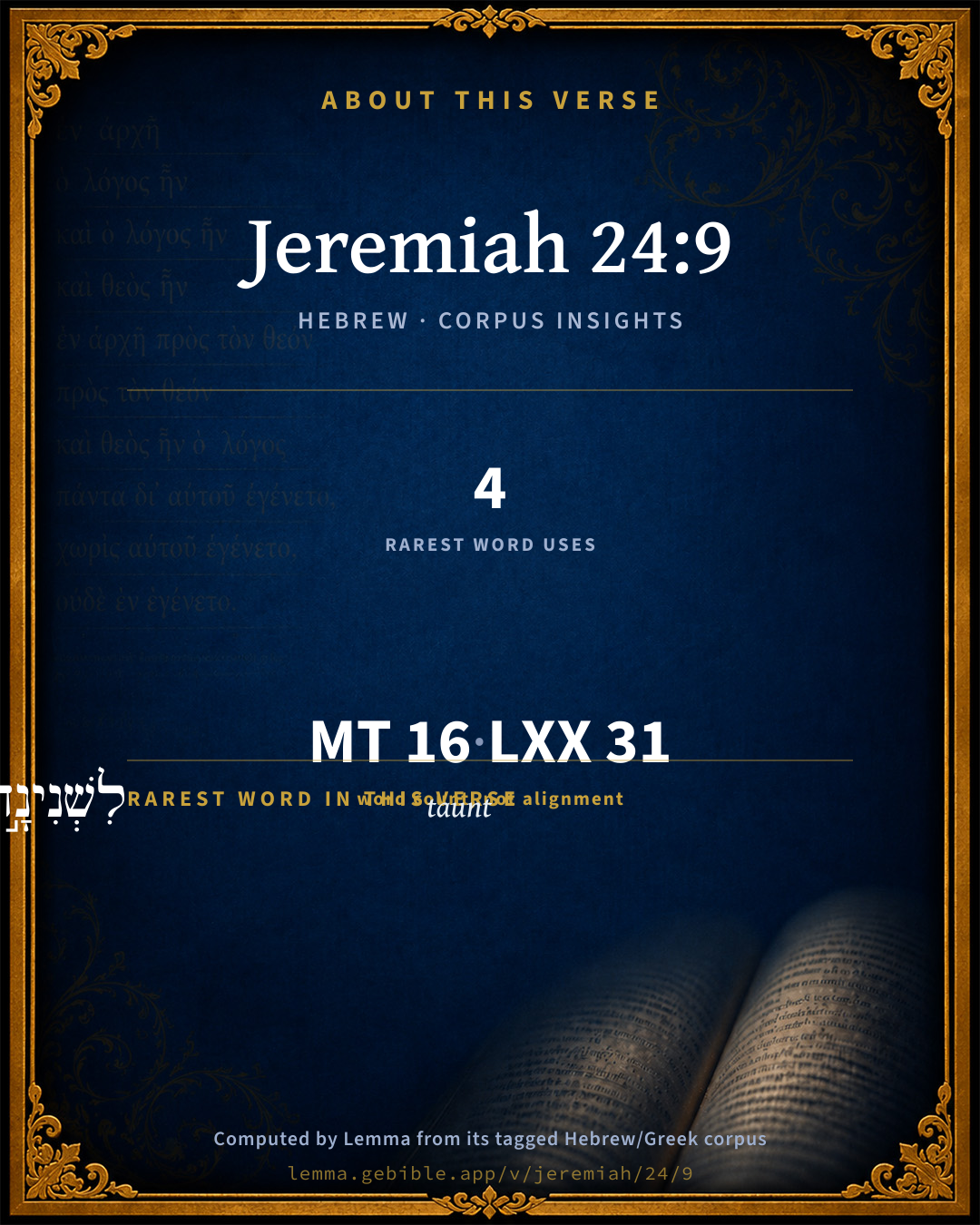
The rarest word here is לִשְׁנִינָ֣ה taunt H8148 — appearing just 4 times in the whole Hebrew Bible.

Shared distinctive vocabulary

לִשְׁנִינָ֣ה taunt H8148 occurs in 4 verses of the Hebrew Bible. Also found in:

Grammatical profile

  • 2 verbs
  • 12 nouns
  • 1 adverb
  • 1 particle

Verb forms

  • וּנְתַתִּים֙ Qal · Sequential Perfect
  • אַדִּיחֵ֥ם Hiphil · Imperfect

Repetition

Words recur within this verse — often emphatic in Hebrew:

  • לזועה terror H2113 ×2
  • לְכֹ֖ל all H3605 ×2

Hebrew & Septuagint length

In the original languages it is 16 Hebrew tokens and 31 Greek tokens — but the two are counted differently (Hebrew bundles its prefixes and suffixes into one token; the Greek is in lemma form), so that isn’t a like-for-like length.

Cross-references

24

Topical passages linked to Jeremiah 24:9 in the Treasury of Scripture Knowledge — connected by theme and wording, ordered by reader-vote popularity; previews shown in the World English Bible.

  • Deuteronomy 28:37 You shall become an astonishment, a proverb, and a byword, among all the peoples where Yahweh shall lead you away.
  • Jeremiah 29:18 I will pursue after them with the sword, with the famine, and with the pestilence, and will deliver them to be tossed back and forth among all the kingdoms of the earth, to be an object of horror, and an astonishment, and a hissing, and a reproach, among all the nations where I have driven them;
  • 1 Kings 9:7 then will I cut off Israel out of the land which I have given them; and this house, which I have made holy for my name, will I cast out of my sight; and Israel shall be a proverb and a byword among all peoples.
  • Jeremiah 15:4 I will cause them to be tossed back and forth among all the kingdoms of the earth, because of Manasseh, the son of Hezekiah, king of Judah, for that which he did in Jerusalem.
  • Jeremiah 25:18 [to wit], Jerusalem, and the cities of Judah, and the kings of it, and the princes of it, to make them a desolation, an astonishment, a hissing, and a curse, as it is this day;
  • Jeremiah 34:17 Therefore thus says Yahweh: you have not listened to me, to proclaim liberty, every man to his brother, and every man to his neighbor: behold, I proclaim to you a liberty, says Yahweh, to the sword, to the pestilence, and to the famine; and I will make you to be tossed back and forth among all the kingdoms of the earth.
  • Deuteronomy 28:25 Yahweh will cause you to be struck before your enemies; you shall go out one way against them, and shall flee seven ways before them: and you shall be tossed back and forth among all the kingdoms of the earth.
  • 2 Chronicles 7:20 then will I pluck them up by the roots out of my land which I have given them; and this house, which I have made holy for my name, will I cast out of my sight, and I will make it a proverb and a byword among all peoples.
  • Psalms 44:13–14 You make us a reproach to our neighbors, A scoffing and a derision to those who are around us.
  • Isaiah 65:15 You shall leave your name for a curse to my chosen; and the Lord Yahweh will kill you; and he will call his servants by another name:
  • Jeremiah 26:6 then will I make this house like Shiloh, and will make this city a curse to all the nations of the earth.
  • Jeremiah 29:22 and of them shall be taken up a curse by all the captives of Judah who are in Babylon, saying, Yahweh make you like Zedekiah and like Ahab, whom the king of Babylon roasted in the fire;
  • Jeremiah 42:18 For thus says Yahweh of Hosts, the God of Israel: As my anger and my wrath has been poured forth on the inhabitants of Jerusalem, so shall my wrath be poured forth on you, when you shall enter into Egypt; and you shall be an object of horror, and an astonishment, and a curse, and a reproach; and you shall see this place no more.
  • Jeremiah 44:12 I will take the remnant of Judah, that have set their faces to go into the land of Egypt to sojourn there, and they shall all be consumed; in the land of Egypt shall they fall; they shall be consumed by the sword and by the famine; they shall die, from the least even to the greatest, by the sword and by the famine; and they shall be an object of horror, [and] an astonishment, and a curse, and a reproach.
  • Lamentations 2:15–17 All that pass by clap their hands at you; They hiss and wag their head at the daughter of Jerusalem, [saying], Is this the city that men called The perfection of beauty, The joy of the whole earth?
  • Deuteronomy 28:65–67 Among these nations shall you find no ease, and there shall be no rest for the sole of your foot: but Yahweh will give you there a trembling heart, and failing of eyes, and pining of soul;
  • Psalms 109:18–19 He clothed himself also with cursing as with his garment. It came into his inward parts like water, Like oil into his bones.
  • Jeremiah 19:8 I will make this city an astonishment, and a hissing; everyone who passes thereby shall be astonished and hiss because of all the plagues of it.
  • Jeremiah 44:22 so that Yahweh could no longer bear, because of the evil of your doings, and because of the abominations which you have committed; therefore is your land become a desolation, and an astonishment, and a curse, without inhabitant, as it is this day.
  • Ezekiel 5:1–2 You, son of man, take a sharp sword; [as] a barber's razor shall you take it to you, and shall cause it to pass on your head and on your beard: then take balances to weigh, and divide the hair.
  • Ezekiel 5:12–13 A third part of you shall die with the pestilence, and with famine shall they be consumed in the midst of you; and a third part shall fall by the sword round about you; and a third part I will scatter to all the winds, and will draw out a sword after them.
  • Ezekiel 25:3 and tell the children of Ammon, Hear the word of the Lord Yahweh: Thus says the Lord Yahweh, Because you said, Aha, against my sanctuary, when it was profaned; and against the land of Israel, when it was made desolate; and against the house of Judah, when they went into captivity:
  • Ezekiel 26:2 Son of man, because Tyre has said against Jerusalem, Aha, she is broken: the gate of the peoples; she is turned to me; I shall be replenished, now that she is laid waste:
  • Ezekiel 36:2–3 Thus says the Lord Yahweh: Because the enemy has said against you, Aha! and, The ancient high places are ours in possession;

Cross-references courtesy of OpenBible.info (CC BY 4.0).

Hebrew and Greek witnesses Masoretic Hebrew ↔ Greek Septuagint

The same verse in the two great witnesses to the Old Testament, shown verse-for-verse.

These are two independent witnesses, not word-aligned to each other, and the Septuagint is shown in lemma (dictionary) form.

Hebrew Jeremiah 24:9 Masoretic · Westminster Leningrad Codex

וּנְתַתִּים֙ לזועה לְזַעֲוָ֣ה לְרָעָ֔ה לְכֹ֖ל מַמְלְכ֣וֹת הָאָ֑רֶץ לְחֶרְפָּ֤ה וּלְמָשָׁל֙ לִשְׁנִינָ֣ה וְלִקְלָלָ֔ה בְּכָל הַמְּקֹמ֖וֹת אֲשֶֽׁר אַדִּיחֵ֥ם שָֽׁם

I will even give them up to be tossed back and forth among all the kingdoms of the earth for evil; to be a reproach and a proverb, a taunt and a curse, in all places where I shall drive them.

World English Bible · Public Domain

Greek LXX Structure differs

In the Septuagint, Jeremiah is about an eighth shorter than the Hebrew and arranges its material differently — the Oracles Against the Nations (Hebrew chapters 46–51) appear in the middle of the Greek book, after 25:13. Because the chapter and verse boundaries do not line up, a verse-for-verse comparison with the Hebrew is not shown.

A verse-for-verse comparison isn’t shown here because the chapters and verses don’t line up. Switch to the LXX edition with the MT / LXX toggle above to read the Greek directly.

Hebrew: Westminster Leningrad Codex (CC BY 4.0). Greek: Septuagint (public domain); English from a public-domain English Septuagint. How the Septuagint differs from the Hebrew →

Targum (Aramaic paraphrase)

1

The Targum is the ancient Jewish Aramaic paraphrase of the Hebrew Scriptures — an interpretive translation, not the Hebrew text itself. Onkelos (literal) and Pseudo-Jonathan (expansive) render the Torah, and Jonathan the Prophets. Coverage is partial: where no permissively-licensed English translation exists for a verse, only the Aramaic is shown. This is verse-level text, not a word-by-word alignment to the Hebrew.

  1. Targum Jonathan Prophets (Joshua–Malachi)
    וְאֶתְּנִינוּן לְזִיעַ וּלְבִישָׁא לְכָל מַלְכְּוַת אַרְעָא לְחִיסוּדִין וְלִמְתַל וּלְשׁוֹעִי וְלִלְוָטָא בְּכָל אַתְרַיָא דְאַגְלִינוּן לְתַמָן:

    (no public-domain English translation for this verse)

    Targum Jonathan — Aramaic: “Mikraot Gedolot” (public domain). English: “Sefaria Community Translation” (CC0 1.0 (public-domain dedication)); “London "Chaldee Paraphrase," 1871” (public domain). Text via Sefaria.

Commentary

Notes on Jeremiah 24:9 from classic Christian and Jewish commentators (each source and its license shown beneath its notes). The classic Christian expositions comment on the surrounding passage and are grouped to its opening verse, so a note may address several verses; the Jewish commentaries on the Tanakh (Rashi and others) are per-verse, so they appear only where the commentator wrote on this verse.

Lemma curates 59 commentaries, every one of them public domain or Creative Commons licensed, each selected and text-cleaned for this edition rather than reprinted as found. About our sources →

Trapp's Complete Commentary

John Trapp

Jer 24:9 And I will deliver them to be removed into all the kingdoms of the earth for [their] hurt, [to be] a reproach and a proverb, a taunt and a curse, in all places whither I shall drive them.

Ver. 9. And I will deliver them.] As men throw out naughty figs, rotten apples, or the like. All the figs were carried out, but in diverse baskets, and for diverse purposes.

To be a taunt and a curse.] As when they were called in scorn by the heathen Verpi, Apellae, Recutiti, &c., and were noted, as they are still, for a nasty people.

John Trapp, A Commentary or Exposition upon All the Books of the Old and New Testament (1647–1656) — public domain. Text from a community e-Sword module.

Jamieson, Fausset & Brown

Robert Jamieson, A. R. Fausset & David Brown

removed, &c.-- (Jer 15:4). CALVIN translates, "I will give them up to agitation, in all," &c.; This verse quotes the curse (Deu 28:25, Deu 28:37). Compare Jer 29:18, Jer 29:22; Psa 44:13-14.

Next: Jeremiah Chapter 25

Jamieson, Fausset & Brown — Commentary Critical and Explanatory on the Whole Bible (1871) — public domain (CC PDM 1.0). Text via the HelloAO Bible API.

John Calvin's Commentaries

Here the Prophet borrows his words from Moses, in order to secure authority to his prophecy; for the Jews were ashamed to reject Moses, as they believed that the Law came from God: it would at least have been deemed by them an abominable thing to deny credit to the Law. And yet they boldly rejected all the prophets, though they were but faithful interpreters of the Law, as the case is with the Papists of the present day, who, though they dare not deny but that the Scripture contains celestial truth, yet furiously reject what is alleged from it. Similar was the perverseness of the Jews. Hence the prophets, in order to gain more credit to their words, often borrowed their very words from Moses, as though they had recited from a written document what had been dictated to them. For in Deuteronomy and in other places Moses spoke a language of this kind, — that God would give up the people to a concussion or a commotion, for a reproach, for a proverb, for a taunt, to all the nations of the earth. (Deuteronomy 28:37; 1 Kings 9:7.)

It is then the same as though Jeremiah had said, that the time would at length come when the Jews would find that so many maledictions had not been pronounced in vain by Moses. They no doubt read Moses; but as they were so stupid, no fear, no reverence for God was felt by them, even when he terrified them with such words as these. The Prophet then says, that the time was now near when they should know by experience that God had not in vain threatened them.

I will set them for a commotion The verb זוע, zuo, means to move and to be noisy. Many render the noun here “noise,” others “perturbation,” and others, “the shaking of the head;” for we are wont to shake the head in scorn.

However this may be, we are to read in connection with this the following words, — that they would be for a reproach, and a terror, and a taunt, and an execration, to all nations It is then said, on account of evil: for the preposition ל, lamed, is to be taken here in different senses: before “commotion,” it means “for;” but here it is causal, “on account of.” The severe and dreadful vengeance of God would be such, that it would move and disturb all nations. He indeed mentions all kingdoms, but the meaning is the same. He then adds reproach, that is, that they would be subjected to the condemnation of all nations. They had refused to submit to God’s judgment, and when he would have made them ashamed for their good, they had wickedly resisted. It was therefore necessary to subject them to the reproach of all people.

It is added, for a proverb and for a tale, or as some read, “for a parable and for a proverb.” The word משל, meshel, means a common saying; but here it signifies a scoff, and a similar meaning must be given to, שנינה, shenine, a tale or a fable. By both words he means, that when the heathens wished to describe a most grievous calamity, they would take this example, “Yes, it is all over with the Jews, no nation has become so wretched.” The same view is to be taken of execration; for he intimates that they would become a type and a pattern of a curse, “Yes, may you perish like the Jews; may God execute vengeance on you, as he has done on the Jews.” He then adds, that this would happen to them in all places wherever God would drive them; as though the Prophet had said, that God would not be satisfied with their exile, though that was to be grievous and bitter; but that when driven to distant lands they would become objects of reproach, so that all would point at them with the finger of scorn, accompanied with every mark of reproach, and would be also taking them as an example of execration. He afterwards adds —

John Calvin's Commentaries (1540-1563) — public domain. Text from the Calvin Translation Society English edition (1840s-50s) via the Christian Classics Ethereal Library (ccel.org). Calvin's coverage is partial (roughly two-thirds of the Bible); uncommented books and verses are honest gaps, never fabricated. The 19th-century editor's footnotes and remarks are omitted so the notes are faithfully Calvin's own voice.

Ellicott's Commentary for English Readers

(9) To be a reproach and a proverb.—The language of the verse is coloured by that of Deu_28:25; Deu_28:37, from which most of the words are chosen.

A Bible Commentary for English Readers, edited by Charles John Ellicott (1878–1897) — public domain. Text from a community e-Sword module.

The Cambridge Bible for Schools and Colleges

gen. ed. J. J. S. Perowne

9. tossed to and fro] See on Jer_15:4. The v. is the substance of Deu_28:25; Deu_28:37.

The Cambridge Bible for Schools and Colleges (gen. ed. J. J. S. Perowne; Cambridge University Press, 1878–1918) — public domain. Text from a community e-Sword module.

John Gill's Exposition

And I will send the sword, the famine, and the pestilence,

among them,.... Meaning not in other lands, where they should be driven, but while in their own land, by which many should perish; and the rest that escaped these dreadful judgments should be carried captive. The Targum is,

"I will send those that kill with the sword, &c.''

till they be consumed from off the land that I gave unto them and to their fathers; so that none of them should be left there to inhabit it, which is now their case; and it is an aggravation of their calamity and punishment, that they are no more the inhabitants of that good land, which was God's gift to them, and to their fathers before them.

Next: Jeremiah Chapter 25

John Gill's Exposition of the Whole Bible (1746–1763) — public domain (CC PDM 1.0). Text via the HelloAO Bible API.

Matthew Poole's English Annotations

The Lord by his prophet expresseth those tremendous judgments which he had designed to bring upon this wicked prince and people in the words of Moses the man of God; as well because the Jews had a great reverence (pretendedly at least) for Moses, how little soever they had for Jeremiah; as to let them see that what the Lord here threatened, and suddenly would bring to pass, was but in a just accomplishment of what he before had threatened in his law, by which they ought to have taken warning. The sum is, he would make them a common scoff and by-word, that their misery should be a common proverb, and when men would curse one another, they should wish them like Zedekiah and the Jews.

Matthew Poole's English Annotations on the Holy Bible (1683–1685) — public domain. Text from a community e-Sword/MySword module.

The Pulpit Commentary

And I will deliver them, etc.. (see on Jer_15:4, and comp. Jer 29 Deu_28:37)

The Pulpit Commentary (1880–1919), ed. H.D.M. Spence-Jones & Joseph S. Exell — public domain. Text from a community e-Sword module.

Rashi

Rabbi Shlomo Yitzchaki (Rashi)

for a horror [and] for evil for all the kingdoms of the earth For they will hear the evil that came upon them and quake.

and for a conversation piece That everyone will repeat and discuss their retribution.

Rashi on the Tanakh — English translations: “The Judaica Press complete Tanach with Rashi, translated by A. J. Rosenberg” (CC BY 4.0); “Pentateuch with Rashi's commentary by M. Rosenbaum and A.M. Silbermann, 1929-1934” (public domain); “The Metsudah Tanach series, Lakewood, N.J” (CC BY 4.0); and “The Book of Joshua, Metsudah Publications, 1997” (CC BY 4.0). Text via Sefaria.

Lesson kit

Teaching starters — assembled from the data on this page, not authored interpretation. Every prompt links to the verse data it draws on. Edit before teaching.

Jeremiah, in the Prophets, opens this verse with 16 words (14 distinct Hebrew lemmas). Its most distinctive word is shᵉnîynâh (“taunt”). A historical commentator’s framing appears above. Read the whole chapter for the surrounding context.

Discussion questions

  1. The word shᵉnîynâh carries the sense “taunt.” How does it shape the verse?
  2. Deuteronomy 28:37 shares the word «taunt» with this verse. How do the two illuminate each other?
  3. “terror” occurs 2× in this one verse. What is the effect of the repetition?
  4. The translations on this page render this verse differently — a whole-verse word diff, not a word-by-word alignment. What might account for the different wordings?
  5. The verb «וּנְתַתִּים֙» is Qal Sequential Perfect. How does its form color the action?
  6. Reading how Trapp's Complete Commentary and Jamieson, Fausset & Brown read this verse, where do the two commentators agree and where do they part?

Things to notice

Reading settings

Reading text

Shown beneath each verse's original-language words.

Old Testament
Old Testament edition

Read the OT as the Masoretic Hebrew (MT) or the Greek Septuagint (LXX).

English shown for the Greek Septuagint (in the Hebrew ↔ Greek comparison).

Comparing translations? Open the Compare panel on any verse page to stack up to four side by side.