Deuteronomy 15:20

Hebrew (Westminster Leningrad Codex) Deuteronomy 15:20 appears in the Hebrew Old Testament. The text above is from the Westminster Leningrad Codex. Each word links to its Strong’s number, a concise gloss, and parsing drawn from the Open Scriptures Hebrew Bible morphology. Click any word for its full Brown-Driver-Briggs (BDB) entry.
Download image
Cite this verse

Deuteronomy 15:20 (World English Bible). Public Domain. Lemma interlinear Bible study tool, https://lemma.gebible.app/v/deuteronomy/15/20.

Show BibTeX & RIS
BibTeX
RIS
English Translation
You shall eat it before Yahweh your God year by year in the place which Yahweh shall choose, you and your household.
World English Bible · Public Domain
Download a study sheet

One document with this verse’s original text, its word-by-word gloss line, the meaning frame, cross-references with their text, attributed commentary, and full source and license credits — printable, and it pastes into notes with its structure intact.

This verse Autodidact and up

Study sheet (.html) Plain text (.txt)

A passage Seminary Student

Up to 50 verses in one chapter. A passage sheet keeps up to 6 commentary sources and 12 cross-references per verse, in the order this page ranks them, and says so on the sheet whenever that leaves anything out. Ask for a single verse and you get the Autodidact verse sheet above.

Everything on this page stays free to read, with no account — the sheet is a download of what is already on screen, not access to it.

Want to remove ads? Support Godless Engineer
Compare translations 3

The same verse in 3 English versions, stacked beneath the original-language interlinear above. Click any original word for its lexicon entry.

Each is an independent rendering of the whole verse — the interlinear is not word-aligned to these translations.

Highlighted words mark where these versions differ — a whole-verse word diff, not a word-by-word alignment.

  • World English Bible Public Domain
    You shall eat it before Yahweh your God year by year in the place which Yahweh shall choose, you and your household.
  • King James Version Public Domain
    Thou shalt eat it before the LORD thy God year by year in the place which the LORD shall choose, thou and thy household.
  • unfoldingWord Literal Text CC BY-SA 4.0
    You must eat it year by year to the face of Yahweh your God in the place that Yahweh will choose, you and your house.

unfoldingWord Literal Text — © unfoldingWord, licensed CC BY-SA 4.0. Word-aligned USFM3 via Door43 (git.door43.org/unfoldingWord/en_ult).

Versions to compare (up to 4)

3 of 4 selected

Show all 18 translations

Every available English version of this verse, each an independent rendering of the whole verse.

  • World English Bible Public Domain
    You shall eat it before Yahweh your God year by year in the place which Yahweh shall choose, you and your household.
  • Berean Standard Bible Public Domain
    Each year you and your household are to eat it before the LORD your God in the place the LORD will choose.
  • Majority Standard Bible Public Domain
    Each year you and your household are to eat it before the LORD your God in the place the LORD will choose.
  • King James Version Public Domain
    Thou shalt eat it before the LORD thy God year by year in the place which the LORD shall choose, thou and thy household.
  • American Standard Version (1901) Public Domain
    Thou shalt eat it before Jehovah thy God year by year in the place which Jehovah shall choose, thou and thy household.
  • Revised Version (1885) Public Domain
    Thou shalt eat it before the LORD thy God year by year in the place which the LORD shall choose, thou and thy household.
  • Geneva Bible (1599) Public Domain
    Thou shalt eate it before the Lord thy God yeere by yeere, in the place which the Lord shall chose, both thou, and thine household.
  • Douay-Rheims (1899) Public Domain
    In the sight of the Lord thy God shalt thou eat them every year, in the place that the Lord shall choose, thou and thy house.
  • Young's Literal Translation Public Domain
    before Jehovah thy God thou dost eat it year by year, in the place which Jehovah doth choose, thou and thy house.
  • Literal Standard Version CC BY-SA 4.0
    you eat it before your God YHWH year by year, in the place which YHWH chooses, you and your house.
  • Unlocked Literal Bible CC BY-SA 4.0
    You must eat the firstborn before Yahweh your God year by year in the place that Yahweh will choose, you and your household.
  • unfoldingWord Literal Text CC BY-SA 4.0
    You must eat it year by year to the face of Yahweh your God in the place that Yahweh will choose, you and your house.
  • Darby Bible Public Domain
    Thou shalt eat it before Jehovah thy God, year by year, in the place which Jehovah will choose, thou and thy household.
  • World Messianic Bible Public Domain
    You shall eat it before the LORD your God year by year in the place which the LORD shall choose, you and your household.
  • Webster's Bible Public Domain
    Thou shalt eat it before the LORD thy God year by year in the place which the LORD shall choose, thou and thy household.
  • Free Bible Version CC BY-SA 4.0
    Every year you and your family are to eat these animals that have been sacrificed in the presence of the Lord your God in the place that the Lord will choose.
  • Bible in Basic English Public Domain
    But year by year you and all your house are to take a meal of it before the Lord, in the place of his selection.
  • JPS Tanakh (1917) Public Domain
    Thou shalt eat it before the LORD thy God year by year in the place which the LORD shall choose, thou and thy household.

Literal Standard Version (2020), Covenant Press — licensed CC BY-SA 4.0. Text via the HelloAO Bible API (eBible.org). Unlocked Literal Bible (unfoldingWord) — licensed CC BY-SA 4.0. Text via the HelloAO Bible API (eBible.org). unfoldingWord Literal Text — © unfoldingWord, licensed CC BY-SA 4.0. Word-aligned USFM3 via Door43 (git.door43.org/unfoldingWord/en_ult). Free Bible Version, Dr. Jonathan Gallagher — licensed CC BY-SA 4.0. Text via the HelloAO Bible API (eBible.org).

Word by word

More ways to search: Search by grammar → Find every occurrence → Compare this word →

Practice this passage: Drill this verse → Learn its vocabulary →

יִבְחַ֣ר
bâchar
H977
“to choose”
Verb, Qal, Imperfect, 3rd Person, Masculine, Singular
Part of Speech
Verb
Stem
Qal
Form
Imperfect
Person
3rd Person
Gender
Masculine
Number
Singular
Full BDB Definition

Origin: a primitive root

TWOT: 231

to choose, elect, decide for - (Qal) to choose - (Niphal) to be chosen - (Pual) to be chosen, selected
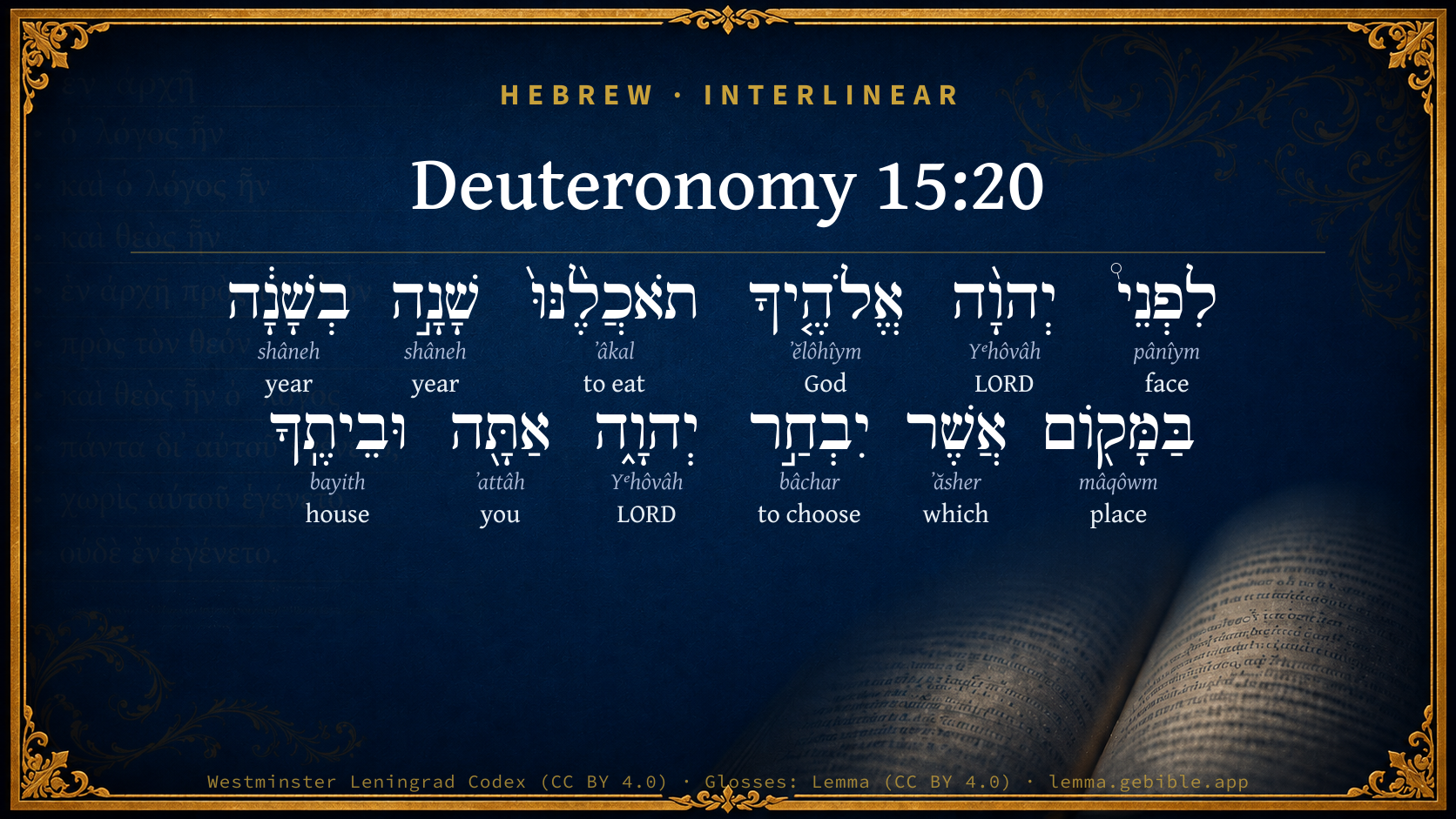
  1. לִפְנֵי֩ pânîym H6440 “to/for · face(s) of” Preposition + Noun, Common, Both, Plural, Construct
  2. יְהוָ֨ה Yᵉhôvâh H3068 “LORD” Noun, Proper
  3. אֱלֹהֶ֤יךָ ʼĕlôhîym H430 “God(s) · your” Noun, Common, Masculine, Plural, Construct + Suffix, Personal, 2nd Person, Masculine, Singular
  4. תֹאכֲלֶ֨נּוּ֙ ʼâkal H398 “to eat · him” Verb, Qal, Imperfect, 2nd Person, Masculine, Singular + Suffix, Personal, 3rd Person, Masculine, Singular
  5. שָׁנָ֣ה shâneh H8141 “year” Noun, Common, Feminine, Singular, Absolute
  6. בְשָׁנָ֔ה shâneh H8141 “in/at · year” Preposition + Noun, Common, Feminine, Singular, Absolute
  7. בַּמָּק֖וֹם mâqôwm H4725 “in/at the · place” Preposition, Determined + Noun, Common, Masculine, Singular, Absolute
  8. אֲשֶׁר ʼăsher H834 “which” Particle, Relative
  9. יְהוָ֑ה Yᵉhôvâh H3068 “LORD” Noun, Proper
  10. אַתָּ֖ה ʼattâh H859 “you” Pronoun, Personal, 2nd Person, Masculine, Singular
  11. וּבֵיתֶֽךָ bayith H1004 “and · house · your” Conjunction + Noun, Common, Masculine, Singular, Construct + Suffix, Personal, 2nd Person, Masculine, Singular

About this verse

These counts appear in no published source. They are computed here, from the morphology-tagged text and Lemma’s own curated glosses. What Lemma adds →

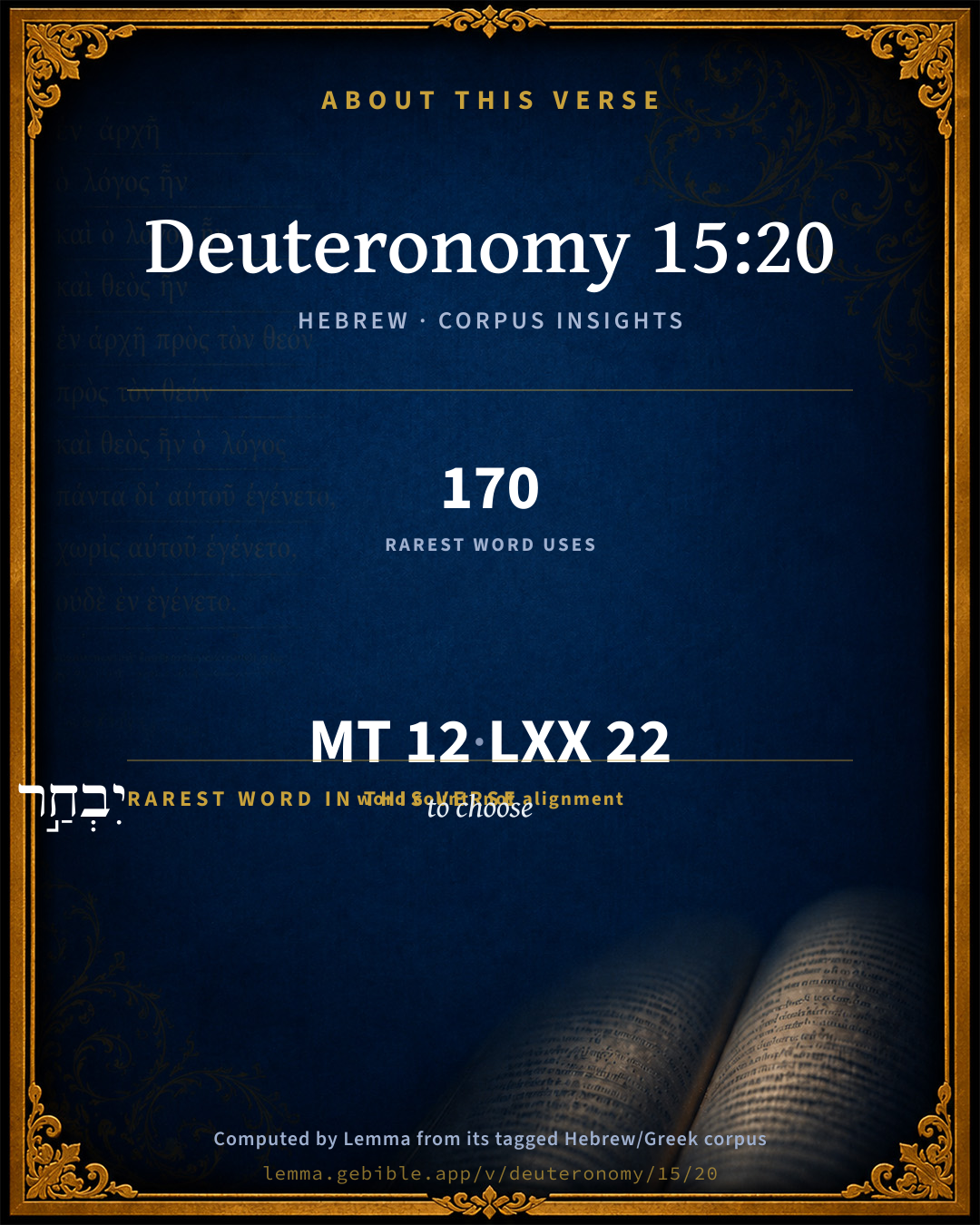
12
words
10
distinct lemmas
Pentateuch
section

Grammatical profile

  • 2 verbs
  • 8 nouns
  • 1 pronoun
  • 1 particle

Verb forms

  • תֹאכֲלֶ֨נּוּ֙ Qal · Imperfect
  • יִבְחַ֣ר Qal · Imperfect

Repetition

Words recur within this verse — often emphatic in Hebrew:

  • יְהוָ֨ה LORD H3068 ×2
  • שָׁנָ֣ה year H8141 ×2

Hebrew & Septuagint length

In English translation the verse runs 22 words from the Hebrew and 24 from the Septuagint (LXX English) — closely comparable.

A rough comparison of the two English renderings, which tokenize alike — not a word-level alignment.

Word counts can differ between the Hebrew and the Greek without any difference in meaning — e.g. the Hebrew direct-object marker אֵת has no separate Greek word, and Greek often adds the article ὁ.

In the original languages it is 12 Hebrew tokens and 22 Greek tokens — but the two are counted differently (Hebrew bundles its prefixes and suffixes into one token; the Greek is in lemma form), so that isn’t a like-for-like length.

Cross-references

3

Topical passages linked to Deuteronomy 15:20 in the Treasury of Scripture Knowledge — connected by theme and wording, ordered by reader-vote popularity; previews shown in the World English Bible.

  • Deuteronomy 12:5–7 But to the place which Yahweh your God shall choose out of all your tribes, to put his name there, even to his habitation shall you seek, and there you shall come;
  • Deuteronomy 12:17 You may not eat within your gates the tithe of your grain, or of your new wine, or of your oil, or the firstborn of your herd or of your flock, nor any of your vows which you vow, nor your freewill-offerings, nor the heave-offering of your hand;
  • Deuteronomy 14:23 You shall eat before Yahweh your God, in the place which he shall choose, to cause his name to dwell there, the tithe of your grain, of your new wine, and of your oil, and the firstborn of your herd and of your flock; that you may learn to fear Yahweh your God always.

Cross-references courtesy of OpenBible.info (CC BY 4.0).

Hebrew and Greek witnesses Masoretic Hebrew ↔ Greek Septuagint

The same verse in the two great witnesses to the Old Testament, shown verse-for-verse.

These are two independent witnesses, not word-aligned to each other, and the Septuagint is shown in lemma (dictionary) form.

Hebrew Deuteronomy 15:20 Masoretic · Westminster Leningrad Codex

לִפְנֵי֩ יְהוָ֨ה אֱלֹהֶ֤יךָ תֹאכֲלֶ֨נּוּ֙ שָׁנָ֣ה בְשָׁנָ֔ה בַּמָּק֖וֹם אֲשֶׁר יִבְחַ֣ר יְהוָ֑ה אַתָּ֖ה וּבֵיתֶֽךָ

You shall eat it before Yahweh your God year by year in the place which Yahweh shall choose, you and your household.

World English Bible · Public Domain

Greek LXX Deuteronomy 15:20 Septuagint · lemma form

ἔναντι κύριος ἐσθίω αὐτός ἐνιαυτός ἐκ ἐνιαυτός ἐν ὁ τόπος ὅς ἐάν ἐκλέγω κύριος ὁ θεός σύ σύ καί ὁ οἶκος σύ

You shall eat it before the Lord year by year in the place which the Lord your God shall choose, you and your house.

LXX2012 (modern English Septuagint) · Public Domain

Hebrew: Westminster Leningrad Codex (CC BY 4.0). Greek: Septuagint (public domain); English from LXX2012 (modern English Septuagint) (Public Domain). How the Septuagint differs from the Hebrew →

Targum (Aramaic paraphrase)

2

The Targum is the ancient Jewish Aramaic paraphrase of the Hebrew Scriptures — an interpretive translation, not the Hebrew text itself. Onkelos (literal) and Pseudo-Jonathan (expansive) render the Torah, and Jonathan the Prophets. Coverage is partial: where no permissively-licensed English translation exists for a verse, only the Aramaic is shown. This is verse-level text, not a word-by-word alignment to the Hebrew.

  1. Targum Onkelos Torah (Genesis–Deuteronomy)
    קֳדָם יְיָ אֱלָהָךְ תֵּיכְלִנֵהּ שַׁתָּא בְשַׁתָּא בְּאַתְרָא דִי יִתִּרְעֵי יְיָ אַתְּ וֶאֱנַשׁ בֵּיתָךְ

    (no public-domain English translation for this verse)

    Targum Onkelos — Aramaic: “Onkelos Genesis” (public domain); “Onkelos Exodus” (public domain); “Onkelos Leviticus” (public domain); “Onkelos Numbers” (public domain); “Onkelos Deuteronomy” (public domain). English: “Sefaria Community Translation” (CC0 1.0 (public-domain dedication)); “J.W. Etheridge. The Targums of Onkelos and Jonathan Ben Uzziel on the Pentateuch. London: Longmans, Green, 1862” (public domain). Text via Sefaria.

  2. Targum Pseudo-Jonathan Torah (Genesis–Deuteronomy)
    קֳדָם יְיָ אֱלָהָכוֹן תֵּיכְלִינֵיהּ שְׁנָא בִּשְׁנָא בְּאַתְרָא דְיִתְרְעֵי יְיָ אַתּוּן וְאֵינַשׁ בָּתֵּיכוֹן

    you shall eat thereof before the Lord your God from year to year, in the place which the Lord will choose, you and the men of your houses.

    Targum Pseudo-Jonathan — Aramaic: “Targum Jonathan on Genesis” (public domain); “Targum Jonathan on Exodus” (public domain); “Targum Jonathan on Leviticus” (public domain); “Targum Jonathan on Numbers” (public domain); “Targum Jonathan on Deuteronomy” (public domain). English: “The Targum of Jonathan ben Uzziel, trans. J. W. Etheridge, London, 1862” (public domain). Text via Sefaria.

Commentary

Notes on Deuteronomy 15:20 from classic Christian and Jewish commentators (each source and its license shown beneath its notes). The classic Christian expositions comment on the surrounding passage and are grouped to its opening verse, so a note may address several verses; the Jewish commentaries on the Tanakh (Rashi and others) are per-verse, so they appear only where the commentator wrote on this verse.

Lemma curates 59 commentaries, every one of them public domain or Creative Commons licensed, each selected and text-cleaned for this edition rather than reprinted as found. About our sources →

The Biblical Illustrator

Joseph S. Exell

Deu_15:20

Eat it before the Lord thy God year by year.

Memorial days

Year by year. It might seem at first sight, antecedent to experience, a surprising thing that the mere mechanical movement of the earth through the heavens should have any special relationship to mans mind and spirit. Yet we know that it has. Our memory associates special experiences with certain seasons and days. As the season or day returns the event is recalled, and sometimes the impressions awakened by it have, apparently, all their original sharpness. So, in this regard, the course of the heavens comes to be, as it were, a colossal memorandum book.

1. There is a sure evidence of the event seen in the fact of its commemoration.

2. We are taught how comparatively rare are these conspicuous and startling events which punctuate our public and private life. It is well for the sanity of the human mind that life is not filled with startling events. It would be like substituting pyrotechnics for the moonlight, or the stars for the silent skies. It is in the ordinary quiet on going of life that we find healthfulness of heart.

3. Life is always, serious. For we are ever treading on the edge of something unexpected, it may be something terrible. Let us walk circumspectly, and realise that we may always dwell under the shield of Gods providence and under the light of His promises.

4. We see the innate superiority of mind to all temporary events. You recall perhaps your wedding day, the hour, the place, the guests, the joy, through a score of years, a half century ago. Intervals of time fade from view in presence of this supreme experience, just as you look from one lofty peak to another and think not of field, valley, and river between. You see those shining points of life when you were at twenty, forty, or sixty years of age, and lesser experiences are hidden. The mind itself is superior to mere measurements of time, and so is constituted for immortality; is akin to Him to whom a thousand years are but as yesterday.

5. How deep in us is the element of affection which has its expression in the anniversary or festival. As we review the past our memory clings to those experiences in which the heart has a part, those which have touched its springs of joy and grief. We properly cultivate intellectual strength, power of will and endurance, but, after all, it is love that is supreme. Love brings us nearer Him who is perfect love.

6. A sweet illustration of the grace of God in the Gospel is furnished in the fact, with which every believer is familiar, that in these remembered events sorrow loses its sting and joy comes to be even more full in reminiscence than it was at first. Our sorrow only makes more glorious the preciousness and amplitude of Divine grace and sympathy, just as the glory of the sun, shot through a dark cloud, illumines and transfigures it by its splendour and its peace.

7. What a rest it is to the aged to recall the past when they are released from lifes active and strenuous struggles! They are like ships home from long voyages, moated in a quiet harbour, where the memory of storms that are past only enhances the serenity and peace enjoyed.

8. Whatever measurements may hereafter be had as to time and eternity in our immortal life, one thing is certain: we will keep one point in vivid remembrance--that of our entrance into life, when we first knew the joys eternal. (R. S. Storrs, D. D.)

.

The Biblical Illustrator, edited by Joseph S. Exell (c. 1880s–1900s) — public domain. Text from a community e-Sword module.

Adam Clarke's Commentary

Verse 20. Thou shalt eat it - in the place which the Lord shall choose] Thus God in his mercy made their duty and interest go hand in hand. And in every case God acts thus with his creatures; well, therefore, might Satan ask, Doth Job serve God for naught? No! nor does God design that any man should.

Adam Clarke's Commentary on the Bible (1810–1826) — public domain. Text from a community e-Sword/MySword module.

Ellicott's Commentary for English Readers

(20) Thou shalt eat it before the Lord thy God year by year.—This connects the eating of the firstlings with the “second” tithe (Deu_14:23), There is some difficulty in understanding the exact relation between this precept and that which assigns the firstlings to the priests (Num_18:15) with the first tithe. The practical solution is to be sought in the practice of the Jews. One suggestion is (that of Rashi), that “thou shalt eat” in this place refers to the priest; another is, that the firstlings without blemish were for the priest; those that were not fit for sacrifice were for the household of the owner. But it is perfectly conceivable that there was a collection of firstlings at one time of the year for the first tithe, and these were given to the priests. At the time of the collection of the second tithe, there might, and generally would, be other firstlings born since, and these, with the second tithe, would be disposed of in the manner indicated in these verses. And this, upon the whole, seems the most probable explanation. If two tithes were a regular institution, they must have been regularly collected at fixed times. And there might easily be firstlings in both of them; in fact, there almost certainly would be. At any rate, no contradiction can be maintained as between laws which were both observed in practice by the Jews. It appears from the Talmud, that tithes and offerings might be presented, more or less, at any of the three great feasts. They would not all be presented at one time. The tithes and first-fruits in some cases were liable to be delayed. The rule was, that everything due for three years last past must be cleared out of the establishment, and paid over to the proper authorities at the Feast of the Passover in the fourth and eighth years reckoned by the Sabbatical system. (See Deu_26:12-13, for more on this head.)

A Bible Commentary for English Readers, edited by Charles John Ellicott (1878–1897) — public domain. Text from a community e-Sword module.

The Cambridge Bible for Schools and Colleges

gen. ed. J. J. S. Perowne

20. thou shalt eat it before the Lord thy God] See on Deu_12:7; Deu_12:12; Deu_12:18.

year by year] At one of the feasts, probably the Passover, hence the place of this law of firstlings; in D immediately before that on the Passover, in Exo_34:19 immediately after that on unleavened bread.

in the place, etc.] See on Deu_12:5; Deu_12:18.

thy household] including the local Levite, as explicitly stated in Deu_12:12; Deu_12:18.

The Cambridge Bible for Schools and Colleges (gen. ed. J. J. S. Perowne; Cambridge University Press, 1878–1918) — public domain. Text from a community e-Sword module.

John Gill's Exposition

Thou shalt eat it before the Lord thy God, year by year,.... Which, if understood of male firstlings, as in connection with the preceding verse, only priests might eat of them, being devoted to the Lord; so Jarchi says, to the priest he speaks; but if this respects the Israelites in common, then they must be understood either of female firstlings or second firstlings, which the people voluntarily separated, and which they were not to eat in their own houses:

but in the place which the Lord shall choose, which was the city of Jerusalem; see Deu 12:5,

thou and thy household; the household of the priest, as Aben Ezra interprets it; but if it designs the same as in Deu 12:17, then the Israelites and their families are meant.

John Gill's Exposition of the Whole Bible (1746–1763) — public domain (CC PDM 1.0). Text via the HelloAO Bible API.

Matthew Poole's English Annotations

Thou shalt eat; either,

1. Thou, O priest. Or rather,

2. Thou, O Israelite. For it is evident that the same person who was forbidden to work with these, Deu 15:19, is here commanded to eat them, &c. Thou shalt eat it, together with the Levites, as it is to be understood from Deu 12:18; 14:27,29, where that is expressed in like cases.

Year by year, to wit, in the solemn feasts which returned upon them every year. See Deu 16:11,14.

Matthew Poole's English Annotations on the Holy Bible (1683–1685) — public domain. Text from a community e-Sword/MySword module.

John Wesley's Explanatory Notes

Year by year - Namely, in the solemn feasts which returned upon them every year.

John Wesley, Explanatory Notes Upon the Whole Bible (1754–1765) — public domain. Text via the GEBible commentary corpus.

Rashi

Rabbi Shlomo Yitzchaki (Rashi)

לפני ה׳ אלהיך תאכלנה THOU SHALT EAT IT BEFORE THE LORD THY GOD — Scripture is speaking to the priest (not to the owner to whom תקדיש in the previous verse refers), for we find already stated that it (the בכור) is one of the dues of the priests whether it is unblemished (and its blood and fat portions are to be sacrificed on the altar and the flesh eaten by the priests), or whether it is blemished (when it must not be offered on the altar), for it states, (Numbers 18:18) “and the flesh of them (the firstborn animals, both the blemished and the unblemished) shall be thine” (the priest’s) (cf. Bekhorot 28a).

שנה בשנה [THOU SHALT EAT IT BEFORE THE LORD …] YEAR BY YEAR — From here we derive the law that one should not defer it (i.e. sacrificing and eating it) beyond its first year (Bekhorot 28a). If so, one might think that it becomes invalid as a sacrifice as soon as its first year has passed! This is not the case, for it has been put in comparison with the second tithe, as it is said, (Deuteronomy 14:23; cf. Rashi on that verse): “and thou shalt eat before the Lord thy God the tithe of thy corn, of thy wine, and of thine oil, and the firstlings of thy herds, and thy flocks”. How is it in the case of the second tithe? It does not become invalid if left over from one year to the other (cf. Rashi on Deuteronomy 14:28 and 29), so, too, does the firstborn animal not become invalid under the same circumstances, only that it is a meritorious act to offer and consume it within its first year.

שנה בשנה (may also be translated A YEAR WITH ANOTHER YEAR) — If one slaughtered it at the end of its first year (an the last day) he may eat it that day and the first day of the next year. This teaches us that it (a firstborn animal) may in all cases be eaten on two successive days and the intervening night (cf. Sifrei Devarim 125; Bekhorot 27b).

Rashi on the Tanakh — English translations: “The Judaica Press complete Tanach with Rashi, translated by A. J. Rosenberg” (CC BY 4.0); “Pentateuch with Rashi's commentary by M. Rosenbaum and A.M. Silbermann, 1929-1934” (public domain); “The Metsudah Tanach series, Lakewood, N.J” (CC BY 4.0); and “The Book of Joshua, Metsudah Publications, 1997” (CC BY 4.0). Text via Sefaria.

Lesson kit

Teaching starters — assembled from the data on this page, not authored interpretation. Every prompt links to the verse data it draws on. Edit before teaching.

Deuteronomy, in the Pentateuch, opens this verse with 12 words (10 distinct Hebrew lemmas). Its most distinctive word is bâchar (“to choose”). A historical commentator’s framing appears above. Read the whole chapter for the surrounding context.

Discussion questions

  1. How does “to choose” (bâchar) shape what this verse is saying?
  2. How does Deuteronomy 12:5–7, which shares this passage’s theme, read alongside this verse?
  3. What does the repetition of “LORD” (2× in this one verse) do in this verse?
  4. These translations render this verse differently. What is at stake in choosing one wording over another?
  5. «תֹאכֲלֶ֨נּוּ֙» is a Qal Imperfect verb. How does that grammatical form shape the action described?
  6. Compare how The Biblical Illustrator and Adam Clarke's Commentary read this verse. Where do they agree or differ?

Things to notice

Reading settings

Reading text

Shown beneath each verse's original-language words.

Old Testament
Old Testament edition

Read the OT as the Masoretic Hebrew (MT) or the Greek Septuagint (LXX).

English shown for the Greek Septuagint (in the Hebrew ↔ Greek comparison).

Comparing translations? Open the Compare panel on any verse page to stack up to four side by side.